Jesus

Jesus’ Ascension Presence With Us

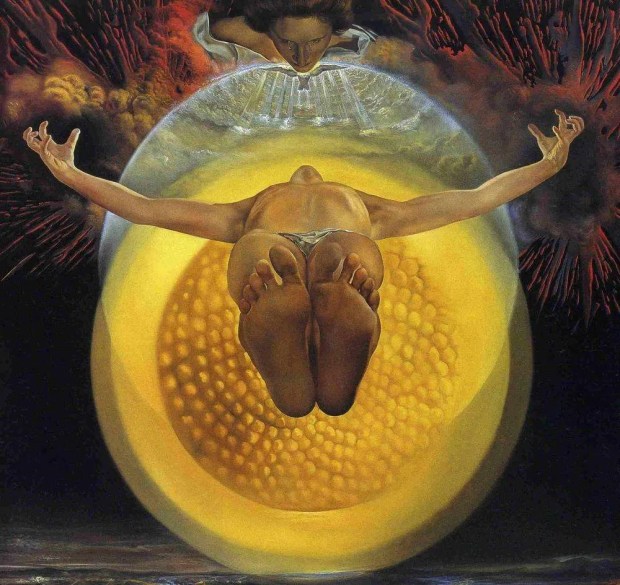
Salvadore Dali, The Ascension of Christ {Christ lifting in his embrace the whole of Creation to the Father, in the Holy Spirit}

Jesus ascended not so that he might withdraw from the world, making room as it were for the mission of the Holy Spirit. Instead, his Ascension marked his transition from being present at one time and in one place, to becoming present in all places, all the time. Before his death, there were countless places where he was not. After his Ascension, there is no place where he is not. From being with only some of those who lived during his earthly years, he is with all of us now. And from having a particular presence and context for his ministry, Jesus in his Ascension transitioned to a universal presence for his continuing mission, so “that he might fill all things,” even us.

The way that we envision the Ascension of Jesus is largely shaped by Luke’s Gospel, as well as by his book of Acts. As the Church’s liturgy observes and celebrates Luke’s presentation of this event, it occurs on the fortieth day after Easter Sunday, which always falls on a Thursday. With diminished weekday worship attendance in most churches, the feast of the Ascension is often observed on the following Sunday, on the Seventh Sunday of Easter. As Luke’s Gospel records the event,

“[Jesus] led [the disciples] out as far as Bethany, and lifting up his hands he blessed them. While he blessed them, he parted from them and was carried up into heaven. And they worshiped him and returned to Jerusalem with great joy, and were continually in the temple blessing God.”

In Acts, Luke presents a fuller account of

“… the day when he was taken up…, [when] he presented himself alive to them… [H]e said to them, ‘… you will receive power when the Holy Spirit has come upon you, and you will be my witnesses in Jerusalem and in all Judea and Samaria, and to the end of the earth.’ And when he had said these things, as they were looking on, he was lifted up, and a cloud took him out of their sight. And while they were gazing into heaven as he went, behold, two men stood by them in white robes, and said, ‘Men of Galilee, why do you stand looking into heaven? This Jesus, who was taken up from you into heaven, will come in the same way as you saw him go into heaven.'”

Giotto, The Ascension of Jesus

Giotto beautifully portrays Jesus’ Ascension in a fresco found within the Scrovegni Chapel (also known as the Arena Chapel) in Padua, Italy. Giotto’s approach to painting proved pivotal in the transition within Western art from dependence upon Eastern Christian iconographic imagery toward a greater realism and sensitivity to ‘ordinary’ human life in this world. Unlike medieval and eastern Christian icons, which tend to be absorbed with expressing dimensions of the eternal, Giotto portrays an actual event in the temporal lives of actual people. Nevertheless, Giotto’s Ascension is clearly also attentive and faithful to the supernatural elements of the Luke-Acts descriptions of Jesus’ Ascension.

It has been observed that in these modern times, among the most neglected aspects of traditional Christian doctrine is a proper understanding of Jesus’ Ascension. This may be due to a contemporary proclivity to read the New Testament as if its significance is primarily ethical, while shying away from engagement with the metaphysical and the supernatural elements of the Gospel narratives. Yet, though often overlooked within the spiritual reflections of many people in this modern era, we need to remember that Jesus’ atoning work was not limited to his offering himself for the life of the world in going to Golgotha. His Ascension and his Resurrection, just as his anticipation of the acknowledged presence and gift of the Holy Spirit, were all a part of his mission of atonement – opening our pathway to one-ness with God.

A collect from The Book of Common Prayer helps us appreciate why the Ascension of Jesus continues to be a major feast of Our Lord on the Church’s calendar:

“Almighty God, whose blessed Son our Savior Jesus Christ ascended far above all heavens that he might fill all things: Mercifully give us faith to perceive that, according to his promise, he abides with his Church on earth, even to the end of the ages; through Jesus Christ our Lord, who lives and reigns with you and the Holy Spirit, one God, in glory everlasting.” (BCP:226)

Just as at his Baptism, in the Ascension of Jesus, the veil between heaven and earth, between the spiritual and the material, between God and us, is pierced and set aside.

Alleluia. Christ is Risen and Ascended! And in the Holy Spirit he is present everywhere and in all who might welcome him into our lives.


Note: this post is adapted from one I have shared previously. We honor our Lords Ascension this week, as we do throughout our days, especially when we speak of it together in the Apostles Creed, in daily Morning and Evening Prayer as well as in the renewal of our Baptismal Covenant, and when we recite the Nicene Creed during the Eucharist. For He is risen, ascended, and continues to be glorified through our prayers.

On Monday of this week, I offered a sample homily for this coming Sunday, Easter 7 A, and an accompanying handout based on themes in the reading from John’s Gospel. I will offer here another sample handout based more directly on Ascension themes related to the above post.

As Kingfishers Catch Fire

A Kingfisher, a brightly colored fish-eating bird with a large head, a dagger-like bill, which dives to catch prey

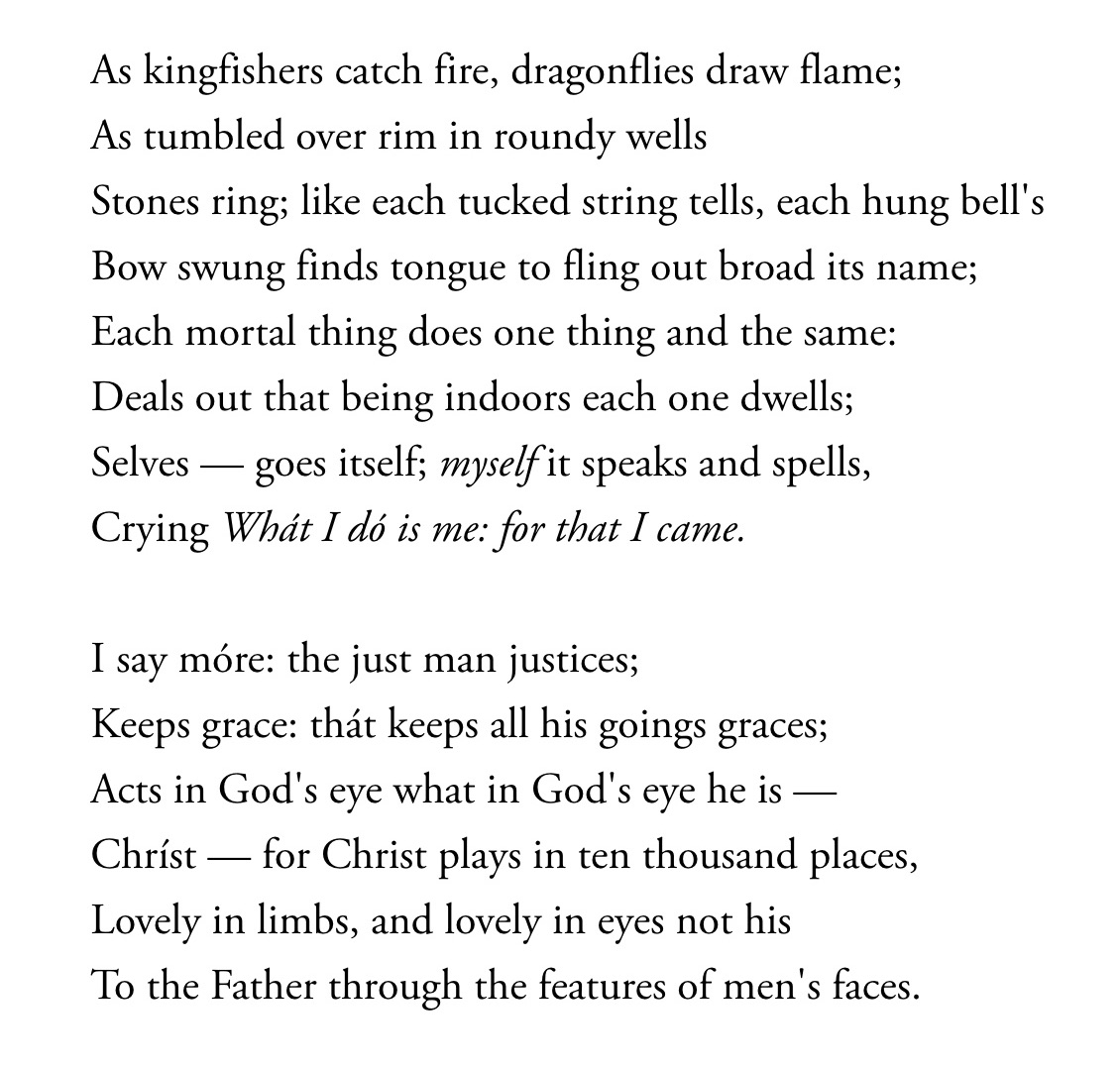
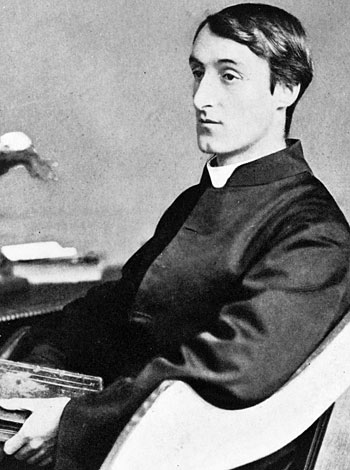
One of my favorite poems was written by the English poet and Jesuit priest, Gerard Manley Hopkins (1844-1889), from whom I have received inspiration in my continuing desire to glorify God by helping others perceive and give thanks for beauty. The poem from which I have borrowed my title for this post, provides a wondrous example of his gifts at work. I quote his poem here in full:

Hopkins’ Kingfisher poem, which is known by its first line

Reading poetry with insight does not come naturally to me, though I much appreciate the art form. As many others do, when approaching a poem like Hopkins’ “As Kingfishers catch fire,” I rely upon essays written by interpreters trained in literature. Since poems involve verbal communication, it may be that sharing insight about a poem with words is a more fruitful endeavor as compared with attempting the same regarding a painting. Yet, I believe that – as with most art forms – we can best express the things that have caught our attention and stirred our spirit in the paintings and poems that have stayed with us. Here are some aspects of Hopkins’ Kingfisher poem that continue to draw me in when I read its lines and speak its words aloud.

In this poem, Gerard Manley Hopkins displays what I consider to be an essentially “Catholic” sensibility when reflecting upon the world and our place within it. Here, his suggestion of the inner relationship and yet the difference between God’s mission in Creation and in Redemption, stands out to me, as does the continuity that may be perceived between the two. Order, purpose, meaning, and – yes – beauty, are to be found in God’s handiwork. The patterns we discern in nature attest to God’s intentions for us and for all other things touched by God’s ‘hands’ and by ours, and so we are reminded to look within ourselves for the same kind of purpose.

In discerning something of God’s purposes for us, we act in accord with what we observe and come to know. We are created to be just and so we choose to act justly. And we are created and then blessed further with God’s grace to be instruments of the same beautiful love. Risen Jesus, who comes to be with us, and then in us, manifests his divine role, inhabits our being, and brings new life to where it was not. In us, among the myriads upon myriads of those who see his beauty, who say, “Yes.”

Gerard Manly Hopkins as a Jesuit
A kingfisher – metaphorically – ‘catching fire’
Diving for a catch

Being True, Being Good, and Being Beautiful

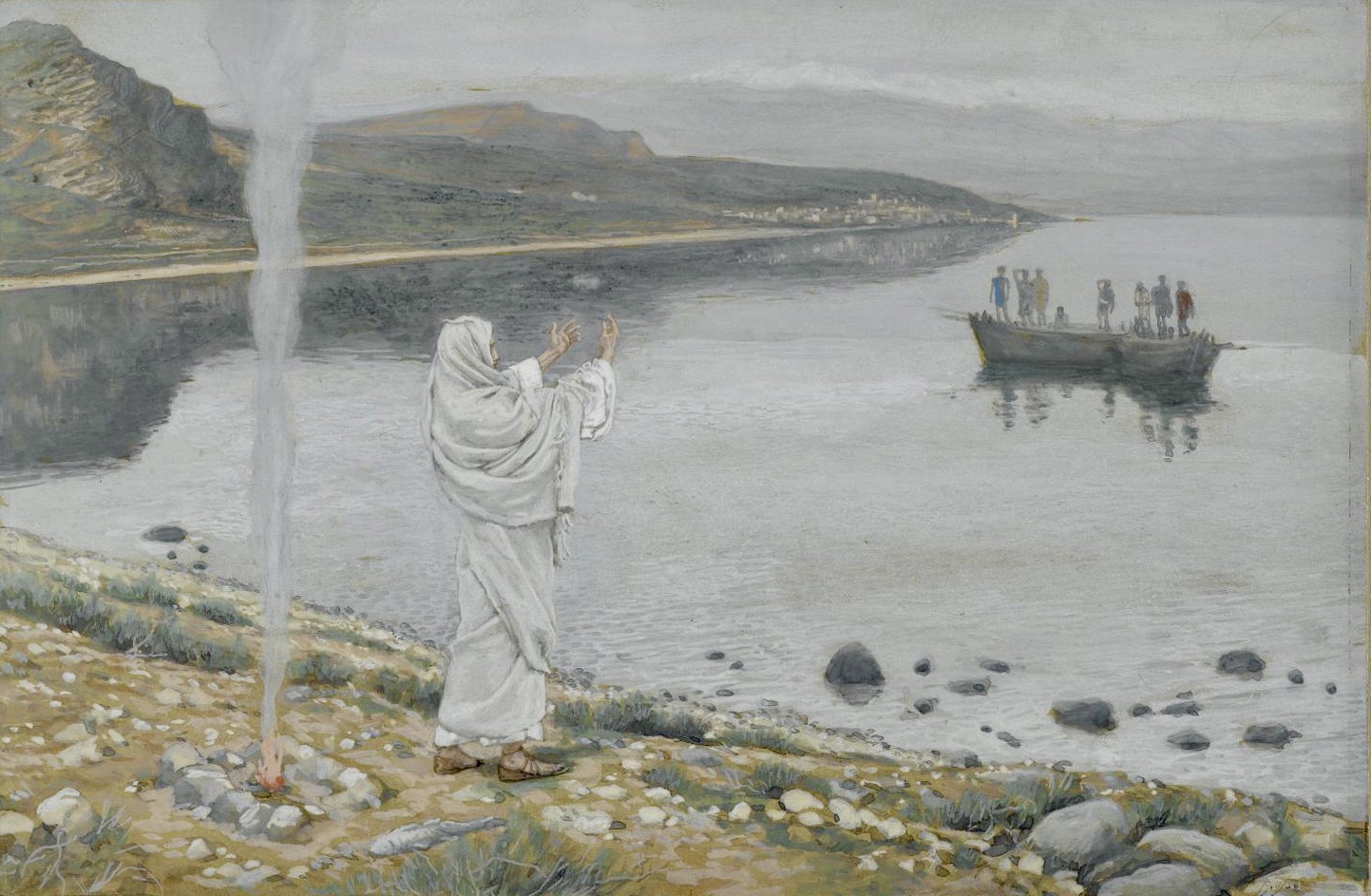
James Tissot, Christ Appears on the Shore of Lake Tiberius

“To thine own self be true.” This familiar adage is now known to many people through their experience with 12-Step Recovery programs. Yet the phrase is traced back to its appearance in a play by Shakespeare, and hearkens back to a simple statement attributed to Plato from the pre-Christian Classical period, “Know thyself.” One way to understand being true to ourselves involves living toward spiritual wellness and in an ethical manner. If these pursuits are of value to us, we may be open to receiving counsel about how we can be truthful, and good in our conduct, even if we are not comfortable with the degree of our adherence to these ideals. But to be beautiful?

Here, modern translations of the New Testament may provide a benefit to our thinking about questions like these. In our contemporary sensitivity to employing gender-neutral and inclusive language, sayings from the lips of Jesus or in the Letters of Paul are often cast in plural language. The potential benefit to us may lie in the encouragement we can receive to think in corporate or in community-minded terms.

We often need to remind ourselves to think about our lives with a wider frame of reference, for we are so much more than individuals with only chosen or willed connections and relationships with others. We will be truer to the message of Jesus and the teaching of the New Testament when we are equally attentive to our membership in the Body of Christ, the Church, within the Communion of Saints. Our baptismal identity is shaped fundamentally not by what we do, but by our grace-enabled incorporation within the community of the Risen Lord.

In other words, we can learn to receive and follow gladly the advice that we be true to ourselves when we do so as members of the Body of Christ. We can then see ourselves in more expansive terms than those based merely upon our physical birth identity as unique individuals, our social status, or upon our achievements.

One way to understand Jesus’ use of the mysterious phrase, the Son of Man, is to see this title in terms of the transformed personhood we apprehend in the Risen Lord. As such, he embodies for us the ‘true’ and fully redeemed human person and therefore the full goodness of human being. If so, the Risen Christ also embodies for us the fully realized beauty of both created and also redeemed human personhood. In him we find our new baptismal identity in communion fellowship with one another, which is the distinctive characteristic of participation in the Risen Body of Christ. We are, in Christ, people living together into the beauty of his Resurrection.

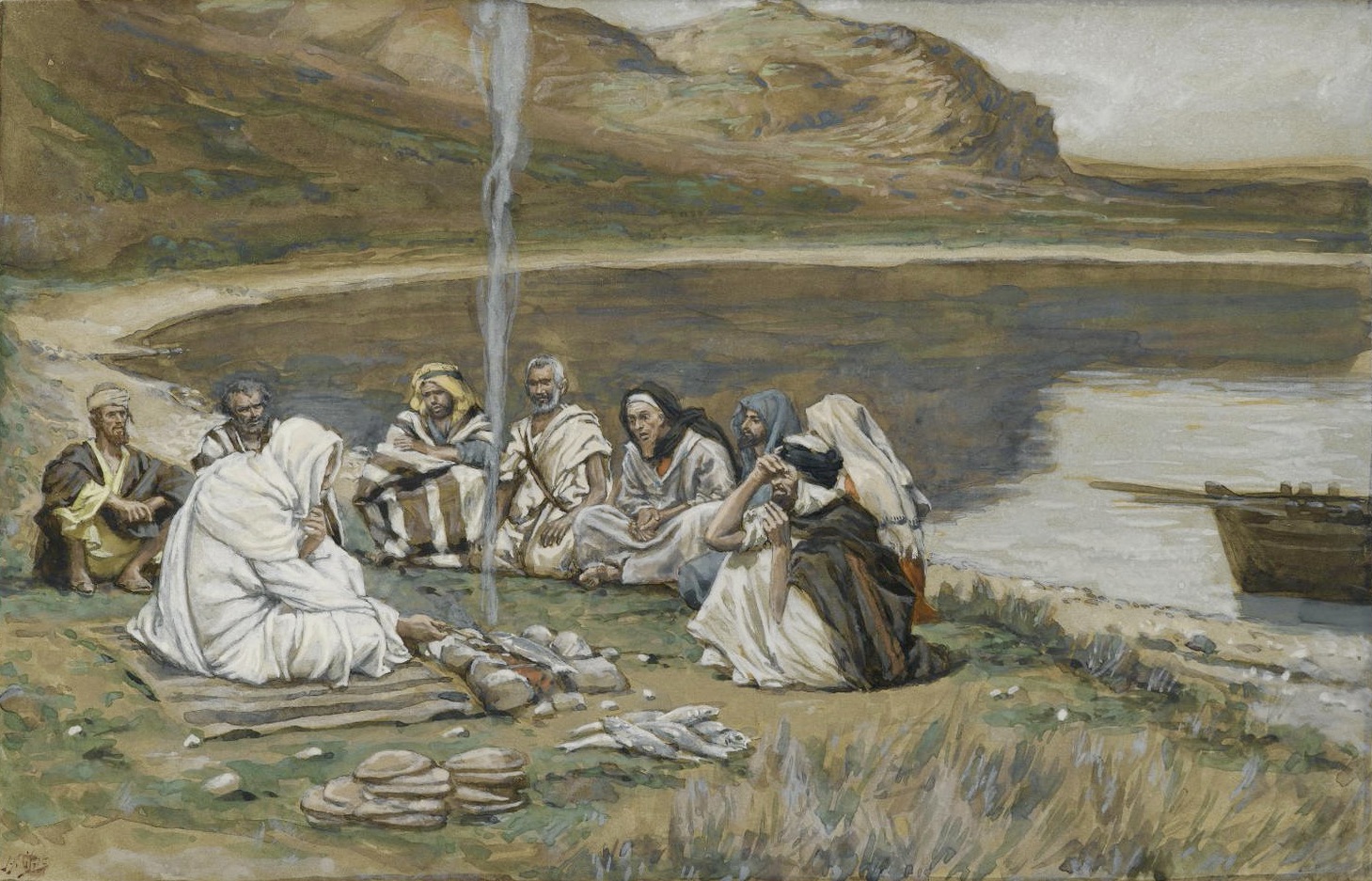
James Tissot, Meal of Our Lord and the Apostles

Here is the challenge that arises with disciplining ourselves to think in these corporate and communal terms. In the culture in which we live and raise our children and grandchildren, beauty for us is most commonly thought of in visible, physiological terms. Perhaps encouraged by the advertising and media to which we are contstantly subjected, we pursue pharmaceutical products, health and exercise regimens, and even plastic surgery. We do so in search of achieving outward beauty of a kind communicated to us by others as a goal we need to seek.

We then lose sight of inward beauty, the beauty we can attain as persons who mature, become wiser, and more generous in our viewpoints. I have previously written about Sister Wendy Beckett, who I have described as one of the most beautiful persons I have come to know through my reading and media viewing. Outwardly, it must be admitted, Sister Wendy was not the kind of person whose countenance would be featured on magazine covers as an exemplar of physical beauty. Our view of what it means to be fully human is diminished if we do not also see how she, over her long years of life as a solitary devoted to prayer, became one whose face and physical presence radiated the beauty of the Risen Lord.

In this Eastertide, we hear stories from the Gospels that are echoed in passages from Acts of the appearances of the Risen Jesus, returning to his first followers. He came into their presence, encouraging and strengthening them for mission as witnesses to his realization of God’s hopes and plans for all people, for we all are God’s beloved. By grace, we are among those who have been embraced by this mission, as are those who have yet to hear and receive the hope of the Gospel. Too quickly, we assume that in the lives of hearers and readers of these stories the appropriate fruit of these appearances will be manifest primarily in truthful speaking and admirable conduct. As a result, we neglect to imagine how these stories also encourage us to embody the Beauty of the Risen Lord.

“He is Risen! The Lord is Risen, indeed!” These are wonderful phrases for us to repeat, and take to heart in this season of the Great Fifty Days. We can find in these words their intended corollary: For us who are baptised, ‘we are risen’! We are risen, indeed, and called to live into the Way, the Truth, and the beautiful Life into which the Risen Lord has invited all people. And he has made this possible for all who might be open to receiving this wonder-filled message.

Beauty and Revelation

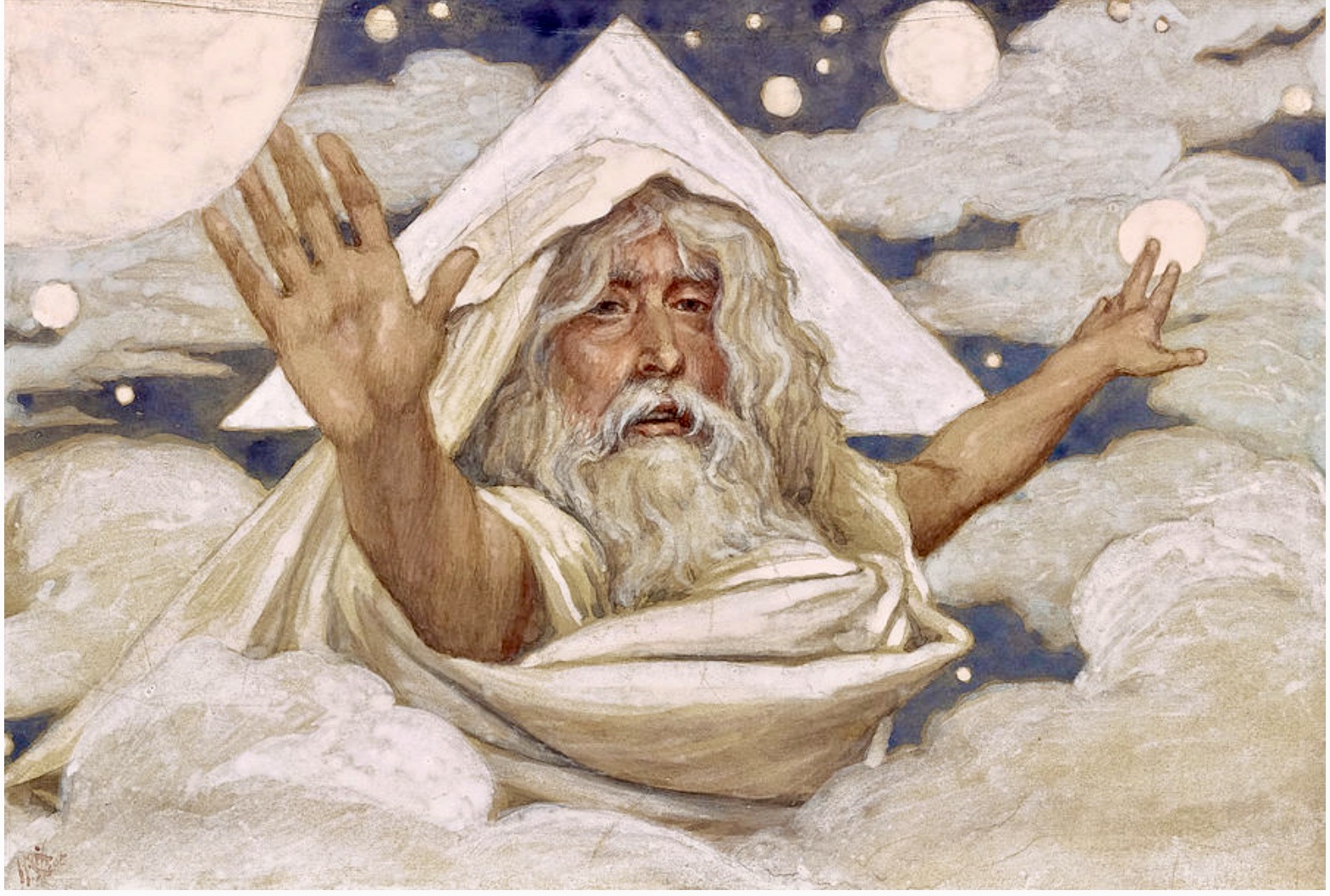
James Tissot, God Creating

James Tissot’s painting depicting God’s creative work is likely to strike us as childishly simplistic in its portrayal of divinity. For it quite obviously displays what we consider to be the flaw of anthropomorphism, as if the artist was naive in his approach to faith. But what if our hesitation about anthropomorphism, aside from reflecting a proper theological concern, could also become an obstacle for us? What if the mysterious implausibility of God entering into and sharing the limitations of human being keeps us from appreciating how fallen human beings can – by the same graceful Providence – share in the beautiful fullness of God?

I believe that James Tissot came to realize this: Beauty is a form of divine revelation. And, that our joy when beholding beauty is our experience of God’s love manifest to and within us.

These themes are intrinsic to our participation in Holy Week. As we can learn from observing the traditional pattern for the liturgy on Good Friday, our focus in Holy Week is upon what God has done and is doing for us. The sign of this on Good Friday is our abstention from celebrating the Eucharist, and instead we receive communion from the sacrament reserved following the Maundy Thursday liturgy on the prior evening.

For God creates, God discloses, and God provides. Through all, God reveals self. God’s revelation involves God’s self-disclosing gifts. Within the divine attributes are those of initiative and efficacy, constitutive aspects of creativity. And so, when God creates human beings in God’s own image and likeness, God not only exercises creativity but also self-revelation.

Among the ways that we resemble our Maker is one that paradoxically can become a source of frustration for us. Positively, our Creator has given us intelligence and a God-reflecting capacity for creativity, initiative, and efficacy. In addition, God has given us an inclination toward experiencing freedom and an accompanying desire for its fulfillment. Employing these gifts can lead to an ironic and negative result: They allow us the freedom wrongly to imagine that God is actually a dispensable concept, and a coping mechanism which is just a reflection of our psychological needs and a projection of ourselves.

Reflecting on these things can lead us to recognize the heart of divine humility, that it should please God to create us in God’s own image and likeness. God has given us the capacity to imagine that we are self-made, and then to function in a parody of the divine role in Creation. This happens when we fool ourselves into thinking that we are the center of the universe. Expressions of this parody include our ideas that the universe is infinite, as are our own endless possibilities within it. Yet – and this is critical – only God is infinite, and we – like the universe – are finite beings, endowed not only with divine-reflecting capacities, but also with purpose, meaning, and identities that are not of our own making.

James Tissot, What Our Lord Saw From the Cross, a remarkable inversion of how we so often picture the scene

As we approach Holy Week, we have the opportunity once again to be those who watch, who listen, and reflect. As we do, we remind ourselves that we are bit players in the Divine Drama, whose Author has generously written for us a script that has a curious feature, ample provision for ‘ad-libbing.’ In fact, divine generosity is so abounding that we are allowed to create sub-plots within the overall story. To the point that we forget to reference the overall plot lines shaping the whole, as well as the Author’s purposes in creating them.

One thing that God achieved in the events of the Exodus was to remind both Pharaoh, as well as Moses and the people of Israel, that God was and is sovereign over history as well as over geography, the realms of both time and place. Forgetting this ancient truth, we neglect the comfort we can gain from the doctrine of Providence, that God provides for the needs of the world as well as our own, which God knows more intimately and with greater perception than we do. We should wonder that we are left free to imagine otherwise, a fantasy in which some of us at least occasionally engage.

But the humility we are invited to recover in this latter part of Lent, and most of all in Holy Week, involves opening ourselves to a very real possibility. That God’s way of overcoming our refusal and failure to live into the potential we have been given involves the beauty of a strange and unexpected gift. Christmas reminded us of part of this gift, that God became human so that humans could become God-like, and in the best possible way. Holy Week allows us to rediscover the gift that God chose to identify so much with us that, in the ‘Son of Man,’ the Incarnate divine-human being, God passed through human death into the fullness of human life so that we might be enabled by grace to do the same.

Finding Beauty in Easter Living

A book for the New Church’s Teaching Series

Visitors to this space are familiar with my fondness for the words of St. Richard of Chichester: “Day by day, dear Lord, of thee three things I pray: to see thee more clearly, love thee more dearly, follow thee more nearly, day by day.” The theme can be expressed more compactly: We seek to live more nearly as we pray. These words voice our desire to walk a path of beauty in life, such as we find in ‘Easter Living.’

While serving as an Assistant Professor at one of our seminaries in The Episcopal Church, I was invited by the editor of the New Churches Teaching Series to write the volume on Ethics and Moral Theology. This was the third such series of books going back to the 1950’s that seek to provide learning for persons interested in our tradition. Books in these series have addressed a wide range of areas in faith and community life pertinent to our common desire to become informed members. I wrote my book while teaching its content in the seminary, and in about 10 different parish weekend teaching events in Episcopal churches across the country, ‘field testing’ the material. My book was published in 2000, and is still in print. I wish to note that proceeds from all the books in this series were and are donated to the Anglican Theological Review, an independent journal offering the fruits of scholarship for the benefit and educational formation of those within as well as beyond the academy.

At the time of being granted tenure, a seminary trustee asked me what the title of the book implied about its content. It became evident that her concern was focused on my use of the word “after.” I was able to explain that I used the word to mean “in light of.” The book’s title is an indirect tribute to the theological vision of my doctoral supervisor, Oliver O’Donovan, then Regius Professor of Moral and Pastoral Theology at the University of Oxford, whose book, Resurrection and Moral Order, has had a profound impact upon my thinking.

It may be helpful to clarify that I use the terms “Christian ethics” and “moral theology” interchangeably. However, it is worth observing that many within the wider Protestant tradition tend to prefer the term “Christian ethics,” while those within the wider Catholic tradition tend to use that of “moral theology.” Note that “ethics,” as a named field of inquiry without the religious qualifier, is generally understood as a branch of philosophy, which may or may not observably underpin theological writings relevant to this field.

I would like to highlight a number of themes evident within and or suggested by the structure my book, which I think are particularly relevant to Christians at this point of time:

  • Foremost, the interdependence between ethics and spirituality, which I refer to as ‘two sides of the same coin’ despite their separate spheres of concern.
  • The centrality of Baptism in the lives of every Christian believer, and its implications regarding the vital relationship between what we believe and how we live
  • Our historic Anglican dependence upon the natural world as a source of insight about the Creator’s intentions for us and for our lives. This reflects our traditional emphasis upon the Incarnation of our Lord in human embodiment. We look for the complementarity between – but do not equate nor confuse – what the Medievals called the Book of Nature and the Book of Scripture, ‘written’ by the same Author, while having different even if overlapping purposes.
  • The distinctions that I offer between what I call “laws,” “manners,” and “moral principles.” Neglecting to distinguish among what these terms represent frequently causes confusion.

The final chapter of the book moves from elaboration of basic principles in Christian ethics/moral theology to an application of these principles by offering a methodological approach to how they might be applied with reference to a particular set of ethical questions, centering on how we approach a broad concern for all of us: “Should a Christian ever been involved in or associated with an act of violence?”

I wish to stress that this is not a book about “issues.” My goal was -and remains – an effort to recover and present the foundations of a solid Christian world view for how we might best approach any issue that may be of concern. So, this is not a book where you can turn to the index and look up such matters as capital punishment or a discussion of what might be a fair interest rate on loans. I try to remain careful about observing the important distinction between moral or ethical principles that we might share, and particular policy implementations that we then undertake to reflect or enact those principles in our common life.


For those who may be interested, I include here a précis of the structure of my book, articulated in the series of Axioms that are appended within it, as well as bullet point chapter summaries:

Finding Identity in Who We Are Becoming

A promotional photo for Forrest Gump, a film exploring destiny and chance in relation to personal identity as people move through their lives

We are simultaneously two things that may seem to be in tension: We are who we are and have been, and, we are who we are becoming. The paradoxical conjunction between these statements challenges a prevalent social assumption, that personal identity is in some ways fixed.

Another observation to consider: We can no longer be who we were, years ago, nor who we thought we might someday become. For we are no longer who we were then, and surely not the person who we thought we might want to be as we matured.

But who we are now is the person we are becoming.

A trustworthy maxim from my field of ethics provides a reliable insight: practice shapes character. And character shapes practice. What we do shapes who we are (and who we are becoming), just as who we are shapes what we are likely to do. And a good definition of character is “a disposition to act in particular ways.” Our character is shaped by what we do, and what we do continues to shape our character.

Sally Fields and a youth playing the roles of Forrest Gump and his mama

Or, as Forrest Gump’s mama famously said, “Stupid is as stupid does.”

Whatever truth may be found in another old saying (“character is destiny”), who we are becoming is not in some way predetermined. We are in large part shapers of ourselves, even while we may feel like we are being shaped by events and or by other people. Yet, from the Beginning, God has been the Great Shaper of all things, even of us. As our Redeemer, through Baptism, God changes us and gives us a new life centered on the graced possibility of redemptive transformation.

In formal terms, the ideas I am exploring here involve dialectical relationships, such as we find between act and character, and between us and others. In these relationships, there is always a two-way, dynamic process of interaction between these various entities, whether we are speaking of God, ourselves, others, and or the circumstances in which we find ourselves.

Within all this, we experience a lifelong quest for a better sense of our identity. It is too easy, though often tempting, to try and resolve this quest in terms of external factors, such as who we imagine ourselves to be in the eyes and thoughts of other people. To be directed in our ideas and actions by what we think may be expected of us, or by what other people hope for us, usually comes at the expense of the influence of the Great Shaper, the One who reveals to us our true meaning and the purpose of our life journeys. Our primary dialectical relationship is with our Creator and Redeemer, our grounding guide for who we are meant to be, and become.

For these reasons, it is good to resist the typical kinds of “I am… “ statements so current in popular culture – statements like “I am a Democrat, or a Republican,” or “I am an introvert, or an extrovert.” A more helpful kind of self-definition springs from statements based on what we tend to do. For example, instead of the prior statements, it would help us to say things like, “I tend to vote in the following ways…,” or “I tend to respond to social situations by preferring to…” Consistent with these views, I resist self-definition in similar “I am” terms when it comes to how I measure when using Myers-Briggs related personal inventory instruments. This is, in part, because of their foundation upon Jungian thought, which anticipates how we as human beings have the opportunity to grow and change over time, especially in the direction of our ‘shadow’ strengths or areas of challenge.

I continue to value an insight offered by a former teaching colleague. In a conference he once said, “People don’t actually ‘learn from experience;’ they learn from reflecting on experience.” We experience and do things; we reflect on both, and we learn as we continue to think about what we encounter, and choose to do.” In the process, we are becoming who we are now.

Who am I becoming in relation to what I am doing now? This is a helpful Lenten question in light of our preparation for Easter living.

“… She Is Still Out There…”

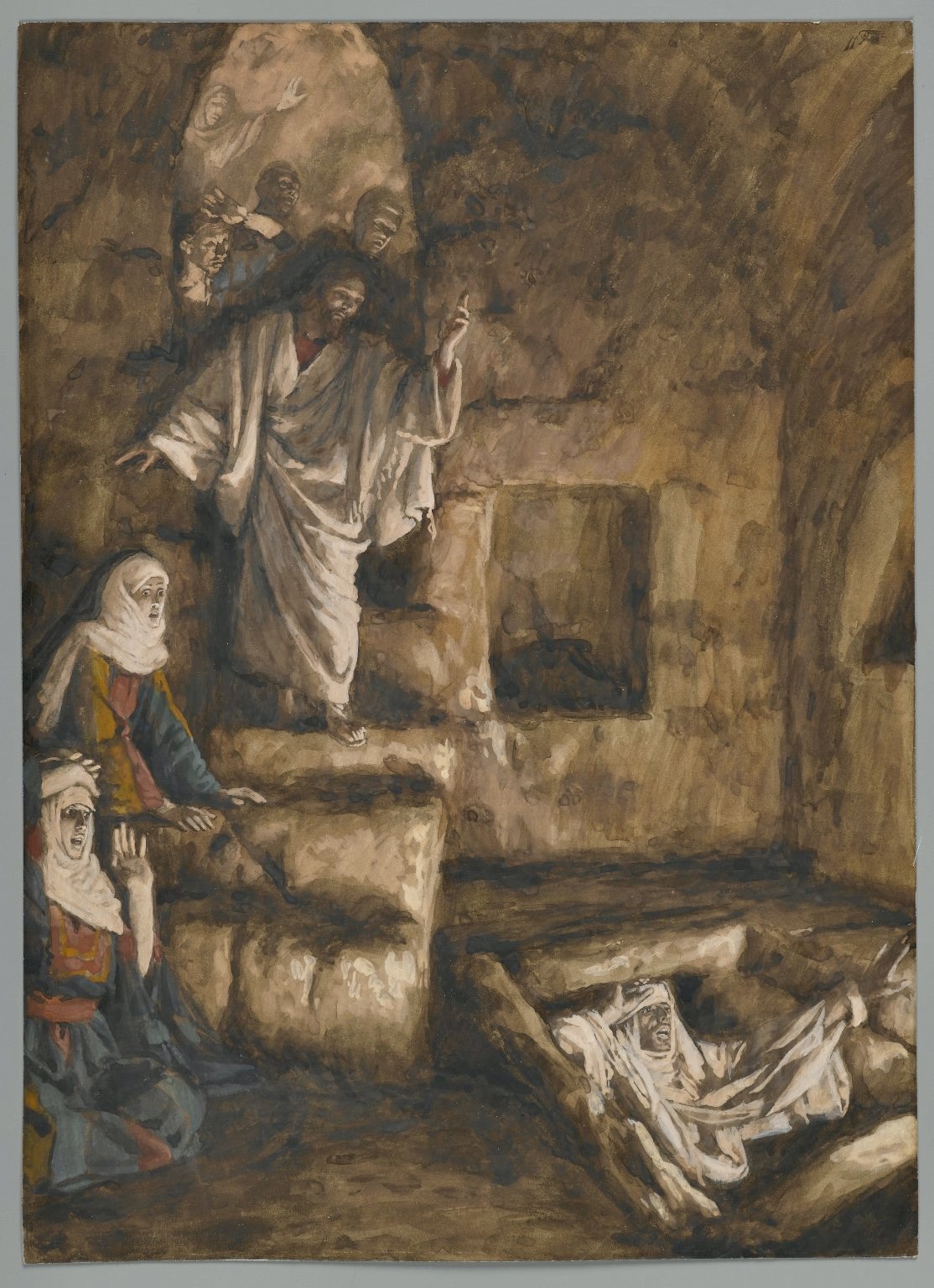
James Tissot, The Resucitation of Lazarus

(Note: At the time of publication, what has happened to Nancy, the mother of Samantha Guthrie, is still unclear.)

The beginning of Lent offers us a stark reminder of our mortality, and of our ’nothingness’ apart from God’s Grace. This may lead some of us to be mindful of the death that we fear, or the deaths of loved ones whom we mourn. Our observance of ‘a holy Lent’ provides a season when we can grow in our assurance of the New Life we are given in and through Christ. This happens through our Baptism into his death and Resurrection. The Easter season that lies ahead has much to say about this, which is one reason we might devote ourselves to particular disciplines of preparation during these Forty Days.

I want to approach this theme in light of the recent widespread publicity given to the abduction of Nancy, the mother of Samantha Guthrie. This tragedy has focused a great deal of attention on some words that she and her siblings have used with reference to their mother: “We believe she is still out there.” This cautious statement has been oft-repeated by law officers and the news media.

We hear these words in the context of learning that Samantha Guthrie has been a member of St. Philip in the Hills Episcopal Church, in Tucson, where a prayer vigil was offered on behalf of her mother. Samantha has also written a book in which she expresses her Christian faith, a fact also evident in some of her recent public communications.

For Christians, our loved ones are always ‘still out there.’ I want to offer some reflection on this phrasing, and explore what the Guthries’ quoted words may mean in terms of Christian belief.

Despite a common notion we sometimes encounter in popular culture, people who die do not become ‘angels.’ Nevertheless, traditional Christian faith teaches us that angels are like us in reflecting a divine attribute, personhood. For we believe in One God in Three Persons (the Father, the Son, and the Holy Spirit). This is the mystery of the holy Trinitarian nature of God, in whose image and likeness all persons have been created. From our knowledge of God, and our experience of ourselves, we know that an integral feature of personhood is being in relationship with other persons.

Yet, unlike angels, we are embodied, and remain embodied regardless of our transformation through the resurrection of the dead at the end of our mortal, physical, lives.

Since the time of the New Testament, Christians have spoken about this transformation into a new form of embodiment by employing various metaphors. In view of this, at our demise, we do not become like a drop of water returning to the sea, or move from a personal identity based on our differentiation from others into an unconscious and undifferentiated state of life. As if – at death – we will somehow be dissolved into a greater realm of ‘Spirit.’

By our Baptism into the death and Resurrection of Jesus, we become named members of His Body, the one Body of Christ. This is the Church in its essence, which comprises the communion of all the Baptized, whether they are ‘on this side of the veil’ or have gone before us to the next life. Thus, though we (as Anglicans) do not pray to saints, we pray with them as the Holy Spirit enables this activity within us. Those presently alive in this life and those who have ‘gone before us’ – are both ‘here’ and ‘there,’ in a shared living stream of ongoing prayer and fellowship.

An oft-neglected article of traditional Christian faith is that of the Ascension of our Lord, directly tied to his Resurrection from the dead. In our faith, Christ did not ‘go up’ alone, but carried with him our human nature. This enabled our own transition – with him – into the next life. When we die, by Grace we move into a greater experience of nearness with our Lord, who is already with us, and in us. Therefore, we do not cease ‘to be’ at death. And we are taught not to fear physical death in view of our belief in the significance of our Baptism into Christ’s death and Resurrection. By virtue of this Ascension-fortified faith, we have assurance about our continuing fellowship with those who have died “in the Lord.”

In view of these fundamental aspects of Christian believing, we can recognize how Nancy Guthrie continues to be among us, and always will be, regardless of what may have happened to her in the recent tragic circumstances now so familiar to us. For as Jesus is quoted as saying, in John 11:25-26, “I am the resurrection and the life. Those who believe in me, even though they die, will live, and everyone who lives and believes in me will never die.”


Note: I present these reflections without implying that my words here have negative implications regarding those who do not share our faith nor our baptismal identity. As for people whose faith (or lack of it) is known to God alone, we need to remind ourselves that, in God’s Providential wisdom, the divine will for those who do not identify as Christian remains a mystery to us.

The Gift of Joy and Wonder

I have long been captivated by some words offered in our Prayer Book for the newly baptized, that they might receive the gift of joy and wonder in all of God’s works. These 12 Days of Christmas are surely the time of the year when hopes for joy and wonder are most honored by people all over the world.

While we focus on the gift of the long-promised Prince of Peace, and Wonderful Counselor, we also engage in what we might think of as a widespread indulgence in sentimentality. Our celebration of the Promised One can become overwhelmed by the secular accoutrements of ‘the season,’ with various permutations of the legacy of St Nicholas of Myra morphed into an attractive mythic figure we call Santa Claus, or Father Christmas as folks in the U.K. like to call him. His popular name in America, diminutively reduced to Santa or Saint Nick, masks the religious history of his churchly origins as a figure numbered among those on the Calendar and in the Lectionary. Elves in Santa’s fabled workshop take the place of saints and un-named believers whose works of faith are not remembered with specifics, while the lore of the mythic figure who comes to visit children’s’ homes with gifts occupies public attention.

We love reminders like this of the joy to be found at Christmas

Among others who have led parish church congregations, I have done my share of encouraging observance of a traditional Advent, stressing the significance of St Nicholas’ feast day (December 6), and urging retention of Advent hymns and restraint in home and church decorations characteristic of our culture’s ways of anticipating Christmas. For me and others, the 12 Days of Christmas would be our time of celebrating our Lord’s Nativity by lighting trees, sharing gifts, and treating ourselves to special foods, right through the feast days of St Stephen, St. John, Holy Innocents, and The Holy Name, to Twelfth Night and a proper regard for the Magi’s visit on the Epiphany, January 6. Preferring such an emphasis has caused some of us to appear to be in quiet conflict with the patterns of our wider culture. For the world around us has more and more begun its anticipation of Christmas by playing ‘music of the season’ early in November, long before Thanksgiving, while also decorating homes and public spaces with Christmas-related lights, poinsettia, and objects related to our enjoyment of gift-giving and receiving. At the heart of all these outward signs of anticipation is our longing for a recovery and enjoyment of what we celebrate as ‘the most wonderful time of the year.’

My adult children like to gently rib me that I have ‘gone soft’ on Advent. And that I have slowly succumbed to the influence of ‘secular culture’ upon what I think should properly be seen as a religious holiday – as if the two emphases are in some way counterposed, and in tension. With my predilection for retaining our Anglican heritage’s rightly attributed but oft-caricatured principle of taking a “both-and” approach to many aspects of our faith and beliefs, I prefer to think that I have broadened my outlook in my search for forms of a deeper synthesis that lies within ‘reality.’ Perhaps these changes in me are due to having grandchildren who live nearby. Yet, as I remember Oliver O’Donovan encouraging us to perceive, compromise is not always ‘of the Truth,’ but can also be ‘in relation to the Truth.’

Hence, my continued fascination with joy and wonder. Joy and wonder might be two of the best words to describe what we think of, and may remember as, a child’s view of what Christmas is all about. And if there is any substance to the perception that our transition from childhood through adolescence to adulthood is often marked by our loss of genuine engagement in imagination, fantasy, and therefore with wonder, it is surely reflected in our thinking that Christmas is primarily significant for children. And therefore something that we enjoy cheerfully when we participate in social occasions where we temporarily suspend our disbelief in fantasy for the sake of the merriment we can enjoy with others.

Christmas inspires us to seek stories of places filled with wonder

All this has deeper significance. What if the world we live in is truly animated by the Holy Spirit, thoroughly infused with divine Grace and Wisdom, and permeated by a wellspring of joy that is godly? What if our culture’s pattern of anticipating and celebrating Christmas is an example of what Jesus had in mind when he encouraged his adult listeners to become like the children he embraced and held up as an example of Kingdom-participation and life?

As when he placed a child in the midst of them, and said, “Truly, … unless you turn and become like children, you will never enter the kingdom of heaven. Whoever humbles himself like this child is the greatest in the kingdom of heaven.” Has it occurred to us that he may have been speaking first about himself (He who humbled himself to become an infant and then a child)?

Childish and child-like are, of course, not necessarily the same. And by distinguishing the terms, we may begin to recover something. That we don’t necessarily need to pare down features of our cultural approach to Christmas to get our celebration back to being something Jesus might want us to enjoy. But that we could also see our patterns of Christmas celebration as involving the kinds of gatherings and events at which he would have enjoyed himself, identifying with our delight in such moments, and where he would encourage us to embody his spirit of discernment of how God is present and at work in all that is around us.

It is all about him. And he is all about us.


Note: the quoted words of Jesus, above, are from Matthew 18:2-4. Christmas Story (filmed in Finland/Lapland, and A Boy Called Christmas are movies currently streaming.

Mary’s Joy-Filled Acceptance


Picture the scene: About 750 years before Jesus, at the Lord’s bidding the prophet Isaiah goes out to the south side of Jerusalem near the aquaduct. He has been asked to do a difficult thing, to meet the fearful and apprehensive Ahaz, king of Judah. This happens at the moment when God’s people are threatened by Tiglath-pileser, king of the Assyrians. Making a bad situation worse, the Assyrians have been joined by armed forces from the separated northern kingdom of Israel, who have already been brought under subjection by the threatening foreign power. Ahaz does not respond as God would like. When he demurs from asking God for a sign of assurance, Isaiah confronts him with the Lord’s Word:

“… Listen to this, government of David! It’s bad enough that you make people tired with your pious, timid hypocrisies, but now you’re making God tired. So the Master is going to give you a sign anyway. Watch for this: A girl who is presently a virgin will get pregnant. She’ll bear a son and name him Immanuel (God-With-Us). By the time the child is twelve years old, able to make moral decisions, the threat of war will be over. Relax, those two kings that have you so worried will be out of the picture. But also be warned: God will bring on you and your people and your government a judgment worse than anything since the time the kingdom split, when Ephraim (northern Israel) left Judah. The king of Assyria is coming!”

What a strange promise! How could the promised birth of a child be a gift for a troubled world?

This is the kind of promise that Mary later received through the Angel Gabriel. We all receive a similar promise when we are called to acknowledge and accept that same Gift-Child that Mary received.

During Advent this year we have reflected on how there can be several aspects of our response to God’s call, and to the promises latent within God’s Gift to us. Fear is often our first reaction, followed then by wonder and uncertainty about the fit between God’s promise and our own suitability for receiving it. By attentiveness to God’s Grace, our uncertainty can be transformed into a humility ~ a humility that is willing to accept the Word of Promise and the Call to receive it. And if we come that far, if we are willing to believe and remain attentive, we may experience a wonderful moment. We find it in a fourth aspect of Mary’s response to God’s Word of Call. It is quite simply, Joy! There is no other word for it. Both Mary and Joseph, each in their own way, accept God’s unlikely and unexpected Word of promise. By accepting and receiving God’s will for what it is, they find a beautiful joy.

Over the course of Advent, I shared with you three images portraying aspects of the Angel Gabriel’s Annunciation to Mary of the promised gift of a child ~ a child who would be God with us. In the image above, El Greco beautifully captures the sublime quality of the moment. Having accepted God’s Word in humility, Mary’s eyes and her whole being are uplifted to receive the message. Her up-turned hand says it all! The gilded and hovering angel points upward, in the direction where all this is supposed to go, into the realm of Spirit. This is where the Lord will ascend through his Resurrection, taking us and our humanity with him into the very being of God.

Joy may not be the defining feature of our lives today. Yet, we can find the fullness of joy in the beautiful Gift we celebrate this week. For we receive a gift whose meaning and value we can never fully anticipate in advance.

To this gift, Mary says “Yes!” And, with her, we can say, “yes,” as well. Yes to God’s Word that comes to us as both promise and call – a promise that he will be with us always, as we accept him for who He really is. And, a call for us to become new persons in him. For in him we find a spiritual maturity that this world can never give.

In raising our hearts in assent to God’s promises, and by receiving God’s call to be transformed by the Spirit, we grow. We grow into that quiet joy which was Mary’s, instilled by the Angel’s visit. Behold – a virgin has conceived, and has borne a Son, and we call his name Immanuel – for God is with us!


The image above is of El Greco’s Annunciation (1600). The biblical quotes from Isaiah are based on Eugene Peterson’s translation, The Message. This post is based on my homily for the Fourth Sunday of Advent, December 22, 2019, which can be accessed by clicking here.

Learning from Mary’s Attentive Openness


Perhaps people living at the time of our Lord’s first coming were in some important ways like us. They may have been just as prone to orienting their security and sense of wellbeing around material concerns, while being generally indifferent to the spiritual life. Yet, in this season of Advent when many sing “O come, O come Emmanuel,” it is easy to imagine the people of Roman-occupied Palestine crying out with longing for the God of Israel to draw near in power. Even so, God chose an out of the way place in which to appear among us, incarnate in human form. Paradoxically, for this and other reasons, the arrival of the Holy One was largely overlooked. At least until his person and message provoked enough reactivity to cause the authorities to have to deal with him. Otherwise, the periodic waves of public attention that he received were most often inspired by the miraculous works of mercy attributed to him. While he encountered significant examples of deference to the revealed Law among his contemporaries, lived-adherence to God’s hope-shaping promises appeared to be rare.

This is why the Lectionary features a particular aspect of the Christian Gospel story at this time of the year. It does this by presenting some notable counter-examples to what may have been – in the first century – a widespread indifference to or loss of confidence in God’s promises. We learn about Zechariah, the father of the ‘forerunner,’ John the Baptizer, and about Elizabeth, John’s mother, who was a cousin of Mary and another woman that would bear a promised child. These three stand out for having been open in heart and mind to the heavenly glory that God was about to reveal in the midst of the lives of his wayward children.

In particular we remember the spirit of attentiveness that we find displayed in a third aspect of Mary’s response to God’s call through the Angel Gabriel. God’s call often challenges us to live in a different way; or to try and be a different person, especially in our relationships with our family, our friends, and those with whom we work. Receiving this call, we can react at first in fear at what this call will mean in practice. We can also respond with uncertainty, wondering about our worthiness or suitability for what God may have in mind for us. We have reflected on these themes in the last two web posts on this site.

But we can also see that —in faith— we are able to go into the heart of our fear, and find God’s power. Receiving God’s grace, we may move beyond relying on our own strength, and resist depending upon our estimate of our own abilities and worthiness for what God may have in mind. And we can choose to respond to God’s gracious invitation to participate in the Spirit’s redeeming work, just as Mary did, by saying, “Yes!” As John Lennon so simply captured the spirit of it, in the words of his famous song, “Let it be!” As Mary said to God through the Angel, “Behold the handmaid of the Lord; let it be unto me according to thy Word.”

This is the spirit of Mary’s response to the message of the angel as portrayed in the third image I am sharing with you this Advent ~ Trygve Skogrand’s photo-collage, pictured above. The artist has skillfully placed a traditional painted figure onto a contemporary scene, juxtaposing an image of something old within a contemporary setting. We see a simplicity and spirit of humility in Mary’s posture, as she kneels in her plain gown. In the plain ‘bed-sit’ room in which she prays, we notice her uplifted eyes. They are now focused on the divine source of the message she is receiving.

Attentiveness is key to meaningful perception, just as we find in the Gospel reading for the third Sunday in Advent. John the Baptizer sends his disciples to Jesus with what should be our most persistent question ~ “Are you the One?” ‘Are you the One for whom we are looking, and whom we are awaiting?’ Notice Jesus’ response: “Go and tell John what you hear and see…” For they only hear and see if they are attentive. This is one reason why the Church sets aside this season of Advent ~ to encourage our attentiveness, so that we can hear and see, and then accept God’s Word to and for us.

“Let it be as God would have it.” Let things be as God wills. Let God be God! Perhaps nothing will be so hard in our lives, as to say those words in faith and in humility. Our pride objects. Our desire to be at the center of reality intrudes. But to say, “Let it be…,” in faith and in humility, is to return to the grace of the Garden of Creation. And it is also to begin to live forward into the fullness of the Kingdom, manifest in the New Jerusalem, as God will have things be.


The image above is a detail of Trygve Skogrand’s photo-collage, Bedsit Annunciation (one of my favorite artistic renderings of the Annunciation). This post is based on my homily for the Third Sunday of Advent, December 15, 2019, which can be accessed by clicking here.