Prior homilies or sermons of mine are occasionally downloaded by readers. Noticing this, I anticipate that some of those preparing to preach (or offer a reading) on an upcoming Sunday might benefit from the perspective I have taken regarding the Lectionary readings for a particular day. I am therefore offering (when I can) a prior text that I have used for the occasion. I will try to do this on Sunday evenings or Mondays believing that there might interest in these texts being made available. When I have one prepared, I will also offer an accompanying handout (in pdf format) in case these may also be helpful.
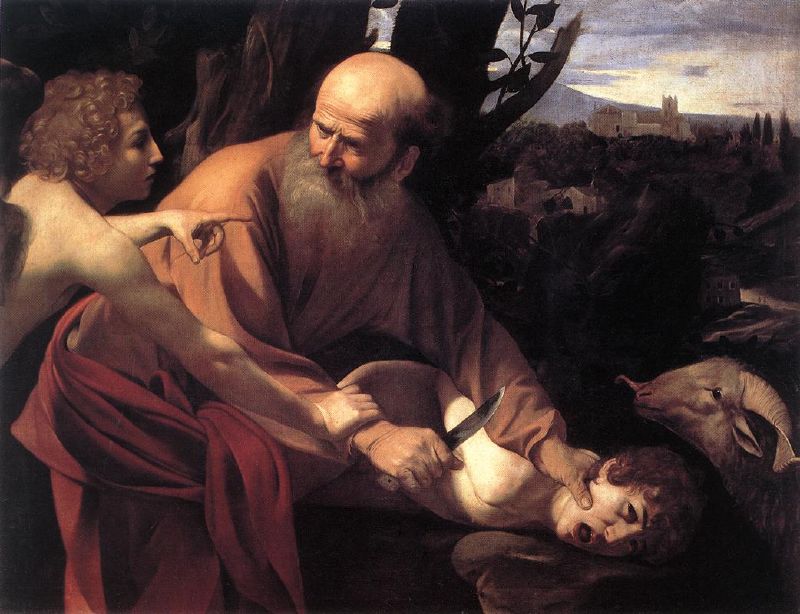
For this coming Sunday, June 28, I offer a link to my web post regarding the Feast of the Presentation, where I offered reflection on Genesis 22 and the story of Abraham and Isaac, featured in Track 1 for Proper 8 A. This reading and its story is worth attention, I think, since it is so significant, and appears so infrequently in our Sunday Lectionary.
The image above from Caravaggio reflects what continues to be our natural and contemporary response to a disturbing aspect of the story it depicts. Other images might be chosen for a handout, which might more directly correlate with theological reflection on other aspects of the story, especially upon God’s role in that particular historical context where the God’s bidding to Abraham may have seemed less surprising.
A Pentecost Frontal from Wells Cathedral in England
Prior homilies or sermons of mine are occasionally downloaded by readers. Noticing this, I anticipate that some of those preparing to preach (or offer a reading) on an upcoming Sunday might benefit from the perspective I have taken regarding the Lectionary readings for a particular day. I am therefore offering (when I can) a prior text that I have used for the occasion. I will try to do this on Sunday evenings or Mondays believing that there might interest in these texts being made available. When I have one prepared, I will also offer an accompanying handout (in pdf format) in case these may also be helpful.
For this coming Sunday, June 21, I offer the following homily from a prior year
James Tissot, The Ordaining of the Twelve Disciples
As Matthew tells the story, those who are called to follow Jesus are then sent out. Before they go, they are not only commissioned to represent him and his message; he shares with them portion of his remarkable power. According to Matthew, “… Jesus summoned his twelve disciples and gave them authority over unclean spirits, to cast them out, and to cure every disease and every sickness.” They have witnessed his teaching in what we know of as the Sermon on the Mount, which in the first Gospel runs over several chapters. Yet this moment is relatively early in the Gospel narrative, and it should surprise us that Jesus is so willing to let them go out on his behalf, and apart from him.
It is sometimes observed that with certain vocations one never really ‘retires” even if one ceases to be engaged in remunerated employment. This bears witness to the fact that through the calling that underlies all other callings, our baptismal vocation never has a terminus though it may come to greater fulfillment in life. Yet as we go through successive stages in our lives, we may be more open to being ‘sent out’ when we are younger even if we continue to be open to being ‘called’ – and, indeed, called anew – through our later years. My parents were relatively young when they were sent out as missionaries to Japan, living into a pattern that we can recognize in many spheres of our human communities such as in the Peace Corps and in Teach for America. Having myself been more recently retired, I find that I am now less inclined toward the opportunity of being sent out in and for the mission of the Kingdom though I still experience being called.
For reasons like these I tend to think that the twelve whom Jesus first called to be his disciples were more likely to have been young rather than middle-aged. In that they may have had a greater openness to discipleship formation; they may have had a greater degree of idealism and more energy for a new kind of work; and they may simply have had the prospect of more years ahead with which to share with others what they would perceive and learn about God’s mission in and to his Creation.
It is a subtle point, but this may be why Tissot – following Matthew – portrays what is titled The Ordaining of the Twelve Disciples separately from a depiction of their initial experiences of being called. For this moment in their lives and in their time with him became the occasion of their formal participation in Jesus’ mission, even when they were not in proximity to him and his work. Jesus, as Matthew tells us, had already gone “about all the cities and villages, teaching in their synagogues and proclaiming the good news of the kingdom, and curing every disease and every sickness.” And having commissioned the twelve, and given them his own authority, Jesus sent them “out with the following instructions: ‘… go to the lost sheep of the house of Israel. As you go, proclaim the good news, The Kingdom of heaven has come near. Cure the sick, raise the dead, cleanse the lepers, cast out demons’.”
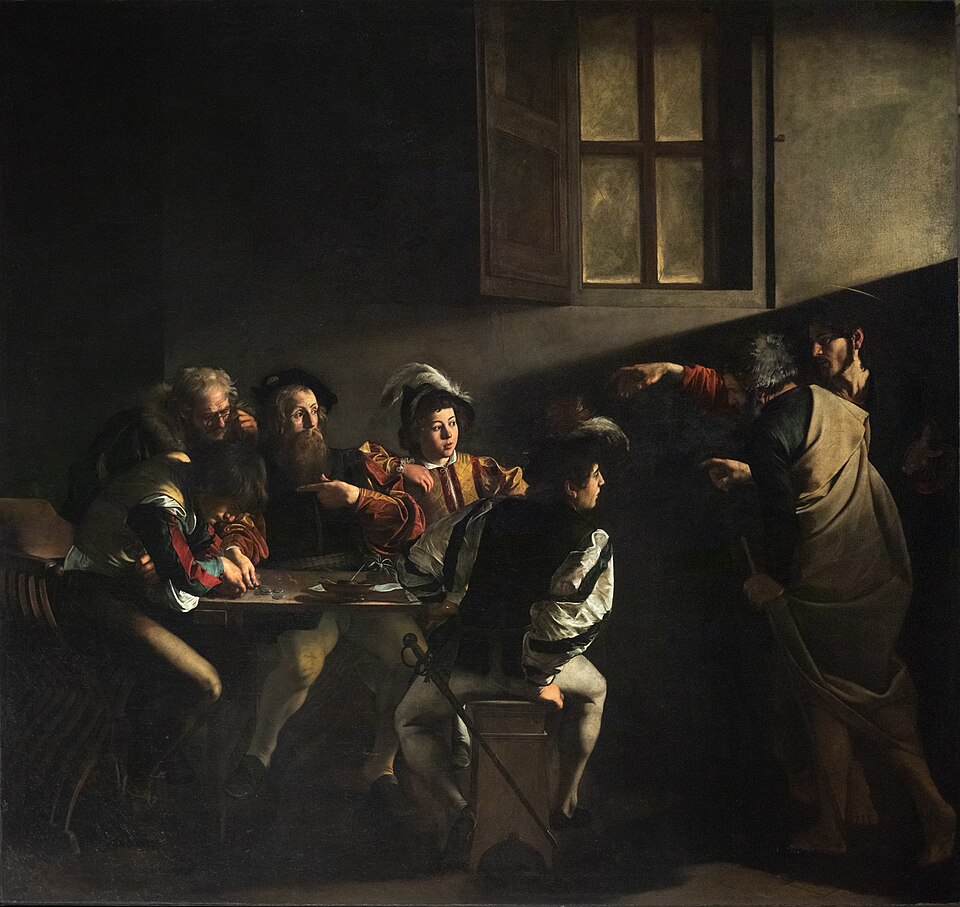
When doing this, Jesus not only equips them for the mission upon which they are sent. He also forewarns them of the adversity they are likely to face, adversity which might involve betrayal, trials and flogging, being hated, and even being put to death. This is yet another reason why I tend to think of the disciples, at this point in their lives, as generally younger than older, just as we saw with Caravaggio’s likely portray of Matthew’s calling, last week.
As we get older, some but not all of us may be less open to being sent out, and less inclined to seek such an opportunity. But we should never cease to be open to ‘the call,’ and the varying ways it may be ever-renewed in our lives.
This posting is offered in relation to the readings appointed for Proper 6, Year A, in the Revised Common Lectionary for Sunday, June 14, 2026.
Prior homilies or sermons of mine are occasionally downloaded by readers. Noticing this, I anticipate that some of those preparing to preach (or offer a reading) on an upcoming Sunday might benefit from the perspective I have taken regarding the Lectionary readings for a particular day. I am therefore offering (when I can) a prior text that I have used for the occasion. I will try to do this on Sunday evenings or Mondays believing that there might interest in these texts being made available. When I have one prepared, I will also offer an accompanying handout (in pdf format) in case these may also be helpful.
For this coming Sunday, June 7, I offer the following notes that I prepared in a prior year, referencing Caravaggio’s painting and the Track One Genesis reading.
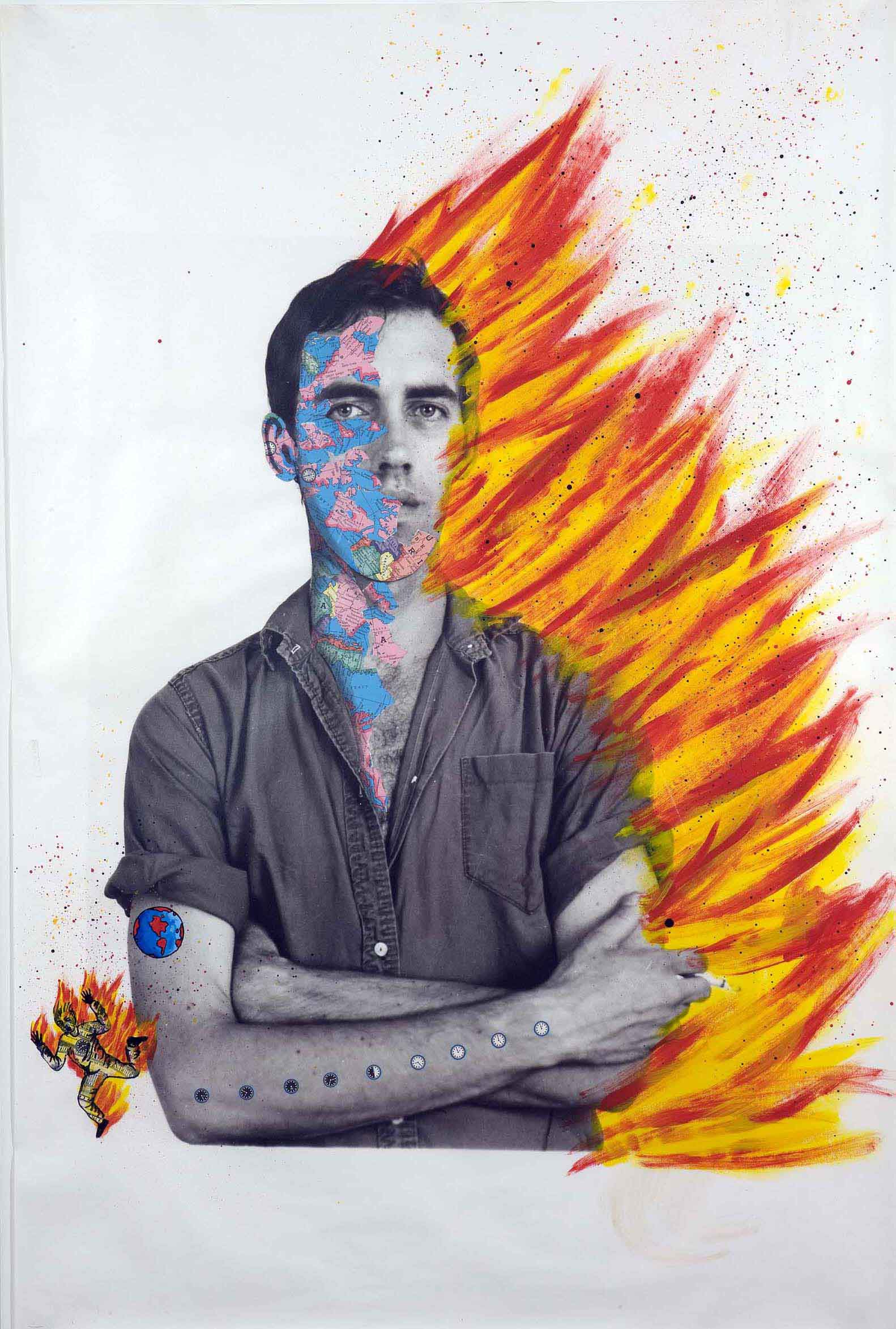
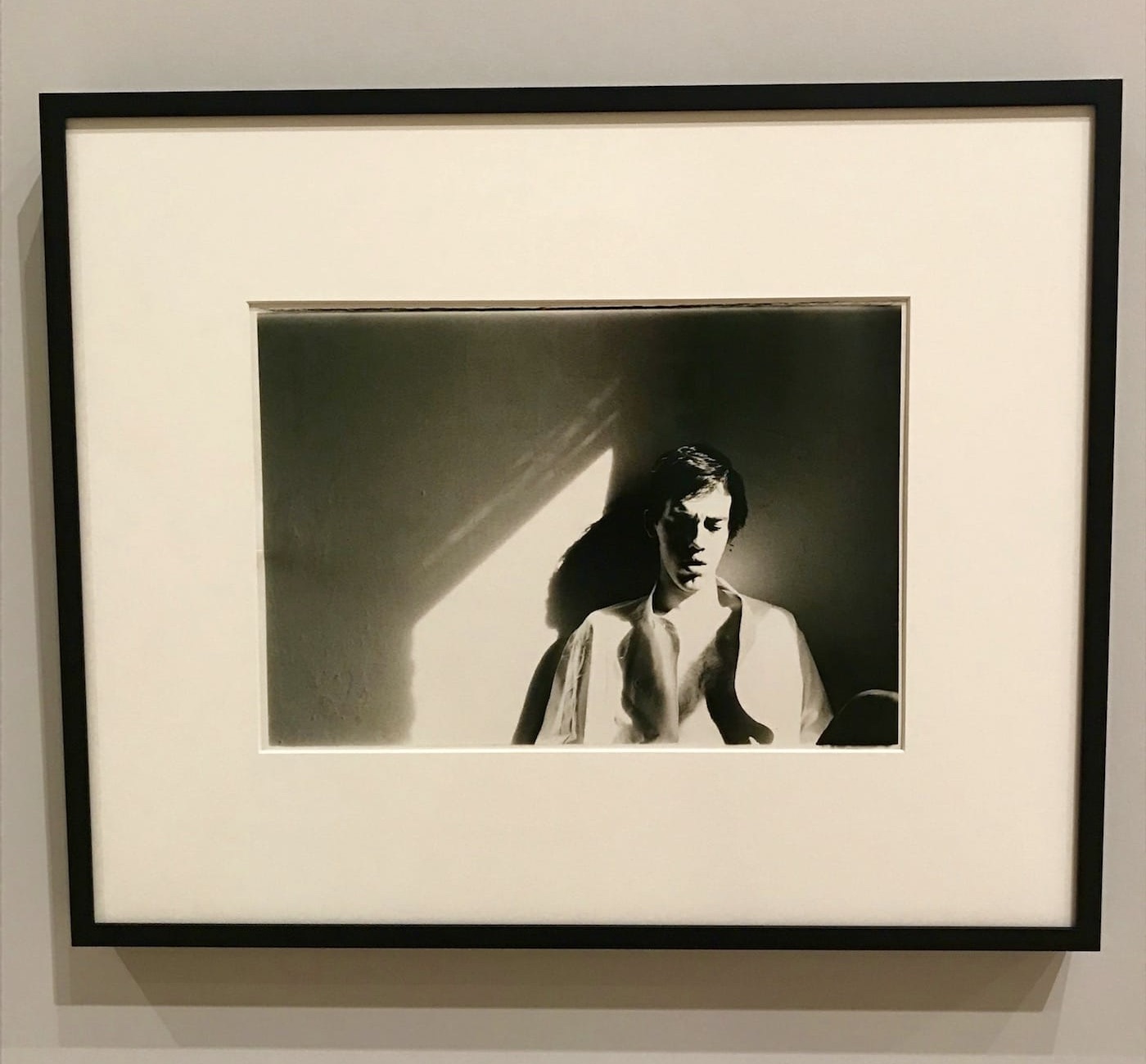
David Wojnarowicz, Self Portrait (photo collage with paint / I knew the ‘blue,’ inner and gentle side of David)
One of the most visited posts on this website is the piece I wrote about Picasso’s painting, Guernica. In it, I began to explore the challenging question of where and how we find beauty amidst darkness, evil, and grievous misfortune. One key that I am discerning in the process of exploring this question is to be open to finding glimpses of beauty within such unpromising circumstances, rather than try to gain an impression of beauty from them. Moments of beauty can be found even within the horror of war, such as in the fabled Christmas Day truce during WW I. And artists such as Henry Moore and writers such as Ernest Hemingway and TS Eliot have captured aspects of beauty that can be discerned within the traumatizing devastation caused by armed conflict.
My challenge in addressing this topic continues as I contemplate my early friendship with someone whose later work in the arts became notorious for his willingness to become completely transparent about his own involvement in acts and relationships that, at the time, moved beyond the bounds of social acceptability.
After graduating from high school in 1974, I found a job at Bookmasters, a chain of stores later absorbed into Barnes & Noble. I worked at the location in New York City’s Times Square, which like parts of the city in those days was chaotic. I remember ducking with fellow passengers on the subway as we pulled into the 42nd St. station when gunshots were fired on the platform. I began to carry an otherwise superfluous cane, imagining that it was for safety. Times Square at night was less populated by curious tourists and more by ‘ladies of the evening’ and their business-protective minders. Aside from Nathan’s Famous (hotdog restaurant) and the One Times Square building with its news ticker banner flashing around the center of the square, our bookstore appeared to be to be one of the few places patronized by people looking for products and experiences that might be found in ‘ordinary’ neighborhoods.
Having just turned 18, I was a newcomer to working a shift in a business location, learning such basic matters as clocking in with a time card, running a cash register and manually processing credit cards with carbon copy receipt slips. I was befriended by a very kind and supportive young man who gently taught me how to complete such tasks, as well as how to manage new inventory and then shelve books in their proper locations. He was David Wojnarowicz, whose name was easier to pronounce than it was to spell. I was impressed by his thoughtfulness, while I also saw that he had a perceptive sense of humor, aware of the irony that could be found in our interactions with some of our colorful late evening customers and with our night manager.
As I got to know him, I learned first about his particular interest in poetry, and more specifically in the work of those known as the Beat Generation, William S. Burroughs, Allen Ginsburg, and Gregory Corso. David was sensitive to not only the content of the little collections of poems that we would shelve, but to aspects of their printing, to the quality of the paper chosen for their covers and texts, and also to the sewn bindings and sometimes unusual fonts selected by the small scale publishers of these interesting and – in our chain bookstore – distinctive little books.
Soon David and I would meet in the early afternoons, before our 3–11 shift, at the apartment he shared with a couple on the Upper West Side, overlooking Central Park. While I was beginning to learn about contemporary poetry from him, I shared with David how to make collages, using an X-ACTO knife on a plate of glass with pages from cast-aside glossy magazines that we had found. I had no way of knowing then that, along with paint, David’s new interest in this medium would later play a significant role in the artistic output for which he has become known.
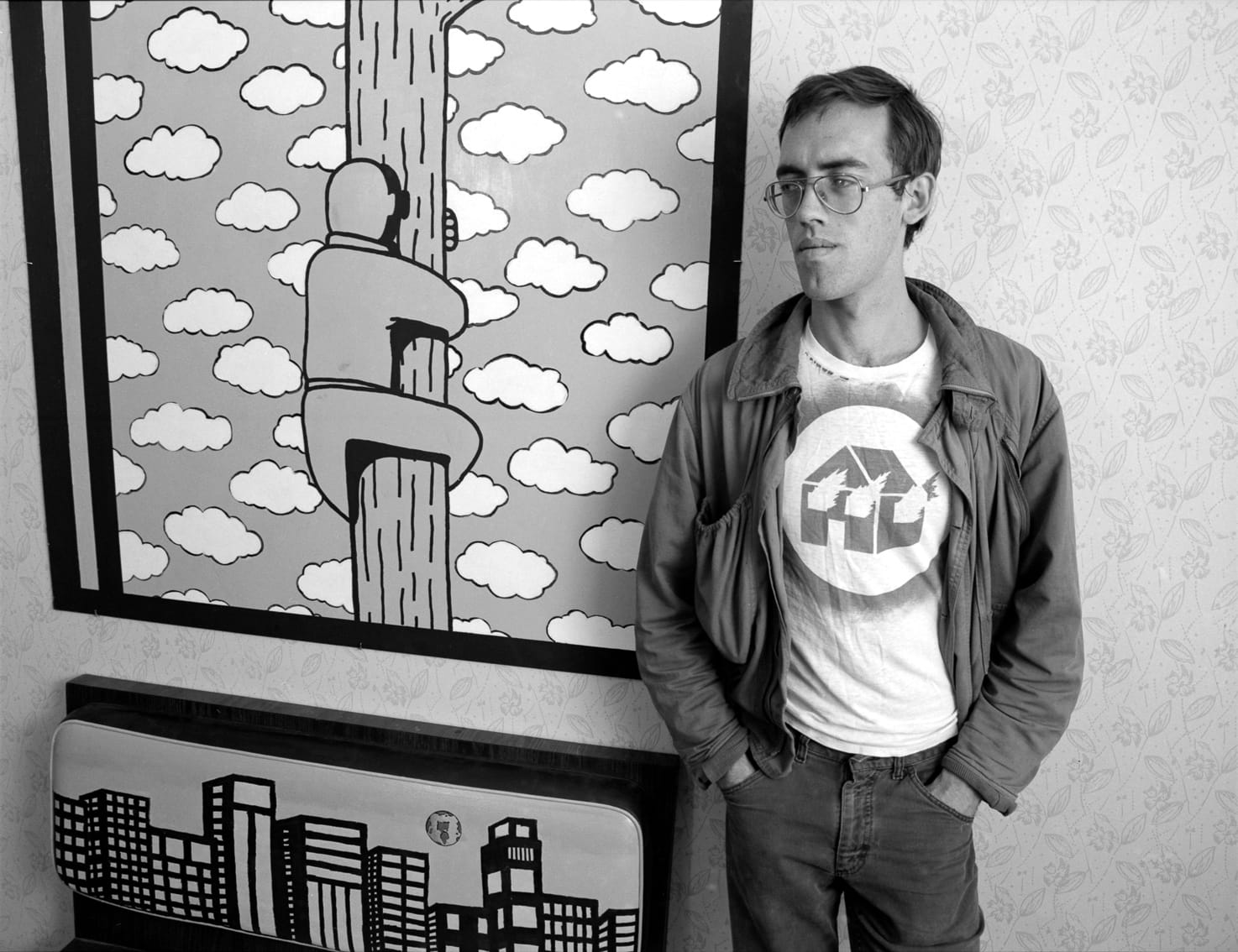
David with two of his works on display (along with his T-shirt here, and his self-portrait above, there must have been ‘a house on fire’ inside my calm friend)
It was only after some months that I became aware of a number of things David tentatively shared with me regarding his traumatic childhood. He still kept hidden from me what we now call his sexual orientation, not yet apparent to me because of my own naivety, and given my girlfriend and our occasional banter about attractive women we had seen at the store or on the subway.
It was probably as a result of me telling David about crossing the Pacific Ocean numerous times during my childhood that he shared with me how his father had been a steward on the famed SS United States, a man whose frequent extended absences were not unwelcome because he was an abusive alcoholic while on shore leave. I came to learn only the barest details of how David had survived, living on the streets at times, and how he had found escape in the City after his childhood across the Hudson.
Toward the end of my first and only year in New York, David and I made a couple of trips down to the far Lower East Side of Manhattan to explore some abandoned tenement buildings. David had an abiding vision for how one or more of these buildings might be reclaimed for use by a community of artists and writers who – because of costs – were willing to live and work in the most marginal of circumstances. I was too young, and less prepared than David to face the realities involved in such a venture, to be able to join him in starting it.
In late summer after that year, I moved to Minnesota in a failed attempt at being a college art student for two quarters. I took a room in the old Victorian style Stuart Hotel in Northfield, built the year after Jessie James had robbed the local bank. Thinly populated by some old men who I suppose were living with hot plates and getting by on meager Social Security checks, and by occasional overnight guests who used shared bathrooms down the hall, the Stuart was a just-affordable place for me to stay. But it was the sort of place with which I now realize David was very familiar. He came to visit me on his first cross-country trip, traveling with a friend on their way to San Francisco. We talked mostly about art and our hopes for the future. I still have a postcard drawn and watercolored by David, showing a hobo ‘traveler’ heading toward the sunset, and featuring a caption that had become a mantra between us, “Goodbye, blue Monday!”
When he and his friend left on a Jefferson Lines bus that stopped regularly at the hotel, it was the last time I saw him. It was only later, after numerous years, that I became aware of David’s subsequent notable art works, published writing, occasional film pieces, and the acclaim he has received following his early death due to HIV.
In a future post I hope to explore some aspects of David’s work and his struggle to find and express beauty in the midst of the darkness that he often experienced, and faced more boldly than I think I could. At the same time, I urge caution to anyone unfamiliar with David’s artwork – some of it is ‘unsafe for family viewing’ and may offend those who seek to be guided by a traditional approach to ethics.
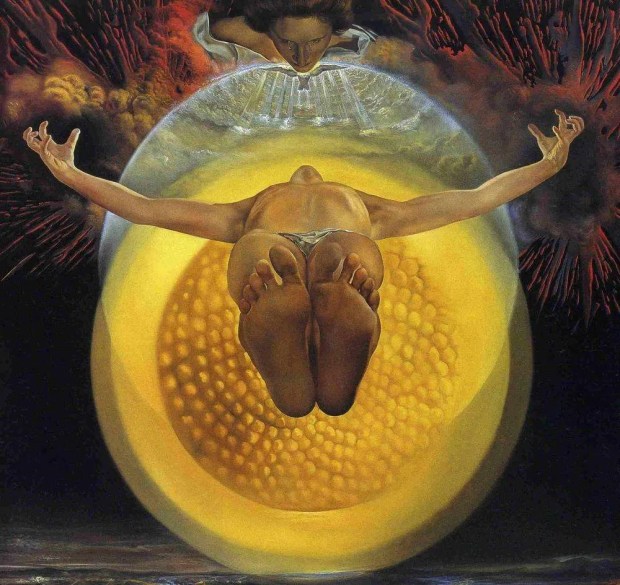
Salvadore Dali, The Ascension of Christ {Christ lifting in his embrace the whole of Creation to the Father, in the Holy Spirit}
Jesus ascended not so that he might withdraw from the world, making room as it were for the mission of the Holy Spirit. Instead, his Ascension marked his transition from being present at one time and in one place, to becoming present in all places, all the time. Before his death, there were countless places where he was not. After his Ascension, there is no place where he is not. From being with only some of those who lived during his earthly years, he is with all of us now. And from having a particular presence and context for his ministry, Jesus in his Ascension transitioned to a universal presence for his continuing mission, so “that he might fill all things,” even us.
The way that we envision the Ascension of Jesus is largely shaped by Luke’s Gospel, as well as by his book of Acts. As the Church’s liturgy observes and celebrates Luke’s presentation of this event, it occurs on the fortieth day after Easter Sunday, which always falls on a Thursday. With diminished weekday worship attendance in most churches, the feast of the Ascension is often observed on the following Sunday, on the Seventh Sunday of Easter. As Luke’s Gospel records the event,
“[Jesus] led [the disciples] out as far as Bethany, and lifting up his hands he blessed them. While he blessed them, he parted from them and was carried up into heaven. And they worshiped him and returned to Jerusalem with great joy, and were continually in the temple blessing God.”
In Acts, Luke presents a fuller account of
“… the day when he was taken up…, [when] he presented himself alive to them… [H]e said to them, ‘… you will receive power when the Holy Spirit has come upon you, and you will be my witnesses in Jerusalem and in all Judea and Samaria, and to the end of the earth.’ And when he had said these things, as they were looking on, he was lifted up, and a cloud took him out of their sight. And while they were gazing into heaven as he went, behold, two men stood by them in white robes, and said, ‘Men of Galilee, why do you stand looking into heaven? This Jesus, who was taken up from you into heaven, will come in the same way as you saw him go into heaven.'”
Giotto, The Ascension of Jesus
Giotto beautifully portrays Jesus’ Ascension in a fresco found within the Scrovegni Chapel (also known as the Arena Chapel) in Padua, Italy. Giotto’s approach to painting proved pivotal in the transition within Western art from dependence upon Eastern Christian iconographic imagery toward a greater realism and sensitivity to ‘ordinary’ human life in this world. Unlike medieval and eastern Christian icons, which tend to be absorbed with expressing dimensions of the eternal, Giotto portrays an actual event in the temporal lives of actual people. Nevertheless, Giotto’s Ascension is clearly also attentive and faithful to the supernatural elements of the Luke-Acts descriptions of Jesus’ Ascension.
It has been observed that in these modern times, among the most neglected aspects of traditional Christian doctrine is a proper understanding of Jesus’ Ascension. This may be due to a contemporary proclivity to read the New Testament as if its significance is primarily ethical, while shying away from engagement with the metaphysical and the supernatural elements of the Gospel narratives. Yet, though often overlooked within the spiritual reflections of many people in this modern era, we need to remember that Jesus’ atoning work was not limited to his offering himself for the life of the world in going to Golgotha. His Ascension and his Resurrection, just as his anticipation of the acknowledged presence and gift of the Holy Spirit, were all a part of his mission of atonement – opening our pathway to one-ness with God.
A collect from The Book of Common Prayer helps us appreciate why the Ascension of Jesus continues to be a major feast of Our Lord on the Church’s calendar:
“Almighty God, whose blessed Son our Savior Jesus Christ ascended far above all heavens that he might fill all things: Mercifully give us faith to perceive that, according to his promise, he abides with his Church on earth, even to the end of the ages; through Jesus Christ our Lord, who lives and reigns with you and the Holy Spirit, one God, in glory everlasting.” (BCP:226)
Just as at his Baptism, in the Ascension of Jesus, the veil between heaven and earth, between the spiritual and the material, between God and us, is pierced and set aside.
Alleluia. Christ is Risen and Ascended! And in the Holy Spirit he is present everywhere and in all who might welcome him into our lives.
Note: this post is adapted from one I have shared previously. We honor our Lords Ascension this week, as we do throughout our days, especially when we speak of it together in the Apostles Creed, in daily Morning and Evening Prayer as well as in the renewal of our Baptismal Covenant, and when we recite the Nicene Creed during the Eucharist. For He is risen, ascended, and continues to be glorified through our prayers.
On Monday of this week, I offered a sample homily for this coming Sunday, Easter 7 A, and an accompanying handout based on themes in the reading from John’s Gospel. I will offer here another sample handout based more directly on Ascension themes related to the above post.
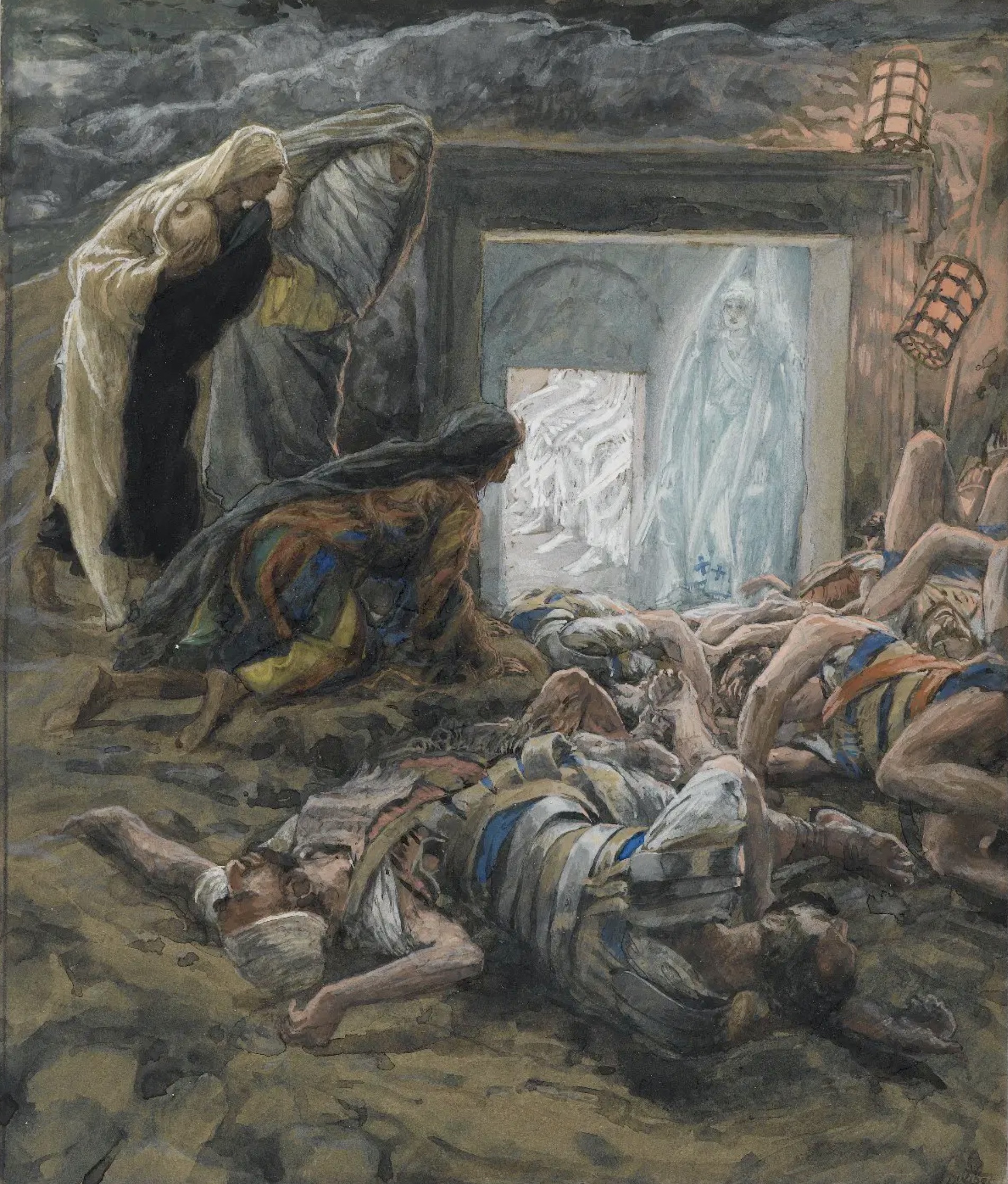
James Tissot, Mary Magdalen and the Holy Women at the Tomb
What an indescribable series of moments those were with the discovery of the empty tomb, first by the women, and then by some of the disciples. What made those moments so unexpected was the sense of emptiness that pervaded the scene after Jesus’ death on Golgotha. A few had stayed until the last. Most left, surely overwhelmed by a feeling of loss and of dark absence. He was gone. And then, so were they. Furtively moving off toward a place of hiding.
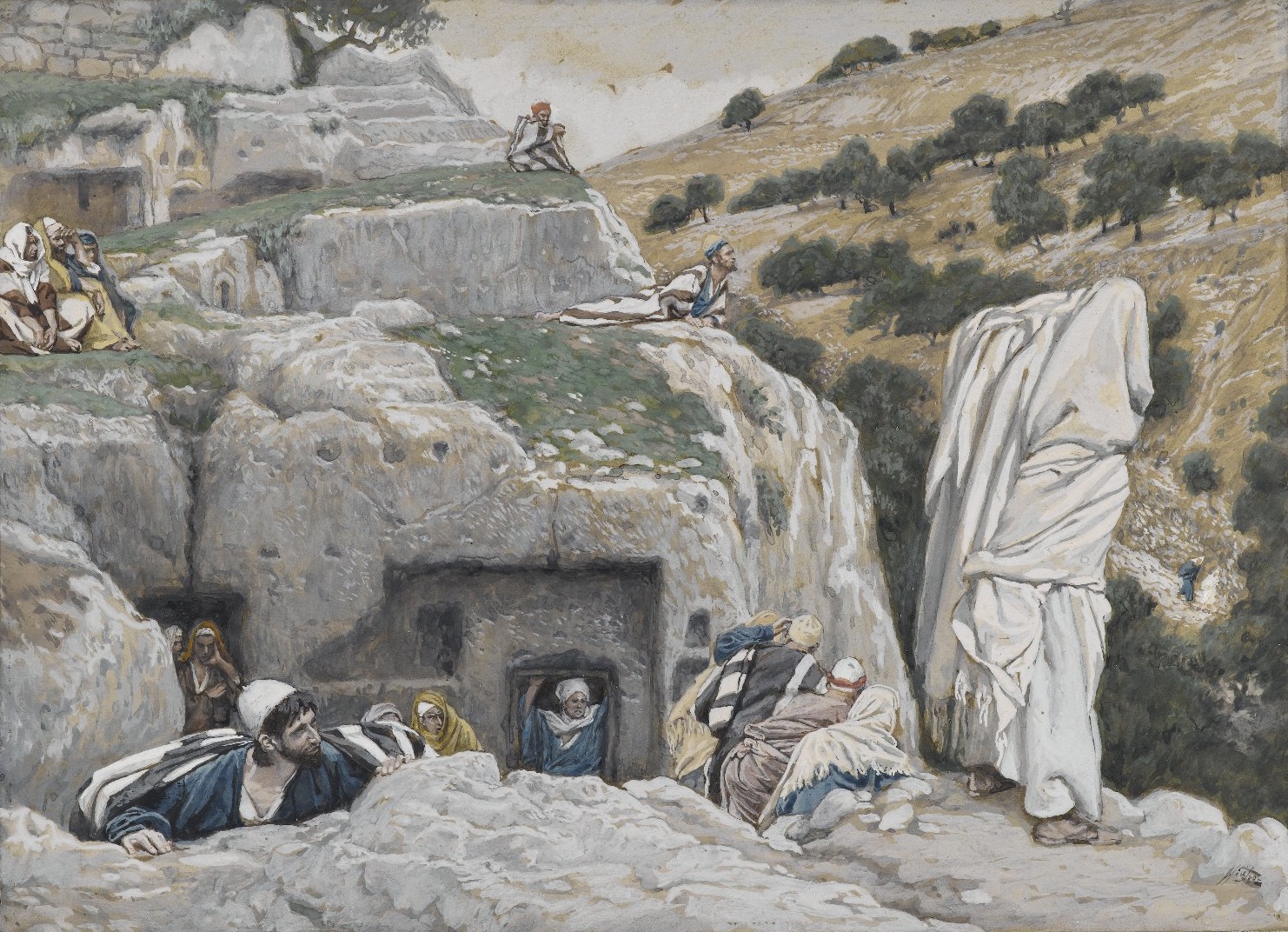
James Tissot, The Apostles’ Hiding Place
Then… from nothing came something. On the morning after the sabbath, surprised joy broke through fear and sadness as He who seemed no longer to be appeared amidst them. Among many promises, God had once said, “Behold, I make all things new.” This promise was now fulfilled, but not in a way that his people were expectating. Listless because of doubt, immobile due to their fears, their place of retreat strangely mirrored their Lord’s entombment.
Then, amidst the stillness of a death-prompted isolation, the followers of the Holy One experienced startling wonder, unanticipated joy, and a new sense of community. Excitement overcame their troubled conviction that all was lost. How had this come about? By reflecting on this question, we join writers of the New Testament and others by imagining how the Resurrection of Jesus not only happened to him, but how it also then happened to the disciples.
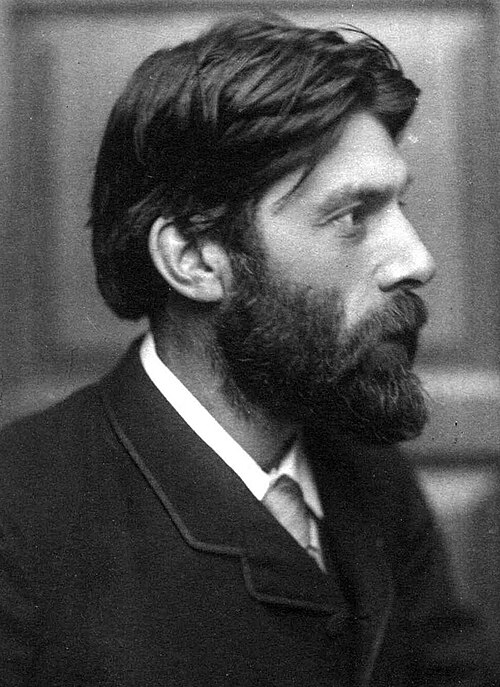
Robert Seymour Bridges was a nineteenth century physician and an esteemed poet, such that later in life he was named Poet Laureate of the United Kingdom. Though not well-known now, he deserves our attention for how he adapted and rendered in lyrical English verse a hymn text by the seventeenth century German theologian and hymn writer, Joachim Neander. Bridges’ version of that text is known by its first line, “All My Hope on God is Founded.”
Robert Seymour Bridges
Bridges’ poetic text is familiar to people in our own day because of the way it has been set to a twentieth century tune, MICHAEL, by Herbert Howells. Many heard this hymn when it was sung as a fitting part of an internationally televised occasion, the Committal Service for Queen Elizabeth II, in September of 2022.
“All My Hope on God is Founded” therefore represents a remarkable synthesis of a seventeenth century devotional text, Victorian poetical sensibility, and expressive twentieth century hymnology. Each of these features can be appealing, and in my perception, how they work together in this example makes for a very moving hymn that enhances contemporary eucharistic worship.
Hope, based on God’s grace and providence, provides the thematic structure for the five verses of the text as it appears in The Hymnal 1982 (of The Episcopal Church). The third verse evokes the blessings that we have received through God’s work in Creation. The text here is nuanced, evoking the role of divine wisdom, while at the same time making allusion to things we have learned through the science of astronomy. Here is verse 3 in full:
“God’s great goodness e’er endureth, deep his wisdom, passing thought: splendor, light, and life attend him, beauty springeth out of nought.”
Clearly, the hymn’s words here speak of what theologians refer to as creation ex nihilo, how God created all that is from nothing rather than from something preexisting. We remember the way that God’s handiwork is portrayed in Genesis 1, especially God’s recognition that what has been created isgood. Andrew Cuneo observes how, in Genesis’s opening chapter, this repeated refrain that it was good, “contains a Hebrew word which may be translated either as good or as beautiful. The feel of the whole chapter changes if one hears God proclaim that the light, the sun, the greenery, the animals are all beautiful, and mankind very beautiful.”
This helps us appreciate how Robert Bridges’ rendering of Neander’s text transposes the object of God’s appreciative regard from the attribute of goodness to that of Beauty. The beautiful splendor, light, and life that attend God then, by implication, become attributes that accrue to humankind, we who are created in God’s image and likeness.
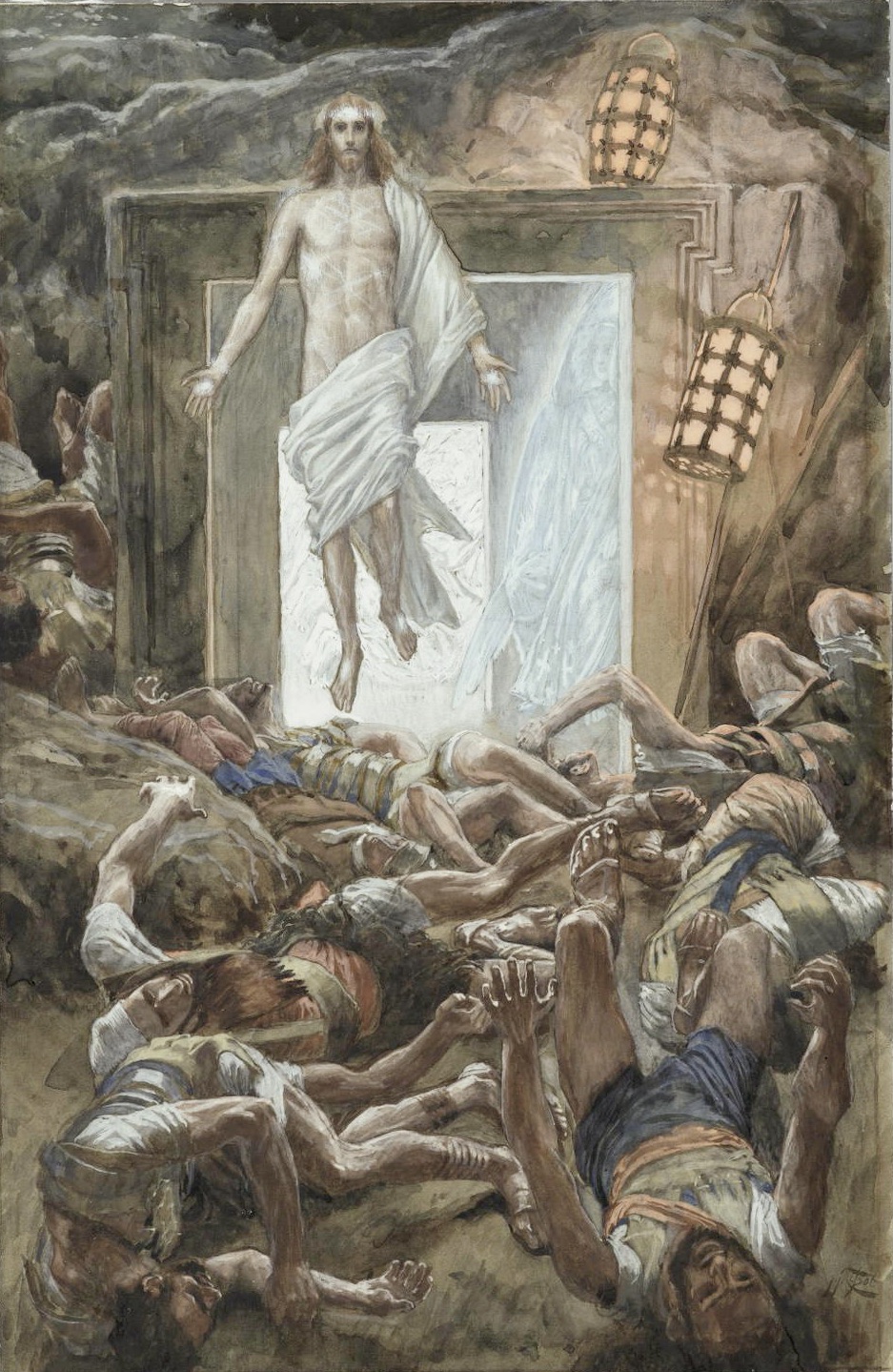
James Tissot, The Resurrection
A significant feature of New Testament theology appears in the theme of “a new creation,” signified by and inaugurated through Jesus’ Resurrection from the dead. As Paul puts it, “if anyone is in Christ, there is a new creation. The old has passed away; behold, the new has come” (2 Corinthians 5:17). Paul is here referring to death and resurrection, and the transformation we undergo through Baptism, when “what is mortal is swallowed up by life.” We can therefore say that the pattern of God’s work of Redemption mirrors that of Creation. For just as God created goodness and beauty out of nothing, God brought beautiful redemption to the world out of the emptiness of Jesus’ tomb. And as we feel joy when encountering beauty in Creation, so we find joy in God’s work of Redemption.
The disciples discovered new life within themselves through their encounter with and transformation by the Risen Jesus. This led them to a renewed sense of confidence that the Lord’s mission continued, and would now continue in and through them. They would have found fitting, and would have been able to sing, Robert Bridges’ words from the first verse of his hymn:
“All my hope on God is founded; he doth still my trust renew, me through change and chance he guideth, only good and only true.”
In a prior post I offered a reflection on the Committal Service for Queen Elizabeth II and noted its inclusion of the hymn, All My Hope on God is Founded. That post may be found here.
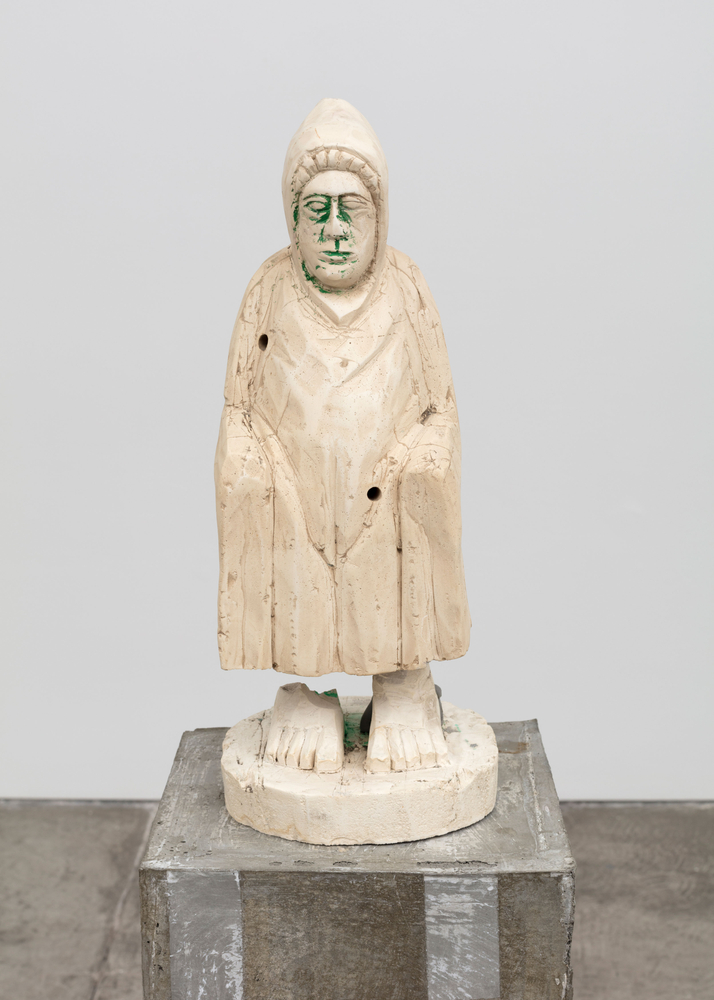
Justin Matherly, (Untitled), Fear Anxiety Joy, 2016
Prior homilies or sermons of mine are occasionally downloaded by readers. Noticing this, I anticipate that some of those preparing to preach (or offer a reading) on an upcoming Sunday might benefit from the perspective I have taken regarding the Lectionary readings for a particular day. I am therefore offering (when I can) a prior text that I have used for the occasion. I will try to do this on Sunday evenings or Mondays believing that there might interest in these texts being made available. When I have one prepared, I will also offer an accompanying handout (in pdf format) in case these may also be helpful.
For this coming Sunday, Easter 2 in Lectionary year A, I offer the following.
The link for it is here. The link to the handout may be found further below.
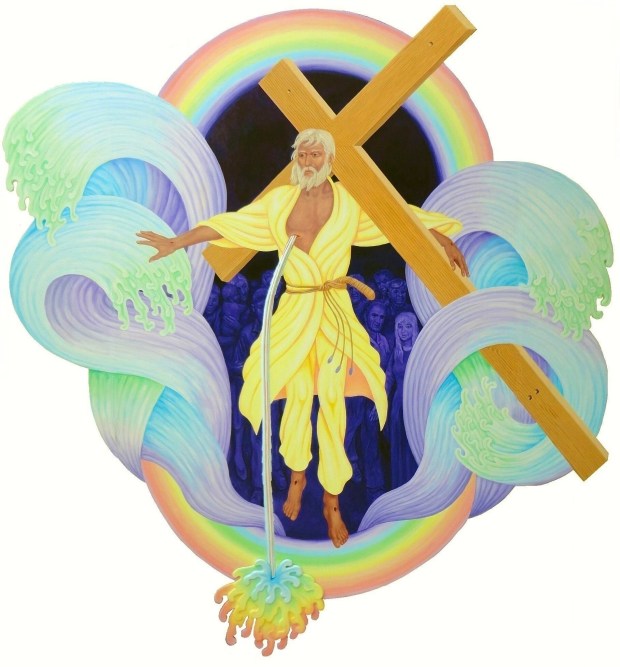
Peter Koenig, Christ as Second Moses, The Rainbow ResurrectionSide Panels that accompany Christ as Second Moses
A perennial theme in the New Testament and in Christian reflection concerns how – in Christ – we are called to live through death into new life. When we die to our worldly attachments and their hold upon us, we open ourselves to a greater life that extends beyond this present one. As the Christ our Passover canticle from The Book of Common Prayer puts it,
Christ being raised from the dead will never die again; * death no longer has dominion over him. The death that he died, he died to sin, once for all; * but the life he lives, he lives to God. So also consider yourselves dead to sin, * and alive to God in Jesus Christ our Lord.
Peter Koenig’s painting with its side panels, centered on themes within this Easter season, expresses this motif in a particularly evocative way. Just as Moses led the people of Israel through the waters of death into a new covenant life with God, so Christ leads us through and to the same. This happens for us liturgically in the rite of Baptism. As Koenig explores this idea, he not only depicts Christ parting the waters but also shows the water emerging from the Lord’s side. This reflects John’s account of how blood and water came forth from Jesus’ side on the cross, but also suggests how water from the rock in the wilderness brought life to God’s people during Israel’s wandering toward the Promised Land. The “Thanksgiving over the Water,” in The Prayer Book Baptismal Rite articulates these ideas in a compact way:
“We thank you, Almighty God, for the gift of water. Over it the Holy Spirit moved in the beginning of creation. Through it you led the children of Israel out of their bondage in Egypt into the land of promise. In it your Son Jesus received the baptism of John and was anointed by the Holy Spirit as the Messiah, the Christ, to lead us, through his death and resurrection, from the bondage of sin into everlasting life.
We thank you, Father, for the water of Baptism. In it we are buried with Christ in his death. By it we share in his resurrection. Through it we are reborn by the Holy Spirit.”
Notice how, in the painting at the top, Peter Koenig portrays the crucified and risen Christ before what appears to be a darkened tomb filled with people. As we hear Isaiah quoted in Advent, “The people who walked in darkness have seen a great light; those who dwelt in a land of deep darkness, on them has light shone.” Christ leads the way, and makes possible our journey from the darkness of death into our new covenant life with God.
The two side paintings that accompany Koenig’s Christ as Second Moses artfully yet powerfully suggest the drama within the Exodus account of Israel’s Red Sea Crossing. The chariots of Pharaoh succumb to the waters of death while Israel is safely delivered on dry ground to their Covenant encounter with God at Sinai. Another canticle from The Prayer Book puts it well:
I will sing to the Lord, for he is lofty and uplifted; *
the horse and its rider has he hurled into the sea.
The Lord is my strength and my refuge; *
the Lord has become my Savior.
This is my God and I will praise him, *
the God of my people and I will exalt him.
The Lord is a mighty warrior; *
Yahweh is his Name.
The chariots of Pharaoh and his army has he hurled into the sea; *
the finest of those who bear armor have been drowned in the Red Sea.
The fathomless deep has overwhelmed them; *
they sank into the depths like a stone.
Your right hand, O Lord, is glorious in might; *
your right hand, O Lord, has overthrown the enemy.
Most of us have the blessing of not facing the equivalent of Pharaoh’s army. But we do have an enemy. And our enemy is the darkness and death of loving self and this world, even to the point of contempt for God, when God bids us to love him, even to the point of contempt for self and this world. When we live as we pray, to the Father, through the Son, and in the Spirit, we experience new life.
The above painting is Peter Koenig’s, Christ as the Second Moses, also known as The Rainbow Resurrection (used by permission of the artist). The final paragraph contains a paraphrase of St. Augustine concerning how we love God, from The City of God (Book 14, chapter 28). / I am once again pleased to share Peter Koenig’s painting and the material in this post as we prepare for Easter Sunday, and the Baptisms that may be a part of the liturgy in many churches.
(This week, I am offering a Good Friday homily that I have shared before.)
In the Passion Reading for this day, we are reminded of the dark spectacle of what human cruelty can accomplish. With Jesus, it was a vain attempt to obliterate the most beautiful human being who ever lived. Thank God, we have no photographs of the horrifying things that were done to him, but only paintings. But consider this paradox: the beauty of art has provided a way for us to a reflect on one of the darkest examples of human violence.
Paintings of our Lord’s Passion seem divided into two broad groups. There are those concerned to portray the grim reality of Roman execution. And, there are those inclined to explore and express the inner redemptive significance of what happened.
At the center of any portrayal of the Crucifixion of Jesus is an inescapable fact ~ that it was an act of political and judicial violence, where the forces of earthly injustice pretended to act in the name of human truth. The corollary to this is how Jesus’ subsequent Resurrection restored heavenly justice in the name of divine truth. Paintings of Jesus’ Crucifixion, and those of his Resurrection, usually give attention to his wounded body, even though his wounds then appear transformed on the Third Day. After all, this is one way the disciples recognize him after his death. How the death-marked body of Jesus looked after his resurrection, also provides a preview of his appearance at the end of time.
Charles Wesley’s Advent hymn, “Lo! he comes, with clouds descending” offers words that also apply to Good Friday.
“Every eye shall now behold him,
robed in dreadful majesty;
those who set at nought and sold him,
pierced and nailed him to the tree,
deeply wailing, deeply wailing…
shall the true Messiah see.
Those dear tokens of his passion
still his dazzling body bears,
cause of endless exultation
to his ransomed worshippers;
with what rapture, with what rapture
gaze we on those glorious scars!”
It is natural to imagine how the people directly responsible for Jesus’ death, from Judas and the high priests, to Herod and Pilate, might be overcome with grief at the triumphal Second Coming of the Lord. Those who pierced him might feel themselves pierced by awakened guilt and remorse. Indeed, for every one of us, seeing the fruit of our mischief and misdeeds can provoke us to tears.
But I think Wesley was getting at more than repentance and contrition. Surely, seeing the full beauty of the glory of our Lord, with his wounds transfigured, will also summon our tears — but with tears of joy. Wesley, prayerfully and with sensitivity, has given voice to the profound power of beauty. Especially when it is discerned in the most unexpected of places – in the face and body of the Crucified One. Love… the most profound love beyond human imagining, is manifest in the face and gestures of the crucified messiah. For he reaches out his hands even to forgive those who have tortured and sought to kill him. This is the most beautiful thing we could ever see.
As we pray in a Morning Prayer collect, “Lord Jesus Christ, you stretched out your arms of love on the hard wood of the cross that everyone might come within the reach of your saving embrace…”
Perceiving all this helps us make sense of the paradox at the heart of Jesus’ Crucifixion. For, in it, we perceive the dramatic juxtaposition of serenity with antagonism, of beauty with its dark opposite, and of moral good with apparent evil. We can see this in two paintings I have included with your worship bulletin: Hieronymus Bosch’ painting of Christ Carrying the Cross, and Stanley Spencer’s 1958 painting, The Crucifixion. Looking at them, I encourage you to join me in asking an awkward question: with which person or persons in these paintings do we identify?
Hieronymus Bosch, Christ Carrying the Cross
Though some 500 years apart, both painters portray the tranquil appearance of the peaceful heart of Jesus, even in the face of vicious hostility. And like Bosch, Spencer helps us see what the beautiful One in our midst sometimes provokes. Especially when the shining light of his presence exposes the dark shadows within and around us. For his light sometimes prompts fierce anger and envy, as well as a callous indifference to cruelty and suffering. Things of which we are all capable. And we are likely to have much invested in denying this ugly truth. Strangely, when confronted face to face with the divine opposite of our perversity, we will either fight the light that we encounter, or surrender to it. The Passion Narratives give us examples of those who resisted and even fought against the Light of the World. For we sometimes fight against the disturbing possibility that Jesus will conquer our pervasive ungodliness. And so, consciously or not, we try to do away with his godliness.
An encounter with true beauty can be unsettling and troubling, especially if we have already settled for so much less. We may often hope for the triumph of good over evil, that beauty will overcome darkness, and serenity will displace antagonism. But we cannot find it within ourselves to do more than hope. We cannot achieve the redemptive resolution for which we haltingly reach out with our feeble hands and hearts.
It is not an accident that the figure of Jesus in Stanley Spencer’s painting visually recedes in the foreground, while those who oppose and crucify him grab our interest and attention. Spencer, after mastering traditional realism, adopted what he called a neo-primitive style. He was a gifted colorist, and highly proficient with composition. And so, as Spencer has rendered him, Jesus’ skin tone and color roughly match that of the wood of the cross, as well as the clothing of the man with the hammer swung over his head. Spencer’s rendering of the Lord’s skin tone and color also match much of the sky and the ground below… including the tunic of Mary Magdalene, prostrate at the foot of the cross. This forms a compelling visual symbol. For Jesus totally identified with us, in his Incarnation, and in his Crucifixion. His crucifixion symbolizes his complete joining with us, and with our world of wrenching hurts and suffering.
In fact —as we see in Spencer’s composition and coloring— it is precisely because Jesus blended in so well with everyday life, that those who opposed him could literally gain the upper hand, ultimately with hammers and nails. (For he did not call down an army of angels to help him, as he could have.) But this is the marvel of the incarnation of our God in Jesus. The fullness of divinity thoroughly became joined with our fallen humanity. As the Gospels attest, this joining was so complete that many did not notice or have regard for his divinity. When we do notice his total identification with us, when we come face to face with the truth it represents, we have either one or the other of two reactions. We throw ourselves down in humility before him. Or, we seek to throw him down, to humble him before us.
These paradoxes are brought to their greatest prominence when, as he predicted, he is lifted up. His lifting up is his glorification, and the glorification of God within him. Yet his lifting up is on a cross, and in the agony of a humiliating public execution. Here we see the ‘strange beauty’ of our Lord — a beauty for which churches and museums better prepare us than do our malls and most TV shows.
So, let us “behold the fair beauty of the Lord, and … seek him in his temple.” We will find him! We will find him in the “temple” that he promised to raise in three days.
Attached here is a link to a handout that I have used in connection with this homily.
Additional note: Those interested in further reflection on some of the Holy Week themes raised here might wish to read my prior post, “The Beauty of What God Can Do, and Is Doing.”