I observe that prior homilies or sermons of mine occasionally have been downloaded by readers. I anticipate that some of those preparing to preach (or offer a reading) on an upcoming Sunday might benefit from the perspective I have taken regarding the Lectionary readings for a particular day. I am therefore offering (when I can) a prior text that I have used for the occasion. I will try to do this on Sunday evenings or Mondays believing that there might interest in these texts being made available. When I have one prepared, I will also offer an accompanying handout (in pdf format) in case these may also be helpful.
For this coming Sunday, the third Sunday after the Epiphany in Lectionary year A, I offer the following.
The link for it is here. The link to the handout may be found further below.
We are created in God’s image and likeness. We often assume that this is reflected in the way that we think, in our capacity for reason and in our desire for wisdom. But we also reflect our creation in God’s image and likeness in our desire to love. We all want to love, and receive love. Sometimes, especially in this fallen world, we love in ways that are disordered. We love the right things in the wrong way, and we love the wrong things in what we deceive ourselves into thinking may be a good or right way.
And yet, we still love, whether it is ourselves that we love to the point of it being at the expense of loving others and the world around us, or it may be that we love others and the world at the expense of rightly loving ourselves.
The Holy Scriptures remind us that God is love. And that God first loved us before we knew it. And that God so loved the world that he gifted himself in the form of the Word made flesh, who came among us, full of the grace and truth that he has so generously shared with us. “I am who I am” (what God spoke to Moses from the burning bush) becomes the source of “we are who we are,” especially when we become aware of and live into the fullness of who we really are.
And so, to love what God loves is to share in the experience of God’s love. Awareness of this leads us to become more aware of the way we are called to share in God’s own way of loving. To do so actually comes to us naturally, even though we in our fallen state are impaired in our ability fully to live into this reality, and believe we are capable of it.
In my prior post, I reflected on how some of this capacity to love what God loves may be revealed in the life and work of Walter Inglis Anderson, who himself may not have been aware of the fact, nor may have had the conscious ability to believe it. In this respect, Anderson, followed in the spiritual footsteps of John Muir, whose earlier example may help us appreciate this dimension of the Mississippi painter’s relationship with nature. For Muir, through his childhood formation in orthodox Reformed Christian beliefs, came to believe he was loving Creation as God loves it, however much Muir’s vision expanded and broadened over the years so as to appear that he had moved beyond the bounds of traditional faith.
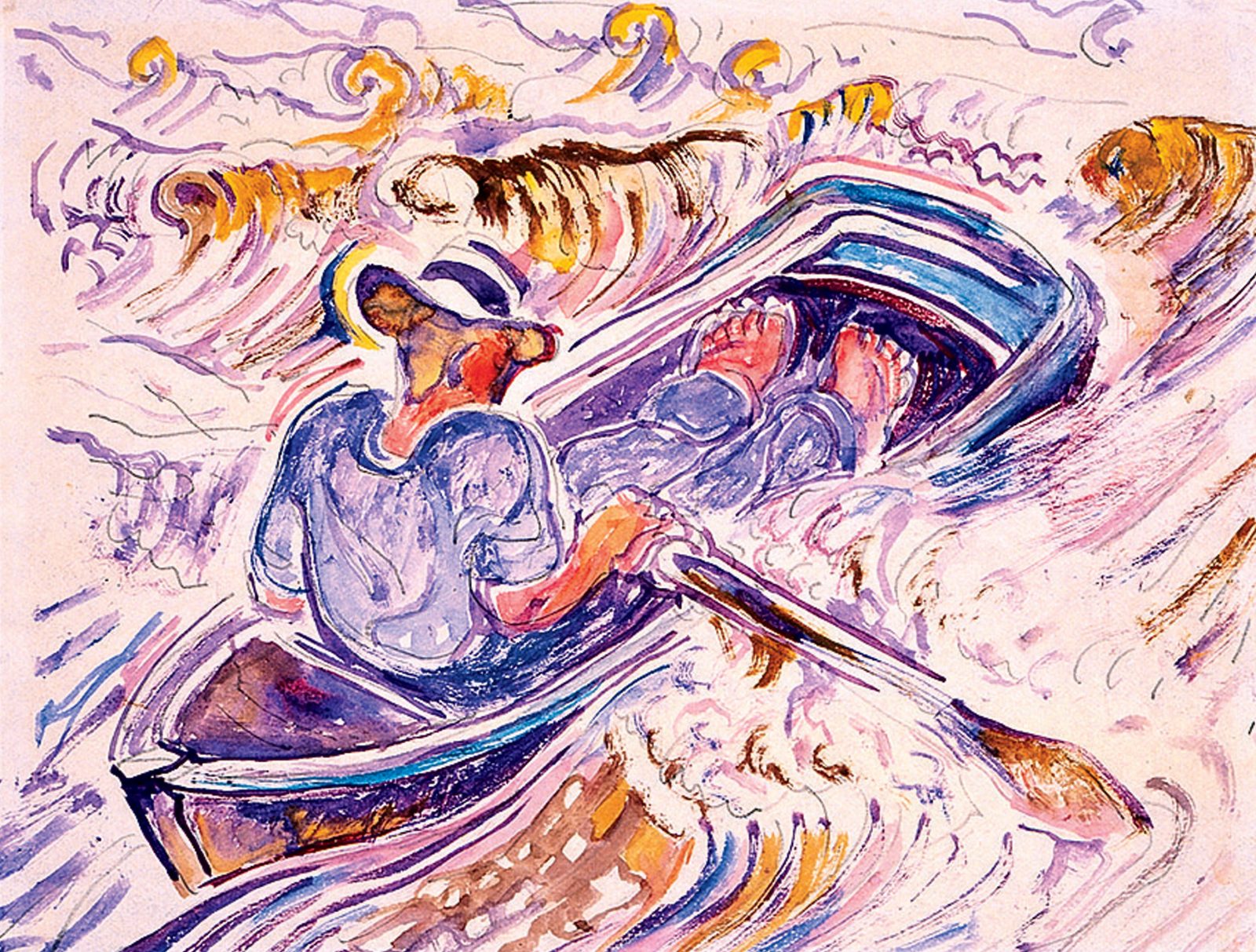
The painter and solitary, Walter Inglis Anderson, portraying himself rowing out to Horn Island
To experience joy when we encounter and perceive the beauty we find in the world – even in ourselves – is to experience God’s love for the world. Beauty in the world is a manifestation of God’s self-giving, and of a love that is self-giving, even to the point where we are capable of bringing harm to it or rejecting it. The same is true for God’s love for us, and for those with whom we have been given the opportunity for fellowship and community. For God’s love is not for us solely, as individuals, but is present in fellowship and in community, especially in communities founded upon this great gift of divine love.
Anderson’s son, John, retracing some of his father’s footsteps
Here, we can come to appreciate another insight we can gain from learning about Walter Inglis Anderson. Like the earlier Muir, Anderson came to perceive – or perhaps always intuitively knew – that to see, to really see what is in and around us, is enabled by ‘getting out of the way.’ When I, as one who sees, am conscious and then distracted by my awareness of my process of seeing and perceiving, I become absorbed with my own subjectivity, at the expense of more fully becoming focused upon the objects of my perception. In seeking to love you, or things in the world around us, my focus upon my process of loving or seeking to love impedes my actual participation in really loving you, you who are a fellow subject of loving and not simply an object of my love.
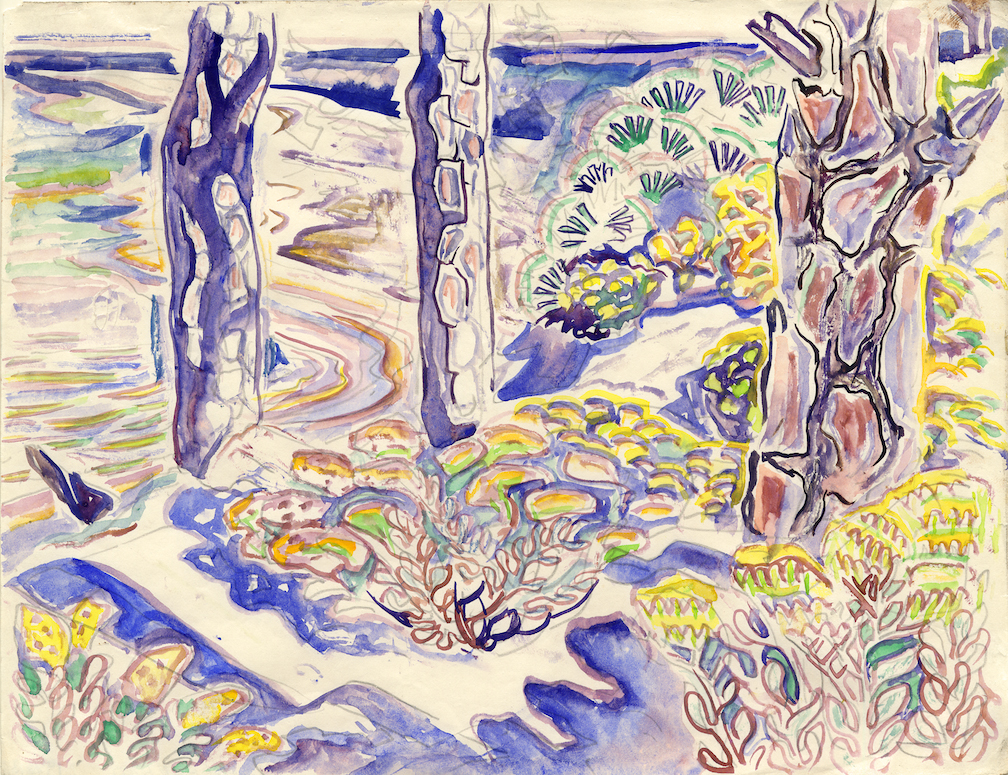
A Horn Island painting by Walter Inglis Anderson
I think that Anderson was enabled to arrive at such an awareness by enacting his desire to be among and really see the plants, birds, animals, the seashore, and the changing weather conditions, while on his solitary sojourns to Horn Island. Therein lies the paradox. God’s love for the divine beauty reflected in the world that he has made was at the heart of Anderson’s love for the beauty that we find in nature. And in sharing in that same love of beauty, he came to perceive how he was actually not alone, even in his periodic states of hermitage under the shelter of his upturned dinghy.
Awareness of this is one doorway into perceiving and then enjoying what Jesus spoke of when he said, “Wherever two or three of you are gathered, I am there.” The great “I am” is with us, now to behold and embrace, Spirit in Flesh, Word made human, not only in ourselves and in the things around us, but also between us at the heart of our fellowship.
I observe that from time to time prior homilies or sermons of mine have been downloaded by readers. I anticipate that some of those preparing to preach (or offer a reading) on an upcoming Sunday might benefit from the perspective I have taken regarding the Lectionary readings for a particular day. I therefore plan to offer when I can a prior text that I have used for the occasion. I will try to do this on Sunday evenings or Mondays believing that there might interest in these texts being made available. When I have one prepared, I will also offer an accompanying handout (in pdf format) in case these may also be helpful.
For this coming Sunday, the second Sunday after the Epiphany in Lectionary year A, I offer the following. As with last week’s offering, this one is from 2017, as well.
The link for it is here. The link to the handout may be found further below.
Perhaps like Henry David Thoreau or John Muir, a gifted painter named Walter Inglis Anderson came to discern some things of great significance within the visible beauty latent in nature. Like his venturesome forbears, he did this by seeking out an area of wilderness. It became his habit to row out the ten or so miles to Horn Island in the Mississippi Sound, where he slept on the sand using his upturned dinghy as his hermitage. Out there amidst the shifting dunes, with only the shell of his boat for cover against storms, Walter Anderson perceived more of who he was as he experienced harmony with what was around him. In time, compelling objects of his attention became for him fellow-subjects apprehending the splendor of Creation.
A shoreline inhabitant whose common name (‘hermit’ crab) was often derisively applied to Walter Anderson
Paradoxically, by his solitary coastal journeys, a man who had suffered bouts of mental illness became aware of an elusive but precious quality that he shared with those from whom he was isolated. His transient island resting places, where he spent weeks at a time over the course of twenty years, provided him with fleeting glimpses of what it might mean to be more fully human. There, away from others, he experienced moments when he felt he had become who he was meant to be.
As one writer has put it, “Anderson’s isolation from humanity convinced him, in the end, of humanity’s beauty… [He] believed that if we re-established our primal relationship with nature, we would regain our beauty.” Walter’s youngest son, John, summed it up succinctly: “Solitude was a tool that helped him to find unity with all people and all creatures.”
Anderson’s portrayal of himself rowing out to the island
Walter Anderson expressed the point compactly in one of his Horn Island logbooks: “In order to realize the beauty of man, we must realize our relation to nature.” His son, John, later explained what his father had meant by this. “I think that in those twenty years that he was living in solitude on the wilderness island, he was attempting to realize his relation to nature so that he could realize the beauty of humanity.”
Underlying these words, and the perception they express, may be a nature-mysticism of the kind often associated with Thoreau and Muir. I also find an affinity here with the spirituality we can discern in traditions as widely different as Zen Buddhism and the writings of Christian monastic solitaries.
Eugene Peterson’s rendering of Jesus’ words in John 12:25 (in context), captures a similar perception: “Listen carefully: Unless a grain of wheat is buried in the ground, dead to the world, it is never any more than a grain of wheat. But if it is buried, it sprouts and reproduces itself many times over. In the same way, anyone who holds on to life just as it is destroys that life. But if you let it go, reckless in your love, you’ll have it forever, real and eternal.”
To this mystical vision of the world I think we can also connect an insight attributable to St. Augustine of Hippo, regarding what we love, and how we love. If we love ourselves and our lives, or the world around us, for our own sake, we belong to the ‘city of the world,’ and we live turned away from God. Yet, if we love these same things for God’s sake, we belong to the City of God, and live in a God-ward way. Here it is important to remember that to love in the latter way that Augustine commended may not necessarily be an activity that we undertake with conscious awareness.
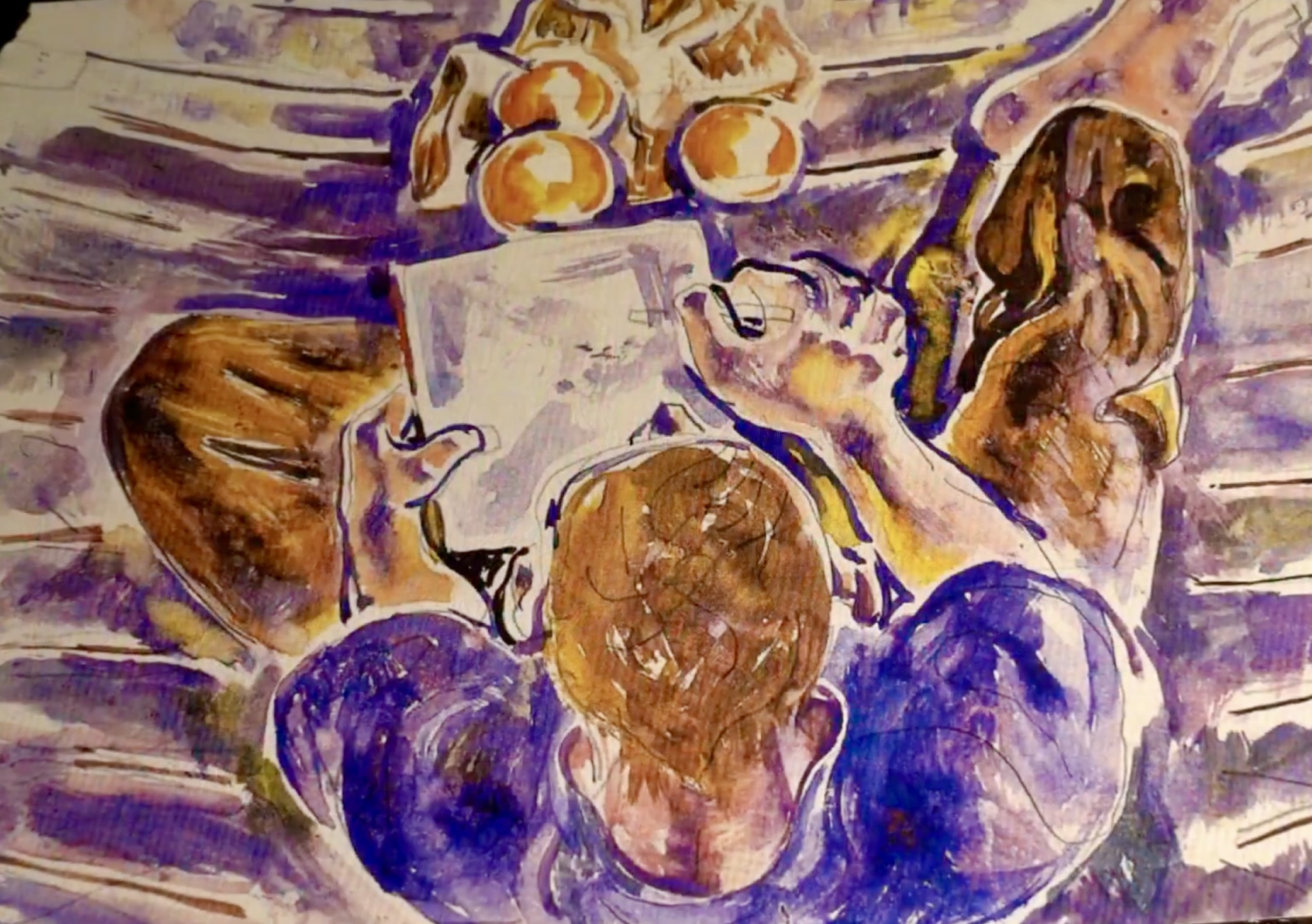
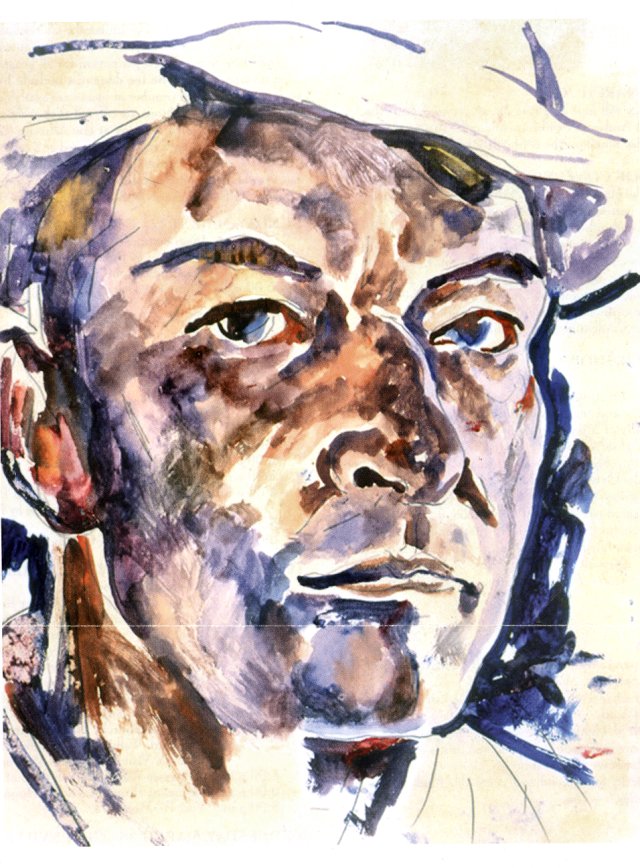
Self-Portrait by Anderson
It is actually possible to love God without ever consciously intending to do so. I believe this was the case in the adult life of Walter Anderson. It happens when we love what God dearly loves. And such true love can be expressed unconsciously, in ways that may be apparent to others while not to ourselves.
This truth connects the experience of the non-religious nature mystic with that of the religious contemplative, as both in various ways are focussed upon the Beauty inherent in Creation and within our human experience of Nature. This brings joy to the Author of Creation, who so loves the world that he has brought us into the new life that – through the Word made flesh – he now shares with us.
Emphasis has been added to the Eugene Peterson quote above. In a later post I will offer further reflection on Walter Anderson’s life and work, including his wondrous artistic creations, among which are paintings and drawings, as well as ceramics, linoleum prints and patterns for fabrics.
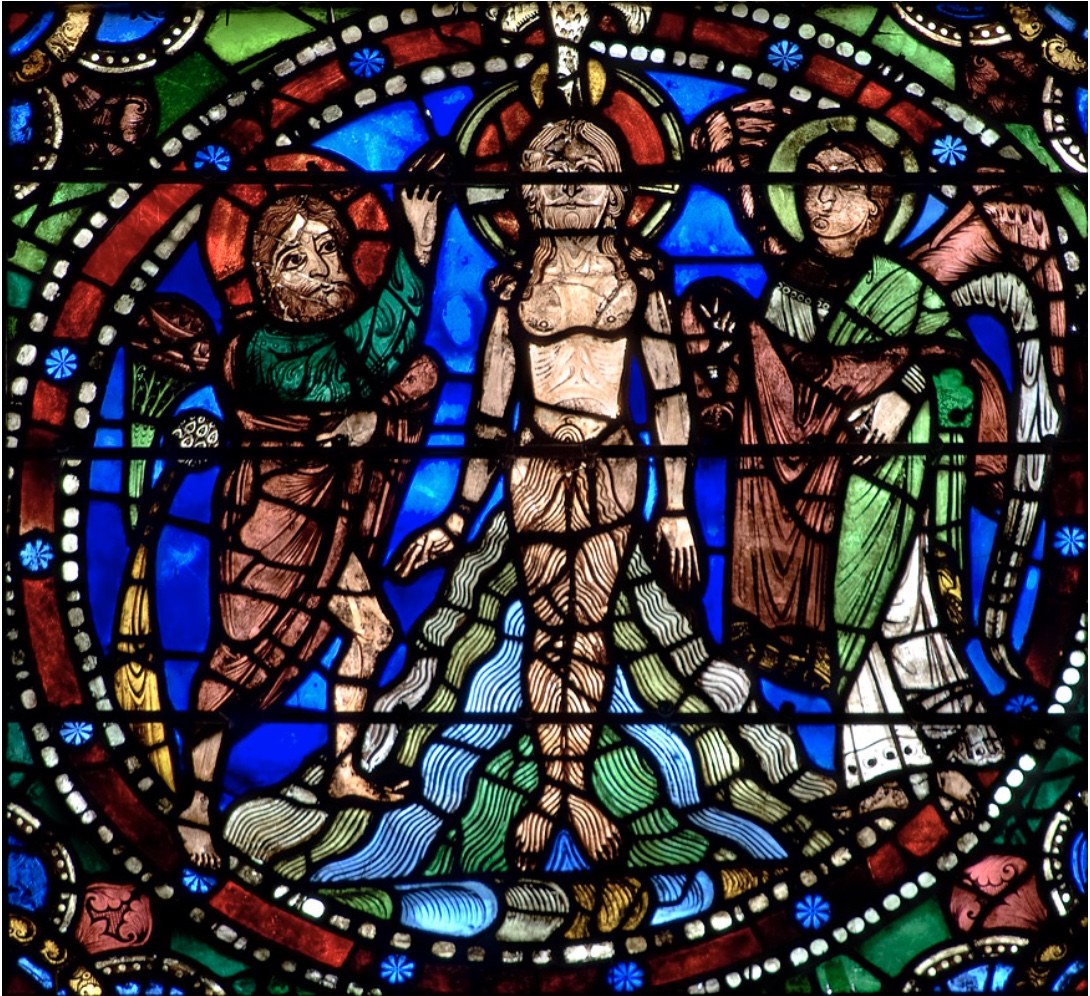
The Baptism of Christ, Chartres Cathedral, 12th century
I observe that from time to time prior homilies or sermons of mine have been downloaded by readers. I anticipate that some of those preparing to preach (or offer a reading) on an upcoming Sunday might benefit from the perspective I have taken regarding the Lectionary readings for a particular day. I therefore plan to offer when I can a prior text that I have used for the occasion. I will try to do this on Sunday evenings or Mondays believing that there might interest in these texts being made available. When I have one prepared, I will also offer an accompanying handout (in pdf format) in case these may also be helpful.
For this coming Sunday, the first Sunday after the Epiphany, the Baptism of Our Lord, I offer the following.
I have long been captivated by some words offered in our Prayer Book for the newly baptized, that they might receive the gift of joy and wonder in all of God’s works. These 12 Days of Christmas are surely the time of the year when hopes for joy and wonder are most honored by people all over the world.
While we focus on the gift of the long-promised Prince of Peace, and Wonderful Counselor, we also engage in what we might think of as a widespread indulgence in sentimentality. Our celebration of the Promised One can become overwhelmed by the secular accoutrements of ‘the season,’ with various permutations of the legacy of St Nicholas of Myra morphed into an attractive mythic figure we call Santa Claus, or Father Christmas as folks in the U.K. like to call him. His popular name in America, diminutively reduced to Santa or Saint Nick, masks the religious history of his churchly origins as a figure numbered among those on the Calendar and in the Lectionary. Elves in Santa’s fabled workshop take the place of saints and un-named believers whose works of faith are not remembered with specifics, while the lore of the mythic figure who comes to visit children’s’ homes with gifts occupies public attention.
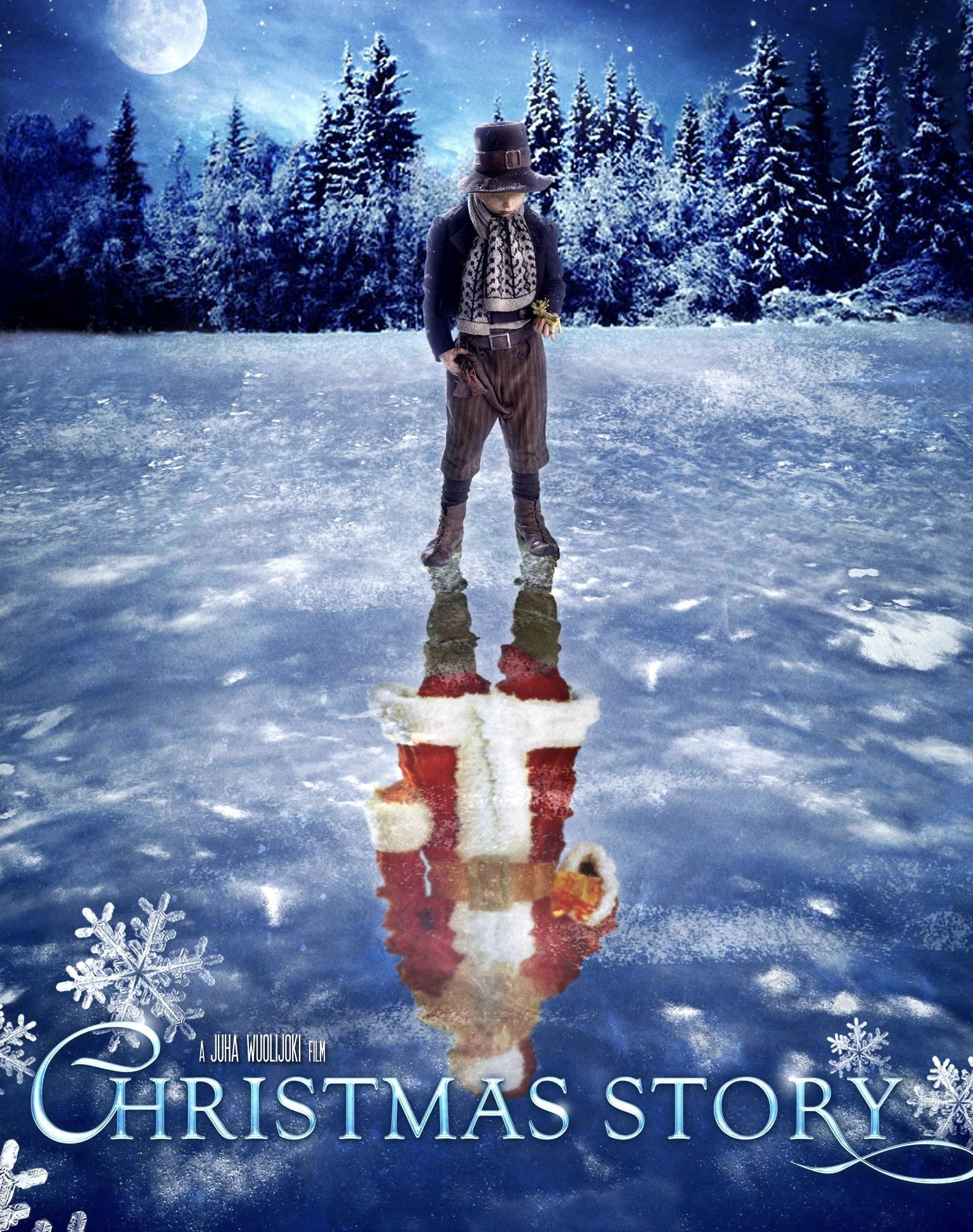
We love reminders like this of the joy to be found at Christmas
Among others who have led parish church congregations, I have done my share of encouraging observance of a traditional Advent, stressing the significance of St Nicholas’ feast day (December 6), and urging retention of Advent hymns and restraint in home and church decorations characteristic of our culture’s ways of anticipating Christmas. For me and others, the 12 Days of Christmas would be our time of celebrating our Lord’s Nativity by lighting trees, sharing gifts, and treating ourselves to special foods, right through the feast days of St Stephen, St. John, Holy Innocents, and The Holy Name, to Twelfth Night and a proper regard for the Magi’s visit on the Epiphany, January 6. Preferring such an emphasis has caused some of us to appear to be in quiet conflict with the patterns of our wider culture. For the world around us has more and more begun its anticipation of Christmas by playing ‘music of the season’ early in November, long before Thanksgiving, while also decorating homes and public spaces with Christmas-related lights, poinsettia, and objects related to our enjoyment of gift-giving and receiving. At the heart of all these outward signs of anticipation is our longing for a recovery and enjoyment of what we celebrate as ‘the most wonderful time of the year.’
My adult children like to gently rib me that I have ‘gone soft’ on Advent. And that I have slowly succumbed to the influence of ‘secular culture’ upon what I think should properly be seen as a religious holiday – as if the two emphases are in some way counterposed, and in tension. With my predilection for retaining our Anglican heritage’s rightly attributed but oft-caricatured principle of taking a “both-and” approach to many aspects of our faith and beliefs, I prefer to think that I have broadened my outlook in my search for forms of a deeper synthesis that lies within ‘reality.’ Perhaps these changes in me are due to having grandchildren who live nearby. Yet, as I remember Oliver O’Donovan encouraging us to perceive, compromise is not always ‘of the Truth,’ but can also be ‘in relation to the Truth.’
Hence, my continued fascination with joy and wonder. Joy and wonder might be two of the best words to describe what we think of, and may remember as, a child’s view of what Christmas is all about. And if there is any substance to the perception that our transition from childhood through adolescence to adulthood is often marked by our loss of genuine engagement in imagination, fantasy, and therefore with wonder, it is surely reflected in our thinking that Christmas is primarily significant for children. And therefore something that we enjoy cheerfully when we participate in social occasions where we temporarily suspend our disbelief in fantasy for the sake of the merriment we can enjoy with others.
Christmas inspires us to seek stories of places filled with wonder
All this has deeper significance. What if the world we live in is truly animated by the Holy Spirit, thoroughly infused with divine Grace and Wisdom, and permeated by a wellspring of joy that is godly? What if our culture’s pattern of anticipating and celebrating Christmas is an example of what Jesus had in mind when he encouraged his adult listeners to become like the children he embraced and held up as an example of Kingdom-participation and life?
As when he placed a child in the midst of them, and said, “Truly, … unless you turn and become like children, you will never enter the kingdom of heaven. Whoever humbles himself like this child is the greatest in the kingdom of heaven.” Has it occurred to us that he may have been speaking first about himself (He who humbled himself to become an infant and then a child)?
Childish and child-like are, of course, not necessarily the same. And by distinguishing the terms, we may begin to recover something. That we don’t necessarily need to pare down features of our cultural approach to Christmas to get our celebration back to being something Jesus might want us to enjoy. But that we could also see our patterns of Christmas celebration as involving the kinds of gatherings and events at which he would have enjoyed himself, identifying with our delight in such moments, and where he would encourage us to embody his spirit of discernment of how God is present and at work in all that is around us.
It is all about him. And he is all about us.
Note: the quoted words of Jesus, above, are from Matthew 18:2-4. Christmas Story (filmed in Finland/Lapland, and A Boy Called Christmas are movies currently streaming.
Picture the scene: About 750 years before Jesus, at the Lord’s bidding the prophet Isaiah goes out to the south side of Jerusalem near the aquaduct. He has been asked to do a difficult thing, to meet the fearful and apprehensive Ahaz, king of Judah. This happens at the moment when God’s people are threatened by Tiglath-pileser, king of the Assyrians. Making a bad situation worse, the Assyrians have been joined by armed forces from the separated northern kingdom of Israel, who have already been brought under subjection by the threatening foreign power. Ahaz does not respond as God would like. When he demurs from asking God for a sign of assurance, Isaiah confronts him with the Lord’s Word:
“… Listen to this, government of David! It’s bad enough that you make people tired with your pious, timid hypocrisies, but now you’re making God tired. So the Master is going to give you a sign anyway. Watch for this: A girl who is presently a virgin will get pregnant. She’ll bear a son and name him Immanuel (God-With-Us). By the time the child is twelve years old, able to make moral decisions, the threat of war will be over. Relax, those two kings that have you so worried will be out of the picture. But also be warned: God will bring on you and your people and your government a judgment worse than anything since the time the kingdom split, when Ephraim (northern Israel) left Judah. The king of Assyria is coming!”
What a strange promise! How could the promised birth of a child be a gift for a troubled world?
This is the kind of promise that Mary later received through the Angel Gabriel. We all receive a similar promise when we are called to acknowledge and accept that same Gift-Child that Mary received.
During Advent this year we have reflected on how there can be several aspects of our response to God’s call, and to the promises latent within God’s Gift to us. Fear is often our first reaction, followed then by wonder and uncertainty about the fit between God’s promise and our own suitability for receiving it. By attentiveness to God’s Grace, our uncertainty can be transformed into a humility ~ a humility that is willing to accept the Word of Promise and the Call to receive it. And if we come that far, if we are willing to believe and remain attentive, we may experience a wonderful moment. We find it in a fourth aspect of Mary’s response to God’s Word of Call. It is quite simply, Joy! There is no other word for it. Both Mary and Joseph, each in their own way, accept God’s unlikely and unexpected Word of promise. By accepting and receiving God’s will for what it is, they find a beautiful joy.
Over the course of Advent, I shared with you three images portraying aspects of the Angel Gabriel’s Annunciation to Mary of the promised gift of a child ~ a child who would be God with us. In the image above, El Greco beautifully captures the sublime quality of the moment. Having accepted God’s Word in humility, Mary’s eyes and her whole being are uplifted to receive the message. Her up-turned hand says it all! The gilded and hovering angel points upward, in the direction where all this is supposed to go, into the realm of Spirit. This is where the Lord will ascend through his Resurrection, taking us and our humanity with him into the very being of God.
Joy may not be the defining feature of our lives today. Yet, we can find the fullness of joy in the beautiful Gift we celebrate this week. For we receive a gift whose meaning and value we can never fully anticipate in advance.
To this gift, Mary says “Yes!” And, with her, we can say, “yes,” as well. Yes to God’s Word that comes to us as both promise and call – a promise that he will be with us always, as we accept him for who He really is. And, a call for us to become new persons in him. For in him we find a spiritual maturity that this world can never give.
In raising our hearts in assent to God’s promises, and by receiving God’s call to be transformed by the Spirit, we grow. We grow into that quiet joy which was Mary’s, instilled by the Angel’s visit. Behold – a virgin has conceived, and has borne a Son, and we call his name Immanuel – for God is with us!
Perhaps people living at the time of our Lord’s first coming were in some important ways like us. They may have been just as prone to orienting their security and sense of wellbeing around material concerns, while being generally indifferent to the spiritual life. Yet, in this season of Advent when many sing “O come, O come Emmanuel,” it is easy to imagine the people of Roman-occupied Palestine crying out with longing for the God of Israel to draw near in power. Even so, God chose an out of the way place in which to appear among us, incarnate in human form. Paradoxically, for this and other reasons, the arrival of the Holy One was largely overlooked. At least until his person and message provoked enough reactivity to cause the authorities to have to deal with him. Otherwise, the periodic waves of public attention that he received were most often inspired by the miraculous works of mercy attributed to him. While he encountered significant examples of deference to the revealed Law among his contemporaries, lived-adherence to God’s hope-shaping promises appeared to be rare.
This is why the Lectionary features a particular aspect of the Christian Gospel story at this time of the year. It does this by presenting some notable counter-examples to what may have been – in the first century – a widespread indifference to or loss of confidence in God’s promises. We learn about Zechariah, the father of the ‘forerunner,’ John the Baptizer, and about Elizabeth, John’s mother, who was a cousin of Mary and another woman that would bear a promised child. These three stand out for having been open in heart and mind to the heavenly glory that God was about to reveal in the midst of the lives of his wayward children.
In particular we remember the spirit of attentiveness that we find displayed in a third aspect of Mary’s response to God’s call through the Angel Gabriel. God’s call often challenges us to live in a different way; or to try and be a different person, especially in our relationships with our family, our friends, and those with whom we work. Receiving this call, we can react at first in fear at what this call will mean in practice. We can also respond with uncertainty, wondering about our worthiness or suitability for what God may have in mind for us. We have reflected on these themes in the last two web posts on this site.
But we can also see that —in faith— we are able to go into the heart of our fear, and find God’s power. Receiving God’s grace, we may move beyond relying on our own strength, and resist depending upon our estimate of our own abilities and worthiness for what God may have in mind. And we can choose to respond to God’s gracious invitation to participate in the Spirit’s redeeming work, just as Mary did, by saying, “Yes!” As John Lennon so simply captured the spirit of it, in the words of his famous song, “Let it be!” As Mary said to God through the Angel, “Behold the handmaid of the Lord; let it be unto me according to thy Word.”
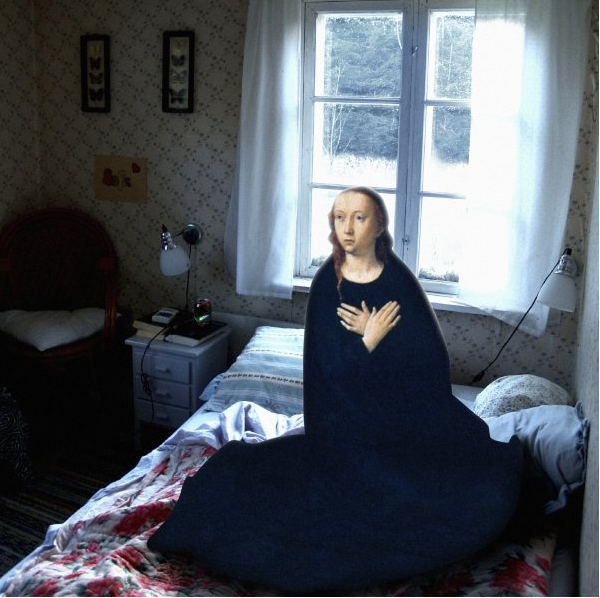
This is the spirit of Mary’s response to the message of the angel as portrayed in the third image I am sharing with you this Advent ~ Trygve Skogrand’s photo-collage, pictured above. The artist has skillfully placed a traditional painted figure onto a contemporary scene, juxtaposing an image of something old within a contemporary setting. We see a simplicity and spirit of humility in Mary’s posture, as she kneels in her plain gown. In the plain ‘bed-sit’ room in which she prays, we notice her uplifted eyes. They are now focused on the divine source of the message she is receiving.
Attentiveness is key to meaningful perception, just as we find in the Gospel reading for the third Sunday in Advent. John the Baptizer sends his disciples to Jesus with what should be our most persistent question ~ “Are you the One?” ‘Are you the One for whom we are looking, and whom we are awaiting?’ Notice Jesus’ response: “Go and tell John what you hear and see…” For they only hear and see if they are attentive. This is one reason why the Church sets aside this season of Advent ~ to encourage our attentiveness, so that we can hear and see, and then accept God’s Word to and for us.
“Let it be as God would have it.” Let things be as God wills. Let God be God! Perhaps nothing will be so hard in our lives, as to say those words in faith and in humility. Our pride objects. Our desire to be at the center of reality intrudes. But to say, “Let it be…,” in faith and in humility, is to return to the grace of the Garden of Creation. And it is also to begin to live forward into the fullness of the Kingdom, manifest in the New Jerusalem, as God will have things be.
We may remember some pivotal moments from within the sweep of the Old Testament: God’s call to Moses from within the burning bush; God’s call to Isaiah in the Temple; and God’s later call to Jeremiah. In each of these encounters, a divine invitation accompanied by a word of hope comes to those whom God calls to be prophets. When this happens, they react in a similar way. Each of them responds with fear, just like the reaction we saw last week in Simone Martini’s Annunciation painting of Mary’s encounter with the Angel Gabriel. In these call passages, we also hear about Moses, Isaiah, and Jeremiah responding in a related way: each of them is overwhelmed by a sense of unworthiness at being called to serve the Lord. For in our hearts and our minds, we as God’s people do not always hear or receive what the Lord intends to be a word of hope as a hopeful message. And when challenged to participate in God’s ongoing mission, we fear our inadequacy in being able to respond positively.
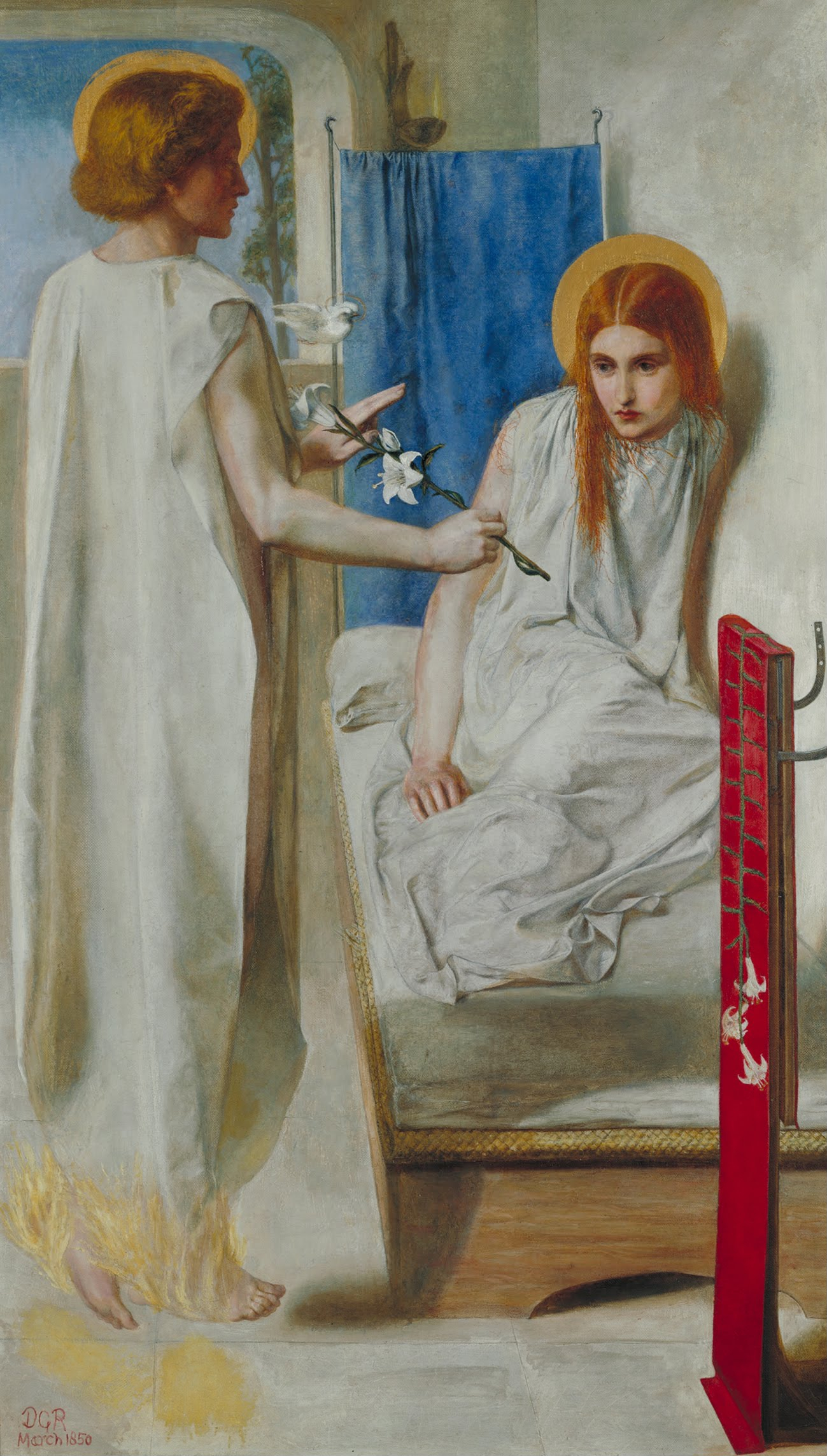
During this season of Advent I am once again reflecting on four Annunciation paintings. Here, I invite you to consider Dante Gabriel Rossetti’s depiction of the angel’s visitation to Mary, calling her to be a servant in God’s ongoing work of redemption. Observe how Rossetti portrays Mary’s response to the angel, and its contrast with Simone Martini’s painting (included below). In Martini’s Annunciation, we see an image portraying fear – Mary clutching the top of her cloak turning away from the angel and yet not able to take her eyes off the divine messenger. In Rossetti’s Annunciation (above), we see Mary looking in a different direction. Her gaze is off into the middle distance, and we can tell that she is not looking at anything in particular, ‘out there.’ Instead, she is looking within.
Here, we can make a common mistake, based on the self-absorption that is so much a part of the fallen humanity we share. For the angel’s announcement amounted to something even more dismaying than the news that Mary would bear a son as a result of this visitation rather than through the circumstances of a conventional marriage. That alone would cause confused wonder about how much this unexpected development would alter her life. But what we usually overlook is how she was being invited to become a feature in someone else’s story! As things emerged, the challenge of this momentary encounter did not so much concern how the coming of this child might alter her life, in part by diminishing her reputation. But rather, the real challenge came later as something else became clear. The coming of this child became the story for even more astonishing reasons. Mary then had to reckon with how her life and its circumstances would be significant for this child and the message of his story.
As the Annunciation helps us to perceive, when encountering the holiness, righteousness, and purity of God, we may experience not only fear about change that might lie ahead. Very likely we will also feel a sense of our own unworthiness. Perceiving the glory of God, we will become more aware of what within us falls short of God’s glory. When the Spirit invites us to experience a process of transformation back toward God’s own likeness, we are called to face and then set aside all that stands in the way of this positive change. In the Gospels we learn how God’s Word came through John the Baptizer’s ministry as a call to repent. We hear the same call to turn toward renewal in our own day. And – in the process – we learn how Mary and then the Baptizer responded. The story is not about us. It is about the Coming One.
Notice what Rossetti depicts in the angel’s hand. When inviting Mary to bear the Word of God for the sake of the world, the angel holds lilies. Lilies are a sign of the resurrection. We also see the prominent red sash that Mary may have been stitching. It bears an image of the same lilies, along with a vine that may recall the ‘Tree of Jesse’ motif (inspired by Isaiah 11). But here they are set against a red background – a sign of the passion that lies ahead. This suggests the path of suffering which the ‘Son of Man’ must walk so that we might experience the restoration and transformation of our fallen nature into his greater likeness.
Advent can be a providential season for reflecting on how the Holy Spirit invites us to go to a new place for the sake of God’s Kingdom. There is no question that this can happen at least spiritually, whether we hear the call or not. The real question, when it does happen, is how we will respond to God’s holy invitation.
This is the season when we focus especially on how God’s Kingdom enters the world in a new way. We look back to the earthly kingdom of Israel, and her difficulty fulfilling her spiritual vocation. We also look back to the promised first coming of the Messiah, who was to bring God’s Kingdom into the world with power. During Advent, we also look forward, to the Messiah’s coming again in glory. But here is a crucial fact about the first coming of the Messiah: Without Mary’s acceptance of God’s overture, there would have been no Jesus of Nazareth. In order for God’s great “YES” to us in Jesus to become manifest, Mary had to say “yes” to God.
As Luke tells the story, God’s call to Mary embodies God’s holiness and righteousness. In like manner, our encounter with God’s presence and holy invitation causes everything in us that is less than godly to undergo judgment. The bright light of God’s glory illumines all the dark corners of the world ~ and all the dark corners in our lives. The purity of God shows up all that is less than pure.
Our reaction to all this may involve at least one thing: fear! God’s call comes to us as Good News. And yet, we experience God’s call for us to become new persons, and do new things, as a fearful invitation. For me, it has involved a call to consider moving away from one beloved church and congregation to what I could only hope would be another. For both you and for me, it may be a call to go and speak to someone with whom we have a disagreement, or to reconcile with someone whom we have failed to forgive. When God calls us to new life, by inviting us to do something challenging, our first reaction is often fear. We think of all the things we are afraid might happen: like losing the security of a familiar home and community; or setting aside our own pride and sense of right; and opening ourselves in vulnerability to being hurt by another person.
In the above detail of Simone Martini’s Annunciation, we see what may have been Mary’s first response to the presence of the holy angel. Gabriel comes to her sharing God’s good news about a child she will bear, who will bring salvation for the world. And in Martini’s image of the event, Mary draws back in fear at the message, frightened about what it might mean for her and her life. We all know the end of the story, how it all turned out for good. But in that moment, as may happen for us, God’s call surely had a frightening aspect to it. Because a change to something always means a change from something else, from where we started.
Martini’s painting reminds me of spiritual advice I received years ago ~ spiritual advice that gave me the courage to leave a tenured faculty position at one of our seminaries and return to parish ministry. The prospect of this change, for which I had a sense of call, was frightening. And the good advice I received was this: When you go toward the heart of your fear in faith, God will meet you there with power.
We know that this is what Mary did. For she moved beyond her reaction to the seeming strangeness of the angel’s greeting, not knowing what it would mean for her. She then opened herself to embrace the angel’s message and all that it would entail for her ~ and for the world.
It was my CREDO Institute team leader and colleague, (The Rev. Dr.) Bob Hansel, who offered the wonderful spiritual advice that I share above. I continue to benefit from it. The image at the top is a detail of Simone Martini’s painting, The Annunciation (a painting I have shared before). This post is adapted from one that first appeared here in 2019, and is based on my homily for the first Sunday of Advent, December 1, 2019, which can be accessed by clicking here.











 Toward Beauty