Creation and Redemption

Reminders of Divine Beauty in The Book of Common Prayer

Anglican artists, writers, and musicians, have found deep spiritual significance in our encouter with beauty in the natural world, and they have left us with abundant examples of beauty in the places and things of worship. Our liturgies have been shaped by faithful people who, echoing the Psalmist, have sought to glorify “the fair beauty of the Lord.” It is therefore somewhat surprising to notice the relative paucity of references to beauty in The Book of Common Prayer, though the concept is interwoven in its many texts. In subtle and in sometimes hidden ways, beauty nevertheless functions as a significant concept in our prayers.

For Anglicans, The Book of Common Prayer [hereafter as BCP] functions as a resource for our prayers. And, in time and through practice, it becomes the source of our prayers, especially in the way that it is founded upon, and leads back into the Holy Scriptures. We are open to individually-crafted voluntary prayers offered for specific occasions. Yet, in our experience, these ‘unscripted’ prayers characteristically also become formulaic and repetitive in content as well as in phrasing, just our BCP prayers are sometimes said to be. As Anglicans, we find that – like practices handed down over generations – prayers shaped by communities also become ‘hallowed by time.’

Further, we hold in common a premise upon which Anglican Christians have typically relied. We often find our basic doctrine expressed in our prayers, though we do not usually look to our prayers to find nor to establish our doctrine. For it would be contrary to the spirit of this approach if we were to conclude that, by simply changing our prayers, we would then change our doctrine. Therefore, in the same spirit, the phrases that I cite here from the BCP are authoritative because they are true, rather than true as a result of coming from what we consider to be an authoritative source.

From the BCP, we are reminded about many things concerning Beauty, among them that:

⁃ Beauty is an attribute of God
⁃ God’s beauty is manifest in God’s handiwork in Creation, and therefore {by implication} manifest also in us, and between us
⁃ Creation is permeated with God’s beauty and grace, which is a reflection of God’s goodness as well as of divine truth, God’s own nature and a characteristic attribute of God’s creative activity
⁃ When we behold the beauty with which God has imbued Creation, we rejoice and experience joy as we encounter the presence of God’s love for the world and for us
⁃ Having this encounter, we perceive how God has given us work to do in truth and beauty and for the common good

Goodness, Beauty, and Truth, are attributes of God’s being and nature. How do we know this? We see the reflection, even the manifestation, of these transcendentals in the things that are created and here for us to behold and encounter. When we encounter these transcendentals in the things that are made, we encounter these attributes of God, not merely the residue of God’s action. And in so doing, we experience peaceful joy. This joy in us is our experience of God’s love for God’s work, the fruit of God’s creativity.

We often experience a disconnect between ourselves and our work, between who we are and how we act. With God, there is no such disconnect. God’s being and activity are indivisible, even if we distinguish them in our reflection. For at least in traditional Christian doctrine, God is all good, all knowing, and all powerful, dwelling outside of time, but acts and is fully present within it.

In our reflection therefore, God’s work of Creation and God’s work of Redemption may and should be distinguished but not confused nor separated. The principal reason for this is our recognition of the fallen state of Creation and of our human nature within it, to which God’s loving work of Redemption has been addressed.

As I previously reflected, in both Creation and in Redemption, God has formed and shaped the world and its inhabitants so that the world through God’s Creation is good and beautiful, and also a repository for what is true. Through Redemption, God embraces and transforms fallen Creation in such a way so that all that is amenable to fulfillment and completion in Christ may come to be so, and those things that are not amenable to the same have no future in Christ. Along with Truth and Goodness, Beauty plays a principal role in this ongoing process.

A Collect from The Book of Common Prayer

As a portion of Psalm 90 can be translated, “Let the beauty of the Lord our God be upon us, and prosper us for the work of our hands!” And in Psalm 96, we find: “Sing to the Lord a new song; sing to the Lord, all the earth… Honor and majesty are before him; strength and beauty are in his sanctuary.” And so, by divine grace, may these attributes of God and of the Risen Lord be present in our midst, and within us.


For reference, and as background material for the above, I include here some specific sources in the BCP for what I have shared:

In the BCP section, Prayers and Thanksgivings [BCP:814], Prayers for the World, from the Collect, For Joy in God’s Creation [BCP:814], we are reminded that:
⁃ Our Heavenly Father has filled the world with beauty
⁃ We ask God to open our eyes so that we can then behold God’s gracious in all of God’s works
⁃ So that, by rejoicing in God’s whole creation, we may learn to serve God with gladness, for Jesus’ sake, through whom all things were made
⁃ In other words, we find this implied sequence of ideas: —> God has filled the world with beauty -> God opens our eyes -> we behold God’s gracious hand in God’s works -> thereby we rejoice in God’s whole creation -> in the process, we learn to serve God with gladness

From the Collect for “The Transfiguration” [BCP:243], we are reminded that
⁃ We ask God to grant that we might be delivered from the disquietude of this world, so that we may by faith hold the King in his beauty, who with the Father and the Holy Spirit lives and reigns, one God, world without end

From the Collects for “Various Occasions,” the Collect for Vocation in Daily Work” [BCP:251], we are reminded that
⁃ Almighty God, our Heavenly Father, declares his glory and shows forth his handiwork in the heavens and in earth
⁃ We ask God to deliver us in our various occupations from serving ourselves alone, so that we may do the work God has given us to do in truth and beauty and for the common good

From the liturgy for “The Dedication and Consecration of a Church” [BCP:567ff], we are reminded that
⁃ We give God thanks for the gifts of God’s people, and for the work of many hands, which have beautified places and furnished them for the celebration of God’s holy mysteries
⁃ We ask God to accept and bless all that we have done, and to grant that in these earthly things we may behold the order and beauty of things heavenly
⁃ Through Jesus Christ our Lord

From the “A Litany of Thanksgiving for a Church” [BCP:578, from within the above liturgy], we are reminded that
⁃ we thank God whom we worship [here] in the beauty of holiness

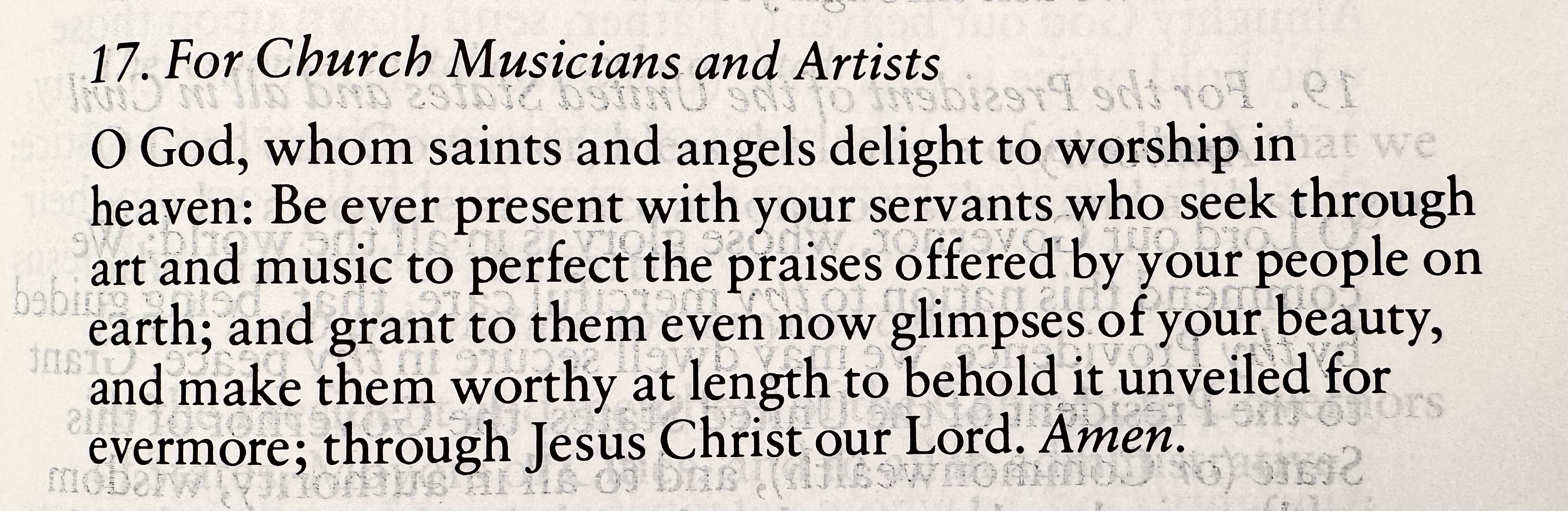
In the BCP section, Prayers and Thanksgivings [BCP:814], Prayers for the Church, from the Collect, “For Church Musicians and Artists,” we are reminded that
⁃ Saints and angels delight to worship God in heaven
⁃ We ask God to be ever present with his servants who seek through art and music to perfect the praises offered by God’s people on earth
⁃ And, to grant to them even now glimpses of God’s beauty and make them worthy at length to behold it unveiled for evermore
⁃ Through Jesus Christ our Lord
⁃ {and thus that God’s beauty is unveiled to those faithful who have gone before us to the other side}

In the BCP section, Thanksgivings [BCP:836ff], by “A General Thanksgiving” [BCP:836], we are reminded that
⁃ we thank God for the splendor of the whole creation, and for the beauty of this world
⁃ {and} for the wonder of life, and
⁃ for the mystery of love

In the same section, by “A Litany of Thanksgiving,” we are reminded that
⁃ we “give thanks to God our Father for all his gifts so freely bestowed upon us”
⁃ {and} for the beauty and wonder of God’s creation, in earth and sky and sea

Among the “Thanksgivings for National Life” [BCP:838ff, by the Thanksgiving “For the Nation,” we are reminded that
⁃ we thank almighty God for the natural majesty and beauty of this land, which restore us though we often destroy them

From among the “Thanksgivings for the Natural Order” [BCP:840ff], by the Thanksgiving “For the Beauty of the Earth,” we are reminded that
⁃ We give our most gracious God thanks for the beauty of earth and sky and sea; for the richness of mountains, plains, and rivers; for the songs of birds and the loveliness of flowers
⁃ That we praise God for these good gifts, and pray that we may safeguard them for our posterity
⁃ we ask God to grate that we may continue to grow in our grateful enjoyment of God’s abundant creation, to the honor and glory of God’s name

Note: I have retained and employed the pronouns and grammatical style employed by the 1979 Book of Common Prayer, which continues to be our primary and most widely shared reference point for theological expression and beliefs. Our beliefs are founded upon Scripture, which always provides the standard for a community that believes that prayer both reflects and shapes belief. And the Scripture that we “read, mark, learn, and inwardly digest” is the Scripture that has been received and confirmed by the believing community of the wider Church through the centuries. Different Christian communities of course prefer differing translations of the Bible. Here, for Anglicans, Scripture is authoritative as we are guided by an ancient maxim attributed to St. Vincent of Lérin: What has always been believed by everyone, everywhere. Very little, it may seem, wholly fulfills the requirements of this maxim. Yet, what comes closest to fulfilling it is therefore most authoritative for us.

Being True, Being Good, and Being Beautiful

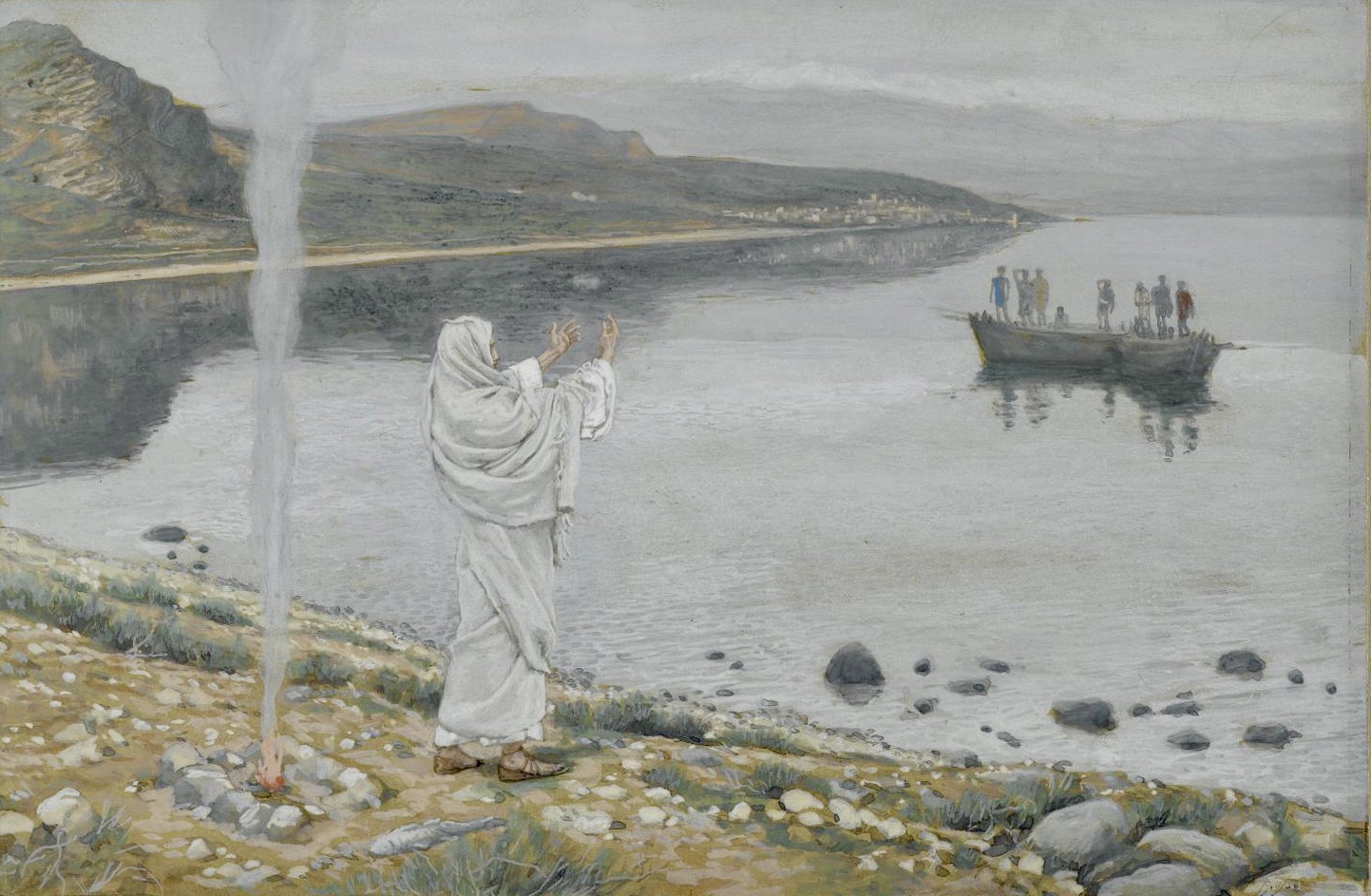
James Tissot, Christ Appears on the Shore of Lake Tiberius

“To thine own self be true.” This familiar adage is now known to many people through their experience with 12-Step Recovery programs. Yet the phrase is traced back to its appearance in a play by Shakespeare, and hearkens back to a simple statement attributed to Plato from the pre-Christian Classical period, “Know thyself.” One way to understand being true to ourselves involves living toward spiritual wellness and in an ethical manner. If these pursuits are of value to us, we may be open to receiving counsel about how we can be truthful, and good in our conduct, even if we are not comfortable with the degree of our adherence to these ideals. But to be beautiful?

Here, modern translations of the New Testament may provide a benefit to our thinking about questions like these. In our contemporary sensitivity to employing gender-neutral and inclusive language, sayings from the lips of Jesus or in the Letters of Paul are often cast in plural language. The potential benefit to us may lie in the encouragement we can receive to think in corporate or in community-minded terms.

We often need to remind ourselves to think about our lives with a wider frame of reference, for we are so much more than individuals with only chosen or willed connections and relationships with others. We will be truer to the message of Jesus and the teaching of the New Testament when we are equally attentive to our membership in the Body of Christ, the Church, within the Communion of Saints. Our baptismal identity is shaped fundamentally not by what we do, but by our grace-enabled incorporation within the community of the Risen Lord.

In other words, we can learn to receive and follow gladly the advice that we be true to ourselves when we do so as members of the Body of Christ. We can then see ourselves in more expansive terms than those based merely upon our physical birth identity as unique individuals, our social status, or upon our achievements.

One way to understand Jesus’ use of the mysterious phrase, the Son of Man, is to see this title in terms of the transformed personhood we apprehend in the Risen Lord. As such, he embodies for us the ‘true’ and fully redeemed human person and therefore the full goodness of human being. If so, the Risen Christ also embodies for us the fully realized beauty of both created and also redeemed human personhood. In him we find our new baptismal identity in communion fellowship with one another, which is the distinctive characteristic of participation in the Risen Body of Christ. We are, in Christ, people living together into the beauty of his Resurrection.

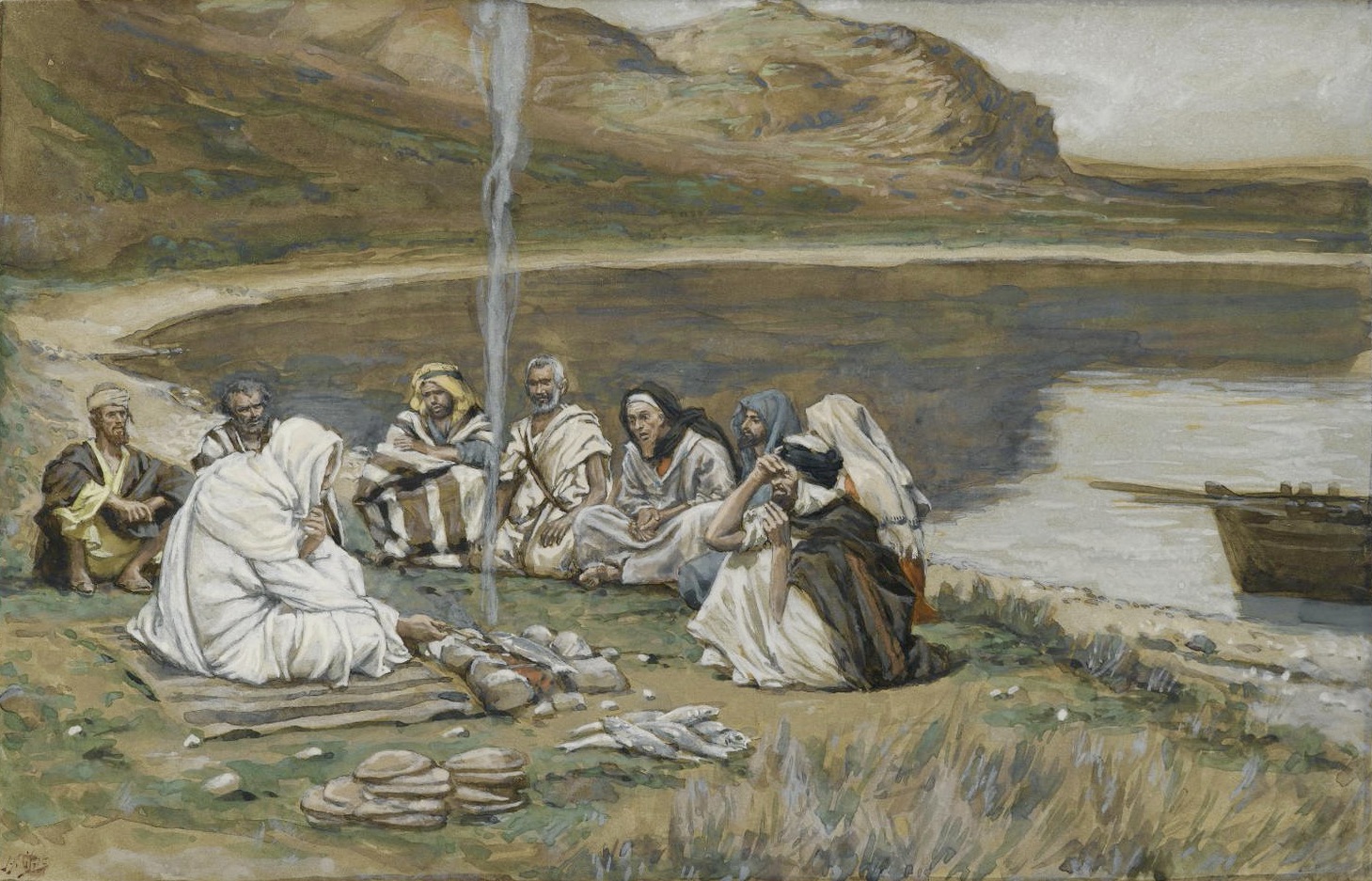
James Tissot, Meal of Our Lord and the Apostles

Here is the challenge that arises with disciplining ourselves to think in these corporate and communal terms. In the culture in which we live and raise our children and grandchildren, beauty for us is most commonly thought of in visible, physiological terms. Perhaps encouraged by the advertising and media to which we are contstantly subjected, we pursue pharmaceutical products, health and exercise regimens, and even plastic surgery. We do so in search of achieving outward beauty of a kind communicated to us by others as a goal we need to seek.

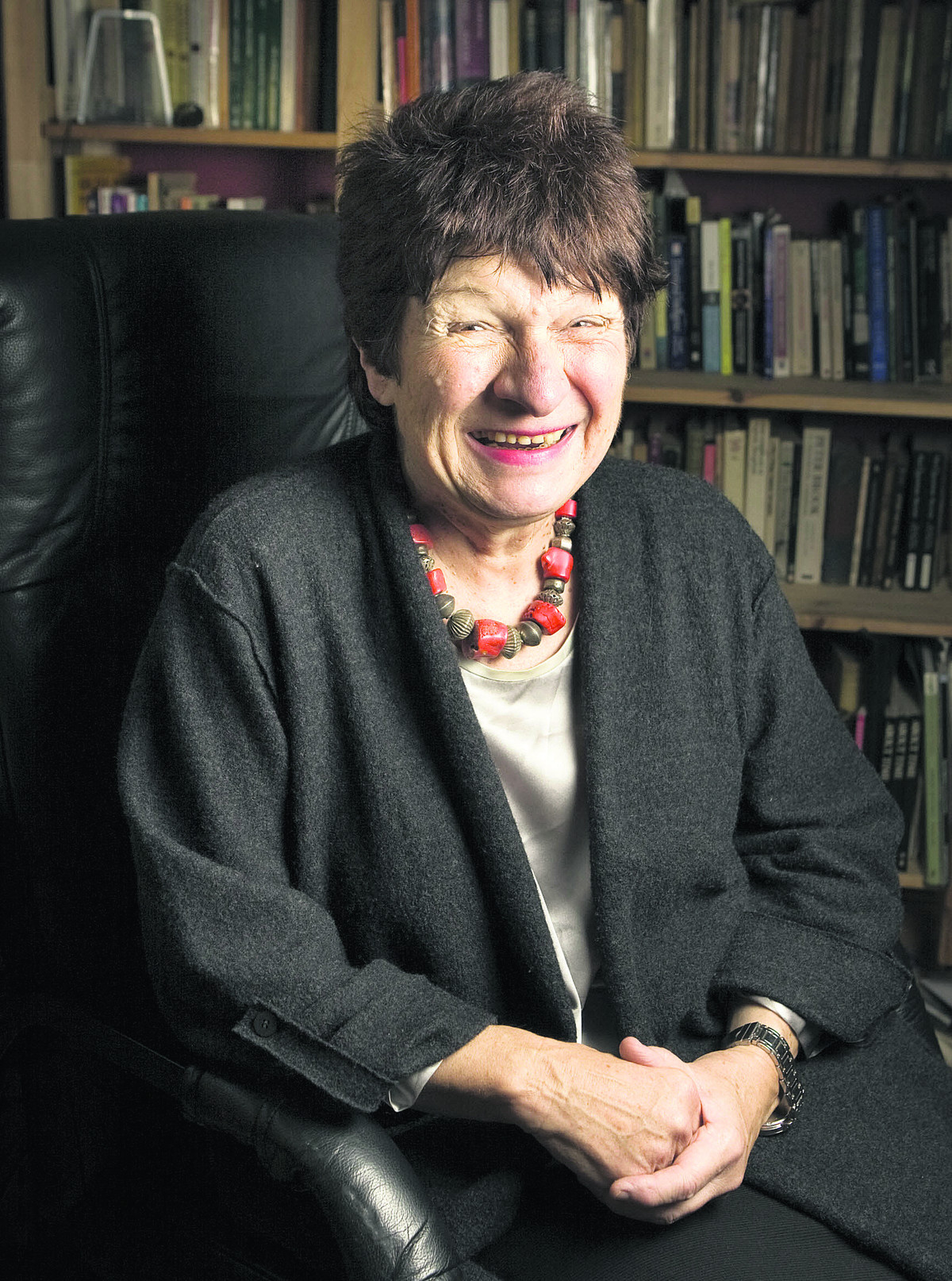
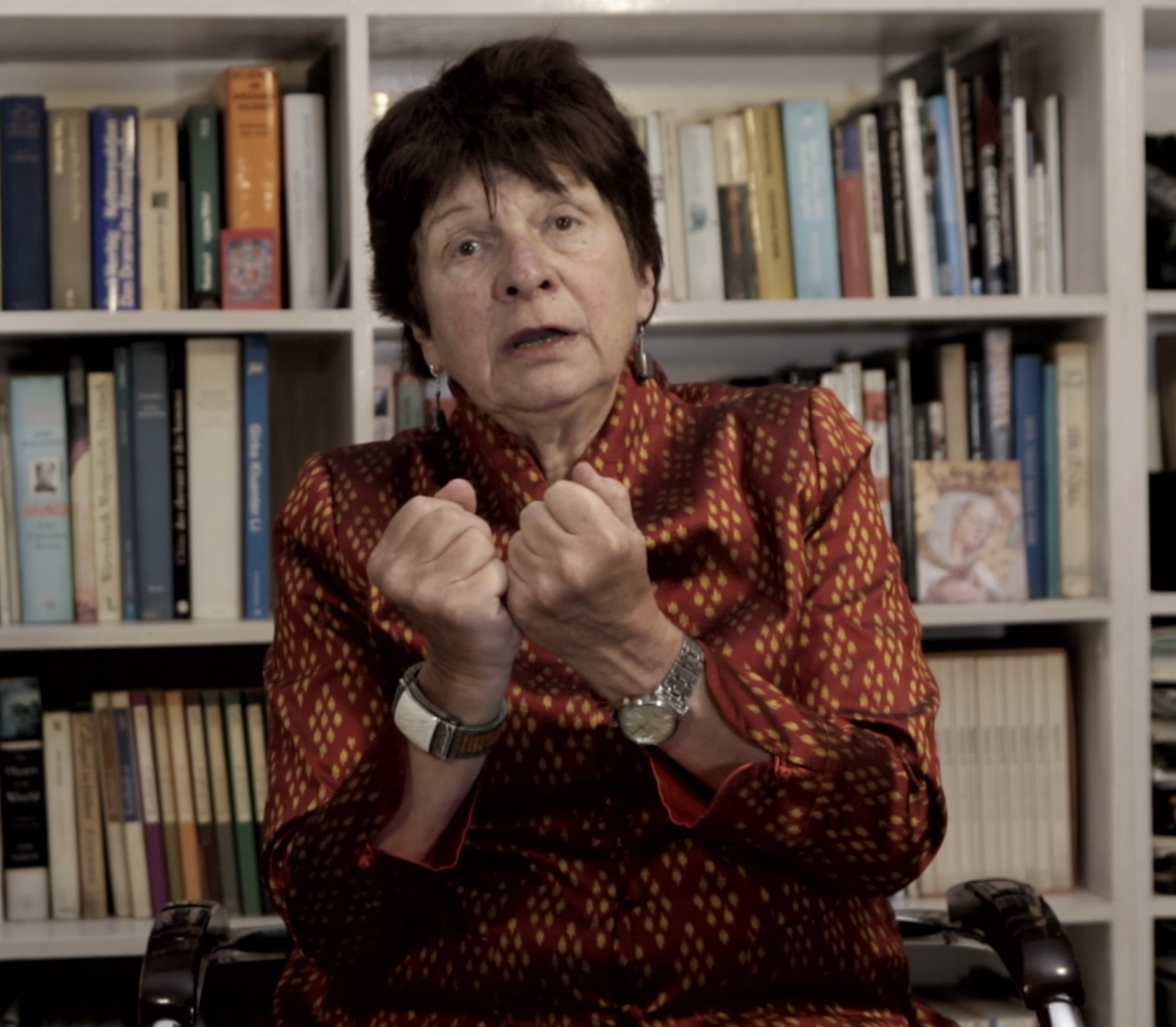
We then lose sight of inward beauty, the beauty we can attain as persons who mature, become wiser, and more generous in our viewpoints. I have previously written about Sister Wendy Beckett, who I have described as one of the most beautiful persons I have come to know through my reading and media viewing. Outwardly, it must be admitted, Sister Wendy was not the kind of person whose countenance would be featured on magazine covers as an exemplar of physical beauty. Our view of what it means to be fully human is diminished if we do not also see how she, over her long years of life as a solitary devoted to prayer, became one whose face and physical presence radiated the beauty of the Risen Lord.

In this Eastertide, we hear stories from the Gospels that are echoed in passages from Acts of the appearances of the Risen Jesus, returning to his first followers. He came into their presence, encouraging and strengthening them for mission as witnesses to his realization of God’s hopes and plans for all people, for we all are God’s beloved. By grace, we are among those who have been embraced by this mission, as are those who have yet to hear and receive the hope of the Gospel. Too quickly, we assume that in the lives of hearers and readers of these stories the appropriate fruit of these appearances will be manifest primarily in truthful speaking and admirable conduct. As a result, we neglect to imagine how these stories also encourage us to embody the Beauty of the Risen Lord.

“He is Risen! The Lord is Risen, indeed!” These are wonderful phrases for us to repeat, and take to heart in this season of the Great Fifty Days. We can find in these words their intended corollary: For us who are baptised, ‘we are risen’! We are risen, indeed, and called to live into the Way, the Truth, and the beautiful Life into which the Risen Lord has invited all people. And he has made this possible for all who might be open to receiving this wonder-filled message.

Beauty Springeth Out of Nought

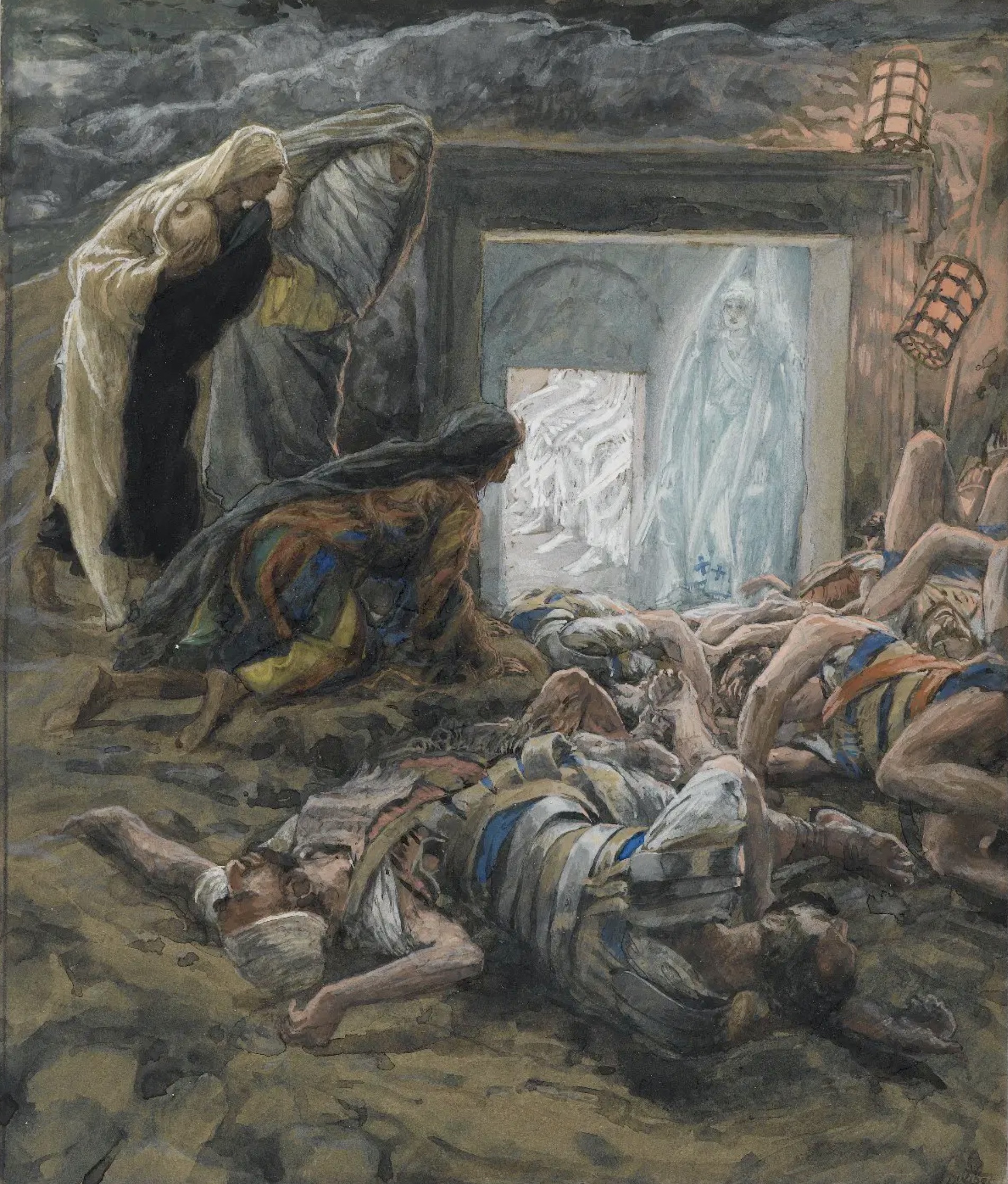
James Tissot, Mary Magdalen and the Holy Women at the Tomb

What an indescribable series of moments those were with the discovery of the empty tomb, first by the women, and then by some of the disciples. What made those moments so unexpected was the sense of emptiness that pervaded the scene after Jesus’ death on Golgotha. A few had stayed until the last. Most left, surely overwhelmed by a feeling of loss and of dark absence. He was gone. And then, so were they. Furtively moving off toward a place of hiding.

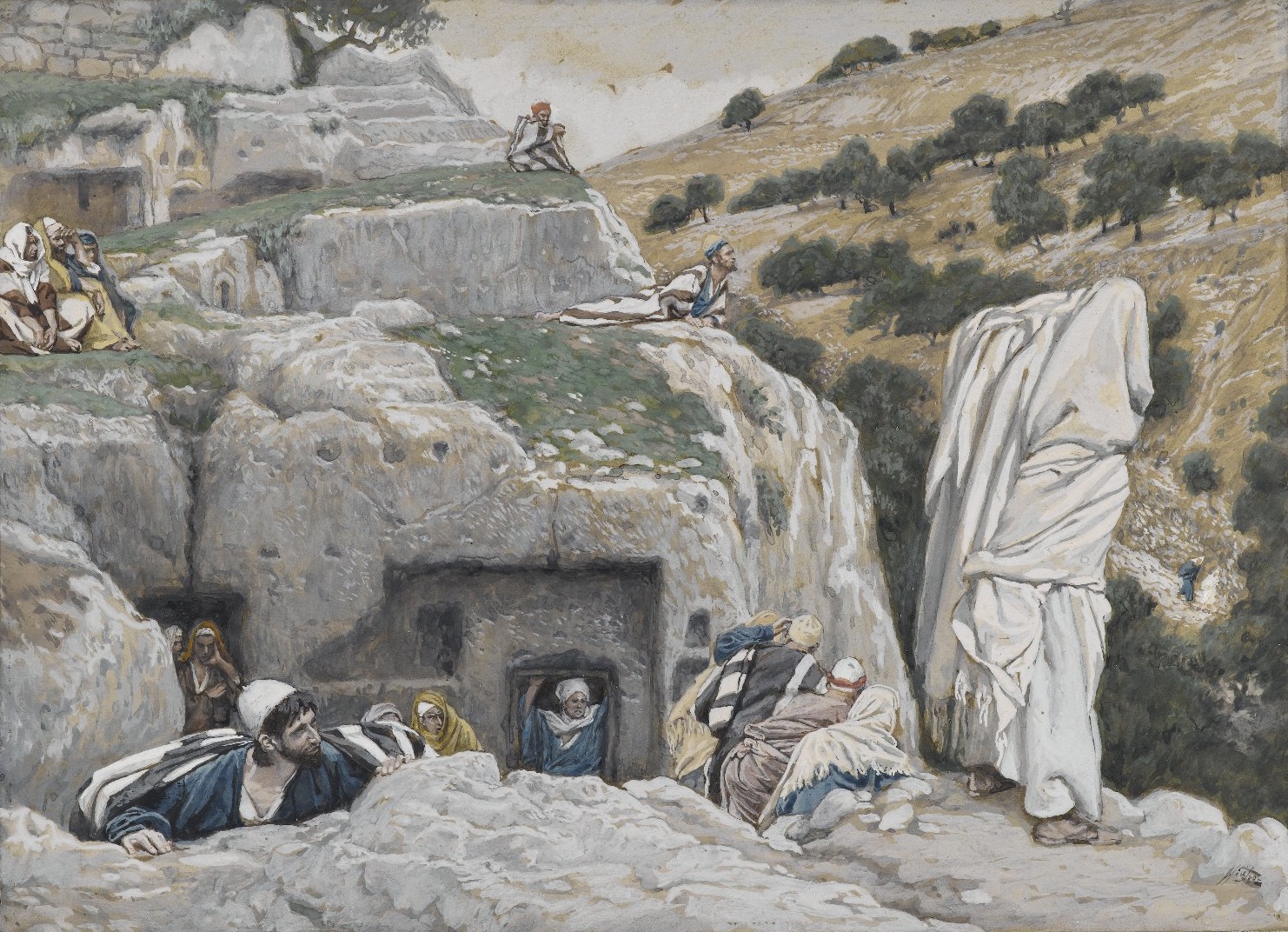
James Tissot, The Apostles’ Hiding Place

Then… from nothing came something. On the morning after the sabbath, surprised joy broke through fear and sadness as He who seemed no longer to be appeared amidst them. Among many promises, God had once said, “Behold, I make all things new.” This promise was now fulfilled, but not in a way that his people were expectating. Listless because of doubt, immobile due to their fears, their place of retreat strangely mirrored their Lord’s entombment.

Then, amidst the stillness of a death-prompted isolation, the followers of the Holy One experienced startling wonder, unanticipated joy, and a new sense of community. Excitement overcame their troubled conviction that all was lost. How had this come about? By reflecting on this question, we join writers of the New Testament and others by imagining how the Resurrection of Jesus not only happened to him, but how it also then happened to the disciples.

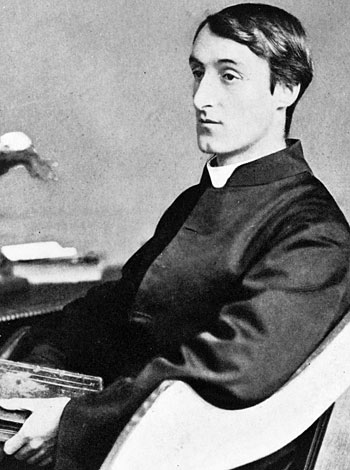
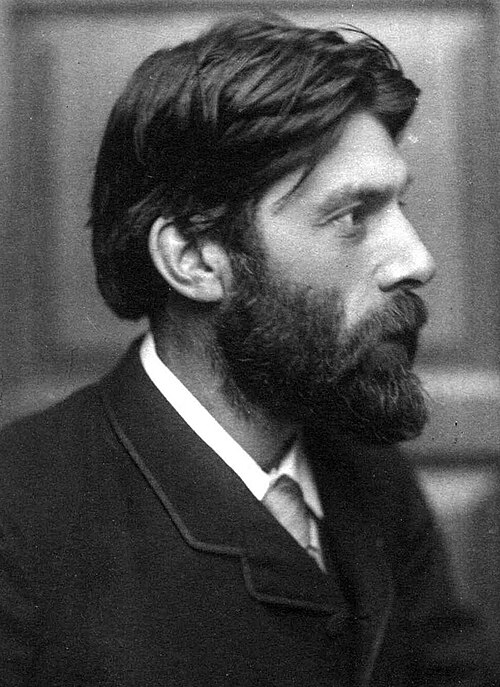
Robert Seymour Bridges was a nineteenth century physician and an esteemed poet, such that later in life he was named Poet Laureate of the United Kingdom. Though not well-known now, he deserves our attention for how he adapted and rendered in lyrical English verse a hymn text by the seventeenth century German theologian and hymn writer, Joachim Neander. Bridges’ version of that text is known by its first line, “All My Hope on God is Founded.”

Robert Seymour Bridges

Bridges’ poetic text is familiar to people in our own day because of the way it has been set to a twentieth century tune, MICHAEL, by Herbert Howells. Many heard this hymn when it was sung as a fitting part of an internationally televised occasion, the Committal Service for Queen Elizabeth II, in September of 2022.

“All My Hope on God is Founded” therefore represents a remarkable synthesis of a seventeenth century devotional text, Victorian poetical sensibility, and expressive twentieth century hymnology. Each of these features can be appealing, and in my perception, how they work together in this example makes for a very moving hymn that enhances contemporary eucharistic worship.

Hope, based on God’s grace and providence, provides the thematic structure for the five verses of the text as it appears in The Hymnal 1982 (of The Episcopal Church). The third verse evokes the blessings that we have received through God’s work in Creation. The text here is nuanced, evoking the role of divine wisdom, while at the same time making allusion to things we have learned through the science of astronomy. Here is verse 3 in full:

“God’s great goodness e’er endureth,
deep his wisdom, passing thought:
splendor, light, and life attend him,
beauty springeth out of nought.”

Clearly, the hymn’s words here speak of what theologians refer to as creation ex nihilo, how God created all that is from nothing rather than from something preexisting. We remember the way that God’s handiwork is portrayed in Genesis 1, especially God’s recognition that what has been created is good. Andrew Cuneo observes how, in Genesis’s opening chapter, this repeated refrain that it was good, “contains a Hebrew word which may be translated either as good or as beautiful. The feel of the whole chapter changes if one hears God proclaim that the light, the sun, the greenery, the animals are all beautiful, and mankind very beautiful.”

This helps us appreciate how Robert Bridges’ rendering of Neander’s text transposes the object of God’s appreciative regard from the attribute of goodness to that of Beauty. The beautiful splendor, light, and life that attend God then, by implication, become attributes that accrue to humankind, we who are created in God’s image and likeness.

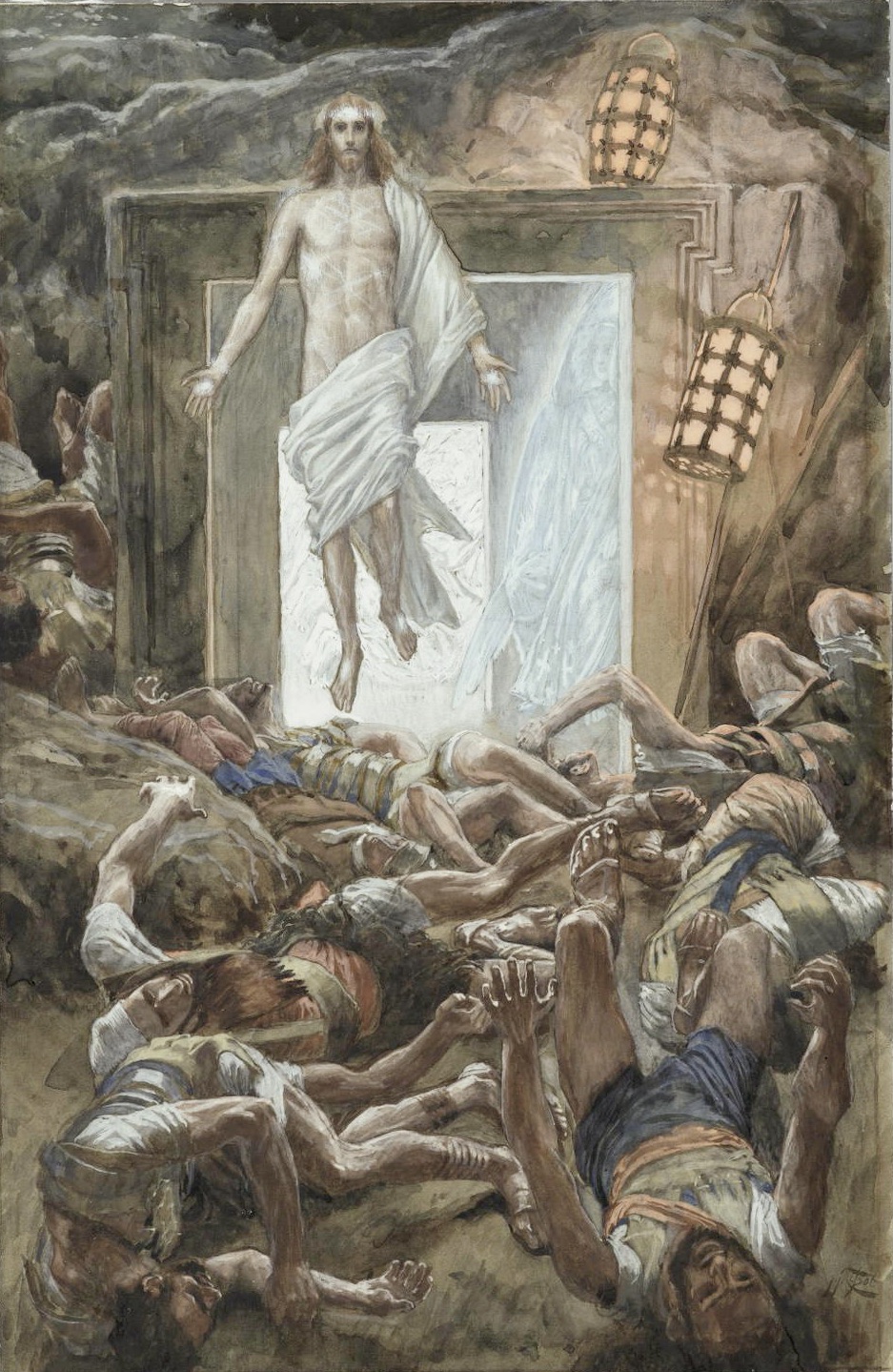
James Tissot, The Resurrection

A significant feature of New Testament theology appears in the theme of “a new creation,” signified by and inaugurated through Jesus’ Resurrection from the dead. As Paul puts it, “if anyone is in Christ, there is a new creation. The old has passed away; behold, the new has come” (2 Corinthians 5:17). Paul is here referring to death and resurrection, and the transformation we undergo through Baptism, when “what is mortal is swallowed up by life.” We can therefore say that the pattern of God’s work of Redemption mirrors that of Creation. For just as God created goodness and beauty out of nothing, God brought beautiful redemption to the world out of the emptiness of Jesus’ tomb. And as we feel joy when encountering beauty in Creation, so we find joy in God’s work of Redemption.

The disciples discovered new life within themselves through their encounter with and transformation by the Risen Jesus. This led them to a renewed sense of confidence that the Lord’s mission continued, and would now continue in and through them. They would have found fitting, and would have been able to sing, Robert Bridges’ words from the first verse of his hymn:

“All my hope on God is founded;
he doth still my trust renew,
me through change and chance he guideth,
only good and only true.”

And toward beauty.


Note: The full text of Robert Seymoure Bridges’ hymn text for “All My Hope in God is Founded” may be found here.

In a prior post I offered a reflection on the Committal Service for Queen Elizabeth II and noted its inclusion of the hymn, All My Hope on God is Founded. That post may be found here.