Ascension

Jesus’ Ascension Presence With Us

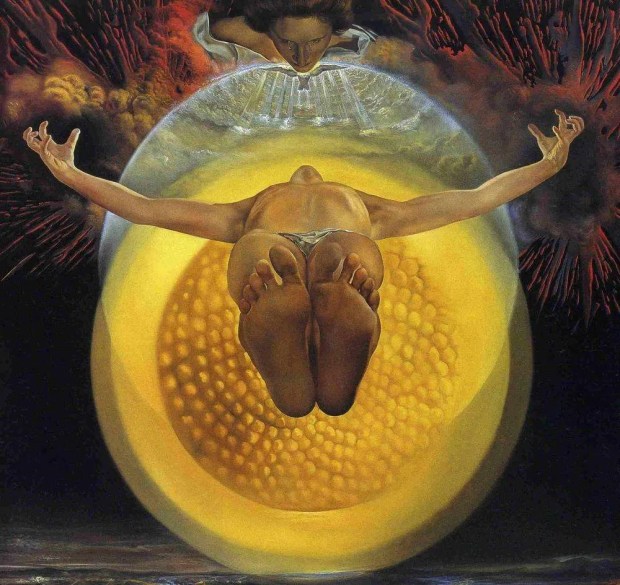
Salvadore Dali, The Ascension of Christ {Christ lifting in his embrace the whole of Creation to the Father, in the Holy Spirit}

Jesus ascended not so that he might withdraw from the world, making room as it were for the mission of the Holy Spirit. Instead, his Ascension marked his transition from being present at one time and in one place, to becoming present in all places, all the time. Before his death, there were countless places where he was not. After his Ascension, there is no place where he is not. From being with only some of those who lived during his earthly years, he is with all of us now. And from having a particular presence and context for his ministry, Jesus in his Ascension transitioned to a universal presence for his continuing mission, so “that he might fill all things,” even us.

The way that we envision the Ascension of Jesus is largely shaped by Luke’s Gospel, as well as by his book of Acts. As the Church’s liturgy observes and celebrates Luke’s presentation of this event, it occurs on the fortieth day after Easter Sunday, which always falls on a Thursday. With diminished weekday worship attendance in most churches, the feast of the Ascension is often observed on the following Sunday, on the Seventh Sunday of Easter. As Luke’s Gospel records the event,

“[Jesus] led [the disciples] out as far as Bethany, and lifting up his hands he blessed them. While he blessed them, he parted from them and was carried up into heaven. And they worshiped him and returned to Jerusalem with great joy, and were continually in the temple blessing God.”

In Acts, Luke presents a fuller account of

“… the day when he was taken up…, [when] he presented himself alive to them… [H]e said to them, ‘… you will receive power when the Holy Spirit has come upon you, and you will be my witnesses in Jerusalem and in all Judea and Samaria, and to the end of the earth.’ And when he had said these things, as they were looking on, he was lifted up, and a cloud took him out of their sight. And while they were gazing into heaven as he went, behold, two men stood by them in white robes, and said, ‘Men of Galilee, why do you stand looking into heaven? This Jesus, who was taken up from you into heaven, will come in the same way as you saw him go into heaven.'”

Giotto, The Ascension of Jesus

Giotto beautifully portrays Jesus’ Ascension in a fresco found within the Scrovegni Chapel (also known as the Arena Chapel) in Padua, Italy. Giotto’s approach to painting proved pivotal in the transition within Western art from dependence upon Eastern Christian iconographic imagery toward a greater realism and sensitivity to ‘ordinary’ human life in this world. Unlike medieval and eastern Christian icons, which tend to be absorbed with expressing dimensions of the eternal, Giotto portrays an actual event in the temporal lives of actual people. Nevertheless, Giotto’s Ascension is clearly also attentive and faithful to the supernatural elements of the Luke-Acts descriptions of Jesus’ Ascension.

It has been observed that in these modern times, among the most neglected aspects of traditional Christian doctrine is a proper understanding of Jesus’ Ascension. This may be due to a contemporary proclivity to read the New Testament as if its significance is primarily ethical, while shying away from engagement with the metaphysical and the supernatural elements of the Gospel narratives. Yet, though often overlooked within the spiritual reflections of many people in this modern era, we need to remember that Jesus’ atoning work was not limited to his offering himself for the life of the world in going to Golgotha. His Ascension and his Resurrection, just as his anticipation of the acknowledged presence and gift of the Holy Spirit, were all a part of his mission of atonement – opening our pathway to one-ness with God.

A collect from The Book of Common Prayer helps us appreciate why the Ascension of Jesus continues to be a major feast of Our Lord on the Church’s calendar:

“Almighty God, whose blessed Son our Savior Jesus Christ ascended far above all heavens that he might fill all things: Mercifully give us faith to perceive that, according to his promise, he abides with his Church on earth, even to the end of the ages; through Jesus Christ our Lord, who lives and reigns with you and the Holy Spirit, one God, in glory everlasting.” (BCP:226)

Just as at his Baptism, in the Ascension of Jesus, the veil between heaven and earth, between the spiritual and the material, between God and us, is pierced and set aside.

Alleluia. Christ is Risen and Ascended! And in the Holy Spirit he is present everywhere and in all who might welcome him into our lives.


Note: this post is adapted from one I have shared previously. We honor our Lords Ascension this week, as we do throughout our days, especially when we speak of it together in the Apostles Creed, in daily Morning and Evening Prayer as well as in the renewal of our Baptismal Covenant, and when we recite the Nicene Creed during the Eucharist. For He is risen, ascended, and continues to be glorified through our prayers.

On Monday of this week, I offered a sample homily for this coming Sunday, Easter 7 A, and an accompanying handout based on themes in the reading from John’s Gospel. I will offer here another sample handout based more directly on Ascension themes related to the above post.
“… She Is Still Out There…”

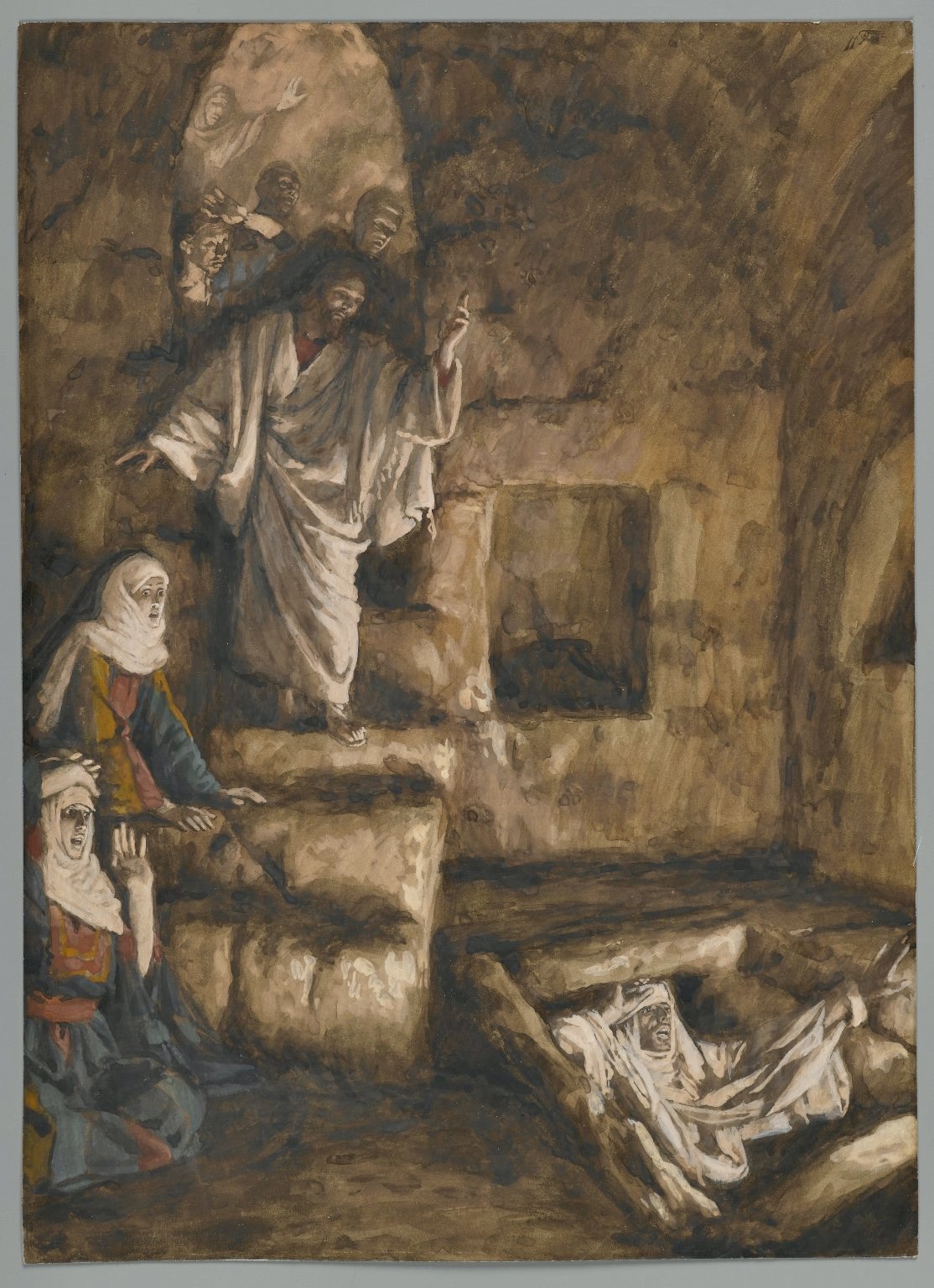
James Tissot, The Resucitation of Lazarus

(Note: At the time of publication, what has happened to Nancy, the mother of Samantha Guthrie, is still unclear.)

The beginning of Lent offers us a stark reminder of our mortality, and of our ’nothingness’ apart from God’s Grace. This may lead some of us to be mindful of the death that we fear, or the deaths of loved ones whom we mourn. Our observance of ‘a holy Lent’ provides a season when we can grow in our assurance of the New Life we are given in and through Christ. This happens through our Baptism into his death and Resurrection. The Easter season that lies ahead has much to say about this, which is one reason we might devote ourselves to particular disciplines of preparation during these Forty Days.

I want to approach this theme in light of the recent widespread publicity given to the abduction of Nancy, the mother of Samantha Guthrie. This tragedy has focused a great deal of attention on some words that she and her siblings have used with reference to their mother: “We believe she is still out there.” This cautious statement has been oft-repeated by law officers and the news media.

We hear these words in the context of learning that Samantha Guthrie has been a member of St. Philip in the Hills Episcopal Church, in Tucson, where a prayer vigil was offered on behalf of her mother. Samantha has also written a book in which she expresses her Christian faith, a fact also evident in some of her recent public communications.

For Christians, our loved ones are always ‘still out there.’ I want to offer some reflection on this phrasing, and explore what the Guthries’ quoted words may mean in terms of Christian belief.

Despite a common notion we sometimes encounter in popular culture, people who die do not become ‘angels.’ Nevertheless, traditional Christian faith teaches us that angels are like us in reflecting a divine attribute, personhood. For we believe in One God in Three Persons (the Father, the Son, and the Holy Spirit). This is the mystery of the holy Trinitarian nature of God, in whose image and likeness all persons have been created. From our knowledge of God, and our experience of ourselves, we know that an integral feature of personhood is being in relationship with other persons.

Yet, unlike angels, we are embodied, and remain embodied regardless of our transformation through the resurrection of the dead at the end of our mortal, physical, lives.

Since the time of the New Testament, Christians have spoken about this transformation into a new form of embodiment by employing various metaphors. In view of this, at our demise, we do not become like a drop of water returning to the sea, or move from a personal identity based on our differentiation from others into an unconscious and undifferentiated state of life. As if – at death – we will somehow be dissolved into a greater realm of ‘Spirit.’

By our Baptism into the death and Resurrection of Jesus, we become named members of His Body, the one Body of Christ. This is the Church in its essence, which comprises the communion of all the Baptized, whether they are ‘on this side of the veil’ or have gone before us to the next life. Thus, though we (as Anglicans) do not pray to saints, we pray with them as the Holy Spirit enables this activity within us. Those presently alive in this life and those who have ‘gone before us’ – are both ‘here’ and ‘there,’ in a shared living stream of ongoing prayer and fellowship.

An oft-neglected article of traditional Christian faith is that of the Ascension of our Lord, directly tied to his Resurrection from the dead. In our faith, Christ did not ‘go up’ alone, but carried with him our human nature. This enabled our own transition – with him – into the next life. When we die, by Grace we move into a greater experience of nearness with our Lord, who is already with us, and in us. Therefore, we do not cease ‘to be’ at death. And we are taught not to fear physical death in view of our belief in the significance of our Baptism into Christ’s death and Resurrection. By virtue of this Ascension-fortified faith, we have assurance about our continuing fellowship with those who have died “in the Lord.”

In view of these fundamental aspects of Christian believing, we can recognize how Nancy Guthrie continues to be among us, and always will be, regardless of what may have happened to her in the recent tragic circumstances now so familiar to us. For as Jesus is quoted as saying, in John 11:25-26, “I am the resurrection and the life. Those who believe in me, even though they die, will live, and everyone who lives and believes in me will never die.”


Note: I present these reflections without implying that my words here have negative implications regarding those who do not share our faith nor our baptismal identity. As for people whose faith (or lack of it) is known to God alone, we need to remind ourselves that, in God’s Providential wisdom, the divine will for those who do not identify as Christian remains a mystery to us.