Giotto

Jesus’ Ascension Presence With Us

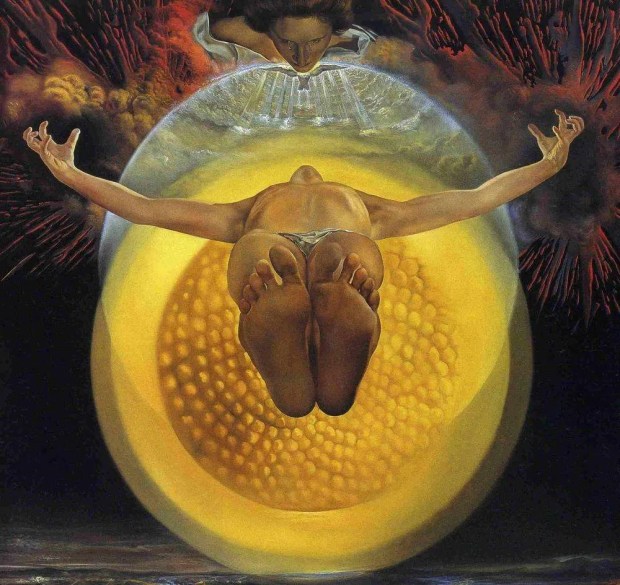
Salvadore Dali, The Ascension of Christ {Christ lifting in his embrace the whole of Creation to the Father, in the Holy Spirit}

Jesus ascended not so that he might withdraw from the world, making room as it were for the mission of the Holy Spirit. Instead, his Ascension marked his transition from being present at one time and in one place, to becoming present in all places, all the time. Before his death, there were countless places where he was not. After his Ascension, there is no place where he is not. From being with only some of those who lived during his earthly years, he is with all of us now. And from having a particular presence and context for his ministry, Jesus in his Ascension transitioned to a universal presence for his continuing mission, so “that he might fill all things,” even us.

The way that we envision the Ascension of Jesus is largely shaped by Luke’s Gospel, as well as by his book of Acts. As the Church’s liturgy observes and celebrates Luke’s presentation of this event, it occurs on the fortieth day after Easter Sunday, which always falls on a Thursday. With diminished weekday worship attendance in most churches, the feast of the Ascension is often observed on the following Sunday, on the Seventh Sunday of Easter. As Luke’s Gospel records the event,

“[Jesus] led [the disciples] out as far as Bethany, and lifting up his hands he blessed them. While he blessed them, he parted from them and was carried up into heaven. And they worshiped him and returned to Jerusalem with great joy, and were continually in the temple blessing God.”

In Acts, Luke presents a fuller account of

“… the day when he was taken up…, [when] he presented himself alive to them… [H]e said to them, ‘… you will receive power when the Holy Spirit has come upon you, and you will be my witnesses in Jerusalem and in all Judea and Samaria, and to the end of the earth.’ And when he had said these things, as they were looking on, he was lifted up, and a cloud took him out of their sight. And while they were gazing into heaven as he went, behold, two men stood by them in white robes, and said, ‘Men of Galilee, why do you stand looking into heaven? This Jesus, who was taken up from you into heaven, will come in the same way as you saw him go into heaven.'”

Giotto, The Ascension of Jesus

Giotto beautifully portrays Jesus’ Ascension in a fresco found within the Scrovegni Chapel (also known as the Arena Chapel) in Padua, Italy. Giotto’s approach to painting proved pivotal in the transition within Western art from dependence upon Eastern Christian iconographic imagery toward a greater realism and sensitivity to ‘ordinary’ human life in this world. Unlike medieval and eastern Christian icons, which tend to be absorbed with expressing dimensions of the eternal, Giotto portrays an actual event in the temporal lives of actual people. Nevertheless, Giotto’s Ascension is clearly also attentive and faithful to the supernatural elements of the Luke-Acts descriptions of Jesus’ Ascension.

It has been observed that in these modern times, among the most neglected aspects of traditional Christian doctrine is a proper understanding of Jesus’ Ascension. This may be due to a contemporary proclivity to read the New Testament as if its significance is primarily ethical, while shying away from engagement with the metaphysical and the supernatural elements of the Gospel narratives. Yet, though often overlooked within the spiritual reflections of many people in this modern era, we need to remember that Jesus’ atoning work was not limited to his offering himself for the life of the world in going to Golgotha. His Ascension and his Resurrection, just as his anticipation of the acknowledged presence and gift of the Holy Spirit, were all a part of his mission of atonement – opening our pathway to one-ness with God.

A collect from The Book of Common Prayer helps us appreciate why the Ascension of Jesus continues to be a major feast of Our Lord on the Church’s calendar:

“Almighty God, whose blessed Son our Savior Jesus Christ ascended far above all heavens that he might fill all things: Mercifully give us faith to perceive that, according to his promise, he abides with his Church on earth, even to the end of the ages; through Jesus Christ our Lord, who lives and reigns with you and the Holy Spirit, one God, in glory everlasting.” (BCP:226)

Just as at his Baptism, in the Ascension of Jesus, the veil between heaven and earth, between the spiritual and the material, between God and us, is pierced and set aside.

Alleluia. Christ is Risen and Ascended! And in the Holy Spirit he is present everywhere and in all who might welcome him into our lives.


Note: this post is adapted from one I have shared previously. We honor our Lords Ascension this week, as we do throughout our days, especially when we speak of it together in the Apostles Creed, in daily Morning and Evening Prayer as well as in the renewal of our Baptismal Covenant, and when we recite the Nicene Creed during the Eucharist. For He is risen, ascended, and continues to be glorified through our prayers.

On Monday of this week, I offered a sample homily for this coming Sunday, Easter 7 A, and an accompanying handout based on themes in the reading from John’s Gospel. I will offer here another sample handout based more directly on Ascension themes related to the above post.

Advent Annunciations: Anne, Mother of Mary

[If reading this by email, please tap the title at the top to open your browser for the best experience. Then, clicking individual pictures will reveal higher resolution images.

Giotto, The Annunciation to St. Anne, Scrovegni Chapel, Padua


Without seeing the title of this fresco at the stunningly beautiful Scrovegni Chapel, in Padua, Italy, we might assume that it portrays the angel’s annunciation to the Virgin Mary. The parallels with traditional Annunciation iconography are readily evident. Yet Giotto also executed a series of panels there devoted to the life of St. Anne, Mary’s mother, who is shown in the fresco, above.

As with so many Marian annunciations, the scene is domestic, with Anne here suggested as having been occupied at home with her maid, preparing thread for stitching. Just as familiar paintings of Mary often show her at prayer, Giotto portrays Anne upon her knees with her hands clasped. But unlike familiar Marian parallels we do not see a devotional book open next to Anne. Just as later happens to her daughter, we see this grandmother-to-be of Jesus met by an angelic visitor who discloses an unexpected new role for her. Unlike her daughter Mary’s experience, Anne’s encounter with God’s Word to her is not recorded in canonical Scripture.

Interior of the Scrovegni Chapel

The frescos in the Scrovegni Chapel contain an interesting mix of images, with some portraying events in their presumed original historical context (such as the Nativity scenes), and others (like the annunciation to Anne) in buildings and settings more characteristic of Giotto’s own time and place, including the architecture of the chapel housing them. While he paints them this way, Giotto’s choices regarding imagery suggest that he seeks to be faithful to the supposition that Mary’s family came from an ordinary background. After all, Mary’s parents, named Anne and Joachim according to tradition, later allowed her to marry Joseph, a local builder; she was not betrothed to nobility. The painter, therefore, shows some restraint in his rendering of the context of Anne’s visitation. This simplicity in approach may also be due as much to Giotto’s early place in the historical development of European painting as it does his personal temperament.

In this remarkably large series of Scrovegni frescos, we can see that Giotto has discovered and effectively employs the technical skill of linear perspective. With some care, he depicts the stonework of Anne’s home and that of many other buildings as sculpturally ornamented. But rather than display undue deference to the known wealth and social position of his patron, he allows the particularity of the angel’s visitation to be what sets Anne apart from her contemporaries rather than the finery of her home’s appointments. An emerging humanism in painting is evident in Giotto’s artistic style, and he presents Anne as a distinctly recognizable person rather than as a merely symbolic religious figure. Though she appears to be a woman of some means, she is depicted as someone who could have been the neighbor or relative of many people of his community.

Here is one theme we find in Giotto’s fresco of Anne’s annunciation. All it takes to play a part in God’s unfolding plan of redemption for the world is an open heart and a spirit of willingness to say yes. What part we are to play, and its significance to and for others is, in the end, up to God – and probably not something to which we should give much thought. At least not in the way that we hope or imagine our personal skills and accomplishments might be thought of by others. Saving the whole world, even small parts of it, is God’s work and not our own.

And so, the key is what God might decide to do in and through us (while inviting our help), rather than what we might decide to do for God (while perhaps asking for divine help).

The mystery of this season of Advent centers upon how we are drawn into what God ‘has been up to’ for a very long time. In a season of growing astronomical darkness we are invited to seek the most significant source of light, the light of Christ. And at a time when the world around us seems more colored by signs of decay and dissolution, He in whom all things hold together comes anew to embrace us, and ever hold us fast. It may not be through an angel, but surely the One born among us calls all of us to share His love for the world.


The Mystery of Pentecost

[If reading this by email, please tap the title at the top to open your browser for the best experience.]

Giotto, Pentecost (Scrovegni (or Arena) Chapel, Padua)


Once again we turn to Giotto, who helps put a ‘human face’ on a supernaturally-charged event. As we observed with his fresco depicting the Ascension of Jesus, Giotto’s Pentecost painting evidences the influence of medieval and Eastern Orthodox iconography (e.g., the gold-leaf halos). Yet, his work distinctively moved away from a primary absorption with portraying aspects of the eternal so as to display an appreciation for daily human life and activity. One mark of this is his employment of architectural perspective in his composition of the scene. In addition, each of the faces in this Scrovegni Chapel fresco are recognizably distinct from one another, with some of them reflecting a genuine regard for individual personality and temperament.

Here we can also notice Giotto’s attention to the biblical text. This scene portraying the gift of the Holy Spirit follow’s Luke rather than John. In John’s Gospel, on the evening of the day of the discovery of his Resurrection – the Risen Jesus enters the private room where the disciples are hiding fearfully behind a locked door. He breathes on them his Holy Spirit and implies that his Ascension has already occurred.

Luke, as Giotto faithfully portrays, describes the disciples being gathered together 50 days after the Resurrection on the Jewish feast of Pentecost. As Luke reports in the last two verses of his Gospel, after witnessing Jesus’ Ascension the disciples “worshiped him and returned to Jerusalem with great joy, and were continually in the temple blessing God.” Luke then commences his second book, Acts, with a parallel account of Jesus’ Ascension, and the selection process of Matthias as a replacement for the traitor, Judas. Having returned joyfully to Jerusalem, the disciples have been visiting the Temple daily, where they blessed and worshipped God in a public setting.

Luke’s Pentecost assembly differs markedly from John’s account of the fearful disciples on the afternoon of the first day of the new week, forty nine days before. For on Pentecost, into their midst and visibly upon their heads, came the Holy Spirit filling each of them with its power and presence.

Many visitors to Jerusalem for the great feast became aware of what had occurred, and were perplexed, marveling at the unexpected spectacle of how each of them heard the men from the north country speak in their own separate and distinct languages. The legacy of the tower of Babel had been overcome.

Peter quickly helped account for what was happening in light of Scriptures familiar to those gathered, which were fulfilled in and through Jesus’ death and resurrection. God was now doing a new thing, yet something promised long before.

How contrary to the spirit of Jesus’ ‘high priestly prayer, in John 17, and to the witness to the power and presence of the Holy Spirit at Pentecost, is our frequent experience of the Church throughout the world in our present day. Despite moving words centered on unity and a commonality of mission that we hear and recite in the baptismal rite, we are more often confronted with evidence of difference and division among Christians of varying denominations and cultural backgrounds. Perhaps it is because we let our own concepts of our mission and ministries take precedence over our awareness of and belief in the primacy of Christ’s continuing mission and ministry.

And so, we forget to marvel at what came about through the embodied presence of God. A divinely appointed and inspired country rabbi, who had recruited 12 unlikely followers, met persecution and a tragic death at the hands of a corrupt earthly empire. Yet, in the power of the Holy Spirit, over the course of a few centuries he transformed a sizable portion of the known world into the New Israel, his beloved community and family.