Beauty, Goodness, & Truth

David Wojnarowicz, and Our Search for Beauty Amidst Darkness

David Wojnarowicz, Self Portrait (photo collage with paint / I knew the ‘blue,’ inner and gentle side of David)

One of the most visited posts on this website is the piece I wrote about Picasso’s painting, Guernica. In it, I began to explore the challenging question of where and how we find beauty amidst darkness, evil, and grievous misfortune. One key that I am discerning in the process of exploring this question is to be open to finding glimpses of beauty within such unpromising circumstances, rather than try to gain an impression of beauty from them. Moments of beauty can be found even within the horror of war, such as in the fabled Christmas Day truce during WW I. And artists such as Henry Moore and writers such as Ernest Hemingway and TS Eliot have captured aspects of beauty that can be discerned within the traumatizing devastation caused by armed conflict.

My challenge in addressing this topic continues as I contemplate my early friendship with someone whose later work in the arts became notorious for his willingness to become completely transparent about his own involvement in acts and relationships that, at the time, moved beyond the bounds of social acceptability.

After graduating from high school in 1974, I found a job at Bookmasters, a chain of stores later absorbed into Barnes & Noble. I worked at the location in New York City’s Times Square, which like parts of the city in those days was chaotic. I remember ducking with fellow passengers on the subway as we pulled into the 42nd St. station when gunshots were fired on the platform. I began to carry an otherwise superfluous cane, imagining that it was for safety. Times Square at night was less populated by curious tourists and more by ‘ladies of the evening’ and their business-protective minders. Aside from Nathan’s Famous (hotdog restaurant) and the One Times Square building with its news ticker banner flashing around the center of the square, our bookstore appeared to be to be one of the few places patronized by people looking for products and experiences that might be found in ‘ordinary’ neighborhoods.

Having just turned 18, I was a newcomer to working a shift in a business location, learning such basic matters as clocking in with a time card, running a cash register and manually processing credit cards with carbon copy receipt slips. I was befriended by a very kind and supportive young man who gently taught me how to complete such tasks, as well as how to manage new inventory and then shelve books in their proper locations. He was David Wojnarowicz, whose name was easier to pronounce than it was to spell. I was impressed by his thoughtfulness, while I also saw that he had a perceptive sense of humor, aware of the irony that could be found in our interactions with some of our colorful late evening customers and with our night manager.

As I got to know him, I learned first about his particular interest in poetry, and more specifically in the work of those known as the Beat Generation, William S. Burroughs, Allen Ginsburg, and Gregory Corso. David was sensitive to not only the content of the little collections of poems that we would shelve, but to aspects of their printing, to the quality of the paper chosen for their covers and texts, and also to the sewn bindings and sometimes unusual fonts selected by the small scale publishers of these interesting and – in our chain bookstore – distinctive little books.

Soon David and I would meet in the early afternoons, before our 3–11 shift, at the apartment he shared with a couple on the Upper West Side, overlooking Central Park. While I was beginning to learn about contemporary poetry from him, I shared with David how to make collages, using an X-ACTO knife on a plate of glass with pages from cast-aside glossy magazines that we had found. I had no way of knowing then that, along with paint, David’s new interest in this medium would later play a significant role in the artistic output for which he has become known.

David with two of his works on display (along with his T-shirt here, and his self-portrait above, there must have been ‘a house on fire’ inside my calm friend)

It was only after some months that I became aware of a number of things David tentatively shared with me regarding his traumatic childhood. He still kept hidden from me what we now call his sexual orientation, not yet apparent to me because of my own naivety, and given my girlfriend and our occasional banter about attractive women we had seen at the store or on the subway.

It was probably as a result of me telling David about crossing the Pacific Ocean numerous times during my childhood that he shared with me how his father had been a steward on the famed SS United States, a man whose frequent extended absences were not unwelcome because he was an abusive alcoholic while on shore leave. I came to learn only the barest details of how David had survived, living on the streets at times, and how he had found escape in the City after his childhood across the Hudson.

Toward the end of my first and only year in New York, David and I made a couple of trips down to the far Lower East Side of Manhattan to explore some abandoned tenement buildings. David had an abiding vision for how one or more of these buildings might be reclaimed for use by a community of artists and writers who – because of costs – were willing to live and work in the most marginal of circumstances. I was too young, and less prepared than David to face the realities involved in such a venture, to be able to join him in starting it.

In late summer after that year, I moved to Minnesota in a failed attempt at being a college art student for two quarters. I took a room in the old Victorian style Stuart Hotel in Northfield, built the year after Jessie James had robbed the local bank. Thinly populated by some old men who I suppose were living with hot plates and getting by on meager Social Security checks, and by occasional overnight guests who used shared bathrooms down the hall, the Stuart was a just-affordable place for me to stay. But it was the sort of place with which I now realize David was very familiar. He came to visit me on his first cross-country trip, traveling with a friend on their way to San Francisco. We talked mostly about art and our hopes for the future. I still have a postcard drawn and watercolored by David, showing a hobo ‘traveler’ heading toward the sunset, and featuring a caption that had become a mantra between us, “Goodbye, blue Monday!

When he and his friend left on a Jefferson Lines bus that stopped regularly at the hotel, it was the last time I saw him. It was only later, after numerous years, that I became aware of David’s subsequent notable art works, published writing, occasional film pieces, and the acclaim he has received following his early death due to HIV.


In a future post I hope to explore some aspects of David’s work and his struggle to find and express beauty in the midst of the darkness that he often experienced, and faced more boldly than I think I could. At the same time, I urge caution to anyone unfamiliar with David’s artwork – some of it is ‘unsafe for family viewing’ and may offend those who seek to be guided by a traditional approach to ethics.

As Kingfishers Catch Fire

A Kingfisher, a brightly colored fish-eating bird with a large head, a dagger-like bill, which dives to catch prey

One of my favorite poems was written by the English poet and Jesuit priest, Gerard Manley Hopkins (1844-1889), from whom I have received inspiration in my continuing desire to glorify God by helping others perceive and give thanks for beauty. The poem from which I have borrowed my title for this post, provides a wondrous example of his gifts at work. I quote his poem here in full:

Hopkins’ Kingfisher poem, which is known by its first line

Reading poetry with insight does not come naturally to me, though I much appreciate the art form. As many others do, when approaching a poem like Hopkins’ “As Kingfishers catch fire,” I rely upon essays written by interpreters trained in literature. Since poems involve verbal communication, it may be that sharing insight about a poem with words is a more fruitful endeavor as compared with attempting the same regarding a painting. Yet, I believe that – as with most art forms – we can best express the things that have caught our attention and stirred our spirit in the paintings and poems that have stayed with us. Here are some aspects of Hopkins’ Kingfisher poem that continue to draw me in when I read its lines and speak its words aloud.

In this poem, Gerard Manley Hopkins displays what I consider to be an essentially “Catholic” sensibility when reflecting upon the world and our place within it. Here, his suggestion of the inner relationship and yet the difference between God’s mission in Creation and in Redemption, stands out to me, as does the continuity that may be perceived between the two. Order, purpose, meaning, and – yes – beauty, are to be found in God’s handiwork. The patterns we discern in nature attest to God’s intentions for us and for all other things touched by God’s ‘hands’ and by ours, and so we are reminded to look within ourselves for the same kind of purpose.

In discerning something of God’s purposes for us, we act in accord with what we observe and come to know. We are created to be just and so we choose to act justly. And we are created and then blessed further with God’s grace to be instruments of the same beautiful love. Risen Jesus, who comes to be with us, and then in us, manifests his divine role, inhabits our being, and brings new life to where it was not. In us, among the myriads upon myriads of those who see his beauty, who say, “Yes.”

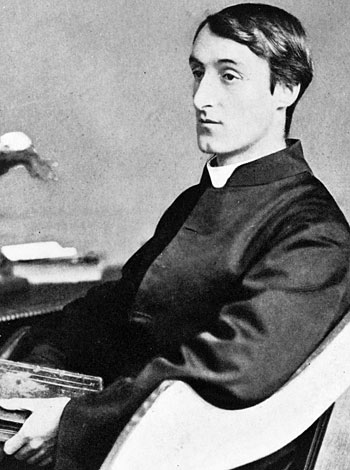
Gerard Manly Hopkins as a Jesuit
A kingfisher – metaphorically – ‘catching fire’
Diving for a catch

Being True, Being Good, and Being Beautiful

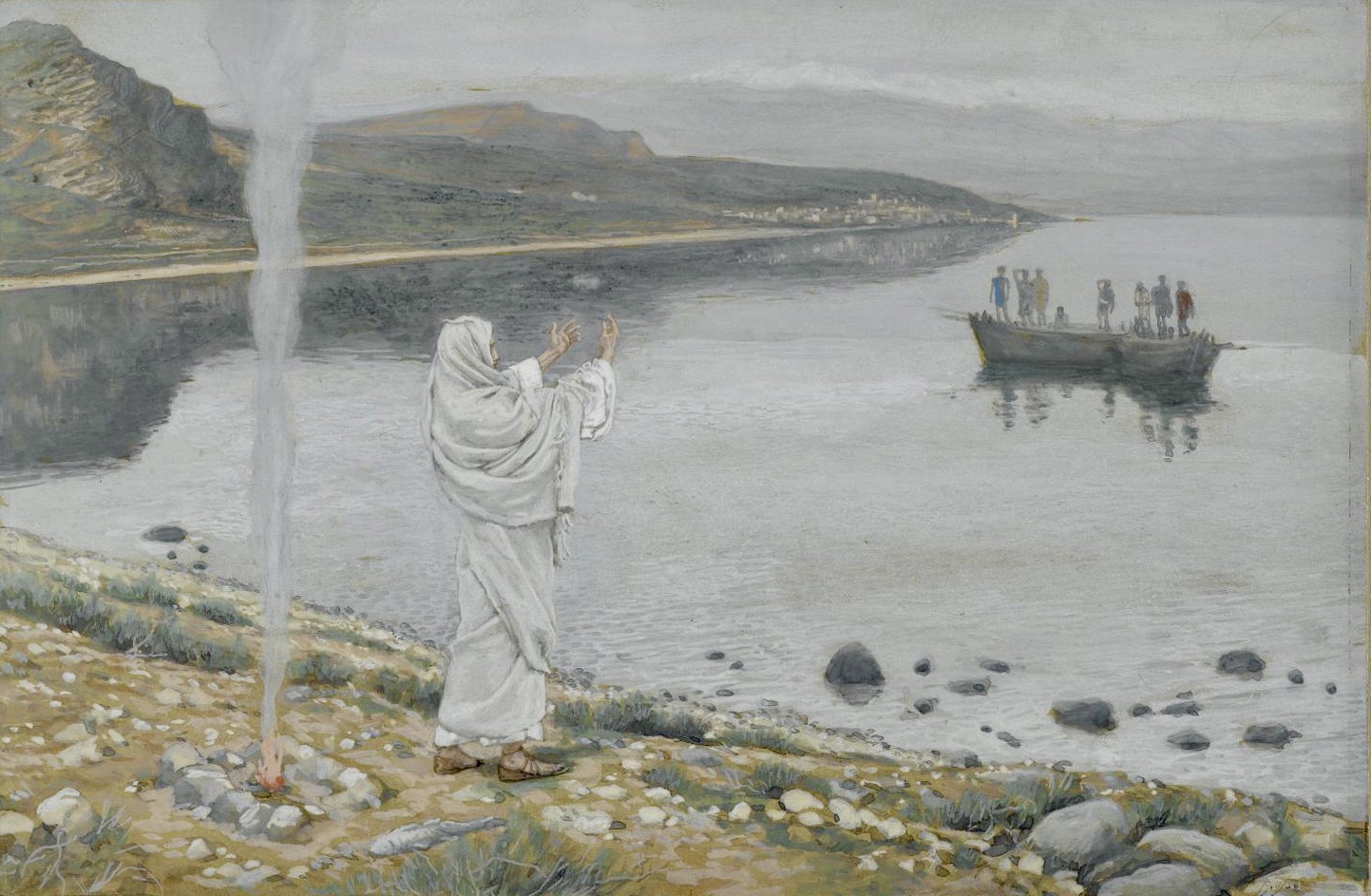
James Tissot, Christ Appears on the Shore of Lake Tiberius

“To thine own self be true.” This familiar adage is now known to many people through their experience with 12-Step Recovery programs. Yet the phrase is traced back to its appearance in a play by Shakespeare, and hearkens back to a simple statement attributed to Plato from the pre-Christian Classical period, “Know thyself.” One way to understand being true to ourselves involves living toward spiritual wellness and in an ethical manner. If these pursuits are of value to us, we may be open to receiving counsel about how we can be truthful, and good in our conduct, even if we are not comfortable with the degree of our adherence to these ideals. But to be beautiful?

Here, modern translations of the New Testament may provide a benefit to our thinking about questions like these. In our contemporary sensitivity to employing gender-neutral and inclusive language, sayings from the lips of Jesus or in the Letters of Paul are often cast in plural language. The potential benefit to us may lie in the encouragement we can receive to think in corporate or in community-minded terms.

We often need to remind ourselves to think about our lives with a wider frame of reference, for we are so much more than individuals with only chosen or willed connections and relationships with others. We will be truer to the message of Jesus and the teaching of the New Testament when we are equally attentive to our membership in the Body of Christ, the Church, within the Communion of Saints. Our baptismal identity is shaped fundamentally not by what we do, but by our grace-enabled incorporation within the community of the Risen Lord.

In other words, we can learn to receive and follow gladly the advice that we be true to ourselves when we do so as members of the Body of Christ. We can then see ourselves in more expansive terms than those based merely upon our physical birth identity as unique individuals, our social status, or upon our achievements.

One way to understand Jesus’ use of the mysterious phrase, the Son of Man, is to see this title in terms of the transformed personhood we apprehend in the Risen Lord. As such, he embodies for us the ‘true’ and fully redeemed human person and therefore the full goodness of human being. If so, the Risen Christ also embodies for us the fully realized beauty of both created and also redeemed human personhood. In him we find our new baptismal identity in communion fellowship with one another, which is the distinctive characteristic of participation in the Risen Body of Christ. We are, in Christ, people living together into the beauty of his Resurrection.

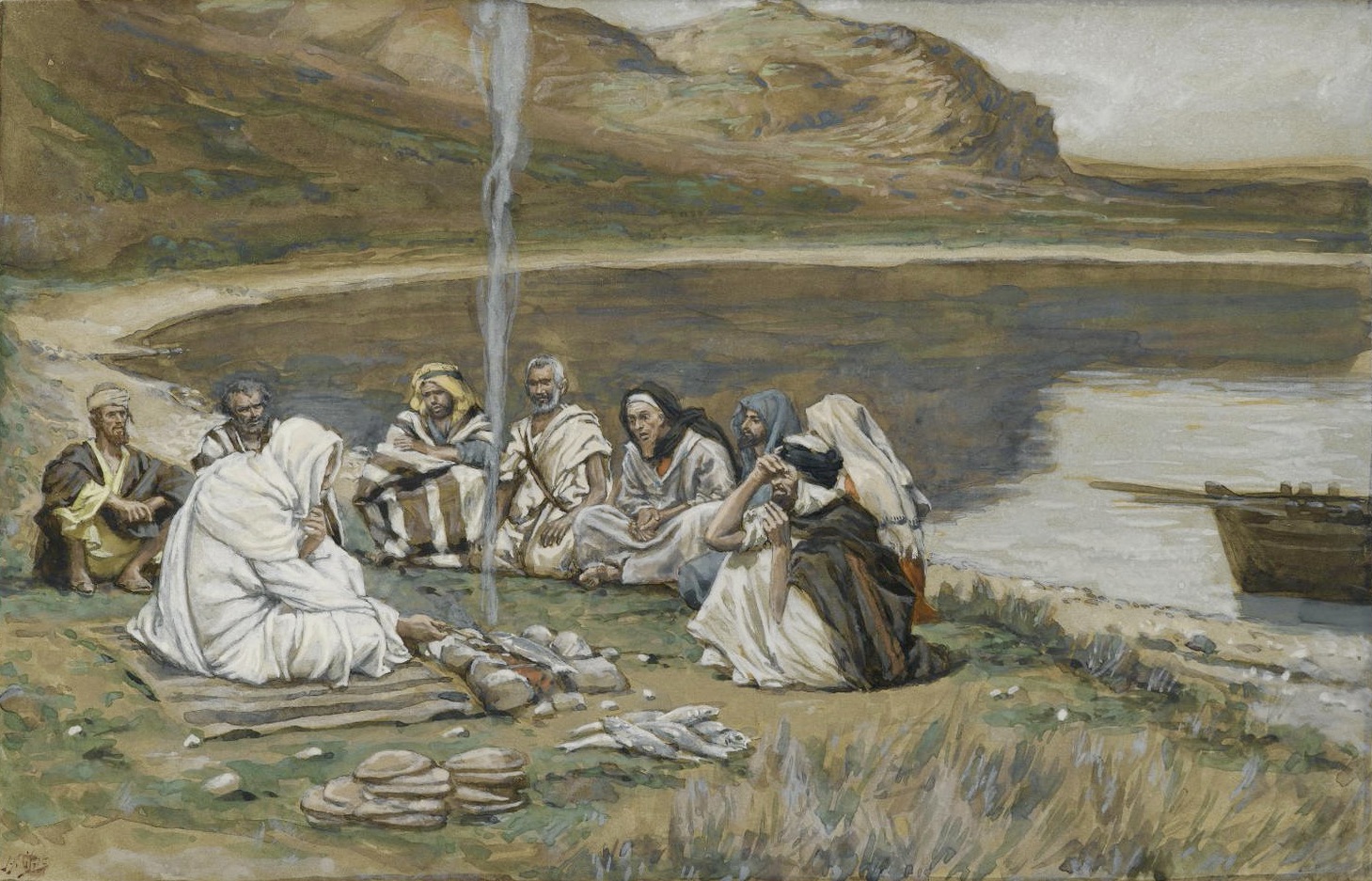
James Tissot, Meal of Our Lord and the Apostles

Here is the challenge that arises with disciplining ourselves to think in these corporate and communal terms. In the culture in which we live and raise our children and grandchildren, beauty for us is most commonly thought of in visible, physiological terms. Perhaps encouraged by the advertising and media to which we are contstantly subjected, we pursue pharmaceutical products, health and exercise regimens, and even plastic surgery. We do so in search of achieving outward beauty of a kind communicated to us by others as a goal we need to seek.

We then lose sight of inward beauty, the beauty we can attain as persons who mature, become wiser, and more generous in our viewpoints. I have previously written about Sister Wendy Beckett, who I have described as one of the most beautiful persons I have come to know through my reading and media viewing. Outwardly, it must be admitted, Sister Wendy was not the kind of person whose countenance would be featured on magazine covers as an exemplar of physical beauty. Our view of what it means to be fully human is diminished if we do not also see how she, over her long years of life as a solitary devoted to prayer, became one whose face and physical presence radiated the beauty of the Risen Lord.

In this Eastertide, we hear stories from the Gospels that are echoed in passages from Acts of the appearances of the Risen Jesus, returning to his first followers. He came into their presence, encouraging and strengthening them for mission as witnesses to his realization of God’s hopes and plans for all people, for we all are God’s beloved. By grace, we are among those who have been embraced by this mission, as are those who have yet to hear and receive the hope of the Gospel. Too quickly, we assume that in the lives of hearers and readers of these stories the appropriate fruit of these appearances will be manifest primarily in truthful speaking and admirable conduct. As a result, we neglect to imagine how these stories also encourage us to embody the Beauty of the Risen Lord.

“He is Risen! The Lord is Risen, indeed!” These are wonderful phrases for us to repeat, and take to heart in this season of the Great Fifty Days. We can find in these words their intended corollary: For us who are baptised, ‘we are risen’! We are risen, indeed, and called to live into the Way, the Truth, and the beautiful Life into which the Risen Lord has invited all people. And he has made this possible for all who might be open to receiving this wonder-filled message.