A Tao of Seeing: Reflections Inspired by Feng Shui

Michael Pollan’s writer’s hut, intentionally situated by a boulder on the brow of a hill

Recently, I observed my middle son moving a black plastic pond module around in a small space in his New Orleans courtyard. As he moved the container that would soon have fish in it, he tried situating the vessel in various ways, in relation to a tree, a fence, some potted plants, and an existing low stone wall. He is not a student or practitioner of feng shui, but I believe I was seeing some of those principles at work in his decision-making.

Western readers may have heard of feng shui, the Asian philosophical approach to discerning the unseen forces that affect objects and their balance in nature. It gives attention to the metaphysical or non-material energies thought to be at work upon or within the world around us. We might say that this approach provides a Tao of seeing, or a natural way of perceiving within and around surface phenomena to the underlying dynamisms that are believed to affect what happens in nature.

This notion that there are unseen forces at work in the world is an idea that is receiving something of a revival in Western Christian spirituality. This is noticeable when people refer to a concept attributable to the Celtic tradition, in which it has become common to refer to “thin places. “ These are places where the veil between the material and the ethereal or the heavenly seems temporarily dissolved. Another parallel here between East and West may lie in the quest within Christian spirituality for the goal of harmony and balance between people and the created world.

However, my reflections here constitute an aesthetic rather than a philosophical or historical inquiry. I am interested in the dynamics of movement we perceive in the circumstances that we encounter, and less in the metaphysical forces or energies that may be present within them. At the outset, however, I want acknowledge how a nuanced Asian approach can be an authentic route toward a culturally-informed appreciation of the phenomena we encounter, especially from a historically Asian perspective.

As we look at paintings in the context of Western culture, one factor we discern assesses composition and attends to the way our seeing is drawn from one part of a larger image to another. This dynamic is often an artist-intended aspect of an overall composition. Sight lines in garden design and arrangement provide another example, as does the architectural arrangement of space in buildings.

Attention given by Western designers to feng shui is sometimes criticized as being a superficial application of historically and philosophically nuanced ideas. But I want to give credit to ways in which our sensitivity toward perceiving movement and direction is a genuine factor that is available for analysis and articulation. We notice this when we encounter both two dimensional compositions as well as three dimensional spaces and the objects we find in them. We can always come to know more about what we see.  Because what we see is something that is there, not simply what we believe, or are disposed or inclined to see.

An Asian garden said to be designed according to feng shui principles

Motion, balance between forces, spatial arrangement of objects, and the dynamic relationships that are visible because they exist between and among these variables, continue to grab my interest. Contrasts between colors and textures, as well as between sizes and shapes, play a significant role.  Additionally, the perceived difference between what is natural and things that are humanly fashioned is equally significant, as is our perception of the criteria for what constitutes that which we consider to be natural. These are among the factors that help account for our sensitivity towards and interest in these many observable variables, and our common quest for purpose and meaning in the contexts where we find ourselves.

Motions and balance as we find these factors in Wassily Kandinsky’s painting, Several Circles

Painters, sculptors, and architects, seriously consider these factors within visual and spatial compositions. The painter, Wassily Kandinsky, and the architect, Frank Lloyd Wright, provide two examples of those who also perceived a spiritual dimension within their creative work.

If so, we –  as caring lay observers of the world and of the things and places among which we find ourselves – should give deference to this evident fact. For we can all be thoughtful, as people often are inclined to be, about what we see, touch, and experience when we interact with visual phenomena.

I find myself increasingly sensitive to these aspects of our appreciation for Beauty, and endeavor to be more mindful about them. I am intrigued by possible parallels that may exist between Eastern metaphysical interpretations of visual phenomena and more familiar approaches to what we see that are shaped by Western aesthetics. Especially as these familiar approaches are described and developed within our artistic and architectural best practices.

The Beauty of Japanese Woodworking Tools

A vintage photo of a Japanese carpenter employing a smoothing plane

I was once asked a rhetorical question that has stayed with me: have you ever tried to push a rope? If this thought-question is new to you, I invite you to consider what we can learn from it. Obviously, it has to do with attempting something futile, which most of us have done more than once. Even when such efforts yield frustrating results, we often try again. Our impulse to repeat the act can be instructive, especially if we reflect on the process. A fellow teaching-team member once offered a counter-intuitive claim, that nobody ever learns from experience! He then quickly added that we only learn when we reflect on experience.

Thinking about actions that we choose to undertake actually benefits from consciously exploring why we might do them in the supposedly wrong way. For such thinking may yield valuable insight. Solving puzzles and brain-teasers is often helped by taking just such an obverse approach.

Learning to use a few Japanese tools while growing up in that country helped me begin to appreciate how undertaking a task or project in an apparently contrary way can be beneficial. When I was in 5th grade, our Yokohama International School added a ‘shop class’ to help us learn to use some basic carpentry tools. Each of us was given a canvas bag containing two particular tools (along with some chisels): one looked like a saw, and the second, a block of wood that had a metal blade inserted in it. 

I had seen a hand saw before, at my grandfather’s house, and he had shown me how to use it. “Pull the saw back gently on the line,” he said, “in order to start the cut, and then push the handle forward in a deliberate manner.” It worked, and with mixed results, I began to fashion a V-shaped bow for a simple boat out of an ordinary 2 x 4.

A common American hand saw

Here, in my new carpentry bag was a saw, but it had sharp teeth on both edges of the blade. Yet, it looked wrong! For there was no hand grip – just a long handle resembling a broomstick. I then discovered the magic of my new tool. It was a Japanese hand saw, and I soon discerned the merits of its design. Pulled – not pushed – for its cutting stroke, it yielded a straight cut more often than my grandfather’s American model. 

A Japanese Ryoba saw

Why? Because when pulling the saw while cutting, the saw’s thin blade is much less likely to warp, keeping true to the desired cutting line on the wood. (Something we can learn from pulling a rope!) It takes a little practice to make the switch when sawing, but it can make a big difference.

Working with a smoothing plane was entirely new to me. A plane is a traditional tool employed by carpenters and boat builders to take thin shavings off the surface of a piece of wood, both to remove unwanted material as well as to smooth an otherwise rough or uneven surface.

A common American smoothing or bench plane

My first use of a plane came with my new set of Japanese tools. The way this plane worked was consistent with how one uses a Japanese handsaw. While planing the surface of a piece of wood, you pull the plane rather than push it (as one does with the American model). Like the Japanese saw, the Japanese smoothing plane yields good results by giving the user a greater sense of control over the process, especially given how pressure, when applied to a plane (as with a saw), can affect its performance.

A Japanese Kanna smoothing plane

Just as the Japanese, the British, and many others, appear to drive ‘on the wrong side of the road,’ Japanese carpenters use familiar tools in the opposite direction from what we expect. I can’t comment on the benefits to the Japanese from driving on the left. But having come to appreciate the beauty within the function of Japanese pull saws and smoothing planes, it is hard for me to appreciate using their American counterparts. Traditional Japanese woodworking tools are also beautiful to behold and to handle.

I am happy to have discovered that traditional Japanese-style tools are now increasingly common in America. I recently bought a pull saw, albeit with a plastic rather than a bamboo handle, at a local store, at an affordable price.

I wish I still had my first set of Japanese tools! For I now realize that they helped me begin to learn a basic insight later articulated by my doctoral supervisor about my professional field of ethics: ethics is ‘how to think about how to act,’ an insight so applicable to much in life.

(Note: I have no commercial connection with any of the products featured in this post, nor do I receive any compensation from them.)

The Challenge Posed by Eric Gill

If reading this by email, please tap the title at the top to open your browser for the best experience. Then, clicking individual pictures will reveal higher resolution images.

Eric Gill, Christ Crowned


To my mind, some of the most beautiful work in the area of graphic art was created by the British artist and craftsman, Eric Gill. The intractable problem posed by Eric Gill is not a legacy of his artistic output, but of his personal life. Largely unknown to those outside his family until about 50 years after his death, Eric Gill – by admission in his own unpublished writings – had engaged in personal behavior of a kind that most people would find not only abhorrent but, increasingly, as also criminal.

This is related to the larger problem posed by the work of artists, musicians, and architects whose work is seen as having been collaborative with tyrannical regimes (eg., the Third Reich, the Soviet Union). How do we view beauty in art that either depicts or is simply associated in some way with sin or with evil? (This is a matter I have previously tried to understand in relation to Picasso’s great painting, Guernica.)

To cite Scripture to the effect that “all have sinned,” may help us begin to locate the terrain upon which we need to address the problems stemming from Eric Gill’s biography, but it is not in any way to excuse his conduct. Though all sin is bad, and equally problematic in the eyes of God, not all sin is equal in its damaging effect upon others, and upon ourselves. The traditional distinction in moral theology between mortal and venial sins provides one way to try to parse some of these differences, while not excusing any forms or examples of sin, whether in ourselves or among others.

My purpose here is to invite reflection upon how we might appreciate Eric Gill’s religious art, as many did for several generations, without having our view of the merit of his work diminished by our moral evaluation of troubling ethical choices he made, and the lapses from good moral judgment they represent. In other words, and as an amateur student of the arts while also being a retired parish priest and former professor of moral theology, I wish to present some examples of Eric Gill’s art, letting his work speak for itself apart from ethical consideration of his personal life, and without ignoring the problems associated with the latter.

Perhaps my theme here can be summed up in this way: I invite you to benefit from the beauty of what Eric Gill created without asking you to overlook what we have learned about his private life. And I offer this invitation aware that some will not find it possible to accept.

A sculpted carving by Eric Gill above the altar of the Chapel of St George and the English Martyrs, Westminster Cathedral, London
Eric Gill, Crucifixion
Eric Gill, sculpted relief panel from a series of the Stations of the Cross, Westminster Cathedral, London

As we consider some of his art, we should not overlook Eric Gill’s impact, at least indirectly, upon much of the daily life of the population of Great Britain (and elsewhere), in the form of three type faces he created. The most well-known is Gill Sans, named after its designer, and evident at almost every Tube stop in London. An effort to erase his work from the public eye, and replace it with alternatives, would require removing virtually every train station sign in Britain. It could be done. Should it?

Three fonts designed by Eric Gill

To put the problem I have raised here most bluntly, how can we appreciate the beauty in the holy art created by someone who behaved in a way most people would describe as sinful? I do not have a ready answer to this question. Note that, in what I have written above about Gill’s behavior, I have not gone into detail. Would that make a difference? If so, in what way?

And even if we refuse to give any amount of attention to Eric Gill’s artwork, we must still grapple with a timeless question: are there any unforgivable sins? Is anyone, because of his or her behavior, beyond the power of God’s redeeming love? Is it not likely that someone having Gill’s religious inclination also possesses a glimmer of moral awareness such that he or she might be open to repentance when – at the end of life – the person faces the awesome and undiminished light of God’s truth-seeking love?

Here is one thing that we can do: pray for the repose of the soul of Eric Gill, and for God’s Providential mercy.

In beginning to approach the questions I have raised here, I would start with some of the distinctions I shared above. I do not think we can deny this reality – that we, as people who are created in the image and likeness of God, and who have lost that likeness through the Fall and human sin, still bear God’s image however marred it may be by the corruption resulting from our sins. And, that we are still capable while in this life of acts and works of uplifting beauty.

Leo XIV: The Beauty of Possibility

If reading this by email, please tap the title at the top to open your browser for the best experience. Then, clicking individual pictures will reveal higher resolution images.

Pope Leo XIV, upon his election

As an Anglican, I join other non-Roman Catholics in hoping and praying that the new Bishop of Rome will live fully into the beautiful opportunity he has been given. His new office brings with it a symbolic role for all Christians, to be a principled unifier and peacemaker. In this era, that will surely be a challenge.

People of good will seek truth where it is to be found. We want all persons to live in harmony with one another, and with the beautiful world in which we find ourselves. We see this spirit of inquiry and discernment exemplified in many Christian leaders, as well as in non-Christian leaders like the Dalai Lama.

At heart, we seek and desire to serve what Christians and Jews hold to be true regarding all human beings. For we believe that all persons were and are created in the image of God, and that despite the woeful effects of our sin, we all still bear that image, however much we may have lost likeness with God. This was the central insight that some Roman Catholic Christian thinkers, along with fellow spiritual travelers from other traditions, brought to the creation of the United Nations Universal Declaration on Human Rights.

Principal documents from the Second Vatican Council display this theme in abundance. These texts continue to inform and guide wise souls who are genuinely concerned about the numerous lingering and emerging problems within the worldwide Church, and in the many societies and cultures where Christians seek to serve Christ in all persons, and respect the dignity of every human being.

Pope Leo has in large measure the same opportunity that we all have. May he have grace to live and serve well, and may we remember the importance of our own often overlooked roles in seeking to do the same. Every day brings new opportunities to seek and serve what is true, especially as we come to know the source of all Beauty, Goodness, and Truth, in Christ.

As St. Richard, the 13th century pre-Reformation Bishop of Chichester (England), taught us to pray: “Dear Lord, of thee three things [we] pray: to see thee more clearly, to love thee more dearly, and to follow thee more nearly, day by day.” (text from The Hymnal 1982, yet familiar to many from the musical, Godspell)

We find the same words as part of a prayer found in the liturgy of the Roman Catholic Church:

MOST merciful Redeemer,
who gavest to thy Bishop Richard a love of learning,
a zeal for souls, and a devotion to the poor:
grant that, encouraged by his example,
and aided by his prayers,
we may know thee more clearly,
love thee more dearly,
and follow thee more nearly,
day by day;
who livest and reignest with the Father
in the unity of the Holy Spirit, ever one God,
world without end. Amen.

A stained glass window commemorating St. Richard of Chichester, found in the church of St. Saviour, Eastbourne, East Sussex, England

M/S Juno: A Floating Beauty

If reading this by email, please tap the title at the top to open your browser for the best experience. Then, clicking individual pictures will reveal higher resolution images.

The M/S Juno on her inland voyage


Did you know that it’s possible to book a safe and enjoyable overnight passage on a small ship that was launched over 150 years ago, in 1874? The M/S Juno, built for and still ‘sailing’ on largely inland waters in Sweden, is the oldest registered passenger-accommodating ship in the world. At about 100 feet in length, and with only 24 cabins, she is tiny compared to the grand vessels now being launched for the cruise industry. Not well-suited for ocean crossings, the Juno is perfect for her comparatively short runs between the Swedish ports of Gothenburg and Stockholm. Her usual route takes her from salt water through inland canals and lakes, and then through salt water again to the Stockholm archipeligo of islands and the Baltic Sea.

Originally, the Juno’s superstructure containing her bridge, lounge and dining room, as well as some cabins, was significantly smaller when the little ship served to convey freight as well as travelers. But these days, after a century and a half of service, her mission continues as a passenger vessel. Her age and small size, as well as her historic purpose, account for the fact that modern day voyagers need to be prepared for limited amenities such as shared restrooms.

Juno transits one of many locks along her route

Her principal route takes her through canals and locks, as well as inland lakes, up and over the lower Swedish peninsula, with the highest point on the journey reaching a remarkable 300 feet above sea level.

An upper level cabin on the Juno
Juno’s dining salon

I love Juno’s diminutive size and her classic lines that feature an upturned stern. Her bow line, with a vertical sheer that is now being rediscovered in boat design, is particularly appealing to me, being the skipper of a vintage 24 foot sailboat displaying a similar profile. I would enjoy a berth in one of Juno’s small cabins, resembling as they do old time railway carriage compartments. I think that Martha and I would appreciate the intimacy of sailing with a relatively small number of fellow passengers as well as the proximity of the up-country scenery along the route.

Juno’s upper level stern deck
A vintage photo of Juno taken before the lengthening of her superstructure

My great-grandfather, August Anders Holmgren, hailed from the northern seaside city of Sunsvall on the Baltic coast of Sweden. He emigrated to America in 1893, sailing most likely from Gothenburg, via Liverpool, to Montreal, and then by train to the Midwest just as many other Swedes had done before him. Perhaps my great-grandfather reached his ocean-going ship in Gothenburg via the Juno or one of her sister ships, sleeping on the floor of the dining room as many deck passengers did in the era when the Juno was still in freight service.

Juno’s route through Sweden

Given this personal history, I am sure that a short voyage on the Juno would prove to be a particularly nostalgic experience for me. My family connections with coastal Sweden, and my own experience of having crossed the Pacific Ocean five times by ship, help me to appreciate why I am so drawn to the Juno and the opportunity – some day, I hope – to sail on her.

A replica of Juno displaying her hull

Background note: I remember my surprise at encountering Cracker Bay, a 150 foot long private yacht (50% longer than Juno) with three decks above her water line, which one summer cruised into Round Harbor, Charlevoix, MI, from the Great Lakes. That year, as a vessel registered in the Cayman Islands, Cracker Bay was ‘manned’ by a family with young children and a crew of four or five. She took on $20,000 worth of gasoline supplied by a tanker truck parked near the fuel dock at which small craft like mine received a comparatively few gallons at a time. One of the children on Cracker Bay rode a bike over to the dock where my 15′ West Wight Potter was berthed, on which I was cruising for a couple of weeks. He marveled at the diminutive size of my boat, saying he wished he had one just like her!

Cracker Bay, with accommodations for up to 12 passengers, at Charlevoix, MI, in 2010

The Kelpies: Canal-Side Art and Engineering

If reading this by email, please tap the title at the top to open your browser for the best experience. Then, clicking individual pictures will reveal higher resolution images.

The Kelpies sculptures by Andy Scott

The Kelpies in evening light


If ever there was a reason to take a narrow boat journey, especially in Scotland, an engineering marvel will reward those who travel in that region by such means. Two magnificent large scale sculptures called the Kelpies commemorate the horses that once pulled cargo canal boats along what are still called towpaths. This monument straddling the Firth and Clyde Canal, northwest of Edinburgh, is comprised of twin large scale structures that are said to be the largest equine sculptures in the world. Just under 100’ tall, and each weighing over 300 tons, the structures were built of steel, partly in deference to the historic steel industry in Scotland.

With an interior armature made of construction-steel beams prefabricated elsewhere, the sculptures were assembled on site with the assistance of large cranes and then clad with stainless steel plates. Aside from their resulting durability and their efficient use of materials, the Kelpies’ engineering design permits dramatic interior lighting, especially effective in the evening and early morning hours.

The Kelpies sit adjacent to a newly created canal lock and basin in the Helix Park, and serve as symbolic sentinels in a newly created juncture between the Union Canal and the River Carron.

Boats can be seen on the River Carron in the background

A lighting engineer adjusts an interior light in one of the Kelpies

Stainless steel plates being added to the structural armature

Some people have suggested that the two sculptures are based upon a pair of draft horses of the type that may once have been used on the Firth and Clyde Canal. In my observation, Clydesdale and other draft horses tend to be gentle and of a mild temperament. They are rather stocky in appearance, not only in their bodies but also in their necks and heads. Draft horses are certainly capable of running, and I am sure that some have been known to kick, especially if they have been mistreated. But draft horses can also look as if they embody a spirit of docile resignation to their tasks.

The artist’s design for these Kelpies reminds me not of those lovable working companions, the Clydesdales, but instead look like Arabians or the Mustangs and other wild horses one sees in the American West, spirited, lean, and untamed. I am glad the Kelpies appear this way, as I think they are inspirational, rising up hugely as they do at Helix Park. These horses, especially the one on the right, look as if they have not only been ‘given their head,’ they seem never to have surrendered themselves to our governance. This is only fitting, given the mythological source of the Kelpie name. Kelpies were said to be the spirits of streams that when ridden, might carry their riders down to a tempestuous demise in the depths. As such, we can not only admire their beauty, but these Kelpies can remind us of the canals and those who died building them, the canals’ unromantic industrial past, and those who toiled at canal-side factories in what William Blake – in his poem commonly known as “Jerusalem” – memorably termed Britain’s “dark Satanic Mills.”

Nina Akamu, The American Horse

Another large scale equine sculpture may come to mind when viewing the Scottish Kelpies, inspired by Leonardo da Vinci’s drawing of a large horse monument, designed for the Duke of Milan. A modern day sculpture, based on Leonardo’s drawings, can be found at the Meijer Gardens, in Grand Rapids, Michigan, as well as one cast for the city of Milan. Nina Akamu’s, The American Horse, expresses a similar kind of energetic vitality such as we find in Andy Scott’s great figures along the Firth and Clyde Canal. 24 feet high, Akamu’s strong and vigorous impression of a horse has something of the bone structure and mass of a Clydesdale, and every bit of the spirit that we find in Scott’s two stirring examples.


Entering The Easter Joy of Our Lord

If reading this by email, please tap the title at the top to open your browser for the best experience. Then, clicking individual pictures will reveal higher resolution images.

Peter Farago, The Resurrection


A prayer appointed for the closing moments of the Good Friday liturgy provides words with which we commit ourselves to God, and pray for the grace of a holy life. We pray this prayer “with all who have departed this world and have died in the peace of Christ.” The liturgy provides this prayer so that, having made our commitment, and request for grace, “we may be accounted worthy to enter into the fullness of the joy of our Lord.”

Through Baptism, through dying and rising again in Christ, we have already entered into the joy of our Lord. This is the joy that our Lord so freely shares with all who are open to receiving it. A notable aspect of the first disciples’ response to encountering the Risen Lord, was joy. He brought joy to those who had despaired, or doubted, or even had given up hope. He brought joy to Peter who had denied him three times. He brings the same joy to us.

To experience the joy of the Lord, we don’t need to wait until we pass beyond this life, through the veil, into what lies before us. What we await is the fullness of joy when, finally, we behold him, unburdened from the cares and allure of this world as these occupy our attention now. In Jesus’ Resurrection, and through our participation in his Risen Life, we see further dimensions of the New Creation that already is.

Through Grace, joy is now ours. Rightly, and by faith, we anticipate entering the fullness of the joy of the Lord. As a Robert Lentz icon of Thomas Aquinas reminds us, joy is more than a feeling; for “joy is the noblest human act.”
 

Easter Sunday 2025

If reading this by email, please tap the title at the top to open your browser for the best experience. Then, clicking individual pictures will reveal higher resolution images.

Peter Koenig, Christ as Second Moses (The Rainbow Resurrection)


Having six granddaughters, aged twelve down to two years, I’m very familiar with unicorns and rainbows. There is something about little girls and pastel colors that seems universal. So, when I go into the stores these days, and see all the Easter decorations, I think of our granddaughters. Because everything I see on display seems to be a rainbow of pastels, colors, and patterns, which our little girls love.

Well, as we know, our culture has tamed and domesticated Easter. Good Friday with its silence and its dark remembering is a challenge for us. For we seem to have enough darkness and bad news everyday as it is. And Easter Sunday morning provides the antidote we long for. For a few hours, and even for a few days, we can get a lift, a happy bounce, in a way that we hope for.

But deep down, we know that we want more than a brief lift in our mood, a brief enhancement of our sense of well-being. Our hearts truly long for a lasting joy. For we hope that though happiness may be fleeting, blessedness is abiding. And it was blessedness that Jesus was announcing and commending in his Sermon on the Mount. So here is our question this morning: How does the Gospel Good News about the discovery of an empty tomb help us find a sense of blessedness, and, in a way that might be lasting.

This morning I share with you three images by the English painter, Peter Koenig, images which I think can help us on our spiritual journey this Eastertide. This is our Easter journey toward discovering and experiencing a lasting sense of blessedness. For we discover the kind of blessedness that does not overlook the darkness, or pain, or sadness, that may be a real part of our lives. What we celebrate at Easter is not the simple replacement of what has come before, with something new that wipes away the past. We are not celebrating the spiritual equivalent of a vacation from daily life. For then, in a few days or weeks, we would have a sense that ‘we must now return to reality.’ The reality we celebrate today and throughout Eastertide is the reality of Resurrection transformation.

Now, how do we know this? We know this first from the reports of the Disciples – both the women and the men – who saw the Risen Lord. And who recognized him when they saw his healed scars – not absent scars, but healed scars! They were the first witnesses to the transformation that God brings to us in Resurrection Life. And Resurrection Life is God’s great culminating chapter of what we call Salvation History.

So let’s set our spiritual awareness within the sweep of biblical Salvation History. Here, I offer you a simple phrase with which to help identify and to remember the heart of this mystery. “Through the waters of death into a new covenant life with God.”

Left side panel for Christ as Second Moses

I invite you to look at Peter Koenig’s painting, Jesus as a Second Moses (or, The Rainbow Resurrection), along with its two glorious side panels. Here we notice several details, at least one of which will direct our thoughts toward Easter. We readily notice the rainbow, along with the pastel colors at the top and bottom of the central panel. These – of course – suggest the pastel colors we associate with Easter cards and Easter eggs, and other holiday decorations.

But let’s remind ourselves of what that rainbow first represented. In Salvation History, a rainbow came after a forty day period of massive death and destruction. Most of what we would consider to have been ‘life on earth’ was destroyed and lost, most people, and almost all animals and plants. Noah and his family, and the animals on the ark, traveled through the waters of death into a new covenant life with God. That death, however extensive, however gruesome and abhorrent, was and never would be the last word. God’s Word is – and always has been – a word of promise, a word of covenant. Where we aim for good, things often seem to go bad. Yet, God always aims for good, and achieves good.

Next, we should think of Israel, walking between and through the waters of death at the Red Sea. This brought them to Mt. Sinai, and to the great new Covenant between God and Israel, where blood was sprinkled upon the altar of God, and also upon God’s people. They were then led on a forty year journey through the wilderness to the threshold of their Land of Promise.

This was the moment when Joshua and God’s people crossed the Jordan. This water crossing echoed and recalled our forebears’ two prior journeys through the waters of death into a renewed covenant relation with God. Israel’s renewed covenant relation with God upon the west bank of the Jordan, within the Promised Land, signaled their desire to be faithful to God, and to God’s ways, no matter what.

Right side panel for Christ as Second Moses

And yet, the next most significant event embodying this pattern was the baptismal practice of John at the same river Jordan, centuries later, and Jesus’ own Baptism, by John. Of those who came out to John, many if not most of them were Jews by birth and also upbringing. To them, baptism was foreign. For baptism was what Gentile converts did, not Jews! And so, for them to submit to, and receive, John’s Baptism, was a genuine act of living into God’s holy covenants with their ancestors. Yet it was also a submersion into the waters of death ~ death to old ways and old ideas, as well as death to certain prior social and family relations. For John pointed to the renunciation of sin, and a return to God’s ways. It was also the path into a re-newed covenant life with God.

Jesus’ own acceptance of Baptism at the hands of his cousin, John, symbolized something other than a personal need of his. Scripture instead suggests that Jesus, himself, chose to live into this moment. He did so out of his deep identification with all of us, in what would become his world-wide family. Through John’s ministry, and in Jesus’ acceptance of it, Jordan waters once again became a symbol ~ a symbol of going through the waters of death to sin, and acceptance of a renewed or new covenant life with God.

And so, when each of us was or is baptized into Christ, we join all of these faithful people who came before us. In Baptism, with them we cross through the waters of death, into a new covenant life with God.

This may prepare us to acknowledge how we are portrayed in Peter Koenig’s painting. For we are represented by those depicted as standing in the purple shadows, behind the ‘Christ-as-Moses’ figure. We are people who live and walk in darkness until we meet the true light, the Light that comes into the world to enlighten everyone. On what, then do we base our hope? Surely, it is on the hope represented by the fruit of Jesus’ death and Resurrection.

The Son of God embraced the human body, and he became one with it. His body has become the Body we have embraced, and with which we have become one. The Body of his transformation has become the Body of our own transformation. His death and Resurrection was and is our doorway into a new life. This is what this day and our liturgy are all about.

Alleluia! Christ is Risen!


Additional note: here I offer my Easter homily, shared this morning at Grace Church, St. Francisville, LA.

Good Friday 2025

If reading this by email, please tap the title at the top to open your browser for the best experience. Then, clicking individual pictures will reveal higher resolution images.

Stanley Spencer, The Cruicifixion (1958)


(I am offering here my Good Friday homily for this year, based on one previously shared)

In the passion reading we have just heard, we are reminded of the dark spectacle of what human cruelty can accomplish. With Jesus, it was a vain attempt to obliterate the most beautiful human being who ever lived. Thank God, we have no photographs of the horrifying things that were done to him, but only paintings. But consider this paradox: the beauty of art has provided a way for us to a reflect on one of the darkest examples of human violence.

Paintings of our Lord’s Passion seem divided into two broad groups. There are those concerned to portray the grim reality of Roman execution. And, there are those inclined to explore and express the inner redemptive significance of what happened.

At the center of any portrayal of the Crucifixion of Jesus is an inescapable fact ~ it was an act of political and judicial violence, where the forces of earthly injustice pretended to act in the name of human truth. The corollary to this is how Jesus’ subsequent Resurrection restored heavenly justice in the name of divine truth. Paintings of Jesus’ Crucifixion, and those of his Resurrection, usually give attention to his wounded body, even though his wounds then appear transformed on the Third Day. After all, this is one way the disciples recognize him after his death. How the death-marked body of Jesus looked after his resurrection, also provides a preview of his appearance at the end of time.

Charles Wesley’s Advent hymn, “Lo! he comes, with clouds descending” offers words that also apply to Good Friday.

“Every eye shall now behold him,
robed in dreadful majesty;
those who set at nought and sold him,
pierced and nailed him to the tree,
deeply wailing, deeply wailing…
shall the true Messiah see.

Those dear tokens of his passion
still his dazzling body bears,
cause of endless exultation
to his ransomed worshippers;
with what rapture, with what rapture
gaze we on those glorious scars!”

It is natural to imagine how the people directly responsible for Jesus’ death, from Judas and the high priests, to Herod and Pilate, might be overcome with grief at the triumphal Second Coming of the Lord. Those who pierced him might feel themselves pierced by awakened guilt and remorse. Indeed, for every one of us, seeing the fruit of our mischief and misdeeds can provoke us to tears.

But I think Wesley was getting at more than repentance and contrition. Surely, seeing the full beauty of the glory of our Lord, with his wounds transfigured, will also summon our tears — but with tears of joy. Wesley, prayerfully and with sensitivity, has given voice to the profound power of beauty. Especially when it is discerned in the most unexpected of places – in the face and body of the crucified One. Love… the most profound love beyond human imagining, is manifest in the face and gestures of the crucified messiah. For he reaches out his hands even to forgive those who have tortured and sought to kill him. This is the most beautiful thing we could ever see.

As we pray in a Morning Prayer collect, “Lord Jesus Christ, you stretched out your arms of love on the hard wood of the cross that everyone might come within the reach of your saving embrace…”

Perceiving all this helps us make sense of the paradox at the heart of Jesus’ Crucifixion. For, in it, we perceive the dramatic juxtaposition of serenity with antagonism, of beauty with its dark opposite, and of moral good with apparent evil. We can see this in two paintings I have included with your worship bulletin: Hieronymus Bosch’ painting of Christ Carrying the Cross, and Stanley Spencer’s 1958 painting, The Crucifixion. Looking at them, I encourage you to join me in asking an awkward question: with which person or persons in these paintings do we identify?

Hieronymus Bosch, Christ Carrying the Cross

Though some 500 years apart, both painters portray the tranquil appearance of the peaceful heart of Jesus, even in the face of vicious hostility. And like Bosch, Spencer helps us see what the beautiful One in our midst sometimes provokes. Especially when the shining light of his presence exposes the dark shadows within and around us. For his light sometimes prompts fierce anger and envy, as well as a callous indifference to cruelty and suffering. Things of which we are all capable. And we are likely to have much invested in denying this ugly truth. Strangely, when confronted face to face with the divine opposite of our perversity, we will either fight the light that we encounter, or surrender to it. The Passion narratives give us examples of those who resisted and even fought against the Light of the World. For we sometimes fight against the disturbing possibility that Jesus will conquer our pervasive ungodliness. And so, consciously or not, we try to do away with his godliness.

An encounter with true beauty can be unsettling and troubling, especially if we have already settled for so much less. We may often hope for the triumph of good over evil, that beauty will overcome darkness, and serenity will displace antagonism. But we cannot find it within ourselves to do more than hope. We cannot achieve the redemptive resolution for which we haltingly reach out with our feeble hands and hearts.

It is not an accident that the figure of Jesus in Stanley Spencer’s painting visually recedes in the foreground, while those who oppose and crucify him grab our interest and attention. Spencer, after mastering traditional realism, adopted what he called a neo-primitive style. He was a gifted colorist, and highly proficient with composition. And so, as Spencer has rendered him, Jesus’ skin tone and color roughly match that of the wood of the cross, as well as the clothing of the man with the hammer swung over his head. Spencer’s rendering of the Lord’s skin tone and color also match much of the sky and the ground below… including the tunic of Mary Magdalene, prostrate at the foot of the cross. This forms a compelling visual symbol. For Jesus totally identified with us, in his Incarnation, and in his Crucifixion. His crucifixion symbolizes his complete joining with us, and with our world of wrenching hurts and suffering.

In fact —as we see in Spencer’s composition and coloring— it is precisely because Jesus blended in so well with everyday life, that those who opposed him could literally gain the upper hand, ultimately with hammers and nails. (For he did not call down an army of angels to help him, as he could have.) But this is the marvel of the incarnation of our God in Jesus. The fullness of divinity thoroughly became joined with our fallen humanity. As the Gospels attest, this joining was so complete that many did not notice or have regard for his divinity. When we do notice his total identification with us, when we come face to face with the truth it represents, we have either one or the other of two reactions. We throw ourselves down in humility before him. Or, we seek to throw him down, to humble him before us.

These paradoxes are brought to their greatest prominence when, as he predicted, he is lifted up. His lifting up is his glorification, and the glorification of God within him. Yet his lifting up is on a cross, and in the agony of a humiliating public execution. Here we see the ‘strange beauty’ of our Lord — a beauty for which churches and museums better prepare us than do our malls and most TV shows.

So, let us “behold the fair beauty of the Lord, and … seek him in his temple.” We will find him! We will find him in the “temple” that he promised to raise in three days.


Additional note: Those interested in further reflection on some of the Holy Week themes raised here might wish to read my prior post, “What God Can Do, and Is Doing.”

The Beauty of What God Can Do, and Is Doing

If reading this by email, please tap the title at the top to open your browser for the best experience. Then, clicking individual pictures will reveal higher resolution images.

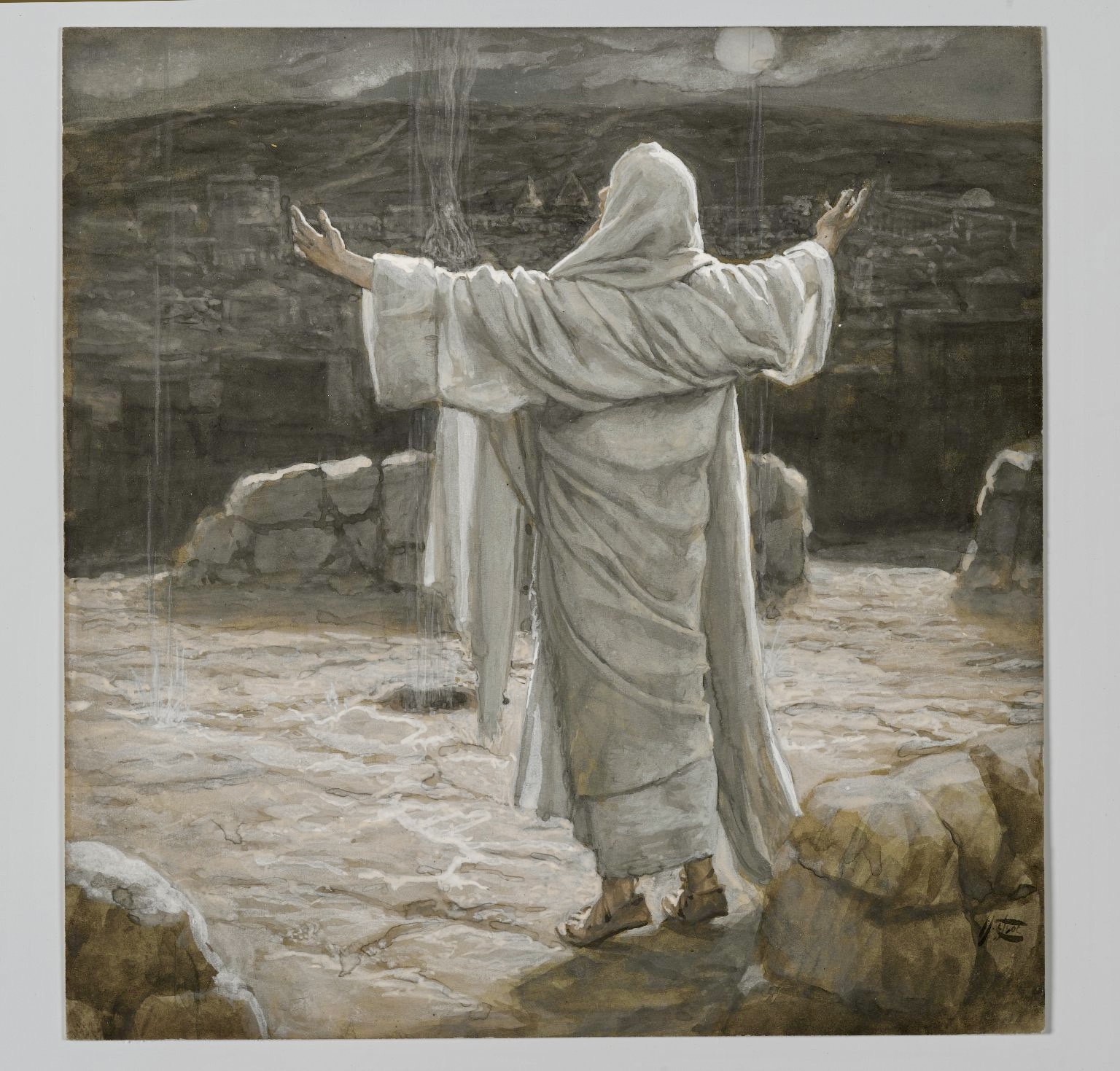
James Tissot, God Creating the World


If you are a Christian, and if you reflect on your formation as a person of faith, consider this question: Do you believe it is reasonable for God’s will to make sense to us? To ask this question opens the door to discovering how our beliefs about God were shaped, as well as our beliefs about God’s providential ordering of the world. Indeed, does God even want us to think about such things, or are we simply to accept and obey the divine will, regardless of whether we find this reasonable.

These questions also bear upon how we reflect upon what happened in Jerusalem 2,000 years ago, events that we consider during this Holy Week.

Broadly speaking, the Catholic tradition of thought – going back at least to Thomas Aquinas – anticipates a discernible overlap between divine rationality and that of created and redeemed human nature. God’s rationality is imprinted upon our powers of reasoning. By contrast, broad strands of the Protestant tradition – with its comparatively elevated concept of the Fall and human sin – have not nurtured and have even discouraged a similar expectation of such an overlap. Accordingly, we cannot expect or believe that our rationality has any real continuity with divine rationality.

One of the two traditions described above has emphasized the self-revealing comprehensibility of God, who intends for us to know, and not simply obey, the divine will. The other tradition has privileged the sense that God was and is wholly other, and therefore God’s ways are incomprehensible, except for small graces. Each of these two traditions has therefore had a different understanding of what it means for us to have been created in the image and likeness of God (see Genesis 1:26, in context).

A related and observable distinction regarding these two broad traditions concerns the relationship between grace and nature, and how this is construed. In the wider Catholic understanding, grace is more often seen as infusing nature, and present everywhere. Whereas a common view often found in Protestant piety anticipates that grace touches nature episodically, and sometimes is antithetical to it, given nature’s and our Fallen state.

James TIssot, God Appears to Noah

Another way we can distinguish the spiritual influence of the two traditions I am sketching here concerns the nature of God and of God’s activity. For example, shaped by a broadly Catholic catechesis, it is believed that there are at least three things that God cannot do: create a rock bigger than God can lift; choose to cease to exist; and, command us to hate ‘him.’ For, in the spirit of that same catechetical tradition, each of these three theoretical possibilities would be irrational, and thus contrary to the divine nature and being, as well as to who and how we were and are made to be.

Most Protestant thinkers and preachers would likely dismiss the first two of these three (im)possible ‘things’ as perhaps irrelevant rhetorical distractions. Yet, the third thing, however disagreeable and unforeseen in light of the New Testament, would probably be conceded as theoretically possible, especially given the historically Protestant stress on divine freedom and the importance of acts of will for personal right-believing. (In other words, though God could, God wouldn’t.)

A result of these differences between the two traditions is that questions about sin, misfortune, and the presence of evil, have tended to be handled differently in Protestant belief and teaching as compared to that shaped by Catholic spirituality. This difference can be noticed when we reflect on and speak about ‘bad things’ that happen to us. Does God cause such misfortune, or, allow it? How we tend to answer this ‘cause’ question can reveal something about the Christian catechesis by which our thinking and beliefs have been shaped. And how we think about this question regarding divine responsibility will benefit from insight going back to Aristotle concerning four different aspects of what the word ’cause’ can mean.

James Tissot, God’s Promises to Abram

Here is a fundamental question that can bring many of the above strands of thought into focus: Do we believe that God always loves us; always seeks intimate fellowship with us; and always seeks to draw us more fully into the merciful embrace of God’s redemptive purposes? Or are our answers to these facets of a fundamental question somewhat qualified? And if qualified, then by what?

Especially in view of our observance of Good Friday this week, I believe that we can answer this question about how God loves us in the affirmative. And we can do this without overlooking or ignoring such NT images as the narrow gate, and the Lord who will ask what we have done for the least of his brothers and sisters.

CS Lewis, among others, reminds us of a way that we can appropriately affirm God’s abiding love for all people. We can illustrate Lewis’ view with the following image: We may weep when we come before Him at the end of our lives. But our tears may be both from sorrow as well as from joy at our redemptive inclusion, despite all that may count against us. As long as, in that moment, we acknowledge Him, and who He really is. For we all will have the opportunity to do so.

Alleluia – Easter comes for everyone. If only we could better see how and why that is true!


Additional note: As an Anglican, I include my own tradition within what I refer to above as the broadly Catholic tradition. My goal with this post is not historical analysis but to provide grounds for reflection regarding two differing – yet sometimes overlapping – ways of approaching some central questions.