Boats

Remembering Stuart Levine in Charlevoix

Stuart Levine, about 2010, heading out to fish

* I first published a version of this piece in 2020, and I would like to share once again what this friendship meant to me.

For me, getting to know Stuart began with seeing a boat, an old boat. From when I first visited the northern Michigan harbor town of Charlevoix in about 2005, I noticed and was attentive to a classic fishing boat. It was a lapstrake wooden-hulled motor boat from the late 1950’s, painted in a beautiful dark forest green. Yet, I was also attentive to the easy skill and confident style of the boat’s captain, an older man whose approach to open water I admired and wished to emulate. During my increasingly frequent summer visits to Charlevoix, I took note of this boat and its persistent captain, who obviously knew what he was doing when going in and out every day to fish on Lake Michigan.

After about seven or eight years of seeing him and his boat each summer, and having taken photographs of them during many of those years, I finally met Stuart. One morning, early in the summer of 2013, I saw that venerable boat in my marina. The next afternoon I saw it again, while her captain was tying her up, having come in from another fishing trip. Plucking up my courage, I walked over and introduced myself. I told him of my admiration for his boat and for what I had inferred from my limited observation about his daily practice. As it turned out, both Stuart and I loved old boats. And, serendipitously, Stuart and I hit it off. We were weekly correspondents, and fellow summer boaters from then on.

As time has shown me, I had encountered and begun to be acquainted with a person of remarkable ability, sensitivity, and enhanced intuition. From first knowing him, Stuart seemed to look beyond the apparent limitations of the present moment, attend to what might be hoped for, and reflect on how the future could really be different. As I came to see, Stuart’s approach to life was nothing like the proverbial person who ‘sees things through rose-colored lenses.’ Stuart’s optimism was grounded in a belief that a different and more positive future results from actually choosing to live in a different way now, not just from believing or hoping differently.

A great example of this aspect of his character took place one summer. Standing with him on the Charlevoix dock while he was stowing his fishing gear after an outing, I asked about all the fishing tackle and gear he left on the boat, openly visible to anyone who might come by. Stuart told me about a valuable fishing rod that he had once left on the boat in a similar way. Upon discovering the rod’s disappearance the next day, he wrote a letter to the editor of the local newspaper, describing the theft but saying that he would not change his usual trusting practice. He wanted to spend his summers in a community where people modeled trust, rather than self-protective fear.

I am reminded of an episode in a video by the former National Geographic photographer, Dewitt Jones (Celebrate What’s Right With the World). On assignment, Jones visits a living national treasure of the UK, a woman who was an acclaimed weaver up in the northern Hebrides Islands. Jones asks her, what do you think about when you weave? She responds by first saying, “I wonder if I will run out of thread!” Jones admits to being surprised by this. But then, she says, “When I weave, I weave…”

Stuart lit up when I told him this story, and he then said, “When I fish, I fish.” He told me that his delight was in the process, more than in the results. His comment then struck me, as it still does, as absolutely authentic to him. Even though this was a man whom the Michigan DNR highly regarded for having documented every lake trout he had caught and released for decades!

At a marina cookout in 2019, Stuart and I talked about the evolving challenge of evaluating college and graduate students in this current era. With several other boaters attentive to his comments, Stuart talked about his commitment to trusting his students. As always, he spoke positively about how placing trust in others encourages them to live into our imputed and projected hope for them. He often reflected on this principle with me, hoping to commend it. After all, it is founded (among other places) in Aristotle and in the Hebrew Scriptures. For what we practice, and live into, shapes who we are becoming. Stuart exemplified this insight.

And yet, at that cookout, as a less-wise and less-experienced former academic, I responded by describing my disappointing prior service on a national examination board. As he invariably would in such conversations, Stuart challenged my apparently less-than-positive view of such processes. He did this in a way that was shaped by his long life experience of having served as a reflective scholar. By his comments in conversations like this, he would disclose how he was both intellectually curious as well as spiritually sensitive. In this way, he showed how he was often a mentor not only for young intellects but also for older souls.

Stuart reminded me of some my favorite teachers. He did this by how he modeled a particular virtue. It was his disposition to value good questions over what often seem to be important answers. For me, Stuart was an excellent example of one who always encourages others to wonder, and then ask, “But, what is the question?” For when we come to appreciate the horizon of a beautiful question, we are then more open to discovering meaningful answers to which it may give rise. Stuart displayed an abiding curiosity about finding good questions. And this led him to discerning an ever-expanding body of insightful answers.

In one other important respect I would like to offer a tribute to Stuart. From time to time he would share with me words of respectful remembrance he had shaped in his effort to honor former colleagues, friends and students. His approach to this sometimes difficult task was compelling. For Stuart embodied a desire to recognize and express appreciation for the gifts, strengths and achievements of others, as a kind of spiritual practice in itself.

May Bard College and other teaching institutions always be blessed to have persons like Stuart Levine among their faculty and in their administrative staffs. And may we all be blessed to have a friend like him.


I first offered this tribute in memory of Professor Dr. Stuart Levine six years ago, who died on May 1, 2020. He was formerly a Dean and Professor of Psychology for many years at Bard College, Annandale on the Hudson, New York. Stuart’s cultural and spiritual roots were within Judaism, and Bard College’s early history was associated with The Episcopal Church, within which I was ordained as a deacon and priest.
The Dynamic Beauty of Wind and Water

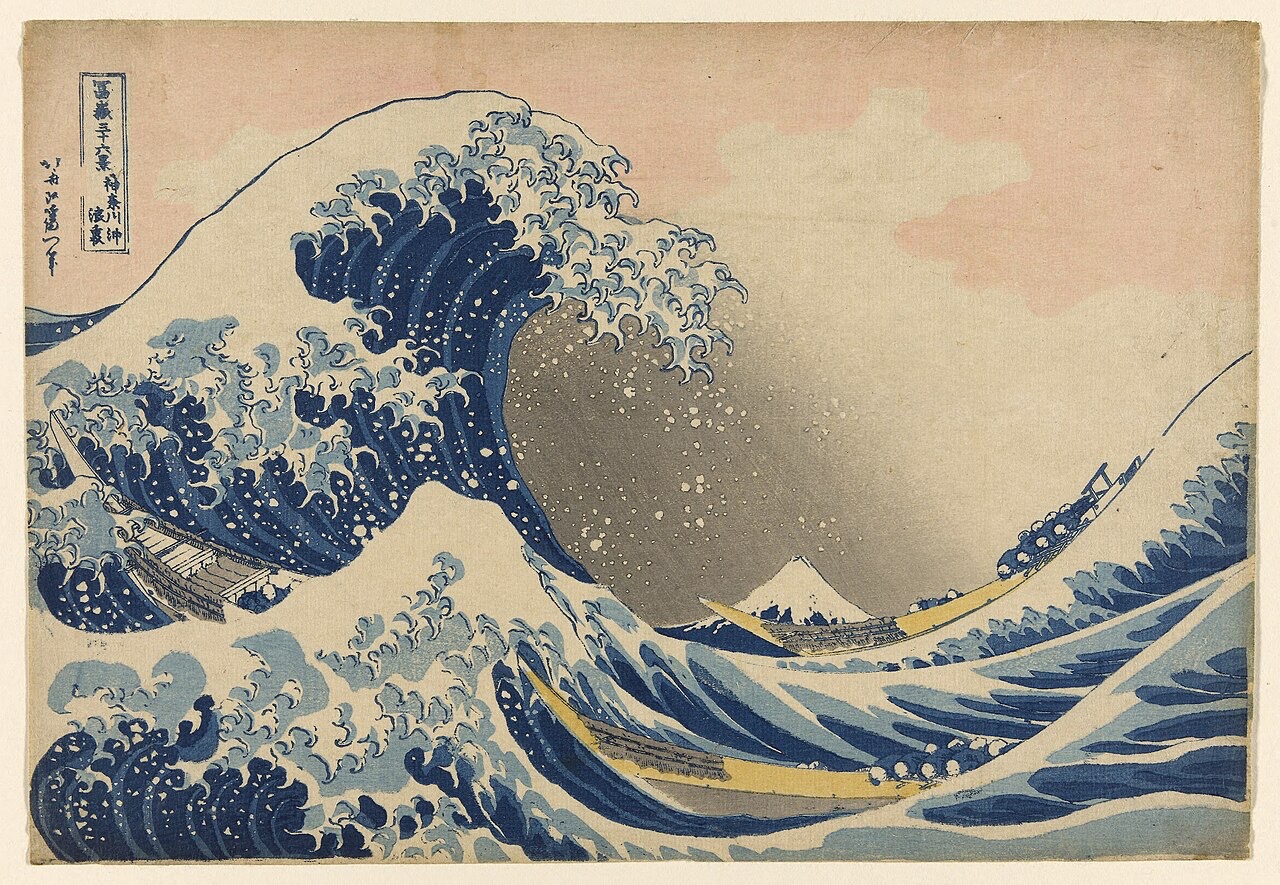
Hokusai, Great Wave of Kanagawa

Being a sailor, I appreciate what it means to reckon with the variability of wind and water, key factors that make successfully navigating a sailboat so much more challenging than contending with the same weather on the shore. As Captain Ron is often-quoted as saying in a humorous film, “If it’s going to happen, it’s going to happen out there.”

An old adage reminds us that there are old sailors, and risk-taking sailors, but no old risk-taking sailors. So, we learn to observe and attend to the present state of the wind and the water. Wise sailors don’t sail according to a calendar, but according to the conditions. Such a responsive approach to what we behold in the world around us is strangely antithetical to our modern often unexamined belief that we can gain control of almost everything. 

I think that one thing I learned from growing up in Japan was the quality of the calming effect of water. Like people all over the world, but especially those who live on island nations, the Japanese have a vivid and dynamic history of encounter with the power of water that can also be adverse to settled life on land. Over the centuries, they have cultivated a keen sense of the healing power of water in what strike many as spiritually-designed contexts. Yet, Japanese fishermen have for centuries fought and endured stressful circumstances in the seas, most especially off their eastern shore, with the deep blue Pacific beckoning beyond. Yet, that was the direction from which maritime trade with the West became most available, not neglecting their historic links with the southeast Asian peoples with whom they had historically traded and warred.

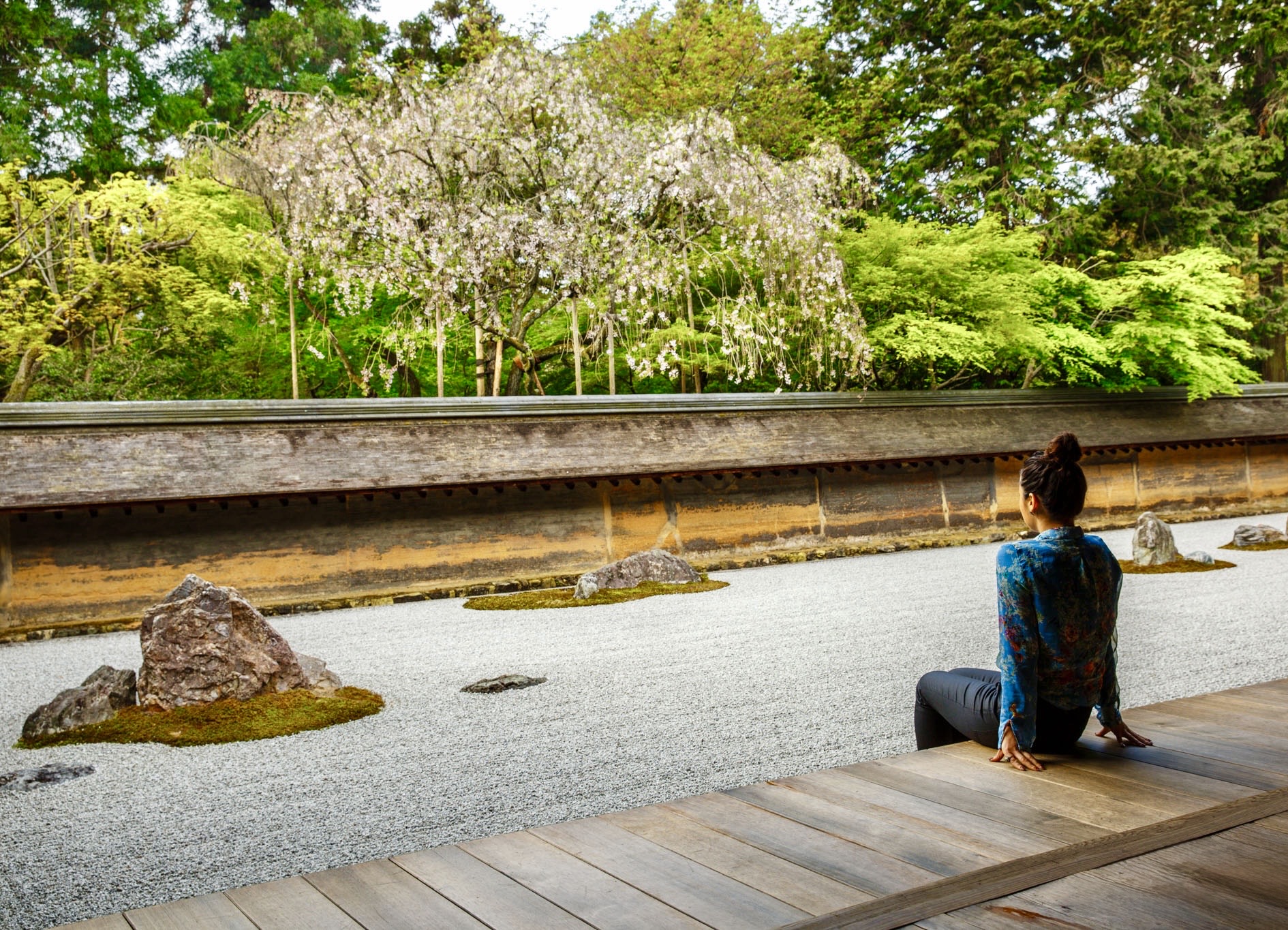
A visitor contemplates the serenity of Ryoanji Temple stone garden in Kyoto

Think of what we often consider to be examples of Zen gardens like Ryoanji Temple in Kyoto, with its raked spread of dry pebbles mimicking the rippled surface of calm seas around stone islands, paralleled elsewhere by garden ponds for Koi and ornamental goldfish. Or the beautiful motes surrounding ancient castles, which provided safety from hostile neighbors as well as tranquility when circumstances were free from war-making.

The tranquil mote surrounding Matsumoto Castle in Japan

My next brother in age order and I like to remember our first sailing experiences, bobbing in dinghy’s among large floats designed for securing ships in Yokohama Harbor, a principal historic seaport in which oceangoing ships often arrived. We did not really know what we were doing except responding to immediate circumstances, which is a lot of what sailing is about, especially when the sailors are at least minimally informed.

Water has latent power that is often not apparent to us. A quiet brook near our present boat slip still channels through the remains of an old mill, which harnessed the energy to be found in a stream only a few feet wide. And 19th and 20th century engineers, following the practices of a millennia of predecessors, saw in the movement of rivers running through peaceful valleys the latent energy to light up cities. Water seeks every opportunity to go where it is not, provided the least occasion to fill a void or find a lower elevation. Water can be one of the strongest abrasives, wearing down even the hardest rocks, especially when in frozen form as glaciers. 

In view of all this, it is fitting that Jesus – as quoted by John – found in wind and water metaphors for life in the Spirit of God. For “the wind blows where it will” while we seek to be lead “beside still waters.”

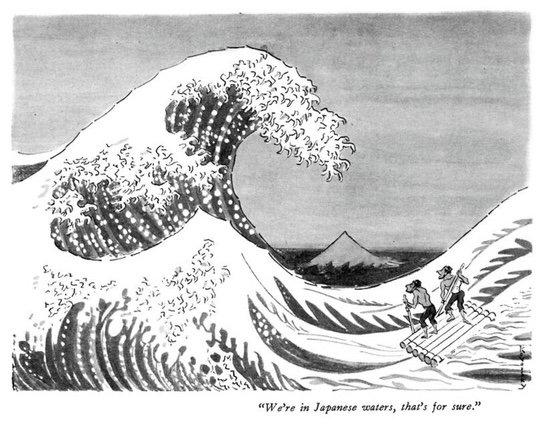
A magazine cartoon from The New Yorker showing a debt to Hokusai

Some Rebuild Classic Wooden Boats

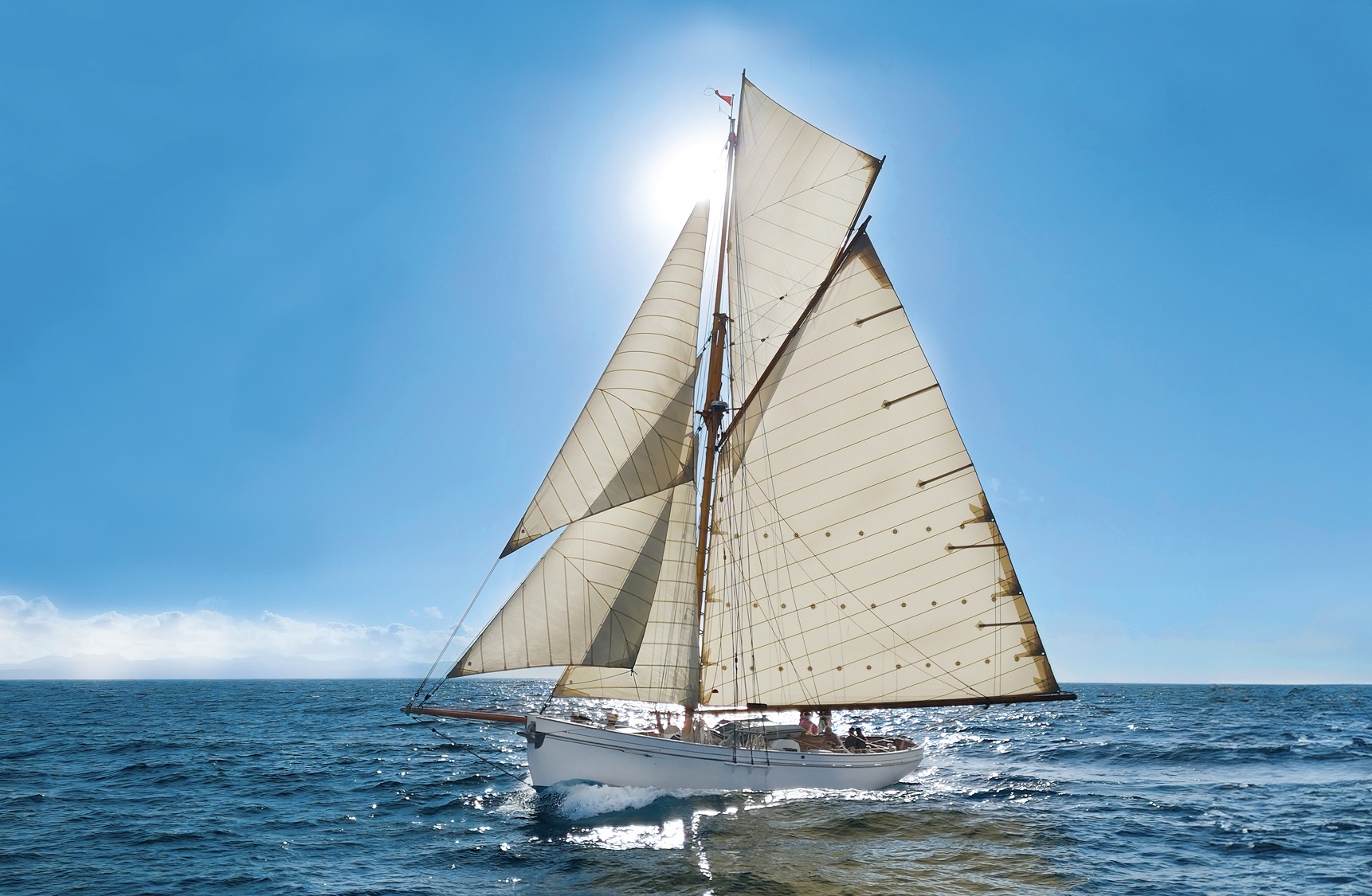
Tally Ho in her glory, with her full suit of sails

My brother, who shares my love of boats, introduced me to the YouTube video channel based on Tally Ho, a classic wooden sailboat rebuilt by a young man named Leo Goolden. Watching Leo’s videos led me to those made by Nicholas Verrochi, about his preservation work on the Argonaut II. Through further viewing, I found videos made by the boatwright, Barry Collins, and then Joshua Alexander’s series titled A Boat in the Woods.

Several noteworthy things connect these particular examples of folks who love boats. Most appear to be in their 30’s or younger; they have pursued restoring or re-building traditional wooden boats; and they have gravitated around or have connections with the boat community at Port Townsend, Washington. Together, they display what is perhaps the simplest definition of vocation: doing what you cannot not do. And then, applying yourself to it as fully as you can. This may be the most elemental way that we gain God-awareness in our lives.

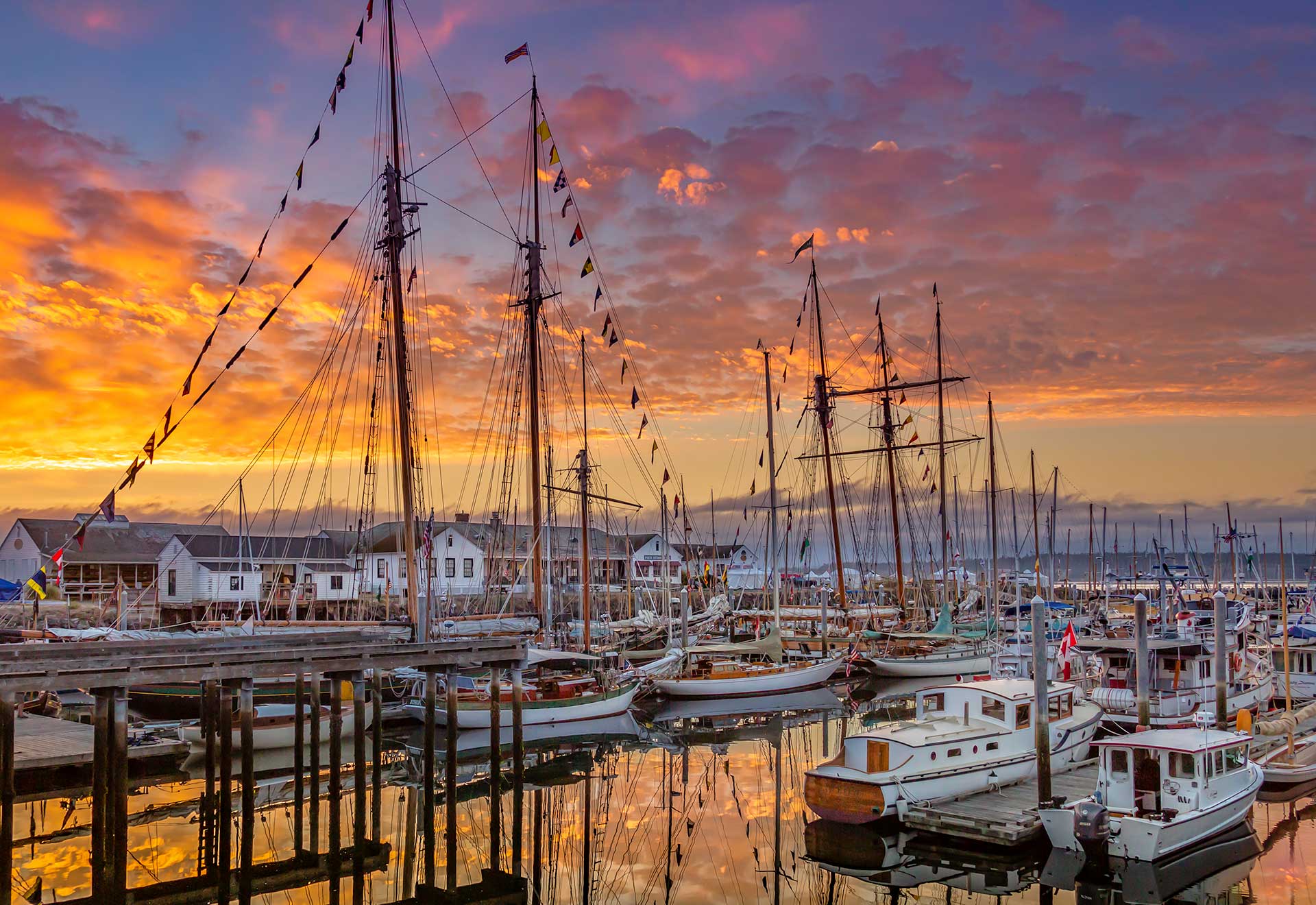
A photo capturing the Port Townsend Wooden Boat Festival

As long as there have been young dreamers and old hulls, there have been romantic attachments to wooden boats. This may especially be true in our technological era, run by electronics operating on industrial mechanisms composed of synthetic materials. The art of building wooden boats, well associated with the “age of sail,” has experienced something of a renaissance. Evidence for this includes nationally-known boatbuilding schools offering project workshops, and companies that produce wooden kits with pre-cut materials, attractive to aspiring boat builders. Wooden Boat and Small Boats Monthly are two examples of popular publications that provide knowledge about boats of this kind, as well as basic instruction concerning building techniques employing traditional tools.

There is an observable confluence of energy and enthusiasm amongst the particular group of folks I am featuring here, with their common interest in restoring examples of wooden boats, along with their shared rediscovery of fulfilling patterns of life on vessels not permanently moored in a single location. Their videos offer continuing education regarding the restoration and maintenance of old boats, as well as an introduction to facets of essential ‘boat craft.’

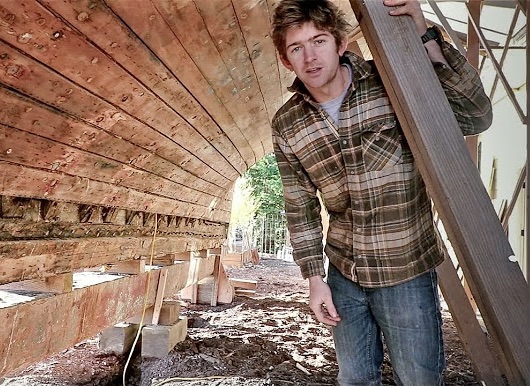
Leo Goolden under the hull of Tally Ho during her reconstruction

Tally Ho! Leo Goolden is a very likable young man with the skills of a master shipwright who possesses a keen eye for craftsmanship in work, materials, and ship hardware. It is impossible not to fall in love with the restored Tally Ho (launched in 1910), presently making her way into the Caribbean Sea, having transited from British Columbia. Leo’s well-filmed videos, along with their explanatory power and evocative musical selections, provide evidence of his successful fundraising. Every feature of this 48’ gaff-rigged cutter attests to the ‘quality-first’ orientation of a purist who knows what he is doing, and who is open to learning about the ‘best next options.’ Those who dream about sailing the perfect wooden boat will love following Tally Ho and her continuing adventures.

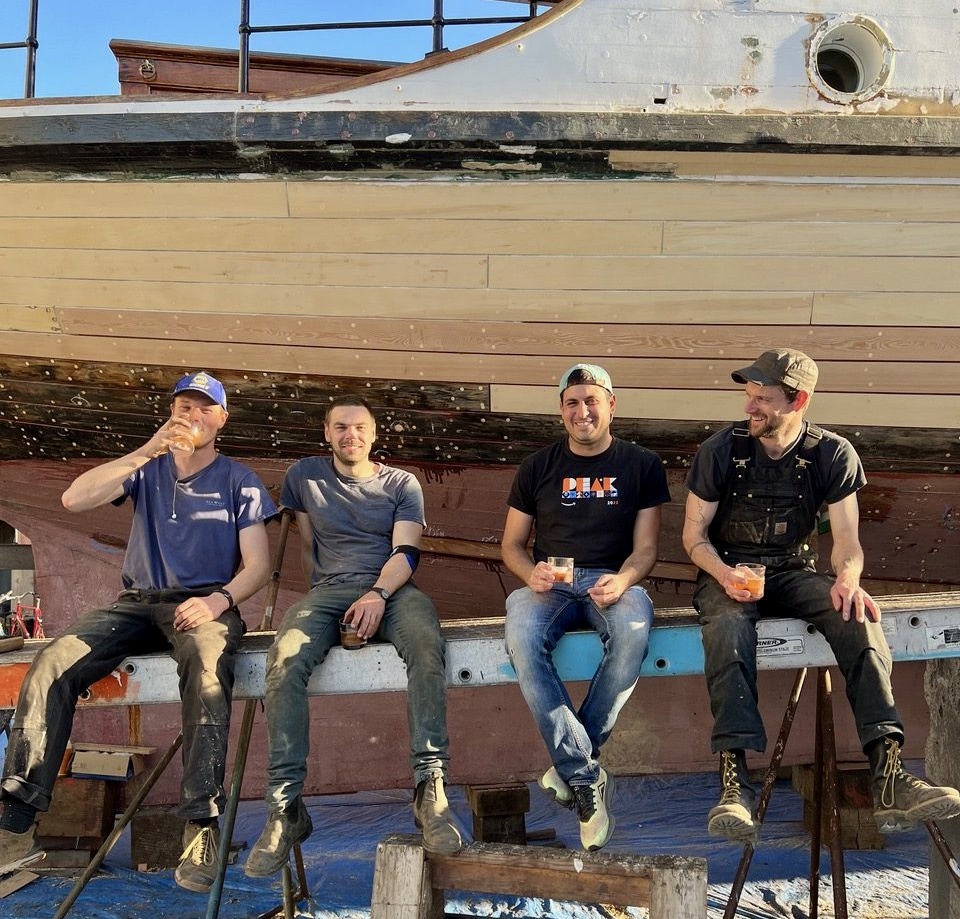
Nicholas Verrochio and his boatwright assistants
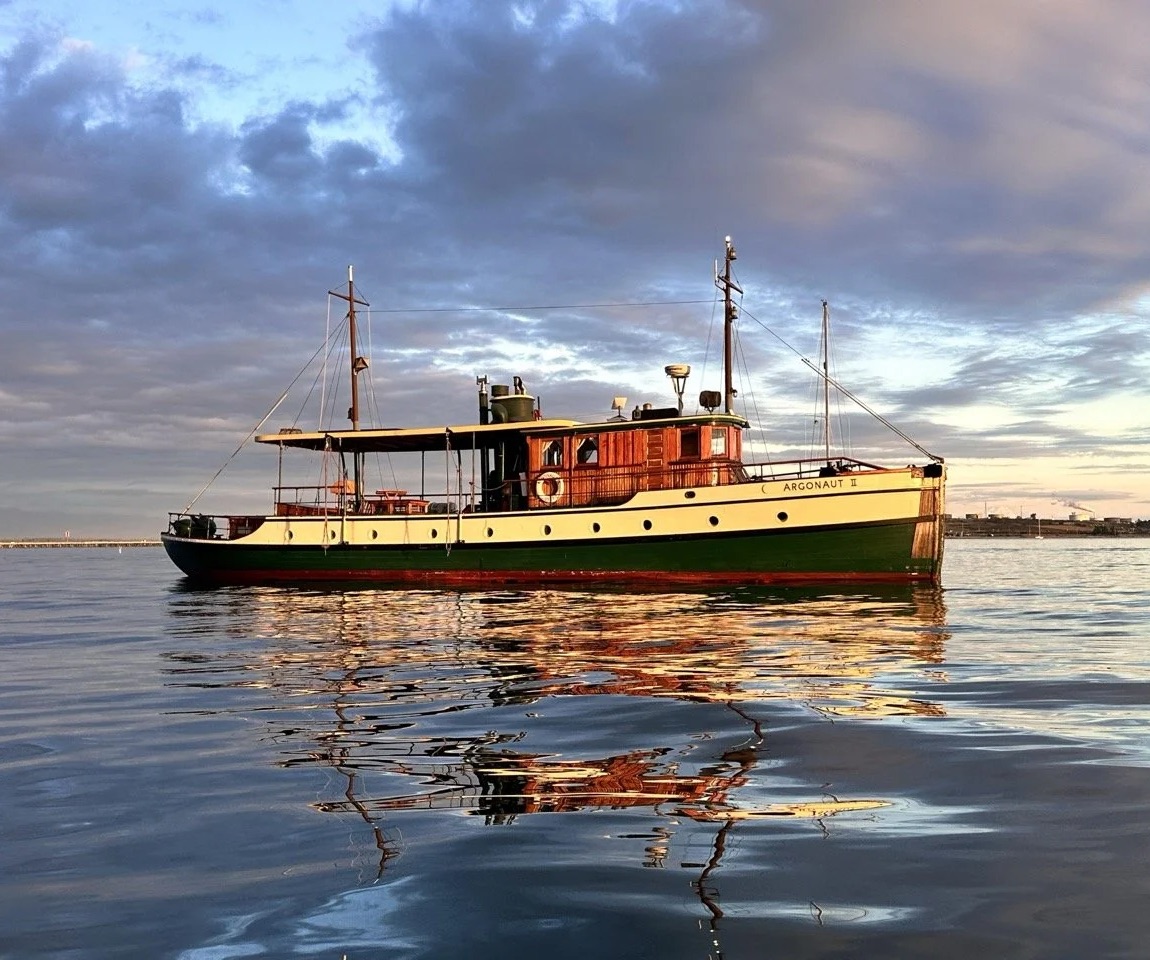
Argonaut II at sunset on her home waters

Nicholas Verrochio and a team of marine carpenters are presently rebuilding signficant portions of the hull of Argonaut II, a beautiful 73’ motor cruiser originally launched in 1922 for a lumber tycoon, and subsequently used by the United Church of Christ for decades as a floating missionary post stationed in the Georgia Straight. Nicholas has evident gifts for both hospitality and the stewardship of history, and sees his work on Argonaut II as having a mission to share discovery experiences on the water in the comfort of a historic and well-preserved yacht. Watching his videos, including those displaying the meals he prepares, inspires pleasant thoughts of chartering his boat.

Sailor Barry and Hailly, who share stewardship of Thunder Child
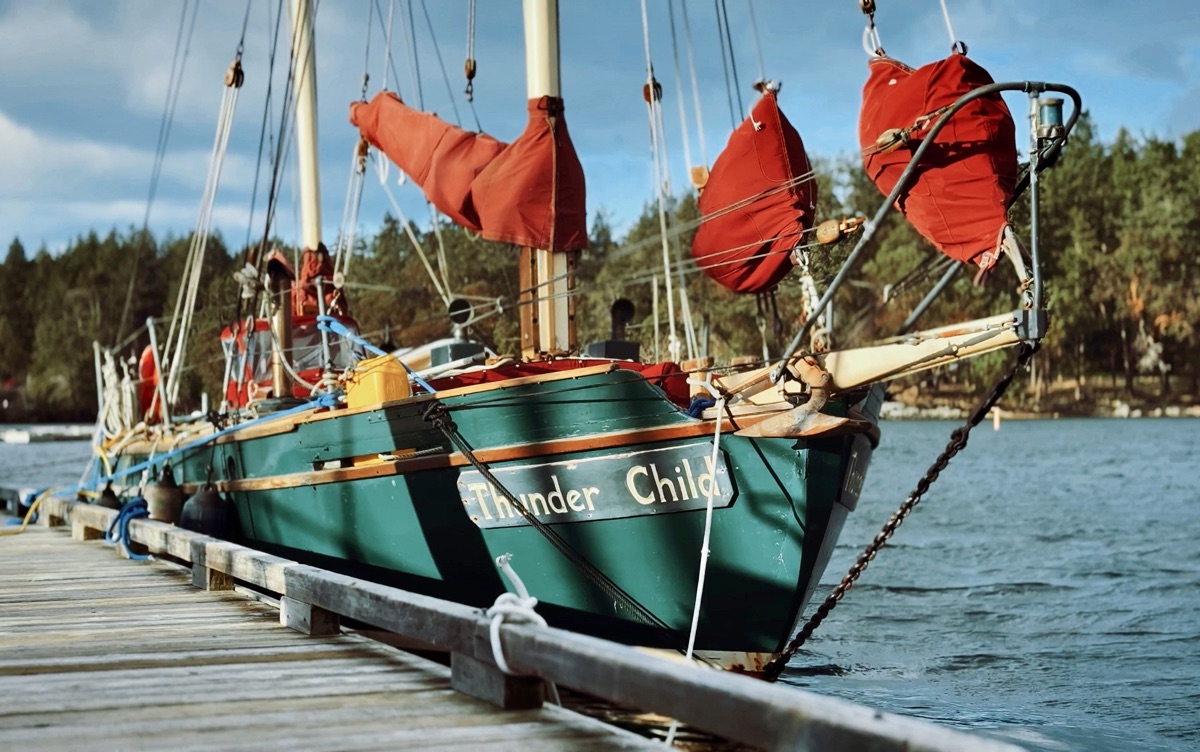
Thunder Child at her dock

Sailor Barry’s videos tell us as much about how tending to boats has been ‘life work’ for him as it has been about being a shipwright. His path has been strongly shaped by hard work on the sea, and he seems to have a natural affinity with marine carpentry and mechanical matters. Watching him at work, we learn how his abiding application of himself to boats and woodworking have had an attractive healing power for him. He and his sailing partner, Hailly, have done wonders with transforming Thunder Child, their 1971 William Atkin 36’ gaff-rigged ketch, purchased from a couple who had owned and sailed it for 49 years.

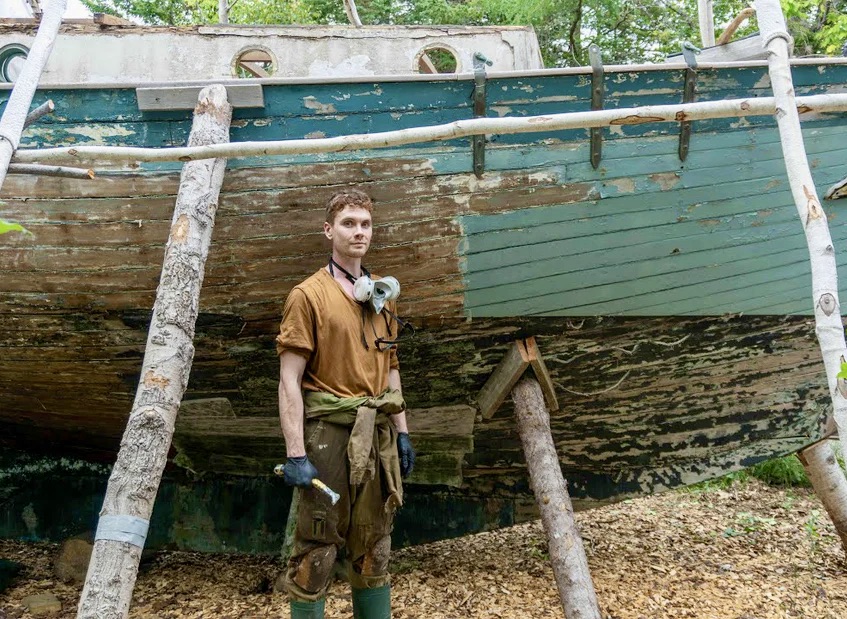
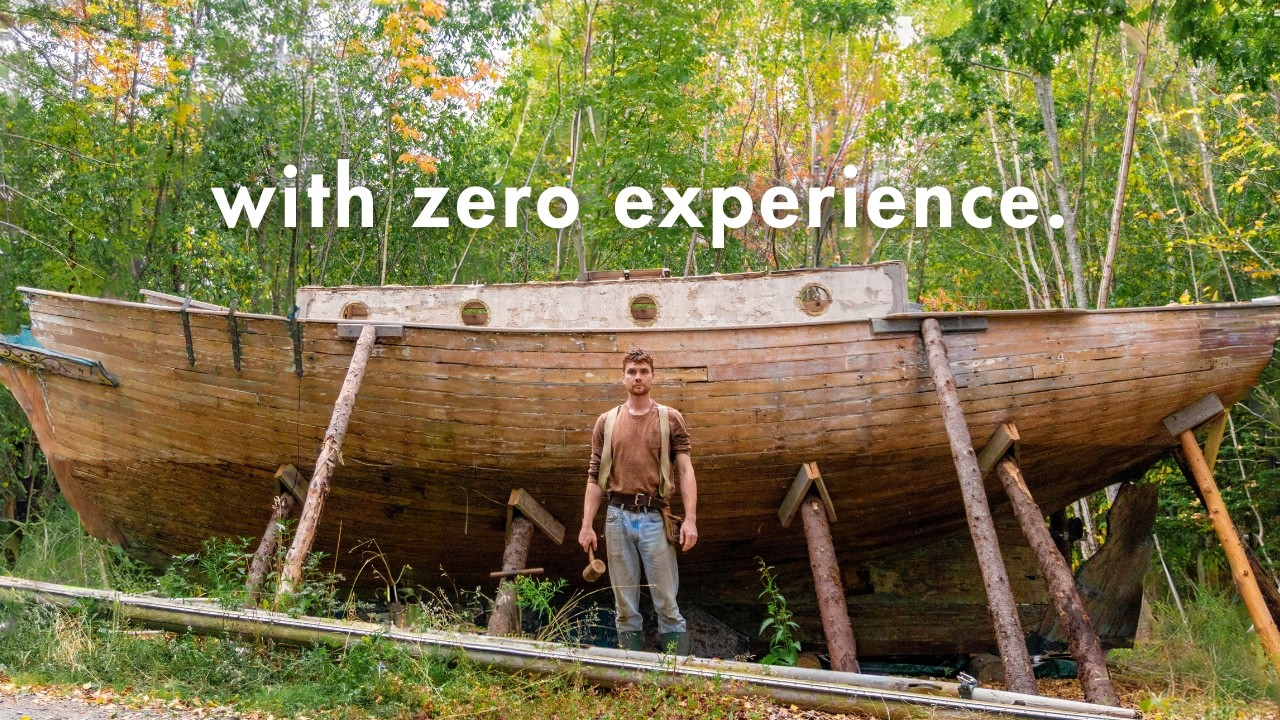
Joshua Alexander working on the hull of his as yet unnamed boat in a Nova Scotian forest

Joshua Alexander’s videos effectively document his ongoing campaign to make seaworthy a forlorn 40’ boat built in 1966 in Yokohama, Japan. He had the hulk moved to a friend’s wooded property where he built a tented structure in which to live while working on her. With very limited resources and alone except for a curious owl, he demonstrates the vision, dedication, and woodworking knowledge to see through this immense project. His droll, emotionless voice-over narration, which does not overlook his recurring setbacks, is strangely compelling, conjuring up images of a 19th century New England sea captain reincarnated as a youth in the woods of contemporary Nova Scotia. Yet, until recently, Joshua has never sailed a boat! For those who love ‘underdogs,’ Joshua and his boat present us with a paradoxical conjunction between our high hopes for him, and a project that faces immense challenges.

A still image from Joshua Alexander’s A Boat in the Woods series

Additional Note: YouTube provides an accessible way to become more familiar with these boat builders and their projects. Their videos can be found linked to the following YouTube channel names (in the order in which I have presented them, above): Sampson Boat Co (for Tally Ho); Argonaut II; SailorBarry; and A Boat in the Woods.

Nikawa’s Voyage From Coast to Coast

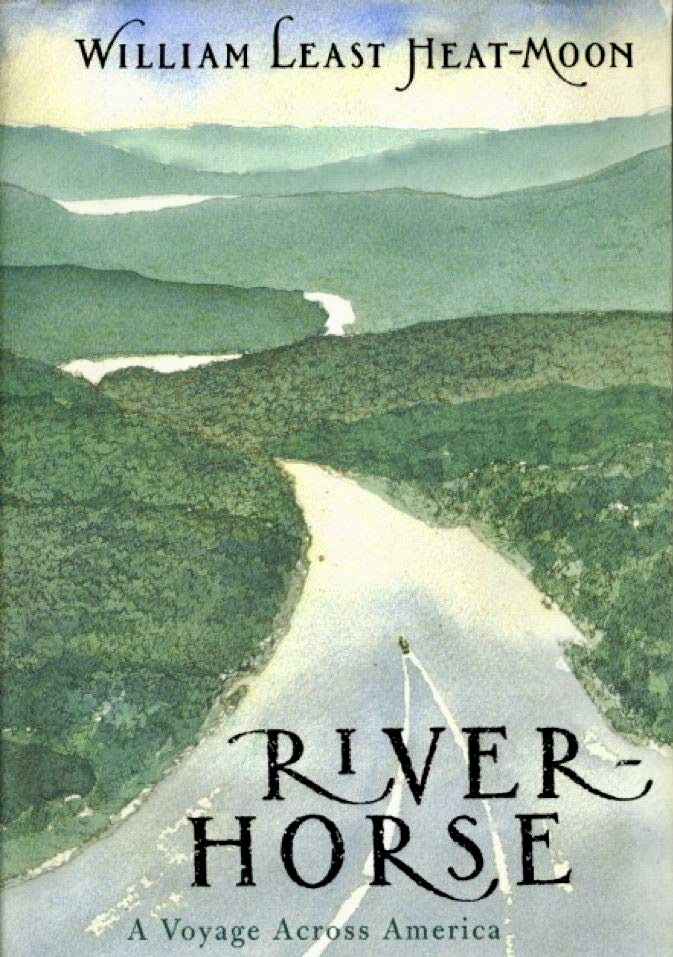
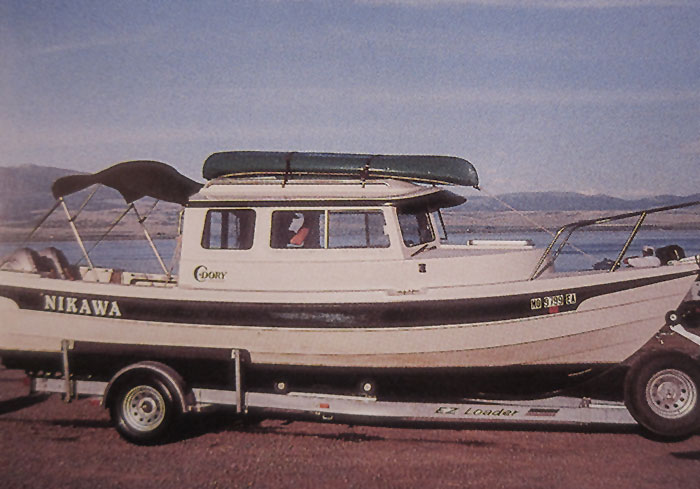
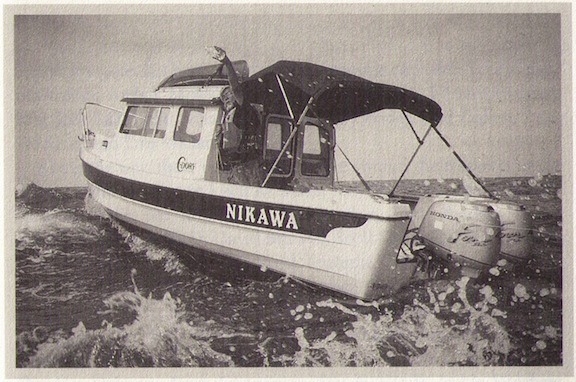
William Least Heat-Moon (the pen name for William Lewis Trogdon, hereafter WLHM), continues to impress me with his nuanced vision of the United States. He consistently offers his readers a synthesis of well-crafted writing, an appreciation for the sometimes hidden beauty of the lands and waters he explores, and a sensitivity to features of our common humanity latent within the historical events attendant to the people and places he visits. I return from time to time to his book, River Horse: A Voyage Across America, a book I love for its clear-eyed record of his water-based journey across this country. On a 26’ C-Dory motor cruiser, and accompanied by several friends whose roles are represented by symbolic monickers (e.g., Pilotis, and ‘the Photographer’), he traces a voyage from the mouth of New York Harbor to that of the Columbia River in Oregon. Readers familiar with geography but new to this book will wonder how WLHM managed to cross the Continental Divide in the C-Dory, and will discover that the author and his friends’ passage was facilitated by a vehicle trailer around some portage points, and by a canoe through and over the western mountains at their highest points.

Nikawa on her trailer, with the handy canoe secured above the pilothouse

WLHM periodically uses unfamiliar vocabulary in a way that may strike some readers as pretentious, but which I generally find apt and instructive. Clearly, he savors words as much as the sights he seeks to capture through his writing. His evident identification with the sentiments expressed in quotations from earlier journals and public documents, and the care with which he treats them regarding the places he visits, tells us a lot about the author.

This is the kind of book that boaters who have a yen for nautical adventure will love. As I do for his other published work, I have a high regard for what WLHM has accomplished with this travel narrative. He has filled it with insight concerning not only geographical terrain, but also with pertinent observations about the people he meets, who interact with or are sometimes indifferent to the beauty he encounters along his passage. As an able and informed observer, the author communicates much about what he sees as well as about its potential significance for others who might come along after him. His book is shaped by his dialogue with the recorded experience of those who have traversed the same waterways and their surroundings before him, as well as by contemporaries familiar with the same areas. By this means, WLHM draws readers in to his own reflective experience. He invites us ‘to look over his shoulder’ and then journey with him through the captivating but also sometimes less than encouraging features of where he goes. To this point, in his expressed appreciation for numerous rivers negotiated by Nikawa, he does not overlook reporting on the accumulated plastic debris that by the mid 1990’s had already collected in certain pockets of at least one river. He then offers brief but also judicious comments with respect to potential remedies for public attitudes about the waters that border our towns and rural lands.

The author and his boat, observed during his voyage (evidently from a newspaper photo)

Aside from his absorbing description of the commencement of his voyage, which effectively draws the reader into his narrative, several passages in the book linger in my memory. I think of his account of Nikawa’s passage down the relatively gentle Ohio River, which is often calm due to the series of locks and dams. His reflections about the river evoked thoughts of a possible retracing of his pathway through those waters, especially given their occasionally curious personal and historical associations (as in the following vignette). 

In this part of his text, WLHM offers a brief account of an Irishman who was persuaded by Aaron Burr to join a nascent conspiracy to found a new and independent political domain lower down the Ohio and by the Mississippi, a venture later halted by authorities sent under the direction of Thomas Jefferson. This provides a good example of the numerous occasions about which WLHM interweaves observant travelogue with his study of past events. Interspersed within this same portion of the narrative focused on the area around Marietta, the author reports humorous offhand comments gleaned at a diner. After his conversation with a local woman, a beautician named “Enna-mel,” she leaves him with a parting remark that adds spice to the story. 

The author in what may be his second favorite place to be, an historical archives room

Shaping words about the work of an accomplished writer can be hazardous, though I am encouraged by WLHM’s quotation of a portion of William Clark’s Journal from the great 1804-6 expedition to the West. Clark’s struggle to portray the then sublime splendor of the untamed Great Falls of the Missouri River clearly were significant to WLHM. This is evident in the latter writer’s implied recognition of the challenge posed by his own desire to communicate the fullness of his experience of the same waters. 

River Horse is sprinkled with anecdotes from earlier times, along with perceptive observations from William Least Heat-Moon’s journey notes. He well-describes the many rivers through which Nikawa made her way, and almost every page of this book offers detailed insights that will reward an attentive reader, especially those who muse – as I have – about undertaking a similar adventure. 

An ‘Inside’ Passage: Jonathan Raban’s Voyage to Juneau

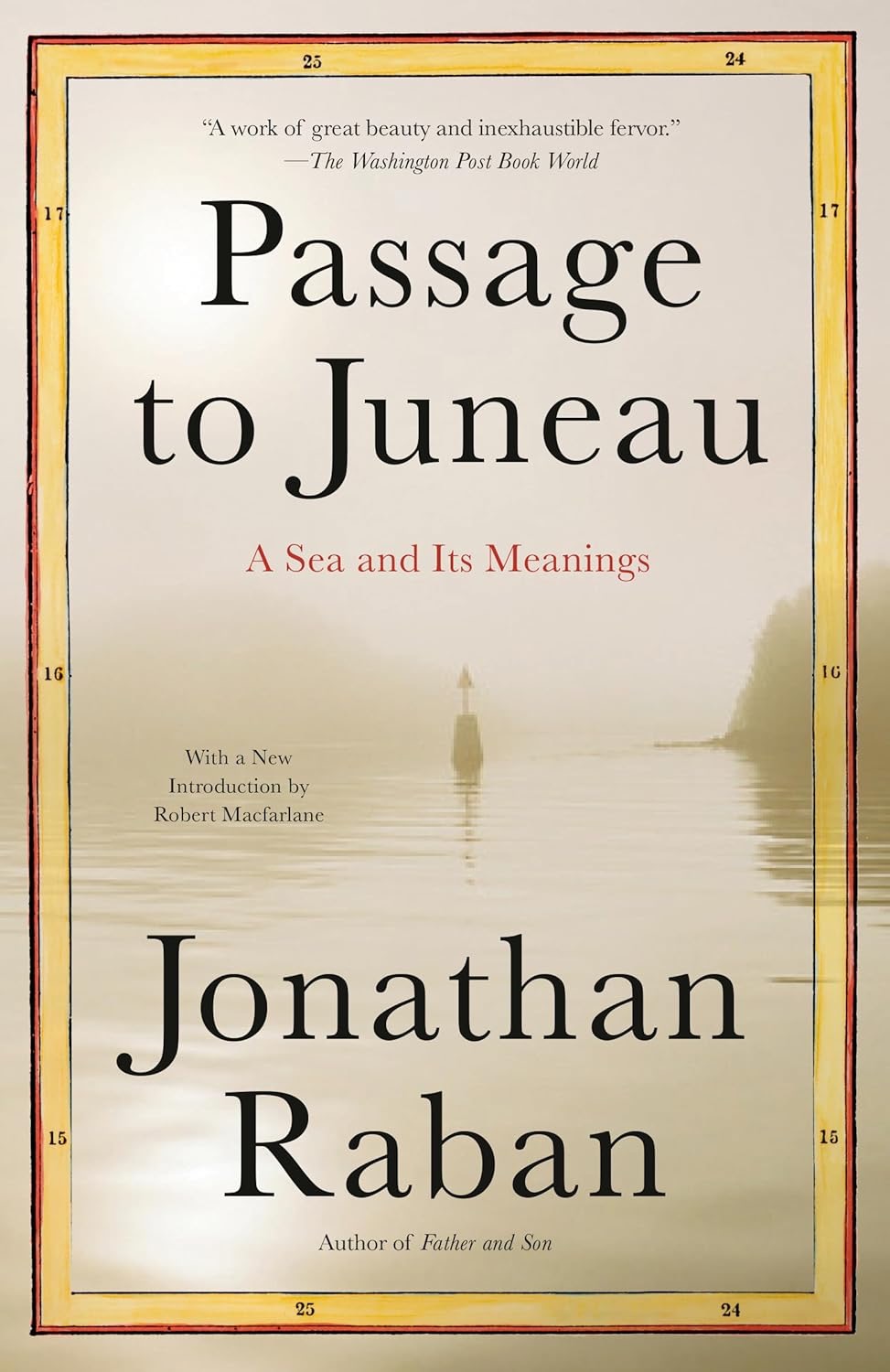
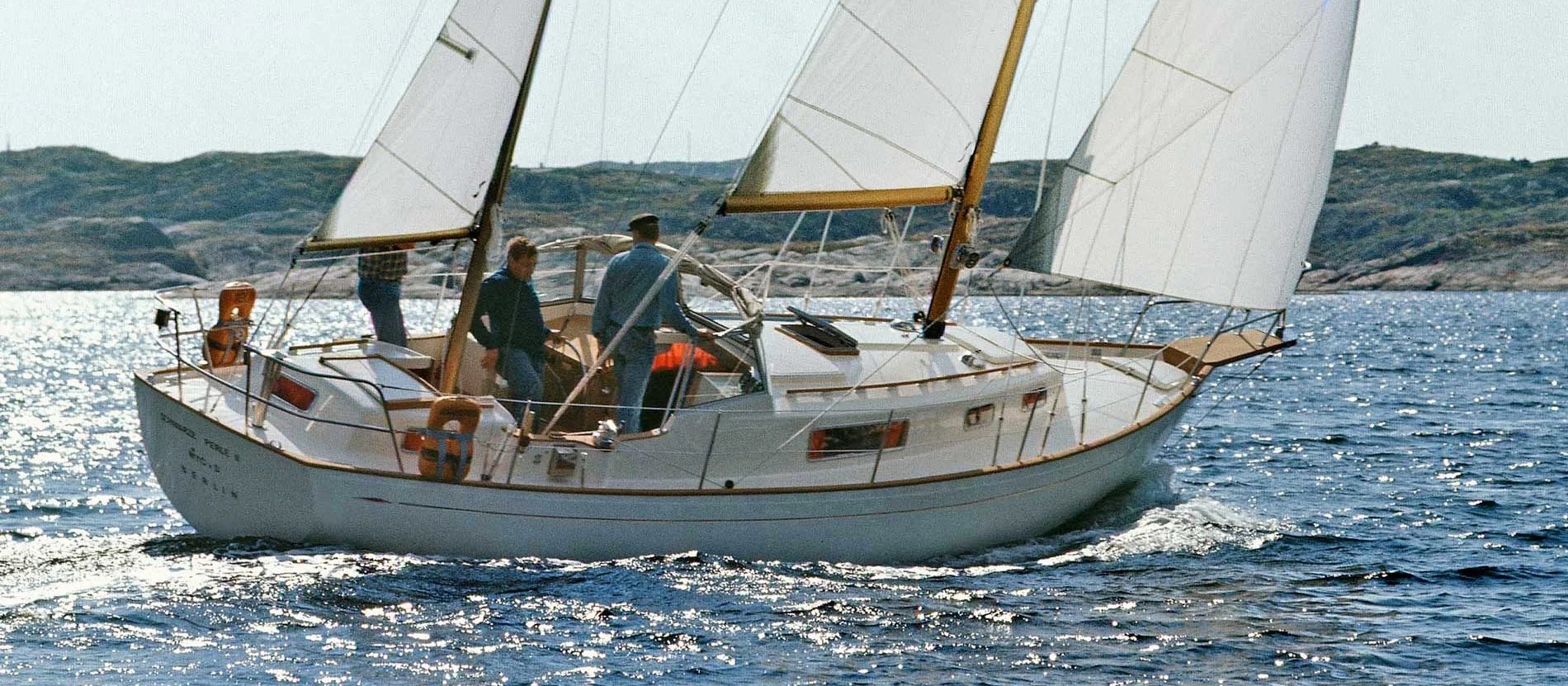
I find that authors who are effective at reading aloud their own writing offer an extra dimension of insight regarding their work. Jonathan Raban’s recording of A Passage to Juneau, is an example to which I like to return. Being a sailor myself, I find voyages, sailboat cruising, and basic navigation provide more compelling metaphors for how we think of our course through life than the often used one of journeying. Raban’s book about sailing his 35′ Swedish-built ketch from Seattle north to the capital of Alaska recounts so much more than a trip up the Inside Passage through the interior waters of British Columbia. His reflective narrative allows us to witness – through his eyes – how he faces the challenges associated with the death of his father, an English Vicar, as well as the coming apart of his marriage while he remains close to his young daughter.

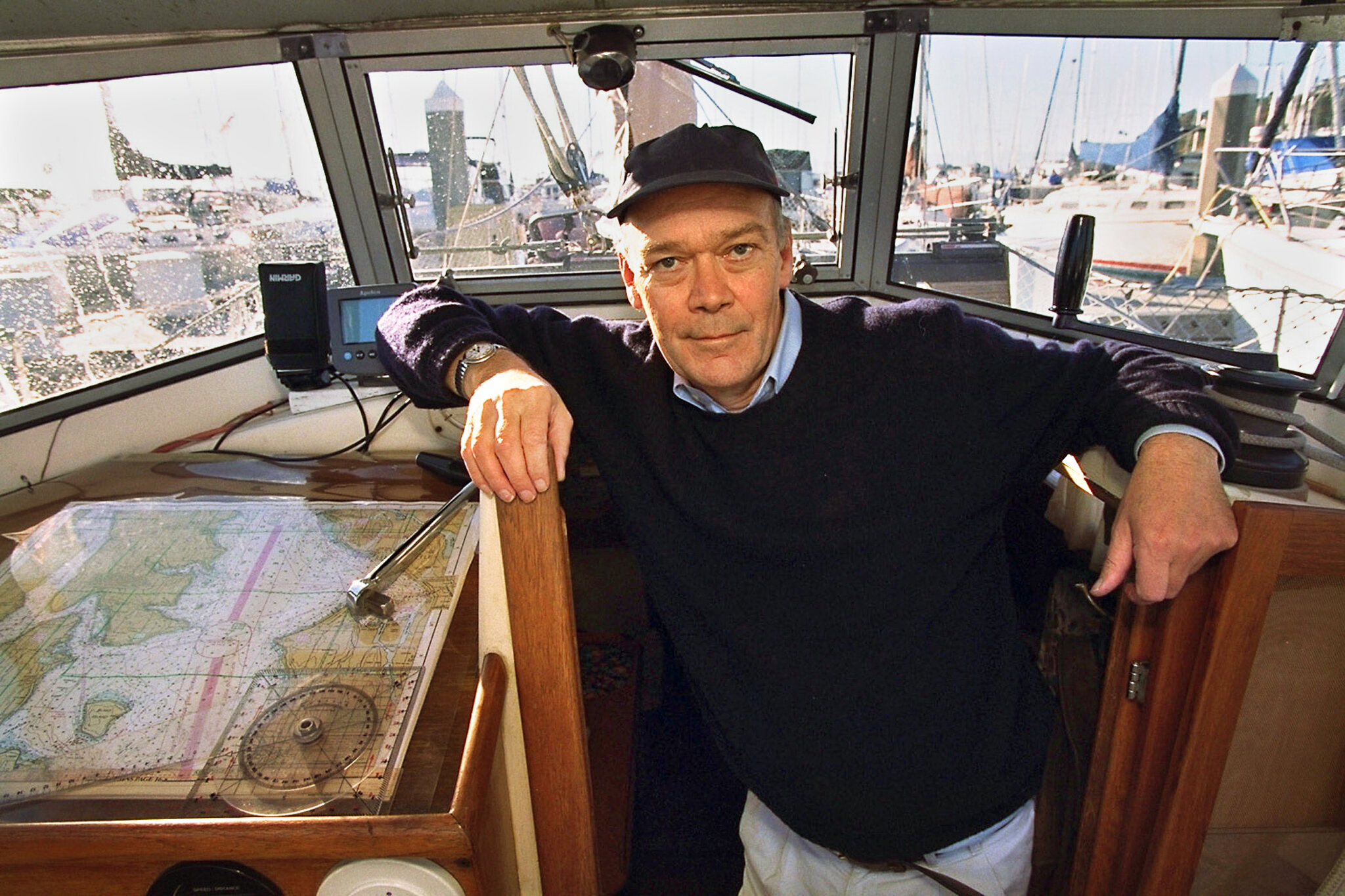
Jonathan Raban in his boat

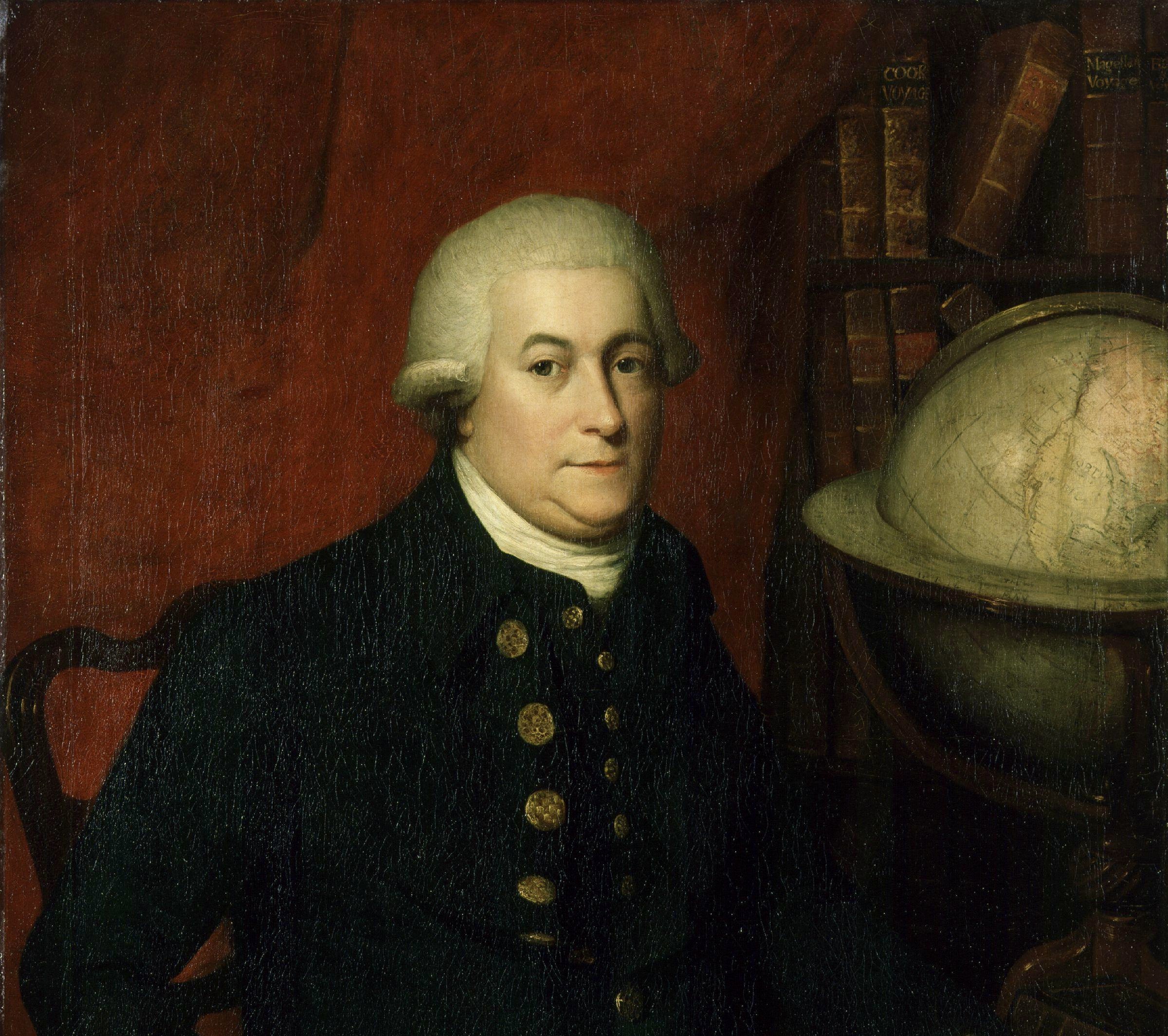
Raban includes as a literary companion, on what unfolds as an imaginatively-shared voyage, the technically gifted but personally flawed explorer, George Vancouver, through the latter’s ships logs and historical biography. Raban’s log of his passage in the Penelope is interspersed with perceptive observations about his family off in England and down in Seattle, while also sharing reflective thoughts regarding Vancouver’s own earlier exploration of the same waters. So there are three interwoven strands within the writer’s expressive narrative, Raban’s cruise, his interior journey through memories and toward an uncertain future, and a travel oriented book that shares his evocative impressions of the waters and terrain of Puget Sound and the Straight of Georgia that is mixed with those Vancouver.

The explorer and esteemed navigator, George Vancouver (1757-1798)

Having lived on Vashon Island while commuting to college on the Washington State ferries, I remain drawn to some of the same locations in Puget Sound that play an early role in the book. The immediacy of the author’s description of the area in and around Seattle’s Fishermen’s Terminal where he prepared for setting off, as well as of the beautiful San Juan Islands, provide a very good sense of what he was leaving behind on his travels, while also emotionally carrying aspects associated with those places with him as he ventured into less familiar waters.

A Hallberg-Rassy 35′ ketch much like Raban’s boat, Penelope

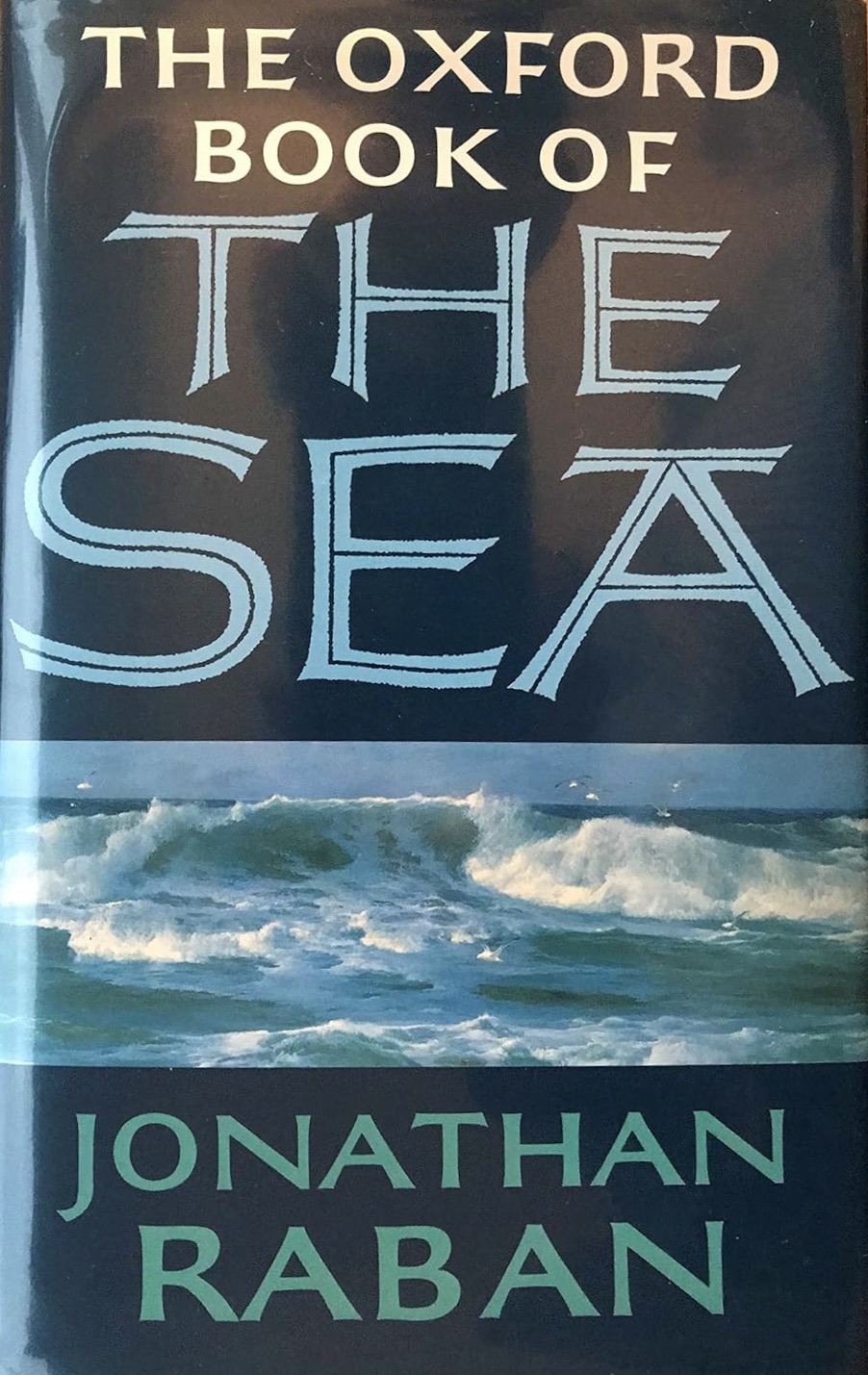
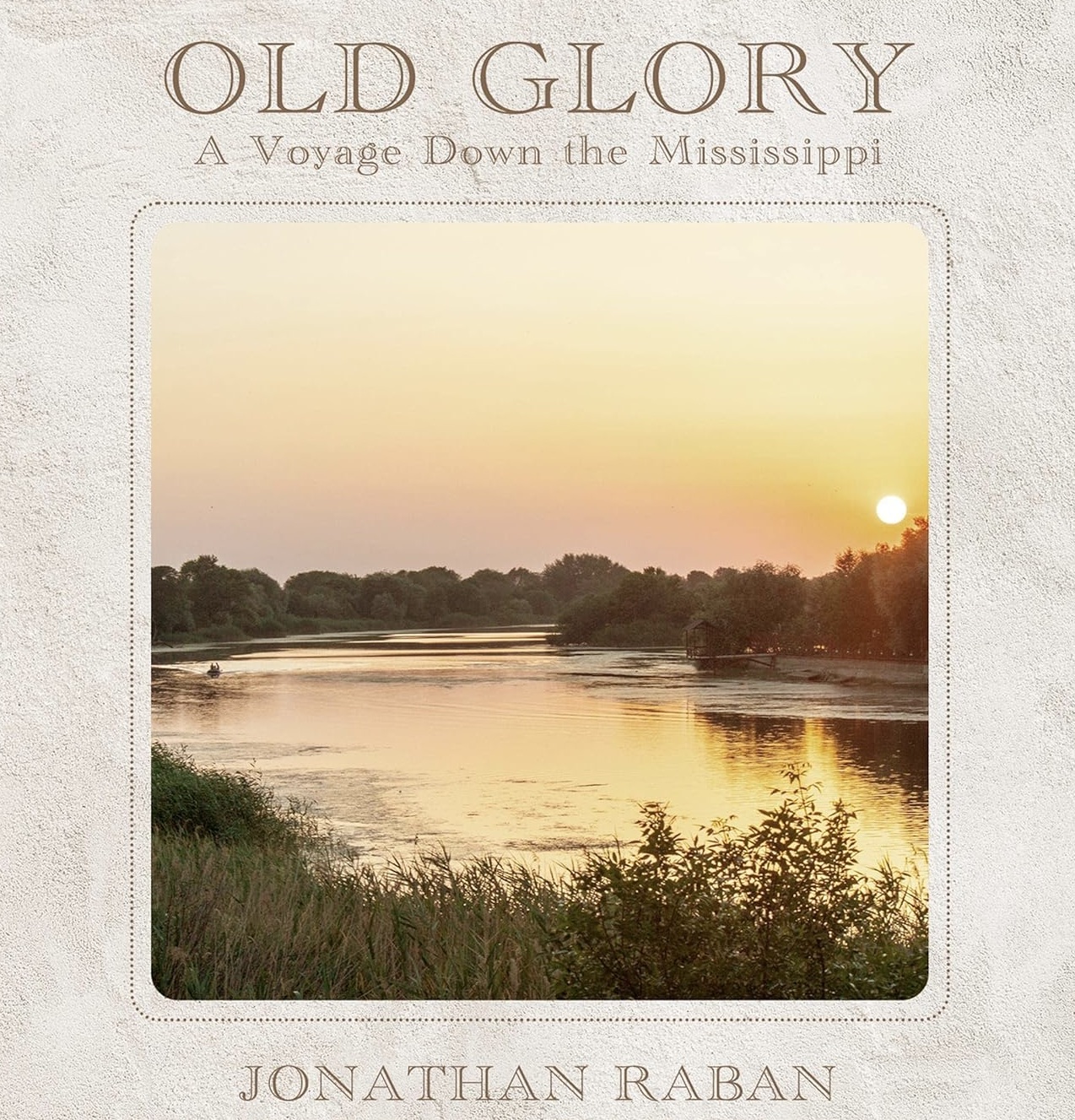
Raban was nothing like an enthusiastic newcomer to sailing when embarking upon his “Passage.” His other voyaging books, particularly his account of his circumnavigation of his native United Kingdom (Coasting), as well as his editorship of The Oxford Book of the Sea, attest to his deep knowledge of sailing and all things nautical. His attraction to such voyages is also reflected in his highly readable account of his water journey down the Mississippi (Old Glory), from St Paul to New Orleans, and was the fulfillment of a childhood fascination with the Great River and its history .

The Audible recording of a condensed version of Passage to Juneau nicely captures Raban’s resonant voice and British vocal style. Portions of his recording give a good sense of the author’s subtle humor, accentuated by his sharp eye for memorable detail. Imagining how Vancouver’s voice must have sounded to his shipmates, Raban reads passages from the explorer’s diary with a slightly exaggerated flat nasal intonation, imbuing the historical figure with a fuller sense for us of the 18th century navigator’s complicated humanity. And Raban’s description of his brief interaction with officious Canadian Customs inspectors regarding a suspect American potato, found during a search of his boat, provides a memorable anecdote. Both examples and others like them function, I think, as thoughtful counterpoints to the more difficult aspects of Raban’s ‘interior passage,’ a journey through reflections prompted by the loss of a parent and the diminishment of a marriage.

The Audible version of a cover for Raban’s book, Old Glory

One key to appreciating Jonathan Raban’s, Passage to Juneau: A Sea and its Meanings, lies in its subtitle. Clearly the author has written something more than an absorbing description of a nautical adventure, though he certainly provides that. The interest of this book for me lies in its implicit invitation to reflect on what draws some of us to the sea, to find our way on waters that may have patterns but no directional lines or unnecessary limits. For the sea is where what is called ‘human geography’ and our created pathways may diverge from the given features of the natural world.

As is broadly true with much of our life on land, a parallel to navigation over the water exists with how we make our way forward in our decisions and actions, day by day. This is the parallel we can perceive between sailing and what is formally called casuistry in moral theology. All of us, in all circumstances, are challenged to apply universal principles or rules of thumb to the ideosyncracies of everyday situations. Generic and abiding principles (with boats, it is things like Coast Guard rules and the observed behavior of tides), coupled with familiar tools (a compass, wind direction finder, charts, etc.), need to be brought into engagement with particular circumstances (the wind, waves, and tides, as we find them today). Through this process we discern with greater clarity location and direction, especially when our efforts are coupled with a grasp of purpose. Otherwise, and in more ways than one, knowing where we are and where we are headed can be difficult.

The author on the veranda overlook of his Seattle home

Walter Inglis Anderson and the Experience of Loving What God Loves

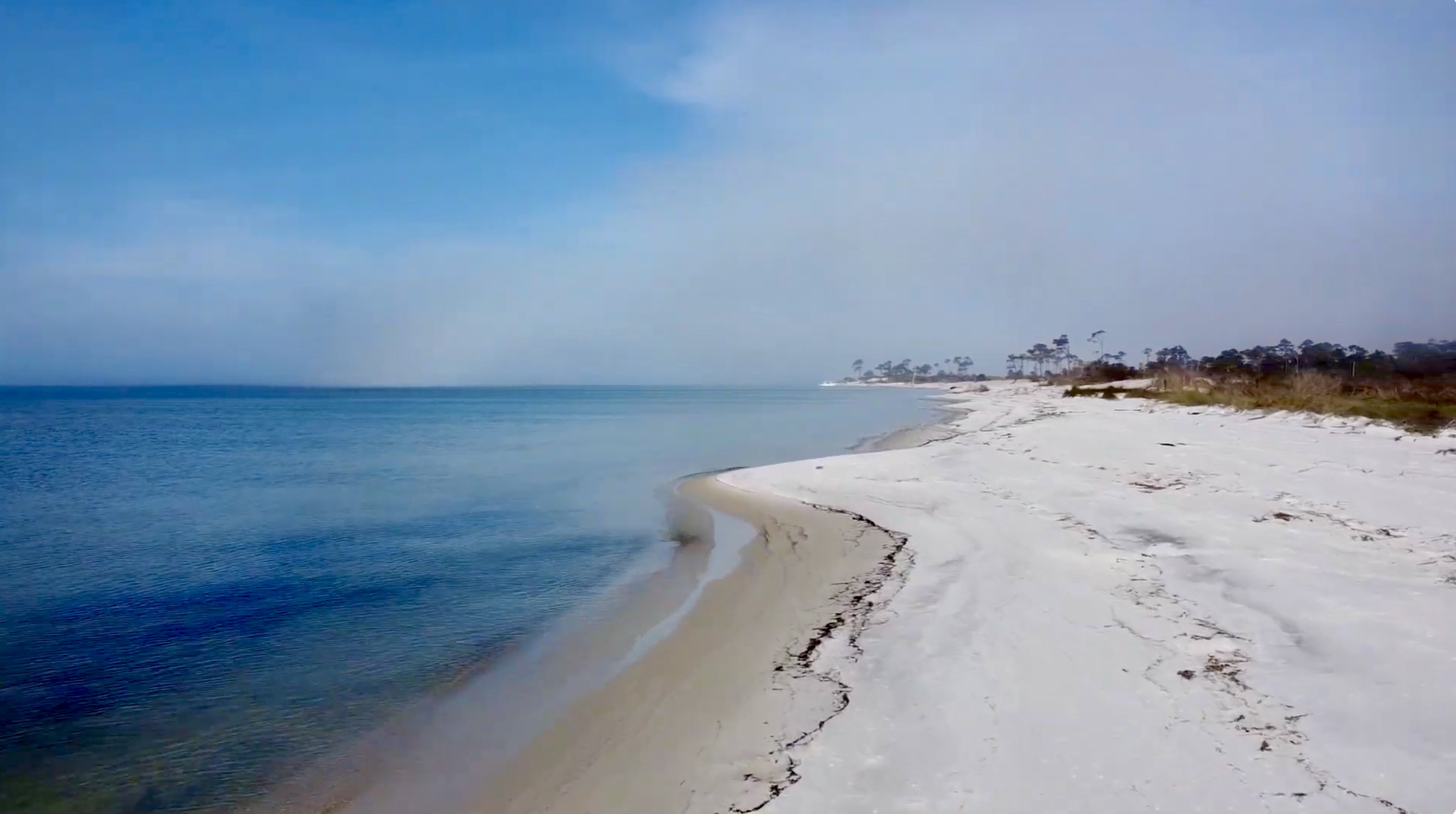
A beach on Horn Island, Mississippi Gulf Coast

We are created in God’s image and likeness. We often assume that this is reflected in the way that we think, in our capacity for reason and in our desire for wisdom. But we also reflect our creation in God’s image and likeness in our desire to love. We all want to love, and receive love. Sometimes, especially in this fallen world, we love in ways that are disordered. We love the right things in the wrong way, and we love the wrong things in what we deceive ourselves into thinking may be a good or right way.

And yet, we still love, whether it is ourselves that we love to the point of it being at the expense of loving others and the world around us, or it may be that we love others and the world at the expense of rightly loving ourselves.

The Holy Scriptures remind us that God is love. And that God first loved us before we knew it. And that God so loved the world that he gifted himself in the form of the Word made flesh, who came among us, full of the grace and truth that he has so generously shared with us. “I am who I am” (what God spoke to Moses from the burning bush) becomes the source of “we are who we are,” especially when we become aware of and live into the fullness of who we really are.

And so, to love what God loves is to share in the experience of God’s love. Awareness of this leads us to become more aware of the way we are called to share in God’s own way of loving. To do so actually comes to us naturally, even though we in our fallen state are impaired in our ability fully to live into this reality, and believe we are capable of it.

In my prior post, I reflected on how some of this capacity to love what God loves may be revealed in the life and work of Walter Inglis Anderson, who himself may not have been aware of the fact, nor may have had the conscious ability to believe it. In this respect, Anderson, followed in the spiritual footsteps of John Muir, whose earlier example may help us appreciate this dimension of the Mississippi painter’s relationship with nature. For Muir, through his childhood formation in orthodox Reformed Christian beliefs, came to believe he was loving Creation as God loves it, however much Muir’s vision expanded and broadened over the years so as to appear that he had moved beyond the bounds of traditional faith.

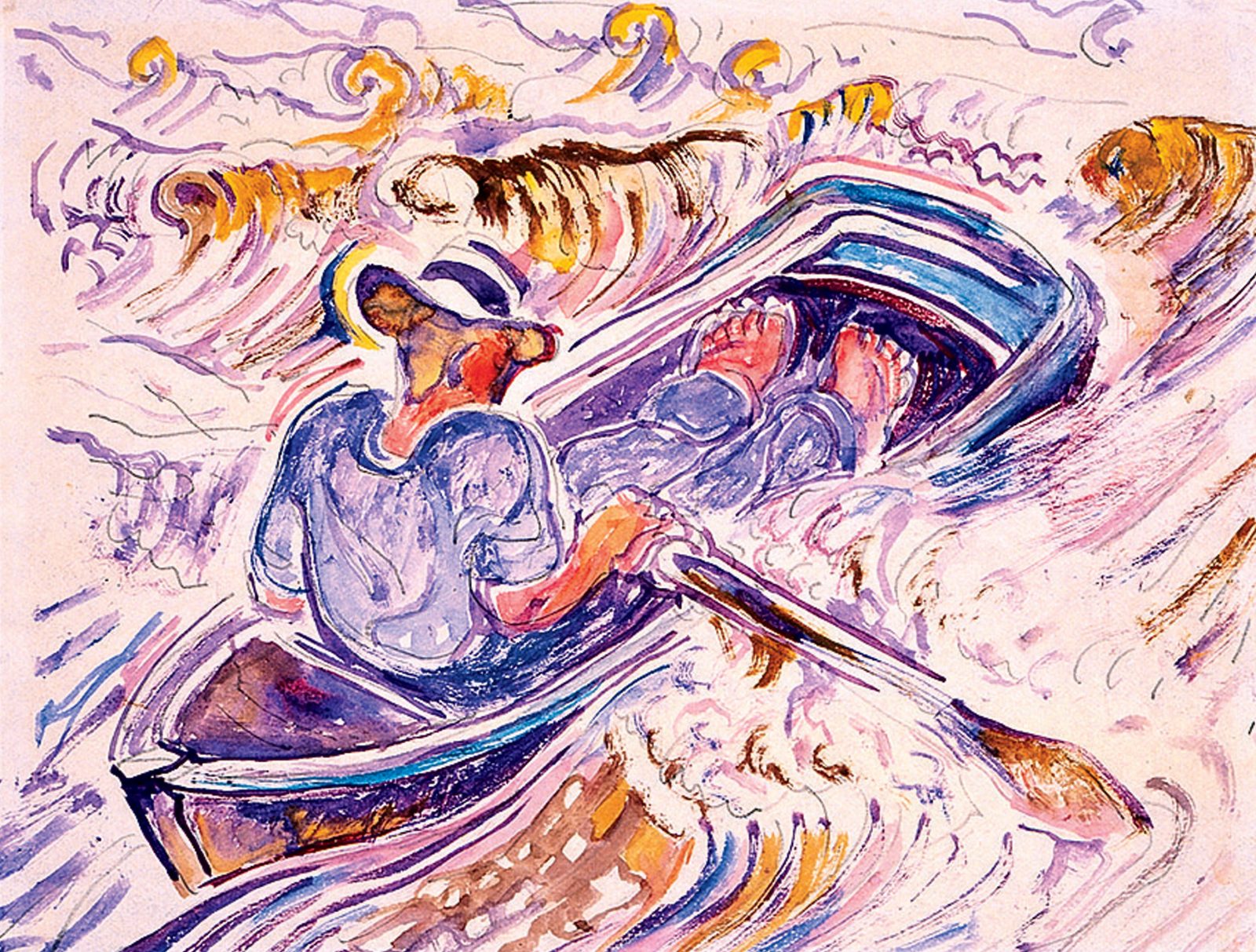
The painter and solitary, Walter Inglis Anderson, portraying himself rowing out to Horn Island

To experience joy when we encounter and perceive the beauty we find in the world – even in ourselves – is to experience God’s love for the world. Beauty in the world is a manifestation of God’s self-giving, and of a love that is self-giving, even to the point where we are capable of bringing harm to it or rejecting it. The same is true for God’s love for us, and for those with whom we have been given the opportunity for fellowship and community. For God’s love is not for us solely, as individuals, but is present in fellowship and in community, especially in communities founded upon this great gift of divine love.

Anderson’s son, John, retracing some of his father’s footsteps

Here, we can come to appreciate another insight we can gain from learning about Walter Inglis Anderson. Like the earlier Muir, Anderson came to perceive – or perhaps always intuitively knew – that to see, to really see what is in and around us, is enabled by ‘getting out of the way.’ When I, as one who sees, am conscious and then distracted by my awareness of my process of seeing and perceiving, I become absorbed with my own subjectivity, at the expense of more fully becoming focused upon the objects of my perception. In seeking to love you, or things in the world around us, my focus upon my process of loving or seeking to love impedes my actual participation in really loving you, you who are a fellow subject of loving and not simply an object of my love.

A Horn Island painting by Walter Inglis Anderson

I think that Anderson was enabled to arrive at such an awareness by enacting his desire to be among and really see the plants, birds, animals, the seashore, and the changing weather conditions, while on his solitary sojourns to Horn Island. Therein lies the paradox. God’s love for the divine beauty reflected in the world that he has made was at the heart of Anderson’s love for the beauty that we find in nature. And in sharing in that same love of beauty, he came to perceive how he was actually not alone, even in his periodic states of hermitage under the shelter of his upturned dinghy.

Awareness of this is one doorway into perceiving and then enjoying what Jesus spoke of when he said, “Wherever two or three of you are gathered, I am there.” The great “I am” is with us, now to behold and embrace, Spirit in Flesh, Word made human, not only in ourselves and in the things around us, but also between us at the heart of our fellowship.

Walter Inglis Anderson and the Beauty of Humanity

Walter Inglis Anderson, Self-Portrait from above

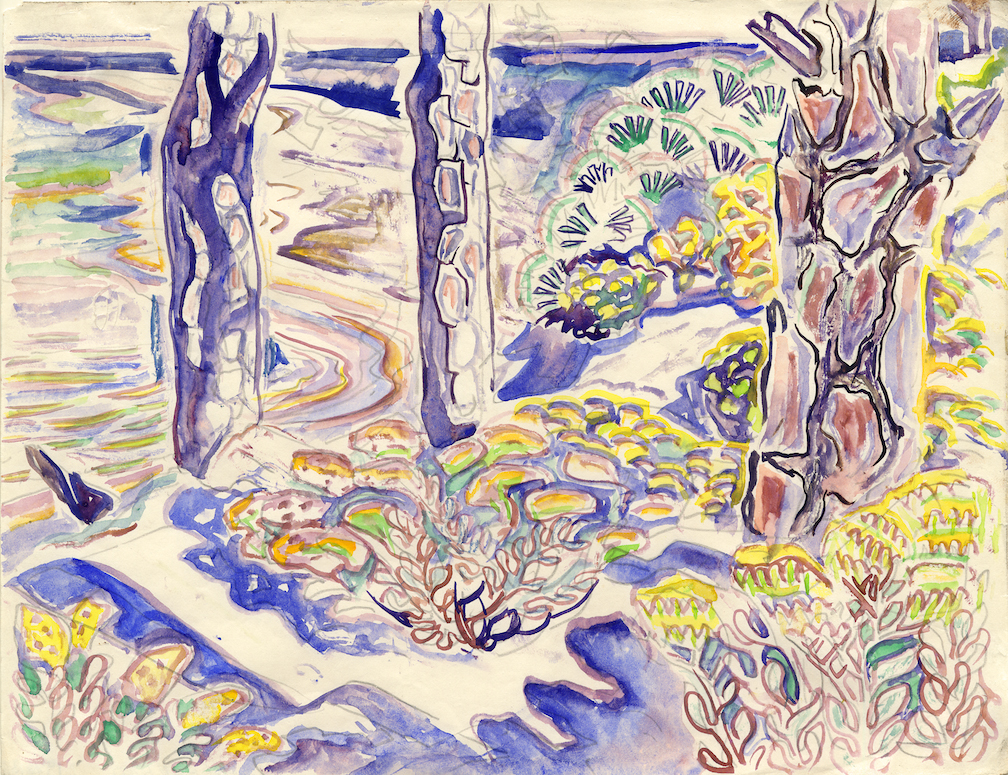
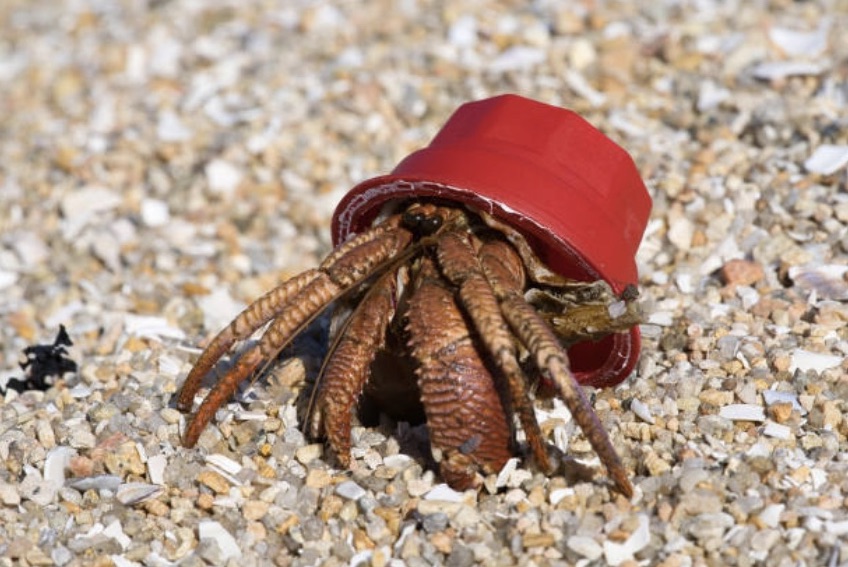
Perhaps like Henry David Thoreau or John Muir, a gifted painter named Walter Inglis Anderson came to discern some things of great significance within the visible beauty latent in nature. Like his venturesome forbears, he did this by seeking out an area of wilderness. It became his habit to row out the ten or so miles to Horn Island in the Mississippi Sound, where he slept on the sand using his upturned dinghy as his hermitage. Out there amidst the shifting dunes, with only the shell of his boat for cover against storms, Walter Anderson perceived more of who he was as he experienced harmony with what was around him. In time, compelling objects of his attention became for him fellow-subjects apprehending the splendor of Creation.

A shoreline inhabitant whose common name (‘hermit’ crab) was often derisively applied to Walter Anderson

Paradoxically, by his solitary coastal journeys, a man who had suffered bouts of mental illness became aware of an elusive but precious quality that he shared with those from whom he was isolated. His transient island resting places, where he spent weeks at a time over the course of twenty years, provided him with fleeting glimpses of what it might mean to be more fully human. There, away from others, he experienced moments when he felt he had become who he was meant to be.

As one writer has put it, “Anderson’s isolation from humanity convinced him, in the end, of humanity’s beauty… [He] believed that if we re-established our primal relationship with nature, we would regain our beauty.” Walter’s youngest son, John, summed it up succinctly: “Solitude was a tool that helped him to find unity with all people and all creatures.”

Anderson’s portrayal of himself rowing out to the island

Walter Anderson expressed the point compactly in one of his Horn Island logbooks: “In order to realize the beauty of man, we must realize our relation to nature.” His son, John, later explained what his father had meant by this. “I think that in those twenty years that he was living in solitude on the wilderness island, he was attempting to realize his relation to nature so that he could realize the beauty of humanity.”

Underlying these words, and the perception they express, may be a nature-mysticism of the kind often associated with Thoreau and Muir. I also find an affinity here with the spirituality we can discern in traditions as widely different as Zen Buddhism and the writings of Christian monastic solitaries.

Eugene Peterson’s rendering of Jesus’ words in John 12:25 (in context), captures a similar perception: “Listen carefully: Unless a grain of wheat is buried in the ground, dead to the world, it is never any more than a grain of wheat. But if it is buried, it sprouts and reproduces itself many times over. In the same way, anyone who holds on to life just as it is destroys that life. But if you let it go, reckless in your love, you’ll have it forever, real and eternal.”

To this mystical vision of the world I think we can also connect an insight attributable to St. Augustine of Hippo, regarding what we love, and how we love. If we love ourselves and our lives, or the world around us, for our own sake, we belong to the ‘city of the world,’ and we live turned away from God. Yet, if we love these same things for God’s sake, we belong to the City of God, and live in a God-ward way. Here it is important to remember that to love in the latter way that Augustine commended may not necessarily be an activity that we undertake with conscious awareness.

Self-Portrait by Anderson

It is actually possible to love God without ever consciously intending to do so. I believe this was the case in the adult life of Walter Anderson. It happens when we love what God dearly loves. And such true love can be expressed unconsciously, in ways that may be apparent to others while not to ourselves.

This truth connects the experience of the non-religious nature mystic with that of the religious contemplative, as both in various ways are focussed upon the Beauty inherent in Creation and within our human experience of Nature. This brings joy to the Author of Creation, who so loves the world that he has brought us into the new life that – through the Word made flesh – he now shares with us.


Emphasis has been added to the Eugene Peterson quote above. In a later post I will offer further reflection on Walter Anderson’s life and work, including his wondrous artistic creations, among which are paintings and drawings, as well as ceramics, linoleum prints and patterns for fabrics.

Reflections Inspired by Tiny Houses

A 14′ Tiny House inspired by Japanese Aesthetics (from the Baluchan website)

As earlier posts of mine attest, I have been interested for some time in the Tiny House movement, which has now become a widespread phenomenon. Whole Tiny House communities are being developed, and Tiny House construction designs have been proposed as an alternative approach to addressing homelessness. Reflecting on this movement, and the broad appeal examples of Tiny Houses seem to have, I have given some thought to what this development in small scale architecture may represent, and to what it may tell us about how we want to live.

I can see an impulse similar to the pursuit and enjoyment of living in a Tiny House in some attractive parallels, which also represent a quest for discerning a simpler way to live. Quite aside from a specific focus on contemporary examples of Tiny Houses, many people appear to have an interest in reading books like Thoreau’s Walden, or those by John Muir. I continue to meet folks who like the idea of having a small boat in which one can actually ’cruise,’ even on local lakes. And still others seem to share my fascination with living environments inspired by Japanese aesthetics.

An interior shot of the Baluchan Bonzai 14′ Tiny House

If these musings seem familiar, learning more about the Tiny House movement is worth pursuing. Here are some observations I have made in the course of my own reflections on the current popularity of this movement: 

First, the appeal of Tiny Houses has much to do with the process of rediscovering, and learning more about the beauty of living simply. And therefore, about more than managing to accept being without some things, but actually doing well with less. Marie Kondo’s videos and published writing have attracted a good deal of attention regarding the desirability of organizing our household belongings, and paring down what we have toward living with what we truly love.

Viewing and reflecting on examples of Tiny Houses can aid one’s discernment regarding needs vs wants. Most of us have probably considered this distinction from time to time, and have likely also experienced some frustration with our halting efforts to enact our reflection upon it. We know we have wants, which often masquerade as needs, while we may not sufficiently consider the potential value to us of having wants that are correlated with our needs. After all, a premise of this post rests on a paradox: the assumption that I not only want to live more simply, but that I may also need to!

The kitchen space between the bathroom and the small main living area

Here, briefly noted, are some potential benefits that may come from spending time in a Tiny House:

  • Living off the grid becomes a much more realistic goal when choosing to live in a Tiny House. Tiny Houses also allow for mobility in relation to one’s surroundings, even if it is not a frequently exercised opportunity. Changes in one’s locale can lead to learning opportunities.
  • Those who build their own or who choose to do maintenance work on a Tiny House are more likely to learn how to use, and use more ably, simple and hand-powered tools.
  • Tiny Houses are well suited as places in which we can experience solitude as a positive aspect of our lives, while also providing an excellent context for significant times spent with others. 
  • Living or spending time in a Tiny House may allow us to have increased time for personal reflection, and an opportunity further to discern our vocation, in addition to our more usual absorption with occupational concerns.
  • Tiny Houses therefore have the potential to be places in which we read more, and spend less time consuming social media or watching videos. While every living place for which we have some care requires time and attention, the theory behind choosing a Tiny House as a place to live assumes that we can devote more time to actually living, rather than preparing to live. Reading makes the world bigger and our lives richer.

For much of the above, and as a bothand rather than an either/or starting point, I commend considering adding a form of a ‘Tiny House’ to your present circumstances rather than making a radical change from them. Experimenting with what can be done with less, while also still retaining one’s present home, can be instructive. This can be accomplished by, for example, purchasing a used but well-equipped small RV. We have recently seen some interesting examples on the road, and ones that could fit in a standard home garage.

For us, it has been our 1988 24 ft trailerable sailboat that has provided this kind of learning opportunity. With its relatively small cabin (about half the length of the boat), comfortable berths (or bunks), a camping stove, cooler, portable toilet, and cockpit which serves as a small ‘back porch,’ we can meet most of our daily needs for a week or more at a time. The slip for our boat is under $200/ month, including electricity and water connections, if needed (ie, if the boat is not yet off-the-grid-ready, though our boat is now thus equipped). DAYSTAR has become our floating ‘tiny house’ or ‘cottage.’

Ably and effectively inhabiting this principle of beautiful simplicity is turning out to be a lifelong project for me, and I believe this is also true for others. I am a neophyte in the process. Perhaps my readers have some similar experience with this ongoing process!

Imagining a Voyage

We all imagine taking journeys or voyages, sometimes out of an unfulfilled desire and sometimes with an apprehension about the potential consequences of such ventures. Even those who do undertake to travel over the land or over water usually prepare, even casually, for their upcoming experiences by anticipating certain items likely to be needed or enjoyed while en route, as well as potential challenges or obstacles to be overcome while away. Having recently spent about a month on our old sailboat of modest size, I realize that my efforts to prepare for any needs we might have while docked or sailing led us to be burdened with some unused items. For the best parts of our recent travels were those that had more to do with ‘being’ than any kind of ‘doing’ in which we were engaged, and in relation to which we might have had particular needs for gear or supplies.

Some people believe that the best journeys are those that we undertake through reading, through our enjoyment of the accounts of such travels as recorded by others. I often choose boat and sailing related reading material for my free time, and when preparing for an upcoming trip I find that such reading helps me anticipate and plan for the kind of lake or coastal cruising that I hope to do.

A.J. (“Sandy”) Mackinnon with Jack de Crow

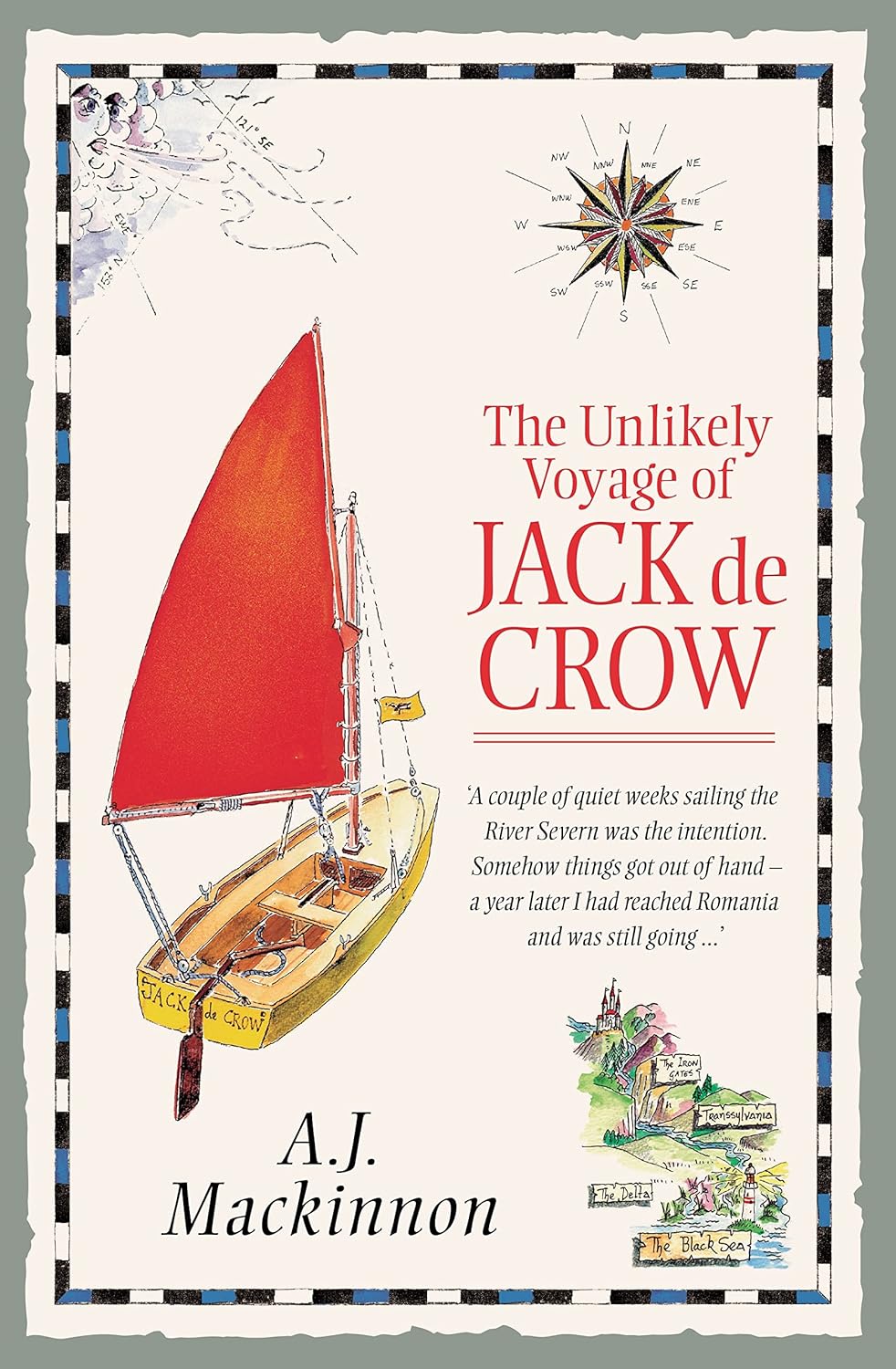
Nonetheless, there is a type of nautical-related reading that I enjoy probably because it challenges my usual approach to trip pre-planning. One example is a book I have come to love reading and re-reading, A.J. Mackinnon’s delightful, The Unlikely Voyage of Jack de Crow. In it, Mackinnon – with engaging humor and self-deprecation – describes how he embarked on a river journey one summer, during a break from teaching at a school in north Wales. He asked to use an old plywood eleven foot Mirror dinghy, and ended up sailing and rowing it all the way to the Black Sea! To say that he embarked upon his voyage under-provisioned would be an understatement. And yet, relying upon his wits and the kindness of strangers, and making use of the floor space of the dinghy to sleep under a cockpit tent fashioned from a tarp, he actually made it – even surviving the incredibly high tides of the Bristol Channel and their strong currents, as well as his subsequent crossing of the unpredictable English Channel.

Cover photo from another edition of Mackinnon’s book

When preparing for our recent trip on our venerable Nimble 24, or when contemplating some modification of it, I often try to remember Larry and Lynn Pardey’s three-fold advice: “Go small, go simple, but go now!” A.J. Mackinnon, without knowing it, followed that advice more fully than many have tried to do, and with astonishing results.

An illustration by Mackinnon from his book

At the same time, I also try to remember what may appear to be some counter-balancing words of advice that I once heard: “There are old sailors, and there are reckless sailors; but there are no old reckless sailors!” And so, while I admire and at times have tried to emulate some aspects of Mackinnon’s approach to his incredible journey, as well as the Pardey’s seasoned counsel, my natural temperament (and perhaps also my additional age) has more often led me to be over-prepared than ill-equipped in terms of gear and supplies.

Mackinnon’s illustration for how he prepared for nights on the boat

There are several qualities that I admire about Mackinnon and his approach to his sailing journey on his little but mighty Jack de Crow. In his account of his adventures, he demonstrates – along with his lively sense of humor – a willingness to make mistakes and not feel defeated by them, courage in the face of multiple situations in which he faced the unknown and the possibility of harm, and that he did not take himself too seriously so as to have been willing to risk derision by others who had more formidable boats and yachting equipment. Continuing to learn from his book, I find that I am doing better about leaving room for how ‘less can be more,’ though my first mate is sure to raise eyebrows at the claim.

Jack de Crow and her skipper arrive in Istanbul harbor

For an entertaining read, allowing you to undertake a fun voyage in your imagination, Mackinnon’s book makes a terrific choice. The cover art, and the drawings within (by Mackinnon) are whimsical and yet accurate, without being overburdened by detail. At the same time, if you are looking for inspiration to undertake some small boat rowing, sailing, and even voyaging, I can think of no better place to start.

Beautiful Charlevoix

A Charlevoix sunset from the pier where the Pine River channel meets Lake Michigan

When thinking of the beauty of a person, his or her character far outshines any outward physical characteristics a person might have. And when thinking of a beautiful community, we may do more justice to those who live in that area by engaging with some aspects of their daily lives than by focusing more simply upon the sights we associate with where they live.

I have been blessed to have been able to spend a number of weeks over many summers in Charlevoix, Michigan, largely through being able to live on our old boat (featured in my last post). With this piece, I want to highlight what I have found to be so special about this community and its splendid harbor and access to nearby ‘big water.’

Thursday Farmers’ Market along the main avenue above the city marina terrace

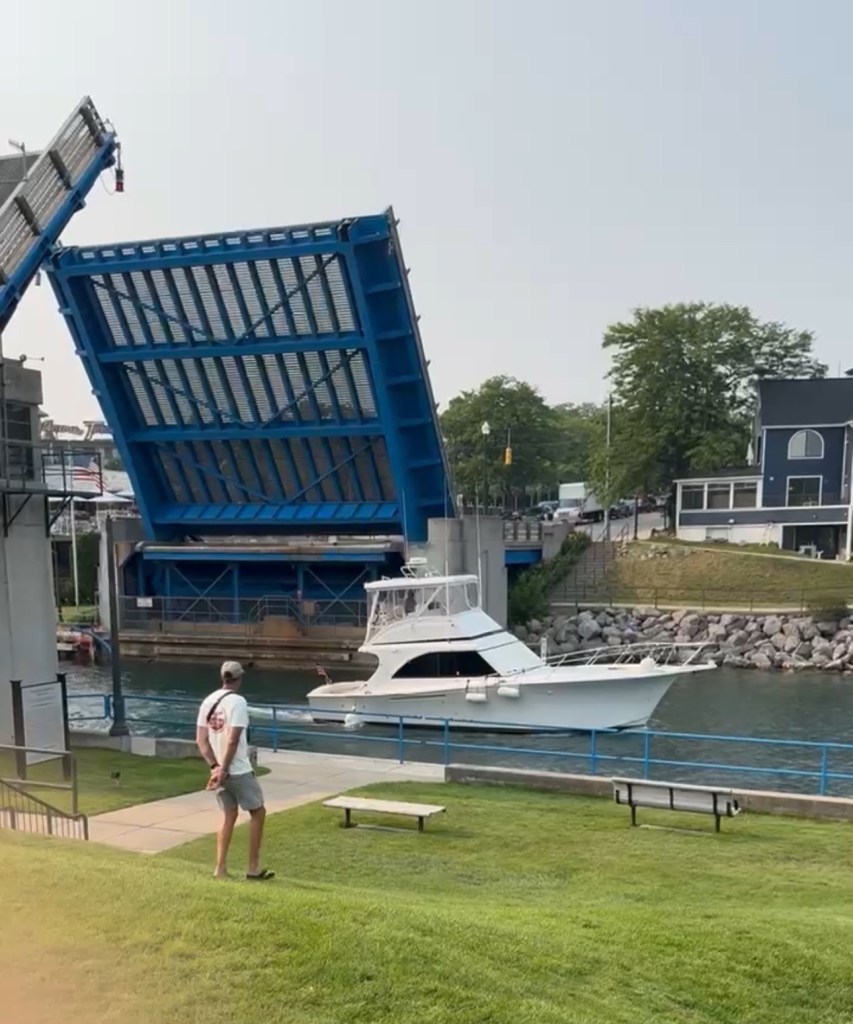
My first visit to Charlevoix may have been in around 2004. I had been to Traverse City and had seen its stunning turquoise waters, but Charlevoix was new to me. I was immediately drawn to what I saw of it during a lunch visit. Sitting on the deck of the Weathervane restaurant, I watched boats of all kinds and sizes pass through the raised arms of the drawbridge that otherwise crosses the channel between the town’s natural harbor, called Round Lake, and Lake Michigan.

The Charlevoix lift bridge over the Pine River channel

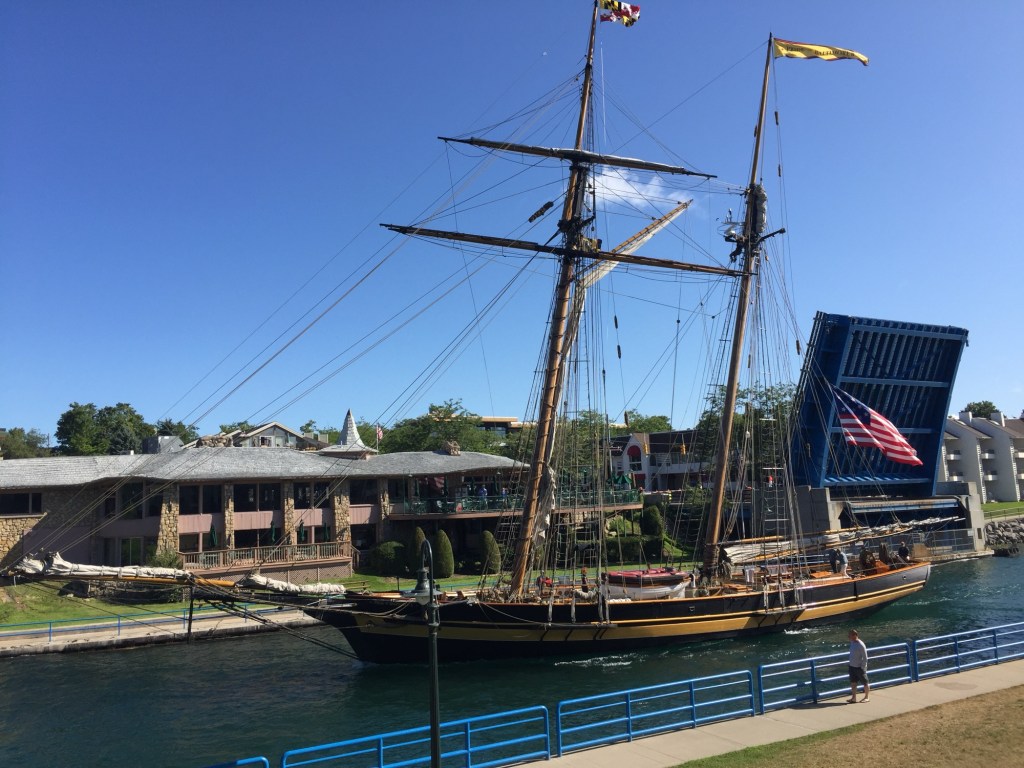
Many voyagers making passages on the American Great Loop stop in Charlevoix, as do occasional sailors from Europe on summer forays across the Atlantic, who then sail here through the Great Lakes. Even some well-known ‘tall ships’ stop here. The Pride of Baltimore was passing through the harbor on the day we arrived for our visit this year.

The Pride of Baltimore passes through the lift bridge by The Weathervane, out to Lake Michigan (in a prior year)

Visitors from larger cities find in Charlevoix a few of the amenities we associate with grander places. For over a century, Charlevoix has also been the home of two private communities of summer ‘cottages.’ Many of the boats (yachts, really) that we see on the area waters attest to the levels of discretionary income available to folks from Chicago and Detroit who make Charlevoix their summer home. Consequently, boat maintenance and winter storage facilities are substantial local businesses here.

Boats receiving maintenance at our boatyard

Yet, upon arriving in Charlevoix for my first boating visit, and docking at the city marina for a couple of weeks, I was struck by what I learned about the real, year-round community to be found here. The harbor master was a teacher at the high school, and the young people working at the marina and at main street stores were his students as well as local residents. I continue to shop for groceries with folks from town at a store they patronize throughout the year, and buy tools and replacement parts with them at the local hardware store.

A typical older and well-kept home in town

I think what many visitors find so compelling about Charlevoix is how the community has yet to succumb to a condition that has beset many places with some similar attributes. Charlevoix, in my estimation, has resisted becoming a caricature of itself. The tourist-souvenir storefronts do not outnumber shops that maintain a viable year-round business, and local history is esteemed because it remains real to those who live here, rather than offered as a commodity for visitors.

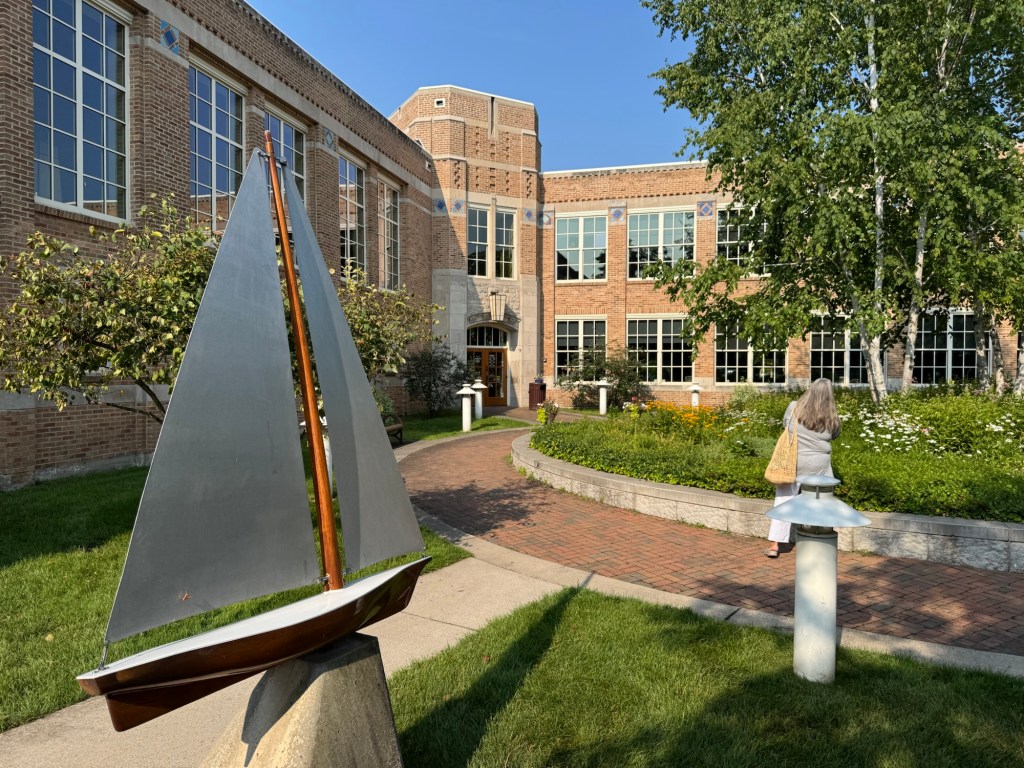
The Charlevoix Public Library, and former community K—12 school

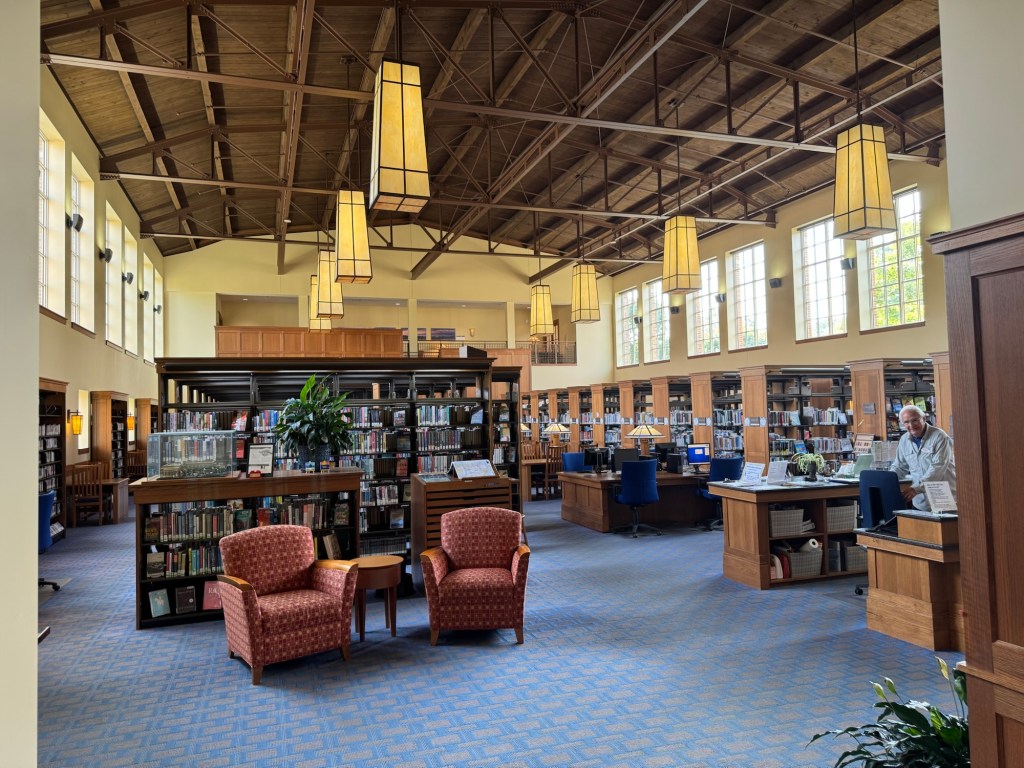
For me, the best example of this is a place we have come to love, the Charlevoix public library, which was once the town’s K—8 school, and which includes a reading room with a fireplace that earlier served as the Kindergarten room! And as long as you are not looking for lake view or waterfront property, an ordinary home in town is still affordable for many people.

The library main reading room, once a school gymn
The former Kindergarten room with its fireplace and bay window

But, of course, sitting as it does on the rocky and wooded shore of northern Lake Michigan, this town and its surrounding fields and forests, along with its tidy and well-kept streets and homes, is a truly beautiful place in the summer. Winter up here lasts a very long time, making the warm months all the more precious. I remember visiting on May 1 years ago, only to find that ice still stretched across the 18 miles of Lake Charlevoix! By that date, it is already full summer in Louisiana.

After some years of regretful absence, I am so happy to be up in beautiful Charlevoix once again.

A postcard aerial view of Charlevoix