Wholeness and Holiness

Reflections Inspired by Tiny Houses

A 14′ Tiny House inspired by Japanese Aesthetics (from the Baluchan website)

As earlier posts of mine attest, I have been interested for some time in the Tiny House movement, which has now become a widespread phenomenon. Whole Tiny House communities are being developed, and Tiny House construction designs have been proposed as an alternative approach to addressing homelessness. Reflecting on this movement, and the broad appeal examples of Tiny Houses seem to have, I have given some thought to what this development in small scale architecture may represent, and to what it may tell us about how we want to live.

I can see an impulse similar to the pursuit and enjoyment of living in a Tiny House in some attractive parallels, which also represent a quest for discerning a simpler way to live. Quite aside from a specific focus on contemporary examples of Tiny Houses, many people appear to have an interest in reading books like Thoreau’s Walden, or those by John Muir. I continue to meet folks who like the idea of having a small boat in which one can actually ’cruise,’ even on local lakes. And still others seem to share my fascination with living environments inspired by Japanese aesthetics.

An interior shot of the Baluchan Bonzai 14′ Tiny House

If these musings seem familiar, learning more about the Tiny House movement is worth pursuing. Here are some observations I have made in the course of my own reflections on the current popularity of this movement: 

First, the appeal of Tiny Houses has much to do with the process of rediscovering, and learning more about the beauty of living simply. And therefore, about more than managing to accept being without some things, but actually doing well with less. Marie Kondo’s videos and published writing have attracted a good deal of attention regarding the desirability of organizing our household belongings, and paring down what we have toward living with what we truly love.

Viewing and reflecting on examples of Tiny Houses can aid one’s discernment regarding needs vs wants. Most of us have probably considered this distinction from time to time, and have likely also experienced some frustration with our halting efforts to enact our reflection upon it. We know we have wants, which often masquerade as needs, while we may not sufficiently consider the potential value to us of having wants that are correlated with our needs. After all, a premise of this post rests on a paradox: the assumption that I not only want to live more simply, but that I may also need to!

The kitchen space between the bathroom and the small main living area

Here, briefly noted, are some potential benefits that may come from spending time in a Tiny House:

  • Living off the grid becomes a much more realistic goal when choosing to live in a Tiny House. Tiny Houses also allow for mobility in relation to one’s surroundings, even if it is not a frequently exercised opportunity. Changes in one’s locale can lead to learning opportunities.
  • Those who build their own or who choose to do maintenance work on a Tiny House are more likely to learn how to use, and use more ably, simple and hand-powered tools.
  • Tiny Houses are well suited as places in which we can experience solitude as a positive aspect of our lives, while also providing an excellent context for significant times spent with others. 
  • Living or spending time in a Tiny House may allow us to have increased time for personal reflection, and an opportunity further to discern our vocation, in addition to our more usual absorption with occupational concerns.
  • Tiny Houses therefore have the potential to be places in which we read more, and spend less time consuming social media or watching videos. While every living place for which we have some care requires time and attention, the theory behind choosing a Tiny House as a place to live assumes that we can devote more time to actually living, rather than preparing to live. Reading makes the world bigger and our lives richer.

For much of the above, and as a bothand rather than an either/or starting point, I commend considering adding a form of a ‘Tiny House’ to your present circumstances rather than making a radical change from them. Experimenting with what can be done with less, while also still retaining one’s present home, can be instructive. This can be accomplished by, for example, purchasing a used but well-equipped small RV. We have recently seen some interesting examples on the road, and ones that could fit in a standard home garage.

For us, it has been our 1988 24 ft trailerable sailboat that has provided this kind of learning opportunity. With its relatively small cabin (about half the length of the boat), comfortable berths (or bunks), a camping stove, cooler, portable toilet, and cockpit which serves as a small ‘back porch,’ we can meet most of our daily needs for a week or more at a time. The slip for our boat is under $200/ month, including electricity and water connections, if needed (ie, if the boat is not yet off-the-grid-ready, though our boat is now thus equipped). DAYSTAR has become our floating ‘tiny house’ or ‘cottage.’

Ably and effectively inhabiting this principle of beautiful simplicity is turning out to be a lifelong project for me, and I believe this is also true for others. I am a neophyte in the process. Perhaps my readers have some similar experience with this ongoing process!

The Beauty of ‘Something Further’

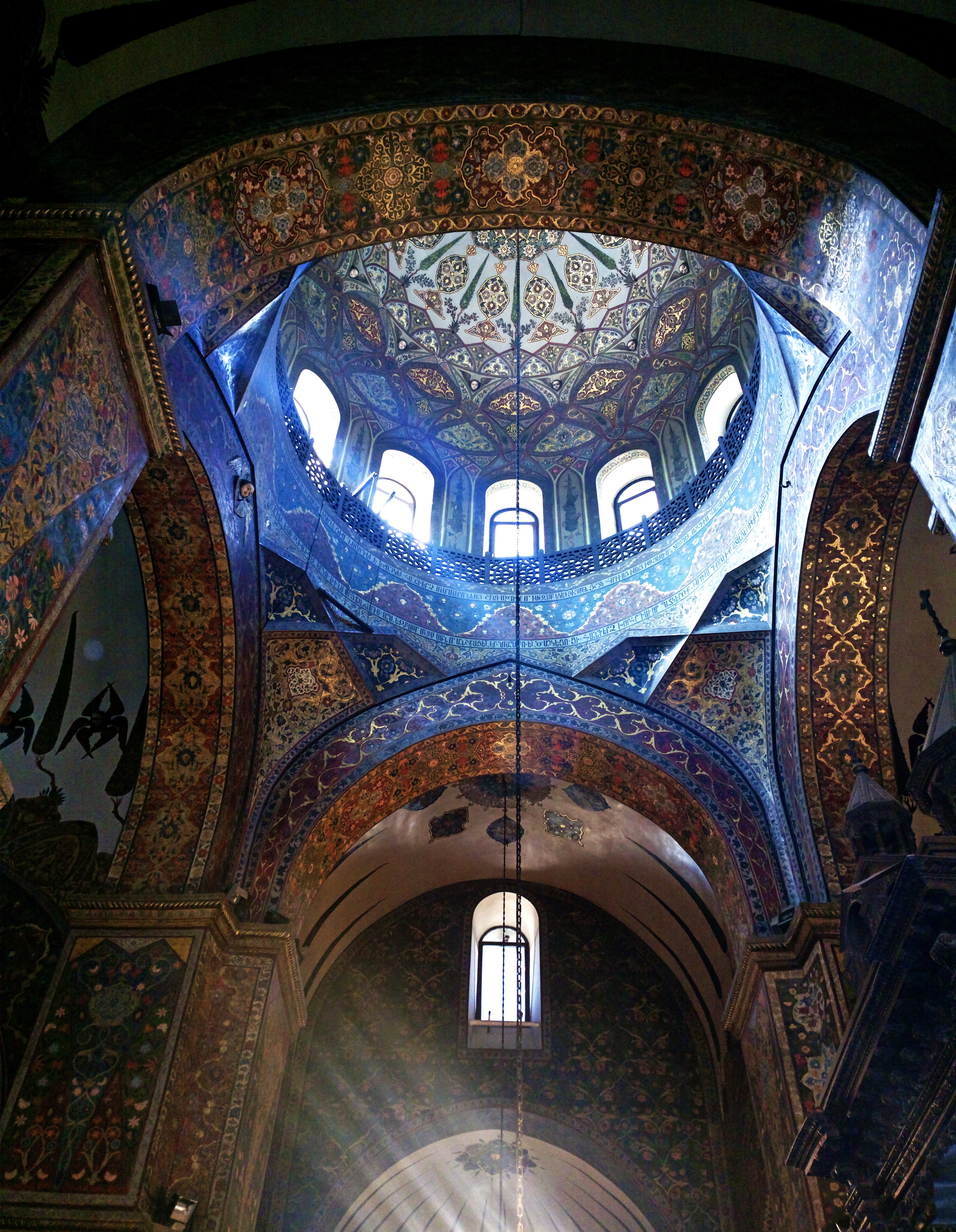
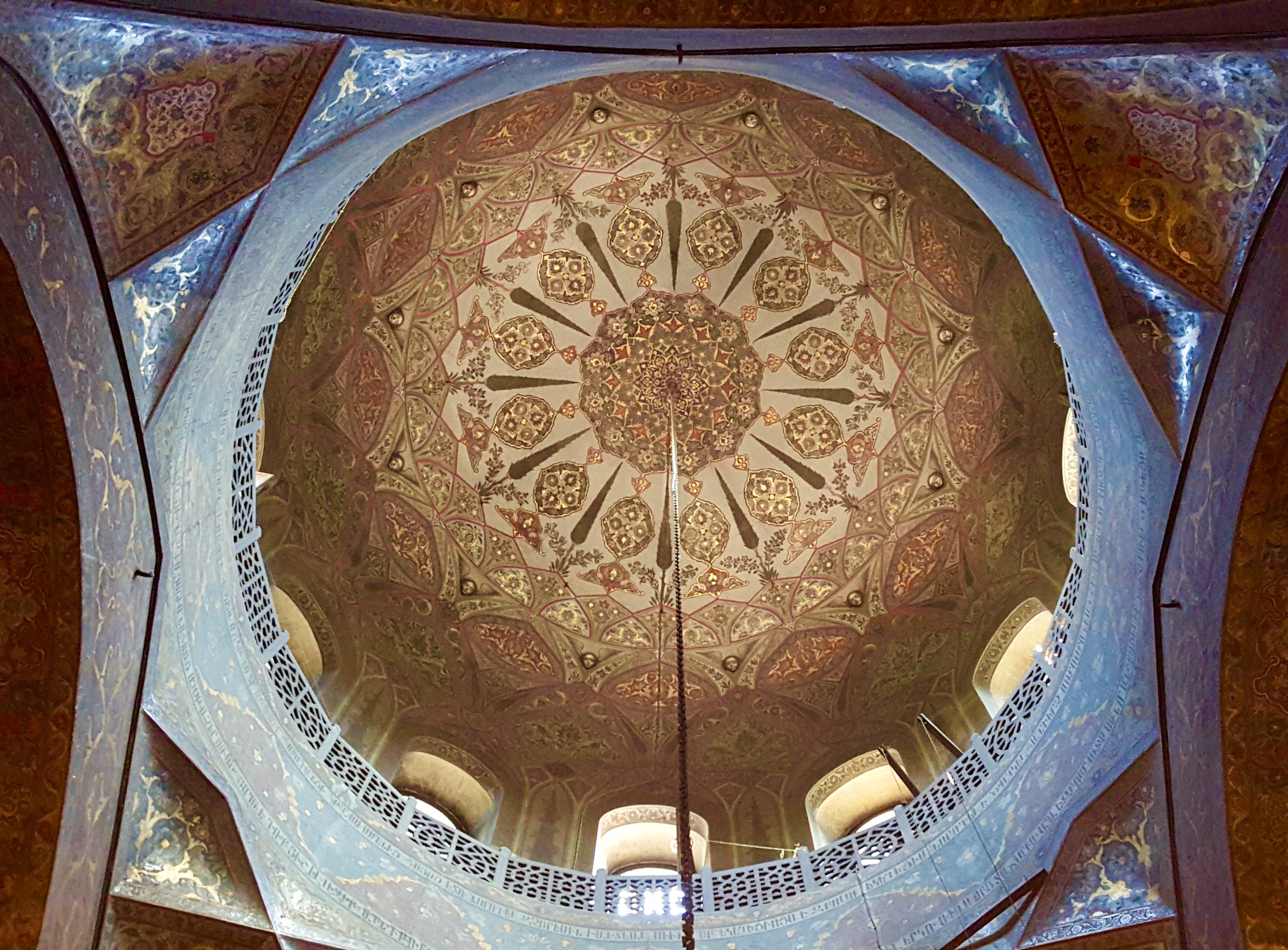
An interior dome, Etchmiadzin Cathedral, Armenia

{This past week I had the honor of offering a homily at the funeral of my longtime friend, Tom, a neurosurgeon and person of faith. What follows is a portion of my homily.}

People in our culture who have been trained in the sciences and who work in medicine can face a particular challenge. They can find it hard to grapple with the intangible aspects of the spiritual life. Walker Percy is a great example of someone who overcame this apparent divide. For Percy, like Tom, was very smart and educated in the medical arts. Like Tom, Percy came to see something very important: we rely upon science to explain too much of the world. And, if we are honest and sensitive in our inquiry, we come to see how – through science alone – we cannot understand ourselves.

Tom, with his advanced work in surgery and in neurology, knew far more about our brains than most of us will ever know. And yet, he also was quite aware of the limits to such knowledge. He was sensitive to how ‘our minds,’ though inextricably connected to our brains, always somehow transcend what we know about brain function. And therefore, despite our continuing advances in understanding neurophysiology, there remains this ineffable, something further, about what it means to human, this thing that non-specialists like the rest of us, as well as priests and pastors, call our souls.

Walker Percy might have put it in terms like this: We can learn the names and composition of the myriad of chemicals that are a part of human brain function. And therefore, as conscious subjects, we can approach our brains as objects of study. Yet, paradoxically, we, as the subjects of our studies, can never really know ourselves as the objects of our studies. There will always be something beyond, something further and equally real about ourselves, even if not fully measurable. And this ‘something further,’ believers call our souls. For even the most brilliant neurologist, even the most perceptive psychologist, can never really know him or herself, just as I – at least in this life, on this side of the veil – can never really know myself. Only God can. And only God does.

Etchmiadzin Cathedral

Physicians can map how our physical bodies eventually fail us when we get older, and cease to function ably as before. But what our physicians and scientists cannot map – at least not yet – is how our consciousness can survive this breakdown in our physiological function. Yet, somehow we continue in self-awareness, and in our awareness of others, especially that great Other One. And we will probably never be able to map, in terms we understand, how we come to have conscious contact with our Creator and Redeemer. For our conscious contact with God happens through God’s loving embrace of us. This is the embrace into which we have all been received – even if we are not conscious of it, and especially when we have not chosen to refuse it.

Tom consciously chose to recognize and accept this embrace. And he put his trust in it, even if – as an accomplished scientist – he could not explain it. For that, we honor him and his memory, as we continue to have fellowship with him in the Communion of Saints. And as we share with him in our celebration of the Eucharist. For just as our Lord Jesus continues to be present with us, and in us, so all the saints – both Tom and ourselves – and all the faithful departed stand before the throne of the Lamb. In Christ, we are joined together, so that we, too, might also be lost in wonder, thanks, and praise.

Tom knew and believed all this. And that is why we are here today. We can honor Tom for his contributions to the sciences and to the practice of medicine. Here, in this church and in this community of faith, we can join others in honoring what God has done in Tom’s life and work. And more especially, we are here today to honor what God is still doing in Tom’s continuing life. For Tom’s life and consciousness continue, even now, in and through God’s loving Grace and favor. His death is the veil that only appears to separate him from us. It disguises the way he is still really connected with us through his Baptism and ours, into Christ’s death and Resurrection.

Chora Church, Istanbul

Most enduring is this truth. And it is a truth for all of us to embrace: we have continuing fellowship with Tom, through Christ, in the power of the Holy Spirit. Thanks be to God!

The Beauty of Hospice Care

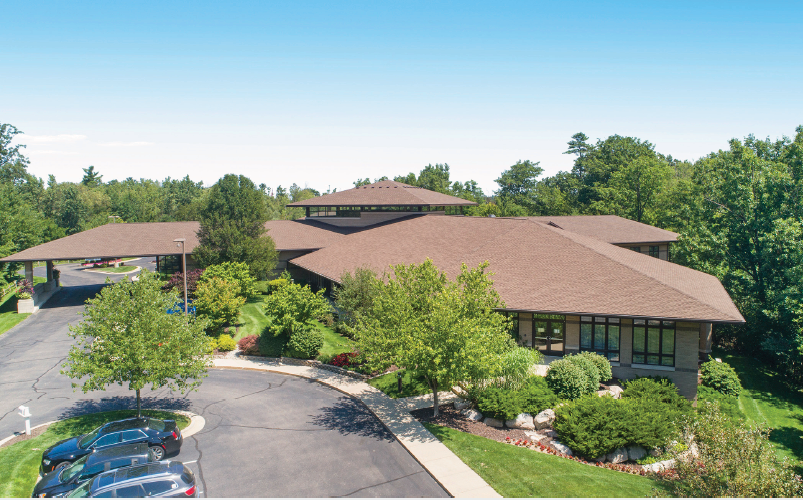
Faith Hospice at Trillium Woods

Having worked in a variety of church-related contexts for over four decades, I have become familiar with the importance of having a clear vision of one’s mission. In my experience, people are motivated by inspiring mission statements, and especially when they are enacted with cheerful efficacy. As advocates of Appreciative Inquiry maintain, a focus on what is working well builds energy and promotes a sense of well-being among participants.

As I reflect on the most compelling examples of institutions, facilities, or programs that I have encountered, the hospice movement in healthcare stands out. Whereas medical practice has increasingly become directed towards problem-solving and the alleviation of various conditions, along with our growing interest in future-oriented health maintenance, hospice care tends to be focused on a wholistic approach to the present well-being of a person. And I have found that hospice advocates and caregivers to be among the most positively mission-focused people I have met.

Aside from occasional background reading and some videos on the topic of hospice care, my experience over the years with this life-enhancing approach to being with other people was relatively brief. But then, it was unexpectedly transformed by a full and meaningful month of time spent with my dad, beginning with the discovery of his having a malignant brain tumor and ending with his peaceful death. He died surrounded by his four sons, in a remarkable facility dedicated solely to hospice care.

Arial view of the Trillium Woods location

I am particularly grateful for my dad’s opportunity to have been admitted to the Faith Hospice inpatient care facility at Trillium Woods in Grand Rapids, Michigan. Through my parish ministry, I knew about hospice care being provided at home and in other settings, but I had not had any personal experience with a residential facility built and maintained solely for hospice care. My dad’s move to Trillium Woods happened four days after his admission to hospital ER, on a cold, mid-December day. The hospice became his new temporary home, and we soon discovered how it was an unanticipated but blessed answer to prayer for him as well as for our family.

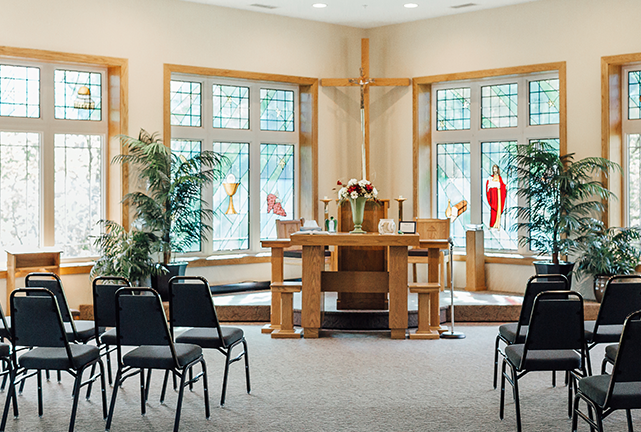
December is a tender time for families caring for or mourning loved ones, and we found that Faith Hospice staff members were especially sensitive to our emotions as the Christmas holiday season came into its fullness. We were impressed by the generously sized and attractively decorated room they were able to provide for my dad and the other patients, which included a comfortable sitting area, a bed area, and large windows and a door leading onto a beautiful terrace. Equally impressive was the rest of the facility, which had large lounge areas, a dining room and adjacent kitchen, and a well-designed chapel. Being able to have our family Christmas dinner there at the hospice (as well as other meals) was a comfort, and allowed us to focus on my dad and his care, and to be less absorbed with our own daily concerns.

A hospice patient’s room like the one my dad was in

Most significant to us was the dedicated staff, who were sensitive and attentive to each subtle stage in the process of my dad reckoning with and moving toward his impending death. Like them, my dad showed himself to be strong in faith, and fully at peace with seeing his final illness as a facet of God’s merciful Providence. Thankfully, he showed no signs of being in denial about what was happening to him. I attribute this to his decades of ministry as an ordained pastoral counselor, and as one who lived his faith while commending it to others.

The Chapel at Trillium Woods

During the process of my dad’s dying, I marveled at the ministry of Faith Hospice at Trillium Woods, and wondered about how many other such facilities exist around the country and elsewhere. I continue to wonder about this, and imagine that such a place is more often desired than found, being the kind of facility that everyone would want to have available should they need it.

The phrase, “the end of life,” is often used to refer to what hospice care is focused upon. Taken simply and literally, these words refer to the termination point we come to in the course of our physical embodiment. Yet, as I like to remember, our English word ‘end’ does not simply connote a terminus but also a point of fulfillment and the realization of purpose. In my experience of the hospice care that was offered to my dad and our family at Trillium Woods, I encountered a culture of ministry oriented toward lifting our eyes to a broader horizon of meaning for daily life. In this, I found the facility was aptly named as Faith Hospice, for clearly a grounded Christian Faith lay at the heart of the mission enacted on a daily basis at Trillium Woods.

Note: I have no official connection with Faith Hospice at Trillium Woods but only my personal experience of holy care from the folks there. With them, we journeyed through our final month with a family member amidst a loving community. More about this ministry and facility can be found by clicking here.

God’s Handiwork Inspires Ours

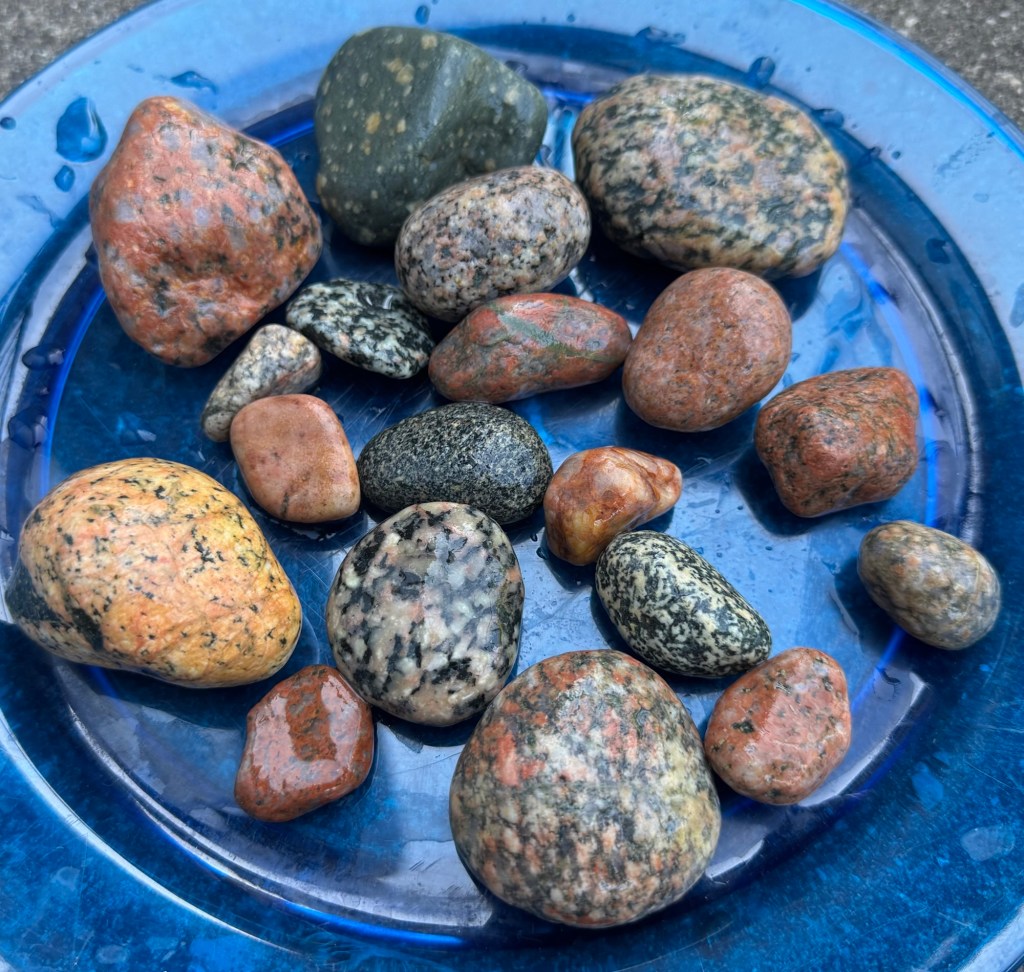
Stones found on a northern Lake Michigan beach

Labor Day is around the corner and some of us may receive and enjoy a day off from work. What we call retirement, a stage in life I am presently enjoying, tends to represent leaving work behind. Yet these and related ideas rest upon a common assumption, that work is different from, and in some ways inimical to, enjoying fulfillment in life.

I find a biblically based theological insight helpful when thinking about work. As with many matters that can be looked at from the perspective of Christian moral theology, our view of work can be enhanced by making reference to four specific reference points. These are, first, what we have learned about God’s purposes in Creation for this or that aspect of our lives; then, what impact sin associated with our Fall has had upon what we are thinking about; third, how God’s ongoing work of Redemption has restored and or transformed the matter presently under consideration; and fourth, to ask what future – if any – does this aspect of our lives have in Christ. 

Work provides a wonderful topic for engaging in this fourfold inquiry. Based on our common way of thinking about work, it may be hard for us to consider the meaning of work from any other vantage point than of attributing its role in our lives to the Fall and to the ongoing effects of human sin. Yet, we can also learn from many who have come before us who have distinguished work from toil. This can help us see how forms of labor, and pejorative associations the word may have for us, are surely due to our proclivity to link such activity with burdensome unpleasant duties.

For what we may overlook is the biblical view of how God has shared stewardship responsibility for aspects of Creation with us, as beings created in God’s image and likeness. This was symbolized by the way that our mythic forebears (Adam and Eve) were given their ‘work’ of naming the animals as a path toward fulfillment. It was not until their expulsion from the Garden that the first human beings are described as prone to acts characteristic of sin. Thereupon, in biblical theology, our heavenly ‘work’ of praise, and of divinely-invited participation in God’s Creation stewardship, ceased to be pleasingly ready pathways toward human fulfillment, and became energy draining and spirit-diminishing activities – such as we tend to find them to be now.

A growing segment of the wider Christian community shows signs of acknowledging how God’s work of Redemption is ongoing, quite aside from its ‘once and for all time’ episodic saving events. The pattern and purpose remains the same – nothing fundamentally new is added, nothing old of lasting value taken away. Preeminent remains God’s abiding purpose for us to become and be God-like in God-intended ways. For, as Athanasius taught us, the Son of God became the Son of Man, so that the children of men and women could become the children of God. Work – not toil nor burdensome labor but creative and fulfilling work – remains a vital part of our holy path toward wholeness.

And to remind us of this abiding truth, the loving Creator has spread around us an uncountable abundance. These are the signs of outpoured and participatory grace, some of them very small, like stepped-upon seashore pebbles and tiny blossoms among hurried-by roadside weeds.

Too quickly we dismiss the significance of our our small acts of selfless giving, not to be counted by us, but adding up to so much more than we imagine in the life-growth of others. This is our holy ‘work,’ overlooked but important stepping stones on our path toward living into the godly fullness with which Christ fills us.

If on our daily course our mind

Be set, to hallow all we find,

New treasures still, of countless price,

God will provide for sacrifice.

Old friends, old scenes, will lovelier be,

As more of heaven in each we see:

Some softening gleam of love and prayer

Shall dawn on every cross and care.

[John Keble, “Morning,” from The Christian Year]

The Challenge Posed by Eric Gill

If reading this by email, please tap the title at the top to open your browser for the best experience. Then, clicking individual pictures will reveal higher resolution images.

Eric Gill, Christ Crowned


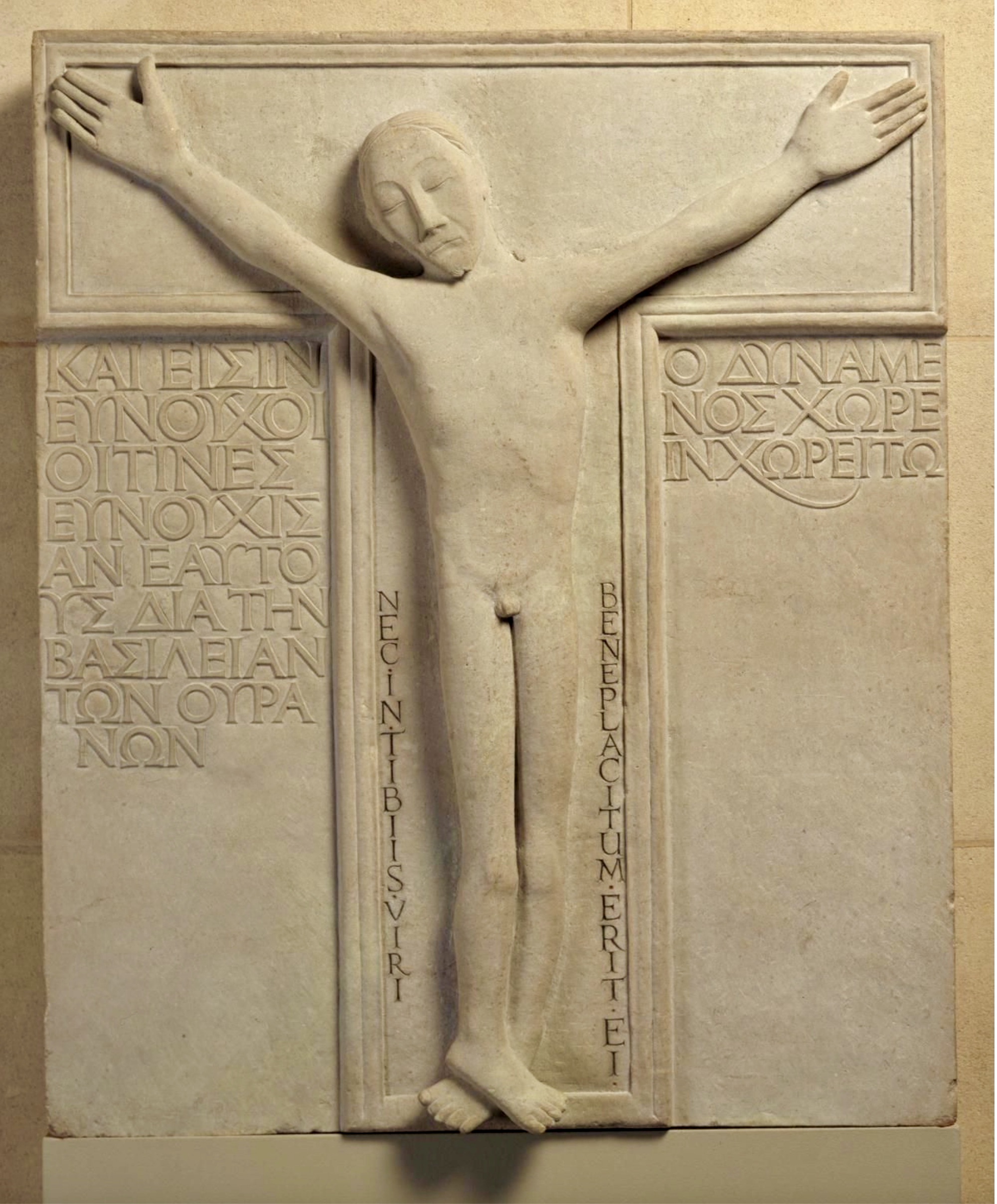
To my mind, some of the most beautiful work in the area of graphic art was created by the British artist and craftsman, Eric Gill. The intractable problem posed by Eric Gill is not a legacy of his artistic output, but of his personal life. Largely unknown to those outside his family until about 50 years after his death, Eric Gill – by admission in his own unpublished writings – had engaged in personal behavior of a kind that most people would find not only abhorrent but, increasingly, as also criminal.

This is related to the larger problem posed by the work of artists, musicians, and architects whose work is seen as having been collaborative with tyrannical regimes (eg., the Third Reich, the Soviet Union). How do we view beauty in art that either depicts or is simply associated in some way with sin or with evil? (This is a matter I have previously tried to understand in relation to Picasso’s great painting, Guernica.)

To cite Scripture to the effect that “all have sinned,” may help us begin to locate the terrain upon which we need to address the problems stemming from Eric Gill’s biography, but it is not in any way to excuse his conduct. Though all sin is bad, and equally problematic in the eyes of God, not all sin is equal in its damaging effect upon others, and upon ourselves. The traditional distinction in moral theology between mortal and venial sins provides one way to try to parse some of these differences, while not excusing any forms or examples of sin, whether in ourselves or among others.

My purpose here is to invite reflection upon how we might appreciate Eric Gill’s religious art, as many did for several generations, without having our view of the merit of his work diminished by our moral evaluation of troubling ethical choices he made, and the lapses from good moral judgment they represent. In other words, and as an amateur student of the arts while also being a retired parish priest and former professor of moral theology, I wish to present some examples of Eric Gill’s art, letting his work speak for itself apart from ethical consideration of his personal life, and without ignoring the problems associated with the latter.

Perhaps my theme here can be summed up in this way: I invite you to benefit from the beauty of what Eric Gill created without asking you to overlook what we have learned about his private life. And I offer this invitation aware that some will not find it possible to accept.

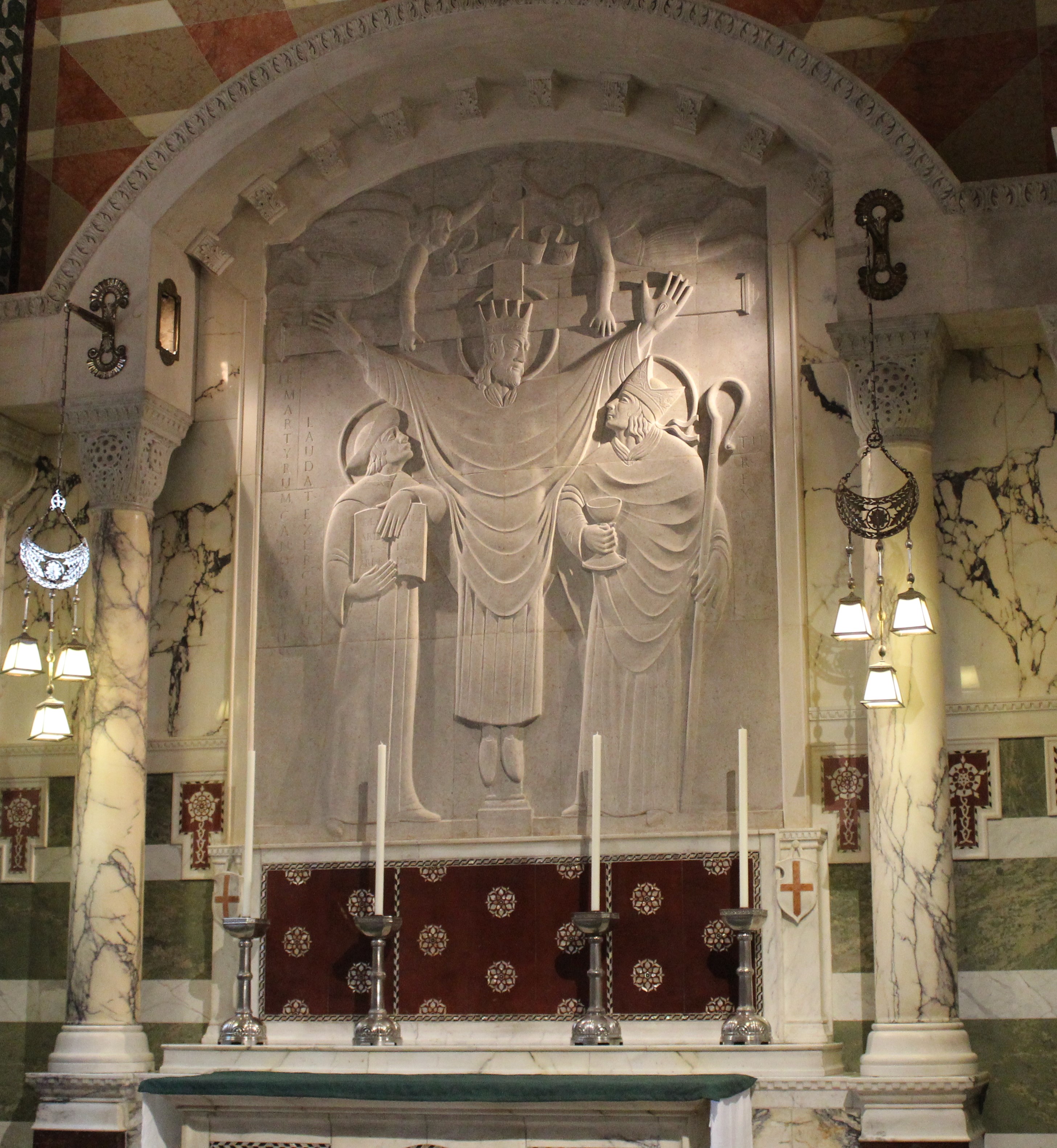
A sculpted carving by Eric Gill above the altar of the Chapel of St George and the English Martyrs, Westminster Cathedral, London
Eric Gill, Crucifixion
Eric Gill, sculpted relief panel from a series of the Stations of the Cross, Westminster Cathedral, London

As we consider some of his art, we should not overlook Eric Gill’s impact, at least indirectly, upon much of the daily life of the population of Great Britain (and elsewhere), in the form of three type faces he created. The most well-known is Gill Sans, named after its designer, and evident at almost every Tube stop in London. An effort to erase his work from the public eye, and replace it with alternatives, would require removing virtually every train station sign in Britain. It could be done. Should it?

Three fonts designed by Eric Gill

To put the problem I have raised here most bluntly, how can we appreciate the beauty in the holy art created by someone who behaved in a way most people would describe as sinful? I do not have a ready answer to this question. Note that, in what I have written above about Gill’s behavior, I have not gone into detail. Would that make a difference? If so, in what way?

And even if we refuse to give any amount of attention to Eric Gill’s artwork, we must still grapple with a timeless question: are there any unforgivable sins? Is anyone, because of his or her behavior, beyond the power of God’s redeeming love? Is it not likely that someone having Gill’s religious inclination also possesses a glimmer of moral awareness such that he or she might be open to repentance when – at the end of life – the person faces the awesome and undiminished light of God’s truth-seeking love?

Here is one thing that we can do: pray for the repose of the soul of Eric Gill, and for God’s Providential mercy.

In beginning to approach the questions I have raised here, I would start with some of the distinctions I shared above. I do not think we can deny this reality – that we, as people who are created in the image and likeness of God, and who have lost that likeness through the Fall and human sin, still bear God’s image however marred it may be by the corruption resulting from our sins. And, that we are still capable while in this life of acts and works of uplifting beauty.

The Beautiful Spirit of my Friend, Renee


I want to share my continuing appreciation for the beautiful spirit of a friend with whom I have been a colleague in life and work for over twenty years, and from whom I have learned much. Renee was first a mentor to me, as someone who exemplified spiritual authenticity while also demonstrating leadership gifts that have come to be recognized in the wider Church and in the corporate world. Renee truly loves people in a genuinely infectious way. It is no surprise, therefore, that she is a natural team leader who is blessed with the gift of inspiring others to become more whole, and to take the pursuit of holiness more seriously.

Renee was raised in the Midwest and the Southwestern desert, but yearned for a wider worldview than what her family and her early educational and social communities seemed to offer. This has led her to pursue a great deal of travel throughout her life, a good bit of it overseas. She has always been a seeker who has moved through life with the humility of an inquisitive learner and perceptive observer. To me, these qualities are fundamental.

I got to know her as a fellow leader at conferences in what she and I humorously might call the ‘early days,’ when she sought to share her vision for mission and ministry with a wider community. I remember her approaching the task of assembling some fifty-plus plastic transparencies to be set upon an overhead projector {remember those?}. And yet, despite these kinds of challenges we commonly faced as conference presenters, her story and personal witness were always compelling. For she quickly made meaningful connections with others in ways that encouraged us to identify with what she had come to see and know, and then as things we could take on to value in our own lives.

Some personal details of Renee’s life-journey fortify my appreciation for who she is, and the person she has been open to becoming. After her childhood and subsequent education, largely shaped by life in middle America, she adventurously responded to a ministry opportunity that took her to a rural area in the Philippines. This was likely a significant growth opportunity as well as an early indication of some emerging directions in her future vision and work. In so many ways, she has had an inclination to approach ideas about what it means to live as a spiritual being who engages with this world in all its complexity, with curiosity and a compelling equanimity. I particularly value her intentional pursuit of aspects of Asian cultural and spiritual life, and her frequent travels to the far side of the Pacific. These pursuits stand out to me given my own childhood and adolescent experience of growing up in Japan.

As a practical example, her decision for many years to risk adopting a pattern of clothing that could by some be labeled as ‘cultural appropriation,’ was yet a sign of her openness to other and non-traditional ways of living and of seeing things. Based on a spiritual principle, she has also often led worship after removing her shoes. For her, these kinds of decisions regarding how she approaches daily life are not an affectation, and call attention to what she is focused upon and to those things in which she finds value, rather than to herself.

Having lived and worked for a period of time in the humid hill country of the Philippines, Renee has also been effective in encouraging church community in the comparatively arid rural areas of Idaho, the azure coastal region of central California, as well as in the rice-growing flat land of southeastern Arkansas. Throughout her life, Renee has been drawn most to the desert, and to the spirituality that can be found in places like where Abraham perceived the nearness of God, outside his tent on a bright starry night, and where Jesus confirmed his vocation while setting aside the alluring possibilities offered by the Enemy. Her regard for the divine Spirit, who is often best found in the desert and in desert-like places, provides insight about the abiding interiority of Renee’s spiritual character.

What particularly marks Renee as a learner and as a teacher is her remarkable capacity for creative but also sincere self-remaking. She has in many ways transcended perceived attitudinal ‘boundaries,’ and has not only grown but has flourished in her life-informed path, to the joy of many others.

I offer this with thanks for my friend, Renee Miller, who embodies a wonderful appreciation for ‘the beauty of holiness.’

Here are some words from Renee that I think capture well her positive view of her life and ministry: “My primary core value is attributing the highest motive to people’s behavior. This helps me stay in the place of unconditional love, and for me, there’s nothing more theological or beautiful than the reality and demonstration of love. It can transform even the ugly and horrific, and if not transform, at least lessen its power.” Surley, these are words that we all want to live by.


Toward a “Catholic” Vision [part 2]

EucharistAtStGregoryOfNyssa_med


In part 1, I shared how Ralph McMichael offers this brief but evocative definition of the word “catholic.”

Catholic means the whole truth, about the whole God, for the whole world.

Ralph’s concise definition calls for intentional follow-through. When we hear ‘catholic’ in conversation, we should anticipate and hope for an encompassing understanding of this word. This can be a first step in helping us to aim at a holistic (and therefore holy) vision of the world.

The challenge I find in Ralph’s definition is for all of us who are baptized to be “catholic” in a genuinely biblical, apostolic and ecclesial way. This means seeking and finding wholeness and holiness within the vocation we have received together in Baptism.

Embracing a larger concept of what it means to have a catholic vision opens us to
a more expansive vision of God’s Mission throughout the world. Jesus has embraced and empowered all of us to go out as grace-enabled participants in God’s continuing mission to redeem and transform the world.

We desire ‘wholeness.’ Encouraged by the culture around us, we think of achieving wholeness as our project, as our task to fulfill, or the solution to our therapeutic needs. Approached in a more encompassing way, wholeness is reconnected with God’s Mission in the world, rather than reduced to being a feature of our personal lives. God nurtures this greater wholeness through our life in community. We express God’s Mission best when we celebrate the Eucharist together.

God’s Mission is always greater than we can ask or imagine. It is not just for us, for our families and friends. God’s Mission enables us to live into the whole truth about the whole God for the whole world. As we live forward, into this wider vision, we will find that it involves beauty and goodness, as well as our perennial concern for what is true.

On this, his feast day, we can join St. Richard of Chichester (d. 1253) in his prayer, “Day by day, dear Lord, of thee three things I pray: to see thee more clearly, love thee more dearly, [and] follow thee more nearly, day by day.”


{St. Richard’s words are quoted from Hymn 654, The Hymnal 1982 / the photo above, from a Eucharist at St. Gregory of Nyssa, San Francisco, is by Mark Pritchard, (c) Attribution-NonCommercial-ShareAlike License}

Toward a “Catholic” Vision [part 1]

OLYMPUS DIGITAL CAMERA


In an earlier age, having catholic tastes or a catholic perspective meant breadth in one’s approach to the world and to objects of interest within it. A “catholic” vision would therefore be expressed in terms of what it includes rather than what it does not.

We live in an age when words and ideas are prone to partisan and ideological interpretation. Too easily, we settle for narrow and limited meaning. When we now hear the word “catholic,” we assume the reference is to an institutional branch of Christianity. Though we find the word “catholic” in the universally accepted Apostles’ Creed, we allow lesser concerns to shape our concept of what it means for the Church to be catholic.

My friend and former teaching colleague, Ralph McMichael, offers this brief but evocative definition of the word:

Catholic means the whole truth, about the whole God, for the whole world.

His definition may help us reclaim the word, so that even ‘free church’ believers might be comfortable using it. Catholic has to do with the whole, with what is universal.

A catholic vision will include all that is beautiful and all that is good, as well as all that is true. Arguably, anything less falls short of being catholic.

I am continually challenged not to settle for less than this encompassing and holistic vision.