Painting

The Beauty of What God Can Do, and Is Doing

If reading this by email, please tap the title at the top to open your browser for the best experience. Then, clicking individual pictures will reveal higher resolution images.

James Tissot, God Creating the World


If you are a Christian, and if you reflect on your formation as a person of faith, consider this question: Do you believe it is reasonable for God’s will to make sense to us? To ask this question opens the door to discovering how our beliefs about God were shaped, as well as our beliefs about God’s providential ordering of the world. Indeed, does God even want us to think about such things, or are we simply to accept and obey the divine will, regardless of whether we find this reasonable.

These questions also bear upon how we reflect upon what happened in Jerusalem 2,000 years ago, events that we consider during this Holy Week.

Broadly speaking, the Catholic tradition of thought – going back at least to Thomas Aquinas – anticipates a discernible overlap between divine rationality and that of created and redeemed human nature. God’s rationality is imprinted upon our powers of reasoning. By contrast, broad strands of the Protestant tradition – with its comparatively elevated concept of the Fall and human sin – have not nurtured and have even discouraged a similar expectation of such an overlap. Accordingly, we cannot expect or believe that our rationality has any real continuity with divine rationality.

One of the two traditions described above has emphasized the self-revealing comprehensibility of God, who intends for us to know, and not simply obey, the divine will. The other tradition has privileged the sense that God was and is wholly other, and therefore God’s ways are incomprehensible, except for small graces. Each of these two traditions has therefore had a different understanding of what it means for us to have been created in the image and likeness of God (see Genesis 1:26, in context).

A related and observable distinction regarding these two broad traditions concerns the relationship between grace and nature, and how this is construed. In the wider Catholic understanding, grace is more often seen as infusing nature, and present everywhere. Whereas a common view often found in Protestant piety anticipates that grace touches nature episodically, and sometimes is antithetical to it, given nature’s and our Fallen state.

James TIssot, God Appears to Noah

Another way we can distinguish the spiritual influence of the two traditions I am sketching here concerns the nature of God and of God’s activity. For example, shaped by a broadly Catholic catechesis, it is believed that there are at least three things that God cannot do: create a rock bigger than God can lift; choose to cease to exist; and, command us to hate ‘him.’ For, in the spirit of that same catechetical tradition, each of these three theoretical possibilities would be irrational, and thus contrary to the divine nature and being, as well as to who and how we were and are made to be.

Most Protestant thinkers and preachers would likely dismiss the first two of these three (im)possible ‘things’ as perhaps irrelevant rhetorical distractions. Yet, the third thing, however disagreeable and unforeseen in light of the New Testament, would probably be conceded as theoretically possible, especially given the historically Protestant stress on divine freedom and the importance of acts of will for personal right-believing. (In other words, though God could, God wouldn’t.)

A result of these differences between the two traditions is that questions about sin, misfortune, and the presence of evil, have tended to be handled differently in Protestant belief and teaching as compared to that shaped by Catholic spirituality. This difference can be noticed when we reflect on and speak about ‘bad things’ that happen to us. Does God cause such misfortune, or, allow it? How we tend to answer this ‘cause’ question can reveal something about the Christian catechesis by which our thinking and beliefs have been shaped. And how we think about this question regarding divine responsibility will benefit from insight going back to Aristotle concerning four different aspects of what the word ’cause’ can mean.

James Tissot, God’s Promises to Abram

Here is a fundamental question that can bring many of the above strands of thought into focus: Do we believe that God always loves us; always seeks intimate fellowship with us; and always seeks to draw us more fully into the merciful embrace of God’s redemptive purposes? Or are our answers to these facets of a fundamental question somewhat qualified? And if qualified, then by what?

Especially in view of our observance of Good Friday this week, I believe that we can answer this question about how God loves us in the affirmative. And we can do this without overlooking or ignoring such NT images as the narrow gate, and the Lord who will ask what we have done for the least of his brothers and sisters.

CS Lewis, among others, reminds us of a way that we can appropriately affirm God’s abiding love for all people. We can illustrate Lewis’ view with the following image: We may weep when we come before Him at the end of our lives. But our tears may be both from sorrow as well as from joy at our redemptive inclusion, despite all that may count against us. As long as, in that moment, we acknowledge Him, and who He really is. For we all will have the opportunity to do so.

Alleluia – Easter comes for everyone. If only we could better see how and why that is true!


Additional note: As an Anglican, I include my own tradition within what I refer to above as the broadly Catholic tradition. My goal with this post is not historical analysis but to provide grounds for reflection regarding two differing – yet sometimes overlapping – ways of approaching some central questions.

Charlie Russell: Stories That We See

If reading this by email, please tap the title at the top to open your browser for the best experience. Then, clicking individual pictures will reveal higher resolution images.

Whose Meat? (1914), on display at the CM Russell Museum


Charlie Russell’s culturally perceptive and action-oriented paintings reflect the social sensitivity that he possessed as well as his visual awareness of the natural world around him. Russell was a much-appreciated story teller, a natural gift that I believe is reflected in his art work. In Charlie Russell’s paintings, we see stories, and many of them represent the climax-point of stories we want to hear.

Shadows Hint Death (1915)

This raises a significant question regarding the works I am featuring in this post: What distinguishes these Russell paintings from examples like those of James Tissot’s biblical scenes, or Norman Rockwell’s Four Freedoms images? Regarding the paintings of both of the latter two artists, the word illustration may be used without diminishing our regard for their beauty or accomplishment. Yet, and without rendering a judgment about Tissot and Rockwell’s work, there may be a discernible difference between what are technically referred to as illustrations, and paintings that are more properly termed “fine art.”

Tom Gilleon’s recent exhibition of paintings at the CM Russell Museum included a personal reflection by the artist regarding his transition from being an illustrator for Walt Disney and NASA, to pursuing painting as a fine art. In that reflection, he refers to an illustrator’s skill in distilling imagery into its simplest forms, for example, by focusing on the power of simple lines and basic shapes. He suggests that, in his transition to fine painting, he pursued those basic shapes and forms as ends in themselves, being aware of how his paintings connect viewers directly to our primal human understanding of such forms. In a statement titled, “Profound Truths in Simple Forms,” he says that “by eliminating all unnecessary elements and being as direct as possible, an artist has the opportunity to guide viewers’ eyes, to tell them stories, to move their emotions.” The Russell paintings I feature here do just that.

Meat’s Not Meat Til Its in the Pan (1915), on display at the CM Russell Museum

Yet, the question remains. What distinguishes fine art paintings from those we call illustrations? If the latter are of a publishable kind, surely they share some of the properties we associate with fine art, and reflect a comparable degree of skill by the artist and a dedication to quality in the results. Building on Gilleon’s reflection noted above, we might say that illustrations are produced to accompany the telling of a story, whereas many examples of fine art paintings do the telling of the story. They do this by capturing more than a particular moment, while being suggestive of the broader context of what has come before, and what might come next. Another way to make the point is this: artworks intended as illustrations generally provide an image of a moment, or a dimension of a story that is communicated by other means, such as narrative.

Yet, in examples of fine art, a painting is meant to communicate on its own, apart from any accompanying text, and sometimes even without a title. In such work, factors such as atmospheric conditions of weather and lighting, or the emotional disposition of any characters portrayed, as well as interaction between them, often play a major role. And the presence and function of these latter elements can significantly determine the effectiveness of a particular work.

Paying the Fiddler (1916), on display at the CM Russell Museum (depicting a cattle rustler caught in the act)

In these works of representational art, we begin to inhabit the scene and story, while finding out more about them as we consider the imagery. Russell’s attention to background, the broader context, and surrounding figures, contribute significantly to the overall effect of his work. His very well-known early painting, Waiting for the Chinook (The Last of 5000), provides a reference point for this distinction. As a relatively simple image, its power lies in how it rises above the simple portrayal of a fact, in how it suggests multiple answers to a larger question.

Waiting for the Chinook (The Last of 5000)

This may help us observe how each of the paintings featured here not only tells a story, but invites the viewer into those stories to imagine what has led up to the moment being portrayed, as well as concerning what might yet happen in the given situation.

Wild Horse Hunters (1913)

Except for the early Chinook painting (seen above), all of the images included here date after the turn of the 20th century, when the “Old West” had in large part already transitioned from the lore and imagery of the “cowboys and indians” days, an ethos Wild Bill Cody had successfully captured in his eponymous Wild West Show, and was a world soon eclipsed by the emerging film industry.

In Without Knocking (1909)


Additional note: Readers may also be interested in the prior post, “Charlie Russell’s Vision of the ‘Old West’.” Once again, I commend a visit to the CM Russell Museum, in Great Falls, MT, to see original Russell paintings and sculptures as well as the artist’s studio and residence, carefully preserved adjacent to the museum. Interior photos of Russell’s studio and home are seen the photo below.

Charlie Russell’s Vision of the “Old West”

If reading this by email, please tap the title at the top to open your browser for the best experience. Then, clicking individual pictures will reveal higher resolution images.

Charles M Russell, The Fireboat (1918)


One of the most prolific and skillful painters and sculptors who sought to portray the myth and reality of the “Old West,” having witnessed its waning days, was the cowboy-turned-artist, Charlie Russell. He discovered his real vocation after moving to Montana in 1880 to try ranching at the age of 16. Fans of Russell like to repeat the story of how the would-be-artist communicated to absent land owners about the condition of the few surviving cattle after a brutal winter decimated their herd. Instead of a written report, Russell sent a painting of a single bony steer surrounded by prowling coyotes. Titled, Waiting for a Chinook (The Last of the 5,000), the illustration has become one of Russell’s best known images.

From his earliest days, Russell had the gift of being able to capture with drawing and paint the lives of what he would have called ‘Cowboys and Indians’ in ways that others found compelling. By the time of his death, at the age of 61 in 1926, Charlie Russell was one of the most famous artists in America. Despite his abiding interest in the romance of the Old West and its cowboy ethos, Russell was quite knowledgeable about Native American cultural patterns and spent a significant amount of time with the Blackfeet and other regional tribal peoples, making many enduring friendships in the process.

Ever since visiting the C.M. “Charlie” Russell Museum while in middle school, I have wanted to return to Great Falls, Montana, in order to see the splendid collection of his paintings and memorabilia for which that facility provides careful and intelligent stewardship. Recently, I was able to attend the annual CM Russell Museum weekend fundraising gala event that includes an auction of a wide array of Western art, including pieces by the museum’s namesake.

The Charlie and Nancy Russell home


Charlie Russell’s Studio, on the same property as the home


The Russell Museum is located adjacent to the artist’s restored home and log cabin studio, on a quiet street in a residential neighborhood in Great Falls, a relatively small city located on the banks of the upper Missouri River. Little did we know that this event, coinciding with the annual Western Art Week expo, attracts many buyers and patrons, eager to add to their collections. We marveled at the auction of a 1924 watercolor by Russell, Women of America, sold for the astonishing price of $1.6 million! Another watercolor by Russell, the 1904 Mandan Buffalo Hunt, attained an auction price of $750,000. Both of these recently sold works (reproduced here from the catalogue) provide a sense of Russell’s culturally perceptive, action-oriented paintings.

Women in America (1924)


The Mandan Buffalo Hunt (1903)


Of particular interest was a presentation offered by the Crow Nation linguist, Dr. Lanny Real Bird, who helped non-Native American listeners undertand the significance of sign language among Plains tribal peoples, and how it was a skill with which Charlie Russell had become proficient. This under-appreciated aspect of Russell’s skillset can be discerned in a painting by the artist that has become one of my favorites, The Fireboat (seen at the top of this post).

Dr. Lanny Real Bird


Russell’s painting, The Fireboat, was completed in the latter part of his career, and appears to depict a scene along the upper Missouri River near the artist’s home territory. A steamboat (visible in the far lefthand edge of the painting) has attracted the attention of three members of the Blackfeet Nation, who are joined by a fourth in the background. A setting western sun illumines the figures of the mounted Blackfeet warriors, which – along with the steamboat – subliminally suggests the cultural shift occurring on the Western Plains in the last decades of the 19th century, with the gradual eclipse of one nation by another. The middle figure, whose image helps form a visual triangle within the composition, employs a hand signal, presumably after having viewed the riverboat making its way along the river. Not obvious to the uninformed viewer, but aided by a knowledgeable interpreter of Native American signs such as Dr. Lanny Real Bird, we learn that the hand signal in The Fireboat is the one for fire, making Russell’s title for the painting intelligible.

Charlie Russell’s Western paintings may not display the refinement of technique that we might associate with the work of Frederick Remington, but possess a compelling dynamic realism in their nuanced portrayal of real people, accurately observed in their daily lives. It is worth noting that many of Russell’s finest compositions were completed at his and Nancy’s summer cabin at the edge of Glacier National Park. A visit to Great Falls to see the Russell Museum as well as the excellent Lewis and Clark Interpretive Center, just an hour or so from Helena (the state capitol), can enhance a visit to Montana – even in winter – with a significant experience of the artistic and historical spirit of the “Old West.”


Beauty in the Face of Jesus

If reading this by email, please tap the title at the top to open your browser for the best experience. Then, clicking individual pictures will reveal higher resolution images.

William Holman Hunt, The Light of the World (detail)


Since the earliest centuries of the Christian era, believers have found encouraging meaning in paintings of the imagined face of Jesus. Since no such images exist from his lifetime (as far as we know), but only written depictions of Jesus’ character as displayed in his words and actions, later artists have literally drawn upon acts of imagination in how best to present him. In so many of these paintings of Jesus, we find abiding images that convey an abiding love.

Salvator Mundi, attributed to Leonardo da Vinci

More than a few in our great Tradition have had an aversion to the making of these images, believing that such efforts to depict Jesus risk engaging in or promoting idolatry, a concern that is not difficult to appreciate. Yet painters, particularly in the Christian East, have believed that, in view of our Lord’s Incarnation, paintings of Jesus and of holy events in which he was involved are not only appropriate, they can be divinely inspired windows into eternity.

Christ Pantocrator, an icon in St. Catherine’s Monastery, Sinai, Egypt

Modern Evangelicalism has played a parallel role to this in the belief that compelling contemporary images of a beautiful and winsome Jesus can aid the faithful by stirring devotion in Bible reading, prayer, and in daily living.

Warner Sallman’s 1940, Head of Christ, reprinted in many Protestant Bibles and devotionals

The face of Jesus, by R. Hook, a 1964 painting widely popular in the Jesus Movement of the 1970’s and among Evangelicals

How do we picture Jesus? Although though we may appropriately demur from referring to God by using personal pronouns or with gender-based associations, when hearing the Gospel reading on Sundays, or while reading devotional books, images of Jesus inevitably arise in our conscious awareness generated by acts of imagination.

Here we receive encouragement from C.S. Lewis, J.R. Tolkien, and other spiritually inclined writers, who have helped us recover confidence in the idea that the power of imagination can be a redeemed vehicle for conceiving holy images, both of biblical scenes and also of allegorical parallels based upon them.

Hieronymus Bosch, Christ Carrying the Cross (detail)

The popular pious suggestion that we ask ourselves, “what would Jesus do, or say about this matter,” can therefore be a helpful spiritual exercise, especially if pursued reverently and with a scripturally informed process of deliberate thought.

Christ and the Rich Young Ruler, Heinrich Hoffman

In my prior post, I shared detail of a compelling image of Jesus by the 19th century painter, Heinrich Hoffman. I love this painting, expressing the artist’s rendering of Jesus’ encounter with the so-called rich young ruler. Hoffman portrays well the love Jesus had for and showed to the man who asked him how he could enter the Kingdom of Heaven. The painter depicts how Jesus loved him and, we believe, continued to love him, both before and after this man turned away in discontent and confusion.

As we grow in our familiarity with images of Jesus, we can become sensitive to the way that Western art has tended to portray our Lord’s humanity, influenced by the European artistic tradition, which has not overlooked Jesus’ Semitic background. Nevertheless, how artists and others portray Jesus finds in him reflections of themselves, which is true to his known desire to identify with who we are. It has become more common in recent years for artists to portray Jesus in the form and appearance of other cultures, and the iconographic paintings of Brother Robert Lentz (some of which I have featured before) provide a good example. Among them is his image of Jesus set within the context of Japanese Buddhist spirituality, seen in the following image.

Turning again and again to such images can be most helpful to us in our spiritual journeys, especially when we choose well-conceived and well-executed paintings, drawings, or sculptures, that express to us facets of divine beauty, as well as the goodness and truth of God, found in the face of Jesus.


Note: Jaroslav Pelikan’s book, The Illustrated Jesus Through the Centuries, provides a ready and helpful way of finding images that can accompany our journey through Lent toward Easter living. Once again, I would like to thank Kathy Kane for my copy of this beautiful book.

In anticipation of this coming Sunday, Lent 2, Year C, I offer here a copy of a homily from a prior year, which may be accessed by clicking here.

The Beauty of Truth

If reading this by email, please tap the title at the top to open your browser for the best experience. Then, clicking individual pictures will reveal higher resolution images.

The Risen body of Christ bears the healed scars from the Crucifixion in Matthias Grunewald’s Isenheim Altarpiece.

My commitment to writing about Beauty is evident in my ongoing posts. I have also written about the connection between Beauty and Goodness as well as Truth, the three so-called Transcendentals. To use a phrase from another context, these are three things we ‘cannot not know,’ at least in principle.

As I expressed in my most recent post, in Christ we find the icon of God. For he is the icon of God’s beauty, God’s goodness, and of God’s truth. In turn, and as we are reminded during Lent, we are all called to become icons of Christ, and to seek to embody in ourselves what we find revealed and embodied in him.

Yet, of these three Transcendentals, Beauty, Goodness, and Truth, the third may be the most difficult for us to realize in ourselves, much less to try to describe. This is one reason why since earlier times people have recognized a hierarchy among these three things that we cannot not know. Among the three, beauty tends to be most evident and accessible to us, followed by goodness. The first often leads to greater appreciation for the second, and both can lead us to search for truth, however and wherever we may find it.

It is nevertheless not uncommon for us to be unsure about the presence or the nature of beauty and goodness when viewing objects, actions, or events. And we are very capable of engaging in disputes regarding such evaluations. But here is a paradox: though we may be just as unsure about how best to characterize what is true, or how to evaluate that quality in relation to ourselves, we seem to have much less hesitancy when it comes to ascribing the apparent absence or deficiency of truth in the words and actions of others.

To paraphrase a successful nineteenth century aspirant to the Presidency, grand ideas outlive those who hold them. James Garfield expressed this view just months before his assassination. Frederick Douglas was so impressed with Garfield’s principles and potential for national leadership that he led the procession onto the rostrum for Garfield’s Inauguration. Among those abiding principles and ideals was Garfield’s voiced recognition of the truth within a difference between many white Confederate soldiers and their leaders, and the black men who served in the Union Army. The former had betrayed the flag and their country; the latter did not. Ideas that help us identify and articulate things we value, like beauty, goodness, and truth, abide.

Nevertheless, for many of us, what we reckon to be true – as compared to what is beautiful and or good – is not always so clear. And yet, we believe in Truth. Even when we despair about its instantiation in general human affairs, and in the more limited spheres of our daily involvements, we believe that what is true should guide our lives and our conduct with one another. And, when it comes to what we practice as compared to what we believe or hope for, truth seems to be a principle that we more often honor in the breach.

Another paradoxical aspect of our desire to know the truth has to do with how what is true can not only be uncomfortable but even painful. A mother waiting up for a teenage son who is hours late getting home, and a husband awaiting word from his spouse who has not returned from responding to a wildfire, are likely to have mixed emotions about what they might learn when answering a knock at the door. And yet, in these and in countless similar cases, we want to know what is true, and the truth we want to know is one that is unleavened with inaccuracy or falsehood even if it is painful to hear.

What is true can be beautiful and good, at least for those who believe in the Gospel of Redemption. This is because Christians believe that ‘facts are friendly,’ and that there is no person or situation that is outside the scope of God’s loving redemptive purposes. What personally can be hard to accept as true can still be beautiful and good. And if not so at the moment, then it can be so when we pass beyond the veil and see the embodied Beauty, Goodness, and Truth, for which we so yearn.

Heinrich Hoffman, Jesus and the Rich Young Ruler (detail)

For us, Beauty and Goodness, as the first Transcendentals, provide this experiential advantage: we find them more readily evident as they are instantiated in objects, events, and in others. Truth, by contrast, can seem more elusive and more subject to the variable preferences and uncertain powers of our apprehension. As a Transcendental, Truth – like Beauty and Goodness – has objective reality. Yet, like her sister “Graces,” Truth must sometimes, if not often, penetrate the fog of our subjectivity and experiential awareness for us to perceive it.


Additional note: I am publishing this post on Ash Wednesday, a day on which we are invited to reflect on the patterns of our lives in light of the truths we have come to know, and which have been revealed to us.

In anticipation of this coming First Sunday in Lent, I offer here a copy of a blog post with an attached homily (with related images) that I presented in a prior year, based on the Lectionary (which may be accessed by clicking here).

The Beauty of Redemption-Based Identity

If reading this by email, please tap the title at the top to open your browser for the best experience. Then, clicking individual pictures will reveal higher resolution images.

Fra Angelico, The Transfiguration, prefiguring the glory of the Risen Christ and the beauty of our redeemed humanity


There is beauty to be found when we base our identity or concept of ourselves upon the Redemption that has been freely shared with us. Yet, we can experience sadness when we rest our self-perception upon our ailments and disorders. Regardless of our feelings, these alternatives represent choices we can make on a daily basis.

We all have an innate disposition to sin, and in various ways we all enact this disposition. But, for Baptized people and all others, this is not ‘the be all and end all’ of who we are made to be. Our end is in Christ, and so our wholeness is in Christ. We may be sinners; we are also among those who have been redeemed and are being transformed by the power of the Resurrection.

Appreciative Inquiry teaches us that what we we focus on grows. This empirical fact can be seen in two readily observable ways. New soccer players, especially the youngest ones, tend to swarm around the soccer ball. And, when on a fast break to try to score a goal, almost inevitably they kick the ball toward the goalie, the apparent impediment on whom their eyes are affixed instead of upon empty areas of the net. Another example lies in how Drivers Ed instruction teaches aspiring drivers to keep their eyes on the road. Why? Because we steer toward what we are looking at, often with sad results when what catches our attention are the flashing lights of an emergency vehicle on the shoulder.

I remember an observant friend remarking about another person known to both of us, regarding how that person was “someone who dotes on his infirmities.” Not a recipe for health in light of our greater awareness about the symbiotic relationship between psychology and physiology.

These insights may have what I hope are obvious spiritual implications. They may lead us to ask, toward what end are we living? Upon what image of our humanity are we most focused?

Raphael, The Transfiguration (detail)

An ironic aspect of the way that we can associate our identity with symptoms or conditions from which we suffer is how we commonly speak about our embodiment. When we say things like, “my leg is killing me,” or “my head feels terrible,” we may unintentionally reinforce a kind of dualism. All too casually, we dismiss such statements as mere figures of speech, and we may wish to consider their further significance. If I say that ‘my leg is killing me,’ then I suggest that in some way ‘my leg’ is not ‘me.’ Because my words imply that ‘it’ is acting upon ‘me.’ In a slightly more abstract way, we make statements like, “my conscience is bothering me.”

When I am inclined to think and speak in this latter way, I suggest by my words that ‘my conscience’ is something other than ‘me,’ and that it has some power of agency over or against me. What we commonly refer to as ‘my conscience’ might better be described as my experience of ‘consciencing’ (an intentional neologism). Or about how I am the kind of being who experiences and engages in acts of conscience. As the older moral tradition recognizes, conscience must not only be followed; conscience can and must be educated.

So, to say that “I am powerless over sin” does not necessarily mean that I am powerless over my disposition to engage in the bad choices and decisions that I tend to make. Like my emotional experience, I may not be able to choose to have the various physiological conditions that I experience. But I can choose how I respond, or how I act in relation to such experiences and conditions. As John Wesley is remembered as having said about the vice of lust, “a bird may land on my head, but I don’t have to make a nest for it with my hair.”

Experientially, I can associate myself with the conditions that may ‘happen to’ me, and with which I may suffer. But conceptually, I can also choose to identify with the reality of the person I have been made to be and become. By grace, we have been made to become icons of Christ, who is the beautiful Icon of God. To seek to become so is to seek to become an icon of the goodness of God as well as of the truth of God, as these have been revealed to us in the face of Christ.

Rembrandt, The Ascension, an image prefiguring our redeemed humanity to keep in mind so that we may, as the Prayer Book’s venerable words put it, “thither thereto ascend.”


Note: The wisdom of our Holy Tradition is reflected in the fact that our Lectionary appoints Gospel readings about the Transfiguration on two occasions every year: on the last Sunday after the Epiphany (or the Sunday before Ash Wednesday and Lent, March 2 this year), and also on August 6, the Feast of the Transfiguration of our Lord. / In addition, readers interested in some of the ideas presented above might consider further material relevant to them in my book, Ethics After Easter, available from libraries and booksellers.

The reflections offered here may assist choosing a theme upon which to focus in preparing for and in keeping a Holy Lent.

A Lost Rembrandt: Is Beauty Ephemeral?

If reading this by email, please tap the title at the top to open your browser for the best experience. Then, clicking individual pictures will reveal higher resolution images.

A lost painting: Rembrandt’s The Storm on the Sea of Galilee

In 1990, in one of the most notable art thefts in modern history, two men disguised as police officers entered the Isabella Stewart Gardner Museum and stole Rembrandt’s famous painting, The Storm on the Sea of Galilee, and 12 other significant works of art. When one considers the loss of this painting (for it has never been recovered), as well as the many significant works of art that have disappeared through history, two related questions may arise: Can beauty be lost? Is beauty ephemeral?

In the process of reckoning with the recent Los Angeles wildfires, people who are art-minded are beginning to wonder about a particular aspect of all that has been lost, which understandably has received less attention, works of art.

After fires and earthquakes, beautiful buildings can be rebuilt, sometimes even better than before given the learning that may have come with their destruction. But what about lost paintings, drawings, and sculptures?

The Adoration of the Magi, attributed to Rembrandt and long thought to be lost but recently re-discovered, known otherwise through copies made by others.

Clearly, and as many of the examples featured in this space attest, works of art may now sometimes be best (or even only) appreciated through photographic reproductions obtained through the internet. It has not always been so. In earlier times collectors relied upon expert advisors and buyers through which they obtained artworks for their collections, for which they may at times only have had descriptions or comparatively poor reproductions – as did Gardner with the assistance of the famed historian, Bernard Berenson. And yet, especially when the originals had yet to be seen “in person,” or are no longer available for personal viewing, works like Rembrandts Storm painting have a beauty that is not transitory, and these artworks continue to exist as they inhabit the memory and imaginations of many others, as has been true in my own experience.

Yet, whether or not examples of Beauty in art or in nature are available for personal perusal, Beauty itself abides.

Another lost painting attributed to Rembrandt, The Unconscious Patient, also recently rediscovered.

To be consistent with their faith claims, those who are Christian believers should be among the first to agree that Beauty is not ephemeral, not here in one moment and gone in the next, nor of passing significance. Beauty, like Goodness and Truth, has since ancient times been recognized as one of the three Transcendentals. In terms of Christian faith claims, we might consider the witness of an example like the prayer for the Feast of the Transfiguration of our Lord (August 6), found in The Book of Common Prayer:

O God, who on the holy mount revealed to chosen witnesses your well-beloved Son, wonderfully transfigured, in raiment white and glistening: Mercifully grant that we, being delivered from the disquietude of this world, may by faith behold the King in his beauty; who with you, O Father, and you, O Holy Spirit, lives and reigns, one God, for ever and ever. Amen.

The Beauty of the King that is spoken of in this prayer, as with his divinity and his full participation in the Shekinah glory of the Father, is eternal rather than temporal. And so, in reference to God, to the divine nature as well as to the three persons of the Trinity who share it, we should properly speak of the source of Beauty, rather than as an example of Beauty.

Yet, as the recent Los Angeles wildfires remind us, while examples of Beauty can – at least in some respects – be ephemeral, the idea and reality of Beauty abides, continuing to inspire us even when examples of Beauty are no longer there before us to admire.

Plato, Aristotle’s teacher, continues to teach us!


Can Beauty be Found in Judgment?

If reading this by email, please tap the title at the top to open your browser for the best experience. Then, clicking individual pictures will reveal higher resolution images.

James Tissot, Jesus Looking Through the Lattice (detail). This may remind us to ask, in whose sight do we live?


One of the most widely quoted, but perhaps least understood, sayings of Jesus amounts to the admonition, do not judge. A common way these words are understood can be summed up in the instruction, do not judge others lest you, yourself, become judged (see Matthew 7:1 and Luke 6:37).

Did Jesus mean to forbid all forms of judgment?

A good way to appreciate Jesus’ teaching in this regard is to make a distinction between judging persons, and judging a person’s actions. For example, trying to appropriate his teaching on this matter may require us to make judgments about what actions would constitute faithful obedience to his words, and those which are proscribed by him. In order to follow his teaching, I may need to ask myself, would this or that act of mine (whether merely in thought, or in my spoken words and or actions) constitute an example of what he meant to forbid?

At the same time, and if following through with the above distinction, I need to consider a further question. If Jesus did have the above distinction in mind, what more precisely was he concerned to have us try to avoid doing?

When interpreting Jesus’ words on this subject, New Testament scholars tend to focus on the inherent problem of our presumption of a divine prerogative. This is evident in our predilection to be the ones who determine which actions, behaviors, and or attitudes, are characteristic of the things that will impede our (and more especially other persons’) enjoyment of eternal fellowship with our Father in heaven. According to this understanding, we are not to make judgements like these: “That person, as a result of his words or actions, is as good as ‘gone to hell!’” Or, “that person is beyond redeeming, and is no longer worthy of my attention or positive regard.”

James Tissot, Woe Unto to You, Scribes and Pharisees

On the other hand, and as I seek to think, live, and love, as a graced participant in the life of Kingdom fellowship, I need to make distinctions about what kinds of thoughts, words, and actions are characteristic of Kingdom life. To do this requires making judgments – judgments about thoughts, words, and actions, rather than about people. And Jesus, as quoted in John 7:24, appears to encourage making right judgements. Though in this context in John’s Gospel, he is asking for right judgement to be made about himself, about who he is; his encouragement to do so rests upon his hearers making such judgements based on their (or our) experience of having engaged in similar acts of prudential reasoning.

James Tissot, The Soul of the Good Thief (a reminder of the Good End toward which we are able to live)

Making good or right judgments about what is characteristic of Kingdom life, and about choices or actions within it, can not only be helpful, even crucial, but also a thing of Beauty. Seeking first the Kingdom of God, and God’s righteousness would seem not only to permit such judgments, it may require making them. Indeed, how else are we to know what patterns of life, and specific types of action, fulfill Jesus’ teaching in the Sermon on the Mount? For we are able to make judgements about what kinds of thoughts or actions, and what kinds of disciplines or practices, can help us grow further into the holiness of Christ, our living icon of a beautifully redeemed humanity.

James Tissot, The Sermon of the Beatitudes (detail)

One key to understanding this implication of Jesus’ teaching about the value of right judement is provided by considering a number of Biblical and Prayer Book texts regarding the connection between our participation in the Beauty of the Lord, and our grace-enabled growth into divine righteousness. I hope to develop this idea in a subsequent post. For the moment, I will restate a maxim I like to remember: We are called to live as we prayto the Father, through the Son, in the Holy Spirit. This helps us to “see thee more clearly, love thee more dearly, follow thee more nearly, day by day.”


The closing words in the last paragraph above are a quote from St. Richard of Chichester, as found in hymn 654, The Hymnal 1982, and are familiar to many of us from a song featured in the musical, Godspell.

The Epiphany: Human Power Encounters Divine Authority

If reading this by email, please tap the title at the top to open your browser for the best experience. Then, clicking individual pictures will reveal higher resolution images.

James Tissot, The Magi Journeying (detail)


Instinctively, there is something we all seem to seek. We want to find purpose and meaning, and organizing principles for our lives. This desire is anchored in a larger one: we seek to discern what is real, and true.

But where does our common impulse come from? In what does this impulse consist? I think the best answer to these questions is found at the heart of the Feast of the Epiphany. On Epiphany, we celebrate how God has revealed to the world the real and true meaning and purpose for our lives. Epiphany is all about God revealing to us the divine center of everything. Epiphany highlights God’s self-revealing in the natural world, and preeminently in God’s Incarnation, which the Magi came to discover and then worship.

We are able to recognize that it is in the nature of a Creator to order reality, imbue it with purpose and meaning, and hence to bring order, purpose, and meaning to our lives. A perhaps-unexpected word that captures this broad idea is authority, in that God possesses the authorizing power to create things, and guide them. Specifically, we discern this authorizing power in God’s creation of the universe and in the divine agency shaping ongoing history. For God is the author of all that is real and true.

In human life, authority and power are not always neatly aligned, and we experience trouble when the two are at odds with one another. We see this dialectic between the two at work in the events of Holy Week, in the confrontation between divine authority (in the vocation of Jesus), and worldly power (as exemplified by Pontius Pilate). Less obvious is the way this dialectic is manifest in the events that are commemorated in our celebration of Christmas and the Epiphany of our Lord, especially in connection with the visit of the Magi from the East.

James Tissot, The Magi in the House of Herod

The Magi, also called ‘wise men,’ or ‘kings’ from the East, arrive in Israel having been guided by an authoritative power greater than themselves. Because of their witness to this higher authority and its implied power, the visitors pose a threat to Herod and his courtiers, who exercise earthly authority and its attendant power. This emerges in the interaction between people who are witnesses to divine authority and its power, and others who are possessors of worldly authority and power. The emerging conflict, later seen in the events of Holy Week, arises amidst the challenges surrounding the beauty revealed in what we call the Epiphany, the revealing of divine light to the whole world rather than to just a particular nation or the people of a particular religious tradition.

The Magi from the East, by explaining their quest, prompt Herod to act. He acts viciously and violently through orders given to soldiers under his command. The result is the series of murders we acknowledge every year on December 28, in the ‘red letter day’ we call the Massacre of the Innocents.

James Tissot, the Adoration of the Magi

What are we to make of the Epiphany of God in human form, and the tragic circumstances to which it led? At the heart of Christian belief is the conviction that God became present to us through a human birth. He revealed himself in a human person who embodied two natures, one fully divine, and one fully human, whose natures are distinguishable yet inseparable. Such a person, regardless of appearances, was and is the transcending center or heart of all that is, manifest in human form. He is, therefore, the One who truly possesses divine authority and divine power. Einstein – who was not in any sense a traditional believer – said this: “The most beautiful thing we can experience is the mysterious.” The divine center of reality, manifest and revealed in a human being, is the most mysterious beautiful thing that we can experience.

Here is the wonder of it: in God’s mysterious Providence, the birth of the Messiah would bring death to many (in the Massacre of the Innocents). And – years later – the death of the Messiah would bring the possibility of new birth to all, through the redemption of human being from the power of sin and death.

Yet, it would be some decades later before those who proclaimed Jesus as Messiah, and the embodiment of God, could understand the connection between his birth along with those soon-resulting deaths of the Innocents, and his later death, along with its soon-resulting new births for those who came to believe in him.

Our proper response to all this — indeed our only response to all this can and should be to praise the Holy One of Israel, the one whose death brought new life to all who receive him. He has come to us. Come let us adore him. And let us receive him with renewed hope and joyful hospitality, in all his light-filled glory.

A blessed Epiphanytide to you and your loved ones.


The Arrival of the Messiah in James Tissot’s Art

If reading this by email, please tap the title at the top to open your browser for the best experience. Then, clicking individual pictures will reveal higher resolution images.

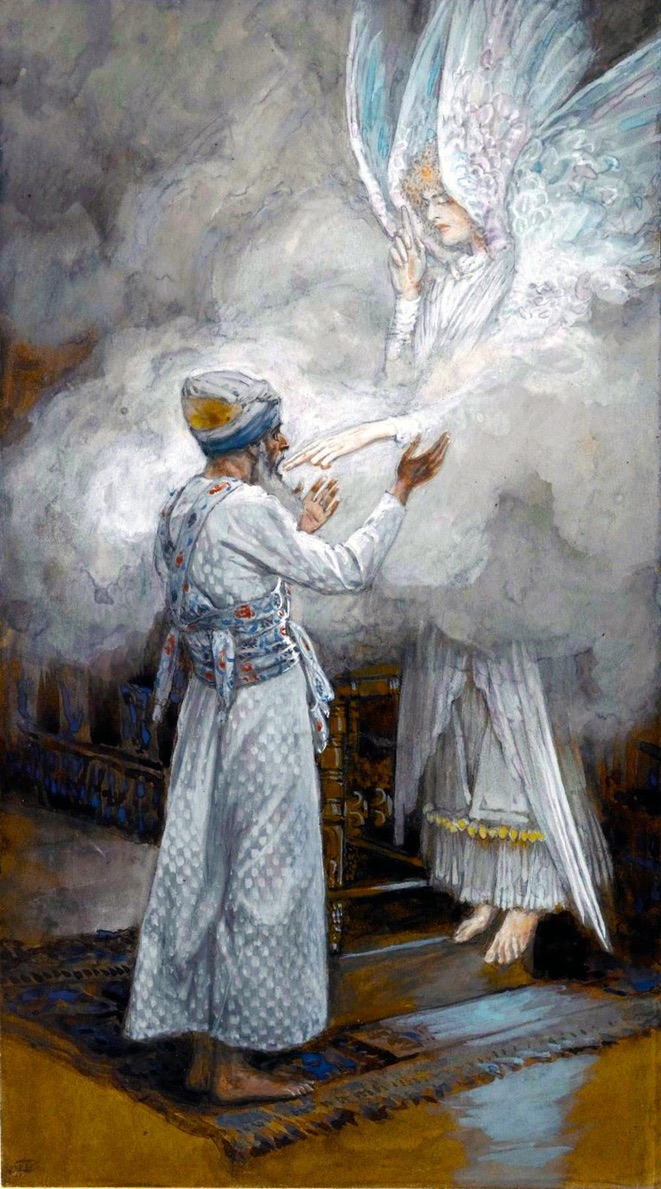
James Tissot, The Vision of Zechariah, with which Luke begins the great story (Luke 1). The priest, Zechariah receives an epiphany, telling him that he and Elizabeth will have a son, to be named John, later known as ‘the Baptizer.’


With this post for Christmas, I share with you a series of paintings by James Tissot on the theme of the Nativity of Jesus. Readers of this blog will know of my high regard for this artist’s life and work. I am pleased to share this collection of Tissot’s paintings related to the great events we celebrate for twelve days in the Church’s calendar year.

The paintings featured here, and many others, later became the illustrations in Tissot’s four volume, The Life of Our Lord Jesus Christ, published in English in 1897-8. The originals of these paintings were purchased by the Brooklyn Museum in 1900, and examples from this collection are periodically on display, both there and elsewhere.

May you and your loved ones have a holy and blessed Twelve Days!

The Betrothal of the Holy Virgin and St. Joseph (mentioned in Matthew 1 & Luke 1)

The Annunciation to Mary (Luke 1)

The Magnificat (Luke 1)

The Vision of St. Joseph (telling him of the coming child, and that he is to receive Mary as his wife / Matthew 1)

The Visitation (of Mary to her cousin, Elizabeth, the expectant mother of John, who would become the Baptizer / Luke 1)

St. Joseph Seeks Lodging at Bethlehem (Luke 1)

The Birth of Our Lord Jesus Christ (Luke 1)

The Adoration of the Shepherds (Luke 2)

The Adoration of the Magi (Matthew 2)

The Flight Into Egypt (Matthew 2)

The Massacre of the Innocents (Matthew 2)

The Sojourn in Egypt (Matthew 2)

The Presentation in the Temple (Luke 2)

Jesus Among the Doctors (the boy, Jesus, at age 12, visiting the Temple in Jerusalem with his parents / Luke 2)


Note: the titles attached to the images above are those that are provided by the Brooklyn Museum