joy

Mary’s Joy-Filled Acceptance


Picture the scene: About 750 years before Jesus, at the Lord’s bidding the prophet Isaiah goes out to the south side of Jerusalem near the aquaduct. He has been asked to do a difficult thing, to meet the fearful and apprehensive Ahaz, king of Judah. This happens at the moment when God’s people are threatened by Tiglath-pileser, king of the Assyrians. Making a bad situation worse, the Assyrians have been joined by armed forces from the separated northern kingdom of Israel, who have already been brought under subjection by the threatening foreign power. Ahaz does not respond as God would like. When he demurs from asking God for a sign of assurance, Isaiah confronts him with the Lord’s Word:

“… Listen to this, government of David! It’s bad enough that you make people tired with your pious, timid hypocrisies, but now you’re making God tired. So the Master is going to give you a sign anyway. Watch for this: A girl who is presently a virgin will get pregnant. She’ll bear a son and name him Immanuel (God-With-Us). By the time the child is twelve years old, able to make moral decisions, the threat of war will be over. Relax, those two kings that have you so worried will be out of the picture. But also be warned: God will bring on you and your people and your government a judgment worse than anything since the time the kingdom split, when Ephraim (northern Israel) left Judah. The king of Assyria is coming!”

What a strange promise! How could the promised birth of a child be a gift for a troubled world?

This is the kind of promise that Mary later received through the Angel Gabriel. We all receive a similar promise when we are called to acknowledge and accept that same Gift-Child that Mary received.

During Advent this year we have reflected on how there can be several aspects of our response to God’s call, and to the promises latent within God’s Gift to us. Fear is often our first reaction, followed then by wonder and uncertainty about the fit between God’s promise and our own suitability for receiving it. By attentiveness to God’s Grace, our uncertainty can be transformed into a humility ~ a humility that is willing to accept the Word of Promise and the Call to receive it. And if we come that far, if we are willing to believe and remain attentive, we may experience a wonderful moment. We find it in a fourth aspect of Mary’s response to God’s Word of Call. It is quite simply, Joy! There is no other word for it. Both Mary and Joseph, each in their own way, accept God’s unlikely and unexpected Word of promise. By accepting and receiving God’s will for what it is, they find a beautiful joy.

Over the course of Advent, I shared with you three images portraying aspects of the Angel Gabriel’s Annunciation to Mary of the promised gift of a child ~ a child who would be God with us. In the image above, El Greco beautifully captures the sublime quality of the moment. Having accepted God’s Word in humility, Mary’s eyes and her whole being are uplifted to receive the message. Her up-turned hand says it all! The gilded and hovering angel points upward, in the direction where all this is supposed to go, into the realm of Spirit. This is where the Lord will ascend through his Resurrection, taking us and our humanity with him into the very being of God.

Joy may not be the defining feature of our lives today. Yet, we can find the fullness of joy in the beautiful Gift we celebrate this week. For we receive a gift whose meaning and value we can never fully anticipate in advance.

To this gift, Mary says “Yes!” And, with her, we can say, “yes,” as well. Yes to God’s Word that comes to us as both promise and call – a promise that he will be with us always, as we accept him for who He really is. And, a call for us to become new persons in him. For in him we find a spiritual maturity that this world can never give.

In raising our hearts in assent to God’s promises, and by receiving God’s call to be transformed by the Spirit, we grow. We grow into that quiet joy which was Mary’s, instilled by the Angel’s visit. Behold – a virgin has conceived, and has borne a Son, and we call his name Immanuel – for God is with us!


The image above is of El Greco’s Annunciation (1600). The biblical quotes from Isaiah are based on Eugene Peterson’s translation, The Message. This post is based on my homily for the Fourth Sunday of Advent, December 22, 2019, which can be accessed by clicking here.


The Act of Joy

An icon of Thomas Aquinas, by Nicholas Markell

A joy that many of us have occasion to experience – either directly or through friends and extended family – accompanies time with young children. Preschool and kindergarten teachers are by the nature of their work in the most favorable position to have this opportunity. The experience of joy we associate with time given in this way stands out for me because it is a shared joy – one shared with and inspired by those young ones who exemplify this virtue. For me, this experience has been awakened especially by my interaction with my granddaughters.

I have written previously about activities that I have enjoyed with our grandson. He shares being a grandchild of ours with six young ‘ladies’ in various stages of growing maturity. Here, I find myself musing about the wonder I have experienced with our granddaughters, who have been the source of some unique experiences for me. Having grown up with three brothers and no sisters, and having three sons and no daughters, I am encountering and learning things with my granddaughters for which I have not previously had the opportunity to experience first hand.

Among our granddaughters is one whom I like to describe as being ebullient. For she just naturally models energetic cheerfulness. She has her challenges, as we all do. But she approaches each new day’s activities with a joyfulness and positive spirit that are infectious. Though being a patient and engaging grandfather is still a growth point for me, I delight in her youthful exuberance.

An image that reminds me of my granddaughters among autumn leaves

I have mentioned before an icon of St. Thomas Aquinas that I particularly value (shown above). I have seen this image attributed to Brother Robert Lentz, but now believe it is by Nicholas Markell. This icon shows Blessed Thomas holding a small plaque with the following words: “Joy is the noblest human act.”

For many of us, joy is a welcome feeling and as such we think of it as something ‘that happens to us.’ Like love and forgiveness, joy therefore is generally an experience we anticipate receiving passively, and an experience for whose value we often rely upon feelings as our guide.

The beauty of Markell’s icon, and the quotation it features, is the reminder it provides that joy is also something we choose, something we do, and not simply something that we happen to feel. We rejoice; we can choose to enjoy; and we are able to express our joy about things we encounter or experiences that we have with others.

We experience joy when we read good books with our grandchildren

We live in a culture that tends to distrust expressions of joy, even though most people we know – and us with them – are sadly in want of it. Perhaps it’s because we encounter so few examples of spontaneous, genuine, and selfless joy, inspired by what we see around us. Is this because there is less beauty in the world these days, or are we less prepared to perceive it? My reflection and training incline me toward the latter belief. 

Joy is not one of the seven formally identified virtues taught to us by the greater Christian Tradition (among then, faith, hope, charity {or love}, prudence, justice, temperance and fortitude {or courage}). Yet, the traditional listing of virtues is not meant to exclude naming others, but rather to help us perceive their common source as well as their unity, being gifts given to us through Creation and through Redemption. Like other virtues, joy is a human capacity and a strength that we can develop through practice.

The rite for Holy Baptism in The Book of Common Prayer includes words that are prayed over candidates after they are baptized. Some of these words are particularly appropriate when thinking about the joy we often see expressed by children, but are also about something that we pray will be given to adult candidates for Baptism. In the rite, the officiant asks God to give the newly baptized persons “an inquiring and discerning heart, the courage to will and to persevere, a spirit to know and to love you, and the gift of joy and wonder in all your works.”

Here we discern a principal attribute of Beauty. In Beauty, among God’s works, we find a repository of joy and a source of wonder. For the beauty that we find in the world embodies and expresses our Father’s love for his Creation. Encountering this love brings us joy as we perceive its source and embrace him.

Today, I am thinking about the joy that each of my grandchildren encourages me to experience with them. I notice the natural joy that many children seem more able to find than do adults of my age. More readily, children delight in the world around them and in the experiences they are blessed to have. At the same time, and especially in this next phase of my life, I am reminded that joy – like Beauty, Goodness, and Truth – is not simply passively experienced. More importantly, joy is something that I want to – and can – practice.

So, with my grandchildren, I choose joy!

I close with a prayer attributed to St Francis, which speaks of joy as something we can contribute to a needy world:

Lord, make us instruments of your peace. Where there is
hatred, let us sow love; where there is injury, pardon; where
there is discord, union; where there is doubt, faith; where
there is despair, hope; where there is darkness, light; where
there is sadness, joy
. Grant that we may not so much seek to
be consoled as to console; to be understood as to understand;
to be loved as to love. For it is in giving that we receive; it is
in pardoning that we are pardoned; and it is in dying that we
are born to eternal life. Amen.

The Beauty of Hospice Care

Faith Hospice at Trillium Woods

Having worked in a variety of church-related contexts for over four decades, I have become familiar with the importance of having a clear vision of one’s mission. In my experience, people are motivated by inspiring mission statements, and especially when they are enacted with cheerful efficacy. As advocates of Appreciative Inquiry maintain, a focus on what is working well builds energy and promotes a sense of well-being among participants.

As I reflect on the most compelling examples of institutions, facilities, or programs that I have encountered, the hospice movement in healthcare stands out. Whereas medical practice has increasingly become directed towards problem-solving and the alleviation of various conditions, along with our growing interest in future-oriented health maintenance, hospice care tends to be focused on a wholistic approach to the present well-being of a person. And I have found that hospice advocates and caregivers to be among the most positively mission-focused people I have met.

Aside from occasional background reading and some videos on the topic of hospice care, my experience over the years with this life-enhancing approach to being with other people was relatively brief. But then, it was unexpectedly transformed by a full and meaningful month of time spent with my dad, beginning with the discovery of his having a malignant brain tumor and ending with his peaceful death. He died surrounded by his four sons, in a remarkable facility dedicated solely to hospice care.

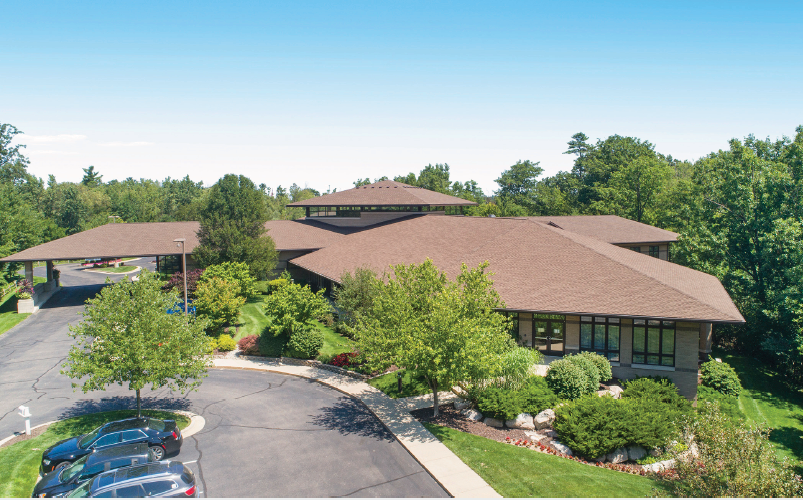
Arial view of the Trillium Woods location

I am particularly grateful for my dad’s opportunity to have been admitted to the Faith Hospice inpatient care facility at Trillium Woods in Grand Rapids, Michigan. Through my parish ministry, I knew about hospice care being provided at home and in other settings, but I had not had any personal experience with a residential facility built and maintained solely for hospice care. My dad’s move to Trillium Woods happened four days after his admission to hospital ER, on a cold, mid-December day. The hospice became his new temporary home, and we soon discovered how it was an unanticipated but blessed answer to prayer for him as well as for our family.

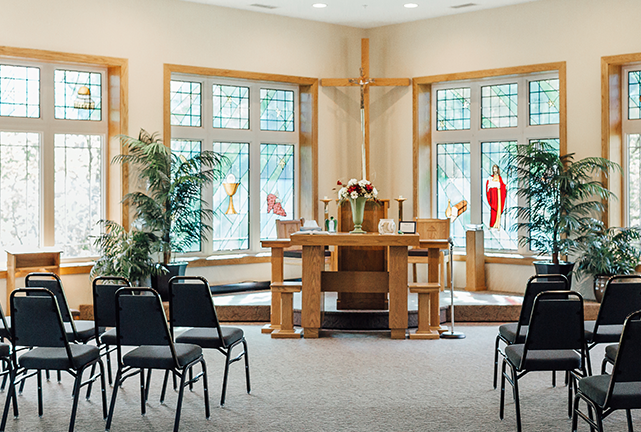
December is a tender time for families caring for or mourning loved ones, and we found that Faith Hospice staff members were especially sensitive to our emotions as the Christmas holiday season came into its fullness. We were impressed by the generously sized and attractively decorated room they were able to provide for my dad and the other patients, which included a comfortable sitting area, a bed area, and large windows and a door leading onto a beautiful terrace. Equally impressive was the rest of the facility, which had large lounge areas, a dining room and adjacent kitchen, and a well-designed chapel. Being able to have our family Christmas dinner there at the hospice (as well as other meals) was a comfort, and allowed us to focus on my dad and his care, and to be less absorbed with our own daily concerns.

A hospice patient’s room like the one my dad was in

Most significant to us was the dedicated staff, who were sensitive and attentive to each subtle stage in the process of my dad reckoning with and moving toward his impending death. Like them, my dad showed himself to be strong in faith, and fully at peace with seeing his final illness as a facet of God’s merciful Providence. Thankfully, he showed no signs of being in denial about what was happening to him. I attribute this to his decades of ministry as an ordained pastoral counselor, and as one who lived his faith while commending it to others.

The Chapel at Trillium Woods

During the process of my dad’s dying, I marveled at the ministry of Faith Hospice at Trillium Woods, and wondered about how many other such facilities exist around the country and elsewhere. I continue to wonder about this, and imagine that such a place is more often desired than found, being the kind of facility that everyone would want to have available should they need it.

The phrase, “the end of life,” is often used to refer to what hospice care is focused upon. Taken simply and literally, these words refer to the termination point we come to in the course of our physical embodiment. Yet, as I like to remember, our English word ‘end’ does not simply connote a terminus but also a point of fulfillment and the realization of purpose. In my experience of the hospice care that was offered to my dad and our family at Trillium Woods, I encountered a culture of ministry oriented toward lifting our eyes to a broader horizon of meaning for daily life. In this, I found the facility was aptly named as Faith Hospice, for clearly a grounded Christian Faith lay at the heart of the mission enacted on a daily basis at Trillium Woods.

Note: I have no official connection with Faith Hospice at Trillium Woods but only my personal experience of holy care from the folks there. With them, we journeyed through our final month with a family member amidst a loving community. More about this ministry and facility can be found by clicking here.

God’s Handiwork Inspires Ours

Stones found on a northern Lake Michigan beach

Labor Day is around the corner and some of us may receive and enjoy a day off from work. What we call retirement, a stage in life I am presently enjoying, tends to represent leaving work behind. Yet these and related ideas rest upon a common assumption, that work is different from, and in some ways inimical to, enjoying fulfillment in life.

I find a biblically based theological insight helpful when thinking about work. As with many matters that can be looked at from the perspective of Christian moral theology, our view of work can be enhanced by making reference to four specific reference points. These are, first, what we have learned about God’s purposes in Creation for this or that aspect of our lives; then, what impact sin associated with our Fall has had upon what we are thinking about; third, how God’s ongoing work of Redemption has restored and or transformed the matter presently under consideration; and fourth, to ask what future – if any – does this aspect of our lives have in Christ. 

Work provides a wonderful topic for engaging in this fourfold inquiry. Based on our common way of thinking about work, it may be hard for us to consider the meaning of work from any other vantage point than of attributing its role in our lives to the Fall and to the ongoing effects of human sin. Yet, we can also learn from many who have come before us who have distinguished work from toil. This can help us see how forms of labor, and pejorative associations the word may have for us, are surely due to our proclivity to link such activity with burdensome unpleasant duties.

For what we may overlook is the biblical view of how God has shared stewardship responsibility for aspects of Creation with us, as beings created in God’s image and likeness. This was symbolized by the way that our mythic forebears (Adam and Eve) were given their ‘work’ of naming the animals as a path toward fulfillment. It was not until their expulsion from the Garden that the first human beings are described as prone to acts characteristic of sin. Thereupon, in biblical theology, our heavenly ‘work’ of praise, and of divinely-invited participation in God’s Creation stewardship, ceased to be pleasingly ready pathways toward human fulfillment, and became energy draining and spirit-diminishing activities – such as we tend to find them to be now.

A growing segment of the wider Christian community shows signs of acknowledging how God’s work of Redemption is ongoing, quite aside from its ‘once and for all time’ episodic saving events. The pattern and purpose remains the same – nothing fundamentally new is added, nothing old of lasting value taken away. Preeminent remains God’s abiding purpose for us to become and be God-like in God-intended ways. For, as Athanasius taught us, the Son of God became the Son of Man, so that the children of men and women could become the children of God. Work – not toil nor burdensome labor but creative and fulfilling work – remains a vital part of our holy path toward wholeness.

And to remind us of this abiding truth, the loving Creator has spread around us an uncountable abundance. These are the signs of outpoured and participatory grace, some of them very small, like stepped-upon seashore pebbles and tiny blossoms among hurried-by roadside weeds.

Too quickly we dismiss the significance of our our small acts of selfless giving, not to be counted by us, but adding up to so much more than we imagine in the life-growth of others. This is our holy ‘work,’ overlooked but important stepping stones on our path toward living into the godly fullness with which Christ fills us.

If on our daily course our mind

Be set, to hallow all we find,

New treasures still, of countless price,

God will provide for sacrifice.

Old friends, old scenes, will lovelier be,

As more of heaven in each we see:

Some softening gleam of love and prayer

Shall dawn on every cross and care.

[John Keble, “Morning,” from The Christian Year]

The Believing Eleven

If reading this by email, please tap the title at the top to open your browser for the best experience. Then, clicking individual pictures will reveal higher resolution images.

Peter Paul Rubens, The Rockox Altarpiece, 1613-1615 (center panel)


It is evening on the day of Resurrection-discovery. John tells us that ten of the disciples are hiding behind a secured door out of fear. Judas is deceased, and Thomas is away.

Jesus suddenly appears to the unprepared disciples, and shares with them his peace. He shows them his hands and his side, and then – as a direct consequence of seeing the places on his body associated with his death – the ten disciples rejoice when they see their Lord. In other words, their recognition of him, and that he was somehow alive again, brings them joy by restoring their belief in him.

When hearing this story from John’s Gospel on the second Sunday of Easter, we may be prone to considering it apart from what happens just before it. The disciples, who are hiding out of fear, have already received an eye-witness to the resurrection of Jesus. Mary Magdalene, to whom Jesus revealed himself at the tomb that morning, had come and told the ten the Lord was alive, and that he had appeared to her. Clearly, and prior to Jesus’ unexpected appearance, the ten disciples are still doubting her personal witness. Even after receiving what should have been trusted testimony from Mary Magdalene, a fellow follower of Jesus.

So why – in popular imagination – isn’t this well-known Gospel reading from John 20 commonly referred to as the “doubting disciples” reading? Why should Thomas be singled out, when his joyful recognition of the risen Jesus depended on nothing more or less than what the 10 had needed, and received, before him?

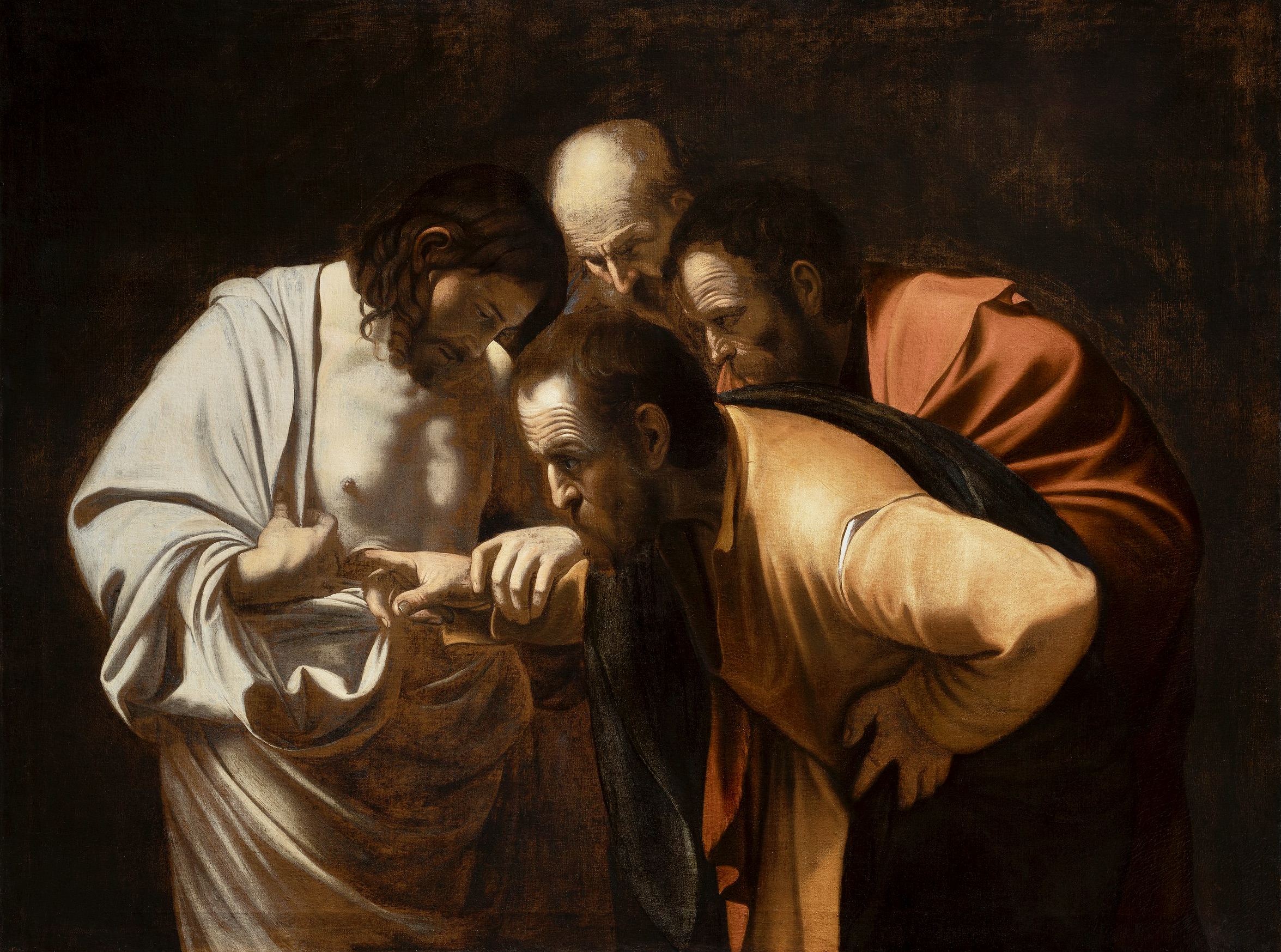
And why have so many painters in the Western tradition privileged Thomas’ purported unbelief in the Risen Lord, rather than depict the earlier reluctance of the ten others to arrive at joyful confidence about the Lord’s astonishing return? Apparently, in many painters’ eyes (especially Caravaggio), more visual drama was to be found in images of a doubter’s hand placed within an open wound.

Caravaggio, Doubting Thomas, 1601 (a famous traditional presentation of the event in John 20)

A further detail to notice, which our familiarity with so many paintings helps to obscure, has to do with how Thomas responds to Jesus. According to John, Jesus appears to the not-yet-believing ten, and – unbidden – shows them his hands and his side. Seeing the traces of his wounds on his risen body brings them joy. Jesus then appears unexpectedly a week later, this time showing himself to the one not present on the prior occasion. And just as he had done previously, Jesus offers Thomas the same opportunity he had provided to the others.

We should therefore not be misled by Thomas’ oft-quoted comment to the other disciples, prior to his own epiphany, about what he needed in order to believe. According to the text, Jesus – upon appearing in the same house a second time – bids Thomas to touch him. Yet, Thomas immediately responds to Jesus’ words without any mention in the Gospel of him having physical contact with the risen Lord’s wounds. Jesus then asks Thomas a rhetorical question, “Have you believed because you have seen me?” Naturally, Thomas’ implied answer is ‘yes.’

For all these reasons, we will do better to find a different and more positive descriptive phrase by which to refer to this well-known passage from John 20. “Jesus meets the disciples according to their needs,” though wordy, would do better.

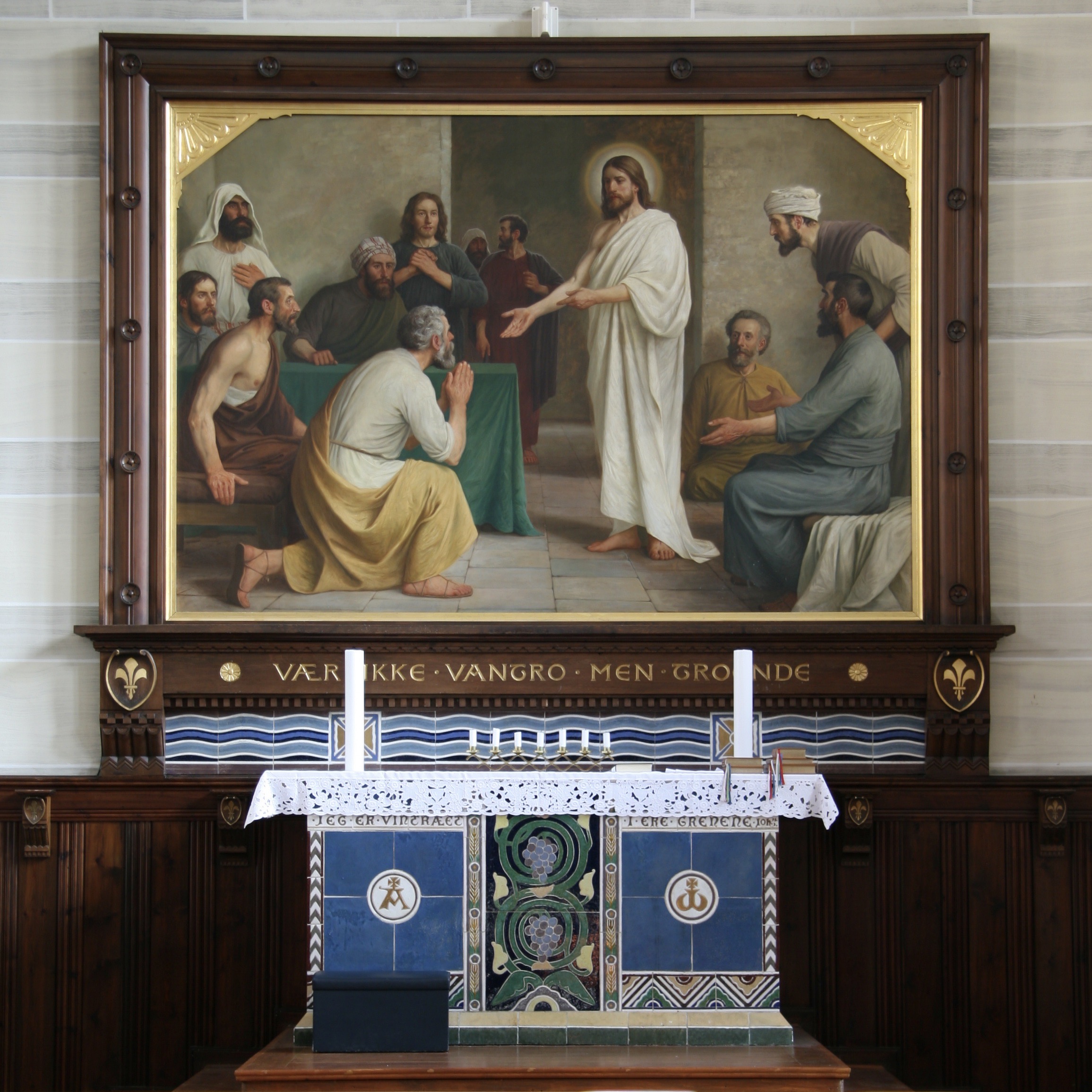
P. Steffensen’s altarpiece painting behind the altar of Zion Lutheran Church, Copenhagen


This post is based on the traditional Gospel reading for the second Sunday of Easter (April 7 in 2024), John 20:19-31. The story within it concludes with these words: “Jesus said to Thomas, ‘Have you believed because you have seen me? Blessed are those who have not seen and yet have believed’.”

Note: The altarpiece paintings by P. Steffensen and Rubens provide an interesting counterpoint to the prevailing tendency of painters to focus on Thomas placing his hand in the side of the Risen Jesus.


Joining Mary’s Joy

[If reading this by email, please tap the title at the top to open your browser for the best experience.]

El Creco, The Annunciation (1600)


With three prior Annunciation images I have pointed to some aspects of the Annunciation to Mary: fear at an unexpected encounter with the divine presence; surprise and wonder about such a greeting; and, the opportunity to accept the significance of God’s visitation. Today, I want to highlight a fourth aspect of Mary’s experience of the Annunciation, her response of joy at having said, “Yes.”

It is not hard for us to admire Mary and her willing response to God’s initiative, at first in her life, and then in and for ours. But how easy is it for us to identify with Mary’s joy, reflected in the words we know as the Magnificat, her song of praise, with regard to the promise of Jesus’ birth?

For many of us, these 12 Holy Days may be a time in which we challenge ourselves to feel as ‘joyful’ as we think we should be – or, perhaps, to criticize ourselves for failing to experience the same. But what is ‘joy?’ I have an icon that depicts St. Thomas Aquinas, wherein he holds a text on which is printed, “Joy is the noblest human act.”

Joy at this time, as always, is not just a spontaneous feeling prompted by fleeting circumstances. Joy is actually an act, a choice, and a willing participation in divine initiative. For the word joy is related to the verb rejoice. God says to us during these 12 Holy Days – as God always does – I am come unto you to bless you, to bring you new life, to transform everything you think you know, and in ways you have yet to imagine.

Until we get to ‘the other side,’ and can ask Mary, herself, none of us will know what she really imagined would be part of her acceptance of God’s strange and unanticipated plan of redemption for our fallen and troubled world. What we can be most thankful for is at least one implied word that was part of Mary’s response to God’s initiative. She said, yes. With her beautiful example, and so many compelling artistic representations of the same, isn’t it a wonder why we so often find it hard to respond as she did.

In this last of the 12 Days of Christmas, let us say “yes” to God with Mary. And then, starting with the feast of the Epiphany, tomorrow, may we live into the real joy of that “yes.” Her uplifted hand, in El Greco’s painting above, says it all.

May our Lord, who was and is, and is to come, bless us and our loved ones during this holy time.


The Beauty of Now


Rembrandt’s paintings are so often moving, and speak well of the Dutch genius who created them. When many of his contemporaries sought to portray people and events with greater realism, even if with much feeling, Rembrandt often put the ‘feeling’ side of his work first.

Rembrandt shows his sensitivity to an aspect of the anticipated birth of John the Baptizer. John’s parents were old and despaired about ever having a son who might carry on their name. The artist depicts the aged priest, Zachariah, leaning on a young attendant upon hearing that Mary has arrived. He portrays Elizabeth as also showing her years as she greets her relative with warm regard. Though Mary bears within her womb the holy child of God, she appears humbled in the presence of Elizabeth, perhaps awed at how the grace of God could touch both of their lives in such an unexpected way. Light shines on the two of them, just as it should, given the way that Luke highlights this holy aspect of their shared story. Thankfulness and quiet joy suffuse the scene like the warm light at its center.

Waiting and anticipation are themes we associate with the beautiful season of Advent. In one sense, these two words suggest we already know what we are anticipating, for what we are awaiting. By contrast, Luke’s story about the Visitation suggests a variation on those themes. “Expect the un-expected,” it seems to say, to us who live a multitude of centuries later. And this is especially hard for us to do, in a culture that is so dependent upon the precise measurement of time, and upon the predictability of events in the natural order of things.

Let’s notice this about Elizabeth and Mary, and about John the Baptist who is not yet born. Luke portrays them as living in the moment, as living in God’s time rather than simply in human calendar time. When Elizabeth hears Mary’s voice, John leaps in her womb. Luke then says that Elizabeth is filled with the Holy Spirit, and she exclaims with a loud cry, “Blessed are you among women, Mary, and blessed is the fruit of your womb.” Neither John nor Jesus are yet born, and so neither mother has yet received the assurance and peace that will come from seeing them safely delivered. And yet, in this moment, both women are filled with joy ~ joy about the fulfillment of God’s promises!

Elizabeth’s son, John, and Mary’s son, Jesus, would never be closer to the two women. And, in Luke’s telling, their quiet joy reflects their awareness of this, that now, in this moment, God is truly present, imparting grace and fulfilling promises. The same is true for us.


Rembrandt van Rijn: The Visitation (1640), Detroit Institute of Arts {many images online}

See Luke 1:41-42: “When Elizabeth heard Mary’s greeting, the child leapt in her womb. And Elizabeth was filled with the Holy Spirit and exclaimed with a loud cry, ‘Blessed are you among women, and blessed is the fruit of your womb.” Context: Luke 1:39-56. This Gospel reading is appointed for the 4th Sunday in Advent, Year C, which features the Visitation of Mary to her relative, Elizabeth.

Acceptance with Joy


“Look,” says the prophet, “the young woman is with child and shall bear a son, and shall name him Immanuel. He shall eat curds and honey by the time he knows how to refuse the evil and choose the good.” What a strange promise! How could the birth of a child be a gift for a troubled world?

This is the kind of promise that Mary received from the Angel Gabriel. And it is the kind of promise that every one of us receives when we are called to acknowledge and accept that same gift. During this Advent season we have reflected on how there are a number of aspects of our response to God’s call, and to the promise of God’s gift to us.

Fear can often be our first reaction, followed then by wonder and uncertainty about the fit between God’s promise and our own suitability for receiving it. By attentiveness to God’s Grace, our uncertainty can be transformed into a humility ~ a humility that is willing to accept the Word of Promise and the Call to receive it. And if we come that far, if we are willing to believe and remain attentive, we may experience a wonderful moment. It is in Mary’s fourth response to God’s Word of Call. It is quite simply, Joy! There is no other word for it. Both Mary and Joseph, each in their own way, accept the unlikely and unexpected word of promise. And by accepting and receiving God’s will for what it is, they find joy.

Over the course of this Advent, I have shared with you four images of the Annunciation to Mary of the promised gift of a child ~ a child who would be God with us. In the image above, El Greco beautifully captures the sublime quality of the moment. Having accepted God’s Word in humility, Mary’s eyes and her whole being are uplifted up to receive the message. Her up-turned hand says it all! The gilded and hovering angel points upward, in the direction where all this is supposed to go, to the realm of Spirit. This is where the Lord will ascend through his Resurrection, taking us and our humanity with him into the very being of God.

Joy may not be the defining feature of our lives today. Yet, we can find the fullness of joy in the gift we celebrate this week. For we receive a gift whose meaning and value we can never fully anticipate in advance.

To this gift, Mary says “Yes!” And, with her, we can say, “yes,” as well. Yes to God’s Word that comes to us as both promise and call – a promise that he will be with us always, as we accept him for who He really is. And, a call for us to become new persons in him. For in him we find a spiritual maturity that this world can never give.

In raising our hearts in assent to God’s promises, and by receiving God’s call to be transformed by the Spirit, we grow. We grow into that quiet joy which was Mary’s, instilled by the Angel’s visit. Behold – a virgin has conceived, and has borne a Son, and we call his name Immanuel – for God is with us!


The image above is of El Greco’s Annunciation (1600). This post is based on my homily for the Fourth Sunday of Advent, December 22, 2019, which can be accessed by clicking hereOther homilies of mine may be accessed by clicking here. The Revised Common Lectionary, which provides the readings for Sundays and other Holy Days, can be accessed by clicking here.

A Beautifully Hospitable Dinner at Bethany


It is evening in Bethany, the little village near the top of the Mount of Olives. A dinner party has been planned at a small and modest home inhabited by Mary, Martha and Lazarus. With their extended invitation the three siblings plan to honor a special guest. Since the three are living together, some folks assume they don’t have much money. This fits well with the highly symbolic world of their Scriptures because Bethany, in Hebrew, means house of the poor.

Jesus is a close friend to these three siblings, each one so different from the others. They embrace him with a love that helps us see what godly friendship is all about. Jesus and the siblings are especially close now. After seeing his loving tears at Lazarus’ tomb, and how he brought their brother back to life, he is dear to the two sisters’ hearts.

While evening brings quiet to the village, those gathered for the meal sense a wariness amongst their neighbors. Jesus’ arrival in nearby Jerusalem has evoked tension and conflict. Despite this, his beloved friends appear not to realize that Lazarus’ resuscitation has prompted a plan to kill Jesus. Just before describing this supper, John tells us that the chief priests and the Pharisees have ordered anyone knowing where Jesus was to report it, so they might arrest him. Tension radiates outward from the Temple, throughout the city. But at the top of the hill across the Kidron Valley, in the soft light of small oil lamps, Jesus and his disciples are welcomed to dinner. Despite having a small household with limited means, their hosts have planned a festive and joyous evening.

With spiritual insight, James Tissot has captured the circumstances of Jesus’ slow walk to the dinner. The Eastern Wall of the Temple is at Jesus’ back ~ the very place where he will enter in a few days on what we now call ‘Palm Sunday.’ He is ascending the Mount of Olives, from which it was believed the Messiah would someday come and enter into the Temple. In a very subtle way, Tissot visually hints at the storms hovering over the Holy City as the Passover approaches. Yet, at this moment, Jesus walks quietly toward what he surely wishes will be a peaceful evening ~ and for a pause from the stress and pressure that his coming to Jerusalem has aroused.

At this dinner, Mary models a beautifully extravagant idea. It is to offer all that we are, and all that we have to God’s self-revelation in Jesus! And, for the sake of God’s kingdom! To make such an offering is way beyond the usual and reasonable bounds within which we constrain ourselves. And far beyond the usual prudent limits by which we measure things in terms of cost. But as we see in Mary’s example, there is usually only one thing that moves us to respond in this way: joy! Sheer joy grabs her heart and moves her to give her all. Mary gives her all to him, and to the new life that he is even now unleashing in this world.


The above painting is James Tissot’s, Jesus Goes in the Evening to Bethany. This post is based on my homily for Sunday, April 7, 2019, which can be accessed by clicking here.  Other homilies of mine may be accessed by clicking here. The Revised Common Lectionary, which specifies the readings for Sundays and other Holy Days, can be accessed by clicking here.

The Beauty of Delight


Periodically I’m struck by the sudden power of familiar words ~ of words which we are so accustomed to hearing that we hardly attend to them. Last week it happened when I was praying the opening confession in (daily) Morning Prayer. After referring to what ‘we have done and left undone,’ we express our repentance, and ask for God’s mercy. There then follow some remarkable words, which we say to God. With them, we identify why we ask for God’s mercy: it is so “that we may delight in your will, and walk in your ways, to the glory of your Name.”

I’m sure these words stood out to me because— like many of you—I am still grieved by the horrible Pennsylvania report, charging dozens (if not more) of Roman Catholic clergy with sexual abuse. Even bishops and cardinals have been involved. And then, on the heels of that troubling news, came word that two men close to the President were now convicted felons. And, one of them has implicated the Commander in Chief regarding immoral and possibly illegal activity.

This leaves me wondering about us as a people and nation. How and why have we strayed so far from walking in God’s ways? And then, remembering the words of the confession, I was struck by this realization: maybe it’s because we no longer delight in God’s will. To seek and accept God’s will; to respect and be obedient to it ~ these are fundamentally different from delighting in it. And this may be the key.

In what do I delight? In what do you delight? Probably it is someone or something you love. I recognize this right away when I see a cute picture of one of my grandchildren. I love them. And I greatly delight when I see them happy, having fun and being creative. Closely related to this kind of delighted appreciation for someone or something we love, is joy. We joy in those in whom we delight, and we love them through joyfully delighting in them.

But we face a challenge here. For we live in a culture in which we have lost our appreciation for the important difference between passive feelings, and acts of virtue. If delight, love and joy are merely feelings, and feelings we hope that others will evoke in us, then we have sold these virtues short. For, in the spirituality and ethics of our great tradition, delight, love and joy are noble acts.They are not just feelings, because practicing these virtues builds character, both within ourselves and in our communities. Thomas Aquinas is remembered for saying that “joy is the noblest human act.” How true! He meant that we choose to take joy in the Lord, and in God’s merciful Providence. This helps us delight in God’s will, and live in God’s love.


This post is based on my homily for Sunday, August 26, 2018, which can be accessed by clicking here. The photo above is of my good friend Stuart, who takes great joy in fishing every day for lake trout, and who delights in catching and releasing them.