Beauty of Creation

Beauty: Found, Received, and Made

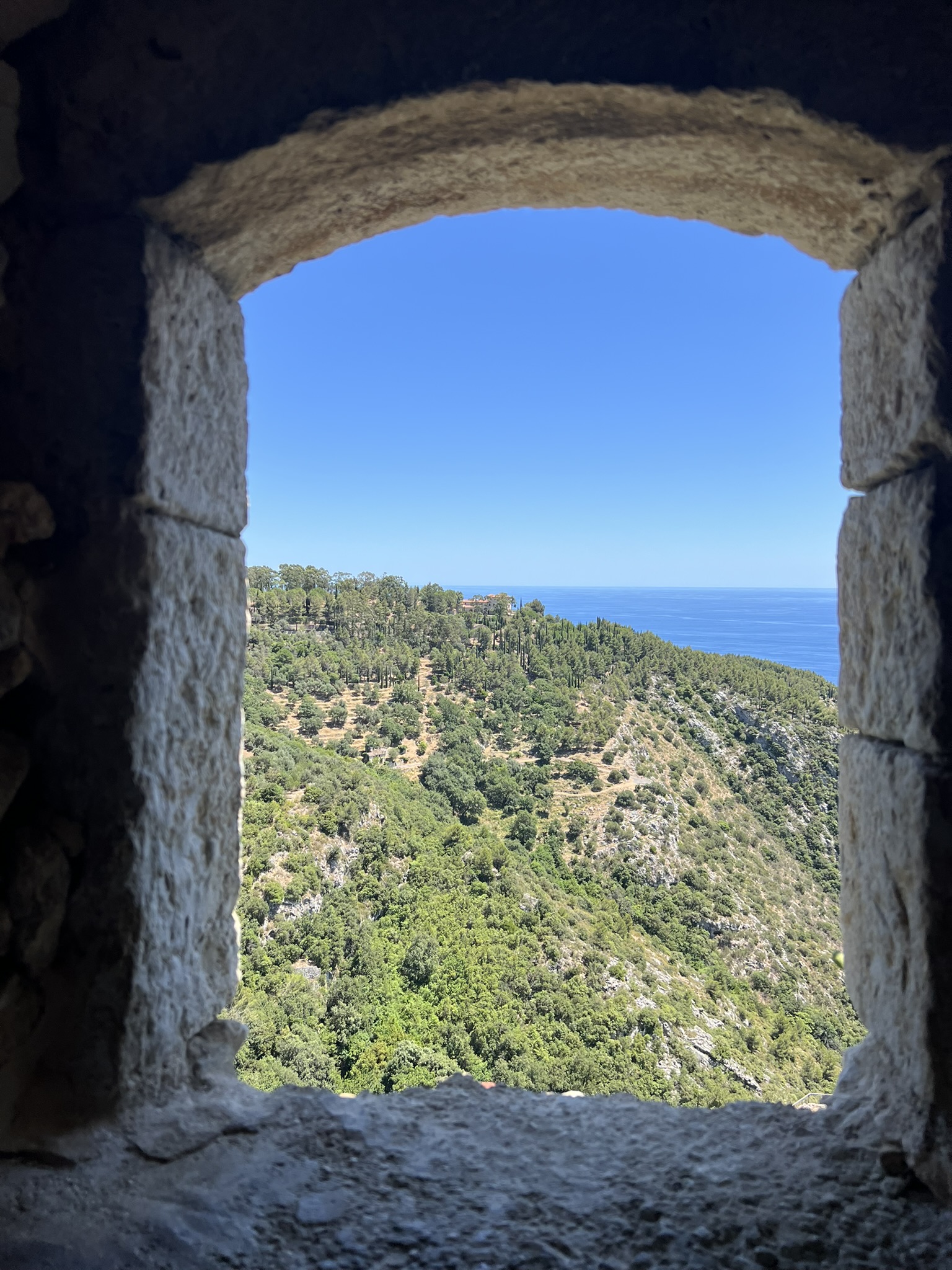
A photo from Èze, France (by my brother)

While undertaking my studies in ethics and moral theology, I discerned a significant parallel that has continued to shape my world-view. The parallel I have in mind connects how we understand law with how we understand ethics. In turn, I have come to see how this discernment applies also to how we appreciate beauty. 

First, about where law comes from. As I understand it, there are three principal theories about our source or sources for law, formally termed theories of jurisprudence. They are not mutually exclusive, and may function for us in overlapping ways. 

A common understanding regarding the source of law views the concept of law as fundamental to and discernible within the structure of reality. Law in this first sense is something we find, written into the patterns of the world, and of its many aspects. This idea gives rise to, but is not the same thing as, the so-called ‘laws of nature,’ or the principles that order the function of many things from the most basic particles within matter, and the function of waves like light and energy, the functions we discern within complex biological organisms however malleable they may seem to be over time, as well as within the structure of rationality. 

A well-known expression of this first concept of law is latent within the familiar phrasing regarding what it means to be a human being: “we hold these truths to be self-evident…” That is, certain truths or principles are there to be found, by those who exercise our capacity for reason and discernment. A simple but sometimes misleading label for this first concept of law is ‘natural law,’ which some skeptics might argue is neither!

The second most commonly recognized theory of the source of law can be articulated by observing those principles and ‘rules’ long-rooted in the history of our communities, which we receive from those who have come before us. British Common Law, which undergirds much of our tradition of law in the United States, is a prime example. ‘Received from history,’ and long relied upon by communities, are two basic ways to label and identify this concept of law. The familiar refrain, ‘we have always done it in this way,’ provides a ready example. 

The third way of understanding the source and character of law perceives law to be comprised of those principles and or rules that have been decided by individuals and communities. It is commonly called ‘positive law,’ a label that refers to the law that we posit, or put into place. The existence of law in this third category represents the assertion of will and of choice, for law in this sense arises from us as something we make, and is dependent upon our projection of what we wish or believe to be true. Many examples, from neighborhood clubhouse rules to Louisiana’s state constitution (resting upon the French Napoleonic legal tradition), are expressions of this approach. 

These three theoretical understandings of the source of law are relevant for my own field of ethics. For in ethics, there are three principal bases for our concept of the Good, and upon which our notion of the Good rests, which correspond to three principal forms of jurisprudence or theories of the source of law. 

Moonrise off the harbor breakwater in Antibes (photo also by Gregory Holmgren)

If this is correct, and I believe it is, then surely we can reason appropriately toward the same conclusion regarding Beauty as well as for Truth. For Beauty and Truth as Transcendentals play the same foundational role in our thinking as the Good, which functions as a principal reference point for ethics in human reasoning and experience.

This leads me to recognize how there are three principal ways of accounting for the source or sources of beauty. With regard to Beauty, positivists will contend that ideas regarding beauty are projections of those who hold them, whether by individuals or by communities. Historicists, in parallel with the common law tradition of jurisprudence, will say that notions of beauty are rooted in the histories of communities and the traditions, and are to this extent reliable guides for thinking about things. And – as follows from the preceding, those who accept the natural law tradition in jurisprudence are those most likely to view beauty as a given feature of reality, here and there for us to encounter, regardless of our shared traditions and personal aspirations. 

In closing, I want to restate a point I made above. Whether we are accounting for the source or sources of Beauty, Goodness, and or Truth, we may prefer one or more of three ways I have articulated based on the three principal approaches to the sources of law. Yet, all three approaches are likely to figure into and be a part of our thinking. For example, we may think that notions of beauty are rooted in nature, while valuing how our Western tradition of art has shaped our thoughts and those of our community, while still also recognizing how we may be somewhat arbitrary regarding the forms or standards of beauty that we prefer to value and pursue! Especially because the first or second of these three approaches may serve as a corrective to and perhaps as also a check against the potential liabilities associated with the third.

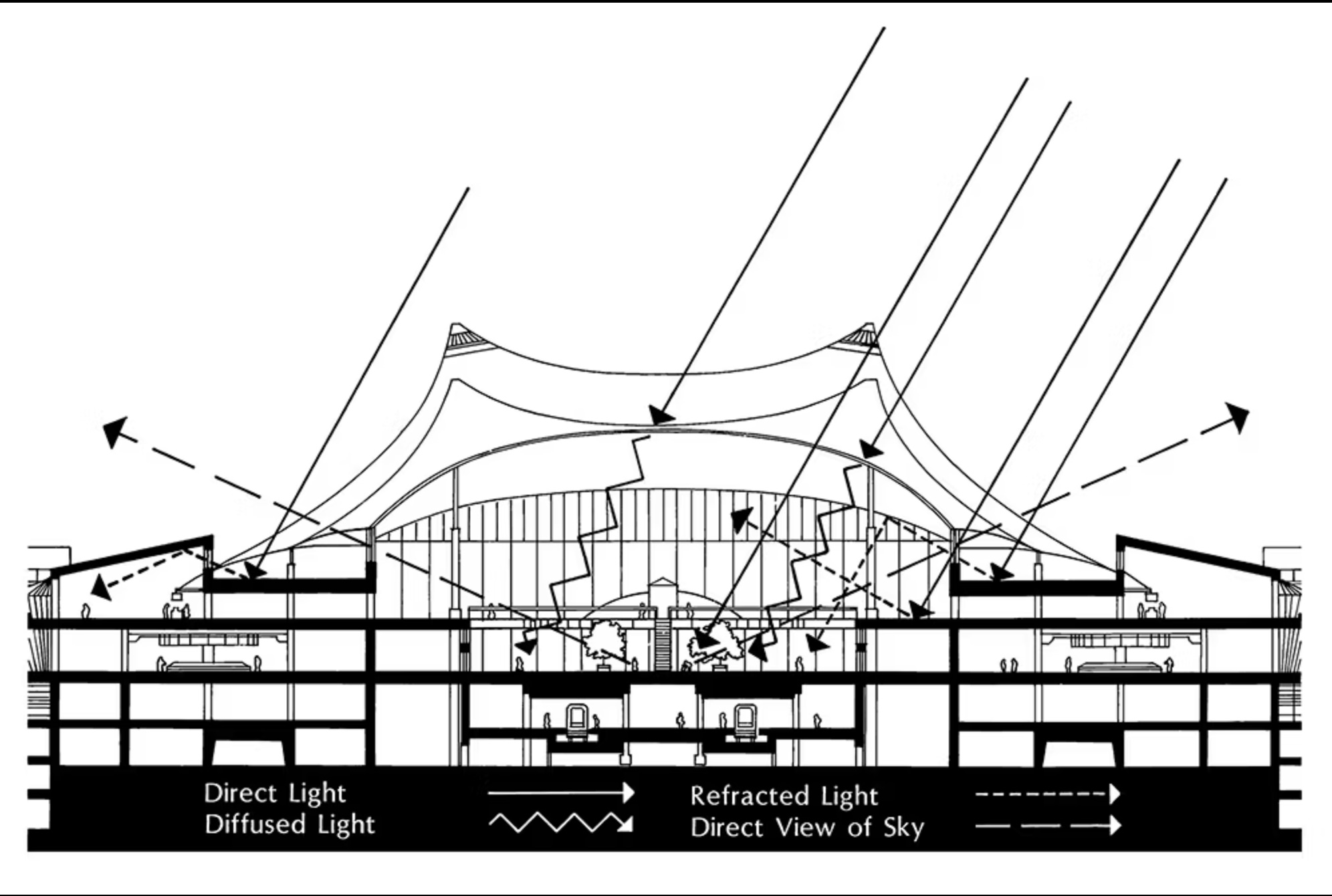
Denver Airport ‘s Beautiful Tensile Architecture 

Some of the tensile structure canopies over the Denver International Airport terminal (DIA)

In order to appreciate the beauty of tensile architecture, we need to remind ourselves of how most traditional buildings, from the ancient pyramids and China’s Great Wall through to the tallest modern buildings, have been built. Familiar architectural structures rely upon compression, the stacking of weighty materials upon others in a stable way to achieve height. Whether those materials are heavy, like the massive stone blocks supporting the Temple Mount in Jerusalem, or as in the first modern reinforced steel ‘skyscrapers’ such as the former Home Insurance Building in Chicago, traditional architecture has relied upon the compression of forces created by their materials to attain successively higher elevations over the course of time.

The tensile structure roofline of the Denver International Airport terminal building

Tensile architecture relies upon what its name suggests in order to attain stable and enduring structures – the dynamic of tension between the various materials and structural elements that are employed. The way that tensile structures achieve what appear to be daring results can be explained by reference to the poles and cables with which they are constructed.

Cable-supported columns, poles, and awnings, at Denver International Airport (DIA)

Though the name for this type of structure may be new to many of us, those who enjoy viewing sporting events set in large public spaces have seen and become visually familiar with tensile structures at least since the 1972 Olympics in Munich, Germany. Designed by Frei Otto and Gunther Behnisch, the imaginative canopy protecting much of the crowd seating was seen by millions on television and in news reports.

1972 Olympic Stadium designed by Frei Otto and Gunther Behnisch

Tensile architectural design continues to be used widely throughout the world to erect buildings for public purposes. Denver’s 1995 International Airport Terminal building, designed by Curtis Fentress and Fentress Architects, provides a compelling example. The architects’ achievement represents a stunning contrast to Denver’s former and very conventional Stapleton AirPort buildings.

Those who travel through DIA have an opportunity to experience firsthand what such structures can inspire. They provide occasions on which we can pass through public spaces filled with light, that feel open and uplifting, and which have the capacity to capture our attention. Buildings of this kind expand our sense of the moment in community with others, and lift us above our personal concerns by reminding us – literally- of more expansive imaginative horizons. As the venerable great dome of the US Capitol building gives convincing evidence, these are qualities to which all public architecture should aspire.

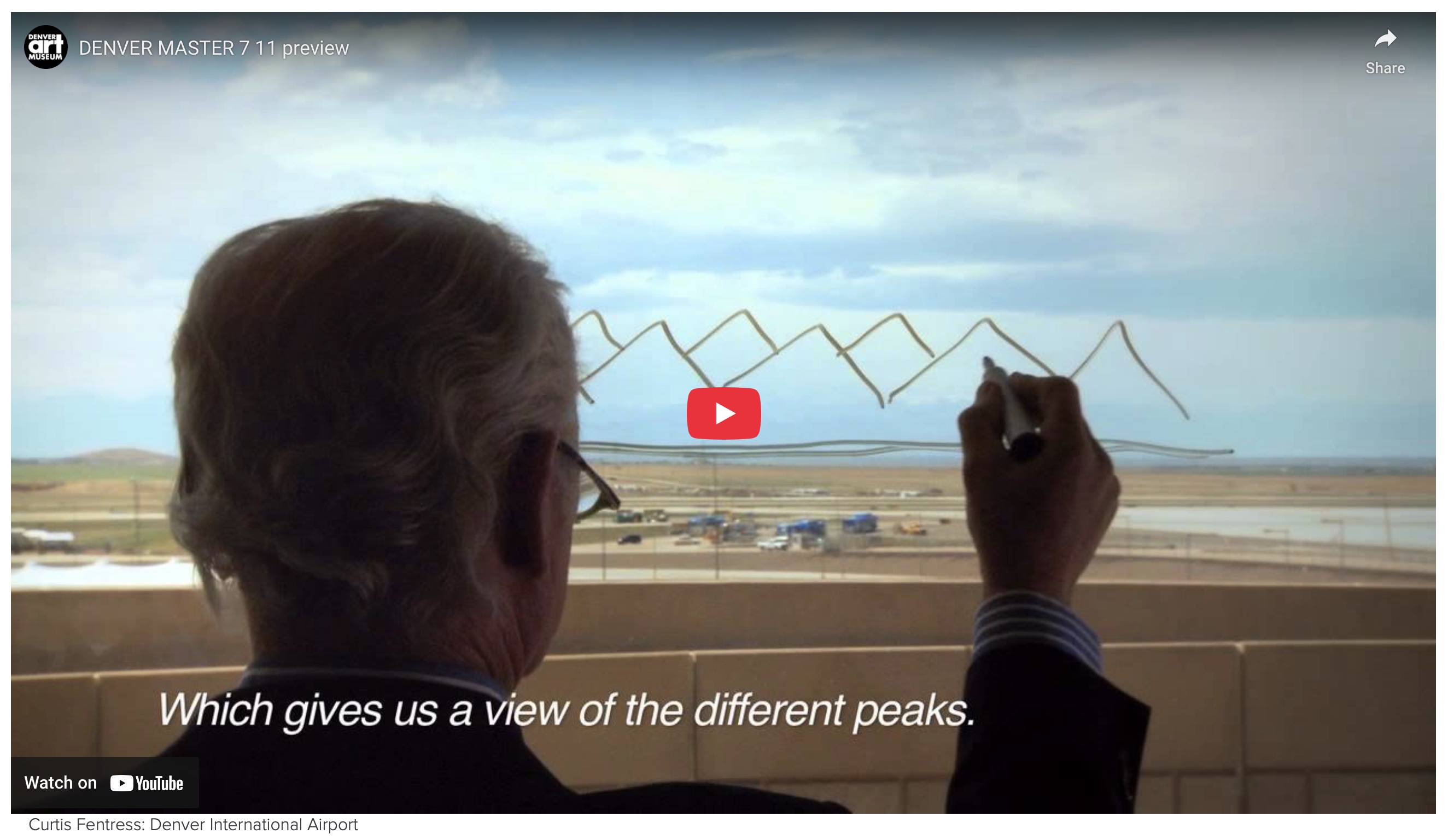
Three thematic sources of inspiration for Curtis Fentress’s design for the DIA terminal include Denver’s well-known reputation for being the ‘mile high city,’ the profile of the Rocky Mountains visible from the terminal and the city, as well as the heights to which modern aviation take us. As the images included here demonstrate, the airport’s tent-like awnings create a dramatic roofline, as well as soaring translucent interior ceilings, delighting both visitors and passengers, as well students of architecture who have never traveled to encounter these structures.

A still from a video showing the architect sketching the Rocky Mountain skyline from the vantage point of the air terminal, in a possible allusion to the terminal’s canopy structure

Since my first visit, the Denver Airport has been one of my favorite examples of modern public architecture, both because of the vision and notable aims of its principal architect, as well as because of the experientially transformative results he and his team of designers and builders were able to achieve. Like the pleasing effect of arriving at London’s St Pancras or one of the other luminous Victorian train sheds, the DIA terminal is the kind of humane environment that can ameliorate the stress of modern-day air travel.

Departure and Arrival areas at DIA

Note: I hope to feature Denver’s new (2014) canopied train platforms, perhaps inspired by the DIA terminal, in a future post.

A Tao of Seeing: Reflections Inspired by Feng Shui

Michael Pollan’s writer’s hut, intentionally situated by a boulder on the brow of a hill

Recently, I observed my middle son moving a black plastic pond module around in a small space in his New Orleans courtyard. As he moved the container that would soon have fish in it, he tried situating the vessel in various ways, in relation to a tree, a fence, some potted plants, and an existing low stone wall. He is not a student or practitioner of feng shui, but I believe I was seeing some of those principles at work in his decision-making.

Western readers may have heard of feng shui, the Asian philosophical approach to discerning the unseen forces that affect objects and their balance in nature. It gives attention to the metaphysical or non-material energies thought to be at work upon or within the world around us. We might say that this approach provides a Tao of seeing, or a natural way of perceiving within and around surface phenomena to the underlying dynamisms that are believed to affect what happens in nature.

This notion that there are unseen forces at work in the world is an idea that is receiving something of a revival in Western Christian spirituality. This is noticeable when people refer to a concept attributable to the Celtic tradition, in which it has become common to refer to “thin places. “ These are places where the veil between the material and the ethereal or the heavenly seems temporarily dissolved. Another parallel here between East and West may lie in the quest within Christian spirituality for the goal of harmony and balance between people and the created world.

However, my reflections here constitute an aesthetic rather than a philosophical or historical inquiry. I am interested in the dynamics of movement we perceive in the circumstances that we encounter, and less in the metaphysical forces or energies that may be present within them. At the outset, however, I want acknowledge how a nuanced Asian approach can be an authentic route toward a culturally-informed appreciation of the phenomena we encounter, especially from a historically Asian perspective.

As we look at paintings in the context of Western culture, one factor we discern assesses composition and attends to the way our seeing is drawn from one part of a larger image to another. This dynamic is often an artist-intended aspect of an overall composition. Sight lines in garden design and arrangement provide another example, as does the architectural arrangement of space in buildings.

Attention given by Western designers to feng shui is sometimes criticized as being a superficial application of historically and philosophically nuanced ideas. But I want to give credit to ways in which our sensitivity toward perceiving movement and direction is a genuine factor that is available for analysis and articulation. We notice this when we encounter both two dimensional compositions as well as three dimensional spaces and the objects we find in them. We can always come to know more about what we see.  Because what we see is something that is there, not simply what we believe, or are disposed or inclined to see.

An Asian garden said to be designed according to feng shui principles

Motion, balance between forces, spatial arrangement of objects, and the dynamic relationships that are visible because they exist between and among these variables, continue to grab my interest. Contrasts between colors and textures, as well as between sizes and shapes, play a significant role.  Additionally, the perceived difference between what is natural and things that are humanly fashioned is equally significant, as is our perception of the criteria for what constitutes that which we consider to be natural. These are among the factors that help account for our sensitivity towards and interest in these many observable variables, and our common quest for purpose and meaning in the contexts where we find ourselves.

Motions and balance as we find these factors in Wassily Kandinsky’s painting, Several Circles

Painters, sculptors, and architects, seriously consider these factors within visual and spatial compositions. The painter, Wassily Kandinsky, and the architect, Frank Lloyd Wright, provide two examples of those who also perceived a spiritual dimension within their creative work.

If so, we –  as caring lay observers of the world and of the things and places among which we find ourselves – should give deference to this evident fact. For we can all be thoughtful, as people often are inclined to be, about what we see, touch, and experience when we interact with visual phenomena.

I find myself increasingly sensitive to these aspects of our appreciation for Beauty, and endeavor to be more mindful about them. I am intrigued by possible parallels that may exist between Eastern metaphysical interpretations of visual phenomena and more familiar approaches to what we see that are shaped by Western aesthetics. Especially as these familiar approaches are described and developed within our artistic and architectural best practices.

The Challenge Posed by Eric Gill

If reading this by email, please tap the title at the top to open your browser for the best experience. Then, clicking individual pictures will reveal higher resolution images.

Eric Gill, Christ Crowned


To my mind, some of the most beautiful work in the area of graphic art was created by the British artist and craftsman, Eric Gill. The intractable problem posed by Eric Gill is not a legacy of his artistic output, but of his personal life. Largely unknown to those outside his family until about 50 years after his death, Eric Gill – by admission in his own unpublished writings – had engaged in personal behavior of a kind that most people would find not only abhorrent but, increasingly, as also criminal.

This is related to the larger problem posed by the work of artists, musicians, and architects whose work is seen as having been collaborative with tyrannical regimes (eg., the Third Reich, the Soviet Union). How do we view beauty in art that either depicts or is simply associated in some way with sin or with evil? (This is a matter I have previously tried to understand in relation to Picasso’s great painting, Guernica.)

To cite Scripture to the effect that “all have sinned,” may help us begin to locate the terrain upon which we need to address the problems stemming from Eric Gill’s biography, but it is not in any way to excuse his conduct. Though all sin is bad, and equally problematic in the eyes of God, not all sin is equal in its damaging effect upon others, and upon ourselves. The traditional distinction in moral theology between mortal and venial sins provides one way to try to parse some of these differences, while not excusing any forms or examples of sin, whether in ourselves or among others.

My purpose here is to invite reflection upon how we might appreciate Eric Gill’s religious art, as many did for several generations, without having our view of the merit of his work diminished by our moral evaluation of troubling ethical choices he made, and the lapses from good moral judgment they represent. In other words, and as an amateur student of the arts while also being a retired parish priest and former professor of moral theology, I wish to present some examples of Eric Gill’s art, letting his work speak for itself apart from ethical consideration of his personal life, and without ignoring the problems associated with the latter.

Perhaps my theme here can be summed up in this way: I invite you to benefit from the beauty of what Eric Gill created without asking you to overlook what we have learned about his private life. And I offer this invitation aware that some will not find it possible to accept.

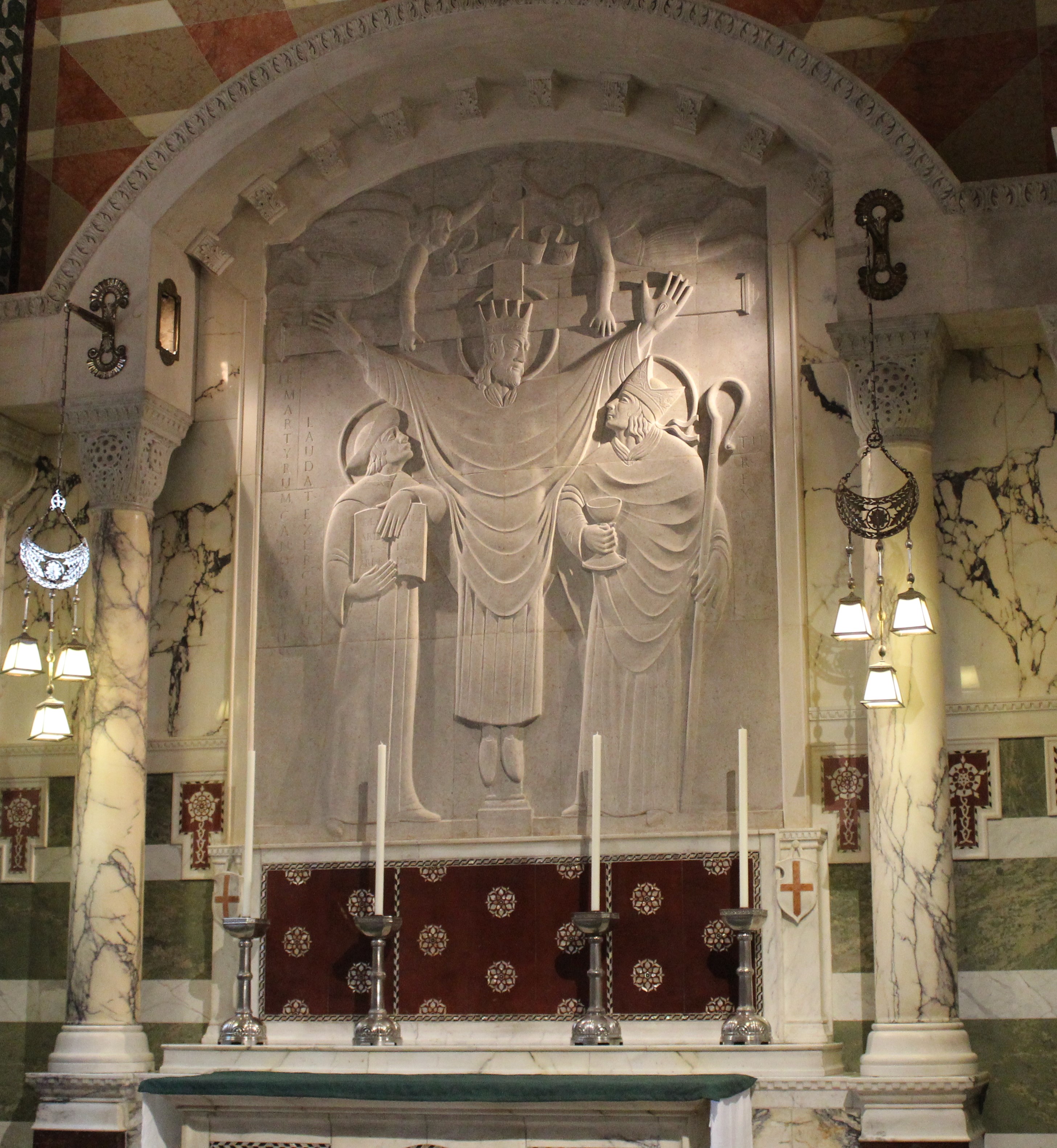
A sculpted carving by Eric Gill above the altar of the Chapel of St George and the English Martyrs, Westminster Cathedral, London
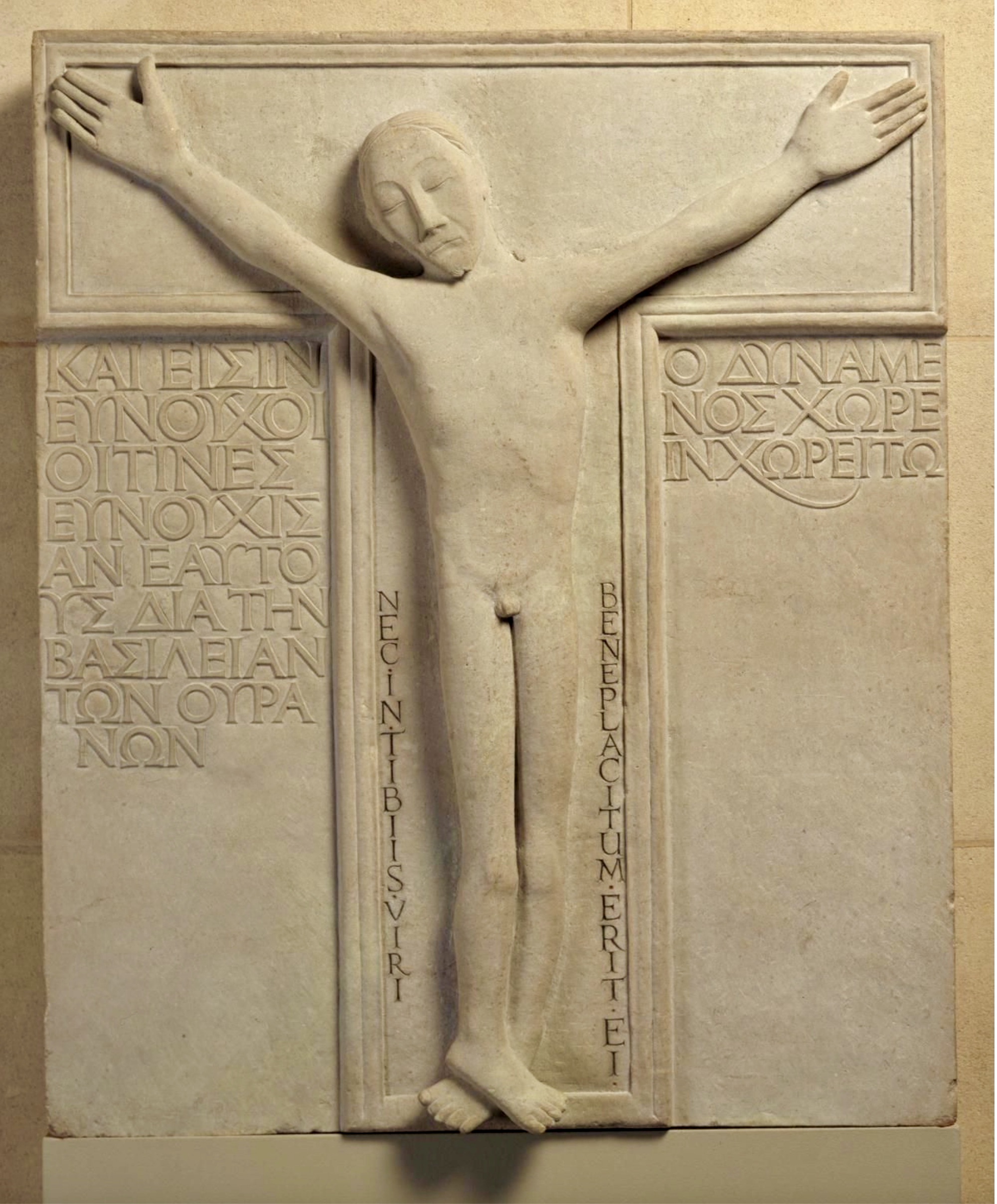
Eric Gill, Crucifixion
Eric Gill, sculpted relief panel from a series of the Stations of the Cross, Westminster Cathedral, London

As we consider some of his art, we should not overlook Eric Gill’s impact, at least indirectly, upon much of the daily life of the population of Great Britain (and elsewhere), in the form of three type faces he created. The most well-known is Gill Sans, named after its designer, and evident at almost every Tube stop in London. An effort to erase his work from the public eye, and replace it with alternatives, would require removing virtually every train station sign in Britain. It could be done. Should it?

Three fonts designed by Eric Gill

To put the problem I have raised here most bluntly, how can we appreciate the beauty in the holy art created by someone who behaved in a way most people would describe as sinful? I do not have a ready answer to this question. Note that, in what I have written above about Gill’s behavior, I have not gone into detail. Would that make a difference? If so, in what way?

And even if we refuse to give any amount of attention to Eric Gill’s artwork, we must still grapple with a timeless question: are there any unforgivable sins? Is anyone, because of his or her behavior, beyond the power of God’s redeeming love? Is it not likely that someone having Gill’s religious inclination also possesses a glimmer of moral awareness such that he or she might be open to repentance when – at the end of life – the person faces the awesome and undiminished light of God’s truth-seeking love?

Here is one thing that we can do: pray for the repose of the soul of Eric Gill, and for God’s Providential mercy.

In beginning to approach the questions I have raised here, I would start with some of the distinctions I shared above. I do not think we can deny this reality – that we, as people who are created in the image and likeness of God, and who have lost that likeness through the Fall and human sin, still bear God’s image however marred it may be by the corruption resulting from our sins. And, that we are still capable while in this life of acts and works of uplifting beauty.

Leo XIV: The Beauty of Possibility

If reading this by email, please tap the title at the top to open your browser for the best experience. Then, clicking individual pictures will reveal higher resolution images.

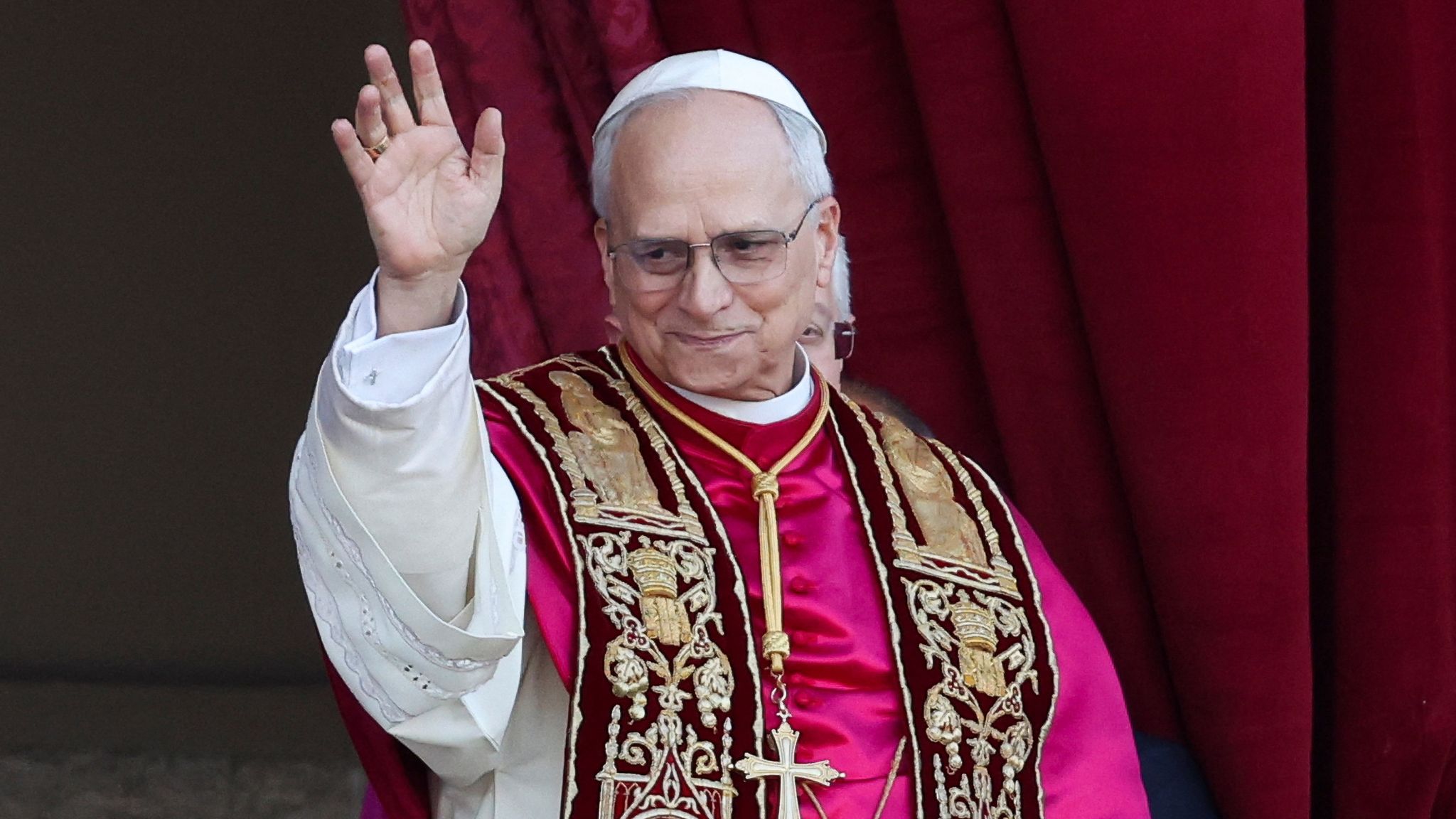
Pope Leo XIV, upon his election

As an Anglican, I join other non-Roman Catholics in hoping and praying that the new Bishop of Rome will live fully into the beautiful opportunity he has been given. His new office brings with it a symbolic role for all Christians, to be a principled unifier and peacemaker. In this era, that will surely be a challenge.

People of good will seek truth where it is to be found. We want all persons to live in harmony with one another, and with the beautiful world in which we find ourselves. We see this spirit of inquiry and discernment exemplified in many Christian leaders, as well as in non-Christian leaders like the Dalai Lama.

At heart, we seek and desire to serve what Christians and Jews hold to be true regarding all human beings. For we believe that all persons were and are created in the image of God, and that despite the woeful effects of our sin, we all still bear that image, however much we may have lost likeness with God. This was the central insight that some Roman Catholic Christian thinkers, along with fellow spiritual travelers from other traditions, brought to the creation of the United Nations Universal Declaration on Human Rights.

Principal documents from the Second Vatican Council display this theme in abundance. These texts continue to inform and guide wise souls who are genuinely concerned about the numerous lingering and emerging problems within the worldwide Church, and in the many societies and cultures where Christians seek to serve Christ in all persons, and respect the dignity of every human being.

Pope Leo has in large measure the same opportunity that we all have. May he have grace to live and serve well, and may we remember the importance of our own often overlooked roles in seeking to do the same. Every day brings new opportunities to seek and serve what is true, especially as we come to know the source of all Beauty, Goodness, and Truth, in Christ.

As St. Richard, the 13th century pre-Reformation Bishop of Chichester (England), taught us to pray: “Dear Lord, of thee three things [we] pray: to see thee more clearly, to love thee more dearly, and to follow thee more nearly, day by day.” (text from The Hymnal 1982, yet familiar to many from the musical, Godspell)

We find the same words as part of a prayer found in the liturgy of the Roman Catholic Church:

MOST merciful Redeemer,
who gavest to thy Bishop Richard a love of learning,
a zeal for souls, and a devotion to the poor:
grant that, encouraged by his example,
and aided by his prayers,
we may know thee more clearly,
love thee more dearly,
and follow thee more nearly,
day by day;
who livest and reignest with the Father
in the unity of the Holy Spirit, ever one God,
world without end. Amen.

A stained glass window commemorating St. Richard of Chichester, found in the church of St. Saviour, Eastbourne, East Sussex, England

M/S Juno: A Floating Beauty

If reading this by email, please tap the title at the top to open your browser for the best experience. Then, clicking individual pictures will reveal higher resolution images.

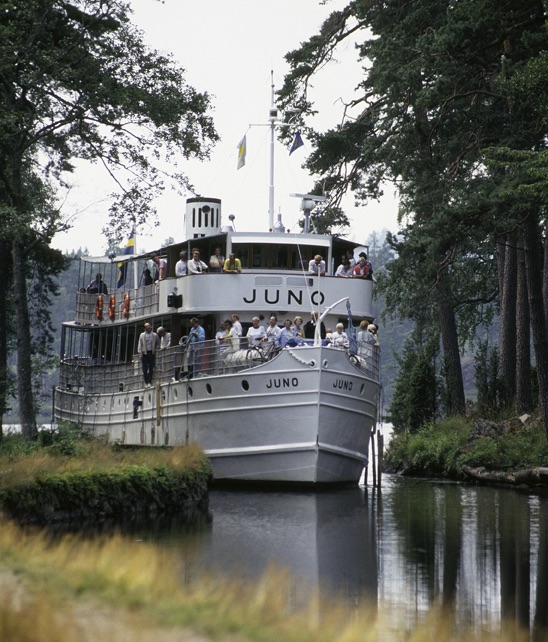
The M/S Juno on her inland voyage


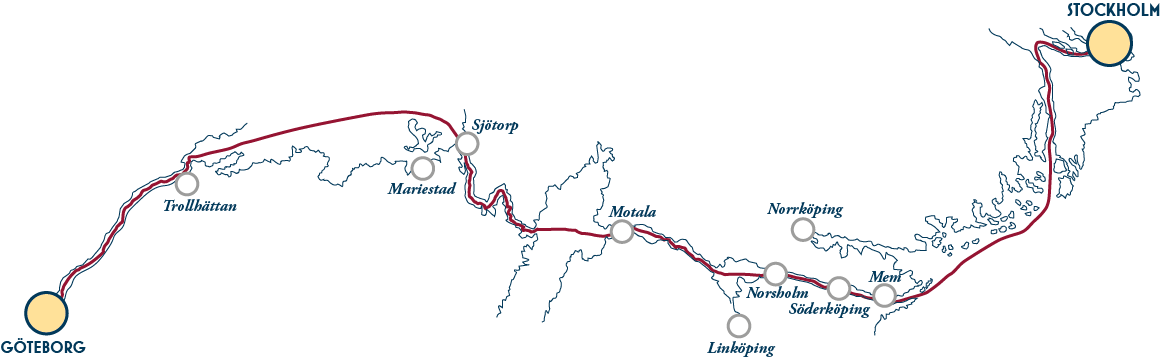
Did you know that it’s possible to book a safe and enjoyable overnight passage on a small ship that was launched over 150 years ago, in 1874? The M/S Juno, built for and still ‘sailing’ on largely inland waters in Sweden, is the oldest registered passenger-accommodating ship in the world. At about 100 feet in length, and with only 24 cabins, she is tiny compared to the grand vessels now being launched for the cruise industry. Not well-suited for ocean crossings, the Juno is perfect for her comparatively short runs between the Swedish ports of Gothenburg and Stockholm. Her usual route takes her from salt water through inland canals and lakes, and then through salt water again to the Stockholm archipeligo of islands and the Baltic Sea.

Originally, the Juno’s superstructure containing her bridge, lounge and dining room, as well as some cabins, was significantly smaller when the little ship served to convey freight as well as travelers. But these days, after a century and a half of service, her mission continues as a passenger vessel. Her age and small size, as well as her historic purpose, account for the fact that modern day voyagers need to be prepared for limited amenities such as shared restrooms.

Juno transits one of many locks along her route

Her principal route takes her through canals and locks, as well as inland lakes, up and over the lower Swedish peninsula, with the highest point on the journey reaching a remarkable 300 feet above sea level.

An upper level cabin on the Juno
Juno’s dining salon

I love Juno’s diminutive size and her classic lines that feature an upturned stern. Her bow line, with a vertical sheer that is now being rediscovered in boat design, is particularly appealing to me, being the skipper of a vintage 24 foot sailboat displaying a similar profile. I would enjoy a berth in one of Juno’s small cabins, resembling as they do old time railway carriage compartments. I think that Martha and I would appreciate the intimacy of sailing with a relatively small number of fellow passengers as well as the proximity of the up-country scenery along the route.

Juno’s upper level stern deck
A vintage photo of Juno taken before the lengthening of her superstructure

My great-grandfather, August Anders Holmgren, hailed from the northern seaside city of Sunsvall on the Baltic coast of Sweden. He emigrated to America in 1893, sailing most likely from Gothenburg, via Liverpool, to Montreal, and then by train to the Midwest just as many other Swedes had done before him. Perhaps my great-grandfather reached his ocean-going ship in Gothenburg via the Juno or one of her sister ships, sleeping on the floor of the dining room as many deck passengers did in the era when the Juno was still in freight service.

Juno’s route through Sweden

Given this personal history, I am sure that a short voyage on the Juno would prove to be a particularly nostalgic experience for me. My family connections with coastal Sweden, and my own experience of having crossed the Pacific Ocean five times by ship, help me to appreciate why I am so drawn to the Juno and the opportunity – some day, I hope – to sail on her.

A replica of Juno displaying her hull

Background note: I remember my surprise at encountering Cracker Bay, a 150 foot long private yacht (50% longer than Juno) with three decks above her water line, which one summer cruised into Round Harbor, Charlevoix, MI, from the Great Lakes. That year, as a vessel registered in the Cayman Islands, Cracker Bay was ‘manned’ by a family with young children and a crew of four or five. She took on $20,000 worth of gasoline supplied by a tanker truck parked near the fuel dock at which small craft like mine received a comparatively few gallons at a time. One of the children on Cracker Bay rode a bike over to the dock where my 15′ West Wight Potter was berthed, on which I was cruising for a couple of weeks. He marveled at the diminutive size of my boat, saying he wished he had one just like her!

Cracker Bay, with accommodations for up to 12 passengers, at Charlevoix, MI, in 2010

Charlie Russell: Stories That We See

If reading this by email, please tap the title at the top to open your browser for the best experience. Then, clicking individual pictures will reveal higher resolution images.

Whose Meat? (1914), on display at the CM Russell Museum


Charlie Russell’s culturally perceptive and action-oriented paintings reflect the social sensitivity that he possessed as well as his visual awareness of the natural world around him. Russell was a much-appreciated story teller, a natural gift that I believe is reflected in his art work. In Charlie Russell’s paintings, we see stories, and many of them represent the climax-point of stories we want to hear.

Shadows Hint Death (1915)

This raises a significant question regarding the works I am featuring in this post: What distinguishes these Russell paintings from examples like those of James Tissot’s biblical scenes, or Norman Rockwell’s Four Freedoms images? Regarding the paintings of both of the latter two artists, the word illustration may be used without diminishing our regard for their beauty or accomplishment. Yet, and without rendering a judgment about Tissot and Rockwell’s work, there may be a discernible difference between what are technically referred to as illustrations, and paintings that are more properly termed “fine art.”

Tom Gilleon’s recent exhibition of paintings at the CM Russell Museum included a personal reflection by the artist regarding his transition from being an illustrator for Walt Disney and NASA, to pursuing painting as a fine art. In that reflection, he refers to an illustrator’s skill in distilling imagery into its simplest forms, for example, by focusing on the power of simple lines and basic shapes. He suggests that, in his transition to fine painting, he pursued those basic shapes and forms as ends in themselves, being aware of how his paintings connect viewers directly to our primal human understanding of such forms. In a statement titled, “Profound Truths in Simple Forms,” he says that “by eliminating all unnecessary elements and being as direct as possible, an artist has the opportunity to guide viewers’ eyes, to tell them stories, to move their emotions.” The Russell paintings I feature here do just that.

Meat’s Not Meat Til Its in the Pan (1915), on display at the CM Russell Museum

Yet, the question remains. What distinguishes fine art paintings from those we call illustrations? If the latter are of a publishable kind, surely they share some of the properties we associate with fine art, and reflect a comparable degree of skill by the artist and a dedication to quality in the results. Building on Gilleon’s reflection noted above, we might say that illustrations are produced to accompany the telling of a story, whereas many examples of fine art paintings do the telling of the story. They do this by capturing more than a particular moment, while being suggestive of the broader context of what has come before, and what might come next. Another way to make the point is this: artworks intended as illustrations generally provide an image of a moment, or a dimension of a story that is communicated by other means, such as narrative.

Yet, in examples of fine art, a painting is meant to communicate on its own, apart from any accompanying text, and sometimes even without a title. In such work, factors such as atmospheric conditions of weather and lighting, or the emotional disposition of any characters portrayed, as well as interaction between them, often play a major role. And the presence and function of these latter elements can significantly determine the effectiveness of a particular work.

Paying the Fiddler (1916), on display at the CM Russell Museum (depicting a cattle rustler caught in the act)

In these works of representational art, we begin to inhabit the scene and story, while finding out more about them as we consider the imagery. Russell’s attention to background, the broader context, and surrounding figures, contribute significantly to the overall effect of his work. His very well-known early painting, Waiting for the Chinook (The Last of 5000), provides a reference point for this distinction. As a relatively simple image, its power lies in how it rises above the simple portrayal of a fact, in how it suggests multiple answers to a larger question.

Waiting for the Chinook (The Last of 5000)

This may help us observe how each of the paintings featured here not only tells a story, but invites the viewer into those stories to imagine what has led up to the moment being portrayed, as well as concerning what might yet happen in the given situation.

Wild Horse Hunters (1913)

Except for the early Chinook painting (seen above), all of the images included here date after the turn of the 20th century, when the “Old West” had in large part already transitioned from the lore and imagery of the “cowboys and indians” days, an ethos Wild Bill Cody had successfully captured in his eponymous Wild West Show, and was a world soon eclipsed by the emerging film industry.

In Without Knocking (1909)


Additional note: Readers may also be interested in the prior post, “Charlie Russell’s Vision of the ‘Old West’.” Once again, I commend a visit to the CM Russell Museum, in Great Falls, MT, to see original Russell paintings and sculptures as well as the artist’s studio and residence, carefully preserved adjacent to the museum. Interior photos of Russell’s studio and home are seen the photo below.

The Beauty of Objectivity

If reading this by email, please tap the title at the top to open your browser for the best experience. Then, clicking individual pictures will reveal higher resolution images.

William Blake, The Ancient of Days (one of numerous hand-colored prints)


I like to use a couple of throw-away lines: First, the world was here before we were here to notice it (or try to describe and evaluate its various facets). And, second, God was here before we were ever able to think the thought, much less give value to or try to describe this fundamental insight. And so, the world had God-given beauty and value before we were here to notice such things. To put this matter in the formal terms I propose that we recover, we were objects of God’s subjectivity before God ever became an object of ours. These insights ought to be primary in our outlook upon the world, and upon our lives within it.

The stark alternative to what these throw-away lines represent is the view that the world, its meaning and any purposes within it, and or God, came to have significance if not also actuality, when we chose to notice or imagine such things.

I have written before urging recognition of how beauty exists apart from the ‘eyes of the beholder.’ This is to say that the reality of beauty transcends the perception and apprehension processes of the one who beholds it. Another way to say this is to contend that beauty has objective reality. But what do we mean when we say something is objective?

Here, I would like to commend an insight regarding this word, ‘objective,’ and its pair, ‘subjective,’ terms we may use too casually. For we tend to employ these words most often to characterize two different aspects of how we perceive matters that come before us. One we regard as being oriented toward what is factual; we use the second to refer to that which is subject to the variability of emotions and sentiments that are particular to ourselves.

We need to recover a prior sense of what these two words, objective and subjective, can mean. We can return to using the word objective, not first to refer to the fact-oriented aspect of our consciousness of the world, but as referring primarily to the world itself and to the things within it. In this recovered use of these terms, the objective can best designate the objects of perception. And the second term, the subjective, can best represent the subject of our perceptions (us).

We can, of course, have ‘subjective’ notions about the objects of our perception, while we can also seek to be more accurate in our sense of those things that we perceive. Accurate description and evaluation of the objects of our perception are aided by comparative reference to the perceptions of those same things by others, and thus are aided by an effort to step beyond notions that are particular to ourselves and to our private experience of them.

In this respect, the practice of good science shares a basic property with the practice of good religion. Both seek to describe what is true, and what is in accord with reality.

God the Geometer (from a medieval manuscript)

In perhaps an overly simplistic summary, the choice between these two outlooks upon ‘what is,’ emerged with what we now call the Enlightenment, and the development of what we now call ‘natural science.’ And yet, the emergence of modern science, and the world view which it has come to nurture, lies in pre-modern theism, in the ancient and primal belief that before all things, was and is God. And that God was and is the author of what the medievals called the Book of Nature, who was also the author of the Book of Scripture. Two books with overlapping significance, by one Author, about all that was, and is, and ever shall be.

Among the works of this author, and behind or within them, are ideas, ideas latent in the mind of the Author. And preeminent among these ideas are Beauty, Goodness, and Truth. These ideas represent the highest things we cannot not know, especially if we seek to have our minds shaped by the mind of the Author of all things. Beauty, Goodness, and Truth, are therefore – as we like to say and think – objective. That is, they are among the highest, most valuable and excellent, objects of our perception. And whether we grasp their significance, and how we grasp their significance, as fellow-subjects of their perception, can of course be – as we like to say and think – subjective.

William Blake, Newton as A Divine Geometer

Nevertheless, the objects of our perception ought to govern and discipline our shared and comparative perception – as fellow-subjects – of Beauty, Goodness, and Truth. This is the beauty of human objectivity and of subjectivity.


The Beautiful Spirit of my Friend, Renee


I want to share my continuing appreciation for the beautiful spirit of a friend with whom I have been a colleague in life and work for over twenty years, and from whom I have learned much. Renee was first a mentor to me, as someone who exemplified spiritual authenticity while also demonstrating leadership gifts that have come to be recognized in the wider Church and in the corporate world. Renee truly loves people in a genuinely infectious way. It is no surprise, therefore, that she is a natural team leader who is blessed with the gift of inspiring others to become more whole, and to take the pursuit of holiness more seriously.

Renee was raised in the Midwest and the Southwestern desert, but yearned for a wider worldview than what her family and her early educational and social communities seemed to offer. This has led her to pursue a great deal of travel throughout her life, a good bit of it overseas. She has always been a seeker who has moved through life with the humility of an inquisitive learner and perceptive observer. To me, these qualities are fundamental.

I got to know her as a fellow leader at conferences in what she and I humorously might call the ‘early days,’ when she sought to share her vision for mission and ministry with a wider community. I remember her approaching the task of assembling some fifty-plus plastic transparencies to be set upon an overhead projector {remember those?}. And yet, despite these kinds of challenges we commonly faced as conference presenters, her story and personal witness were always compelling. For she quickly made meaningful connections with others in ways that encouraged us to identify with what she had come to see and know, and then as things we could take on to value in our own lives.

Some personal details of Renee’s life-journey fortify my appreciation for who she is, and the person she has been open to becoming. After her childhood and subsequent education, largely shaped by life in middle America, she adventurously responded to a ministry opportunity that took her to a rural area in the Philippines. This was likely a significant growth opportunity as well as an early indication of some emerging directions in her future vision and work. In so many ways, she has had an inclination to approach ideas about what it means to live as a spiritual being who engages with this world in all its complexity, with curiosity and a compelling equanimity. I particularly value her intentional pursuit of aspects of Asian cultural and spiritual life, and her frequent travels to the far side of the Pacific. These pursuits stand out to me given my own childhood and adolescent experience of growing up in Japan.

As a practical example, her decision for many years to risk adopting a pattern of clothing that could by some be labeled as ‘cultural appropriation,’ was yet a sign of her openness to other and non-traditional ways of living and of seeing things. Based on a spiritual principle, she has also often led worship after removing her shoes. For her, these kinds of decisions regarding how she approaches daily life are not an affectation, and call attention to what she is focused upon and to those things in which she finds value, rather than to herself.

Having lived and worked for a period of time in the humid hill country of the Philippines, Renee has also been effective in encouraging church community in the comparatively arid rural areas of Idaho, the azure coastal region of central California, as well as in the rice-growing flat land of southeastern Arkansas. Throughout her life, Renee has been drawn most to the desert, and to the spirituality that can be found in places like where Abraham perceived the nearness of God, outside his tent on a bright starry night, and where Jesus confirmed his vocation while setting aside the alluring possibilities offered by the Enemy. Her regard for the divine Spirit, who is often best found in the desert and in desert-like places, provides insight about the abiding interiority of Renee’s spiritual character.

What particularly marks Renee as a learner and as a teacher is her remarkable capacity for creative but also sincere self-remaking. She has in many ways transcended perceived attitudinal ‘boundaries,’ and has not only grown but has flourished in her life-informed path, to the joy of many others.

I offer this with thanks for my friend, Renee Miller, who embodies a wonderful appreciation for ‘the beauty of holiness.’

Here are some words from Renee that I think capture well her positive view of her life and ministry: “My primary core value is attributing the highest motive to people’s behavior. This helps me stay in the place of unconditional love, and for me, there’s nothing more theological or beautiful than the reality and demonstration of love. It can transform even the ugly and horrific, and if not transform, at least lessen its power.” Surley, these are words that we all want to live by.


Laetitia Jacquetton and the Art of Both-And

If reading this by email, please tap the title at the top to open your browser for the best experience. Then, clicking individual pictures will reveal higher resolution images.


Not so long ago, my friend James brought to my attention the striking glass-based sculptural work of Laetitia Jacquetton. Born in France, Jacquetton has a background in fashion design and a longterm interest in the minimalist qualities present within much of Japanese art and its Mingei (or folk art) tradition.

When I consider what I find compelling about her sculpture, I am reminded of the art of photography. A decisive factor in effective photography, especially black and white photography, is that of contrast. This is a predominant feature in Jacquetton’s work. Though this may seem obvious, perhaps too obvious for comment, I would like briefly to explore the significance of this element of contrast, and what her work might help us to appreciate regarding other spheres within our life experience. For the sculpture of Laetitia Jacquetton may alert us to an expansive question: can dissimilar and even contrasting things – as well as ideas – be brought together into beautiful harmony? And, what might asking this tell us about our concepts of nature and grace?

Photos of Jacquetton’s sculptures help acquaint us with how contrast functions in her sculptures. For example, the photo at the top displays an intentional contrast between light and dark, as well as between shiny and matte materials.

Here, we see a contrast between translucent and opaque materials.

We also see in these photos a further contrast, between smooth and textured materials. This feature, along with those previously noted, stems from the way a fluid and malleable material has been brought into relation with a static and unyielding one. Observing this allows us to infer something about the creative process involved in the production of Jacquetton’s sculptures. The artist has taken a humanly-fashioned form and adapted it to a naturally shaped object, bringing something crafted in the studio to bear upon something found in nature.

Empirically observed contrasts like these may also have a bearing upon our ideas, and how we think about concepts like nature and grace. We may have been taught to view such ideas in terms of a perceived contrast between them, even an antithetical one. Here, when thinking about objects found in relation to others that are crafted, or about nature in relation to our view of grace, we may gain insight by considering some apposite words that Eucharistic celebrants may say before consecrating the bread: “Fruit of the earth and work of human hands, it will become for us the Bread of Life.”

Several contrasts already noted are also evident in photos of Jacquetton’s other works:

Reflecting on these photos that feature contrasts allows us to articulate what is most significant within Jacquetton’s work, her intentional juxtaposition of contrasting elements.

Jacquetton as an artisan, a human agent gifted with a creative vision and developed skills, has juxtaposed dissimilar materials, achieving aesthetically pleasing results. A singular focus upon one or more of the contrasting materials (or the qualities associated with their appearance), could lead us to highlight one aspect of the artwork at the expense of another, in an either/or way. Yet, it is the dynamic conjunction between dissimilar materials that Jacquetton prioritizes in her work. Evident contrast is accompanied by intentional conjunction, leading us to appreciate the interplay of the differences in a both-and manner.

Noticing this, I think once again of the Eucharist, which – like the Incarnation – is another and relatable example of what I am referring to as a ‘dynamic conjunction.’ For the Eucharist makes present together both the natural physical properties of bread, and the supernaturally graced properties of the sacrament.

Nevertheless, we tend to view many aspects of our world, and of our lives within it, in a simplistic and reductionist manner. For me, comparative reference to the influence of Plato and Aristotle helps limit this tendency toward reductionism.

For example, I credit Plato’s influence with an implicit encouragement to view things, and especially their moral value, in relation to a single reference point. According to this approach, something either possesses or manifests this or that quality – let us say beauty, or goodness – or it does not.

I credit to Aristotle’s influence a more nuanced approach, which nurtures a willingness to consider what we see and come to know in relation to several reference points. We are then better able to say (in a both-and way) how this or that object of attention has a particular quality, while also possessing something of a second quality, and how it can be aptly described by referring to other qualities or attributes.

In all this, I do not attribute my reflections to Laetitia Jacquetton, though her compelling sculptures have clearly inspired them.


Additional notes: Thanks to my friend, James Ruiz, for introducing me to Laetitia Jacquetton and her evocative sculptural work. / Regarding my references to Plato and Aristotle, I do not presume to have accurately summarized aspects of their thought, but rather cite what I think are aspects of their dual influences.

I hope readers might perceive how my reflective observations above are related to the paradoxical conjunctions of ideas upon which I reflected in my prior post, regarding how repentance may display beauty, and how painful grief may be accompanied by joyful reassurance.