Worship

The Beauty of Hagia Sophia, and the Greek Cross

If reading this by email, please tap the title at the top to open your browser for the best experience. Then, clicking individual pictures will reveal higher resolution images.

Hagia Sophia (late 19th century photo), showing a later-added (and no-longer-extant) marble paneled exterior


The first great church in Christendom, and the largest for a thousand years, was the Hagia Sophia in Istanbul. Many people think of this building as a mosque, the role in which it served from the Ottoman conquest of Constantinople in 1453 until it became a museum in 1935. The addition of minarets reinforces this historic identification of the building with Islam, and those tower-like structures once again serve (since 2020) as a means to broadcast the daily multiple summons to Muslims to attend the designated times of prayer.

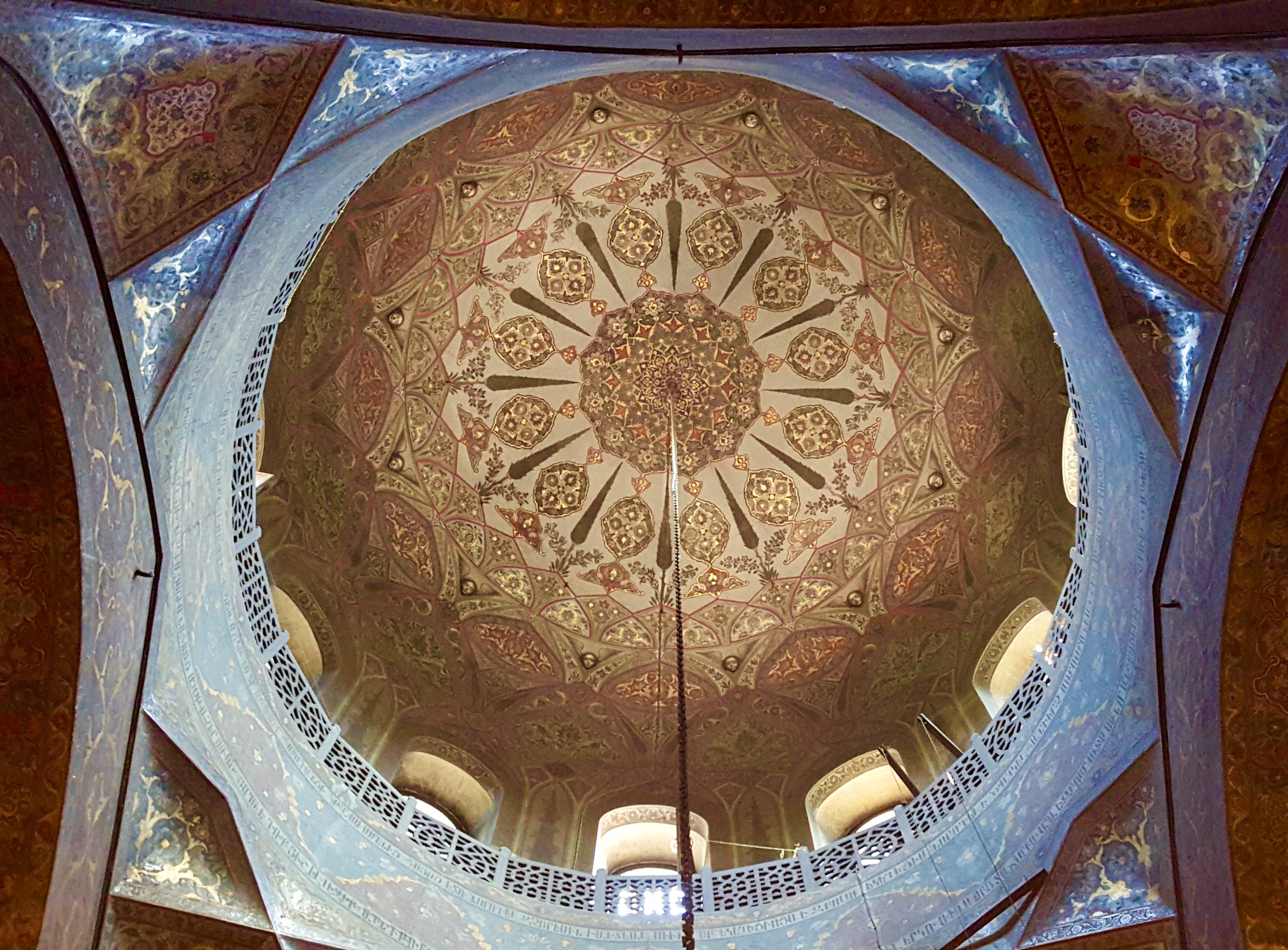
This stunning building’s historical association with two of the worlds most prominent monotheistic religions has given rise to a paradox. The architectural form many of us readily associate with Islamic mosques, epitomized by present-day Hagia Sophia, is a form derived from a Christian house of worship. Most mosques, including those recently built around the world, have a structure reminiscent of this building, constructed under the reign of Justinian as the principal Christian cathedral of the late Roman or Byzantie empire, between 532 and 537 A.D.

Hagia Sophia as it sits today in modern Istanbul

The earliest Christian gathering places, before Christianity was officially recognized in the Roman Empire, were often in synagogues or in private homes as well as in safe outdoor places. Once Christians could build and maintain churches without interference, a common stylistic choice was to adopt the Roman basilica style of building, long used in Roman cities as locations for offices, courts, and for other public and business functions. They were usually designed with a rectagular floor plan, containing a central nave, accompanied by side aisles that were separated by columns supporting the central ceiling and roof.

Roof coverings over the side aisles were built at a lower height, allowing for clerestory windows in the nave above them, illuminating the central area. At one end was an apse, covered by a half or semi-dome. At the center of the apse was a dais where in Roman buildings magistrates sat, and which in later churches provided seating for the clergy.

Longitudinal plan for the Basilica of Maxentius and Constantine, Rome

Noticing how the above described spatial arrangement continues to be evident in modern churches helps us appreciate the significance of Justinian’s innovative plan for the Hagia Sophia. For the longitudinal Roman-derived spatial arrangement, evident in the basilica plan above, led in the West to the the placement of altars as well as the clergy attending them at one end of the building. Over time, these longitudinal basilica plans influenced Western medieval architects to design Gothic churches and cathedrals based loosely on the Latin cross, where the longitudinal length of the nave replicates the tall upright base of the cross, upholding the horizontal arms.

A common floor plan for Western, Latin, longitudinal church design (entrance at the west end; altar placed in the apse at the east end; nave is shaded)

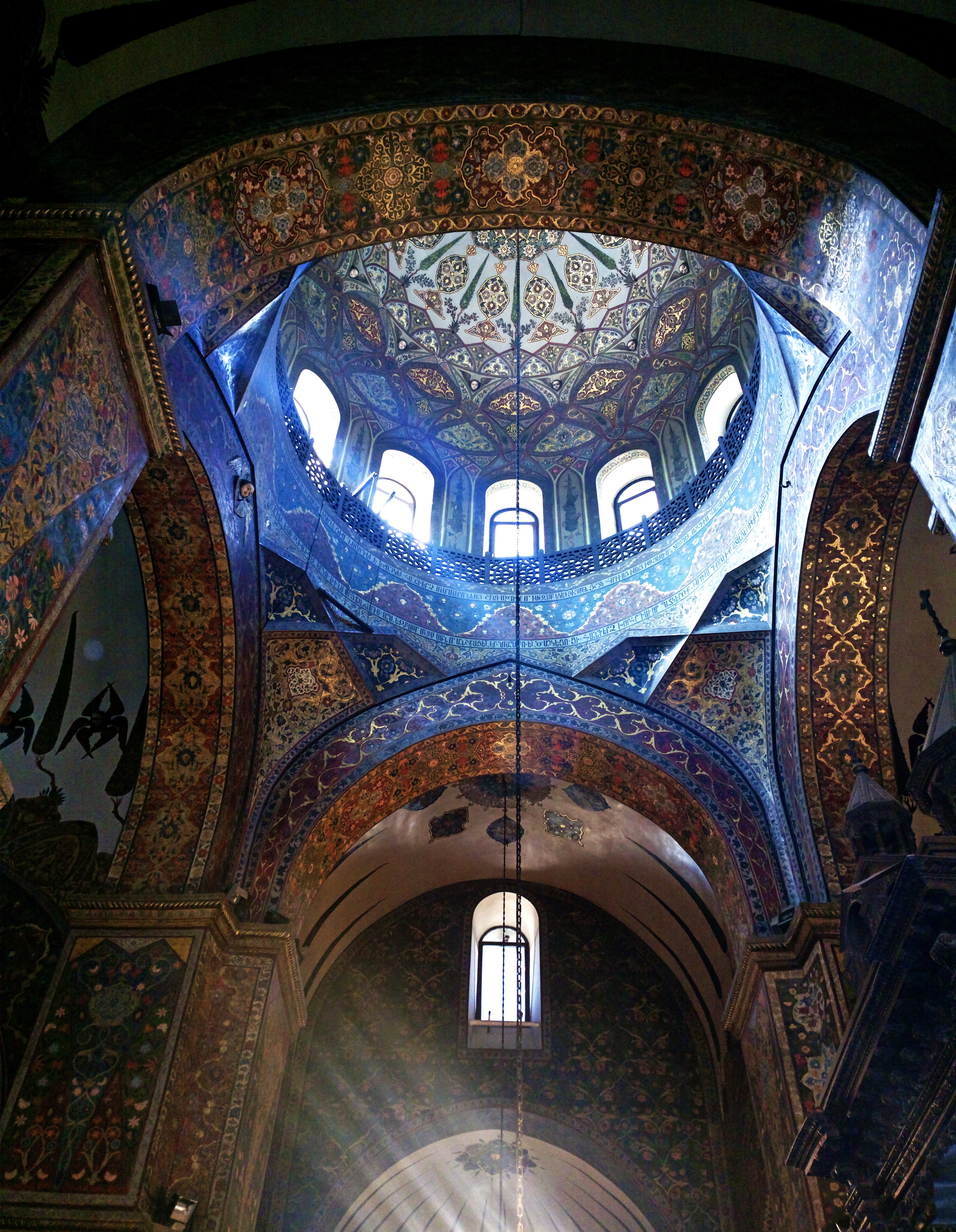
By contrast, Justinian’s Hagia Sophia plan, widely influential in the Christian East, and subsequently adopted in Islamic architecture for mosques, is based on what is commonly called the Greek cross, where each of the four ‘arms’ of the cross are of equal length. Plans based upon the Greek Cross therefore lend themselves a to placement within a square and or a circle, rather than within a rectangle. They also provide scope for the placement of a large dome over the central and main part of the building.

Plan of Hagia Sophia (with an apse, but with a spatial arrangement based upon an equal-armed cross)

The effect of this Greek Cross-based development in church architecture has a symbolic significance in the liturgical use of buildings based upon it. The altar, even if placed near to one end of the building, sits more closely toward the center of the structure and within the resulting worship space. To be sure, the liturgical use of such church buildings in earlier centuries, and the theological views of those who worshipped in them, often implied hierarchical understandings of church membership, something common in the Latin West, as well. [Imagine what was subtly – if not intentionally – communicated when clergy were observed sitting in the places associated in the prior realm with public officials and the exercise of their offices.]

Yet, it is interesting to observe how a preference for Greek Cross (or circular) shaped building plans has received increased attention in modern liturgical renewal. This is because liturgical spaces based on such plans lend themselves more readily to a revived understanding of the Eucharist as an activity of the whole church, and not just of some who are designated if not also elevated to lead it, and provide its benefits.


In a subsequent post I will reflect on some further architectural features of Hagia Sophia and of designs based upon it.


Memorial Day: Finding Beauty in Remembering

For this Memorial Day, I am re-posting part of a piece first published in January.

The grave of Hamilton Sawyer, U.S.C.T. (a Civil War casualty)


A few months ago, I found an unanticipated beauty in a wintry place a short drive from my home. Port Hudson National Cemetery is easy to overlook, though one of many created by the Federal government during the Civil War to provide for proper burial of the Union dead. It helps us remember those who lost their lives during a prolonged siege along the Mississippi River in 1863.

Among several thousand headstones, some include the initials, U.S.C.T. Wondering about them, I discovered they signify membership in a former United States Colored Troops regiment. Hamilton Sawyer (died 2 Feb 1864), and Samuel Daniels (died 19 Jan 1864), were two of many young men about whom history seems to have preserved only these bare facts. And yet, as a nation we remember them. Away from home and family at the time of their deaths, they surrendered their lives to help secure freedoms already declared, yet far from actualized in the lives of so many. Obviously, no contemporary visitor to the cemetery could have known either of these men. But we can – if we choose to – remember their names, and for what they died. The beauty of remembering lies in how we make present what we value.

Not everyone appreciates the beauty we find in a National Cemetery. Though these burial grounds were created and are maintained to honor those who have served in our nation’s military, these settings do not celebrate armed conflict. Instead, they venerate the commitment of many fellow Americans to serve our country and its founding principles, and commemorate their willingness to put the interests of the wider community before those of self. Most of us can recognize this commitment and willingness, even if we are not all moved to prioritize these things among our choices.

Praiseworthy themes often characterize eulogies offered at funerals. On such occasions, people usually identify and highlight the admirable traits of those who have died, whose lives we seek to honor through acts of remembrance. When done well, eulogies provide portraits of people’s lives conveying an appreciation for ways that certain moral principles and spiritual values have been lived out by them. These occasions would be drab and shallow if they merely recalled how a person consistently obeyed civil laws or always observed proper manners and social etiquette. By contrast, we touch upon beauty as we seek to remember people when they were at their best. For as Irenaeus put it, “The glory of God is the human person fully alive.” This is how we desire to be remembered.

Here is something to notice. There is a discernible symmetry between the way different baptismal candidates wear similar white robes, the way that variously styled caskets are covered at separate events by the same pall, and the way our burial liturgies – sacred and secular – ‘clothe’ our departed with the same words, on occasion after occasion. We find a pattern similar to these examples at our National Cemeteries, in how formerly high ranking officers and the lowest ranking enlisted men and women all have essentially the same headstones. In life and in death, we are – in the end – all one. Remembering the people whom the stones commemorate, even those we did not know, makes bigger our appreciation for the beauty of God’s world, and our own place within it.

To remember, and be remembered, can be holy acts. In remembering – even with regret-tinged memories – we reflect our desire for things to become whole, and brought to their fulfillment by God.


Historical note regarding Port Hudson:

From the above information plaque: “In May 1963, Union Gen. Nathaniel Banks landed 30,000 soldiers at Bayou Sara north of Port Hudson {at St. Francisville}. A force of 7,500 men commanded by Confederate Gen. Franklin Gardner held the Mississippi River stronghold. General Banks’ May 27 assault on Port Hudson failed and nearly 2,000 soldiers died. Among them were 600 men from two black regiments–the 1st and 3rd Louisiana Native Guards.* The Port Hudson engagement was among the first opportunities for black soldiers to fight in the Civil War. Their determination proved to the North that they could and would ably serve the Union Cause.”

“Among those buried {at Port Hudson} are 256 men who served in the United States Colored Troops (USCT).”

*Additional note from an informative Wikipedia article: “The 1st Louisiana Native Guard was one of the first all-black regiments in the Union Army. Based in New Orleans, Louisiana, it played a prominent role in the Siege of Port Hudson. Its members included a minority of free men of color from New Orleans; most were African-American former slaves who had escaped to join the Union cause and gain freedom.”

Port Hudson National Cemetery on a summer day

Note: blog settings have been changed to provide more opportunity to offer comments, using the link below.

Pentecost: The Beauty of Unity Amidst Diversity

Peter Warden, Pentecost (1985)


Paul’s stirring words to the Ephesians assert an abiding truth: “There is one Body and one Spirit; there is one hope in God’s call to us; One Lord, One Faith, One Baptism, One God and Father of all.” Paul was focused on the God-given and true things that unite us, that hold us together, and which give us life. Yet, in contemporary American culture, everything now seems to center on how we differ from one another. How might we hold both insights together?

Some years ago, I discovered Peter Warden’s wonderful contemporary painting about the post-Resurrection Pentecost event, which reflects the presence of such differences among us as people. Warden’s painting is based on the well-know story from Acts, chapter 2. The painter portrays the disciples together in their upper room retreat. But, in this case, the first Christian community is gathered in a 20th Century Scottish attic! The painting seems to capture the disciples just at the moment when the mighty Spirit-wind and tongues of fire appear. In other words, the disciples – as Warden depicts them – are not yet bound together, and not yet ready for mission.

Though they are in the same room, these disciples show few signs of unity. They react against one another, as much as they may talk together. Notice how this is suggested by the alternating warm/cool color palette that Warden has used. We also want to notice the suggestively peeling wallpaper behind the group. Can you see the pattern that the artist has created with the lower part of the rendering of the wallpaper?

If you look closely, you can see how Warden has used his depiction of that scrappy wallpaper to suggest Leonardo Da Vinci’s famous painting of the last supper. Da Vinci’s painting has also suffered the fate of being on a peeling wall. Peter Warden portrays a group of people with a shared history, who were brought together by Jesus at their earlier supper with him. But now, after his death, they find themselves regressing, regressing to their before-knowing-Jesus identities, and falling back upon their differences from one another.

Yet, as the painting’s title suggests, in just this moment God’s Holy Spirit finds them. Just as, through the Church, God’s Spirit finds us. When God’s Spirit finds us, we are grafted into the Body of Christ. In the process, we come to perceive who we really are. For we receive a new baptismal identity in Christ.

Our new identity builds upon and transforms the uniqueness of our natural, biological-identity. Our baptismal-identity emphasizes a new way of seeing ourselves in relation to others. Now, we also celebrate what we share and have in common, rather than simply emphasize our practical awareness regarding how we are unique and different from others.

Through hearing and reading Scripture, and in our fellowship with others in Jesus’ beloved community, we learn something very important. It has to do with this matter of our identity. We learn that the “Who am I?” question cannot rightly be answered apart from the “Who are we?” question. And, in turn, the “Who are we?” question cannot rightly be answered apart from another question: “Who are we made to be?” Once we ask, “Who are we made to be?”, we are on the threshold of discovering, perhaps for the first time in our lives, who we are meant to be and become, both as individuals, and in community.

Here is the truth of the great feast of Pentecost: God’s Spirit has come down! God’s Spirit has come down upon, and within, people who are sometimes alienated, and who often fall short of God’s mission. Preoccupied with ourselves and our own pursuits, we are gifted with the experience of transformation. We are drawn into relationship. As we are, we find meaning and we find purpose. We discover who we are, as we discern what we are called to be and do together. The mission of God brings both mercy and meaning. In it, we discover a shared life in God’s Spirit-shaped Kingdom.

John Nava, Pentecost, 2012


The quote from Ephesians is from the Book of Common Prayer Baptismal Rite adaptation of Ephesians 4:4-6. I have featured Peter Warden’s Pentecost painting once before, though without reflective comment, in a post offering Family Devotions during Covid, on May 30, 2020.

Further note: last week I was fortunate to walk down the same central street in ancient Ephesus upon which Paul surely often walked, while – according to Acts – he was there for two years. In writing the words quoted above, Paul was likely responding to the Ephesians’ devotion to the fertility mother goddess, Artemis, and the great temple they had built in dedication to her.

Contradiction, and the Beauty of Paradox and Metaphor

If reading this by email, please tap the title at the top to open your browser for the best experience. Then, clicking individual pictures will reveal higher resolution images.


An observation, a statement, or even a casual comment, may strike us as involving what we call a contradiction. A contradiction involves at least two mutually exclusive claims. Something cannot be both true and false, we like to think.

Yet, with things like photos, we can observe that they may be both light and dark, or both clear and fuzzy looking. Or regarding a poem, we might say it is both meaningful as well as obscure in its meaning. Claims regarding contradiction therefore call for precision, and awareness of context.

One way of viewing objects of attention, and the appearance of contradiction, is to say these things involve paradox. A picture or a description of it , or a picture’s characterization, may also be termed as paradoxical.

Then there are metaphors, which can be beautiful. Especially when – with unanticipated insight – they juxtapose ideas that otherwise would seem to form unlikely pairings. Such metaphors can help us to perceive how apparently contradictory statements, observations, or claims, can each be true.

Not all metaphors do this. But metaphors help our perception and understanding. For this reason, metaphors play a significant role in the Bible, and not in just in the scriptures holy to the Judeo-Christian tradition.

From pastoral experience, I know that various selections from the Bible can strike readers and hearers as involving contradiction. Moving beyond a simple conclusion – that what has been read or heard is contradictory – can be a challenge, and this calls for intentionality. For beauty is not always immediately discerned. The challenge lies in learning to perceive how the same reading may involve paradox as well as metaphor, and that these aspects of the text are intended to be illuminative.

One of the divinely intended purposes of the Bible is to help us perceive, to perceive more than we do now, and therefore to perceive more wholly. The primary purpose of the Bible – and of, we may charitably assume, the sacred scriptures of any religious tradition – is to help us perceive what is holy.

Robert Lentz, The Holy Trinity (featuring Creation, and astronomical images)

These insights may therefore be just as important for Christians as they read the scriptures of other peoples, as they are for when we read the Bible.

For there is one God, who in love shares self and wisdom with the whole cosmos.

Here is a relevant paradox. God may in love share self and wisdom with all the peoples of the world. Yet, it may be that God does not share self in the same way with all people, nor the same wisdom. If this is so, then the reason why ultimately lies in the inscrutable wisdom of God. Yet, possible reasons for why God does or does not share self and wisdom in the same way with different people are suggested in our own scriptures.

Perceiving this, we are moved to listen and read the Bible, and especially our lectionary readings from it, attentively and with a well-founded expectation of spiritual fulfillment.


Pointing Toward Perception

If reading this by email, please tap the title at the top to open your browser for the best experience. Then, clicking individual pictures will reveal higher resolution images.


We live in a world filled with “data.” Disconnected bits of information, especially in great quantity, overwhelm our ability to see and to think. Accumulating additional data or more information does not produce knowledge. Knowledge has to do with seeing the connections between bits of information. When we see the connections, we begin to see a picture, we begin to hear a story, and we gain understanding as well as wisdom.

The unrecognized fellow traveler on the road to Emmaus asks the two disciples, ‘what are all these things you are talking about?’ The answer he receives from them amounts to information. But his question is pointed toward understanding, especially in relation to ‘the big picture. He is challenging them to discover something bigger. He is really asking something like this: ‘All these things’ that have happened… What do they have to do with what God has been up to, all along?”

Here is a basic Christian truth that we find in the Emmaus Road story: Things take on meaning in relation to the risen Jesus. It happens when we see events in our lives in relation to him. It happens also with things like bread and wine as we gather at table. And it happens with people like you and me as we gather in community.

Jesus helps our perception on the road to Emmaus, and reveals something even more profound at the inn. This ‘inn,’ unlike the one where he was born, has many rooms, many mansions. When we see things like past events and the bread in relation to him, we discern more about what they were or are, and what they yet can become. When we see ourselves in relation to him, we better discern who we really are, and who we are called to be.

Prayerfully, we can look around, between things, and within. We can look for the connections. When we do, we see and discern. We see more because we see more wholly. Then we see the holy.


The above painting, Supper at Emmaus (1958), is by Ceri Richards, and is used by permission from the Trustees of the Methodist Modern Art Collection (UK). The penciled notation at the base of this guache painting on paper suggests that it was intended as a study for an altarpiece painting for the chapel of St. Edmund Hall (or College), at Oxford, England. The Emmaus story can be found in Luke 24:13-35, and it is a traditional Eastertide Gospel reading.

This post is adapted from one first published in 2014.

I Will Take You To Myself

If reading this by email, please tap the title at the top to open your browser for the best experience. Then, clicking individual pictures will reveal higher resolution images.

Fra Angelico, Noli me tangere


In the intimacy of his physical embodiment, the disciples and the holy women want to hold on to Jesus. It is the only way they have known him.

Mary is then found by the One she is looking for, in the garden by the tomb, on what becomes the Resurrection-discovery morning.

”Don’t try to cling to me,” he tells her, for he has not yet ascended to where he promises to take us.

We want to hang onto to how we have best known him. He promises to hold us to himself in what will be an even greater intimacy.

It is just beginning. Alleluia!


Jesus said to her, “Do not cling to me, for I have not yet ascended to the Father; but go to my brothers and say to them, ‘I am ascending to my Father and your Father, to my God and your God.’” (John 20:17)

“And if I go and prepare a place for you, I will come again and will take you to myself, that where I am you may be also.” (John 14:3)

Once and For All

If reading this by email, please tap the title at the top to open your browser for the best experience. Then, clicking individual pictures will reveal higher resolution images.

Salvador Dali, The Sacrament of the Last Supper (detail)


With his life, and in his death, Jesus offered himself. In accepting crucifixion, he offered himself and the whole Creation to the Father, in the Holy Spirit. He did this once and for all. Yet, in every Eucharist, and for all who remember him on any day, he continues to make present and real in our experience what he did, once and for all.

He acted, once and for all. Yet – and this is the paradox – he still acts for all… for all time, for all places and things, and for all people. What he is still doing now does not in any way signal an incompleteness to what he did then. For he continues to offer the gift of including us in what he did then, when he did what he did, once and for all.

So what does it mean for him to include us now, in what he did then? That is the question for the holy three days of our Paschal Triduum, which begins on Maundy Thursday evening.

One way into the many answers to our question can be found in Salvador Dali’s painting, The Sacrament of the Last Supper. It is not a painting of, or about, the Last Supper. Instead, this is a painting inspired by the Last Supper, and by what it came to mean in the broader context of all that happened during those three days. For the painting is about the sacrament in which the Risen One now makes present the result of what happened on the Cross, in the Resurrection, and with the descent of the Holy Spirit.

The Book of Common Prayer service for Good Friday is in fact not a Eucharist, just as the Last Supper in that Upper Room was not a Eucharist. The Last Supper prefigured the Eucharist, but could not have been one. For Jesus had not yet died, nor yet Risen from the Tomb, and the Spirit had not yet descended at Pentecost. And neither are the sacramental services on Good Friday intended to be Eucharistic celebrations. For in the wisdom and tradition of the Church we do not celebrate the Eucharist on this most holy day, though we may receive the fruit of it, and all its benefits, when Communion is offered to us.

Instead, all our focus is upon Him, who died and rose again for us, once and for all.

These are some of the reasons why Dali paints the disciples as recognizable, physical, and historically-anchored, people. And why he yet paints our Lord as present in his mystical risen glory.

We gather in his name and in his presence on particular occasions, in particular places, at particular times. Yet he is now present at and on all occasions, in all places, and at all times. We – who are rooted in time and place – receive him who transcends and yet is present within all times and places. Grace infuses nature. The timeless One imbues time with glory.

The Sacrament of the Last Supper (full image)

On the cross, Jesus lifted up the whole Creation to his – and now our – Father, once and for all. Just as he lifted up our human nature in his Ascension, which in a sense then became our Ascension. And yet, he continues to lift up the whole Creation – including us, and including all the uncertain and unfinished aspects of our lives. So, the One who is the source of all purpose and meaning continues to bring meaning and purpose to us, and to all that we lay before him, here and now. Time and again, he brings completeness and wholeness to all that is lacking, so that we might live more fully in his glorious fulfillment of what it means to be human. For all this, we offer our deepest thanks and praise.

May these ‘holy three days’ (Maundy Thursday evening — Easter Eve) in the Church’s Christian observance of Passover be a time of blessing for us and our loved ones.


This post is adapted from my (2024) homily for Good Friday, which may be accessed by clicking here.

Note: blog settings have been changed to provide more opportunity to offer comments, using the link below.


Rousseau and Wilderness: Redemption in Nature?

If reading this by email, please tap the title at the top to open your browser for the best experience. Then, clicking individual pictures will reveal higher resolution images.

Henri Rousseau, The Dream (detail), 1910


What does it mean for God’s grace to be present in nature? Or God’s mission of Redemption to be at work in what Christians view as a fallen Creation? The Gospel for this coming Sunday, with Jesus tempted in the wilderness, might prompt us to think about such things. An unexpected way to do this is to juxtapose Mark’s surprisingly brief ‘temptation narrative’ with Rousseau’s jungle-like images of a state of nature.

How shall we understand Mark’s account of Jesus’ being tested in an inhospitable place? And how does Rousseau conceive of the natural state of what Christians think of as Creation? A painting by Rousseau helps set the scene:

The Sleeping Gypsy, 1907

In light of it, we can consider the two verses that Mark devotes to Jesus’ temptation:

The Spirit immediately drove him out into the wilderness. And he was in the wilderness forty days, being tempted by Satan. And he was with the wild animals, and the angels were ministering to him.

Only two verses are accorded by Mark to this rather pivotal event, to which Matthew devotes 11, and to which Luke gives 12. The way that Matthew and Luke refer to the wilderness of the temptation suggests that it is a hostile context for Jesus’ encounter with the Tempter. In both of these longer Gospel texts, three principal temptations are identified, which occur following Jesus’ forty days of fasting. The three were: to feed himself, to become a wonder-worker, and to receive the adulation of the world’s kingdoms. Matthew adds that Jesus received the ministration of angels following – rather than during – his period of trial.

Whereas Matthew and Luke present the wilderness as an unpromising environment for Jesus’ challenging encounter with his adversary, Mark’s spare account of the event and its setting allows for a rather different reading. We can pose the matter in the form of two questions shaped by Matthew and Luke’s narratives.

Does Mark present the wilderness temptation of Jesus as being in a difficult place due to the presence of the Tempter and because it is filled with prowling and potentially dangerous wild beasts?

Man Attacked by a Jaguar, 1910

Or, does Jesus’ desert encounter in Mark represent not so much the threatening last gasps of a rebellious and dying world, but the first breaths of a life-giving new one, just now coming to be?

The Waterfall, 1910

Rousseau’s painting of the sleeping woman and the nearby lion, above, provides an image of harmonious coexistence in a place shared by a human being and the proverbial king of beasts (an ‘alpha predator’). In other words, Rousseau – in some of his paintings – portrays an ideal image of the original state of nature, the biblical Eden, before nature became ‘red in tooth and claw.’

A Woman Walking in an Exotic Forest, 1905

If so, then Mark’s statements that Jesus “was with the wild animals,” and also that “the angels were ministering to him,” may reflect what Christians have come to think of as ‘the peaceable Kingdom’ and ‘the New Creation.’ Which then suggests that – in Mark – the wilderness was good place despite the presence of the Tempter.

I am drawn to how Rousseau depicts the natural beauty of what we often describe as ‘wild nature,’ portraying it in both inviting and in cautionary ways. He paints it as a context of harmonious interrelation between human beings and animals in a shared environment. He also paints it as being a context where animals are a threat to one another and to humankind. Rousseau’s painting of Eve hints at both possibilities, where she is charmed by the serpent:

Eve, 1907

In the painting below, which complements his image above, another ‘Eve’ charms the serpent. Rousseau fills the beautiful canvas with a limited color palette, largely green, expressing the same dimension of ambiguity. A woman plays a flute while a serpent is draped upon her shoulders and others hang from the trees or rise up from the ground:

The Snake Charmer (detail), 1907

Looking at Rousseau’s many jungle-like ‘exotic landscapes,’ one notices the evocative presence of mystery. The viewer does not immediately know what lurks in the shadows, beneath and behind dense and dark foliage, in scenes often featuring bright flowers or fruit in the foreground. And upon discerning animals and also humans among all the growing things in the thicket between the trees, we can’t be sure whether what we encounter is friend or foe.

Jaguar Attacking a Horse, 1910

Exotic Landscape, 1910

In these and other scenes, Rousseau portrays an invitingly beautiful world, but one that is not without the possibility of misadventure and harm. I may not want to live in some of these scenes. But I find joy living with their beauty. For they help me appreciate a new way of reading and thinking about Mark’s brief account of Jesus’ temptation ‘in the wilderness.’ Jesus possibly could have repeated the great mistake made by Adam in the old Eden. But in not doing so, ’the second Adam’ became the door to a new Eden, and our ‘ark’ to the New Creation.


Note: blog settings have been changed to provide more opportunity to offer comments, using the link below.

Finding Beauty in Remembering

If reading this by email, please tap the title at the top to open your browser for the best experience. Then, clicking individual pictures will reveal higher resolution images.

The grave of Hamilton Sawyer, U.S.C.T. (a Civil War casualty)


I found an unanticipated beauty in a wintry place a short drive from my home. Port Hudson National Cemetery is easy to overlook, though one of many created by the Federal government during the Civil War to provide for proper burial of the Union dead. It helps us remember those who lost their lives during a prolonged siege along the Mississippi River in 1863.

Among several thousand headstones, some include the initials, U.S.C.T. Wondering about them, I discovered they signify membership in a former United States Colored Troops regiment. Hamilton Sawyer (died 2 Feb 1864), and Samuel Daniels (died 19 Jan 1864), were two of many young men about whom history seems to have preserved only these bare facts. And yet, as a nation we remember them. Away from home and family at the time of their deaths, they surrendered their lives to help secure freedoms already declared, yet far from actualized in the lives of so many. Obviously, no contemporary visitor to the cemetery could have known either of these men. But we can – if we choose to – remember their names, and for what they died. The beauty of remembering lies in how we make present what we value.

Not everyone appreciates the beauty we find in a National Cemetery. Though these burial grounds were created and are maintained to honor those who have served in our nation’s military, these settings do not celebrate armed conflict. Instead, they venerate the commitment of many fellow Americans to serve our country and its founding principles, and commemorate their willingness to put the interests of the wider community before those of self. Most of us can recognize this commitment and willingness, even if we are not all moved to prioritize these things among our choices.

Praiseworthy themes often characterize eulogies offered at funerals. On such occasions, people usually identify and highlight the admirable traits of those who have died, whose lives we seek to honor through acts of remembrance. When done well, eulogies provide portraits of people’s lives conveying an appreciation for ways that certain moral principles and spiritual values have been lived out by them. These occasions would be drab and shallow if they merely recalled how a person consistently obeyed civil laws or always observed proper manners and social etiquette. By contrast, we touch upon beauty as we seek to remember people when they were at their best. For as Irenaeus put it, “The glory of God is the human person fully alive.” This is how we desire to be remembered.

Because of this holy desire, we choose patterns for Christian burial that anchor our remembrance of persons in the body of Christ, in the Eucharistic context of God’s redemptive work. Eucharistic remembering is both holy and thankful remembering. As such, we include an appropriate Gospel reading, and offer reflection upon it. Making connections between enduring Gospel truths and how they have become actual in the dear but transitory aspects of a deceased person’s life, is most fitting. For the sake of those gathered, the focus of a funeral homily will then best be upon what the Resurrection of our Lord has made real for all people.

To honor someone in this liturgical way upon his or her death is genuine remembering, and reflects our natural and common desire to respect a person’s unique memory. In the proverbial Anglican “both-and” way, we can keep a focus on the Resurrection, as we also express our regard for the deceased. We do this by centering our liturgical observance upon the Gospel, while focusing our intentional gathering before and after the funeral liturgy upon the person being remembered. For these different but interrelated aspects of the day belong together.

Here is something else to notice. There is a discernible symmetry between the way different baptismal candidates wear similar white robes, the way that variously styled caskets are covered at separate events by the same pall, and the way our burial liturgies – sacred and secular – ‘clothe’ our departed with the same words, on occasion after occasion. We find a pattern similar to these examples at our National Cemeteries, in how formerly high ranking officers and the lowest ranking enlisted men and women all have essentially the same headstones. In life and in death, we are – in the end – all one. Remembering the people whom the stones commemorate, even those we did not know, makes bigger our appreciation for the beauty of God’s world, and our own place within it.

To remember, and be remembered, can be holy acts. In remembering – even with regret-tinged memories – we reflect our desire for things to become whole, and brought to their fulfillment by God.


Historical note regarding Port Hudson:

From the above information plaque: “In May 1963, Union Gen. Nathaniel Banks landed 30,000 soldiers at Bayou Sara north of Port Hudson {at St. Francisville}. A force of 7,500 men commanded by Confederate Gen. Franklin Gardner held the Mississippi River stronghold. General Banks’ May 27 assault on Port Hudson failed and nearly 2,000 soldiers died. Among them were 600 men from two black regiments–the 1st and 3rd Louisiana Native Guards.* The Port Hudson engagement was among the first opportunities for black soldiers to fight in the Civil War. Their determination proved to the North that they could and would ably serve the Union Cause.”

“Among those buried {at Port Hudson} are 256 men who served in the United States Colored Troops (USCT).”

*Additional note from an informative Wikipedia article: “The 1st Louisiana Native Guard was one of the first all-black regiments in the Union Army. Based in New Orleans, Louisiana, it played a prominent role in the Siege of Port Hudson. Its members included a minority of free men of color from New Orleans; most were African-American former slaves who had escaped to join the Union cause and gain freedom.”

Port Hudson National Cemetery on a summer day

Note: blog settings have been changed to provide more opportunity to offer comments, using the link below.

Comfort Ye My People

[If reading this by email, please tap the title at the top to open your browser for the best experience. Then, clicking individual pictures will reveal higher resolution images.

Marc Chagall, Memorial Window, All Saints Church, Tudeley, Tonbridge, UK


As a priest and from recent personal experience, I know how these weeks are a tender time for many of us. Especially for those who have lost loved ones at this time of year. Finding consolation and hope after losing the tangible nearness of a beloved family member or friend is hard at any time. Faced with such a loss or its memory around Christmas, how do we find comfort and reassurance in this season? Are “the hopes and fears of all the years” really met in Him, even now?

I find help with questions like these in what may seem an unlikely place: a beautiful window by an artist whose upbringing was shaped by Hasidic Judaism, placed over the altar of an Anglican church (shown above). It was designed by Marc Chagall for All Saints Church, Tudeley, in England.

Chagall was commissioned by a grieving couple to design this window as a memorial for their adult daughter who drowned in the sea. She is portrayed below the waves in the lower portion of the window, with what appears to be her grieving mother near her feet. We find here an unexpected coupling of images that frequently appear in Chagall’s work. Seeing his depiction of a crucified man juxtaposed with that of a mother and child surprises many Christians when they learn of Chagall’s Judaism.

The imagery in Chagall’s window may seem like an unusual choice for this holiday time. Yet, it fits. Though he often painted crucifixion images in his work, the artist had in mind the suffering of Jews through the centuries, and especially in his own time. In a similar way, he thought the portrayal of a mother and child, so familiar in Christian iconography, was a universal image within human experience. Chagall believed that the Christian conscience could be touched by familiar images from the Gospels, but which were also deeply resonant for Jews based on Hebrew Bible antecedents.

This is why I think that Chagall’s art might speak to us in this season. After all, the one whose birth we celebrate at this troubled time in the world awakens hope in us, hope for new life through the renewal of our shared humanity. Our Christmas hymns touch upon this theme. And, of course, the child born to Mary and Joseph was destined – as was prophesied – for the fall and rise of many (Luke 2:33-35).

Christian artists through the centuries have been captivated by many aspects of our Lord’s Nativity. Countless examples of their work have sought to express our impression of the circumstances of Jesus’ birth, and its significance for the world, not just for his immediate family. It is noteworthy how often depictions of the Annunciation, and of the Nativity contain noticeable hints of his later saving death, and resurrection. The inclusion of discernible palm fronds, passion flowers and of lilies in these works provide common examples of these visual hints of a veiled significance yet to be revealed.

Sadao Watanabe, Nativity Christmas card, with palms, lilies, and passion flowers

Both literally and conceptually, what we celebrate at Christmas is easier to ‘grasp’ than what we celebrate at Easter. We are more prepared for the presence of the Word made flesh in a manger than we are for the absence of the Word, said to be risen and ascended from an empty tomb. The comforting appeal of the Virgin Mary holding her newborn son in a stable contrasts with the mystery of another Mary later reaching out to try and hold the risen Jesus in a garden.

This Holy Child brought us the possibility of new life by overcoming the power of death. We celebrate his birth precisely because his death and resurrection provide the pathway to our own new birth. He was born and died as one of us. And so, in him, we die and rise again to the new life he shares with the world.

Mild he lays his glory by,
born that we no more may die,
born to raise us from the earth,
born to give us second birth.
Risen with healing in his wings,
Light and life to all he brings,
hail, the Sun of Righteousness!
hail, the heaven-born Prince of Peace!

Hark! the herald angels sing,
glory to the newborn King!


The hymn text is by Charles Wesley (Hark! the herald angels sing, verse 3).