Worship

Our Doorway Into God’s Trinitarian Being

William Holman Hunt, The Shadow of Death (1870-73)

When we as Christians pray, we don’t simply pray to God. With faithful assurance, we pray with and through God! As Paul tells us, “When we cry, ‘Abba! Father!’ it is that very Spirit bearing witness with our spirit…” This is because, when we pray “to the Father,” we also pray with and through the Son. We are enabled to pray with and through the Son following our Baptism. For after Baptism, we are assured that we pray in the Holy Spirit. We therefore pray to God not ‘from the outside,’ but ‘from the inside’ of God’s own being and nature!

Well, how can this be? As we can easily discover, every Eucharistic Prayer in The Book of Common Prayer has a common shape. For all of our Eucharistic Prayers are prayed to the Father, through the Son, in the Holy Spirit. This is not an accident. Jesus modeled this in his own life, and particularly at the Last Supper.

When we repeat Jesus’ pattern, offered at that supper, we stand with him around the same table. And by his graceful invitation, we join his prayer to the One he called, ‘Our Father.’ Our prayer with him, to the Father, is in the power of the Spirit, the same Spirit he spoke about at that table. He modeled at that supper what grace means in practice.

Through the grace of the Holy Spirit, Jesus shares with us his own particular intimacy with the Father. Inviting us to stand with him as he prays, he offers the whole world back to the Father-Creator. By this, Jesus – and us with him – fulfills the divinely intended-but-failed stewardship vocation of the mythical Adam and Eve. And so, this is also our vocation, to offer up to our Father all that truly belongs to the Creator. Sharing with Jesus the grace of the Holy Spirit allows us to join him, the Son, in his ongoing Eucharistic vocation.

A good way we can live into the saving implications of God’s Trinitarian nature, is to engage in some creative imagining. Imagine that, in this moment, Jesus reaches out his hands to us. In reaching out his hands, he does not simply extend his greeting. Extending his embrace, he invites us to join him by standing with him, closely at his side. By his invitation, and our acceptance of it, he shares with us his own intimate and particular relationship with our Father.

And with this invitation, he gives us the power of the Spirit, making it a reality in our lives. Because the invitation comes from him, the power of the Spirit he shares with us is God’s grace-filled power. Jesus makes all this actual and true, whether we feel it or not.

This Trinitarian shape of prayer is different from how we usually imagine prayer. Commonly, we think of prayer as our communication to God. When we feel aware of God and close to God, we speak to God of what is good and well and of that for which we feel thankful. And we often ask for help. But, when there seems to be a veil between us and God, we speak to God with lament or we complain, sometimes in anger. This concept and experience of prayer is ‘subjective,’ and therefore narrow. That is, it is a concept of prayer based primarily upon our personal, interior, experience. It reflects our experience of being the subjects of perception and action. Yet, as the Prayer Book Catechism teaches us, prayer is first of all responding to God.

As we learn from Jesus, and by the Holy Spirit, true prayer is not something we do, which we somehow manage to achieve through our faithfulness, devotion, or energy. True prayer is something we allow God to do within us. True prayer is the kind of praying that we find God already making real within us through the indwelling Grace of the Holy Spirit. The Father and the Son and the Holy Spirit are constantly engaged with one another, in what the Eastern Christian tradition calls ‘a dance,’ a perichoresis. Prayer involves being drawn into this dance. Prayer is sharing in the Trinitarian relational being of God. Prayer is participation in the community of fellowship that exists within God’s own being.

The Trinitarian pattern of our lives rests upon the Trinitarian shape of our prayers. We can accept Jesus’ invitation to stand with him. We then experience his own fellowship with the Father, in the grace-filled power of the Holy Spirit. This enables us to live truly. To live truly, is to live to the Father. It is to live with and through the Son. And true prayer is to live in the power of the Holy Spirit.

And so, we seek to live in the way that we pray: to the Father, with and through the Son, in the Holy Spirit.

Note: This post is based on the Western Church’s observance of Trinity Sunday, on June 15, 2025. My title is based on a well-known metaphor found in John’s Gospel. The text here is based on my homily for that occasion, which may be accessed by clicking here.

My goal is to commend the assurance of hope that lies within the Gospel. And while being aware of concerns about the so-called ’scandal of particularity’ associated with Christianity and Judaism, we should be aware that God is free to offer a similarly positive spiritual experience to those of other religious traditions, or of no particular tradition with which they may identify. I hope to address Hunt’s evocative painting, featured above, in a subsequent post.

Leo XIV: The Beauty of Possibility

If reading this by email, please tap the title at the top to open your browser for the best experience. Then, clicking individual pictures will reveal higher resolution images.

Pope Leo XIV, upon his election

As an Anglican, I join other non-Roman Catholics in hoping and praying that the new Bishop of Rome will live fully into the beautiful opportunity he has been given. His new office brings with it a symbolic role for all Christians, to be a principled unifier and peacemaker. In this era, that will surely be a challenge.

People of good will seek truth where it is to be found. We want all persons to live in harmony with one another, and with the beautiful world in which we find ourselves. We see this spirit of inquiry and discernment exemplified in many Christian leaders, as well as in non-Christian leaders like the Dalai Lama.

At heart, we seek and desire to serve what Christians and Jews hold to be true regarding all human beings. For we believe that all persons were and are created in the image of God, and that despite the woeful effects of our sin, we all still bear that image, however much we may have lost likeness with God. This was the central insight that some Roman Catholic Christian thinkers, along with fellow spiritual travelers from other traditions, brought to the creation of the United Nations Universal Declaration on Human Rights.

Principal documents from the Second Vatican Council display this theme in abundance. These texts continue to inform and guide wise souls who are genuinely concerned about the numerous lingering and emerging problems within the worldwide Church, and in the many societies and cultures where Christians seek to serve Christ in all persons, and respect the dignity of every human being.

Pope Leo has in large measure the same opportunity that we all have. May he have grace to live and serve well, and may we remember the importance of our own often overlooked roles in seeking to do the same. Every day brings new opportunities to seek and serve what is true, especially as we come to know the source of all Beauty, Goodness, and Truth, in Christ.

As St. Richard, the 13th century pre-Reformation Bishop of Chichester (England), taught us to pray: “Dear Lord, of thee three things [we] pray: to see thee more clearly, to love thee more dearly, and to follow thee more nearly, day by day.” (text from The Hymnal 1982, yet familiar to many from the musical, Godspell)

We find the same words as part of a prayer found in the liturgy of the Roman Catholic Church:

MOST merciful Redeemer,
who gavest to thy Bishop Richard a love of learning,
a zeal for souls, and a devotion to the poor:
grant that, encouraged by his example,
and aided by his prayers,
we may know thee more clearly,
love thee more dearly,
and follow thee more nearly,
day by day;
who livest and reignest with the Father
in the unity of the Holy Spirit, ever one God,
world without end. Amen.

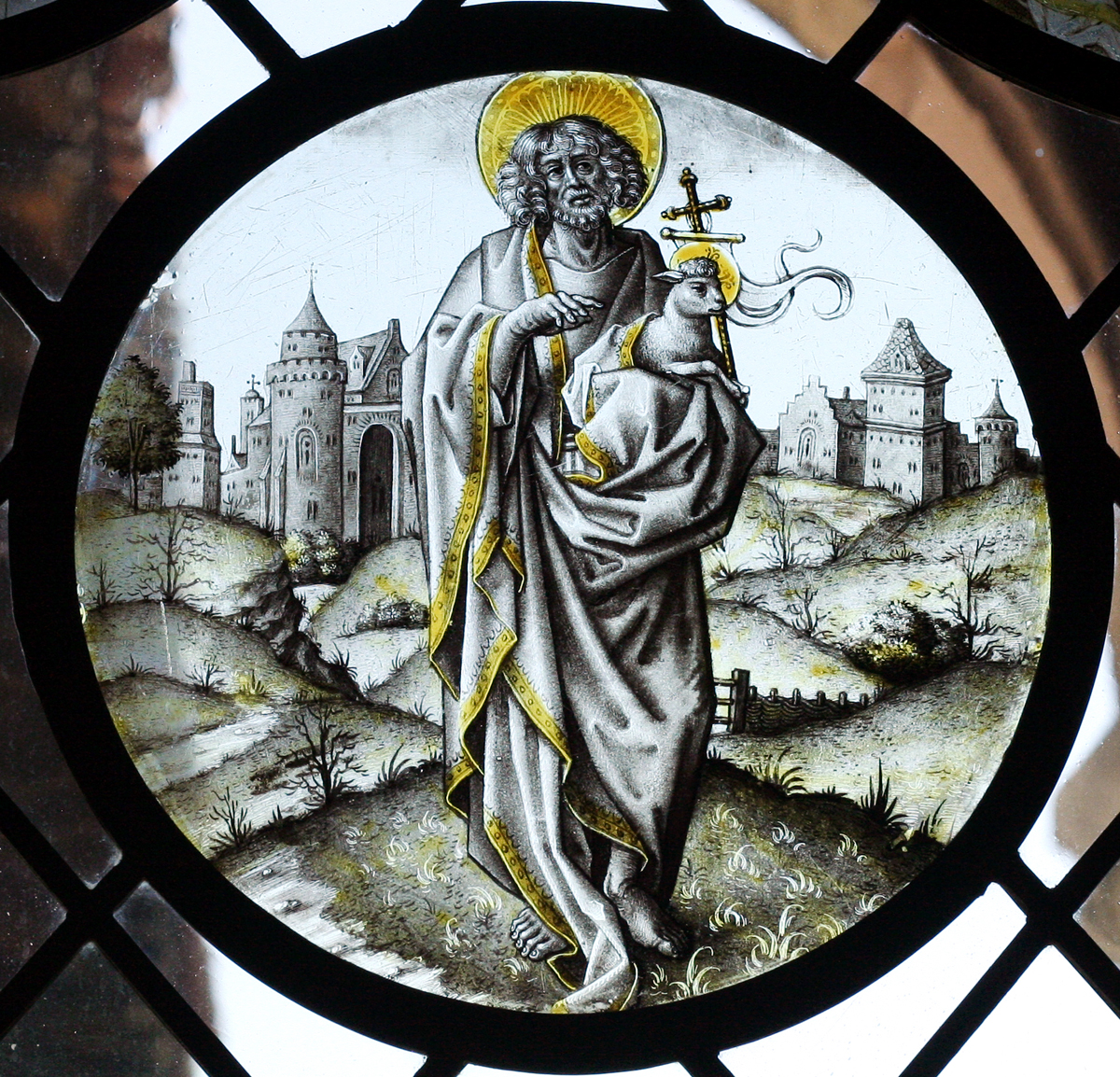
A stained glass window commemorating St. Richard of Chichester, found in the church of St. Saviour, Eastbourne, East Sussex, England

Easter Sunday 2025

If reading this by email, please tap the title at the top to open your browser for the best experience. Then, clicking individual pictures will reveal higher resolution images.

Peter Koenig, Christ as Second Moses (The Rainbow Resurrection)


Having six granddaughters, aged twelve down to two years, I’m very familiar with unicorns and rainbows. There is something about little girls and pastel colors that seems universal. So, when I go into the stores these days, and see all the Easter decorations, I think of our granddaughters. Because everything I see on display seems to be a rainbow of pastels, colors, and patterns, which our little girls love.

Well, as we know, our culture has tamed and domesticated Easter. Good Friday with its silence and its dark remembering is a challenge for us. For we seem to have enough darkness and bad news everyday as it is. And Easter Sunday morning provides the antidote we long for. For a few hours, and even for a few days, we can get a lift, a happy bounce, in a way that we hope for.

But deep down, we know that we want more than a brief lift in our mood, a brief enhancement of our sense of well-being. Our hearts truly long for a lasting joy. For we hope that though happiness may be fleeting, blessedness is abiding. And it was blessedness that Jesus was announcing and commending in his Sermon on the Mount. So here is our question this morning: How does the Gospel Good News about the discovery of an empty tomb help us find a sense of blessedness, and, in a way that might be lasting.

This morning I share with you three images by the English painter, Peter Koenig, images which I think can help us on our spiritual journey this Eastertide. This is our Easter journey toward discovering and experiencing a lasting sense of blessedness. For we discover the kind of blessedness that does not overlook the darkness, or pain, or sadness, that may be a real part of our lives. What we celebrate at Easter is not the simple replacement of what has come before, with something new that wipes away the past. We are not celebrating the spiritual equivalent of a vacation from daily life. For then, in a few days or weeks, we would have a sense that ‘we must now return to reality.’ The reality we celebrate today and throughout Eastertide is the reality of Resurrection transformation.

Now, how do we know this? We know this first from the reports of the Disciples – both the women and the men – who saw the Risen Lord. And who recognized him when they saw his healed scars – not absent scars, but healed scars! They were the first witnesses to the transformation that God brings to us in Resurrection Life. And Resurrection Life is God’s great culminating chapter of what we call Salvation History.

So let’s set our spiritual awareness within the sweep of biblical Salvation History. Here, I offer you a simple phrase with which to help identify and to remember the heart of this mystery. “Through the waters of death into a new covenant life with God.”

Left side panel for Christ as Second Moses

I invite you to look at Peter Koenig’s painting, Jesus as a Second Moses (or, The Rainbow Resurrection), along with its two glorious side panels. Here we notice several details, at least one of which will direct our thoughts toward Easter. We readily notice the rainbow, along with the pastel colors at the top and bottom of the central panel. These – of course – suggest the pastel colors we associate with Easter cards and Easter eggs, and other holiday decorations.

But let’s remind ourselves of what that rainbow first represented. In Salvation History, a rainbow came after a forty day period of massive death and destruction. Most of what we would consider to have been ‘life on earth’ was destroyed and lost, most people, and almost all animals and plants. Noah and his family, and the animals on the ark, traveled through the waters of death into a new covenant life with God. That death, however extensive, however gruesome and abhorrent, was and never would be the last word. God’s Word is – and always has been – a word of promise, a word of covenant. Where we aim for good, things often seem to go bad. Yet, God always aims for good, and achieves good.

Next, we should think of Israel, walking between and through the waters of death at the Red Sea. This brought them to Mt. Sinai, and to the great new Covenant between God and Israel, where blood was sprinkled upon the altar of God, and also upon God’s people. They were then led on a forty year journey through the wilderness to the threshold of their Land of Promise.

This was the moment when Joshua and God’s people crossed the Jordan. This water crossing echoed and recalled our forebears’ two prior journeys through the waters of death into a renewed covenant relation with God. Israel’s renewed covenant relation with God upon the west bank of the Jordan, within the Promised Land, signaled their desire to be faithful to God, and to God’s ways, no matter what.

Right side panel for Christ as Second Moses

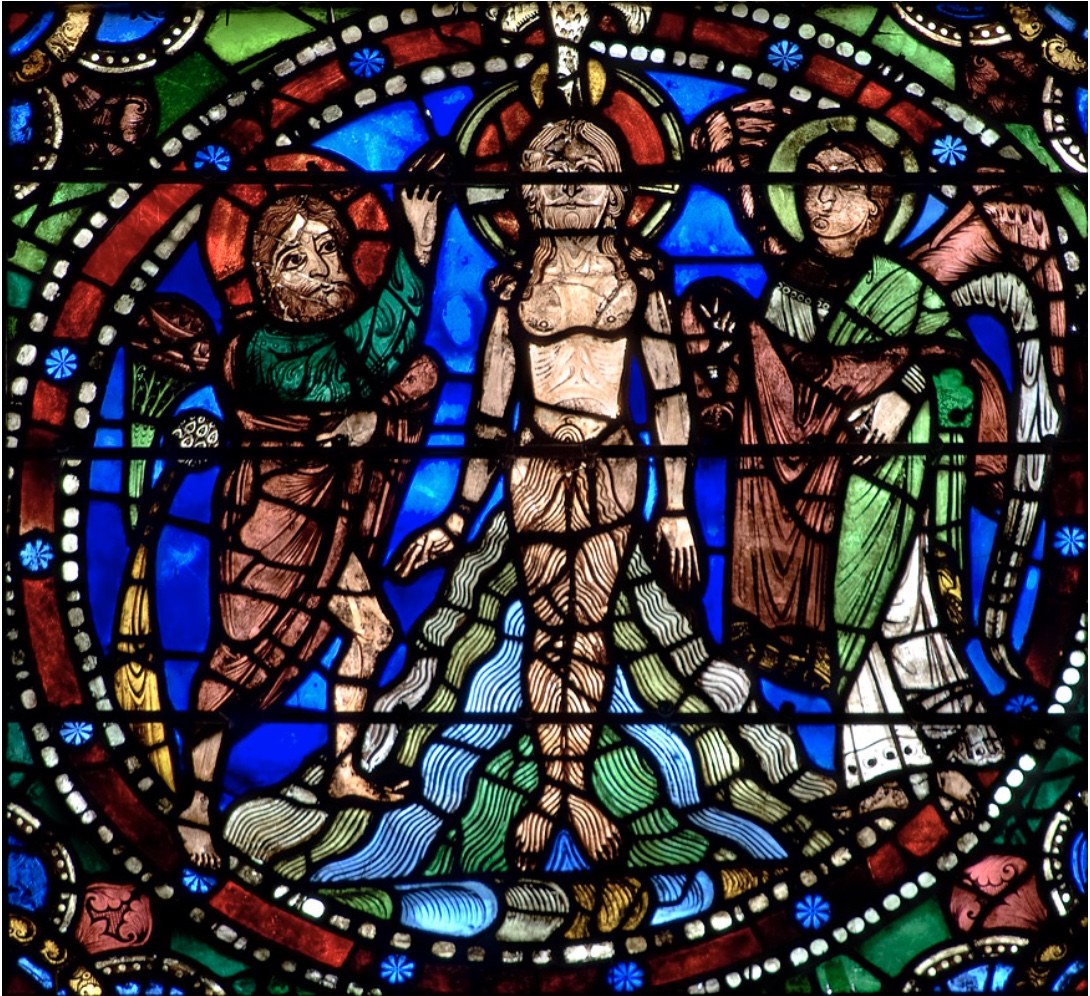
And yet, the next most significant event embodying this pattern was the baptismal practice of John at the same river Jordan, centuries later, and Jesus’ own Baptism, by John. Of those who came out to John, many if not most of them were Jews by birth and also upbringing. To them, baptism was foreign. For baptism was what Gentile converts did, not Jews! And so, for them to submit to, and receive, John’s Baptism, was a genuine act of living into God’s holy covenants with their ancestors. Yet it was also a submersion into the waters of death ~ death to old ways and old ideas, as well as death to certain prior social and family relations. For John pointed to the renunciation of sin, and a return to God’s ways. It was also the path into a re-newed covenant life with God.

Jesus’ own acceptance of Baptism at the hands of his cousin, John, symbolized something other than a personal need of his. Scripture instead suggests that Jesus, himself, chose to live into this moment. He did so out of his deep identification with all of us, in what would become his world-wide family. Through John’s ministry, and in Jesus’ acceptance of it, Jordan waters once again became a symbol ~ a symbol of going through the waters of death to sin, and acceptance of a renewed or new covenant life with God.

And so, when each of us was or is baptized into Christ, we join all of these faithful people who came before us. In Baptism, with them we cross through the waters of death, into a new covenant life with God.

This may prepare us to acknowledge how we are portrayed in Peter Koenig’s painting. For we are represented by those depicted as standing in the purple shadows, behind the ‘Christ-as-Moses’ figure. We are people who live and walk in darkness until we meet the true light, the Light that comes into the world to enlighten everyone. On what, then do we base our hope? Surely, it is on the hope represented by the fruit of Jesus’ death and Resurrection.

The Son of God embraced the human body, and he became one with it. His body has become the Body we have embraced, and with which we have become one. The Body of his transformation has become the Body of our own transformation. His death and Resurrection was and is our doorway into a new life. This is what this day and our liturgy are all about.

Alleluia! Christ is Risen!


Additional note: here I offer my Easter homily, shared this morning at Grace Church, St. Francisville, LA.

Good Friday 2025

If reading this by email, please tap the title at the top to open your browser for the best experience. Then, clicking individual pictures will reveal higher resolution images.

Stanley Spencer, The Cruicifixion (1958)


(I am offering here my Good Friday homily for this year, based on one previously shared)

In the passion reading we have just heard, we are reminded of the dark spectacle of what human cruelty can accomplish. With Jesus, it was a vain attempt to obliterate the most beautiful human being who ever lived. Thank God, we have no photographs of the horrifying things that were done to him, but only paintings. But consider this paradox: the beauty of art has provided a way for us to a reflect on one of the darkest examples of human violence.

Paintings of our Lord’s Passion seem divided into two broad groups. There are those concerned to portray the grim reality of Roman execution. And, there are those inclined to explore and express the inner redemptive significance of what happened.

At the center of any portrayal of the Crucifixion of Jesus is an inescapable fact ~ it was an act of political and judicial violence, where the forces of earthly injustice pretended to act in the name of human truth. The corollary to this is how Jesus’ subsequent Resurrection restored heavenly justice in the name of divine truth. Paintings of Jesus’ Crucifixion, and those of his Resurrection, usually give attention to his wounded body, even though his wounds then appear transformed on the Third Day. After all, this is one way the disciples recognize him after his death. How the death-marked body of Jesus looked after his resurrection, also provides a preview of his appearance at the end of time.

Charles Wesley’s Advent hymn, “Lo! he comes, with clouds descending” offers words that also apply to Good Friday.

“Every eye shall now behold him,
robed in dreadful majesty;
those who set at nought and sold him,
pierced and nailed him to the tree,
deeply wailing, deeply wailing…
shall the true Messiah see.

Those dear tokens of his passion
still his dazzling body bears,
cause of endless exultation
to his ransomed worshippers;
with what rapture, with what rapture
gaze we on those glorious scars!”

It is natural to imagine how the people directly responsible for Jesus’ death, from Judas and the high priests, to Herod and Pilate, might be overcome with grief at the triumphal Second Coming of the Lord. Those who pierced him might feel themselves pierced by awakened guilt and remorse. Indeed, for every one of us, seeing the fruit of our mischief and misdeeds can provoke us to tears.

But I think Wesley was getting at more than repentance and contrition. Surely, seeing the full beauty of the glory of our Lord, with his wounds transfigured, will also summon our tears — but with tears of joy. Wesley, prayerfully and with sensitivity, has given voice to the profound power of beauty. Especially when it is discerned in the most unexpected of places – in the face and body of the crucified One. Love… the most profound love beyond human imagining, is manifest in the face and gestures of the crucified messiah. For he reaches out his hands even to forgive those who have tortured and sought to kill him. This is the most beautiful thing we could ever see.

As we pray in a Morning Prayer collect, “Lord Jesus Christ, you stretched out your arms of love on the hard wood of the cross that everyone might come within the reach of your saving embrace…”

Perceiving all this helps us make sense of the paradox at the heart of Jesus’ Crucifixion. For, in it, we perceive the dramatic juxtaposition of serenity with antagonism, of beauty with its dark opposite, and of moral good with apparent evil. We can see this in two paintings I have included with your worship bulletin: Hieronymus Bosch’ painting of Christ Carrying the Cross, and Stanley Spencer’s 1958 painting, The Crucifixion. Looking at them, I encourage you to join me in asking an awkward question: with which person or persons in these paintings do we identify?

Hieronymus Bosch, Christ Carrying the Cross

Though some 500 years apart, both painters portray the tranquil appearance of the peaceful heart of Jesus, even in the face of vicious hostility. And like Bosch, Spencer helps us see what the beautiful One in our midst sometimes provokes. Especially when the shining light of his presence exposes the dark shadows within and around us. For his light sometimes prompts fierce anger and envy, as well as a callous indifference to cruelty and suffering. Things of which we are all capable. And we are likely to have much invested in denying this ugly truth. Strangely, when confronted face to face with the divine opposite of our perversity, we will either fight the light that we encounter, or surrender to it. The Passion narratives give us examples of those who resisted and even fought against the Light of the World. For we sometimes fight against the disturbing possibility that Jesus will conquer our pervasive ungodliness. And so, consciously or not, we try to do away with his godliness.

An encounter with true beauty can be unsettling and troubling, especially if we have already settled for so much less. We may often hope for the triumph of good over evil, that beauty will overcome darkness, and serenity will displace antagonism. But we cannot find it within ourselves to do more than hope. We cannot achieve the redemptive resolution for which we haltingly reach out with our feeble hands and hearts.

It is not an accident that the figure of Jesus in Stanley Spencer’s painting visually recedes in the foreground, while those who oppose and crucify him grab our interest and attention. Spencer, after mastering traditional realism, adopted what he called a neo-primitive style. He was a gifted colorist, and highly proficient with composition. And so, as Spencer has rendered him, Jesus’ skin tone and color roughly match that of the wood of the cross, as well as the clothing of the man with the hammer swung over his head. Spencer’s rendering of the Lord’s skin tone and color also match much of the sky and the ground below… including the tunic of Mary Magdalene, prostrate at the foot of the cross. This forms a compelling visual symbol. For Jesus totally identified with us, in his Incarnation, and in his Crucifixion. His crucifixion symbolizes his complete joining with us, and with our world of wrenching hurts and suffering.

In fact —as we see in Spencer’s composition and coloring— it is precisely because Jesus blended in so well with everyday life, that those who opposed him could literally gain the upper hand, ultimately with hammers and nails. (For he did not call down an army of angels to help him, as he could have.) But this is the marvel of the incarnation of our God in Jesus. The fullness of divinity thoroughly became joined with our fallen humanity. As the Gospels attest, this joining was so complete that many did not notice or have regard for his divinity. When we do notice his total identification with us, when we come face to face with the truth it represents, we have either one or the other of two reactions. We throw ourselves down in humility before him. Or, we seek to throw him down, to humble him before us.

These paradoxes are brought to their greatest prominence when, as he predicted, he is lifted up. His lifting up is his glorification, and the glorification of God within him. Yet his lifting up is on a cross, and in the agony of a humiliating public execution. Here we see the ‘strange beauty’ of our Lord — a beauty for which churches and museums better prepare us than do our malls and most TV shows.

So, let us “behold the fair beauty of the Lord, and … seek him in his temple.” We will find him! We will find him in the “temple” that he promised to raise in three days.


Additional note: Those interested in further reflection on some of the Holy Week themes raised here might wish to read my prior post, “What God Can Do, and Is Doing.”

The Epiphany: Human Power Encounters Divine Authority

If reading this by email, please tap the title at the top to open your browser for the best experience. Then, clicking individual pictures will reveal higher resolution images.

James Tissot, The Magi Journeying (detail)


Instinctively, there is something we all seem to seek. We want to find purpose and meaning, and organizing principles for our lives. This desire is anchored in a larger one: we seek to discern what is real, and true.

But where does our common impulse come from? In what does this impulse consist? I think the best answer to these questions is found at the heart of the Feast of the Epiphany. On Epiphany, we celebrate how God has revealed to the world the real and true meaning and purpose for our lives. Epiphany is all about God revealing to us the divine center of everything. Epiphany highlights God’s self-revealing in the natural world, and preeminently in God’s Incarnation, which the Magi came to discover and then worship.

We are able to recognize that it is in the nature of a Creator to order reality, imbue it with purpose and meaning, and hence to bring order, purpose, and meaning to our lives. A perhaps-unexpected word that captures this broad idea is authority, in that God possesses the authorizing power to create things, and guide them. Specifically, we discern this authorizing power in God’s creation of the universe and in the divine agency shaping ongoing history. For God is the author of all that is real and true.

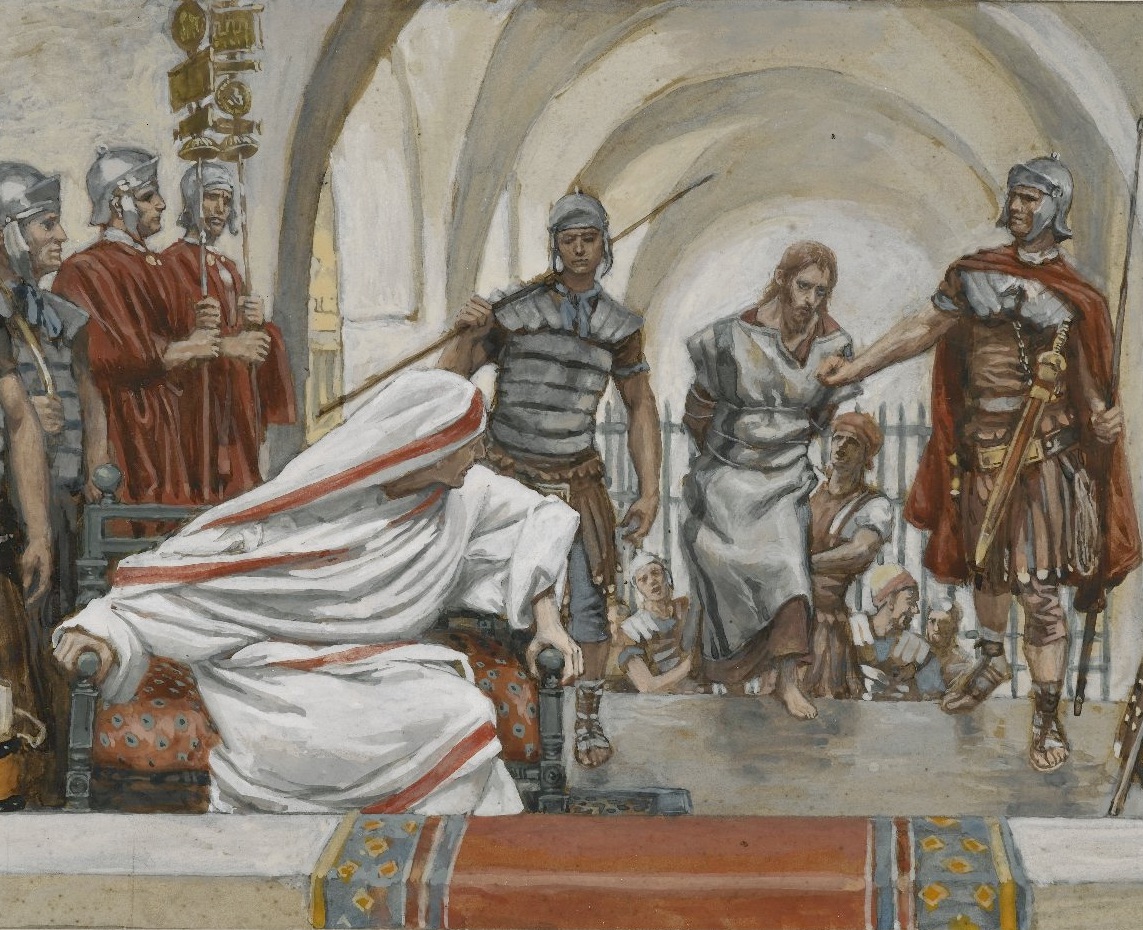
In human life, authority and power are not always neatly aligned, and we experience trouble when the two are at odds with one another. We see this dialectic between the two at work in the events of Holy Week, in the confrontation between divine authority (in the vocation of Jesus), and worldly power (as exemplified by Pontius Pilate). Less obvious is the way this dialectic is manifest in the events that are commemorated in our celebration of Christmas and the Epiphany of our Lord, especially in connection with the visit of the Magi from the East.

James Tissot, The Magi in the House of Herod

The Magi, also called ‘wise men,’ or ‘kings’ from the East, arrive in Israel having been guided by an authoritative power greater than themselves. Because of their witness to this higher authority and its implied power, the visitors pose a threat to Herod and his courtiers, who exercise earthly authority and its attendant power. This emerges in the interaction between people who are witnesses to divine authority and its power, and others who are possessors of worldly authority and power. The emerging conflict, later seen in the events of Holy Week, arises amidst the challenges surrounding the beauty revealed in what we call the Epiphany, the revealing of divine light to the whole world rather than to just a particular nation or the people of a particular religious tradition.

The Magi from the East, by explaining their quest, prompt Herod to act. He acts viciously and violently through orders given to soldiers under his command. The result is the series of murders we acknowledge every year on December 28, in the ‘red letter day’ we call the Massacre of the Innocents.

James Tissot, the Adoration of the Magi

What are we to make of the Epiphany of God in human form, and the tragic circumstances to which it led? At the heart of Christian belief is the conviction that God became present to us through a human birth. He revealed himself in a human person who embodied two natures, one fully divine, and one fully human, whose natures are distinguishable yet inseparable. Such a person, regardless of appearances, was and is the transcending center or heart of all that is, manifest in human form. He is, therefore, the One who truly possesses divine authority and divine power. Einstein – who was not in any sense a traditional believer – said this: “The most beautiful thing we can experience is the mysterious.” The divine center of reality, manifest and revealed in a human being, is the most mysterious beautiful thing that we can experience.

Here is the wonder of it: in God’s mysterious Providence, the birth of the Messiah would bring death to many (in the Massacre of the Innocents). And – years later – the death of the Messiah would bring the possibility of new birth to all, through the redemption of human being from the power of sin and death.

Yet, it would be some decades later before those who proclaimed Jesus as Messiah, and the embodiment of God, could understand the connection between his birth along with those soon-resulting deaths of the Innocents, and his later death, along with its soon-resulting new births for those who came to believe in him.

Our proper response to all this — indeed our only response to all this can and should be to praise the Holy One of Israel, the one whose death brought new life to all who receive him. He has come to us. Come let us adore him. And let us receive him with renewed hope and joyful hospitality, in all his light-filled glory.

A blessed Epiphanytide to you and your loved ones.


The Arrival of the Messiah in James Tissot’s Art

If reading this by email, please tap the title at the top to open your browser for the best experience. Then, clicking individual pictures will reveal higher resolution images.

James Tissot, The Vision of Zechariah, with which Luke begins the great story (Luke 1). The priest, Zechariah receives an epiphany, telling him that he and Elizabeth will have a son, to be named John, later known as ‘the Baptizer.’


With this post for Christmas, I share with you a series of paintings by James Tissot on the theme of the Nativity of Jesus. Readers of this blog will know of my high regard for this artist’s life and work. I am pleased to share this collection of Tissot’s paintings related to the great events we celebrate for twelve days in the Church’s calendar year.

The paintings featured here, and many others, later became the illustrations in Tissot’s four volume, The Life of Our Lord Jesus Christ, published in English in 1897-8. The originals of these paintings were purchased by the Brooklyn Museum in 1900, and examples from this collection are periodically on display, both there and elsewhere.

May you and your loved ones have a holy and blessed Twelve Days!

The Betrothal of the Holy Virgin and St. Joseph (mentioned in Matthew 1 & Luke 1)

The Annunciation to Mary (Luke 1)

The Magnificat (Luke 1)

The Vision of St. Joseph (telling him of the coming child, and that he is to receive Mary as his wife / Matthew 1)

The Visitation (of Mary to her cousin, Elizabeth, the expectant mother of John, who would become the Baptizer / Luke 1)

St. Joseph Seeks Lodging at Bethlehem (Luke 1)

The Birth of Our Lord Jesus Christ (Luke 1)

The Adoration of the Shepherds (Luke 2)

The Adoration of the Magi (Matthew 2)

The Flight Into Egypt (Matthew 2)

The Massacre of the Innocents (Matthew 2)

The Sojourn in Egypt (Matthew 2)

The Presentation in the Temple (Luke 2)

Jesus Among the Doctors (the boy, Jesus, at age 12, visiting the Temple in Jerusalem with his parents / Luke 2)


Note: the titles attached to the images above are those that are provided by the Brooklyn Museum

An Advent Magnificat

If reading this by email, please tap the title at the top to open your browser for the best experience. Then, clicking individual pictures will reveal higher resolution images.

Jim Janknegt, Joyful Mystery 1


Neither the Bible nor history tell us the precise details about the Annunciation to Mary, such as on what day the Angel appeared, or when Jesus was later born. The Angel’s wondrous appearance could have happened on a drab winter’s day. Yet, by virtue of the Angel’s message, it was also like spring. Our Church calendar and holy tradition reckon that the Annunciation was in March. If it was in the spring, the average high temperature in northern Israel would have been in the 60’s. So it could easily have been a season colored by the appearance of emerging flowers and foliage.

Faithful to the pattern of Scripture, Jim Janknegt seeks to portray something beyond literal circumstances. He has more than flowering plants, trees, and shrubs in mind. The decorated edge of the painting is a border of roses, which evoke the mysteries named in the Rosary, of which this scene is only the first. Inside that border are more flowers, and these also play a symbolic role. For we find lilies on Mary’s dress, suggestive of a later-to-be-revealed Easter, and calla lilies in a vase on the table, traditionally associated with the Annunciation to Mary.

Even more dramatically, flowers cover a large part of the angel, which suggest something transcendent and other-worldly. The Angel has come to speak the Word: the Word of Life, which is also a Word of blessing (look at the Angel’s hand-gesture!). Central in the painting, but depicted in a very subtle background way, is a great tree. Surely, it is the Tree of Life, from Genesis and Revelation, the first and last books of the Bible. Surely, the tree also prefigures that toward which everything in this moment is heading ~ the dead wood of the Cross, which paradoxically became a life-giving tree. Yes, it is springtime! But, this is springtime in salvation history.

So this is what we begin to see in Jim Jangknegt’s painting: his portrayal of the Angel’s Annunciation to Mary is not so much about springtime in the world. Instead, it is about springtime for the world.


Jim Janknegt’s painting, featured here, is used by permission of the artist. The text of this post is based on my homily for Sunday, Advent IV, of this year, which may be accessed by clicking here.

The Stirring Choral Music of Michael John Trotta

If reading this by email, please tap the title at the top to open your browser for the best experience. Then, clicking individual pictures will reveal higher resolution images.

Michael John Trotta introducing his choral work, “Requiem,” in a YouTube video


Recently, I had the providential opportunity to meet Baton Rouge resident, and LSU School of Music doctoral recipient, Michael John Trotta. Only later did I learn of his impressive and internationally recognized accomplishments. Four albums incorporating recordings of his musical work can be found on Spotify, among them his stirring and evocative setting for the traditional Latin Requiem. Through subsequent messaging with him, I learned of the recording session that he directed this year of his “Requiem,” with the London Symphony Orchestra and the London Voices. It is a beautiful work of music, all the more meaningful for him and subsequent listeners in that the recording was made in support of the charity, Hospice UK.

A recent screenshot from Spotify featuring the music of Michael John Trotta

Michael John Trotta writes passionate and lyrical sacred music – a series of words not everyone will string together. Reflecting on his music, I am aware of my inclination to find verbal analogies rooted in the visual arts. And so, parallel to how some painters, sensitive to the role of light in our perception of color, seek to mix several colors to achieve a particular hue, Trotta’s choral music strikes me as an effort to express a wide and full spectrum of harmonious sound.

My initial perception of his compositions, that he presents sacred music that is passionate and lyrical, may also be akin to my use of the word beauty in connection with the paintings of Jackson Pollack. In both cases, I may be expressing an unexpected conjunction of ideas that can, I believe, properly belong together. Trotta’s musical works inspire me to write about them in this way.

Those who love to hear large groups of voices singing in harmonic patterns, especially of examples from Renaissance and early English vocal music, as well as modern compositions influenced by them, may find a similar pleasure in hearing his work. For me, this is due to how Trotta’s original choral music and his arrangements provide a moving and also meditative listening experience.

Trotta conducting the London Symphony Orchestra and London Voices while recording his “Requiem”

As an amateur listener, I find that Trotta’s compositions and arrangements are evocative of traditional art forms without sounding imitative. Composed in creative dialogue with musical history, his work retains what we might call a traditional ‘vocabulary.’ This may have parallels with what we can discern in various works by contemporary practitioners of other art forms. Parallel examples of an engagement with traditional elements in an artistic field may include composition and subject matter in painting; ornament or the lack of it and the use of certain structural elements in architecture; as well as selected harmonic patterns and chord sequences in music.

Nigel Short leading the ensemble, Tenebrae, accompanied by organ, while recording “Requiem” in the parish Church of St. John the Evangelist, Islington, North London

Michael John Trotta’s music helps support my renewed sense of confidence that contemporary artists and composers, as well as writers, can utilize and work creatively with inherited forms of expression and yet present new, fresh and compelling compositions. Trotta may epitomize the wisdom expressed by Jesus in another context, that “every scribe {or composer} who has been trained for the kingdom of heaven is like a master of a house, who brings out of his treasure what is new and what is old (Mt. 13:52).”

Michael John Trotta, in Carnegie Hall, conducting the premier of his compositional setting for the traditional Septem Verba Ultima (The Seven Last Words {of Christ})

The pieces that Trotta has composed and or arranged are not only musically harmonious, but also spiritually congruent with what we know about the grace-filled peace and presence of God. Michael John Trotta’s approach to the art of music can broaden our appreciation not only for beauty expressed in the past, but also for beauty as it may be presented anew today. I am very encouraged by my new experience of historically informed music that Trotta’s compositional work has opened for me.

A performance of Michael John Trotta’s” Requiem,” Sunday, April 21, 2024 at Tabernacle Presbyterian Church in Indianapolis, Indiana


Since first posting this piece I have corrected a couple of the details mentioned in two of the photo captions.

Chora Church: A Byzantine Treasure

If reading this by email, please tap the title at the top to open your browser for the best experience. Then, clicking individual pictures will reveal higher resolution images.

Dome over the Side Church (or parecclesion), Chora Church


We missed being able to visit this remarkable place by a day! Sadly, after staying in Istanbul for four nights, the historic Chora Church that had undergone four years of renovation would not reopen until the day after our departure.

Dating back to the time of Constantine in the early fourth-century, the Chora Church was built as part of a monastary outside the walls that were constructed when Constantinople became the new capitol of the Roman Empire in 330 A.D. Its rural location led to its formal title, Church of the Holy Savior in the Country (or Chorai, in Greek).

Interior of the original central nave (naos) in use as a mosque, with Christian mosaics and frescoes covered over

Chora, like the later Hagia Sophia, has over its history served as a church, a mosque, a museum, and now once again as a mosque. As I have noted in prior posts, the fact that buildings like Hagia Sophia and Chora have been able to transition from church to mosque without significant structural change helps us perceive how what became normative in mosque architecture had its origins in churches from the early Christian, pre-Islamic era. As a precursor to Hagia Sophia, the original walls of Chora may provide one of the earliest examples of what would develop into the cruciform plan for churches, a design pattern that became predominant in the Christian East. This approach to design for worship spaces is centered on a square, covered by a dome, a departure from the early rectangular basilica plan favored in the western Roman region.

Floor plan of the Chora Church

In the floor plan above, note the subtle Greek Cross pattern of the central nave (or naos) below the large dome. As this plan indicates, the original, late Classical period Chora was significantly expanded during the Byzantine period, between the 11th century and the 14th century.

Section drawings of Chora Church showing the location of some murals and frescoes

In addition to its cruciform plan, and the church’s great antiquity, another feature that distinguishes Chora is its impressive collection of well-preserved Byzantine mosaics and frescoes, largely from the early fourteenth-century.

Visitors to Chora admiring the murals in the Byzantine-added “side church”

The bulk of the surviving mosaics and frescoes are located primarily in the side church (or parecclesion). This may be due to the central nave or naos having been used for Islamic worship during a significant portion of the building’s history. One of the many beautiful frescoes depicts a common theme found in works of art from the Christian East, that of the Harrowing of Hell. Images based on this theme depict the Christian belief concerning the first saving actions of the Risen Christ: pulling Adam and Eve out of their tombs and the clutches of the underworld (image below).

A fresco in the Side Church – Anastasis (or Resurrection): The Harrowing of Hell

A beautiful example of the Chora mosaics depicting Joseph and Mary’s enrollment for taxation in Bethlehem

Interior view of the side church

Like the later Hagia Sophia, Chora Church – for a time as a museum and now a mosque – still serves as an edifying spiritual place for Christians and people of other faiths to visit. For Orthodox Christians in the East, Chora’s numerous mosaics and frescoes provide multiple opportunities to (re)engage with biblical stories and with articles of faith in a way that the contemporaneous art in the much larger Arena (or Scrovegni) Chapel in Padua, Italy, provides enrichment for Western, Latin, Christians.

Exterior view of the southeast corner of Chora Church (note the later addition of a ‘flying buttress’)

A 1903 photograph of the west entrance to Chora in the late Ottoman period


Fully Alive: The Beauty of Human Nature

A photo of a print given to us years ago


Those familiar with my writing and ministry may not be surprised by how I choose to address the theme of beauty in relation to the human nature we all share.

My response is captured in a quote with words I have long loved and have frequently cited. The quote is from the second century Christian theologian and Bishop of Lyons (in present-day France), Irenaeus. “The glory of God is the human person fully alive.” To which he added, “and to be alive consists in beholding God.”

What an audacious statement! I believe that the fundamental insight here, latent within Irenaeus’s words, stems from the Gospel of John, with whose author Irenaeus likely had a personal connection. That would have been through Polycarp, Bishop of Smyrna (presently, Izmir, Turkey), the city where Ireaneaus was born. One writer has described Irenaeus as the spiritual grandson of the apostle John.

Another calligraphy print, this one featured on the website of Holy Cross Monastery

What does it mean for any one of us to be ‘fully alive’? I believe that the Gospel writer, John, would respond by echoing words from Paul, whose letters frequently employ the phrase, “in Christ.” Through Baptism, we come to be in Christ. Through Baptism, we are re-born in Christ; we live in Christ – and he in us – and we will leave this mortal life in Christ. Indeed, in John’s  compelling witness to Jesus’ teaching, we are told that those who believe in Jesus have already died, and now, will never die! All of the Gospel readings appointed for funerals in The Book of Common Prayer are from John. This is the Gospel that is so centered upon the themes of God’s incarnation within our shared human nature, giving us God-given light, and eternal life.

Words found in the daily pattern for Morning and Evening Prayer, as well as in the Eucharistic pattern used on most Sundays in Episcopal Churches, help amplify this point but in a subtle way. These several patterns for corporate and individual prayer include forms for confession. Using these forms, and after we acknowledge our sin, we pray that we may delight in God’s will , and walk in God’s ways. In the absolution that follows, we hear these remarkable words:

Almighty God, have mercy on you, forgive you all your sins through our Lord Jesus Christ, strengthen you in all goodness, and by the power of the Holy Spirit keep you in eternal life.

In words that may be easy to overlook, we pray that by Holy Spirit power, God will “keep us in eternal life”! Being fully alive involves delighting in God’s will, walking in God’s ways, and being kept by God in eternal life.

Christians believe that the beauty of our human nature was and is found in the Gospel Jesus, and as the Risen Christ comes to be found in us. Our human nature, created in the image and likeness of God, and transformed to become an icon of Christ, is therefore all about the fulfillment of our divinely-given and imbued potential. When by grace we see it happen in people’s lives, it is a beautiful thing to behold.

Yet, human nature, being still what it is, prompts us to look for beauty in outward terms when we view others, as well as ourselves. Jesus, as the Gospels imply, always looked for beauty within – the kind of beauty it was his vocation to share and re-enable in us. This is what we should be looking for, both within ourselves and in others.

The archetypal biblical example of the glory of God beautifully manifest in human nature is found in the Gospel Transfiguration stories. James Tissot, one of my favorite painters, offers us glimpses of Jesus manifesting this same glory on several occasions, a glory that was otherwise often hidden within him.

James Tissot, Jesus Goes Up Onto A Mountain to Pray

Tissot, Jesus Being Ministered to by the Angels

Paul’s remarkable words to the Corinthians bring these themes together nicely. For we want to be among those who are:

seeing the light of the gospel of the glory of Christ, who is the image of God… For God, who said, “Let light shine out of darkness,” has shone in our hearts to give the light of the knowledge of the glory of God in the face of Jesus Christ.”

And, by God’s generous grace, the same may be seen in our faces, as well.


Note: Kenneth Kirk, the esteemed 20th century Bishop of Oxford, and former Regius Professor of Moral Theology at the historic university in that city, titled one of his still-used books (The Vision of God) based on the Irenaeus quote, featured above. Kirk presents Irenaeus’ words in this (now dated) way: “The glory of God is a living man, and the life of man is the vision of God.”