Uncategorized

Pointing Toward Perception

If reading this by email, please tap the title at the top to open your browser for the best experience. Then, clicking individual pictures will reveal higher resolution images.


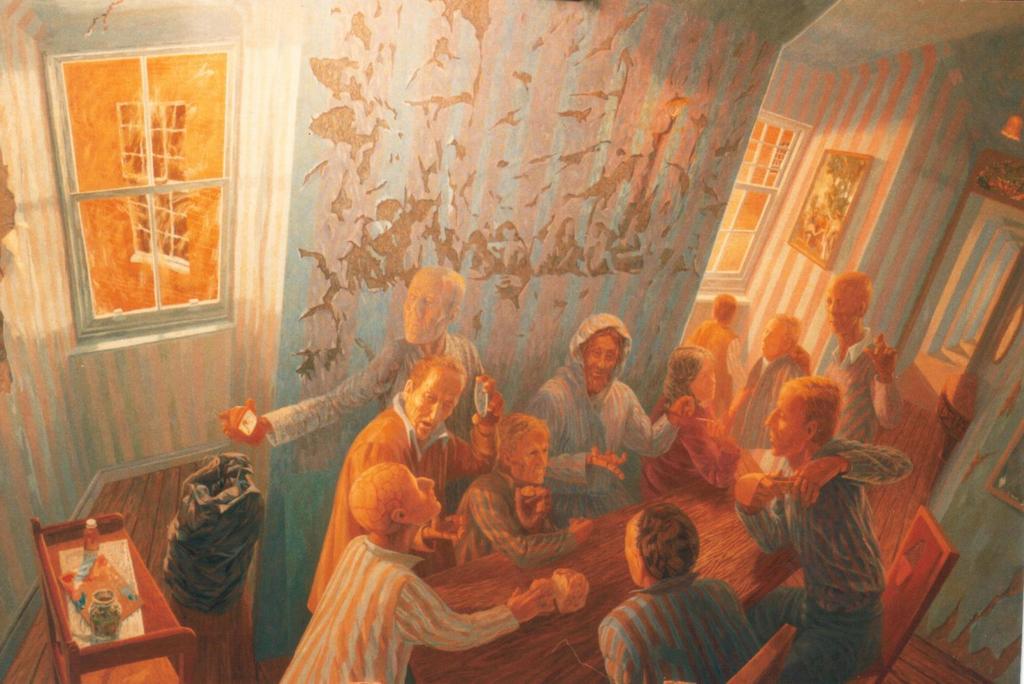
We live in a world filled with “data.” Disconnected bits of information, especially in great quantity, overwhelm our ability to see and to think. Accumulating additional data or more information does not produce knowledge. Knowledge has to do with seeing the connections between bits of information. When we see the connections, we begin to see a picture, we begin to hear a story, and we gain understanding as well as wisdom.

The unrecognized fellow traveler on the road to Emmaus asks the two disciples, ‘what are all these things you are talking about?’ The answer he receives from them amounts to information. But his question is pointed toward understanding, especially in relation to ‘the big picture. He is challenging them to discover something bigger. He is really asking something like this: ‘All these things’ that have happened… What do they have to do with what God has been up to, all along?”

Here is a basic Christian truth that we find in the Emmaus Road story: Things take on meaning in relation to the risen Jesus. It happens when we see events in our lives in relation to him. It happens also with things like bread and wine as we gather at table. And it happens with people like you and me as we gather in community.

Jesus helps our perception on the road to Emmaus, and reveals something even more profound at the inn. This ‘inn,’ unlike the one where he was born, has many rooms, many mansions. When we see things like past events and the bread in relation to him, we discern more about what they were or are, and what they yet can become. When we see ourselves in relation to him, we better discern who we really are, and who we are called to be.

Prayerfully, we can look around, between things, and within. We can look for the connections. When we do, we see and discern. We see more because we see more wholly. Then we see the holy.


The above painting, Supper at Emmaus (1958), is by Ceri Richards, and is used by permission from the Trustees of the Methodist Modern Art Collection (UK). The penciled notation at the base of this guache painting on paper suggests that it was intended as a study for an altarpiece painting for the chapel of St. Edmund Hall (or College), at Oxford, England. The Emmaus story can be found in Luke 24:13-35, and it is a traditional Eastertide Gospel reading.

This post is adapted from one first published in 2014.

The Believing Eleven

If reading this by email, please tap the title at the top to open your browser for the best experience. Then, clicking individual pictures will reveal higher resolution images.

Peter Paul Rubens, The Rockox Altarpiece, 1613-1615 (center panel)


It is evening on the day of Resurrection-discovery. John tells us that ten of the disciples are hiding behind a secured door out of fear. Judas is deceased, and Thomas is away.

Jesus suddenly appears to the unprepared disciples, and shares with them his peace. He shows them his hands and his side, and then – as a direct consequence of seeing the places on his body associated with his death – the ten disciples rejoice when they see their Lord. In other words, their recognition of him, and that he was somehow alive again, brings them joy by restoring their belief in him.

When hearing this story from John’s Gospel on the second Sunday of Easter, we may be prone to considering it apart from what happens just before it. The disciples, who are hiding out of fear, have already received an eye-witness to the resurrection of Jesus. Mary Magdalene, to whom Jesus revealed himself at the tomb that morning, had come and told the ten the Lord was alive, and that he had appeared to her. Clearly, and prior to Jesus’ unexpected appearance, the ten disciples are still doubting her personal witness. Even after receiving what should have been trusted testimony from Mary Magdalene, a fellow follower of Jesus.

So why – in popular imagination – isn’t this well-known Gospel reading from John 20 commonly referred to as the “doubting disciples” reading? Why should Thomas be singled out, when his joyful recognition of the risen Jesus depended on nothing more or less than what the 10 had needed, and received, before him?

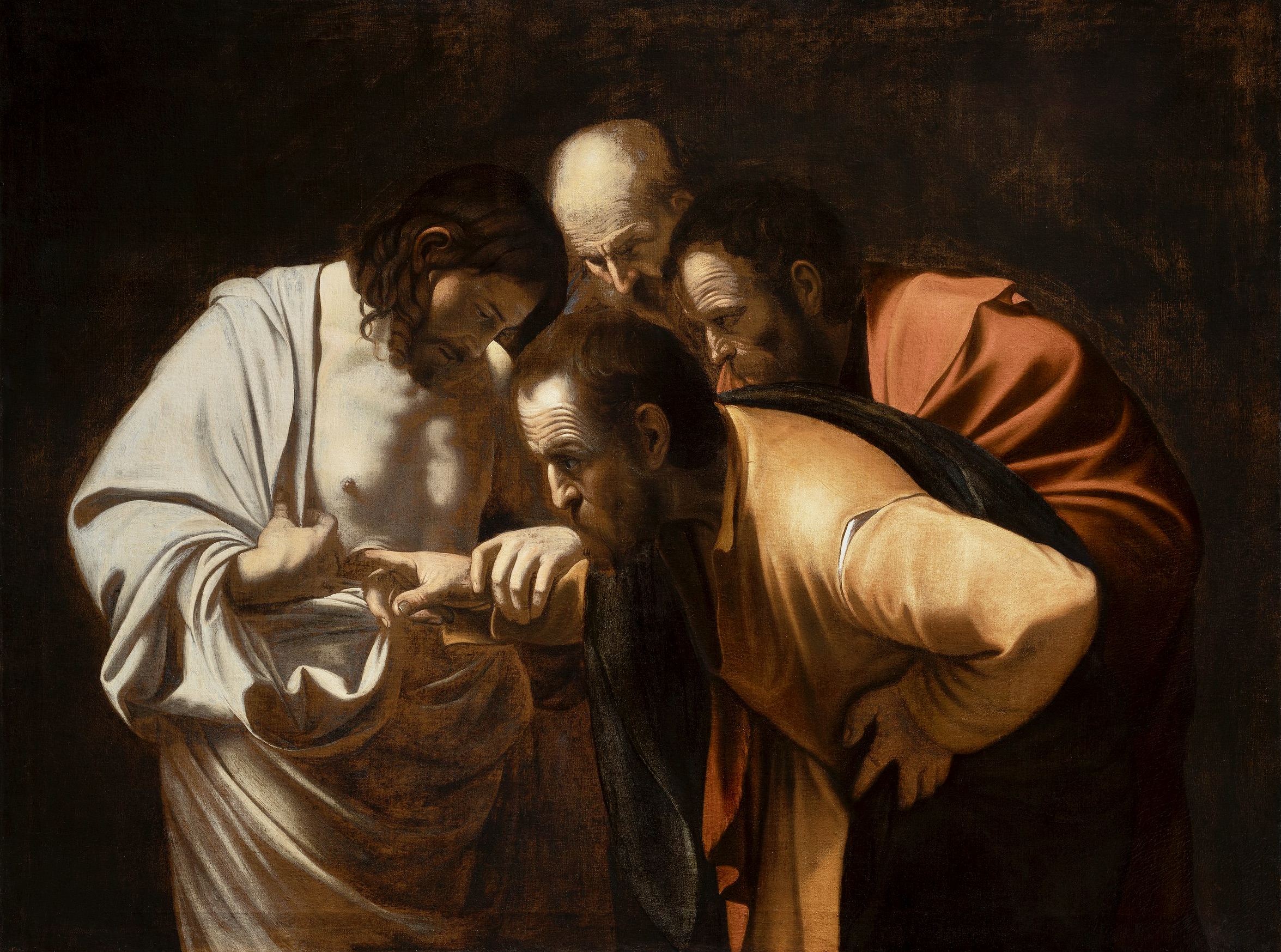
And why have so many painters in the Western tradition privileged Thomas’ purported unbelief in the Risen Lord, rather than depict the earlier reluctance of the ten others to arrive at joyful confidence about the Lord’s astonishing return? Apparently, in many painters’ eyes (especially Caravaggio), more visual drama was to be found in images of a doubter’s hand placed within an open wound.

Caravaggio, Doubting Thomas, 1601 (a famous traditional presentation of the event in John 20)

A further detail to notice, which our familiarity with so many paintings helps to obscure, has to do with how Thomas responds to Jesus. According to John, Jesus appears to the not-yet-believing ten, and – unbidden – shows them his hands and his side. Seeing the traces of his wounds on his risen body brings them joy. Jesus then appears unexpectedly a week later, this time showing himself to the one not present on the prior occasion. And just as he had done previously, Jesus offers Thomas the same opportunity he had provided to the others.

We should therefore not be misled by Thomas’ oft-quoted comment to the other disciples, prior to his own epiphany, about what he needed in order to believe. According to the text, Jesus – upon appearing in the same house a second time – bids Thomas to touch him. Yet, Thomas immediately responds to Jesus’ words without any mention in the Gospel of him having physical contact with the risen Lord’s wounds. Jesus then asks Thomas a rhetorical question, “Have you believed because you have seen me?” Naturally, Thomas’ implied answer is ‘yes.’

For all these reasons, we will do better to find a different and more positive descriptive phrase by which to refer to this well-known passage from John 20. “Jesus meets the disciples according to their needs,” though wordy, would do better.

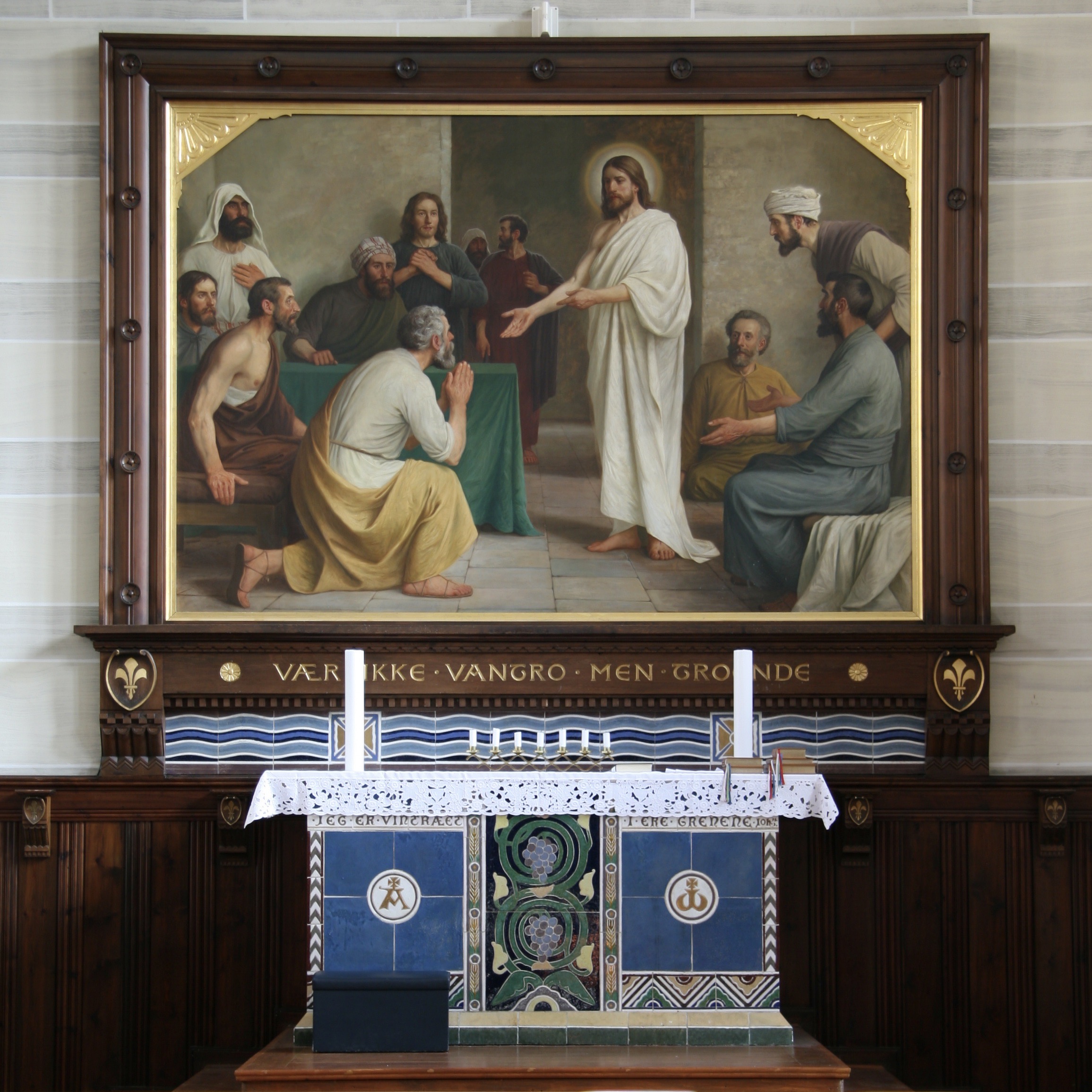
P. Steffensen’s altarpiece painting behind the altar of Zion Lutheran Church, Copenhagen


This post is based on the traditional Gospel reading for the second Sunday of Easter (April 7 in 2024), John 20:19-31. The story within it concludes with these words: “Jesus said to Thomas, ‘Have you believed because you have seen me? Blessed are those who have not seen and yet have believed’.”

Note: The altarpiece paintings by P. Steffensen and Rubens provide an interesting counterpoint to the prevailing tendency of painters to focus on Thomas placing his hand in the side of the Risen Jesus.


I Will Take You To Myself

If reading this by email, please tap the title at the top to open your browser for the best experience. Then, clicking individual pictures will reveal higher resolution images.

Fra Angelico, Noli me tangere


In the intimacy of his physical embodiment, the disciples and the holy women want to hold on to Jesus. It is the only way they have known him.

Mary is then found by the One she is looking for, in the garden by the tomb, on what becomes the Resurrection-discovery morning.

”Don’t try to cling to me,” he tells her, for he has not yet ascended to where he promises to take us.

We want to hang onto to how we have best known him. He promises to hold us to himself in what will be an even greater intimacy.

It is just beginning. Alleluia!


Jesus said to her, “Do not cling to me, for I have not yet ascended to the Father; but go to my brothers and say to them, ‘I am ascending to my Father and your Father, to my God and your God.’” (John 20:17)

“And if I go and prepare a place for you, I will come again and will take you to myself, that where I am you may be also.” (John 14:3)

Once and For All

If reading this by email, please tap the title at the top to open your browser for the best experience. Then, clicking individual pictures will reveal higher resolution images.

Salvador Dali, The Sacrament of the Last Supper (detail)


With his life, and in his death, Jesus offered himself. In accepting crucifixion, he offered himself and the whole Creation to the Father, in the Holy Spirit. He did this once and for all. Yet, in every Eucharist, and for all who remember him on any day, he continues to make present and real in our experience what he did, once and for all.

He acted, once and for all. Yet – and this is the paradox – he still acts for all… for all time, for all places and things, and for all people. What he is still doing now does not in any way signal an incompleteness to what he did then. For he continues to offer the gift of including us in what he did then, when he did what he did, once and for all.

So what does it mean for him to include us now, in what he did then? That is the question for the holy three days of our Paschal Triduum, which begins on Maundy Thursday evening.

One way into the many answers to our question can be found in Salvador Dali’s painting, The Sacrament of the Last Supper. It is not a painting of, or about, the Last Supper. Instead, this is a painting inspired by the Last Supper, and by what it came to mean in the broader context of all that happened during those three days. For the painting is about the sacrament in which the Risen One now makes present the result of what happened on the Cross, in the Resurrection, and with the descent of the Holy Spirit.

The Book of Common Prayer service for Good Friday is in fact not a Eucharist, just as the Last Supper in that Upper Room was not a Eucharist. The Last Supper prefigured the Eucharist, but could not have been one. For Jesus had not yet died, nor yet Risen from the Tomb, and the Spirit had not yet descended at Pentecost. And neither are the sacramental services on Good Friday intended to be Eucharistic celebrations. For in the wisdom and tradition of the Church we do not celebrate the Eucharist on this most holy day, though we may receive the fruit of it, and all its benefits, when Communion is offered to us.

Instead, all our focus is upon Him, who died and rose again for us, once and for all.

These are some of the reasons why Dali paints the disciples as recognizable, physical, and historically-anchored, people. And why he yet paints our Lord as present in his mystical risen glory.

We gather in his name and in his presence on particular occasions, in particular places, at particular times. Yet he is now present at and on all occasions, in all places, and at all times. We – who are rooted in time and place – receive him who transcends and yet is present within all times and places. Grace infuses nature. The timeless One imbues time with glory.

The Sacrament of the Last Supper (full image)

On the cross, Jesus lifted up the whole Creation to his – and now our – Father, once and for all. Just as he lifted up our human nature in his Ascension, which in a sense then became our Ascension. And yet, he continues to lift up the whole Creation – including us, and including all the uncertain and unfinished aspects of our lives. So, the One who is the source of all purpose and meaning continues to bring meaning and purpose to us, and to all that we lay before him, here and now. Time and again, he brings completeness and wholeness to all that is lacking, so that we might live more fully in his glorious fulfillment of what it means to be human. For all this, we offer our deepest thanks and praise.

May these ‘holy three days’ (Maundy Thursday evening — Easter Eve) in the Church’s Christian observance of Passover be a time of blessing for us and our loved ones.


This post is adapted from my (2024) homily for Good Friday, which may be accessed by clicking here.

Note: blog settings have been changed to provide more opportunity to offer comments, using the link below.
 

The Beauty of Sister Wendy

If reading this by email, please tap the title at the top to open your browser for the best experience. Then, clicking individual pictures will reveal higher resolution images.


Paul left us with some of the most remarkable words in the New Testament: “For God, who said, ‘Let light shine out of darkness,’ has shone in our hearts to give the light of the knowledge of the glory of God in the face of Jesus Christ.” And so, we ‘behold the beauty of the Lord’ in each other. Especially If we have died with Christ in Baptism, and risen with him in his Resurrection. For we now live in him, and he in us. I am reminded of these truths when I see images of Sister Wendy Beckett’s face.

Readers familiar with this blog website will have guessed at the sense of affinity I feel when I see Sister Wendy’s videos, or read her books. Discovering her work, and gaining a sense about her perception of her vocation, have been a source of encouragement for me. She has glorified God by helping me to perceive and give thanks for beauty. And not just in art, but in faith and life, and in all the world.

We are often blessed with companions as we journey through our lives in this world, some familial and or some spiritual, some more proximate to us and others further away. When asked about these people, we are likely to offer praise for what they mean to us and for what we have received from them. Sister Wendy has been a companion for me because of what she represents: a life well-lived, one attentive to what is most important, while less distracted by that which is ephemeral.

I like a biblical metaphor with which to think about how things will be when we – as people like to say – ‘pass through the veil,’ ‘get to the other side,’ and experience being ‘in the nearer presence of our Lord.’ It is to consider with whom I might want to sit at table in the kingdom of heaven, along with Abraham, Isaac, and Jacob, with whom Jesus promised many would come to be present (Mt. 8:11). And at table with Mary, Martha, and Lazarus, with whom Jesus dined at an occasion commemorated on Monday in our Holy Week lectionary. Of those not personally known to me in this life, Sister Wendy is one near to whom I want to sit.

Here is a proverb I like to quote, which applies to much of life: we move toward what we are looking at. In addition to the weekly texts from the lectionary and their related readings, I spend a lot of time looking at images of beauty, in its many forms. Having started my adult life as one aspiring to work in art and architecture, and then largely setting those things aside when pursuing ordination and theological work, I now find myself returning to my starting point. But with new eyes, and a wider horizon.

Sister Wendy, and the example she represents for me, have played a quiet but very important role in my growth and aspiration toward greater wholeness.

Thank you, Sister Wendy, for helping me and us see beauty, and by this to know God’s love in a fuller way.


During these forty days of our preparation for the Paschal feast, I have been finding quiet joy and peace in Sister Wendy Beckett’s, The Art of Lent: A Painting a Day from Ash Wednesday to Easter. The quote at the outset from Paul can be found in 2 Cor. 4:6.

Note: blog settings have been changed to provide more opportunity to offer comments, using the link below.

Seeing and Being Seen

If reading this by email, please tap the title at the top to open your browser for the best experience. Then, clicking individual pictures will reveal higher resolution images.

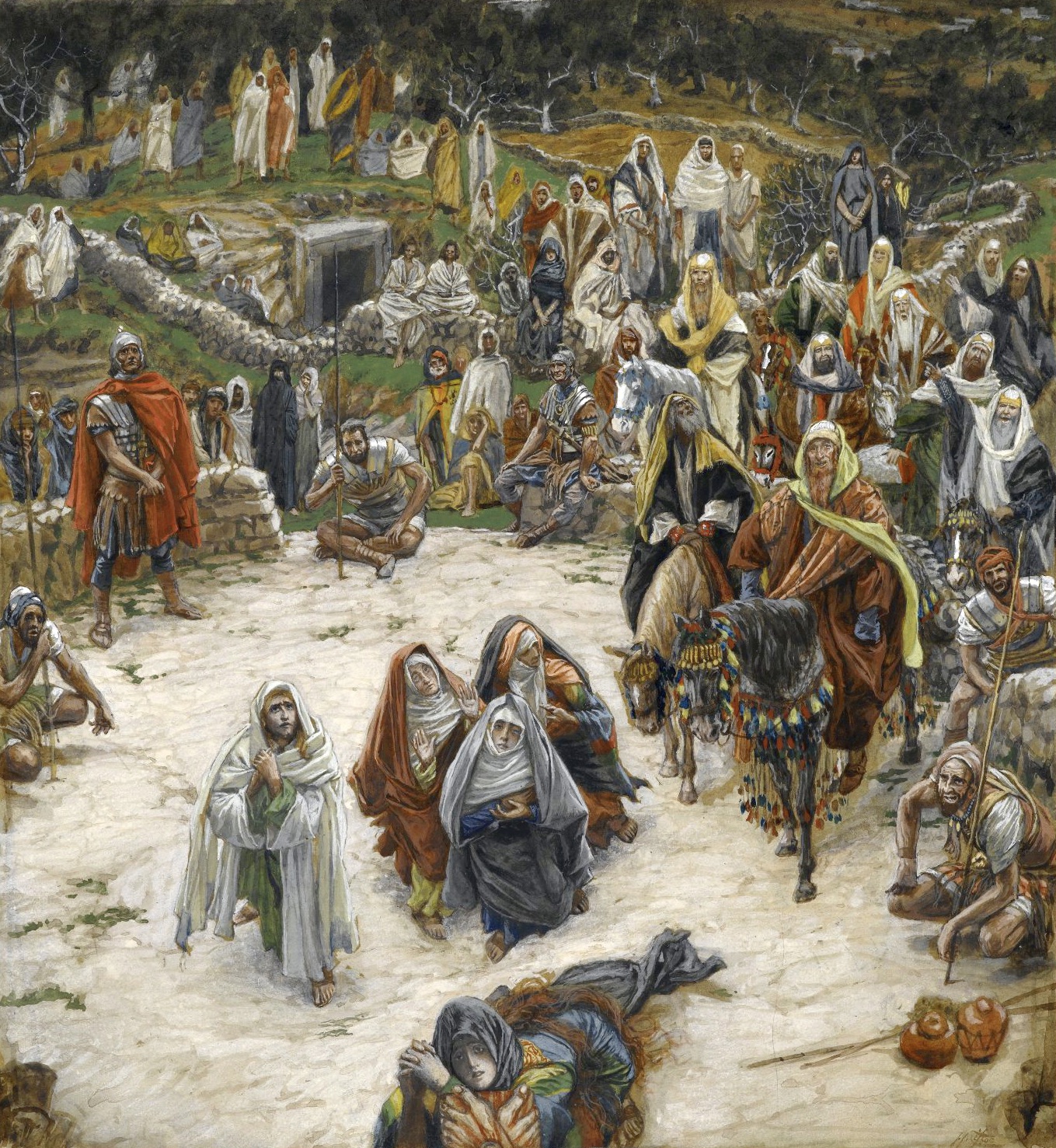
James Tissot, Gentiles Ask to See Jesus


Two perceptive paintings by James Tissot might summarize what the Gospel means for some Christians. The first, Gentiles Ask to See Jesus (above), portrays a familiar scene from John’s Gospel. The second, Jesus Looks Through a Lattice (below), is to my knowledge utterly unique in the history of painting. In these two images, we get a glimpse of something that is reported to have happened, as well as an impression of what it may begin to mean.

James Tissot, Jesus Looks Through a Lattice

We want to see Jesus. Gandhi is an example of someone who showed this curiosity, as well as a Japanese Zen Buddhist priest who befriended my parents. Christian believers go further, and say that He already sees us, even when we are unaware of his loving and knowing gaze.

Or, as John puts it in a NT letter, “We love because he first loved us.”

People often say they are ‘looking for God,’ or that they are ‘trying to find God.’ Yet, of course – as I like to say facetiously – God is not lost! What I think we are really trying to find is the experience of having been found – at least by others, if not also by the divine. Christians say that the good news is that we have been found, for we were the ones who were ‘lost.’

Divinity may seem hidden from us. But then, we are so often hidden from ourselves. One strategy we employ to try and deal with this is to seek ourselves in the eyes of others, as others might see and perceive who we are (Sartre). Given how disappointing this turns out to be – because others usually don’t know us any better than we know ourselves – we might then look elsewhere.

I – as a typical human being – like being ‘a finder,’ someone who finds things, discovers their meaning, and then who seeks to name and describe them. But if and when I feel lonlely, I wish to be found by others whose attention and company I value. This is a clue. Yet, if the view others have of me can seem incomplete and inaccurate, some or even much of the time, I may be looking in the wrong place. I do better when I focus on enjoying the gaze, and even the embrace, of the One who knows me better than I know myself.

I accept that I have been ‘found.’ And I experience this reality more often when I set aside my wholly (holy?) appropriate absorption with being a finder. For that – in part – was what I was created to be. And in the wonder and beauty of this world I find joy and much delight.

Christians believe that the Creator came into the Creation to engage and embrace human beings, and to share with us the fullness of divine love. Christians also believe that God so loved the cosmos (the actual Greek word in the text) that God did the unthinkable, surrendering divine prerogative by giving self unto a death at human hands, and by this overcoming our overestimated powers. All to bring us toward fulfilling our largely unexplored potential within this beautiful world, which the Creator has made and put into our hands.

This is what our observance of Holy Week is all about.


These reflections are based on themes in my homily for Sunday, March 17, 2024, which may be found by clicking here.

Note: blog settings have been changed to provide more opportunity to offer comments, using the link below.

Yo-Yo Ma and The Performance of Art

If reading this by email, please tap the title at the top to open your browser for the best experience. Then, clicking individual pictures will reveal higher resolution images.


Recently, I had the opportunity to see and hear Yo-Yo Ma perform Dvorak’s Cello Concerto. Ma’s presentation of the music was stirring and evocative. Reflecting on the effect of that concert, I want to describe the experience of beauty we find in the human presentation of particular arts. The idea of performance keeps that evening in my thoughts, as well as how presentation by performers plays a significant role in certain art-forms.

When works of art are appreciated, their beauty begins to have an existence within those who encounter and engage it. This continues as we entertain those works within our imaginative and reflective consciousness. In this sense, these works of art may be said to inhabit us, having ‘taken up residence’ within our awareness, and sometimes in our dreams.

Artists convey something of the humanity we all share. They make available perceptions and insights personally important to them but which also become important to us. Artists do this by imparting aspects of their apprehension of what is beautiful, good, and or true. Appreciating their art, our perception is then made finer as we attend to their work, and as that work becomes part of us.

The creation of visual art objects such as paintings and sculptures generally occurs over a period of time, and usually happens in a private setting. Musical composition and playwriting have an affinity with the work of painters and sculptors. For writing music and plays also usually takes time and often occurs in a studio setting or personal study room. Upon completion of these works, whether paintings, sonatas, sculptures, or plays, the results may be offered to viewers and or readers. Parallel to how people often see the work of painters and sculptors, a musical composition can simply be read as a score, just as the text of a play may be read in silence by someone in a library.

In a sense, paintings are simply there. Paintings ‘speak’ in a limited way; they communicate something of an artist’s vision and experience; and, they are available for engagement by viewers who happen to, or choose to, interact with them. Yet, with works for the theater or the concert hall, something further and significantly different happens when a concerto or a play is ‘performed.’ With performances, features of the personality of the composer or writer – as well as those of the performers – are in a position to be displayed and conveyed.

Clearly, we recognize that what is shared in works of art is important to us. How musical or theatrical works of art are then presented can be just as important, especially as they are performed.

Within the visual arts, an artwork comes to inhabit the viewers who engage it. With arts that are performed, performers also inhabit the works they present. This has a significant effect upon our shared engagement with concerts and plays. And Yo-Yo Ma, as a highly skilled performer, provides a compelling example of what it means effectively to communicate a composer’s imaginative vision and passion to a receptive audience.


Note: blog settings have been changed to provide more opportunity to offer comments, using the link below.

The Beauty of Gandhi’s Example

If reading this by email, please tap the title at the top to open your browser for the best experience. Then, clicking individual pictures will reveal higher resolution images.


Mahatma Gandhi remains one of the most revered and idolized figures in modern history. And yet, also, one of the least imitated. His life and thought provide a compelling example that may not be well understood. Asked about this, he might have said, “It’s all rather simple,” and summarize his life’s work with a Kantian principle derived from Jesus: treat one another as you would have them treat you.

“Simple” is sometimes another word for “naive.” In Gandhi’s case, it is otherwise. His journey through life, well-depicted in Richard Attenborough’s fine film, taught Gandhi many things and led him to a wise integrity few others seem to have attained. He learned much through arduous experiences. Gandhi’s uniqueness may lie in how he synthesized his learning with the result that he achieved greater maturity and a resoluteness of character. His personal growth involved a practiced disposition toward honesty, reasoned adherence to principles, and a profound simplicity of manner in life choices.

Gandhi in conversation with his friend, and India’s first Prime Minister, Jawaharlal Nehru

For many, Gandhi’s life story brings to mind the word ‘pacifism.’ More nuanced is the label, ‘non-violence.’ Yet both terms need further qualification. Pacifism and a non-violent response to aggression often reflect a belief that violence (and therefore war) is not governed by reason, and therefore cannot be disciplined or limited by principled reflection and deliberation. Hence, according to this view, no matter how destructive violence may be, responding in kind – even if proportionately – always compounds the evil.

Gandhi’s approach to the evil he apprehended and experienced was indeed reasoned and principled. It was shaped around a resolve that active, non-violent resistance must be distinguished from passive non-resistance, precisely because the former can provide a compelling witness to reasoned propositions. In this sense, Gandhi’s non-violent resistance serves as an active approach in antithesis to a passive, non-violent, approach of non-resistance.

Gandhi – demonstrating active resistance – deliberately harvesting salt in violation of British dominion law

James Douglass’ book, Gandhi and the Unspeakable, helps us understand Gandhi’s adherence to the concept of satyagraha, or truth-force. For Gandhi, this principle nullifies the pursuit of social and political ends through violence. Identified by Thomas Merton in an essay on Gandhi, satyagraha is conceived of as a universal, rather than individual, feature of what it means to be human, articulated in the words, “truth is the inner law of our being.”

This truth-force is manifest in substantive rather than sentimental love. It can be discerned and honored within oneself, while it can – and must be – discerned and honored within others, especially as one confronts evil in human relations. Because this is so, one who seeks to enact this principle can honor all others with trust. Even – counterintuitively – to honor one’s opponents and sworn enemies, because one’s trust becomes anchored in our shared humanity rather than in a calculation of the probable harm that may result from engagement with those others.

Giving primacy to this principle provides the courage to believe that we can die to all that puts us against one another, and therefore the courage to face the death that others may plan for us. Merton and Douglass find this truth-force embodied in the person of Jesus, and with Gandhi, see it as a powerful example of what can profoundly transform human social and political relations. As Douglass explains, Gandhi knew his assassins, and even invited the man who eventually killed him to live with him following that same man’s earlier attempt on Gandhi’s life.

Perceptive hearers of this past Sunday’s Gospel reading from John might wonder what Gandhi would make of Jesus’ actions in the Temple. John tells us that Jesus made “a whip of cords” and drove out those selling animals, or exchanging Roman coins for money acceptable as offerings in Israel’s house of worship. The ambiguity of John’s account makes clear that Jesus at least threatened violence even if he did not resort to it. For his whip was directed not simply to scattering the animals of those selling them, but also against the money changers. Readers may note that some actions of Jesus in the Gospels may have been intended less to model ethical conduct for his followers, and instead to give evidence of his providential and messianic role in history. Much may be inferred from this brief “Temple-cleansing” story.

Given how our culture encourages us to see life in an either/or way, we may be surprised to discern how much the Hindu Gandhi seems to have learned from reading the Gospels. We may also be surprised by how Gandhi’s beautifully lived example – regardless of his personal strengths or failings – may help us discern what the Gospels have yet to teach us.


The reference to the Gospel reading is from John 2:13-22, which helpfully can be compared to its Gospel parallels. James Douglass, with his personal history as a religious scholar of spiritual approaches to questions related to conflict, violence and war-making, brings an informed and insightful perspective to the study of Gandhi, as he did earlier to the wide-ranging circumstances leading to the deaths of Martin Luther King, Jr., Malcom X, and John F. Kennedy.

Note: blog settings have been changed to provide more opportunity to offer comments, using the link below.

Helen Nearing and Beautiful Stone Walls

If reading this by email, please tap the title at the top to open your browser for the best experience. Then, clicking individual pictures will reveal higher resolution images.


With the visionary but also impractical exuberance of youth, I graduated from high school imagining I would build my own house somewhere in New England. My design ideas were shaped by Frank Lloyd Wright while my notion of ‘responsible living’ was largely influenced by Henry David Thoreau as well as Helen and Scott Nearing. While already loving Wright’s architecture, my high school English teacher, Nick Fleck, opened a compelling new world for me through reading and learning about Thoreau and the Nearings. I identified with these mentors and the values they shared regarding building homes for themselves, and of living in harmony with the land.

Through books and articles, I then discovered an unexpected complementarity between the Nearings’ approach to home building in Vermont and Maine, and Frank Lloyd Wright’s method of construction at Taliesin West in Arizona. In what some call slipform masonary construction, builders first erect wooden forms. Between them, stones and cement are poured and allowed to set, creating walls and support pillars for the resulting structures. This method allows for considerable design flexibility while also being very economical, especially when field stone is readily available.

The Nearing’s stone house in Vermont

With the Nearings, the results reflected European and early American traditional influences in their desire to achieve an economical simplicity that was harmonious with the terrain upon which it was situated. For Wright, the plasticity of the method allowed for the creation of non-traditional walls and roof supports of varying angles and sizes. Just as concerned as the Nearings with what he called “an organic architecture” accessible to the common person, FLW – like them – sought to create a home and work environment rooted within a site while employing locally or regionally found materials when feasible. Whether or not the Nearings ever met Wright, they were clearly kindred spirits. In their most well-known book, Living the Good Life, they quote Wright in the chapter relating their stated “principles of architecture.”

Helen Nearing (facing viewer) in the gardens outside the later ‘home made of stone’ in Maine

Drawing from FLW’s writing, the Nearings articulated four general rules that should bear upon the design of domestic architecture. “Form and function should unite in the structure…; buildings should be adapted to their environments…; local materials are better adapted than any other…; {and} the style of a domestic establishment should express the {residents} and be an expression of themselves…” Clearly, the Nearings were more successful honoring that fourth principle than Wright generally was with respect to the wishes and temperament of his clients!

Helen and Scott Nearing identified several reasons for their choice to build their homes and outbuildings with stone. Stone buildings look natural in their setting; these found materials provide a variety of muted but attractive colors; sturctures made of stone are durable, practical, and economical to maintain; and buildings of this kind are less vulnerable to fire, while retaining coolness in the summer and warmth during the winter. For the Nearings, a decision to benefit from all these advantages of working with local stone was made more easy by their desire and willingness to build the structures themselves, thereby saving the financial cost of labor along with a reduction in the cost of materials.

Scott and Helen Nearing at work on a wall

Given their preference for this building material, the Nearings shared an advantage also enjoyed by Wright in Arizona – plentiful local stone with which to work. Many New England fields and forests are strewn with pieces of rock. People in Louisiana who enjoy landscaping, wish they could take for granted finding stone in such abundance. By contrast, the Vermont homesteader wishing to put up some simple but immensely practical buildings, from tool sheds to houses, can begin with a wheel barrow and a pair of gloves. Two other items are needed: cement mix in adequate quantities, and wooden forms within which the walls are to be fashioned. Happy to work without mechanized tools, the Nearings used a wheelbarrow to gather the stone, mix the cement, and transport both to where they were needed.

Two photos of Taliesin apprentices at work building slipform walls

Another point of continuity between the Nearings’ and Wright in their approach to how we might best live was the way in which they attracted large numbers of young visitors and students. With both FLW and the Nearings, those who came and stayed sought to learn about the life and work of their mentors not merely in a intellectual way, but share in it holistically. The Nearings and Wright, in their different spheres of concern, nurtured communities of fellowship and learning. This helped them influence generations of young people who, led by the example of their teachers, lived into a deepened appreciation for significant principles to which one might commit a life.

The finished result of slipform construction at Taliesin West

Helen Nearing in front of a wall she built with Scott


For more about Nick Fleck and his influence upon me and many others, please see my prior post, “The Beauty of Asking ‘Why?’” Helen and Scott Nearing’s farm in Maine is preserved as a living legacy, and is maintained as The Good Life Center (https://goodlife.org/about/).

Here is a link to my earlier post featuring some house design ideas I imagined building for myself, “The Beauty of FL Wright’s Influence” (https://towardbeauty.org/2023/02/15/the-beauty-of-fl-wrights-influence/).

Note: blog settings have been changed to provide more opportunity to offer comments, using the link below.

The Beauty of Asking “Why?”

If reading this by email, please tap the title at the top to open your browser for the best experience. Then, clicking individual pictures will reveal higher resolution images.

Back cover photo from Natural Sustenance: Selected Poems, by Nick Fleck


“Why?” It all started in a seemingly innocuous way. “What do you want from this course,” he asked. A brave one among us ventured the answer that some of us were thinking, but were not honest enough to say: “an ‘A’.” Our English teacher, Nick Fleck, responded to my classmate in a neutral way, with a further question, “Why?” Our fellow aspirant to higher grades began to offer pretty typical answers, unoriginal and unsurprising. “I want a high GPA. (Why?)… I want to get into a good college. (Why?)… I want to get into a ranked law school. (Why?)… I want a good job at a high powered law firm. (Why?)…”

Gradually the pauses before our classmate’s answers became longer. And while his responses still sounded plausible, they seemed less and less assured. That first class session set the tone for the rest of term, as over time Nick prodded all of us to articulate answers to questions like these. And nudged us toward answers that were more and more our own, and less dependent on our peers, our parents’ expectations, and our perceptions of the uncertain world outside our rural New England prep school.

Why? The question at first provides an invitation to share acquired knowledge, display settled opinions, and voice aspirations. But the question can also be unsettling, especially when we begin to run out of platitudes and ‘safe’ answers that don’t require self examination or being open to adopt a different perspective.

I can’t fully explain why, out of a class of some 350 or so fellow graduates, I was one of only 3 or 4 who did not go directly on to college. But Nick Fleck’s persistence in challenging us to think for ourselves played a big part in it. Temperamentally, I was and am a self-learner, which disposed me toward pursuing that risky path (“…in a blind career…,” as in a line from a poem Nick had us read). Naive self-confidence also bolstered my willingness to undertake a journey on what appeared to be a largely untested road. I wanted to be an architect and to make art, and those whom I most admired had embarked upon their careers in earlier times by this same route through apprenticeship and self-study.

Having been so consistently asked why, I made the question my own and began asking it in a self-referential way. Why did I want so strongly to embrace and try to create what was beautiful? Why was this important to me… and to others apparently walking the same path? Why was I then beginning to wonder whether this was good and, if so, to what end? And why then was I going on to ponder what was good for its own sake as compared to things of passing significance?

Within a year, after living in New York City seeking non-existent apprentice drafting positions during the ‘oil crisis,’ I returned hesitantly to formal schooling. My college art studies were interrupted by another sideline, driving a forklift in a warehouse freezer for six months as a Teamster. Then, surely to my parents’ relief, asking why led me on a more traditional path, from art history to classics and medieval studies, during which I experienced an unanticipated spiritual conversion. All the while I was living with the same question: why?

Nick Fleck was not a religious man in any sense that I could discern, though he was clearly attuned to the ethical principles exemplified in Thoreau’s writing, and latent in poems he would have us read. I think it greatly surprised him when, returning for our 25th reunion, I gave him credit for setting me on the path that led to my conversion, ordination, theological studies, seminary teaching, and parochial work – experiences not readily familiar to him. But he was the one who persistently asked why, and who invited us to own the question for ourselves.

This week I realize that Nick’s great question was at the heart of the Disciples’ questions when Jesus predicted his forthcoming suffering and death. Nick’s question is simple, and perfect for Lenten reflection.


I was happy to see an article in the Greenfield Recorder noting how Nick Fleck had founded the Northfield (Mass.) Bird Club and was still active in leading bird walks. I trust that he continues to write and share his poetry, and help open new worlds to young persons. He helped us to discover the power latent in the word, “why,” especially when posed as a question.

The recent movie, The Holdovers, was partly filmed at my school, Northfield Mt. Hermon, and is set in exactly the time period I was there. During those years, I was in the chapel depicted within the movie a couple of times each week for required assembly gatherings. Seeing my school again during my 50th graduation anniversary year has obviously brought back memories.

A recent gathering in Northfield Mt. Hermon’s Memorial Chapel.


Note: blog settings have been changed to provide more opportunity to offer comments, using the link below.