Theological Reflection

Beauty & “The God of Wes Anderson”

This is a reprint of a review article by Germẚn Saucedo, titled “The God of Wes Anderson.” It is reprinted here with permission from the author, and from the publisher of the journal, First Things, where it first appeared.

A scene from Wes Anderson’s new film, The Phoenician Scheme

The God of Francis Thompson is a stubborn God. In his seminal poem “The Hound of Heaven,” a soul is on the run from God: “I fled Him, down the nights and down the days; / I fled Him, down the arches of the years.” The “hound” is persistent, however, and is always pursuing with “unhurrying chase, / And unperturbèd pace, / Deliberate speed, majestic instancy.” Who is this God whose love for us is so passionate and resolute, who will forgive even the gravest of sins and chase us to the ends of the world?

The God of Francis Thompson is the God that operates in Wes Anderson’s latest feature, The Phoenician Scheme. The film follows Anatole “Zsa-Zsa” Korda (Benicio del Toro), an industrialist and morally bankrupt magnate in the style of J. Paul Getty or Aristotle Onassis who, after surviving yet another mysterious assassination attempt, decides to call upon his estranged daughter Liesl (Mia Threapleton), a novice “sister of the cloth.” He intends not only to bequeath his vast fortune to her, but also to enlist her in completing the “most important project of [his] lifetime,” the “Korda Land and Sea Phoenician Infrastructure Scheme.”

Many films have been accused of being “God-haunted,” hinting at the presence of God through the subtleties of the plot or the visuals. The Phoenician Scheme is more than “God-haunted”; he is very much present in the film. He is, in fact, played by Bill Murray. After a plane crash at the beginning of the movie, Korda briefly finds himself in heaven. There, he runs into his grandmother, who fails to recognize the man he has become. Time and time again, as assassins seek to end his life, Korda finds himself at the pearly gates. Each time, he is found lacking.

In the Confessions, St. Augustine famously recounts his youthful desire for the Lord to “Give me chastity and continence, but not yet.” While amusing, this sentiment is spiritually disordered. Many of us live lives apart from God, hoping we can outmaneuver him at the last second, “lest he come suddenly and find you asleep.” Similarly, Korda realizes that he has delayed repentance and conversion until the last minute.

The “hound” is never far away, however. He manifests himself through Liesl who, despite practically being abandoned by Korda, has managed to become a pious nun. While reluctant to enter her father’s world of opulence and luxury, she nevertheless decides to play the role Korda has set for her, seeing potential spiritual fruits from the venture, and quickly begins the work of saving Korda’s soul. She easily forgives his past injustices toward her, brings love to the lives of Korda’s nine neglected sons, and attempts to humanize his enterprise. Liesl also attempts to evangelize the children’s tutor and her father’s new administrative assistant, Bjørn.

Korda’s journey to save his infrastructure project brings him ever closer to God. Liesl’s influence and example, as well as a confrontation with his past (and some amount of self-interest), leads him—along with his nine sons—to be baptized into the Catholic Church. In a defining act of selflessness, Korda gives up his fortune to cover the funding deficit of his major project and save it.

Wes Anderson’s films are often dismissed as mere aesthetic exercises, lacking narrative substance. His protagonists are usually “bourgeois with bourgeois problems,” while his visuals are frequently labeled as “twee” and “quirky.” Unlike the realism of directors like Ermanno Olmi, whose slow and contemplative style focused on the material reality of the lower classes, Anderson’s work is often seen as overly stylized and detached from reality.

But this surface-level reading could not be further from the truth. For Anderson, it seems, beauty is reality. To borrow Keats’s famous verse, “Beauty is truth, truth beauty”; and it is through beauty that God makes himself known to us. When Liesl attempts to exit her father’s opulent world and take her vows as a nun, her mother superior declines, pointing to her love of lavishness—including a bejeweled pipe and diamond-encrusted rosary gifted by Korda, which Anderson commissioned from Dunhill and Cartier—as evidence of her lack of religious vocation. But she does not scold her for loving beautiful things. In fact, she comforts Liesl by saying that God glorifies himself with the lavish and palatial, as not everyone was meant to live in poverty.

In a Q&A at a New York screening of the film, Wes Anderson reflected briefly on the ability of rich magnates to do good, especially in today’s world. The artist has a similar potential. In Thompson’s poem, the “hound” claims that “[N]one but I makes much of naught.” While our riches and our art may amount to nothing, once offered up to God, they can become instruments of his love and mercy. God will never stop his pursuit of us in part because he, unlike the world, knows our full potential. Korda—like us—is thrown lifeline after lifeline, which can only be taken on God’s terms, not ours.

Unlike Korda, we should not wait for brushes with death and brief visits to the pearly gates to turn around and deliver the “hound” from his incessant chase. Every moment is an opportunity to do so. The curious and wonderful thing about the God of Francis Thompson, the God of Wes Anderson, is that he’s real, and he is always seeking us.

A promotional poster for Anderson’s new film

Note: Germẚn Saucedo serves as a Junior Fellow at First Things. I requested permission to reprint his review article because it seems so fitting to the material I explore on this website. I am grateful for this fine piece. I particularly appreciate Saucedo’s statement, based on a quote from Keats: “For Anderson, it seems, beauty is reality… and it is through beauty that God makes himself known to us.”

The Challenge Posed by Eric Gill

If reading this by email, please tap the title at the top to open your browser for the best experience. Then, clicking individual pictures will reveal higher resolution images.

Eric Gill, Christ Crowned


To my mind, some of the most beautiful work in the area of graphic art was created by the British artist and craftsman, Eric Gill. The intractable problem posed by Eric Gill is not a legacy of his artistic output, but of his personal life. Largely unknown to those outside his family until about 50 years after his death, Eric Gill – by admission in his own unpublished writings – had engaged in personal behavior of a kind that most people would find not only abhorrent but, increasingly, as also criminal.

This is related to the larger problem posed by the work of artists, musicians, and architects whose work is seen as having been collaborative with tyrannical regimes (eg., the Third Reich, the Soviet Union). How do we view beauty in art that either depicts or is simply associated in some way with sin or with evil? (This is a matter I have previously tried to understand in relation to Picasso’s great painting, Guernica.)

To cite Scripture to the effect that “all have sinned,” may help us begin to locate the terrain upon which we need to address the problems stemming from Eric Gill’s biography, but it is not in any way to excuse his conduct. Though all sin is bad, and equally problematic in the eyes of God, not all sin is equal in its damaging effect upon others, and upon ourselves. The traditional distinction in moral theology between mortal and venial sins provides one way to try to parse some of these differences, while not excusing any forms or examples of sin, whether in ourselves or among others.

My purpose here is to invite reflection upon how we might appreciate Eric Gill’s religious art, as many did for several generations, without having our view of the merit of his work diminished by our moral evaluation of troubling ethical choices he made, and the lapses from good moral judgment they represent. In other words, and as an amateur student of the arts while also being a retired parish priest and former professor of moral theology, I wish to present some examples of Eric Gill’s art, letting his work speak for itself apart from ethical consideration of his personal life, and without ignoring the problems associated with the latter.

Perhaps my theme here can be summed up in this way: I invite you to benefit from the beauty of what Eric Gill created without asking you to overlook what we have learned about his private life. And I offer this invitation aware that some will not find it possible to accept.

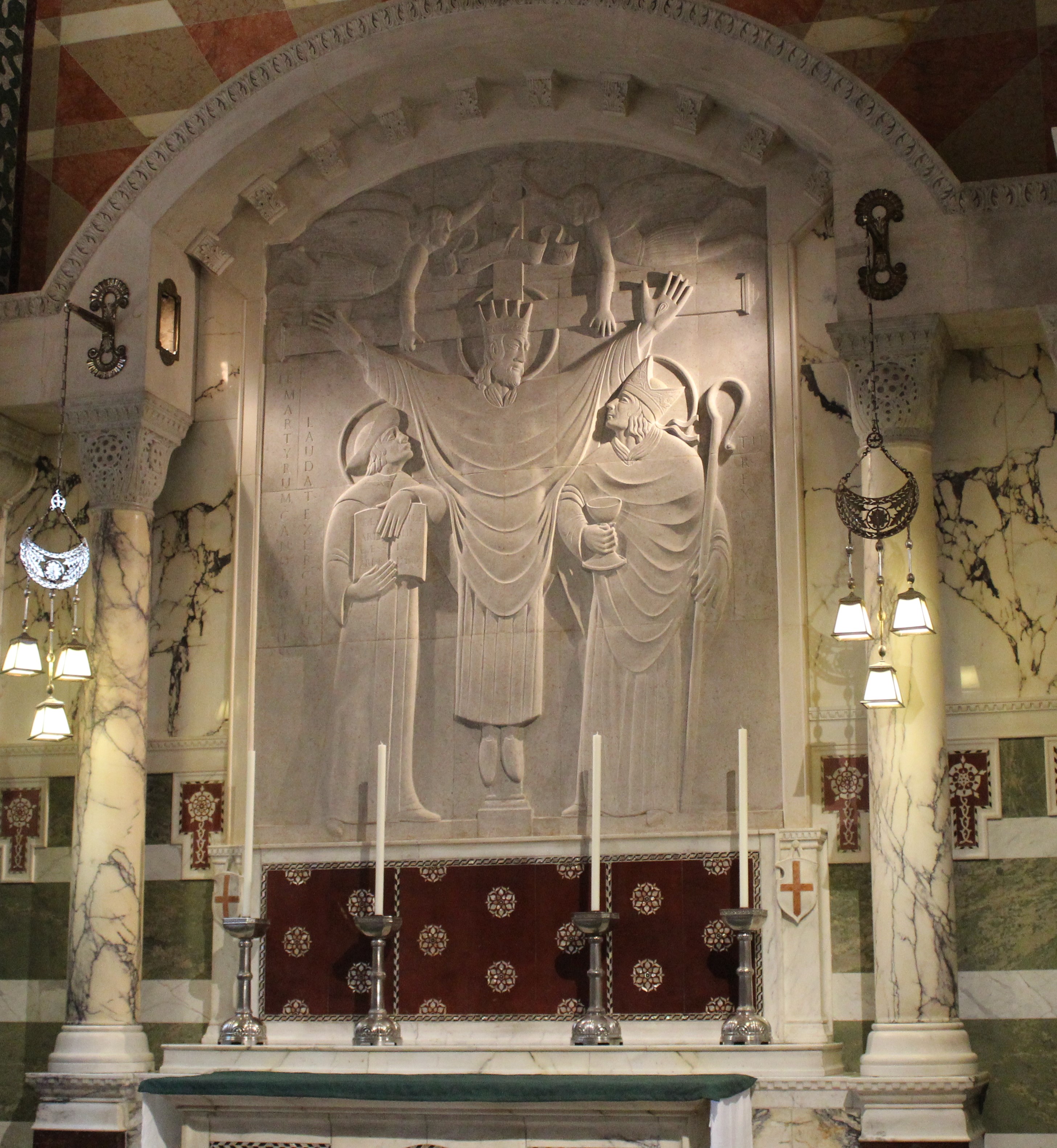
A sculpted carving by Eric Gill above the altar of the Chapel of St George and the English Martyrs, Westminster Cathedral, London
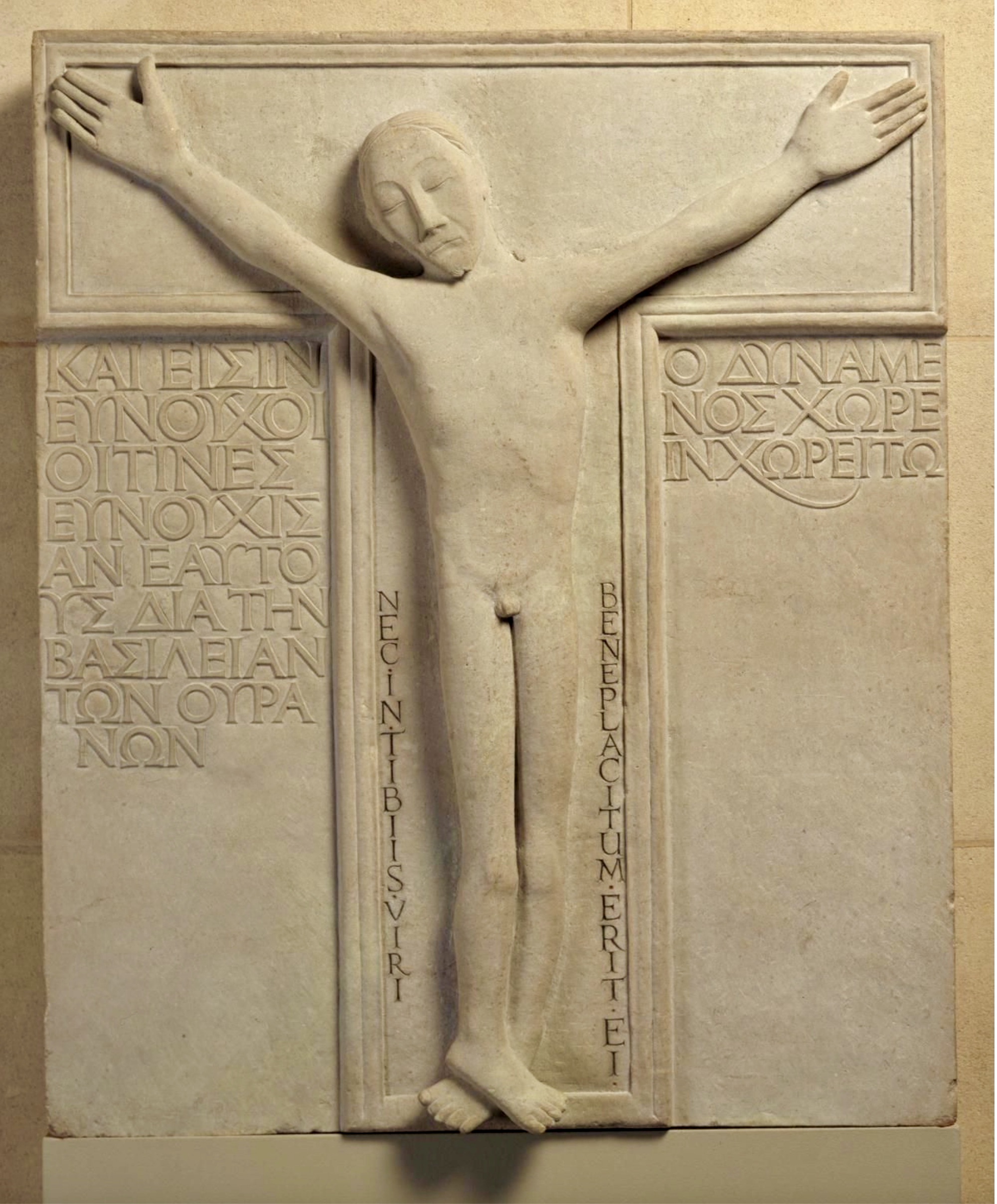
Eric Gill, Crucifixion
Eric Gill, sculpted relief panel from a series of the Stations of the Cross, Westminster Cathedral, London

As we consider some of his art, we should not overlook Eric Gill’s impact, at least indirectly, upon much of the daily life of the population of Great Britain (and elsewhere), in the form of three type faces he created. The most well-known is Gill Sans, named after its designer, and evident at almost every Tube stop in London. An effort to erase his work from the public eye, and replace it with alternatives, would require removing virtually every train station sign in Britain. It could be done. Should it?

Three fonts designed by Eric Gill

To put the problem I have raised here most bluntly, how can we appreciate the beauty in the holy art created by someone who behaved in a way most people would describe as sinful? I do not have a ready answer to this question. Note that, in what I have written above about Gill’s behavior, I have not gone into detail. Would that make a difference? If so, in what way?

And even if we refuse to give any amount of attention to Eric Gill’s artwork, we must still grapple with a timeless question: are there any unforgivable sins? Is anyone, because of his or her behavior, beyond the power of God’s redeeming love? Is it not likely that someone having Gill’s religious inclination also possesses a glimmer of moral awareness such that he or she might be open to repentance when – at the end of life – the person faces the awesome and undiminished light of God’s truth-seeking love?

Here is one thing that we can do: pray for the repose of the soul of Eric Gill, and for God’s Providential mercy.

In beginning to approach the questions I have raised here, I would start with some of the distinctions I shared above. I do not think we can deny this reality – that we, as people who are created in the image and likeness of God, and who have lost that likeness through the Fall and human sin, still bear God’s image however marred it may be by the corruption resulting from our sins. And, that we are still capable while in this life of acts and works of uplifting beauty.

Leo XIV: The Beauty of Possibility

If reading this by email, please tap the title at the top to open your browser for the best experience. Then, clicking individual pictures will reveal higher resolution images.

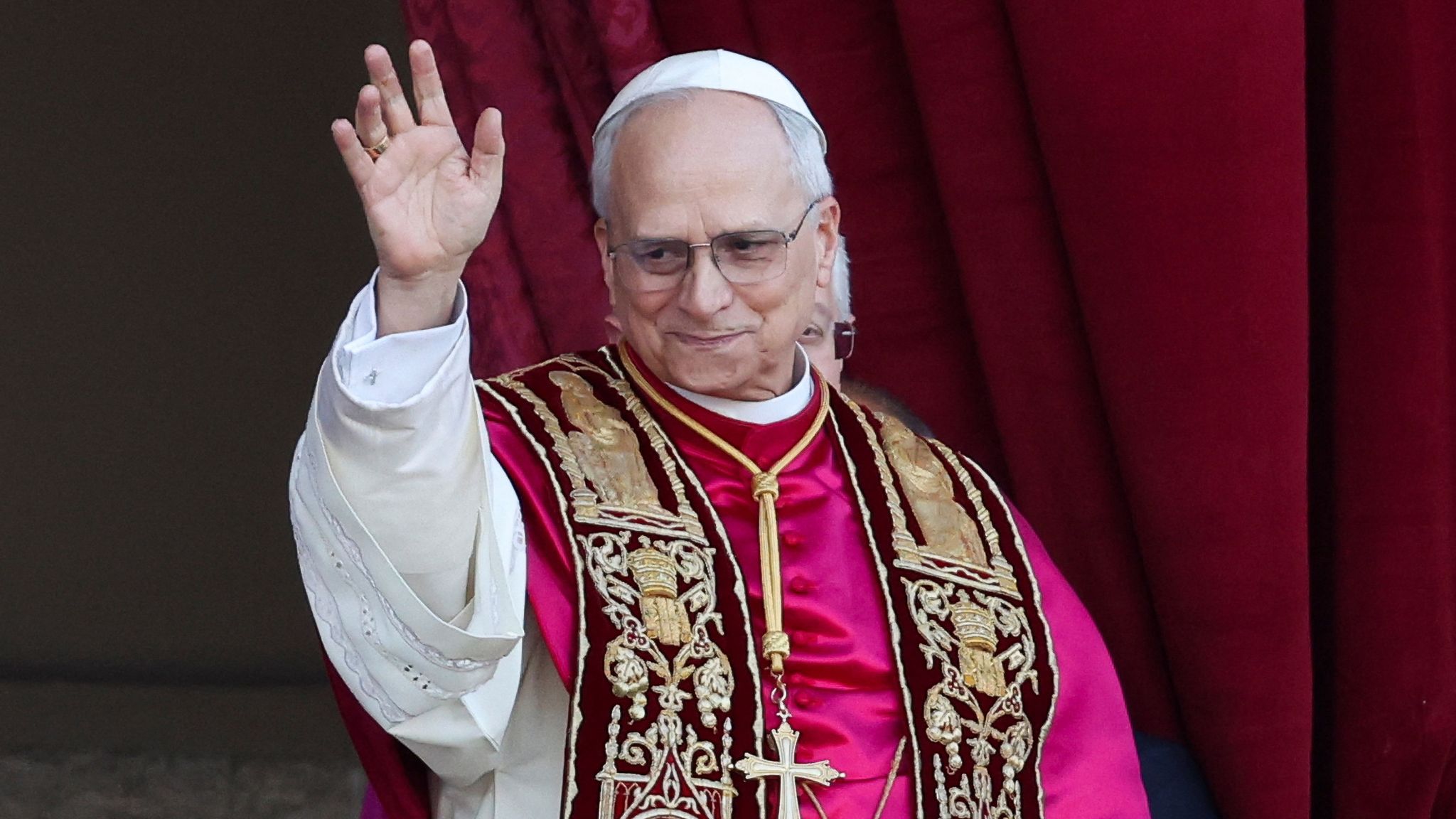
Pope Leo XIV, upon his election

As an Anglican, I join other non-Roman Catholics in hoping and praying that the new Bishop of Rome will live fully into the beautiful opportunity he has been given. His new office brings with it a symbolic role for all Christians, to be a principled unifier and peacemaker. In this era, that will surely be a challenge.

People of good will seek truth where it is to be found. We want all persons to live in harmony with one another, and with the beautiful world in which we find ourselves. We see this spirit of inquiry and discernment exemplified in many Christian leaders, as well as in non-Christian leaders like the Dalai Lama.

At heart, we seek and desire to serve what Christians and Jews hold to be true regarding all human beings. For we believe that all persons were and are created in the image of God, and that despite the woeful effects of our sin, we all still bear that image, however much we may have lost likeness with God. This was the central insight that some Roman Catholic Christian thinkers, along with fellow spiritual travelers from other traditions, brought to the creation of the United Nations Universal Declaration on Human Rights.

Principal documents from the Second Vatican Council display this theme in abundance. These texts continue to inform and guide wise souls who are genuinely concerned about the numerous lingering and emerging problems within the worldwide Church, and in the many societies and cultures where Christians seek to serve Christ in all persons, and respect the dignity of every human being.

Pope Leo has in large measure the same opportunity that we all have. May he have grace to live and serve well, and may we remember the importance of our own often overlooked roles in seeking to do the same. Every day brings new opportunities to seek and serve what is true, especially as we come to know the source of all Beauty, Goodness, and Truth, in Christ.

As St. Richard, the 13th century pre-Reformation Bishop of Chichester (England), taught us to pray: “Dear Lord, of thee three things [we] pray: to see thee more clearly, to love thee more dearly, and to follow thee more nearly, day by day.” (text from The Hymnal 1982, yet familiar to many from the musical, Godspell)

We find the same words as part of a prayer found in the liturgy of the Roman Catholic Church:

MOST merciful Redeemer,
who gavest to thy Bishop Richard a love of learning,
a zeal for souls, and a devotion to the poor:
grant that, encouraged by his example,
and aided by his prayers,
we may know thee more clearly,
love thee more dearly,
and follow thee more nearly,
day by day;
who livest and reignest with the Father
in the unity of the Holy Spirit, ever one God,
world without end. Amen.

A stained glass window commemorating St. Richard of Chichester, found in the church of St. Saviour, Eastbourne, East Sussex, England

Entering The Easter Joy of Our Lord

If reading this by email, please tap the title at the top to open your browser for the best experience. Then, clicking individual pictures will reveal higher resolution images.

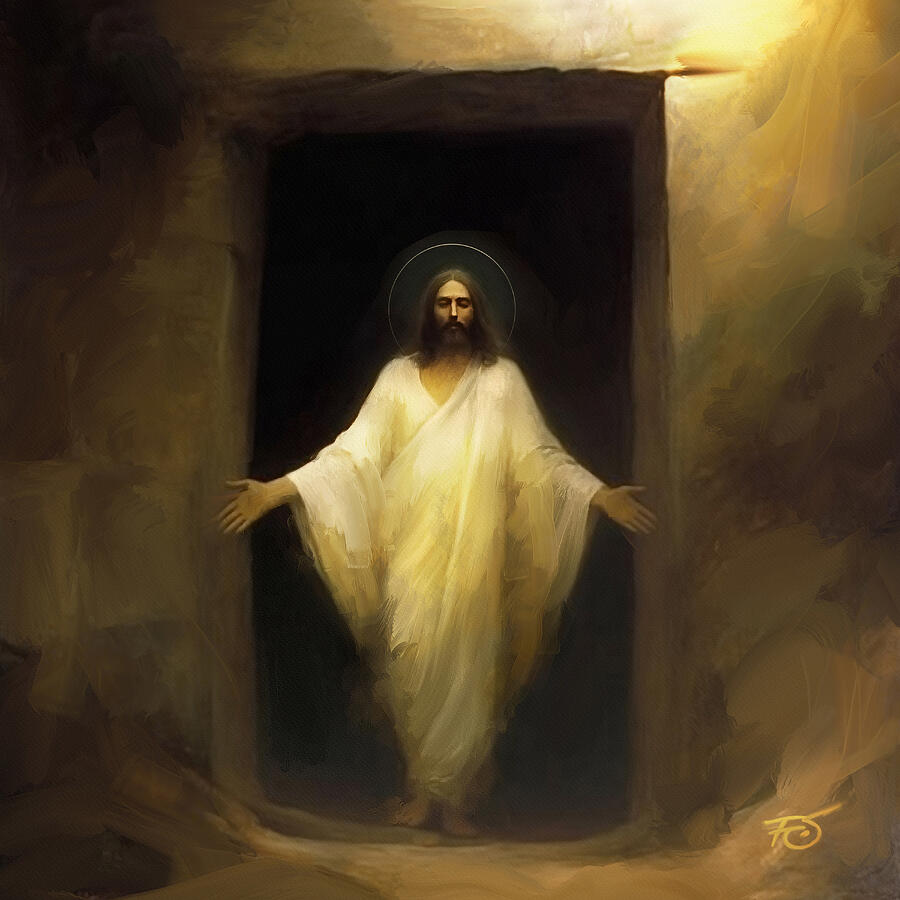
Peter Farago, The Resurrection


A prayer appointed for the closing moments of the Good Friday liturgy provides words with which we commit ourselves to God, and pray for the grace of a holy life. We pray this prayer “with all who have departed this world and have died in the peace of Christ.” The liturgy provides this prayer so that, having made our commitment, and request for grace, “we may be accounted worthy to enter into the fullness of the joy of our Lord.”

Through Baptism, through dying and rising again in Christ, we have already entered into the joy of our Lord. This is the joy that our Lord so freely shares with all who are open to receiving it. A notable aspect of the first disciples’ response to encountering the Risen Lord, was joy. He brought joy to those who had despaired, or doubted, or even had given up hope. He brought joy to Peter who had denied him three times. He brings the same joy to us.

To experience the joy of the Lord, we don’t need to wait until we pass beyond this life, through the veil, into what lies before us. What we await is the fullness of joy when, finally, we behold him, unburdened from the cares and allure of this world as these occupy our attention now. In Jesus’ Resurrection, and through our participation in his Risen Life, we see further dimensions of the New Creation that already is.

Through Grace, joy is now ours. Rightly, and by faith, we anticipate entering the fullness of the joy of the Lord. As a Robert Lentz icon of Thomas Aquinas reminds us, joy is more than a feeling; for “joy is the noblest human act.”


Easter Sunday 2025

If reading this by email, please tap the title at the top to open your browser for the best experience. Then, clicking individual pictures will reveal higher resolution images.

Peter Koenig, Christ as Second Moses (The Rainbow Resurrection)


Having six granddaughters, aged twelve down to two years, I’m very familiar with unicorns and rainbows. There is something about little girls and pastel colors that seems universal. So, when I go into the stores these days, and see all the Easter decorations, I think of our granddaughters. Because everything I see on display seems to be a rainbow of pastels, colors, and patterns, which our little girls love.

Well, as we know, our culture has tamed and domesticated Easter. Good Friday with its silence and its dark remembering is a challenge for us. For we seem to have enough darkness and bad news everyday as it is. And Easter Sunday morning provides the antidote we long for. For a few hours, and even for a few days, we can get a lift, a happy bounce, in a way that we hope for.

But deep down, we know that we want more than a brief lift in our mood, a brief enhancement of our sense of well-being. Our hearts truly long for a lasting joy. For we hope that though happiness may be fleeting, blessedness is abiding. And it was blessedness that Jesus was announcing and commending in his Sermon on the Mount. So here is our question this morning: How does the Gospel Good News about the discovery of an empty tomb help us find a sense of blessedness, and, in a way that might be lasting.

This morning I share with you three images by the English painter, Peter Koenig, images which I think can help us on our spiritual journey this Eastertide. This is our Easter journey toward discovering and experiencing a lasting sense of blessedness. For we discover the kind of blessedness that does not overlook the darkness, or pain, or sadness, that may be a real part of our lives. What we celebrate at Easter is not the simple replacement of what has come before, with something new that wipes away the past. We are not celebrating the spiritual equivalent of a vacation from daily life. For then, in a few days or weeks, we would have a sense that ‘we must now return to reality.’ The reality we celebrate today and throughout Eastertide is the reality of Resurrection transformation.

Now, how do we know this? We know this first from the reports of the Disciples – both the women and the men – who saw the Risen Lord. And who recognized him when they saw his healed scars – not absent scars, but healed scars! They were the first witnesses to the transformation that God brings to us in Resurrection Life. And Resurrection Life is God’s great culminating chapter of what we call Salvation History.

So let’s set our spiritual awareness within the sweep of biblical Salvation History. Here, I offer you a simple phrase with which to help identify and to remember the heart of this mystery. “Through the waters of death into a new covenant life with God.”

Left side panel for Christ as Second Moses

I invite you to look at Peter Koenig’s painting, Jesus as a Second Moses (or, The Rainbow Resurrection), along with its two glorious side panels. Here we notice several details, at least one of which will direct our thoughts toward Easter. We readily notice the rainbow, along with the pastel colors at the top and bottom of the central panel. These – of course – suggest the pastel colors we associate with Easter cards and Easter eggs, and other holiday decorations.

But let’s remind ourselves of what that rainbow first represented. In Salvation History, a rainbow came after a forty day period of massive death and destruction. Most of what we would consider to have been ‘life on earth’ was destroyed and lost, most people, and almost all animals and plants. Noah and his family, and the animals on the ark, traveled through the waters of death into a new covenant life with God. That death, however extensive, however gruesome and abhorrent, was and never would be the last word. God’s Word is – and always has been – a word of promise, a word of covenant. Where we aim for good, things often seem to go bad. Yet, God always aims for good, and achieves good.

Next, we should think of Israel, walking between and through the waters of death at the Red Sea. This brought them to Mt. Sinai, and to the great new Covenant between God and Israel, where blood was sprinkled upon the altar of God, and also upon God’s people. They were then led on a forty year journey through the wilderness to the threshold of their Land of Promise.

This was the moment when Joshua and God’s people crossed the Jordan. This water crossing echoed and recalled our forebears’ two prior journeys through the waters of death into a renewed covenant relation with God. Israel’s renewed covenant relation with God upon the west bank of the Jordan, within the Promised Land, signaled their desire to be faithful to God, and to God’s ways, no matter what.

Right side panel for Christ as Second Moses

And yet, the next most significant event embodying this pattern was the baptismal practice of John at the same river Jordan, centuries later, and Jesus’ own Baptism, by John. Of those who came out to John, many if not most of them were Jews by birth and also upbringing. To them, baptism was foreign. For baptism was what Gentile converts did, not Jews! And so, for them to submit to, and receive, John’s Baptism, was a genuine act of living into God’s holy covenants with their ancestors. Yet it was also a submersion into the waters of death ~ death to old ways and old ideas, as well as death to certain prior social and family relations. For John pointed to the renunciation of sin, and a return to God’s ways. It was also the path into a re-newed covenant life with God.

Jesus’ own acceptance of Baptism at the hands of his cousin, John, symbolized something other than a personal need of his. Scripture instead suggests that Jesus, himself, chose to live into this moment. He did so out of his deep identification with all of us, in what would become his world-wide family. Through John’s ministry, and in Jesus’ acceptance of it, Jordan waters once again became a symbol ~ a symbol of going through the waters of death to sin, and acceptance of a renewed or new covenant life with God.

And so, when each of us was or is baptized into Christ, we join all of these faithful people who came before us. In Baptism, with them we cross through the waters of death, into a new covenant life with God.

This may prepare us to acknowledge how we are portrayed in Peter Koenig’s painting. For we are represented by those depicted as standing in the purple shadows, behind the ‘Christ-as-Moses’ figure. We are people who live and walk in darkness until we meet the true light, the Light that comes into the world to enlighten everyone. On what, then do we base our hope? Surely, it is on the hope represented by the fruit of Jesus’ death and Resurrection.

The Son of God embraced the human body, and he became one with it. His body has become the Body we have embraced, and with which we have become one. The Body of his transformation has become the Body of our own transformation. His death and Resurrection was and is our doorway into a new life. This is what this day and our liturgy are all about.

Alleluia! Christ is Risen!


Additional note: here I offer my Easter homily, shared this morning at Grace Church, St. Francisville, LA.

Good Friday 2025

If reading this by email, please tap the title at the top to open your browser for the best experience. Then, clicking individual pictures will reveal higher resolution images.

Stanley Spencer, The Cruicifixion (1958)


(I am offering here my Good Friday homily for this year, based on one previously shared)

In the passion reading we have just heard, we are reminded of the dark spectacle of what human cruelty can accomplish. With Jesus, it was a vain attempt to obliterate the most beautiful human being who ever lived. Thank God, we have no photographs of the horrifying things that were done to him, but only paintings. But consider this paradox: the beauty of art has provided a way for us to a reflect on one of the darkest examples of human violence.

Paintings of our Lord’s Passion seem divided into two broad groups. There are those concerned to portray the grim reality of Roman execution. And, there are those inclined to explore and express the inner redemptive significance of what happened.

At the center of any portrayal of the Crucifixion of Jesus is an inescapable fact ~ it was an act of political and judicial violence, where the forces of earthly injustice pretended to act in the name of human truth. The corollary to this is how Jesus’ subsequent Resurrection restored heavenly justice in the name of divine truth. Paintings of Jesus’ Crucifixion, and those of his Resurrection, usually give attention to his wounded body, even though his wounds then appear transformed on the Third Day. After all, this is one way the disciples recognize him after his death. How the death-marked body of Jesus looked after his resurrection, also provides a preview of his appearance at the end of time.

Charles Wesley’s Advent hymn, “Lo! he comes, with clouds descending” offers words that also apply to Good Friday.

“Every eye shall now behold him,
robed in dreadful majesty;
those who set at nought and sold him,
pierced and nailed him to the tree,
deeply wailing, deeply wailing…
shall the true Messiah see.

Those dear tokens of his passion
still his dazzling body bears,
cause of endless exultation
to his ransomed worshippers;
with what rapture, with what rapture
gaze we on those glorious scars!”

It is natural to imagine how the people directly responsible for Jesus’ death, from Judas and the high priests, to Herod and Pilate, might be overcome with grief at the triumphal Second Coming of the Lord. Those who pierced him might feel themselves pierced by awakened guilt and remorse. Indeed, for every one of us, seeing the fruit of our mischief and misdeeds can provoke us to tears.

But I think Wesley was getting at more than repentance and contrition. Surely, seeing the full beauty of the glory of our Lord, with his wounds transfigured, will also summon our tears — but with tears of joy. Wesley, prayerfully and with sensitivity, has given voice to the profound power of beauty. Especially when it is discerned in the most unexpected of places – in the face and body of the crucified One. Love… the most profound love beyond human imagining, is manifest in the face and gestures of the crucified messiah. For he reaches out his hands even to forgive those who have tortured and sought to kill him. This is the most beautiful thing we could ever see.

As we pray in a Morning Prayer collect, “Lord Jesus Christ, you stretched out your arms of love on the hard wood of the cross that everyone might come within the reach of your saving embrace…”

Perceiving all this helps us make sense of the paradox at the heart of Jesus’ Crucifixion. For, in it, we perceive the dramatic juxtaposition of serenity with antagonism, of beauty with its dark opposite, and of moral good with apparent evil. We can see this in two paintings I have included with your worship bulletin: Hieronymus Bosch’ painting of Christ Carrying the Cross, and Stanley Spencer’s 1958 painting, The Crucifixion. Looking at them, I encourage you to join me in asking an awkward question: with which person or persons in these paintings do we identify?

Hieronymus Bosch, Christ Carrying the Cross

Though some 500 years apart, both painters portray the tranquil appearance of the peaceful heart of Jesus, even in the face of vicious hostility. And like Bosch, Spencer helps us see what the beautiful One in our midst sometimes provokes. Especially when the shining light of his presence exposes the dark shadows within and around us. For his light sometimes prompts fierce anger and envy, as well as a callous indifference to cruelty and suffering. Things of which we are all capable. And we are likely to have much invested in denying this ugly truth. Strangely, when confronted face to face with the divine opposite of our perversity, we will either fight the light that we encounter, or surrender to it. The Passion narratives give us examples of those who resisted and even fought against the Light of the World. For we sometimes fight against the disturbing possibility that Jesus will conquer our pervasive ungodliness. And so, consciously or not, we try to do away with his godliness.

An encounter with true beauty can be unsettling and troubling, especially if we have already settled for so much less. We may often hope for the triumph of good over evil, that beauty will overcome darkness, and serenity will displace antagonism. But we cannot find it within ourselves to do more than hope. We cannot achieve the redemptive resolution for which we haltingly reach out with our feeble hands and hearts.

It is not an accident that the figure of Jesus in Stanley Spencer’s painting visually recedes in the foreground, while those who oppose and crucify him grab our interest and attention. Spencer, after mastering traditional realism, adopted what he called a neo-primitive style. He was a gifted colorist, and highly proficient with composition. And so, as Spencer has rendered him, Jesus’ skin tone and color roughly match that of the wood of the cross, as well as the clothing of the man with the hammer swung over his head. Spencer’s rendering of the Lord’s skin tone and color also match much of the sky and the ground below… including the tunic of Mary Magdalene, prostrate at the foot of the cross. This forms a compelling visual symbol. For Jesus totally identified with us, in his Incarnation, and in his Crucifixion. His crucifixion symbolizes his complete joining with us, and with our world of wrenching hurts and suffering.

In fact —as we see in Spencer’s composition and coloring— it is precisely because Jesus blended in so well with everyday life, that those who opposed him could literally gain the upper hand, ultimately with hammers and nails. (For he did not call down an army of angels to help him, as he could have.) But this is the marvel of the incarnation of our God in Jesus. The fullness of divinity thoroughly became joined with our fallen humanity. As the Gospels attest, this joining was so complete that many did not notice or have regard for his divinity. When we do notice his total identification with us, when we come face to face with the truth it represents, we have either one or the other of two reactions. We throw ourselves down in humility before him. Or, we seek to throw him down, to humble him before us.

These paradoxes are brought to their greatest prominence when, as he predicted, he is lifted up. His lifting up is his glorification, and the glorification of God within him. Yet his lifting up is on a cross, and in the agony of a humiliating public execution. Here we see the ‘strange beauty’ of our Lord — a beauty for which churches and museums better prepare us than do our malls and most TV shows.

So, let us “behold the fair beauty of the Lord, and … seek him in his temple.” We will find him! We will find him in the “temple” that he promised to raise in three days.


Additional note: Those interested in further reflection on some of the Holy Week themes raised here might wish to read my prior post, “What God Can Do, and Is Doing.”

The Beauty of What God Can Do, and Is Doing

If reading this by email, please tap the title at the top to open your browser for the best experience. Then, clicking individual pictures will reveal higher resolution images.

James Tissot, God Creating the World


If you are a Christian, and if you reflect on your formation as a person of faith, consider this question: Do you believe it is reasonable for God’s will to make sense to us? To ask this question opens the door to discovering how our beliefs about God were shaped, as well as our beliefs about God’s providential ordering of the world. Indeed, does God even want us to think about such things, or are we simply to accept and obey the divine will, regardless of whether we find this reasonable.

These questions also bear upon how we reflect upon what happened in Jerusalem 2,000 years ago, events that we consider during this Holy Week.

Broadly speaking, the Catholic tradition of thought – going back at least to Thomas Aquinas – anticipates a discernible overlap between divine rationality and that of created and redeemed human nature. God’s rationality is imprinted upon our powers of reasoning. By contrast, broad strands of the Protestant tradition – with its comparatively elevated concept of the Fall and human sin – have not nurtured and have even discouraged a similar expectation of such an overlap. Accordingly, we cannot expect or believe that our rationality has any real continuity with divine rationality.

One of the two traditions described above has emphasized the self-revealing comprehensibility of God, who intends for us to know, and not simply obey, the divine will. The other tradition has privileged the sense that God was and is wholly other, and therefore God’s ways are incomprehensible, except for small graces. Each of these two traditions has therefore had a different understanding of what it means for us to have been created in the image and likeness of God (see Genesis 1:26, in context).

A related and observable distinction regarding these two broad traditions concerns the relationship between grace and nature, and how this is construed. In the wider Catholic understanding, grace is more often seen as infusing nature, and present everywhere. Whereas a common view often found in Protestant piety anticipates that grace touches nature episodically, and sometimes is antithetical to it, given nature’s and our Fallen state.

James TIssot, God Appears to Noah

Another way we can distinguish the spiritual influence of the two traditions I am sketching here concerns the nature of God and of God’s activity. For example, shaped by a broadly Catholic catechesis, it is believed that there are at least three things that God cannot do: create a rock bigger than God can lift; choose to cease to exist; and, command us to hate ‘him.’ For, in the spirit of that same catechetical tradition, each of these three theoretical possibilities would be irrational, and thus contrary to the divine nature and being, as well as to who and how we were and are made to be.

Most Protestant thinkers and preachers would likely dismiss the first two of these three (im)possible ‘things’ as perhaps irrelevant rhetorical distractions. Yet, the third thing, however disagreeable and unforeseen in light of the New Testament, would probably be conceded as theoretically possible, especially given the historically Protestant stress on divine freedom and the importance of acts of will for personal right-believing. (In other words, though God could, God wouldn’t.)

A result of these differences between the two traditions is that questions about sin, misfortune, and the presence of evil, have tended to be handled differently in Protestant belief and teaching as compared to that shaped by Catholic spirituality. This difference can be noticed when we reflect on and speak about ‘bad things’ that happen to us. Does God cause such misfortune, or, allow it? How we tend to answer this ‘cause’ question can reveal something about the Christian catechesis by which our thinking and beliefs have been shaped. And how we think about this question regarding divine responsibility will benefit from insight going back to Aristotle concerning four different aspects of what the word ’cause’ can mean.

James Tissot, God’s Promises to Abram

Here is a fundamental question that can bring many of the above strands of thought into focus: Do we believe that God always loves us; always seeks intimate fellowship with us; and always seeks to draw us more fully into the merciful embrace of God’s redemptive purposes? Or are our answers to these facets of a fundamental question somewhat qualified? And if qualified, then by what?

Especially in view of our observance of Good Friday this week, I believe that we can answer this question about how God loves us in the affirmative. And we can do this without overlooking or ignoring such NT images as the narrow gate, and the Lord who will ask what we have done for the least of his brothers and sisters.

CS Lewis, among others, reminds us of a way that we can appropriately affirm God’s abiding love for all people. We can illustrate Lewis’ view with the following image: We may weep when we come before Him at the end of our lives. But our tears may be both from sorrow as well as from joy at our redemptive inclusion, despite all that may count against us. As long as, in that moment, we acknowledge Him, and who He really is. For we all will have the opportunity to do so.

Alleluia – Easter comes for everyone. If only we could better see how and why that is true!


Additional note: As an Anglican, I include my own tradition within what I refer to above as the broadly Catholic tradition. My goal with this post is not historical analysis but to provide grounds for reflection regarding two differing – yet sometimes overlapping – ways of approaching some central questions.

The Beauty of Objectivity

If reading this by email, please tap the title at the top to open your browser for the best experience. Then, clicking individual pictures will reveal higher resolution images.

William Blake, The Ancient of Days (one of numerous hand-colored prints)


I like to use a couple of throw-away lines: First, the world was here before we were here to notice it (or try to describe and evaluate its various facets). And, second, God was here before we were ever able to think the thought, much less give value to or try to describe this fundamental insight. And so, the world had God-given beauty and value before we were here to notice such things. To put this matter in the formal terms I propose that we recover, we were objects of God’s subjectivity before God ever became an object of ours. These insights ought to be primary in our outlook upon the world, and upon our lives within it.

The stark alternative to what these throw-away lines represent is the view that the world, its meaning and any purposes within it, and or God, came to have significance if not also actuality, when we chose to notice or imagine such things.

I have written before urging recognition of how beauty exists apart from the ‘eyes of the beholder.’ This is to say that the reality of beauty transcends the perception and apprehension processes of the one who beholds it. Another way to say this is to contend that beauty has objective reality. But what do we mean when we say something is objective?

Here, I would like to commend an insight regarding this word, ‘objective,’ and its pair, ‘subjective,’ terms we may use too casually. For we tend to employ these words most often to characterize two different aspects of how we perceive matters that come before us. One we regard as being oriented toward what is factual; we use the second to refer to that which is subject to the variability of emotions and sentiments that are particular to ourselves.

We need to recover a prior sense of what these two words, objective and subjective, can mean. We can return to using the word objective, not first to refer to the fact-oriented aspect of our consciousness of the world, but as referring primarily to the world itself and to the things within it. In this recovered use of these terms, the objective can best designate the objects of perception. And the second term, the subjective, can best represent the subject of our perceptions (us).

We can, of course, have ‘subjective’ notions about the objects of our perception, while we can also seek to be more accurate in our sense of those things that we perceive. Accurate description and evaluation of the objects of our perception are aided by comparative reference to the perceptions of those same things by others, and thus are aided by an effort to step beyond notions that are particular to ourselves and to our private experience of them.

In this respect, the practice of good science shares a basic property with the practice of good religion. Both seek to describe what is true, and what is in accord with reality.

God the Geometer (from a medieval manuscript)

In perhaps an overly simplistic summary, the choice between these two outlooks upon ‘what is,’ emerged with what we now call the Enlightenment, and the development of what we now call ‘natural science.’ And yet, the emergence of modern science, and the world view which it has come to nurture, lies in pre-modern theism, in the ancient and primal belief that before all things, was and is God. And that God was and is the author of what the medievals called the Book of Nature, who was also the author of the Book of Scripture. Two books with overlapping significance, by one Author, about all that was, and is, and ever shall be.

Among the works of this author, and behind or within them, are ideas, ideas latent in the mind of the Author. And preeminent among these ideas are Beauty, Goodness, and Truth. These ideas represent the highest things we cannot not know, especially if we seek to have our minds shaped by the mind of the Author of all things. Beauty, Goodness, and Truth, are therefore – as we like to say and think – objective. That is, they are among the highest, most valuable and excellent, objects of our perception. And whether we grasp their significance, and how we grasp their significance, as fellow-subjects of their perception, can of course be – as we like to say and think – subjective.

William Blake, Newton as A Divine Geometer

Nevertheless, the objects of our perception ought to govern and discipline our shared and comparative perception – as fellow-subjects – of Beauty, Goodness, and Truth. This is the beauty of human objectivity and of subjectivity.


Beauty in the Face of Jesus

If reading this by email, please tap the title at the top to open your browser for the best experience. Then, clicking individual pictures will reveal higher resolution images.

William Holman Hunt, The Light of the World (detail)


Since the earliest centuries of the Christian era, believers have found encouraging meaning in paintings of the imagined face of Jesus. Since no such images exist from his lifetime (as far as we know), but only written depictions of Jesus’ character as displayed in his words and actions, later artists have literally drawn upon acts of imagination in how best to present him. In so many of these paintings of Jesus, we find abiding images that convey an abiding love.

Salvator Mundi, attributed to Leonardo da Vinci

More than a few in our great Tradition have had an aversion to the making of these images, believing that such efforts to depict Jesus risk engaging in or promoting idolatry, a concern that is not difficult to appreciate. Yet painters, particularly in the Christian East, have believed that, in view of our Lord’s Incarnation, paintings of Jesus and of holy events in which he was involved are not only appropriate, they can be divinely inspired windows into eternity.

Christ Pantocrator, an icon in St. Catherine’s Monastery, Sinai, Egypt

Modern Evangelicalism has played a parallel role to this in the belief that compelling contemporary images of a beautiful and winsome Jesus can aid the faithful by stirring devotion in Bible reading, prayer, and in daily living.

Warner Sallman’s 1940, Head of Christ, reprinted in many Protestant Bibles and devotionals

The face of Jesus, by R. Hook, a 1964 painting widely popular in the Jesus Movement of the 1970’s and among Evangelicals

How do we picture Jesus? Although though we may appropriately demur from referring to God by using personal pronouns or with gender-based associations, when hearing the Gospel reading on Sundays, or while reading devotional books, images of Jesus inevitably arise in our conscious awareness generated by acts of imagination.

Here we receive encouragement from C.S. Lewis, J.R. Tolkien, and other spiritually inclined writers, who have helped us recover confidence in the idea that the power of imagination can be a redeemed vehicle for conceiving holy images, both of biblical scenes and also of allegorical parallels based upon them.

Hieronymus Bosch, Christ Carrying the Cross (detail)

The popular pious suggestion that we ask ourselves, “what would Jesus do, or say about this matter,” can therefore be a helpful spiritual exercise, especially if pursued reverently and with a scripturally informed process of deliberate thought.

Christ and the Rich Young Ruler, Heinrich Hoffman

In my prior post, I shared detail of a compelling image of Jesus by the 19th century painter, Heinrich Hoffman. I love this painting, expressing the artist’s rendering of Jesus’ encounter with the so-called rich young ruler. Hoffman portrays well the love Jesus had for and showed to the man who asked him how he could enter the Kingdom of Heaven. The painter depicts how Jesus loved him and, we believe, continued to love him, both before and after this man turned away in discontent and confusion.

As we grow in our familiarity with images of Jesus, we can become sensitive to the way that Western art has tended to portray our Lord’s humanity, influenced by the European artistic tradition, which has not overlooked Jesus’ Semitic background. Nevertheless, how artists and others portray Jesus finds in him reflections of themselves, which is true to his known desire to identify with who we are. It has become more common in recent years for artists to portray Jesus in the form and appearance of other cultures, and the iconographic paintings of Brother Robert Lentz (some of which I have featured before) provide a good example. Among them is his image of Jesus set within the context of Japanese Buddhist spirituality, seen in the following image.

Turning again and again to such images can be most helpful to us in our spiritual journeys, especially when we choose well-conceived and well-executed paintings, drawings, or sculptures, that express to us facets of divine beauty, as well as the goodness and truth of God, found in the face of Jesus.


Note: Jaroslav Pelikan’s book, The Illustrated Jesus Through the Centuries, provides a ready and helpful way of finding images that can accompany our journey through Lent toward Easter living. Once again, I would like to thank Kathy Kane for my copy of this beautiful book.

In anticipation of this coming Sunday, Lent 2, Year C, I offer here a copy of a homily from a prior year, which may be accessed by clicking here.

The Beauty of Truth

If reading this by email, please tap the title at the top to open your browser for the best experience. Then, clicking individual pictures will reveal higher resolution images.

The Risen body of Christ bears the healed scars from the Crucifixion in Matthias Grunewald’s Isenheim Altarpiece.

My commitment to writing about Beauty is evident in my ongoing posts. I have also written about the connection between Beauty and Goodness as well as Truth, the three so-called Transcendentals. To use a phrase from another context, these are three things we ‘cannot not know,’ at least in principle.

As I expressed in my most recent post, in Christ we find the icon of God. For he is the icon of God’s beauty, God’s goodness, and of God’s truth. In turn, and as we are reminded during Lent, we are all called to become icons of Christ, and to seek to embody in ourselves what we find revealed and embodied in him.

Yet, of these three Transcendentals, Beauty, Goodness, and Truth, the third may be the most difficult for us to realize in ourselves, much less to try to describe. This is one reason why since earlier times people have recognized a hierarchy among these three things that we cannot not know. Among the three, beauty tends to be most evident and accessible to us, followed by goodness. The first often leads to greater appreciation for the second, and both can lead us to search for truth, however and wherever we may find it.

It is nevertheless not uncommon for us to be unsure about the presence or the nature of beauty and goodness when viewing objects, actions, or events. And we are very capable of engaging in disputes regarding such evaluations. But here is a paradox: though we may be just as unsure about how best to characterize what is true, or how to evaluate that quality in relation to ourselves, we seem to have much less hesitancy when it comes to ascribing the apparent absence or deficiency of truth in the words and actions of others.

To paraphrase a successful nineteenth century aspirant to the Presidency, grand ideas outlive those who hold them. James Garfield expressed this view just months before his assassination. Frederick Douglas was so impressed with Garfield’s principles and potential for national leadership that he led the procession onto the rostrum for Garfield’s Inauguration. Among those abiding principles and ideals was Garfield’s voiced recognition of the truth within a difference between many white Confederate soldiers and their leaders, and the black men who served in the Union Army. The former had betrayed the flag and their country; the latter did not. Ideas that help us identify and articulate things we value, like beauty, goodness, and truth, abide.

Nevertheless, for many of us, what we reckon to be true – as compared to what is beautiful and or good – is not always so clear. And yet, we believe in Truth. Even when we despair about its instantiation in general human affairs, and in the more limited spheres of our daily involvements, we believe that what is true should guide our lives and our conduct with one another. And, when it comes to what we practice as compared to what we believe or hope for, truth seems to be a principle that we more often honor in the breach.

Another paradoxical aspect of our desire to know the truth has to do with how what is true can not only be uncomfortable but even painful. A mother waiting up for a teenage son who is hours late getting home, and a husband awaiting word from his spouse who has not returned from responding to a wildfire, are likely to have mixed emotions about what they might learn when answering a knock at the door. And yet, in these and in countless similar cases, we want to know what is true, and the truth we want to know is one that is unleavened with inaccuracy or falsehood even if it is painful to hear.

What is true can be beautiful and good, at least for those who believe in the Gospel of Redemption. This is because Christians believe that ‘facts are friendly,’ and that there is no person or situation that is outside the scope of God’s loving redemptive purposes. What personally can be hard to accept as true can still be beautiful and good. And if not so at the moment, then it can be so when we pass beyond the veil and see the embodied Beauty, Goodness, and Truth, for which we so yearn.

Heinrich Hoffman, Jesus and the Rich Young Ruler (detail)

For us, Beauty and Goodness, as the first Transcendentals, provide this experiential advantage: we find them more readily evident as they are instantiated in objects, events, and in others. Truth, by contrast, can seem more elusive and more subject to the variable preferences and uncertain powers of our apprehension. As a Transcendental, Truth – like Beauty and Goodness – has objective reality. Yet, like her sister “Graces,” Truth must sometimes, if not often, penetrate the fog of our subjectivity and experiential awareness for us to perceive it.


Additional note: I am publishing this post on Ash Wednesday, a day on which we are invited to reflect on the patterns of our lives in light of the truths we have come to know, and which have been revealed to us.

In anticipation of this coming First Sunday in Lent, I offer here a copy of a blog post with an attached homily (with related images) that I presented in a prior year, based on the Lectionary (which may be accessed by clicking here).