Nature and Creation

A Desecrated Beauty

[If reading this by email, please tap the title at the top to open your browser for the best experience. Then, clicking individual pictures will reveal higher resolution images.]

An encounter with beauty may provide a gateway to what is holy. For beauty often embodies and expresses something sacred. When this is so, a violation or desecration of beauty can strike us as having the character of evil.

When apparent destruction befell Notre Dame cathedral in Paris, or earlier upon the Golden Spruce tree in the Queen Charlotte Islands, British Columbia, people learning about these events were shocked and in mourning. In the case of Notre Dame, a devastating fire accidentally accompanied repair work on the building. But with the Golden Spruce, a  willful human act destroyed a spiritually significant tree.

The several hundred year old Golden Spruce became widely known based on news reports of its loss, and through a subsequent book by John Vaillant. An extremely rare genetic mutation occurred in one of a very large species of trees common to the Pacific Northwest, the Sitka spruce. Vaillant tells the story of this beautiful tree, which was known as Kiidk’yaas to the First Nation Haida people. The Golden Spruce was revered through a mythical spiritual story retold over countless generations in Haida oral tradition.

The author draws us in to the significance of this particular tree for the Haida and for many others, including the person who figures principally in his narrative, Grant Hadwin. He was a forester and logger who developed a reputation for having extraordinary skills as a woodsman who possessed seemingly superhuman physical strength and endurance. Paradoxically for someone whose livelihood depended upon employment by forest product companies, Hadwin over time developed an increasing antipathy toward the detrimental effects of commercial logging and the forest clear-cutting with which he and the industry were associated. Over time he became known as a radical environmental activist, whose views may have been inspired by some remarkable spiritual experiences.

Vaillant lays the groundwork for his story about the Golden Spruce by offering a compelling introduction to the ecosystem of the Pacific Northwest coast and its islands. The reader comes to appreciate the unique habitat within which early European explorers and traders found the huge trees of the old growth forests. These trees include Douglass Fir, Western Red Cedar, and the Sitka Spruce, which in diminishing numbers are still seen today. The reader also learns about the history and culture of the Haida, and the detrimental impact caused first by Sea Otter pelt traders, and then by foresters, upon what became British Columbia, its islands, lands and first peoples. Given this background, one might expect that Grant Hadwin would somehow be the hero of the story, given his abilities, integrity, and emerging commitments.

The central irony of the narrative centers on Hadwin’s concern about the rapacious devastation of the old growth forests by commercial interests and their professional employees, who generally approach the land’s natural endowments as resources to be exploited, quickly and extensively. Yet, Hadwin himself targeted the Golden Spruce, seeing it as a corporate ‘pet,’ falsely preserved by a company in a park-like artificial island of nature, surrounded by lands violated by those who had no care for them. In the process, Hadwin – through an apparent combination of correctable ignorance and oversight – seemed surprised and defensive when he learned about the Golden Spruce’s significance for the Haida, on whose lands it had long stood.

In this book, the author accomplishes several things that taken together may seem incongruous. We gain a regard for the immense scale of the old growth forests of the Pacific Northwest, the towering size of their tall trees, and the hundreds or even thousand years over which some of them have grown undisturbed. We become aware of the astonishing danger and rate of mortality associated with tree felling, while coming to admire something of loggers’ courage and tenacity. And our righteous anger is stirred by the corporate appropriation of natural resources for commercial benefit at the expense of the cultural and spiritual significance of forests. For forests number among special places that have long reminded people of our higher values, and are a context where we can rediscover deeper purpose and meaning for our lives.

Vaillant  leaves us with another unresolved sense of paradox. It is prompted by the knowledge we gain of how the Haida, long feared as brutal victimizers and enslavers of other First Nation peoples, themselves became victims of hostile social, economic and geographical forces. Against this backdrop, we learn how a well-liked man, who was regarded as having extraordinary skills and integrity, and who might once have been defended by the Haida, perpetrated a bewildering act of environmental desecration and came to be seen by them as an enemy of their spiritual history and culture.

Kiidk’yaas, the Golden Spruce may be gone. The transcending beauty it had, and which it still represents, will last.

A sapling from Kiidk’yaas

A Beautiful Garden: Nitobe Memorial (Part II)

[If reading this by email, please tap the title at the top to open your browser for the best experience. Then, clicking individual pictures will reveal higher resolution images.]


In Part I, I closed with this observation: one does not visit a Japanese garden in the way one might go to a park, as a context to pursue some activity like an exercise walk, but as a place to experience simply being.

Here we encounter a paradox, perhaps one of many associated with traditional Japanese gardens. At first, for many Western visitors, the elements within such a garden, and their arrangement, catch the eye and draw one in further to an encounter with what is seen there. Yet, what is seen within a Japanese garden exists less to provide an object of attention, and more to facilitate and enhance how one sees. A journey around the garden therefore encourages a journey within. The “spirit that informs [the] spaces” found in “a garden created and maintained in the Japanese tradition,” to which the UBC website alludes, is a spirit or quality of experience to be nurtured within the viewer who encounters this intangible element of the garden.

A carefully arranged sense of space therefore forms a prominent feature of traditional Japanese gardens, where plantings and structural objects both near and further away are placed deliberately. Except for the surrounding walls, there are no straight lines in a Japanese garden, and formal symmetry is strenuously avoided. Plantings and objects are more often placed singly or in three’s, given how two points often suggest a line and three suggest a circle. The spatial interrelationship between such things as large stones, trees, and water features is not accidental, and for the Japanese has a spiritual as well as visual significance.

In Japanese garden design, each particular feature, whether alive and growing or humanly made, has a distinct significance and is purposely chosen for its location. Perception of this is enhanced when a visitor becomes aware of how the elements of a garden’s composition are selected with an appreciation for seasonal viewing, such as at the annual cherry blossom time. Throughout the year plantings in the garden draw attention to themselves through an occasional heightened display of color, or by contributing to a muted harmony of differing tones and textures. On successive visits, a familiar place somehow can seem different.

Plants, shrubs, and trees in Japanese gardens are cut and trimmed so as to appear manicured  just as European topiary is studiously tended, albeit with very different results. Whereas gardeners in the Southern U.S. might allow azaleas to grow unevenly to avoid looking like a hedge, ornamental shrubs such as holly and cedar, and the branches of evergreens, are painstakingly shaped by the Japanese-trained gardener, often into softly rounded forms. These provide contrast to the smooth sculptural shapes of tree trunks, while also standing out against the flat reflective surface of ponds.

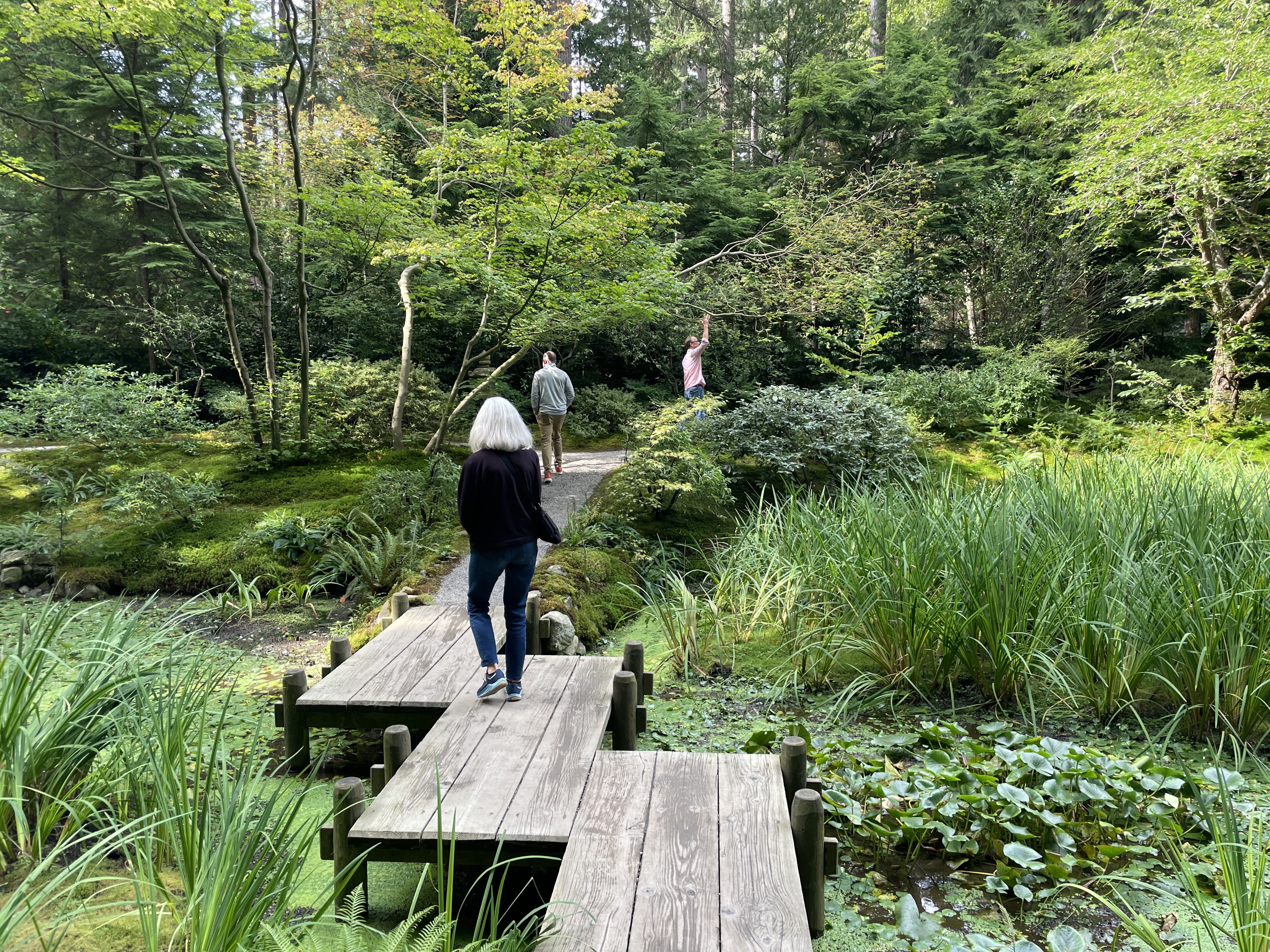
Traditional Japanese gardens usually contains a pathway, a design element not unique to such gardens, though its treatment in this context draws attention to itself. For the pathway through the garden can be just as important as what is viewed from it, so that the experience of the journey becomes in some sense its destination. Even in a relatively compact space, a consideration important in Japan, a pathway in a garden can make a small area seem much larger than it is, as the visitor is prompted to slow down and live into the present moment.

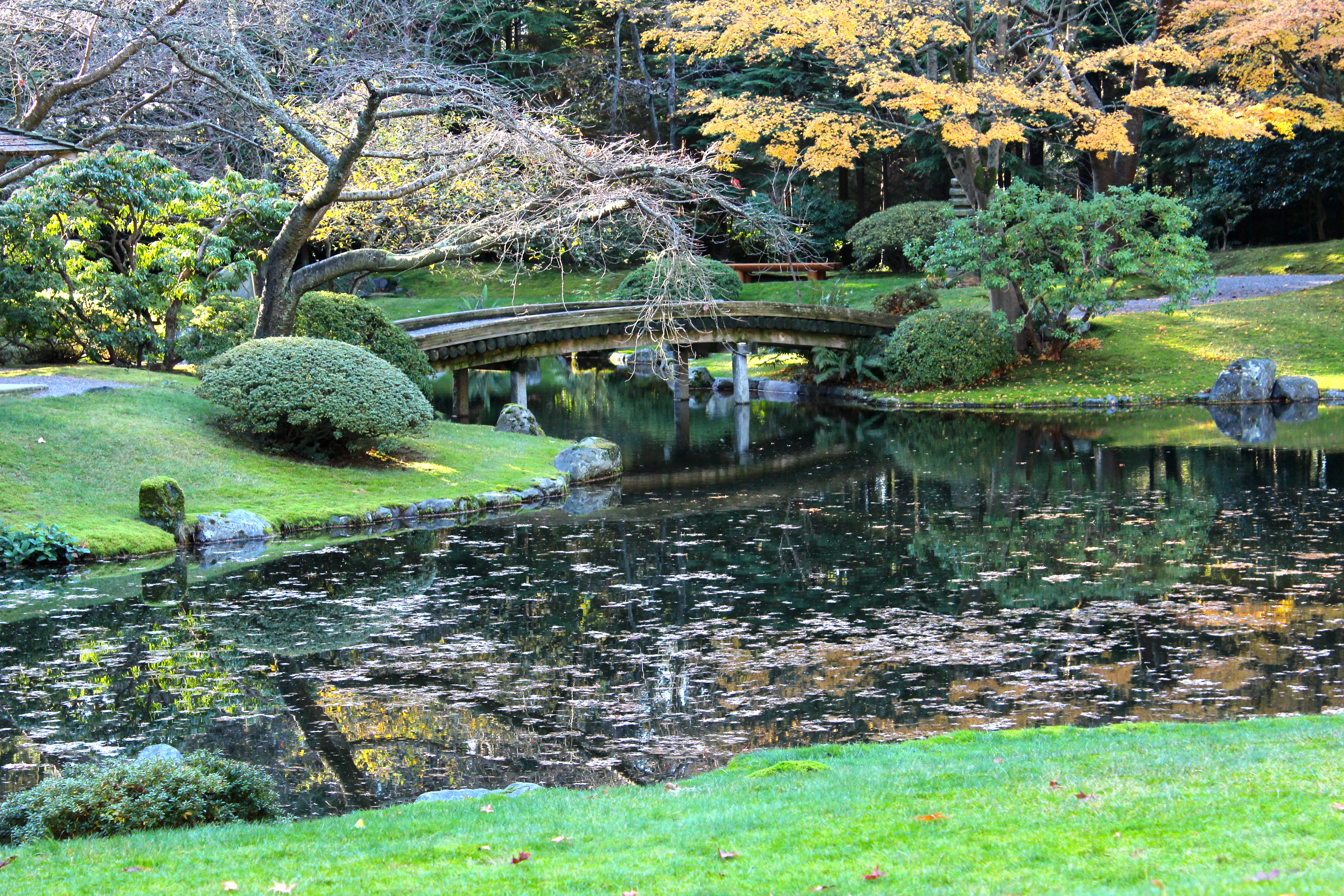
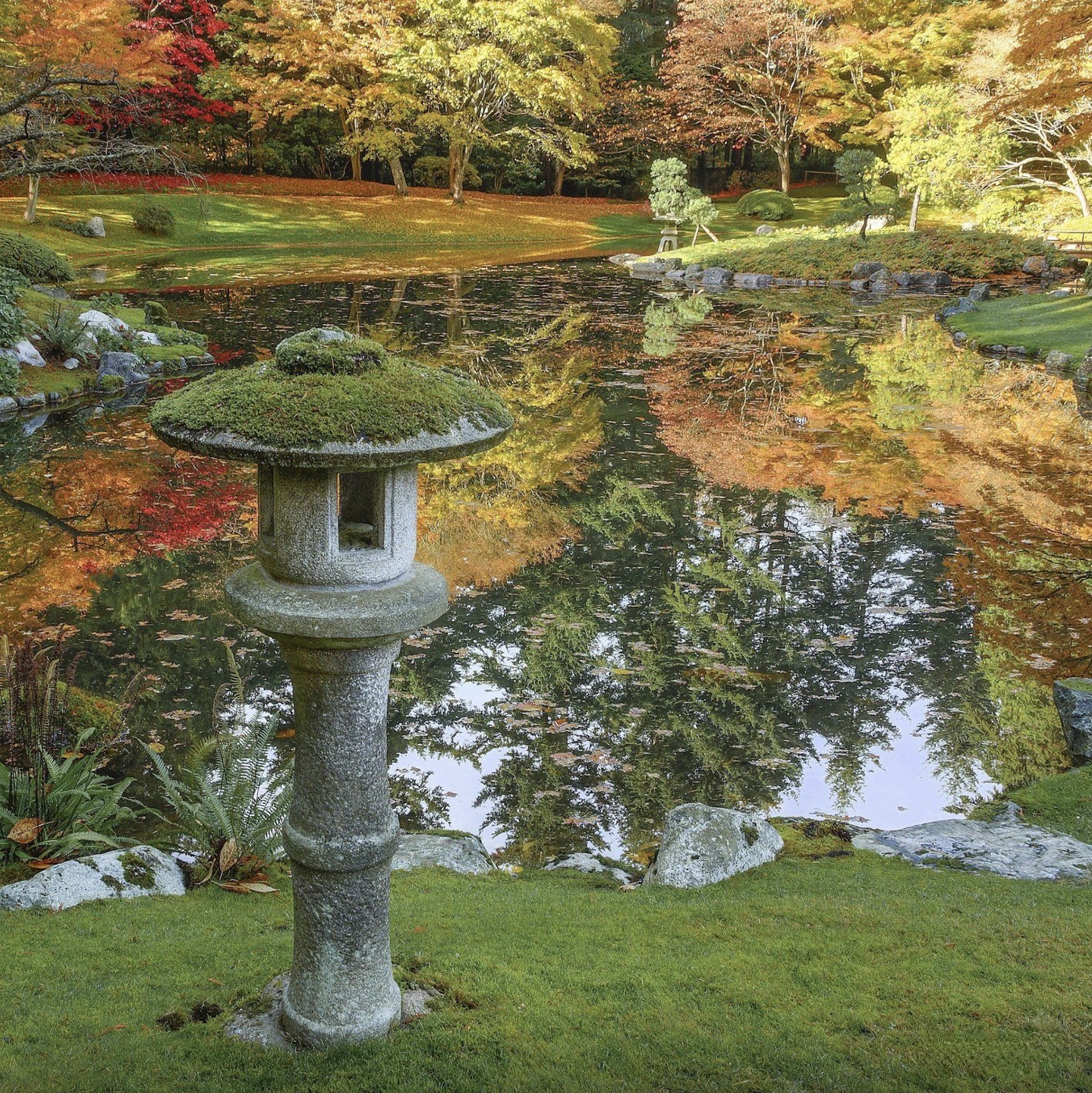
Padding along the soft pea gravel between areas of green covered by multiple textures from soft moss to tall bladed plant spikes, one gains glimpses and then temporarily loses sight of what lies ahead. Views include garden features such as a teahouse awaiting encounter, or a low-arching bridge from which Koi might be observed below the still water’s surface.

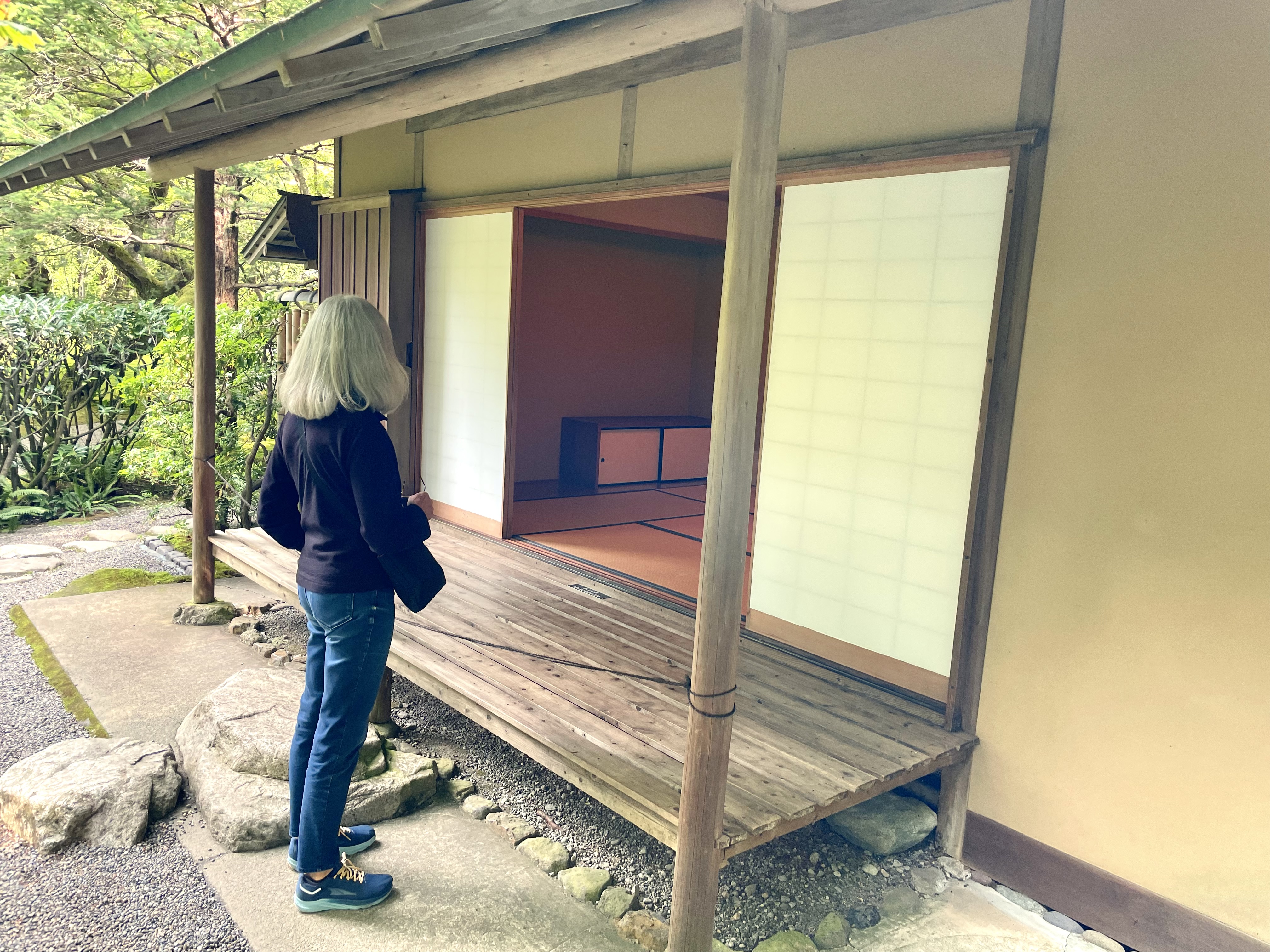
The UBC website says that “Nitobe Memorial Garden is considered one of the most authentic Japanese gardens outside of Japan.” A testament to this perception was provided by Emperor Akihito during a visit there. He said that, while in this garden, “I am in Japan.” Enhancing this sense of being in Japan is the presence of a traditional Japanese house in which opportunities to experience the ‘tea ceremony’ are seasonally available.


A Beautiful Garden: Nitobe Memorial (Part I)

[If reading this by email, please tap the title at the top to open your browser for the best experience. Then, clicking individual pictures will reveal higher resolution images.]


The Nitobe Memorial Garden on the grounds of the University of British Columbia (UBC) is readily recognizable as a traditional Japanese garden. Like other gardens of this type, it provides an experience of tranquility. Even in an urban area such as Vancouver, Nitobe Garden offers a quiet refuge from daily life concerns and tensions that visitors might carry with them.

An interpretive guide to “understanding Japanese Gardens,” found on the UBC Botanical Garden website, asserts the following:

… it is almost impossible to clearly state what defines a Japanese garden. Many Japanese resist classifying and categorizing the various features of Japanese gardens.

The website attributes this reluctance to the idea that beauty “not explained allows the viewer to remain in a state of wonder.” This worthy observation applies as much to modern abstract painting as it does to historic patterns of landscape arrangement. Yet, in this and in the next post, I will articulate characteristics that enable us to distinguish a traditional Japanese garden from, for example, a casual English cottage garden or a formal French garden.

The UBC website acknowledges how “most visitors can tell when they have entered a garden created and maintained in the Japanese tradition,” crediting this perception to people who “are sensing the Japanese spirit that informs these spaces.” This may be due to how various strands within Japan’s cultural history have coalesced to form a recognizable ‘style’ manifest in its gardens. Among the results of such a melding process, we can identify and describe several features in the Nitobe Garden that are common to other well-known Japanese gardens.

We can begin by observing how gardens and parks found in the East and in the West have a number of shared attributes. Among them, most gardens and parks around the world feature a scheme for the arrangement of their various parts even if it is not readily evident to visitors. Many such places appear to promote and preserve a ‘natural’ quality among the things growing in them, even in formal gardens. Some gardens and parks accentuate this natural element, perhaps in deliberate contrast to surrounding urban areas. This fosters an impression that the plants, shrubs, and trees have grown where they are of their own accord, and in their own way, regardless of any horticultural tending they have received. Especially in the West, ‘nature’ and that which is ‘natural’ are seen as what does not readily bear the imprint of human interaction, and as emerging more from its roots than from our planning.

Western gardens and parks may have gates, but often their entrance designs accentuate pubic access, providing a continuity of experience for visitors who may have potted plants or flowers where they live and work. In this sense, these garden and park entranceways draw people in from what is less into what is more. In the process, visitors are likely to encounter familiar though markedly larger and more extensively planted shrubs and trees, many of which do not appear to have been shaped or altered by human hands.

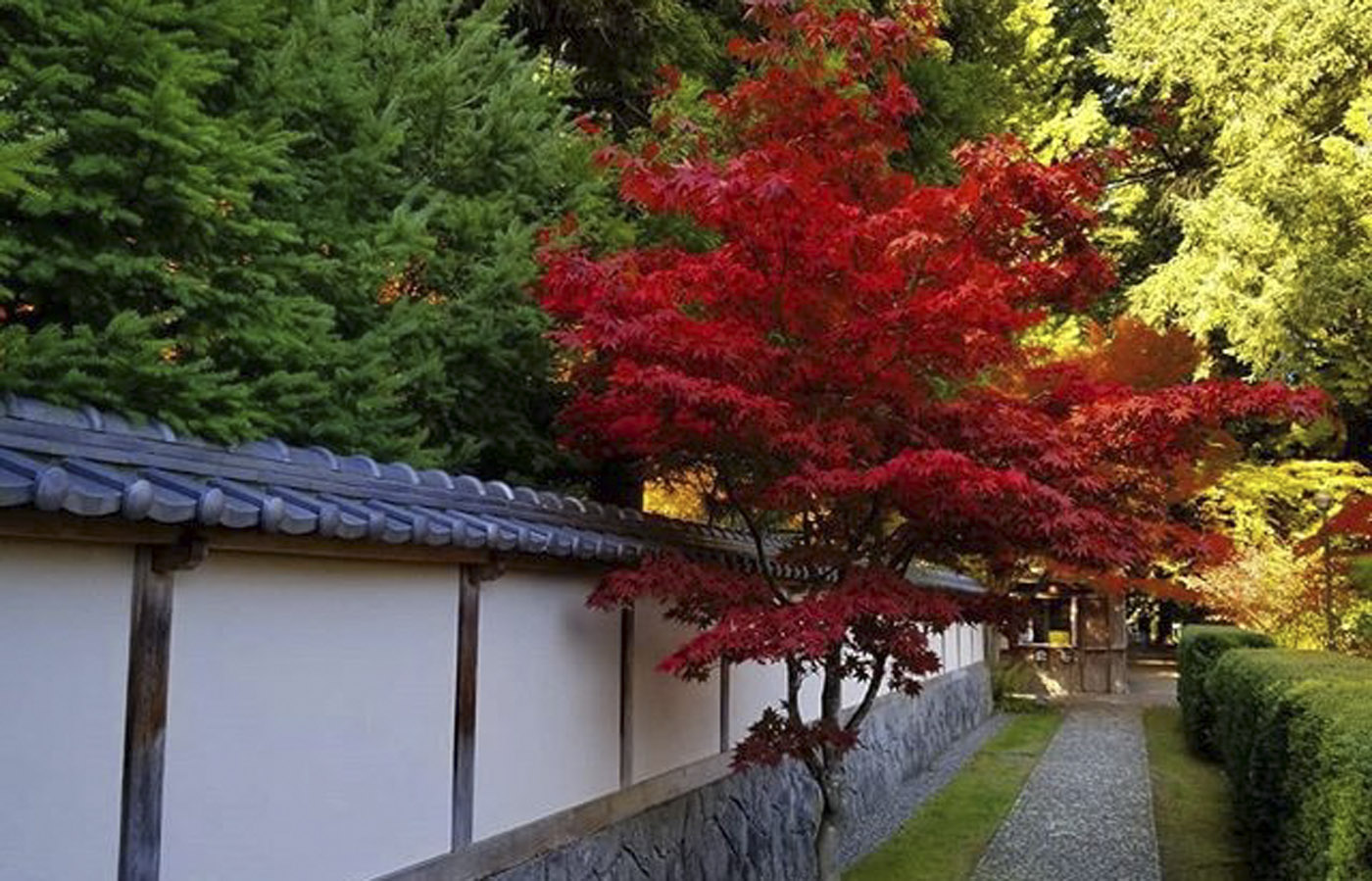
Formal gardens both East and West usually have marked boundaries and even barriers between what is within and that which is outside. Traditional Japanese gardens are typically surrounded by view-blocking walls topped by a ceramic tile parapet. These indicate a formal boundary between the transient outside world of energy-charged daily activity and the stillness available within, where visitors are subtly bidden to release their grasp upon time and their surroundings.

Imposing entrance gates mark a portal to a different realm lying beyond, as much as they appear to provide a barrier protecting what is within. Though these gates and the walls around a Japanese garden may serve to keep out intruders and foraging animals, they exist primarily for the sake of those who enter and take time there. For one does not visit a Japanese garden in the way one might go to a park, as a context to pursue some activity like an exercise walk, but as a place to experience simply being.

In the next post we will continue to explore what is identifiably distinctive about traditional Japanese gardens like the Nitobe Memorial.


The Curve of Time: A Beautiful Book

[If reading this by email, please tap the title at the top to open your browser for the best experience. Then, clicking individual pictures will reveal higher resolution images.]


I discovered M. Wylie Blanchet’s cruising memoir, The Curve of Time, at Village Books in Fairhaven, Washington, not far from the Canadian border. Evidently considered a classic by readers in Canada, I had not known about her book despite having long been an active boater and avid reader about seafaring. With an evocative water color painting as a cover image, a forward by the Seattle-based writer Timothy Egan, and with the copy in my hand being the 50th Anniversary Edition in hard cover, I was intrigued and bought it.

As the dust jacket blurb indicates, Wylie Blanchet set off on numerous summer cruises with her five children on the same boat from which her husband had earlier been lost in 1926, and presumed to have drowned. 25 feet in length, 6.5 feet in width, and with a relatively small enclosed interior, Blanchet along with her children bravely explored the sometimes forbidding but always mysterious waters along the coast of British Columbia and its adjoining and deep inland sea.

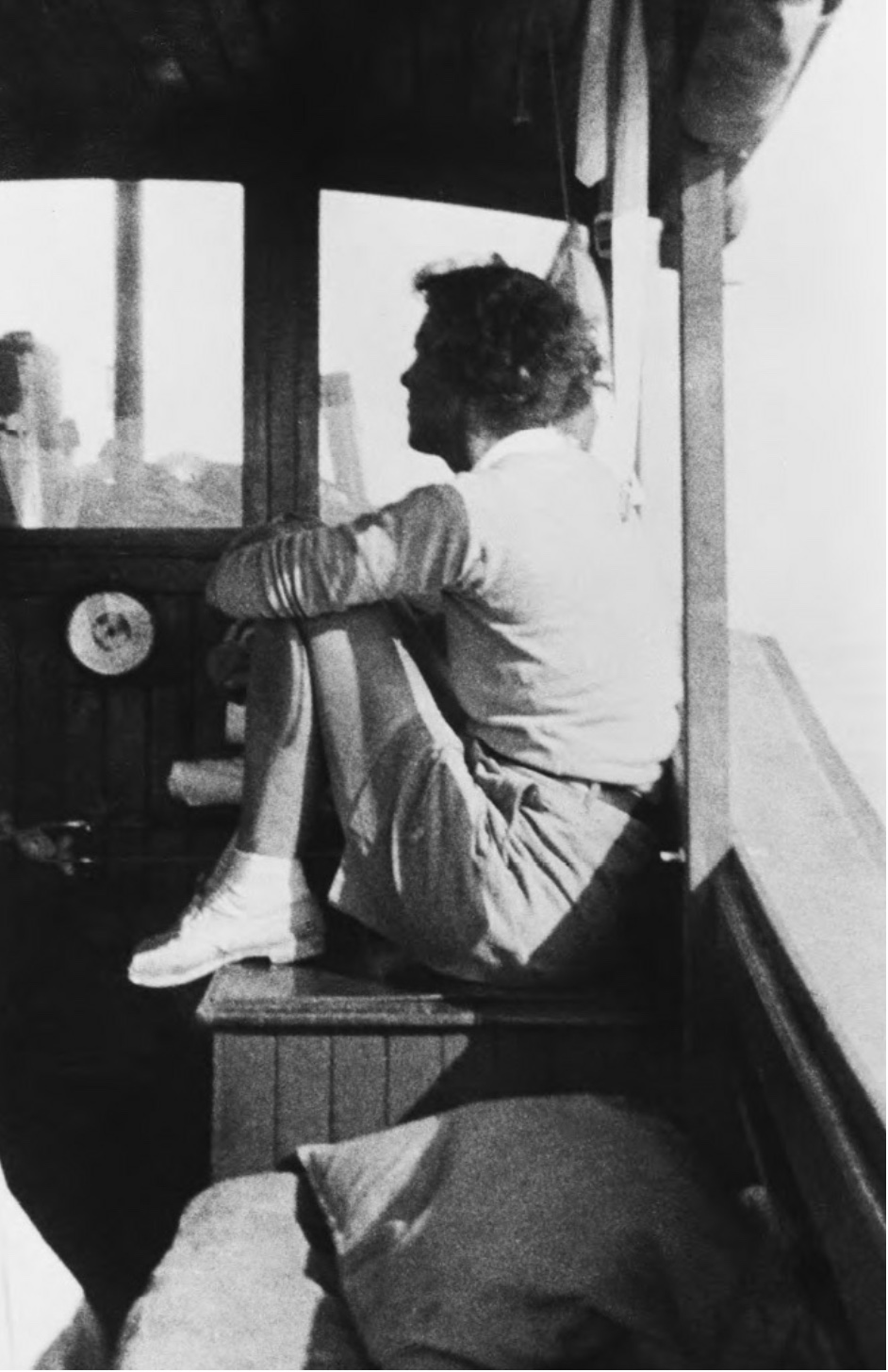
Wylie (a.k.a., Capi) in the wheelhouse of Caprice, and with her family one summer

Those British Columbia waters are famous for the very strong tides running in and out of narrow fiord-like inlets bordered by tall trees and sheer rocky walls that rise up several thousand feet. The walls above the water’s surface are generally paralleled far down below by their unseen foundations. ‘Capi’ Blanchet notes how often her marine charts indicated depths exceeding 100 fathoms in these waters  (600 feet), with the final distance downward marked as unknown. Among other challenges, such depths make anchoring nearly impossible except when a boat is secured to the shore.

Caprice, against a rocky shoreline

With one set of clothes per family member along with a bathing suit, spare but adequate cooking equipment and tableware, minimal sleeping accommodations both within and on deck, and the crew possessing a seemingly boundless sense of curiosity and desire to learn, the Blanchet’s explored hundreds of miles of what at the time were largely unpopulated and untamed seascapes and surrounding terrain. Capi Blanchet’s well-told stories about her family’s adventures during their summer cruises provide the material for her fetching book.

For those who have traveled to or lived in the Pacific Northwest, the author’s prose brings alive the look and feel, and even the smell of the moist coastal air found in that region. It may bring to mind books like I Heard the Owl Call My Name, and Snow Falling on Cedars, novels that also effectively describe aspects of that alluring part of the world. Yet, like those others, Blanchet’s book hardly prompts a romantic longing to explore waters and lands that, as she presents them, are full of potential danger because of their wildness (bears, a cougar) and unpredictable weather.

Readers interested in doing some ‘voyaging’ with Capi Blanchet through reading A Curve in Time will observe how she records experiences from the late 1920’s and 1930’s, and published her memories of them in 1961. She demonstrates sensitivity and concern about our encroachment upon the communities of people who originally inhabited the land, and upon areas of great natural beauty. Her perspective and writing may perhaps best be seen as helping – along with many others – to lay an early foundation for our contemporary approach to ‘the environment’ (a term whose present use would have been unfamiliar to her), and our raised sensitivity about the cultures of First Nations peoples.

Having read Blanchet’s compelling book, I am now curious to read Following the Curve of Time: The Legendary M. Wylie Blanchet, a biography by Cathy Converse. Though often demurring from drawing attention to herself in The Curve of Time, Blanchet clearly was a formidable woman possessed of great practical intelligence and a captivating sense of adventure. Retracing her voyaging would be challenging enough for many experienced boaters, but exploring those same waters in a boat the size of her’s, with its dependent large crew and minimal accoutrements, may suggest caution to other equally capable navigators.

M. Wylie (‘Capi’) Blanchet around the time of her marriage

For first time visitors to the Seattle area who are not embarking upon an Alaskan cruise, I heartily recommend even a short round trip on one of the Washington State Ferries. Having commuted daily to college for a year on the ferry between Vashon Island and Tacoma, and having regularly taken the ferry to Seattle on weekends, I remember how a 20-30 minute ‘voyage’ across parts of Puget Sound can help one experience in an economical and time-sensitive way a genuine bit of the maritime Pacific Northwest – the kind of waters that Capi Blanchet explored nearly 100 years ago.


Chihuly’s Glass Installations

[If reading this by email, please tap the title at the top to open your browser for the best experience. Then, clicking individual pictures will reveal higher resolution images.]

Marine Blue and Citron Tower, by Dale Chihuly, installed in 2021 at Taliesin West, Arizona


The making of art glass, especially when glassblowing, begins with glass melted in a furnace heated to over 2,000 degrees f. by gas-powered flames. As the artist works with the material, additional quantities of glass shards are typically added to the furnace. The added glass may be clear or colored, especially when recycled glass is employed, and other ingredients can be added to achieve a desired hue or tint.

Once, when my glassblowing instructor was scooping shards of recycled material into the flames, he accidentally lost grip of the metal scoop, which fell into the molten glass. To his delight, this produced a most beautiful and unexpected yellow color in the subsequently formed glass objects. Of particular note in Chihuly’s work is the conjunction of multiple colors, and the agate-like striations involving both colored and clear portions of glass.


At the most basic level, glassblowing involves attaching a glob of molten glass to the end of a tube-like metal pipe, which is then spun while air is introduced into it. At first this creates a globe-shaped object. Spinning the material fixed to the pipe can have an effect like that of a spinning pottery wheel upon wet clay. In both cases, the material can be formed into a symmetrical mass. But it can also be spun out of shape into a mess.

Whereas hands are used in ceramics to do the primary shaping, with molten glass a number of tools are employed to achieve various effects. These include assorted molds which Chihuly and his assistants may use to produce the rippled edges in some of his finished pieces like those depicted below. Wooden paddles, tweezers, cutting shears, and a variety of other tools are used in the process of shaping the very hot glassware while it is being formed, sometimes pulling and stretching it, at other times changing its orientation by causing parts of a piece to turn in on themselves. All the while the glassware artist must periodically reintroduce the work in progress into the open end of the furnace, or apply a torch to its surface, so as to keep the material hot and malleable.

Lower image: A portion of Chihuly’s Persian Ceiling, lit from above

In recent years, Chihuly has become known for his sometimes massive installations of glass. These often involve a seemingly uncountable number of objects linked together by an upright frame, suspended from a rack, or cradled from below. Viewers might encounter these installations indoors where they are displayed as a chandelier might be hung, or placed in an outdoor setting.


With his artistic exploration of the possibilities inherent in the manipulation of molten glass, and by pushing the parameters of what conceivably may be accomplished through working with this medium, Chihuly has created a huge portfolio of truly remarkable work. Of note is the way that so many of his pieces simultaneously have a sophistication that appeals to specialists and collectors, while at the same time being works of art that bring delight and wonder to children as well as to those who may not credit themselves with being aesthetically aware or sensitive. Dale Chihuly has effectively devoted his career to helping others encounter and perceive beauty in new and unexpected ways.

Another Chihuly installation, Fire Amber Herons, at Frank Lloyd Wrights’ Taliesin West

The Beauty of a New Dog

[If reading this by email, please tap the title at the top to open your browser for the best experience. Then, clicking individual pictures will reveal higher resolution images.]

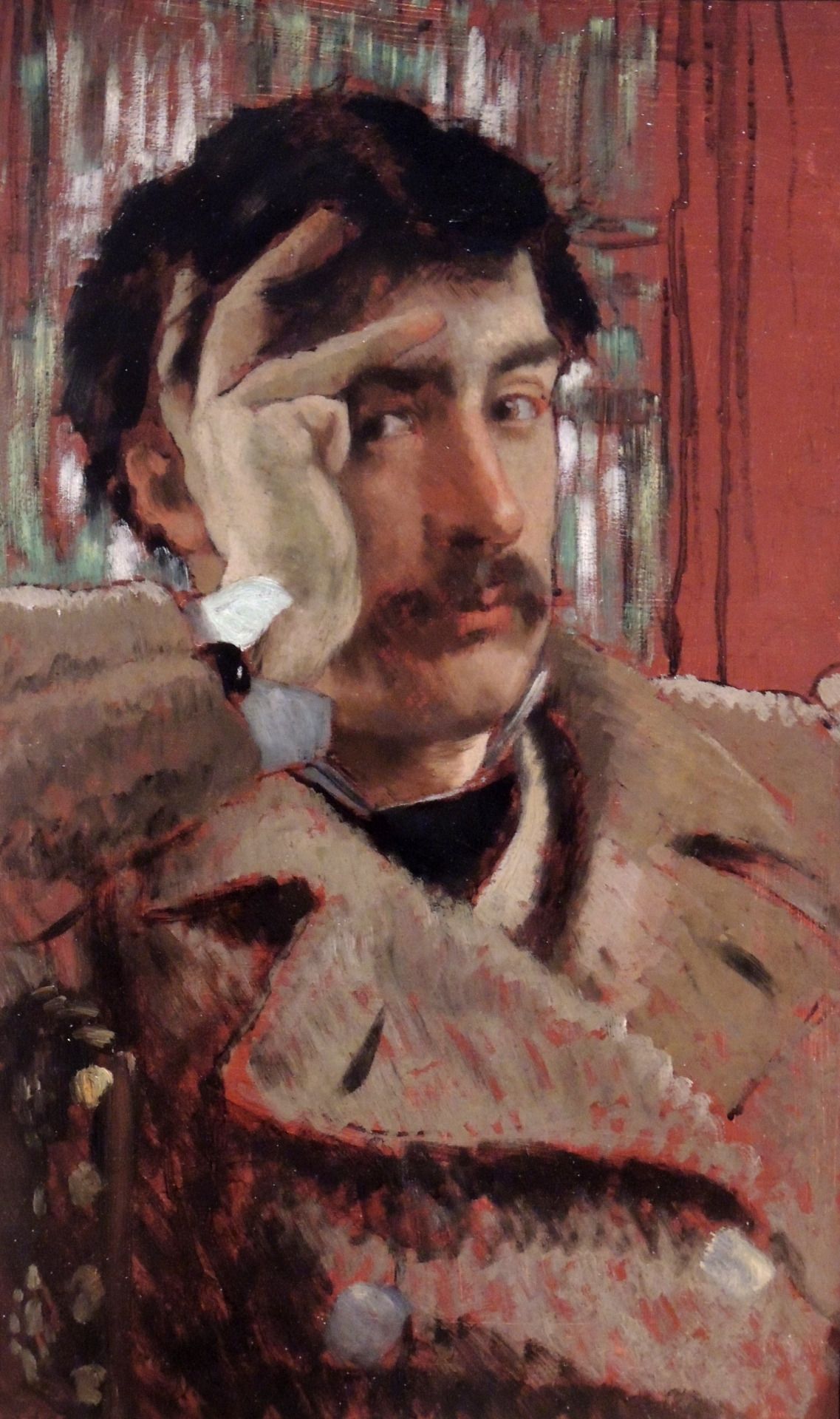
Tissot at 8 weeks, and a self-portrait by his namesake (it was the eyes!)


After experiencing some health issues this past spring I decided it was time for us to consider getting a new dog. Our rat terrier mix, Puddums (or Pudsie), died a few years ago at the happy age of 17. We still think of her affectionately and have missed canine company after moving back South in retirement.

Our oldest son with Pudsie

As Spring began to warm up south Louisiana, we thought it might be nice to have a similar addition to our household if we could find another puppy like Pudsie had been. A local shelter had a litter of rat terrier-mix puppies ready for adoption and the little guy in the photo at the top seemed just right.

His name is Tissot (pronounced ‘Tea-so’), named after a favorite Franco-British painter whose work I have often featured here. Now about 5 months old, he has lived mostly during the daytime on our screened porch. It has proved to be a good place for him to figure out that ‘elimination’ best occurs outside rather than on the floor. With the wave of Southern summer heat we have been experiencing recently, he enjoys cooler afternoons and nights in my study.

He still possesses some of his very sharp ‘baby teeth’ and is a tenacious chewer, even at the expense of some stucco on the porch! Various versions of a well-known brand of hard rubber toys have proved the most resilient to the onslaught of his teeth. We joke about him being perhaps a cross between a fox and a whippet, given his long back and tail, as well as his alertness to anything that moves and his remarkable speed relative to his small size. One thing not so small are his ears, which may have a correspondingly high sensitivity. To my surprise, my playing a small scale of three or four notes on a new recorder prompted him to respond with a mournful howl!

His uncertain lineage may include a retriever of some kind. For he never seems to tire of fetching a thrown ball, and he loves to walk with a stick in his mouth. His high energy level has proved good for me in that we take a brisk two and a quarter mile walk five to six mornings a week through the woods and by a wide creek. As a result, I am in better shape. But our walks leave me hot and tired, and him ready for more. I like to think of him as my ‘therapy dog,’ except that I sometimes wonder if he is not the one who might need therapy! Especially when he is turning in fast, tight circles in his often successful attempt to grab the white tip of his long tail. Yet, he will not be a puppy for ever.

A wise friend who is a retired neurosurgeon said something recently that has stayed with me. We were visiting together while his dog was seeking our company and attention. He said that dogs may be the only animal made by our Creator whose primary aim in life is to please us. No matter how independently-minded some dogs can be (Tissot may have some Jack Russell terrier in him), my friend’s comment rings true in my experience. Caring well for a dog, even a smaller one, is not inexpensive and may involve a considerable time commitment. But it is hard to put a price on all-around better health and the pleasure of canine companionship.

A painting (The Hammock) by Tissot’s namesake from the artist’s society painting days

The Beauty of the Seth Peterson Cottage

[If reading this by email, please tap the title at the top to open your browser for the best experience.]

Frank Lloyd Wright, Cottage for Seth Peterson, 1958

The last commission completed by Frank Lloyd Wright before his death was a small cottage for Seth Peterson. While diminutive in scale, this architectural gem incorporates many of the design features we associate with the Wright’s visionary work. A native of the region near Taliesin, Wright’s home and studio, Peterson had once sought to become one of the student-apprentices there. He later sought to commission Wright to design a personal cottage, sending a check in advance. After declining Peterson’s request more than once, Wright, having already spent the fee, was obliged to fulfill the request to provide the plans. Admirers of FLW’s architecture can be glad for Peterson’s persistence and that this small project was completed with impressive results.

Sadly, Peterson did not live to inhabit the cottage. Yet subsequent owners and devotees of Wright’s legacy helped preserve this small treasure. The fully restored cottage sits on land that is now part of a state park, and it became the first Wright home later available for guest rental (and remains so).

Attention to the relatively simple floor plan of the cottage helps orient those newly acquainted with it to identify some of the principal characteristics of Wright’s many home designs.

The entryway on the upper left side of the plan is in many ways typical of Wright’s preferences in that the structure is approached from the rear and then from the side. Slender double doors open into the compact interior which at the same time appears expansive due to the raised roof and ascending ceiling, which provide shelter over a wall of glass punctuated by warm cedar or redwood uprights. Complementing the beckoning view to the left, over a valley and lake, straight ahead the visitor sees more windows and double doors that open onto a side terrace. This prompts an initial sense that the primary orientation of this small home is toward the natural beauty of the landscape just beyond.

Passing beyond the dining table and chairs (Wright designed, of course) and into the main part of the living space, a second principal point of orientation for the cottage emerges. This is as it is with most FLW-designed homes, where one finds a massive fireplace featuring the same stone work evident throughout the structure and its surrounding terraces. While fireplaces of this kind and scale provide a central anchor point for so many of these domiciles, the plan helps us perceive something more. Wright typically grouped the kitchen (what he termed the workspace), utility room, and bathroom(s) together with the central fireplace in a practical way. Yet, visually and experientially, the fireplace always took pride of place and tended to obscure attention to those other spaces and their functions.

The relatively diminutive scale of the bedroom and bathroom in this cottage befit that of the cottage as a whole, and yet a study of many of Wright’s other house plans reveals a similar result. Just like his designs for kitchens, Wright’s apportionment of space for nighttime rest and personal hygiene was at best modest. It is as if he strongly believed that the greatest amount of waking time for a home’s residents should be in its common areas, where – beyond personal needs – one might pursue learning, social interaction and an experiential connection with the natural world.

In my view, the following photographs show the cottage at its best.

The terrace, which provides a lovely place to enjoy a summer evening.

The Seth Peterson cottage continues to receive guests through all seasons of the year.

The Beauty of Trinitarian Life

[If reading this by email, please tap the title at the top to open your browser for the best experience.]

Brother Robert Lentz, Holy Trinity


Here is a Robert Lentz icon-styled painting that blends an historic approach to portraying the Holy Trinity with an inclusion of modern astronomical imagery. The facial depiction of the first two members of the Holy Trinity are presented in a very traditional way, while the images of the galaxies very obviously depend upon telescopic photography.

The most significant truth expressed within this composition by Lentz is that all three members of the Holy Trinity were and are involved in Creation, both in terms of the primal event, as well as in an ongoing divine presence within the whole of the cosmos, a theme found in John’s Gospel as well as in Paul’s letter to the Colossians among other biblical texts.

If there is any drawback to Lentz’s composition it is one shared with just about every Trinity-themed painting of which I am aware. To put it plainly, Lentz depicts the members of the Holy Trinity as ‘them,’ as objects of our subjectivity, as divine persons we contemplate, hold in regard, and with whom we contemplate or entertain relational involvement.

What this approach lacks, perhaps of necessity in a two dimensional medium, is an expression of the equally important and sometimes non-experiential truth that we are also the objects of the divine subjectivity, and how – after Baptism – we are inseparable from involvement with and in the Trinitarian life of God.

The simplest way to help make this evident can be found in all six of the Eucharistic Prayers in The Book of Common Prayer, as well as in many of the Collects. We pray to the Father, through the Son, in the Holy Spirit. And so, whether we are conscious of it or not, we are to live as we pray, to the Father, through the Son, in the Holy Spirit.

We should no longer try to depict the Holy Trinity through two dimensional imagery, much less with diagrams, or with objects like a three-leaf clover. For in each of these cases, we render the grace-filled context of our new and relational, post-Baptismal, life as if the grounding source for our being, and our life in Christ, was somehow external to us, and something which we might still have a need to approach.

Yet, through Christ and in the Holy Spirit, the Father is now in us, and we are in him. He is closer to us than we are to ourselves. This is the great mystery, the paradox, and the beauty of Trinitarian life in Christ after Baptism.

Beauty in Parallel Revisited

golden_gate_bridge_pillar-smaller-copy

Perhaps the only thing more memorable than driving over the Golden Gate Bridge may be to pass under it on an ocean-going ship. I was lucky enough to have that experience five times before I was a teenager.

Many of us assume the name for this bridge is related to its warm color. But the name comes from the ocean straight over which it stands, and not from the Gold Rush. Rather than mimicking gold, the bridge’s official color—“International Orange”—was chosen to contrast with fog. A story is told about when that color was first applied. Painters dabbed splotches of it on the heads of curious seagulls. Pretty soon, Bay Area birdwatchers reported a new bird species, which was called the California Red-Headed seagull!

Until 1964, the Golden Gate Bridge had the longest main span in the world. Yet, its basic design isn’t unique. We know this from other suspension bridges, which are found all over the world. Bridges of this kind have two main towers, steadied in place by their suspension cables, which are anchored in the ground. From their anchor points, these substantial cables ascend to the top of the towers, and then gently descend again to the center of the bridge. From that low point, they again soar up, to the top of the opposite tower. The slightly arched roadway across is literally suspended from these main cables, by small support cables that hang from them. Here, in the beauty of this simple design, we find a helpful spiritual and liturgical metaphor.

Reflect for a moment about two significant Sundays in the church year. One is the last Sunday after Epiphany, or Transfiguration Sunday, which we observed 10 days ago. The other is Easter Day, which lies ahead. Transfiguration Sunday is the last Sunday before this season of Lent, and Easter Day is the first Sunday after Lent. Both Sundays are as important with regard to our identity as they are to that of Jesus. For in his Transfiguration and in his Resurrection, Jesus does not simply reveal who he really is. He also reveals the fulfillment of our vocation to be fully human, in him.

Imagine these two Sundays on the Church calendar as being like the two towers of the Golden Gate Bridge. Transfiguration Sunday, coming just before Lent, is like the south tower of the Golden Gate bridge, on the busy urban, San Francisco, side of the straight. And, Easter Sunday is like the north tower of that bridge, on the less familiar and historically rural side of that navigational channel. The season of Lent stretches between these two Sundays like the main span of that bridge, taking us from what we think we know to that which may yet to be disclosed to us.

Here is the crucial part ~ every year we need to make this liturgical crossing, from our sharing in the vision of the Transfiguration, to our participation in the joy of Easter Resurrection. And like the great towers of a suspension bridge, Transfiguration Sunday and Easter Sunday uphold us all the way across our Lenten journey over what sometimes may seem like dark, cold, and turbulent waters around us.


This posting is a revised version of a post I first published in 2017, and is based on my recent homily for the Last Sunday after the Epiphany, which explores the parallel between the revelation of glory that we see in the Transfiguration, and the glory we see in the Resurrection (click here for a link to it).

Christo and Jeanne-Claude: Landscape Artists with Vision

Surrounded Islands in Biscayne Bay, ‘wrapped,’ 1983


Having in prior posts featured an introduction to three landscape artists beginning with Andres Amador, today I would like to focus on the earlier work by a couple who gained recognition through the unexpected character of their joint projects.

“Christo and Jeanne-Claude described the myriad elements that brought the projects to fruition as integral to the artwork itself, and said their projects contained no deeper meaning than their immediate aesthetic impact; their purpose being simply for joy, beauty, and new ways of seeing the familiar.” [Wikipedia]

I am grateful for Wikipedia’s succinct summary of Christo and Jeanne-Claude’s shared-aim for their joint work, and especially for that phrase, “their projects contained no deeper meaning than their immediate aesthetic impact…” Modern art in its many forms has been subject to much misunderstanding, as viewers have often looked within it for ‘meaning’ and ‘a higher purpose’ where none has been intended. I have previously featured the work of Alexander Calder and look forward to presenting the work of other 20th century (and later) artists, who have offered us the sheer beauty of non-representative paintings and sculptures.

Christo and Jeanne-Claude’s collaborative work has long struck me as epitomizing this approach to the exploration of beauty. They risked appearing to have trivialized their engagement with the natural world as well as with well-known works of architecture. But they also helped us see familiar and unfamiliar things in different ways, and with new appreciation.

Most significant was their consistent effort to make their projects not only self-funded, but as ecologically sensitive as possible, with their subsequent donation or recycled use of art installation materials. In my view, they did not seek to alter the landscapes or structures with which they worked in more than a very temporary way. And certainly not in any way that would compromise those beautiful places, but instead to enhance our regard for them.

I offer the photos below with appreciation for the simple joy that these prior installations may have brought to those who were able to be present at them, and for the beauty of the preserved digital images we still have of them. I wish I could have seen one myself, in context!

Valley Curtain, Colorado, 1972

Running Fence, Sonoma and Marin Counties, CA, reported as 24 miles long, 1976

Christo on Floating Piers, Lake Iseo, Italy, 2016, after Jeanne-Claude’s death in 2009

Hundreds if not thousands walked on the floating causeway to the island

Pont-Neuf bridge in Paris, ‘wrapped,’ 1985

The Arc-de-Triomphe in Paris, ‘wrapped,’ 2021