Ethics After Easter book

Finding Beauty in Easter Living

A book for the New Church’s Teaching Series

Visitors to this space are familiar with my fondness for the words of St. Richard of Chichester: “Day by day, dear Lord, of thee three things I pray: to see thee more clearly, love thee more dearly, follow thee more nearly, day by day.” The theme can be expressed more compactly: We seek to live more nearly as we pray. These words voice our desire to walk a path of beauty in life, such as we find in ‘Easter Living.’

While serving as an Assistant Professor at one of our seminaries in The Episcopal Church, I was invited by the editor of the New Churches Teaching Series to write the volume on Ethics and Moral Theology. This was the third such series of books going back to the 1950’s that seek to provide learning for persons interested in our tradition. Books in these series have addressed a wide range of areas in faith and community life pertinent to our common desire to become informed members. I wrote my book while teaching its content in the seminary, and in about 10 different parish weekend teaching events in Episcopal churches across the country, ‘field testing’ the material. My book was published in 2000, and is still in print. I wish to note that proceeds from all the books in this series were and are donated to the Anglican Theological Review, an independent journal offering the fruits of scholarship for the benefit and educational formation of those within as well as beyond the academy.

At the time of being granted tenure, a seminary trustee asked me what the title of the book implied about its content. It became evident that her concern was focused on my use of the word “after.” I was able to explain that I used the word to mean “in light of.” The book’s title is an indirect tribute to the theological vision of my doctoral supervisor, Oliver O’Donovan, then Regius Professor of Moral and Pastoral Theology at the University of Oxford, whose book, Resurrection and Moral Order, has had a profound impact upon my thinking.

It may be helpful to clarify that I use the terms “Christian ethics” and “moral theology” interchangeably. However, it is worth observing that many within the wider Protestant tradition tend to prefer the term “Christian ethics,” while those within the wider Catholic tradition tend to use that of “moral theology.” Note that “ethics,” as a named field of inquiry without the religious qualifier, is generally understood as a branch of philosophy, which may or may not observably underpin theological writings relevant to this field.

I would like to highlight a number of themes evident within and or suggested by the structure my book, which I think are particularly relevant to Christians at this point of time:

  • Foremost, the interdependence between ethics and spirituality, which I refer to as ‘two sides of the same coin’ despite their separate spheres of concern.
  • The centrality of Baptism in the lives of every Christian believer, and its implications regarding the vital relationship between what we believe and how we live
  • Our historic Anglican dependence upon the natural world as a source of insight about the Creator’s intentions for us and for our lives. This reflects our traditional emphasis upon the Incarnation of our Lord in human embodiment. We look for the complementarity between – but do not equate nor confuse – what the Medievals called the Book of Nature and the Book of Scripture, ‘written’ by the same Author, while having different even if overlapping purposes.
  • The distinctions that I offer between what I call “laws,” “manners,” and “moral principles.” Neglecting to distinguish among what these terms represent frequently causes confusion.

The final chapter of the book moves from elaboration of basic principles in Christian ethics/moral theology to an application of these principles by offering a methodological approach to how they might be applied with reference to a particular set of ethical questions, centering on how we approach a broad concern for all of us: “Should a Christian ever been involved in or associated with an act of violence?”

I wish to stress that this is not a book about “issues.” My goal was -and remains – an effort to recover and present the foundations of a solid Christian world view for how we might best approach any issue that may be of concern. So, this is not a book where you can turn to the index and look up such matters as capital punishment or a discussion of what might be a fair interest rate on loans. I try to remain careful about observing the important distinction between moral or ethical principles that we might share, and particular policy implementations that we then undertake to reflect or enact those principles in our common life.


For those who may be interested, I include here a précis of the structure of my book, articulated in the series of Axioms that are appended within it, as well as bullet point chapter summaries:

Finding Identity in Who We Are Becoming

A promotional photo for Forrest Gump, a film exploring destiny and chance in relation to personal identity as people move through their lives

We are simultaneously two things that may seem to be in tension: We are who we are and have been, and, we are who we are becoming. The paradoxical conjunction between these statements challenges a prevalent social assumption, that personal identity is in some ways fixed.

Another observation to consider: We can no longer be who we were, years ago, nor who we thought we might someday become. For we are no longer who we were then, and surely not the person who we thought we might want to be as we matured.

But who we are now is the person we are becoming.

A trustworthy maxim from my field of ethics provides a reliable insight: practice shapes character. And character shapes practice. What we do shapes who we are (and who we are becoming), just as who we are shapes what we are likely to do. And a good definition of character is “a disposition to act in particular ways.” Our character is shaped by what we do, and what we do continues to shape our character.

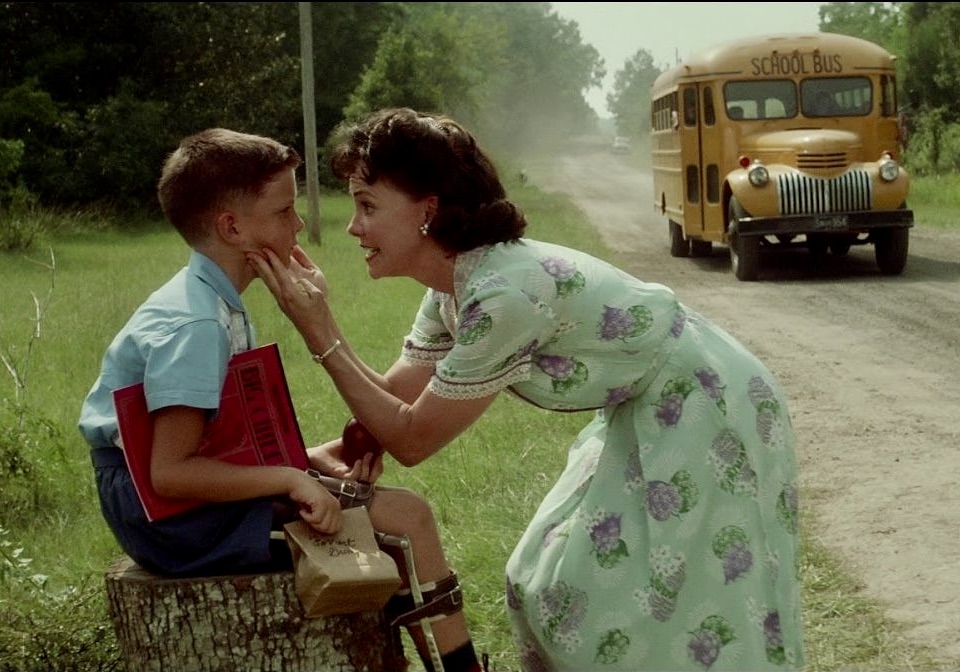
Sally Fields and a youth playing the roles of Forrest Gump and his mama

Or, as Forrest Gump’s mama famously said, “Stupid is as stupid does.”

Whatever truth may be found in another old saying (“character is destiny”), who we are becoming is not in some way predetermined. We are in large part shapers of ourselves, even while we may feel like we are being shaped by events and or by other people. Yet, from the Beginning, God has been the Great Shaper of all things, even of us. As our Redeemer, through Baptism, God changes us and gives us a new life centered on the graced possibility of redemptive transformation.

In formal terms, the ideas I am exploring here involve dialectical relationships, such as we find between act and character, and between us and others. In these relationships, there is always a two-way, dynamic process of interaction between these various entities, whether we are speaking of God, ourselves, others, and or the circumstances in which we find ourselves.

Within all this, we experience a lifelong quest for a better sense of our identity. It is too easy, though often tempting, to try and resolve this quest in terms of external factors, such as who we imagine ourselves to be in the eyes and thoughts of other people. To be directed in our ideas and actions by what we think may be expected of us, or by what other people hope for us, usually comes at the expense of the influence of the Great Shaper, the One who reveals to us our true meaning and the purpose of our life journeys. Our primary dialectical relationship is with our Creator and Redeemer, our grounding guide for who we are meant to be, and become.

For these reasons, it is good to resist the typical kinds of “I am… “ statements so current in popular culture – statements like “I am a Democrat, or a Republican,” or “I am an introvert, or an extrovert.” A more helpful kind of self-definition springs from statements based on what we tend to do. For example, instead of the prior statements, it would help us to say things like, “I tend to vote in the following ways…,” or “I tend to respond to social situations by preferring to…” Consistent with these views, I resist self-definition in similar “I am” terms when it comes to how I measure when using Myers-Briggs related personal inventory instruments. This is, in part, because of their foundation upon Jungian thought, which anticipates how we as human beings have the opportunity to grow and change over time, especially in the direction of our ‘shadow’ strengths or areas of challenge.

I continue to value an insight offered by a former teaching colleague. In a conference he once said, “People don’t actually ‘learn from experience;’ they learn from reflecting on experience.” We experience and do things; we reflect on both, and we learn as we continue to think about what we encounter, and choose to do.” In the process, we are becoming who we are now.

Who am I becoming in relation to what I am doing now? This is a helpful Lenten question in light of our preparation for Easter living.

Beauty: Found, Received, and Made

A photo from Èze, France (by my brother)

While undertaking my studies in ethics and moral theology, I discerned a significant parallel that has continued to shape my world-view. The parallel I have in mind connects how we understand law with how we understand ethics. In turn, I have come to see how this discernment applies also to how we appreciate beauty. 

First, about where law comes from. As I understand it, there are three principal theories about our source or sources for law, formally termed theories of jurisprudence. They are not mutually exclusive, and may function for us in overlapping ways. 

A common understanding regarding the source of law views the concept of law as fundamental to and discernible within the structure of reality. Law in this first sense is something we find, written into the patterns of the world, and of its many aspects. This idea gives rise to, but is not the same thing as, the so-called ‘laws of nature,’ or the principles that order the function of many things from the most basic particles within matter, and the function of waves like light and energy, the functions we discern within complex biological organisms however malleable they may seem to be over time, as well as within the structure of rationality. 

A well-known expression of this first concept of law is latent within the familiar phrasing regarding what it means to be a human being: “we hold these truths to be self-evident…” That is, certain truths or principles are there to be found, by those who exercise our capacity for reason and discernment. A simple but sometimes misleading label for this first concept of law is ‘natural law,’ which some skeptics might argue is neither!

The second most commonly recognized theory of the source of law can be articulated by observing those principles and ‘rules’ long-rooted in the history of our communities, which we receive from those who have come before us. British Common Law, which undergirds much of our tradition of law in the United States, is a prime example. ‘Received from history,’ and long relied upon by communities, are two basic ways to label and identify this concept of law. The familiar refrain, ‘we have always done it in this way,’ provides a ready example. 

The third way of understanding the source and character of law perceives law to be comprised of those principles and or rules that have been decided by individuals and communities. It is commonly called ‘positive law,’ a label that refers to the law that we posit, or put into place. The existence of law in this third category represents the assertion of will and of choice, for law in this sense arises from us as something we make, and is dependent upon our projection of what we wish or believe to be true. Many examples, from neighborhood clubhouse rules to Louisiana’s state constitution (resting upon the French Napoleonic legal tradition), are expressions of this approach. 

These three theoretical understandings of the source of law are relevant for my own field of ethics. For in ethics, there are three principal bases for our concept of the Good, and upon which our notion of the Good rests, which correspond to three principal forms of jurisprudence or theories of the source of law. 

Moonrise off the harbor breakwater in Antibes (photo also by Gregory Holmgren)

If this is correct, and I believe it is, then surely we can reason appropriately toward the same conclusion regarding Beauty as well as for Truth. For Beauty and Truth as Transcendentals play the same foundational role in our thinking as the Good, which functions as a principal reference point for ethics in human reasoning and experience.

This leads me to recognize how there are three principal ways of accounting for the source or sources of beauty. With regard to Beauty, positivists will contend that ideas regarding beauty are projections of those who hold them, whether by individuals or by communities. Historicists, in parallel with the common law tradition of jurisprudence, will say that notions of beauty are rooted in the histories of communities and the traditions, and are to this extent reliable guides for thinking about things. And – as follows from the preceding, those who accept the natural law tradition in jurisprudence are those most likely to view beauty as a given feature of reality, here and there for us to encounter, regardless of our shared traditions and personal aspirations. 

In closing, I want to restate a point I made above. Whether we are accounting for the source or sources of Beauty, Goodness, and or Truth, we may prefer one or more of three ways I have articulated based on the three principal approaches to the sources of law. Yet, all three approaches are likely to figure into and be a part of our thinking. For example, we may think that notions of beauty are rooted in nature, while valuing how our Western tradition of art has shaped our thoughts and those of our community, while still also recognizing how we may be somewhat arbitrary regarding the forms or standards of beauty that we prefer to value and pursue! Especially because the first or second of these three approaches may serve as a corrective to and perhaps as also a check against the potential liabilities associated with the third.

The Beauty of Redemption-Based Identity

If reading this by email, please tap the title at the top to open your browser for the best experience. Then, clicking individual pictures will reveal higher resolution images.

Fra Angelico, The Transfiguration, prefiguring the glory of the Risen Christ and the beauty of our redeemed humanity


There is beauty to be found when we base our identity or concept of ourselves upon the Redemption that has been freely shared with us. Yet, we can experience sadness when we rest our self-perception upon our ailments and disorders. Regardless of our feelings, these alternatives represent choices we can make on a daily basis.

We all have an innate disposition to sin, and in various ways we all enact this disposition. But, for Baptized people and all others, this is not ‘the be all and end all’ of who we are made to be. Our end is in Christ, and so our wholeness is in Christ. We may be sinners; we are also among those who have been redeemed and are being transformed by the power of the Resurrection.

Appreciative Inquiry teaches us that what we we focus on grows. This empirical fact can be seen in two readily observable ways. New soccer players, especially the youngest ones, tend to swarm around the soccer ball. And, when on a fast break to try to score a goal, almost inevitably they kick the ball toward the goalie, the apparent impediment on whom their eyes are affixed instead of upon empty areas of the net. Another example lies in how Drivers Ed instruction teaches aspiring drivers to keep their eyes on the road. Why? Because we steer toward what we are looking at, often with sad results when what catches our attention are the flashing lights of an emergency vehicle on the shoulder.

I remember an observant friend remarking about another person known to both of us, regarding how that person was “someone who dotes on his infirmities.” Not a recipe for health in light of our greater awareness about the symbiotic relationship between psychology and physiology.

These insights may have what I hope are obvious spiritual implications. They may lead us to ask, toward what end are we living? Upon what image of our humanity are we most focused?

Raphael, The Transfiguration (detail)

An ironic aspect of the way that we can associate our identity with symptoms or conditions from which we suffer is how we commonly speak about our embodiment. When we say things like, “my leg is killing me,” or “my head feels terrible,” we may unintentionally reinforce a kind of dualism. All too casually, we dismiss such statements as mere figures of speech, and we may wish to consider their further significance. If I say that ‘my leg is killing me,’ then I suggest that in some way ‘my leg’ is not ‘me.’ Because my words imply that ‘it’ is acting upon ‘me.’ In a slightly more abstract way, we make statements like, “my conscience is bothering me.”

When I am inclined to think and speak in this latter way, I suggest by my words that ‘my conscience’ is something other than ‘me,’ and that it has some power of agency over or against me. What we commonly refer to as ‘my conscience’ might better be described as my experience of ‘consciencing’ (an intentional neologism). Or about how I am the kind of being who experiences and engages in acts of conscience. As the older moral tradition recognizes, conscience must not only be followed; conscience can and must be educated.

So, to say that “I am powerless over sin” does not necessarily mean that I am powerless over my disposition to engage in the bad choices and decisions that I tend to make. Like my emotional experience, I may not be able to choose to have the various physiological conditions that I experience. But I can choose how I respond, or how I act in relation to such experiences and conditions. As John Wesley is remembered as having said about the vice of lust, “a bird may land on my head, but I don’t have to make a nest for it with my hair.”

Experientially, I can associate myself with the conditions that may ‘happen to’ me, and with which I may suffer. But conceptually, I can also choose to identify with the reality of the person I have been made to be and become. By grace, we have been made to become icons of Christ, who is the beautiful Icon of God. To seek to become so is to seek to become an icon of the goodness of God as well as of the truth of God, as these have been revealed to us in the face of Christ.

Rembrandt, The Ascension, an image prefiguring our redeemed humanity to keep in mind so that we may, as the Prayer Book’s venerable words put it, “thither thereto ascend.”


Note: The wisdom of our Holy Tradition is reflected in the fact that our Lectionary appoints Gospel readings about the Transfiguration on two occasions every year: on the last Sunday after the Epiphany (or the Sunday before Ash Wednesday and Lent, March 2 this year), and also on August 6, the Feast of the Transfiguration of our Lord. / In addition, readers interested in some of the ideas presented above might consider further material relevant to them in my book, Ethics After Easter, available from libraries and booksellers.

The reflections offered here may assist choosing a theme upon which to focus in preparing for and in keeping a Holy Lent.