Art

Pointing Toward Perception

If reading this by email, please tap the title at the top to open your browser for the best experience. Then, clicking individual pictures will reveal higher resolution images.


We live in a world filled with “data.” Disconnected bits of information, especially in great quantity, overwhelm our ability to see and to think. Accumulating additional data or more information does not produce knowledge. Knowledge has to do with seeing the connections between bits of information. When we see the connections, we begin to see a picture, we begin to hear a story, and we gain understanding as well as wisdom.

The unrecognized fellow traveler on the road to Emmaus asks the two disciples, ‘what are all these things you are talking about?’ The answer he receives from them amounts to information. But his question is pointed toward understanding, especially in relation to ‘the big picture. He is challenging them to discover something bigger. He is really asking something like this: ‘All these things’ that have happened… What do they have to do with what God has been up to, all along?”

Here is a basic Christian truth that we find in the Emmaus Road story: Things take on meaning in relation to the risen Jesus. It happens when we see events in our lives in relation to him. It happens also with things like bread and wine as we gather at table. And it happens with people like you and me as we gather in community.

Jesus helps our perception on the road to Emmaus, and reveals something even more profound at the inn. This ‘inn,’ unlike the one where he was born, has many rooms, many mansions. When we see things like past events and the bread in relation to him, we discern more about what they were or are, and what they yet can become. When we see ourselves in relation to him, we better discern who we really are, and who we are called to be.

Prayerfully, we can look around, between things, and within. We can look for the connections. When we do, we see and discern. We see more because we see more wholly. Then we see the holy.


The above painting, Supper at Emmaus (1958), is by Ceri Richards, and is used by permission from the Trustees of the Methodist Modern Art Collection (UK). The penciled notation at the base of this guache painting on paper suggests that it was intended as a study for an altarpiece painting for the chapel of St. Edmund Hall (or College), at Oxford, England. The Emmaus story can be found in Luke 24:13-35, and it is a traditional Eastertide Gospel reading.

This post is adapted from one first published in 2014.

The Believing Eleven

If reading this by email, please tap the title at the top to open your browser for the best experience. Then, clicking individual pictures will reveal higher resolution images.

Peter Paul Rubens, The Rockox Altarpiece, 1613-1615 (center panel)


It is evening on the day of Resurrection-discovery. John tells us that ten of the disciples are hiding behind a secured door out of fear. Judas is deceased, and Thomas is away.

Jesus suddenly appears to the unprepared disciples, and shares with them his peace. He shows them his hands and his side, and then – as a direct consequence of seeing the places on his body associated with his death – the ten disciples rejoice when they see their Lord. In other words, their recognition of him, and that he was somehow alive again, brings them joy by restoring their belief in him.

When hearing this story from John’s Gospel on the second Sunday of Easter, we may be prone to considering it apart from what happens just before it. The disciples, who are hiding out of fear, have already received an eye-witness to the resurrection of Jesus. Mary Magdalene, to whom Jesus revealed himself at the tomb that morning, had come and told the ten the Lord was alive, and that he had appeared to her. Clearly, and prior to Jesus’ unexpected appearance, the ten disciples are still doubting her personal witness. Even after receiving what should have been trusted testimony from Mary Magdalene, a fellow follower of Jesus.

So why – in popular imagination – isn’t this well-known Gospel reading from John 20 commonly referred to as the “doubting disciples” reading? Why should Thomas be singled out, when his joyful recognition of the risen Jesus depended on nothing more or less than what the 10 had needed, and received, before him?

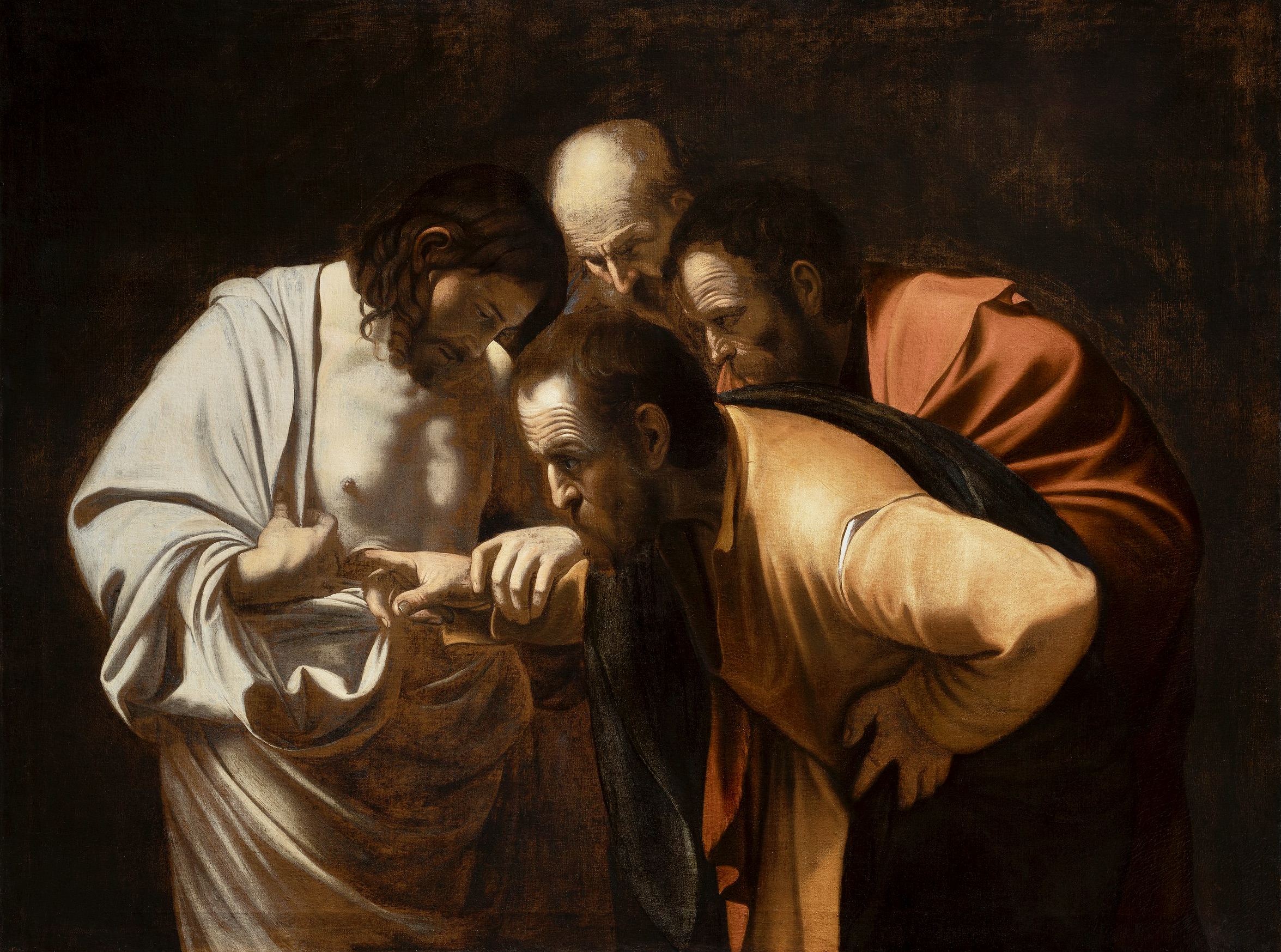
And why have so many painters in the Western tradition privileged Thomas’ purported unbelief in the Risen Lord, rather than depict the earlier reluctance of the ten others to arrive at joyful confidence about the Lord’s astonishing return? Apparently, in many painters’ eyes (especially Caravaggio), more visual drama was to be found in images of a doubter’s hand placed within an open wound.

Caravaggio, Doubting Thomas, 1601 (a famous traditional presentation of the event in John 20)

A further detail to notice, which our familiarity with so many paintings helps to obscure, has to do with how Thomas responds to Jesus. According to John, Jesus appears to the not-yet-believing ten, and – unbidden – shows them his hands and his side. Seeing the traces of his wounds on his risen body brings them joy. Jesus then appears unexpectedly a week later, this time showing himself to the one not present on the prior occasion. And just as he had done previously, Jesus offers Thomas the same opportunity he had provided to the others.

We should therefore not be misled by Thomas’ oft-quoted comment to the other disciples, prior to his own epiphany, about what he needed in order to believe. According to the text, Jesus – upon appearing in the same house a second time – bids Thomas to touch him. Yet, Thomas immediately responds to Jesus’ words without any mention in the Gospel of him having physical contact with the risen Lord’s wounds. Jesus then asks Thomas a rhetorical question, “Have you believed because you have seen me?” Naturally, Thomas’ implied answer is ‘yes.’

For all these reasons, we will do better to find a different and more positive descriptive phrase by which to refer to this well-known passage from John 20. “Jesus meets the disciples according to their needs,” though wordy, would do better.

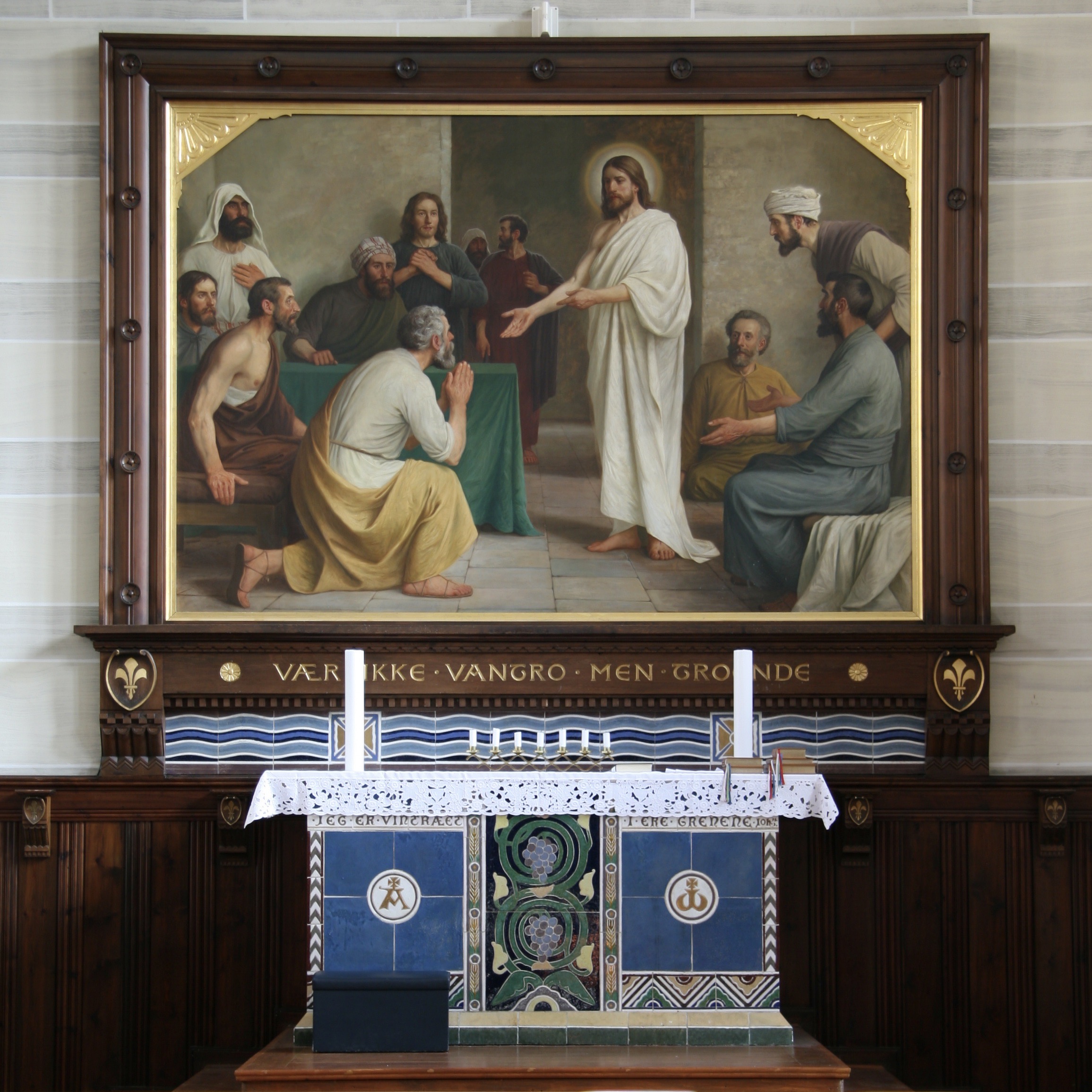
P. Steffensen’s altarpiece painting behind the altar of Zion Lutheran Church, Copenhagen


This post is based on the traditional Gospel reading for the second Sunday of Easter (April 7 in 2024), John 20:19-31. The story within it concludes with these words: “Jesus said to Thomas, ‘Have you believed because you have seen me? Blessed are those who have not seen and yet have believed’.”

Note: The altarpiece paintings by P. Steffensen and Rubens provide an interesting counterpoint to the prevailing tendency of painters to focus on Thomas placing his hand in the side of the Risen Jesus.


I Will Take You To Myself

If reading this by email, please tap the title at the top to open your browser for the best experience. Then, clicking individual pictures will reveal higher resolution images.

Fra Angelico, Noli me tangere


In the intimacy of his physical embodiment, the disciples and the holy women want to hold on to Jesus. It is the only way they have known him.

Mary is then found by the One she is looking for, in the garden by the tomb, on what becomes the Resurrection-discovery morning.

”Don’t try to cling to me,” he tells her, for he has not yet ascended to where he promises to take us.

We want to hang onto to how we have best known him. He promises to hold us to himself in what will be an even greater intimacy.

It is just beginning. Alleluia!


Jesus said to her, “Do not cling to me, for I have not yet ascended to the Father; but go to my brothers and say to them, ‘I am ascending to my Father and your Father, to my God and your God.’” (John 20:17)

“And if I go and prepare a place for you, I will come again and will take you to myself, that where I am you may be also.” (John 14:3)

Once and For All

If reading this by email, please tap the title at the top to open your browser for the best experience. Then, clicking individual pictures will reveal higher resolution images.

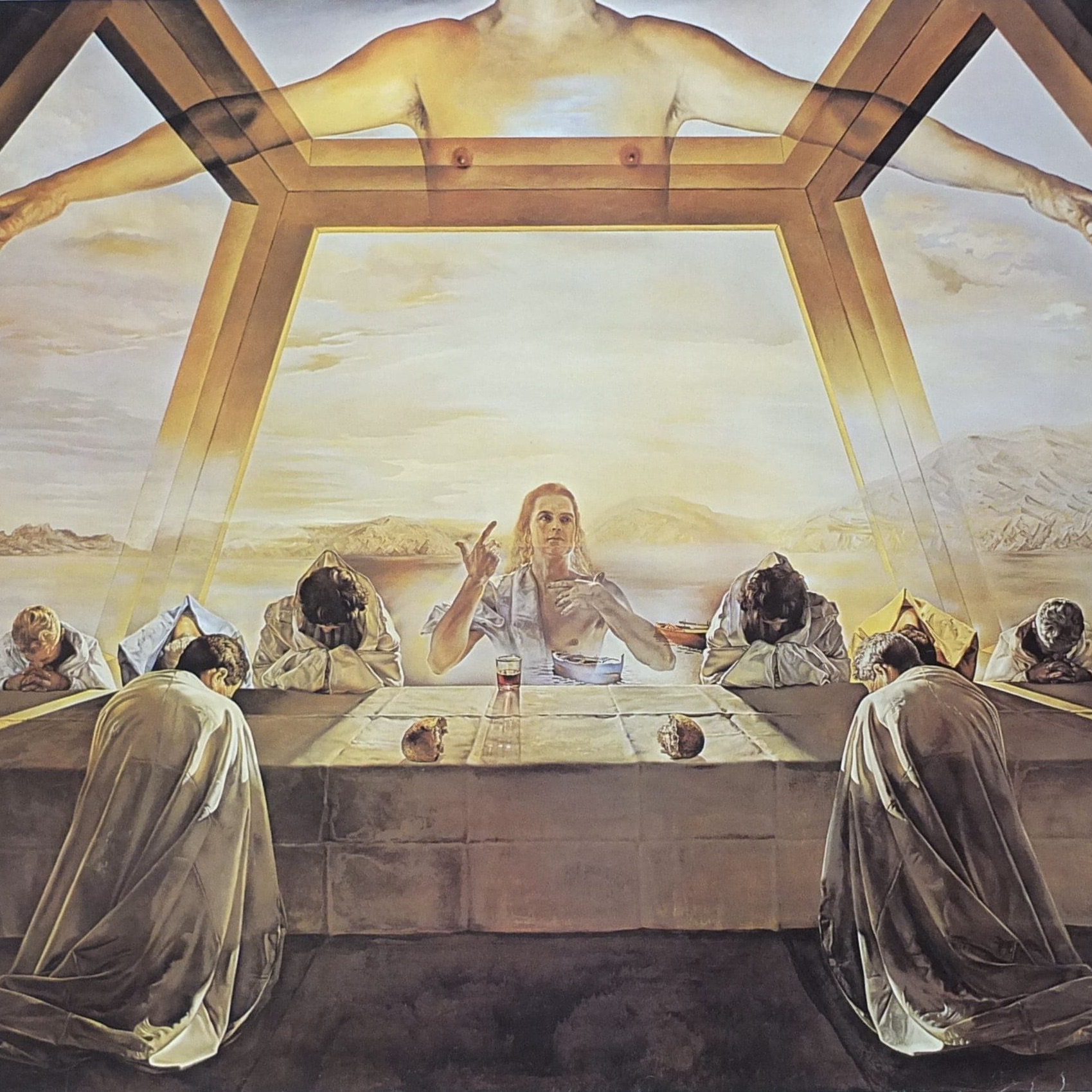
Salvador Dali, The Sacrament of the Last Supper (detail)


With his life, and in his death, Jesus offered himself. In accepting crucifixion, he offered himself and the whole Creation to the Father, in the Holy Spirit. He did this once and for all. Yet, in every Eucharist, and for all who remember him on any day, he continues to make present and real in our experience what he did, once and for all.

He acted, once and for all. Yet – and this is the paradox – he still acts for all… for all time, for all places and things, and for all people. What he is still doing now does not in any way signal an incompleteness to what he did then. For he continues to offer the gift of including us in what he did then, when he did what he did, once and for all.

So what does it mean for him to include us now, in what he did then? That is the question for the holy three days of our Paschal Triduum, which begins on Maundy Thursday evening.

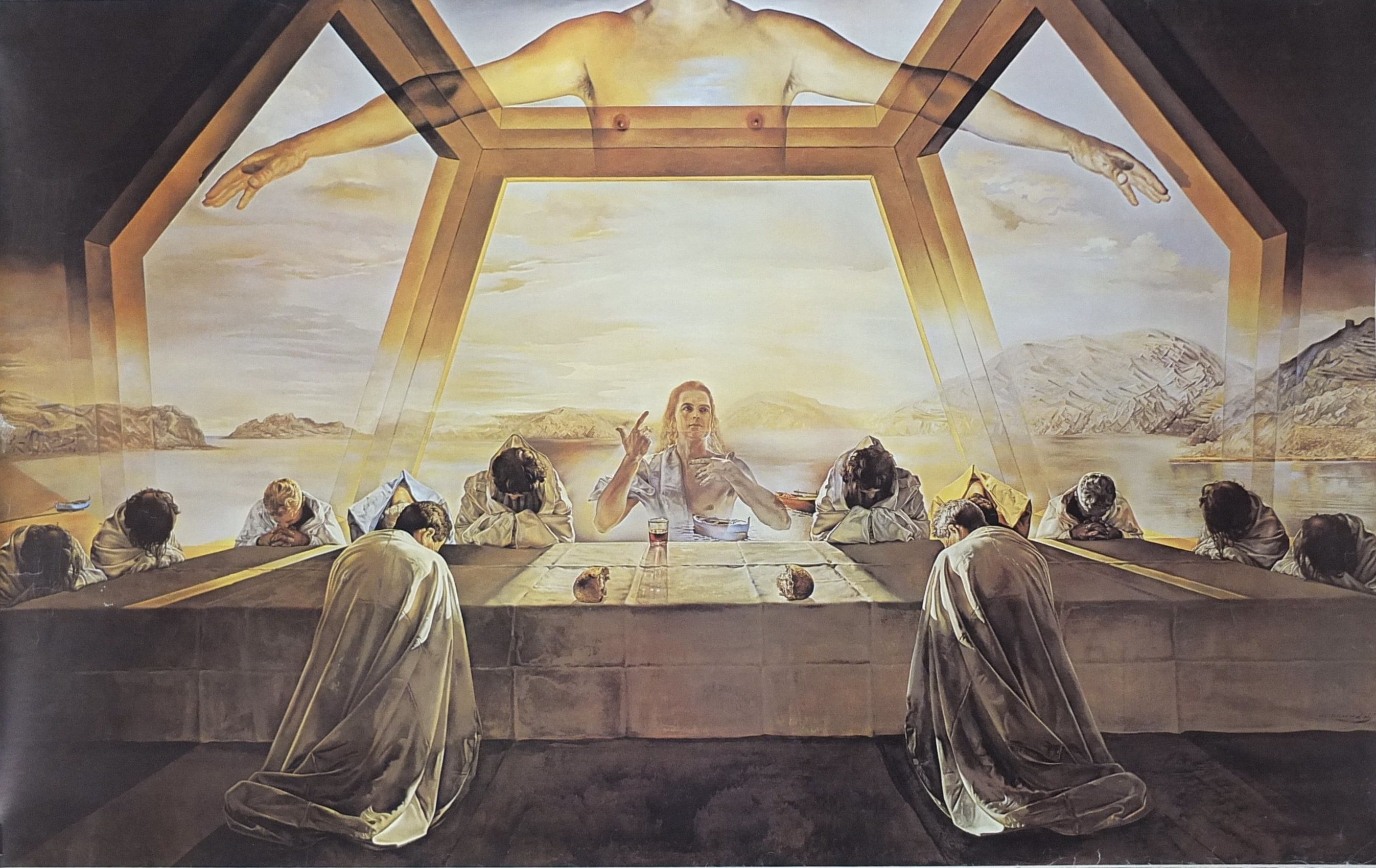
One way into the many answers to our question can be found in Salvador Dali’s painting, The Sacrament of the Last Supper. It is not a painting of, or about, the Last Supper. Instead, this is a painting inspired by the Last Supper, and by what it came to mean in the broader context of all that happened during those three days. For the painting is about the sacrament in which the Risen One now makes present the result of what happened on the Cross, in the Resurrection, and with the descent of the Holy Spirit.

The Book of Common Prayer service for Good Friday is in fact not a Eucharist, just as the Last Supper in that Upper Room was not a Eucharist. The Last Supper prefigured the Eucharist, but could not have been one. For Jesus had not yet died, nor yet Risen from the Tomb, and the Spirit had not yet descended at Pentecost. And neither are the sacramental services on Good Friday intended to be Eucharistic celebrations. For in the wisdom and tradition of the Church we do not celebrate the Eucharist on this most holy day, though we may receive the fruit of it, and all its benefits, when Communion is offered to us.

Instead, all our focus is upon Him, who died and rose again for us, once and for all.

These are some of the reasons why Dali paints the disciples as recognizable, physical, and historically-anchored, people. And why he yet paints our Lord as present in his mystical risen glory.

We gather in his name and in his presence on particular occasions, in particular places, at particular times. Yet he is now present at and on all occasions, in all places, and at all times. We – who are rooted in time and place – receive him who transcends and yet is present within all times and places. Grace infuses nature. The timeless One imbues time with glory.

The Sacrament of the Last Supper (full image)

On the cross, Jesus lifted up the whole Creation to his – and now our – Father, once and for all. Just as he lifted up our human nature in his Ascension, which in a sense then became our Ascension. And yet, he continues to lift up the whole Creation – including us, and including all the uncertain and unfinished aspects of our lives. So, the One who is the source of all purpose and meaning continues to bring meaning and purpose to us, and to all that we lay before him, here and now. Time and again, he brings completeness and wholeness to all that is lacking, so that we might live more fully in his glorious fulfillment of what it means to be human. For all this, we offer our deepest thanks and praise.

May these ‘holy three days’ (Maundy Thursday evening — Easter Eve) in the Church’s Christian observance of Passover be a time of blessing for us and our loved ones.


This post is adapted from my (2024) homily for Good Friday, which may be accessed by clicking here.

Note: blog settings have been changed to provide more opportunity to offer comments, using the link below.


The Beauty of Sister Wendy

If reading this by email, please tap the title at the top to open your browser for the best experience. Then, clicking individual pictures will reveal higher resolution images.


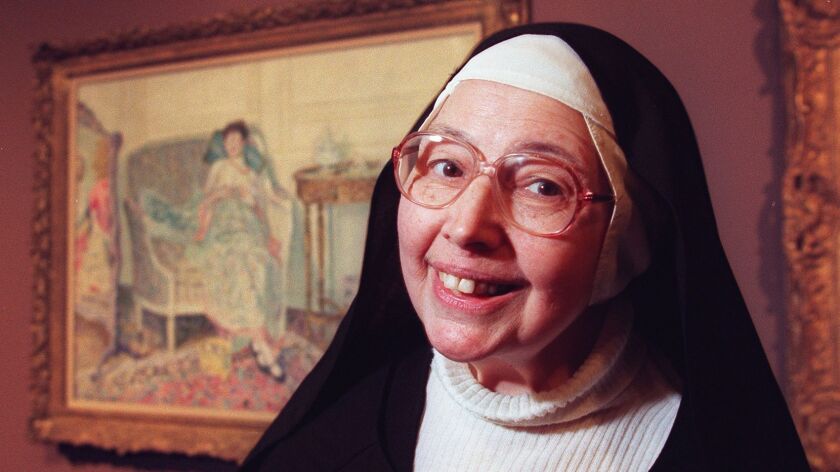
Paul left us with some of the most remarkable words in the New Testament: “For God, who said, ‘Let light shine out of darkness,’ has shone in our hearts to give the light of the knowledge of the glory of God in the face of Jesus Christ.” And so, we ‘behold the beauty of the Lord’ in each other. Especially If we have died with Christ in Baptism, and risen with him in his Resurrection. For we now live in him, and he in us. I am reminded of these truths when I see images of Sister Wendy Beckett’s face.

Readers familiar with this blog website will have guessed at the sense of affinity I feel when I see Sister Wendy’s videos, or read her books. Discovering her work, and gaining a sense about her perception of her vocation, have been a source of encouragement for me. She has glorified God by helping me to perceive and give thanks for beauty. And not just in art, but in faith and life, and in all the world.

We are often blessed with companions as we journey through our lives in this world, some familial and or some spiritual, some more proximate to us and others further away. When asked about these people, we are likely to offer praise for what they mean to us and for what we have received from them. Sister Wendy has been a companion for me because of what she represents: a life well-lived, one attentive to what is most important, while less distracted by that which is ephemeral.

I like a biblical metaphor with which to think about how things will be when we – as people like to say – ‘pass through the veil,’ ‘get to the other side,’ and experience being ‘in the nearer presence of our Lord.’ It is to consider with whom I might want to sit at table in the kingdom of heaven, along with Abraham, Isaac, and Jacob, with whom Jesus promised many would come to be present (Mt. 8:11). And at table with Mary, Martha, and Lazarus, with whom Jesus dined at an occasion commemorated on Monday in our Holy Week lectionary. Of those not personally known to me in this life, Sister Wendy is one near to whom I want to sit.

Here is a proverb I like to quote, which applies to much of life: we move toward what we are looking at. In addition to the weekly texts from the lectionary and their related readings, I spend a lot of time looking at images of beauty, in its many forms. Having started my adult life as one aspiring to work in art and architecture, and then largely setting those things aside when pursuing ordination and theological work, I now find myself returning to my starting point. But with new eyes, and a wider horizon.

Sister Wendy, and the example she represents for me, have played a quiet but very important role in my growth and aspiration toward greater wholeness.

Thank you, Sister Wendy, for helping me and us see beauty, and by this to know God’s love in a fuller way.


During these forty days of our preparation for the Paschal feast, I have been finding quiet joy and peace in Sister Wendy Beckett’s, The Art of Lent: A Painting a Day from Ash Wednesday to Easter. The quote at the outset from Paul can be found in 2 Cor. 4:6.

Note: blog settings have been changed to provide more opportunity to offer comments, using the link below.

Yo-Yo Ma and The Performance of Art

If reading this by email, please tap the title at the top to open your browser for the best experience. Then, clicking individual pictures will reveal higher resolution images.


Recently, I had the opportunity to see and hear Yo-Yo Ma perform Dvorak’s Cello Concerto. Ma’s presentation of the music was stirring and evocative. Reflecting on the effect of that concert, I want to describe the experience of beauty we find in the human presentation of particular arts. The idea of performance keeps that evening in my thoughts, as well as how presentation by performers plays a significant role in certain art-forms.

When works of art are appreciated, their beauty begins to have an existence within those who encounter and engage it. This continues as we entertain those works within our imaginative and reflective consciousness. In this sense, these works of art may be said to inhabit us, having ‘taken up residence’ within our awareness, and sometimes in our dreams.

Artists convey something of the humanity we all share. They make available perceptions and insights personally important to them but which also become important to us. Artists do this by imparting aspects of their apprehension of what is beautiful, good, and or true. Appreciating their art, our perception is then made finer as we attend to their work, and as that work becomes part of us.

The creation of visual art objects such as paintings and sculptures generally occurs over a period of time, and usually happens in a private setting. Musical composition and playwriting have an affinity with the work of painters and sculptors. For writing music and plays also usually takes time and often occurs in a studio setting or personal study room. Upon completion of these works, whether paintings, sonatas, sculptures, or plays, the results may be offered to viewers and or readers. Parallel to how people often see the work of painters and sculptors, a musical composition can simply be read as a score, just as the text of a play may be read in silence by someone in a library.

In a sense, paintings are simply there. Paintings ‘speak’ in a limited way; they communicate something of an artist’s vision and experience; and, they are available for engagement by viewers who happen to, or choose to, interact with them. Yet, with works for the theater or the concert hall, something further and significantly different happens when a concerto or a play is ‘performed.’ With performances, features of the personality of the composer or writer – as well as those of the performers – are in a position to be displayed and conveyed.

Clearly, we recognize that what is shared in works of art is important to us. How musical or theatrical works of art are then presented can be just as important, especially as they are performed.

Within the visual arts, an artwork comes to inhabit the viewers who engage it. With arts that are performed, performers also inhabit the works they present. This has a significant effect upon our shared engagement with concerts and plays. And Yo-Yo Ma, as a highly skilled performer, provides a compelling example of what it means effectively to communicate a composer’s imaginative vision and passion to a receptive audience.


Note: blog settings have been changed to provide more opportunity to offer comments, using the link below.

The Beauty of Asking “Why?”

If reading this by email, please tap the title at the top to open your browser for the best experience. Then, clicking individual pictures will reveal higher resolution images.

Back cover photo from Natural Sustenance: Selected Poems, by Nick Fleck


“Why?” It all started in a seemingly innocuous way. “What do you want from this course,” he asked. A brave one among us ventured the answer that some of us were thinking, but were not honest enough to say: “an ‘A’.” Our English teacher, Nick Fleck, responded to my classmate in a neutral way, with a further question, “Why?” Our fellow aspirant to higher grades began to offer pretty typical answers, unoriginal and unsurprising. “I want a high GPA. (Why?)… I want to get into a good college. (Why?)… I want to get into a ranked law school. (Why?)… I want a good job at a high powered law firm. (Why?)…”

Gradually the pauses before our classmate’s answers became longer. And while his responses still sounded plausible, they seemed less and less assured. That first class session set the tone for the rest of term, as over time Nick prodded all of us to articulate answers to questions like these. And nudged us toward answers that were more and more our own, and less dependent on our peers, our parents’ expectations, and our perceptions of the uncertain world outside our rural New England prep school.

Why? The question at first provides an invitation to share acquired knowledge, display settled opinions, and voice aspirations. But the question can also be unsettling, especially when we begin to run out of platitudes and ‘safe’ answers that don’t require self examination or being open to adopt a different perspective.

I can’t fully explain why, out of a class of some 350 or so fellow graduates, I was one of only 3 or 4 who did not go directly on to college. But Nick Fleck’s persistence in challenging us to think for ourselves played a big part in it. Temperamentally, I was and am a self-learner, which disposed me toward pursuing that risky path (“…in a blind career…,” as in a line from a poem Nick had us read). Naive self-confidence also bolstered my willingness to undertake a journey on what appeared to be a largely untested road. I wanted to be an architect and to make art, and those whom I most admired had embarked upon their careers in earlier times by this same route through apprenticeship and self-study.

Having been so consistently asked why, I made the question my own and began asking it in a self-referential way. Why did I want so strongly to embrace and try to create what was beautiful? Why was this important to me… and to others apparently walking the same path? Why was I then beginning to wonder whether this was good and, if so, to what end? And why then was I going on to ponder what was good for its own sake as compared to things of passing significance?

Within a year, after living in New York City seeking non-existent apprentice drafting positions during the ‘oil crisis,’ I returned hesitantly to formal schooling. My college art studies were interrupted by another sideline, driving a forklift in a warehouse freezer for six months as a Teamster. Then, surely to my parents’ relief, asking why led me on a more traditional path, from art history to classics and medieval studies, during which I experienced an unanticipated spiritual conversion. All the while I was living with the same question: why?

Nick Fleck was not a religious man in any sense that I could discern, though he was clearly attuned to the ethical principles exemplified in Thoreau’s writing, and latent in poems he would have us read. I think it greatly surprised him when, returning for our 25th reunion, I gave him credit for setting me on the path that led to my conversion, ordination, theological studies, seminary teaching, and parochial work – experiences not readily familiar to him. But he was the one who persistently asked why, and who invited us to own the question for ourselves.

This week I realize that Nick’s great question was at the heart of the Disciples’ questions when Jesus predicted his forthcoming suffering and death. Nick’s question is simple, and perfect for Lenten reflection.


I was happy to see an article in the Greenfield Recorder noting how Nick Fleck had founded the Northfield (Mass.) Bird Club and was still active in leading bird walks. I trust that he continues to write and share his poetry, and help open new worlds to young persons. He helped us to discover the power latent in the word, “why,” especially when posed as a question.

The recent movie, The Holdovers, was partly filmed at my school, Northfield Mt. Hermon, and is set in exactly the time period I was there. During those years, I was in the chapel depicted within the movie a couple of times each week for required assembly gatherings. Seeing my school again during my 50th graduation anniversary year has obviously brought back memories.

A recent gathering in Northfield Mt. Hermon’s Memorial Chapel.


Note: blog settings have been changed to provide more opportunity to offer comments, using the link below.

Rousseau and Wilderness: Redemption in Nature?

If reading this by email, please tap the title at the top to open your browser for the best experience. Then, clicking individual pictures will reveal higher resolution images.

Henri Rousseau, The Dream (detail), 1910


What does it mean for God’s grace to be present in nature? Or God’s mission of Redemption to be at work in what Christians view as a fallen Creation? The Gospel for this coming Sunday, with Jesus tempted in the wilderness, might prompt us to think about such things. An unexpected way to do this is to juxtapose Mark’s surprisingly brief ‘temptation narrative’ with Rousseau’s jungle-like images of a state of nature.

How shall we understand Mark’s account of Jesus’ being tested in an inhospitable place? And how does Rousseau conceive of the natural state of what Christians think of as Creation? A painting by Rousseau helps set the scene:

The Sleeping Gypsy, 1907

In light of it, we can consider the two verses that Mark devotes to Jesus’ temptation:

The Spirit immediately drove him out into the wilderness. And he was in the wilderness forty days, being tempted by Satan. And he was with the wild animals, and the angels were ministering to him.

Only two verses are accorded by Mark to this rather pivotal event, to which Matthew devotes 11, and to which Luke gives 12. The way that Matthew and Luke refer to the wilderness of the temptation suggests that it is a hostile context for Jesus’ encounter with the Tempter. In both of these longer Gospel texts, three principal temptations are identified, which occur following Jesus’ forty days of fasting. The three were: to feed himself, to become a wonder-worker, and to receive the adulation of the world’s kingdoms. Matthew adds that Jesus received the ministration of angels following – rather than during – his period of trial.

Whereas Matthew and Luke present the wilderness as an unpromising environment for Jesus’ challenging encounter with his adversary, Mark’s spare account of the event and its setting allows for a rather different reading. We can pose the matter in the form of two questions shaped by Matthew and Luke’s narratives.

Does Mark present the wilderness temptation of Jesus as being in a difficult place due to the presence of the Tempter and because it is filled with prowling and potentially dangerous wild beasts?

Man Attacked by a Jaguar, 1910

Or, does Jesus’ desert encounter in Mark represent not so much the threatening last gasps of a rebellious and dying world, but the first breaths of a life-giving new one, just now coming to be?

The Waterfall, 1910

Rousseau’s painting of the sleeping woman and the nearby lion, above, provides an image of harmonious coexistence in a place shared by a human being and the proverbial king of beasts (an ‘alpha predator’). In other words, Rousseau – in some of his paintings – portrays an ideal image of the original state of nature, the biblical Eden, before nature became ‘red in tooth and claw.’

A Woman Walking in an Exotic Forest, 1905

If so, then Mark’s statements that Jesus “was with the wild animals,” and also that “the angels were ministering to him,” may reflect what Christians have come to think of as ‘the peaceable Kingdom’ and ‘the New Creation.’ Which then suggests that – in Mark – the wilderness was good place despite the presence of the Tempter.

I am drawn to how Rousseau depicts the natural beauty of what we often describe as ‘wild nature,’ portraying it in both inviting and in cautionary ways. He paints it as a context of harmonious interrelation between human beings and animals in a shared environment. He also paints it as being a context where animals are a threat to one another and to humankind. Rousseau’s painting of Eve hints at both possibilities, where she is charmed by the serpent:

Eve, 1907

In the painting below, which complements his image above, another ‘Eve’ charms the serpent. Rousseau fills the beautiful canvas with a limited color palette, largely green, expressing the same dimension of ambiguity. A woman plays a flute while a serpent is draped upon her shoulders and others hang from the trees or rise up from the ground:

The Snake Charmer (detail), 1907

Looking at Rousseau’s many jungle-like ‘exotic landscapes,’ one notices the evocative presence of mystery. The viewer does not immediately know what lurks in the shadows, beneath and behind dense and dark foliage, in scenes often featuring bright flowers or fruit in the foreground. And upon discerning animals and also humans among all the growing things in the thicket between the trees, we can’t be sure whether what we encounter is friend or foe.

Jaguar Attacking a Horse, 1910

Exotic Landscape, 1910

In these and other scenes, Rousseau portrays an invitingly beautiful world, but one that is not without the possibility of misadventure and harm. I may not want to live in some of these scenes. But I find joy living with their beauty. For they help me appreciate a new way of reading and thinking about Mark’s brief account of Jesus’ temptation ‘in the wilderness.’ Jesus possibly could have repeated the great mistake made by Adam in the old Eden. But in not doing so, ’the second Adam’ became the door to a new Eden, and our ‘ark’ to the New Creation.


Note: blog settings have been changed to provide more opportunity to offer comments, using the link below.

Finding Beauty in Adversity

[If reading this by email, please tap the title at the top to open your browser for the best experience. Then, clicking individual pictures will reveal higher resolution images.

Henry Sugimoto, Untitled (Sun, Mountain and Clouds, Reflection on the Sea), ca 1965


I was delighted recently to discover the Japanese American National Museum (JANM), and their collection of artwork by Henry Sugimoto. Henry Sugimoto was born in Japan in 1900, the grandson of a samurai (Japanese military nobility) who most likely was alive at the time of the opening of Japan to commerce with the West by Commodore Perry in 1854. This fact, coupled with that of Sugimoto’s national heritage, would have made him – along with many others – suspect in American government eyes after Pearl Harbor.

Henry Sugimoto with his parents, before their immigration to the United States

Despite his father’s immigration to the United States before World War I, and their willingness to assimilate into American society and receive citizenship, the Sugimotos, like so many Japanese, found themselves rounded up in by our government in 1942. Henry’s family was sent away with one suitcase each from California to a detention camp in Arkansas. Such forced moves in many cases led to the unexpected forfeiture of family property and possessions. Henry Sugimoto lost a large collection of his artwork, auctioned off without his permission or knowledge while he – as an American citizen – was forcibly detained.

Self-Portrait in Camp, 1943

In JANM’s Sugimoto collection, we find several categories among his artwork. The largest is comprised of his oil paintings, many of which are skillfully rendered. I find some of them stylistically indebted to paintings that he studied in Paris by well-known late 19th and early 20th century Europeans.

Fresno Assembly Camp – Peaches, 1942

Others works, exhibiting a freer style he employed in his drawings and paintings of his fellow camp detainees, seem to reflect more of Sugimoto’s own painterly sensibility. Perhaps this was a visual artist’s equivalent of a writer coming to find his or her own voice.

The Mess Hall, 1942

Another significant body of work in the Sugimoto collection is composed of block prints. They include a few that reflect his travels to Europe and his life in New York City. Notable among his prints are his later black and white depictions of detainee life in the crudely appointed Japanese American ‘relocation centers.’ Gradually freed up from the constraints imposed by other employment, Sugimoto shows himself in his mature work to be an accomplished graphic artist, expressing an authentic personal vision.

Riverside Drive and Church (New York City), ca 1965

Back of WRA Truck, 1960’s

Thinking of Him, 1960’s

Other prints include some beautiful, and to my eyes, very Japanese-looking images with a modernist bent, characterized by an elegant simplicity of composition and color palette. The Sugimoto print shown at the top of a mountain set against the sea shadowed by a setting sun is suggestive of the famed Mt Fuji, visible from the Japanese coast. These later pieces by Sugimoto are my favorites among his artwork, and seem most reflective of an aesthetic sensibility associated with his native Japanese background.

Dawn (undated)

Gate of Yashiro (what may be the oldest Shinto shrine in Japan), undated

Untitled (color block print), undated

Though fully Americanized following his own immigration to America at the age of 18, Henry Sugimoto retained a deep sensitivity to the language, culture, and traditions of the land of his birth. One example of this can be found in another print featuring the setting sun and a mountain, like the image at the top of this page. The print below demonstrates how the Japanese Kanji character, Yama (for mountain, as in Fuji Yama), inspired his portrayal of a peak set against the evening sun, and reflected off the surface of the sea. Sugimoto’s interest in this word and its written form is surely no coincidence given that he was born and lived until he was 18 in Wakayama, Japan. Wakayama is the conjunction of the Japanese words for ‘mountain’ and ‘youthful.’

Untitled (featuring the Japanese pictographic Kanji character for Yama, or mountain), undated


These and other works by Sugimoto, along with biographical information, can be found on the website for the Japanese American National Museum (www.janm.org). The museum has an informative documentary video, Harsh Canvas: The Art & Life of Henry Sugimoto, which features his artistic work and introduces viewers to some of his family and to places where he lived and worked. It can be found on YouTube.

Advent Annunciations: Elijah

[If reading this by email, please tap the title at the top to open your browser for the best experience. Then, clicking individual pictures will reveal higher resolution images.

Marc Chagall, Elijah Touched by an Angel


Surely God’s annunciation to Elijah would have come early in his ministry, or before he embarked upon his calling. To our surprise, God’s personal self-revealing to Elijah happens after – rather than before – a series of dramatic events at which Elijah acted powerfully in the Lord’s name.

The presence of the Lord within the prophet’s words and action had already made a powerful impression upon others. After meeting a personal representative sent out by the wicked Ahab to find him, Elijah confronted the king himself. Then followed Elijah’s contest with the prophets of Baal on Mt Carmel, when God mightily came down in fire upon the sacrifice Elijah had prepared.

Marc Chagall, Elijah on Mt. Carmel

It is only after these things, and after Ahab’s wife, Jezebel, threatened to kill Elijah within 24 hours, that he reacts with notable fear and doubt! He flees into the wilderness where he asks the Lord that he might die. Elijah is twice visited by an angel, who bids him to eat and drink what has been provided. Strengthened, Elijah proceeds – apparently on his own initiative – to “Horeb, the mount of God” (called Sinai in Exodus). He travels 40 days and nights to encounter God personally.

Retreating to the safety of a cave, Elijah is confronted by God in a way that prompts him to face his own fears. God says to him, “What are you doing here, Elijah?” The question contains an ambiguity regarding the words doing and here. For why is Elijah not doing what God has already commissioned him to do, which is prophetically to tell the truth in God’s name? And why is Elijah here, in this remote place after a flight of forty days?

James Tissot, Elijah in the Wilderness at Mt Horeb

Elijah answers God, saying, “I have been very jealous for the Lord… For the people of Israel have forsaken your covenant, thrown down your altars, and killed your prophets with the sword, and I, even I only, am left, and they seek my life…” All to which he has devoted himself, all for which he had worked, appears to have been for nought. What would be the point of going any further on his vocational path, or of continuing to live?

God answers his forlorn prophet in a remarkable way. God says to him ,“Go out and stand on the mount before the Lord.”

And behold, the Lord passed by, and a great and strong wind tore the mountains and broke in pieces the rocks before the Lord, but the Lord was not in the wind. And after the wind an earthquake, but the Lord was not in the earthquake. And after the earthquake a fire, but the Lord was not in the fire. And after the fire the sound of a low whisper. And when Elijah heard it, he wrapped his face in his cloak and went out and stood at the entrance of the cave.

Marc Chagall, Elijah’s Vision

God has spoken in a low whisper. Not in the hurricane with which God has just terrified the prophet. Nor in the calamity of a seismic disturbance. And not in a raging wildfire. God has revealed himself to Elijah in stillness and silence. Only then does God send him on to his mission.

To a people whose lives are troubled by extraordinary events and personal crises – us – God often chooses to reveal self in a similar fashion. Unlike Elijah, we have been given assurance that God is not only abidingly with us. As baptized people, God is in us, always. With so much drama around us, why should we expect God to reveal self, and God’s hopes for us, in some dramatic way? But to hear God as God often prefers to speak to us, we may need to find moments and places of quiet amidst all the noise in our lives. Advent helps us prepare to hear the gentle and quiet whisper of God’s voice.

How silently, how silently,
the wondrous gift is giv’n!
So God imparts to human hearts
the blessings of His heav’n.
No ear may hear His coming,
but in this world of sin,
where meek souls will receive Him still,
the dear Christ enters in.


Elijah (later seen as forerunner of the Messiah) and his cycle of stories can be found in 1 Kings 17:1 — 2 Kings 2:12. The episode on Mt. Horeb is found in 1 Kings 19. The hymn, O little town of Bethlehem (verse 3), is by Phillips Brooks.

Note: blog settings have been changed to provide more opportunity to offer comments, using the link below.