Art

The Beauty of His Continuing Presence


The most well-known painting of ‘Doubting’ Thomas and his encounter with the Risen Jesus may be the one by Caravaggio. And yet, paintings like his are misleading, as is referring to Thomas as ‘the doubter.’ Why? Because paintings and labels like these lead us to overlook or misperceive some very important details within John’s Gospel story. Rembrandt’s painting of the event (above) helps us notice the difference.

As John tells it, we first find ten of the disciples hiding behind locked doors out of fear. Consider how, during Jesus’ ministry with them, he had more than once told them to fear not. And at the Last Supper, he had given them ‘his peace.’ Yet, rather than remember what Jesus had shared with them, as well as his miracles, all of them have succumbed to fear. Even though Mary Magdalene that morning had already told them that she had seen the Lord. How can these details be squared with any other description than that the ten behind locked doors are doubting, as well?

Second, observe how John’s Gospel describes Jesus’ initial appearance to the ten, when he finds them fearful and doubting. At first, they do not recognize him. It is only after Jesus shows them his hands and his side that they then recognize him, and rejoice at his presence. When they see him, then they believe, and not before. So, once again, Jesus leaves them with his peace. And now, he gives them his Spirit.

Notice what the ten say to Thomas when he then arrives: “We have seen the Lord” ~ the very same witness Mary had earlier offered to them without having had much effect. Thomas naturally replies by saying something like this: ‘Look, I haven’t see him, like you guys just did— and so, just like you, I won’t be able to believe until I see him, either.” Thomas’ statement to them therefore does not need to be heard as him setting the conditions for his belief. It may simply be a practical prediction of fact.

We need to be equally perceptive about John’s description of Jesus’ later visit to that same locked room. It is a week later when Jesus returns to the eleven, among whom Thomas is present. It is vital to notice what Jesus says to Thomas. It’s even more important to observe how John describes Thomas’ response. Jesus invites Thomas to touch him and to believe. But the Gospel does not say that Thomas has any physical contact with Jesus. It does not tell us that he reaches out, or that he makes an effort to touch Jesus. Instead, and just as Jesus gives him credit for doing, he sees, and then he believes. Just like the prior experience of the other ten!

Rembrandt’s image, like the painting by Carl Bloch, is faithful both to what John tells us, and to what he does not. Observing this, we should refer to this story in John’s Gospel in a different way ~ ‘the doubting disciples, and how they all came to believe.’


The above image is of Rembrandt’s (I think mis-titled) painting, The Incredulity of Saint Thomas. This post is based on my homily for Easter 2, April 28, 2019, which can be accessed by clicking here.  Other homilies of mine may be accessed by clicking here. The Revised Common Lectionary, which specifies the readings for Sundays and other Holy Days, can be accessed by clicking here.

The Beauty of Our Return


I share with you an unusual set of images from James Tissot. They represent his transition from a French and English society painter to being a visual communicator of the Gospel. They are three of his four paintings depicting The Prodigal Son in Modern Life. How beautifully he evokes the son’s presumptuous ascendancy over his father’s legacy. Then, the son’s foolhardy journey into adventures of his own making. And, third, his return home to his father’s good favor. One key to the subtlety of these three paintings is to notice the older brother in the first painting where he is sitting by his wife. He is musing about distant possibilities for himself, just as his more impetuous brother is beginning to act upon a similarly fanciful vision. In the third image, we observe the stoic and prideful older brother standing by his wife, reluctant to approach and embrace his just-returned sibling.

As Tissot show us, wise readers notice in Luke’s story that we hear about two lost sons, not just the one who went to a far-off land. The older brother couldn’t recognize how his own life was gifted, having entered into an abundant legacy that had also become his. This may be true for us, as well. So, we need to be thoughtful about how we refer to this un-named parable. To say it’s about the prodigal son overlooks how it’s also about the presumptuous older brother, as well as about the ever-loving father.

When we focus on the younger son in Jesus’ parable, we become more sensitive to how it may help check us from wandering away from God and from God’s ways. For we find in this story an account of what it’s like to come to our senses, in circumstances that could kill us spiritually and physically. It speaks about what it means to ‘return home.’ But as dramatic as experiences like this can be, they stand out because they are occasional or singular.

Seeing this parable as also about the grumbling older brother helps us notice how significant it is for other times in our lives. This is not just a Gospel about looking back to what was, and has been. This is a Gospel about living forward, toward the future God is even now preparing for us.

We are called to the feast! We gather on Sundays for the same feast about which we hear in Luke’s Gospel parable. Our Eucharist is our celebration of the return of lost ones, both ourselves and others. Henri Nouwen’s great insight about this Gospel passage, and Rembrandt’s painting of it, is this: having once been the younger brother who has experienced the grace of returning home, we are all called to become the father in the story! In other words, we are called to become people who receive others, embracing those who return some time after we do. Let us eat and celebrate! For like us, our later-returning brothers and sisters were dead and are alive again; like us, they were lost, and now are found!


The above paintings are from James Tissot’s, The Prodigal Son in Modern Life, three of his four paintings depicting Jesus’ famous parable in Luke 15. This post is based on my homily for Sunday, March 31, 2019, which can be accessed by clicking here.  Other homilies of mine may be accessed by clicking here. The Revised Common Lectionary, which specifies the readings for Sundays and other Holy Days, can be accessed by clicking here.

The Beauty of Kingdom Potential


What has Jim Janknegt depicted with his painting? Right away, we can see that he portrays the Kingdom mustard seed parable in Mark’s Gospel. With his focus on this parable, we should remember that the Gospels include two kinds of mustard seed teaching. One is in Jesus’ parable ~ about the huge potential of what God can do with apparently small bits of the Kingdom. Jesus’ other teaching is about the tremendous potential of what we might accomplish through personal believing, especially given how personal faith can otherwise be deficient or defective.

To help recognize this difference, between Jesus’ Kingdom parable and his other teaching referring to the size of our personal believing, consider what we see in Janknegt’s painting. In the foreground we see things we usually think of as being big ~ like big cities, their large buildings and the businesses they house. Dwarfing them is a great tree, which may represent the ‘Tree of Life.’ Like the small mustard seed, the great tree that it becomes represents what the Spirit is doing with God’s Kingdom.

Notice the community for which the great tree provides a place of habitation ~ a community characterized by many birds, including both a beautiful peacock and a spoonbill, an owl and a descending dove. In traditional mythology, birds represent communication between the realm of the sky and the realm of the land, or between the heavenly sphere and that of the earth. The Tree of Life provides a context for this communication, and for the Kingdom community that God’s Spirit nurtures between the two.

If we ever worry or despair about the smallness of our faith, we should remember Jesus’ emphasis upon the huge potential of God’s Kingdom power. The seed of this Kingdom potential is planted within us at our Baptism.


This post is based on my homily for Sunday, June 17, 2018. Jim Janknegt’s painting, Worlds Smallest Seed, is used here with his permission. {Editorial note: I preached on this Gospel reading, and referenced Janknegt’s evocative painting again on Sunday, Jun 16, 2024. Here is a link to my reflections on the same Gospel reading.}

A Strange Beauty

Stanley_Spencer_the_crucifixion_1958


An encounter with true beauty can be troubling, especially if we have settled for so much less. It may be our sensitivity to the juxtaposition of opposites, and their apparent lack of resolve. At times we hope for the triumph of good over evil, that beauty will overcome darkness, and serenity displace antagonism. But we cannot find it within ourselves to do more than hope. We cannot achieve the redemptive resolution for which we haltingly reach out our hands and hearts.

It is not an accident that the figure of Jesus recedes into the background of this painting, while those who oppose and crucify him grab our visual interest. Stanley Spencer, who adopted what he called a neo-primitive style, was far too gifted a colorist, and master of light and dark, to let that happen unawares. As Spencer has rendered him, Jesus’ skin tone and color match the wood of the cross, and also the clothing of the man with the hammer swung over his head, as well as much of the sky and of the ground below… including the tunic of Mary Magdalene, prostrate on the ground. This forms a compelling visual symbol of his Jesus’ total identification with us in his incarnation, and his complete joining with us, and with our world of tearing hurts and suffering.

In fact, it is precisely because —in Spencer’s composition and coloring— Jesus could blend in so well with the background of everyday life, that those who opposed him could literally gain the upper hand, with hammers and nails. But this is only the marvel of the incarnation of our God in Jesus, that the fullness of divinity could be so thoroughly joined to the incompleteness of humanity. As the Gospels attest, it was a joining so thorough that many did not notice or have regard for his divinity. When we do notice that thorough joining, when we come face to face with the truths it represents, we have either one or the other of two reactions. When we get close enough to see —to really see him— there are only two responses. We throw ourselves down in humility before him. Or, we seek to throw him down, to humble him before us.

These paradoxes are brought to their greatest prominence when, as he predicted, he is lifted up. His lifting up is his glorification, and the glorification of God within him. Yet his lifting up is on a cross, and in the agony of a humiliating public execution. Here we see a ‘strange beauty’ — the strange beauty of the Lord — a beauty for which museums better prepare us than do our malls. Let us “behold the fair beauty of the Lord, and seek him in his temple.” We will find him! We will find him in the “temple” he promised to raise in three days.


The painting above is The Crucifixion, 1958, by Stanley Spencer. This reflection is based on my homily for Good Friday, which also makes reference to Charles Wesley’s text, “Lo! He comes, with clouds descending.” Click here for a link to this homily.

The Arms of Love

Today we commemorate Charles Henry Brent, who in 1902 was called from a slum parish in Boston to serve as Missionary Bishop of the Philippines, arriving on the same ship as William Howard Taft, the territorial Governor and future President. Brent’s missionary vision was evident in his sustained commitment to minister to those at the margins, his work toward ecumenical unity among churches, and his pastoral oversight as a bishop. A much loved prayer written by Brent is now one of the prayers for mission in the Book of Common Prayer:

Lord Jesus Christ, you stretched out your arms of love on the hard wood of the cross that everyone might come within the reach of your saving embrace: So clothe us in your Spirit that we, reaching forth our hands in love, may bring those who do not know you to the knowledge and love of you; for the honor of your Name. (BCP:101)

Through our small hands, his great arms of love still reach out to embrace the world, and touch everything within it. Through our hands those arms of love transform our work and our play, so that small activities and projects become part of his greater and divine work of love.

Not just through the hands of the priest who reaches out to hold a baby at the font, but also through the hands of a neonatal nurse who tends a newborn in the hospital; the hands of a teacher who writes a supportive comment on a young students worksheet, and a parent who tucks a child into bed at night.

The Lord of glory stretches out arms of love through the hands of painters who help us see light, the hands of poets who put down patterns of words to help us perceive what is true, and the hands of musicians who express harmonies rooted in a beauty more profound than we can create by ourselves.

I hope you see glimpses of those great arms of love at work through your hands.

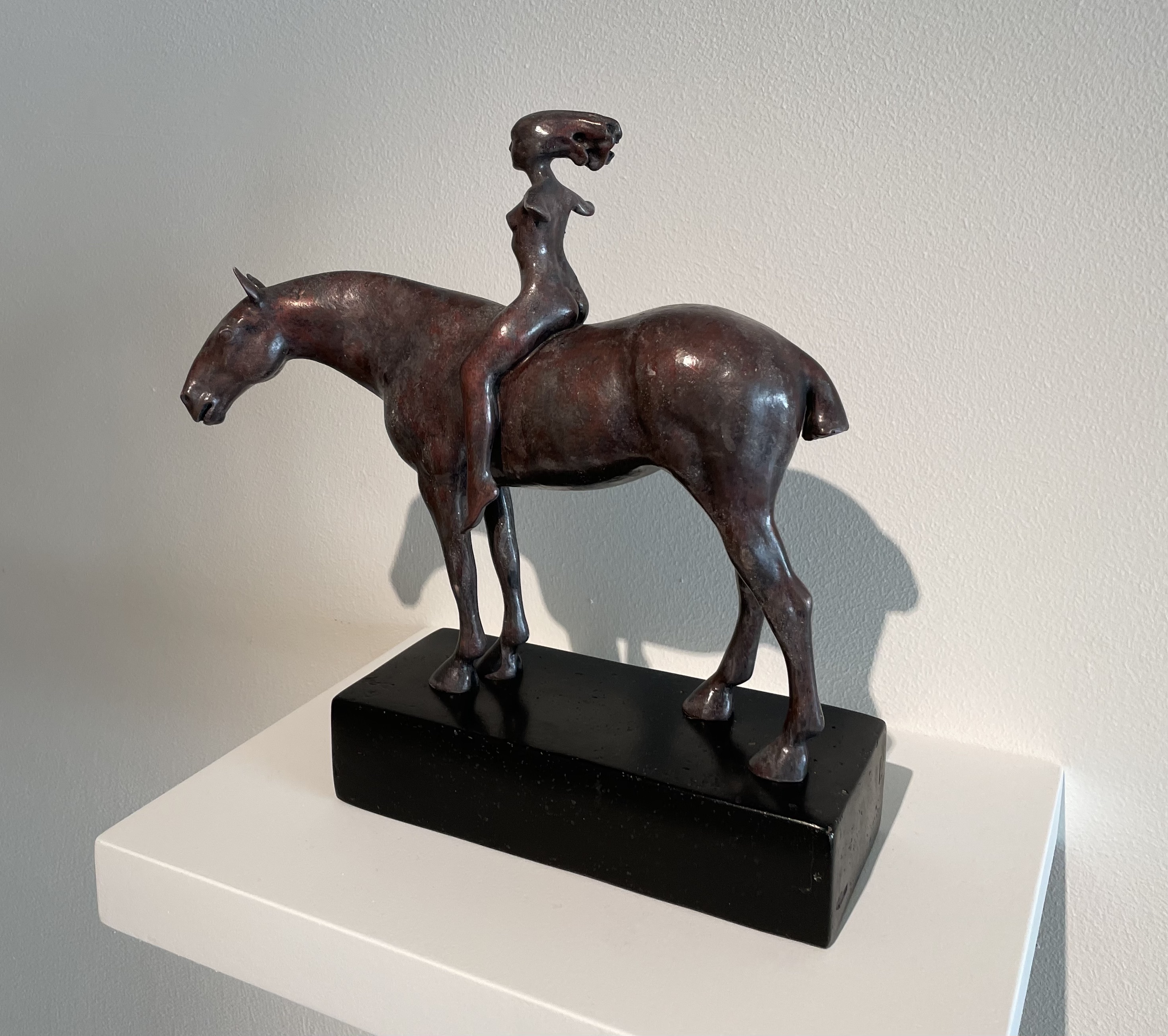
(Shown above is John Singer Sargent’s bronze casting of a plaster study he did (around 1900) in preparation for his mural series at the Boston Public Library. Both the Hirshorn Museum in Washington and the Tate in London have examples.)

Annunciation

Simone_Martini_Annunciation_Detail

Today we celebrate the feast of the Annunciation to Mary. The angel of God brought her “good news” ~ but news she could hardly have understood at the time. She would bear a child, who would be called Son of the Most High. I have always loved Annunciation paintings, and this one by Simone Martini (from 1333), in particular.

When the angel appeared to Mary, she encountered God’s holiness and righteousness. Like so many times in history, God’s presence pushes everything else into clarity. The bright light of Glory throws into relief all the dark places in the world – all the hidden corners of our lives. We usually react to this with disquiet and concern. We hear that God’s word comes as Good News. And yet we experience God’s call to become a new person, or do a new thing, as a fearful invitation!

For me, it has been a call to move from one beloved congregation to what I could only hope would be another. For both you and me, it will be a call to speak to someone with whom we have a misunderstanding, or forgive someone whom we have failed to forgive. When God calls us to new life, we are often afraid. We think of what we fear might happen: like losing a familiar home and community; or setting aside our pride, and opening ourselves to being hurt again.

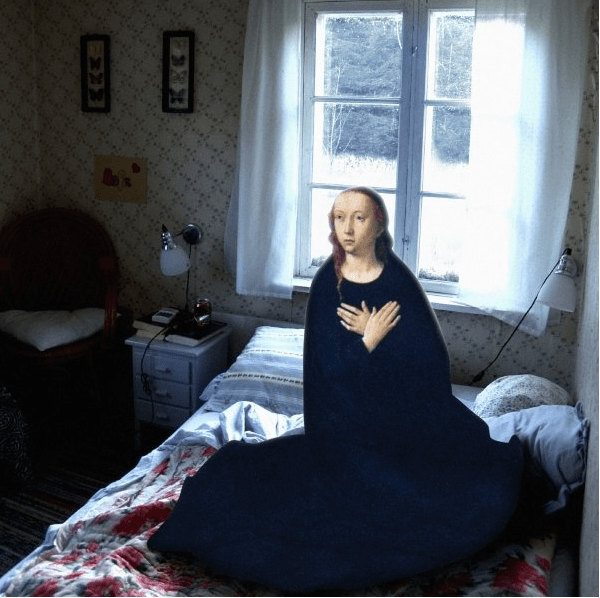
Look at how Martini portrays Mary’s response to the angel! Gabriel visits her with holy news about the child she will bear, who will bring salvation to the world. Mary draws back from his message, fearful about what it might mean. We know it turns out for good. But at first, God’s call can frighten us. A change to something new, always means a change from where we started.

The scene reminds me of spiritual advice I received years ago – advice that helped me be willing to leave a tenured seminary position and return to parish ministry. I had a sense of call, but the prospect of this change was frightening. A wise friend said to me, “when you go toward the heart of your fear in faith, God will always meet you there with power.”