Art

The Beauty of the Song of Solomon, or the Song of Songs


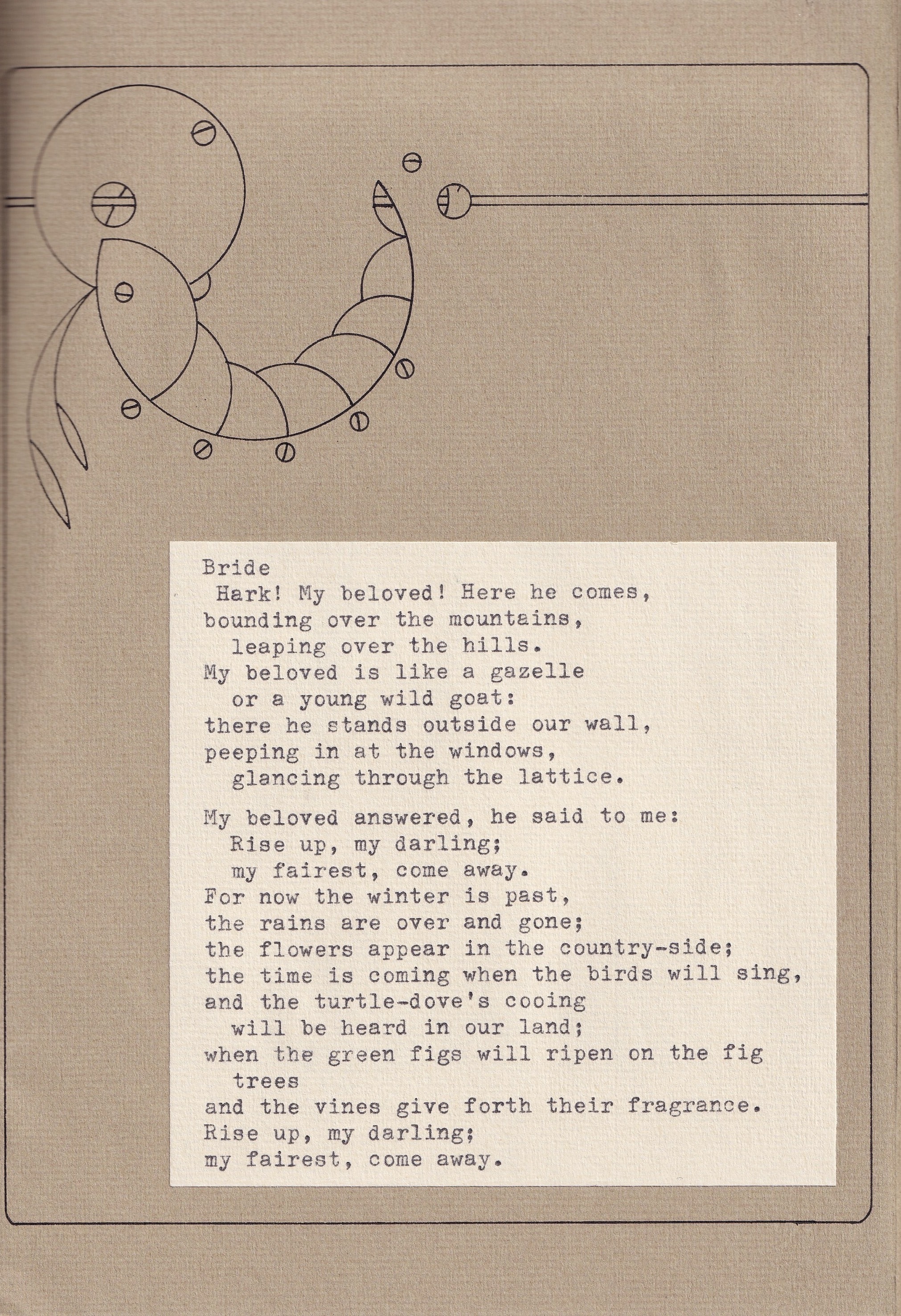
Here, I offer something most personal. Below are some pages from a project I prepared for and then sent to my beloved, in the autumn of 1977 (© Stephen Holmgren 2023), about 45 years ago. She was someone who I very much hoped might in the future be my betrothed. She was and is, Martha, to whom I sent this booklet in the autumn of 1977. Designed and composed in a pension in Florence, Italy, assisted by access to a manual typewriter at St James, the local Episcopal / Anglican parish in Florence, I prepared this multipage document, and sent it to Martha who was pursuing a study year in Taipei. Amazingly, it got there through international mail, and equally amazing is the fact that we still have the physical original of the little  booklet today. (God is good / all the time)

Of course, like all proponents of eternal love and affection, I have fallen short of living into the ideal. But, I still believe in it! Those of us who have entered into this particular covenant can admit this. Why? Because in the covenantal reality of Judaism, and then within Christianity, what we do, and perhaps more importantly what we have failed to do, is not the real issue. The real thing is the the One who grasps us, holds us, and saves us, always. And, the One who holds us together.

The Beauty of Psalm 139

[If reading this by email, please tap the title at the top to open your browser for the best experience.]
 

Frank Lloyd Wright is known primarily for the huge scope of his architectural work, and perhaps secondarily for the furnishings he designed for his buildings, which include everything from furniture to lamps to tableware. Less well-known are Wright’s graphic designs which were materialized in tapestries, wall panels, carpets, and in stained glass windows.

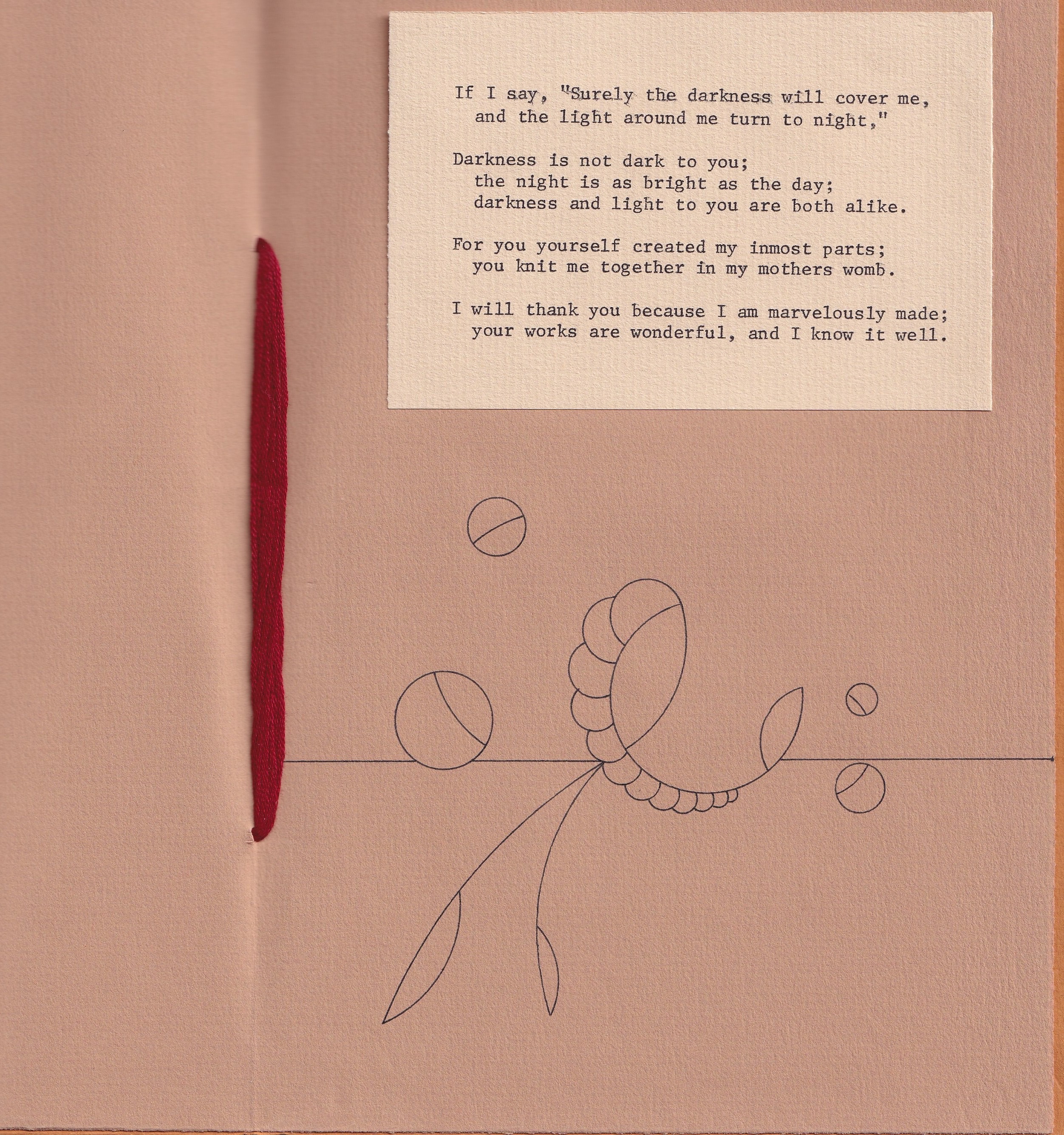
Just as I was strongly influenced by Wright’s architectural work when I aspired to follow him into the practice of his vocation, my design vision was just as impacted by his graphic work. In my case, this influence was not manifest in plans for such things as tapestries or windows, but in designs for paper products such as cards and stationary, and for handmade pamphlets. Among these were one featuring text from Psalm 139 (:1-17), and another text from the Song of Songs.

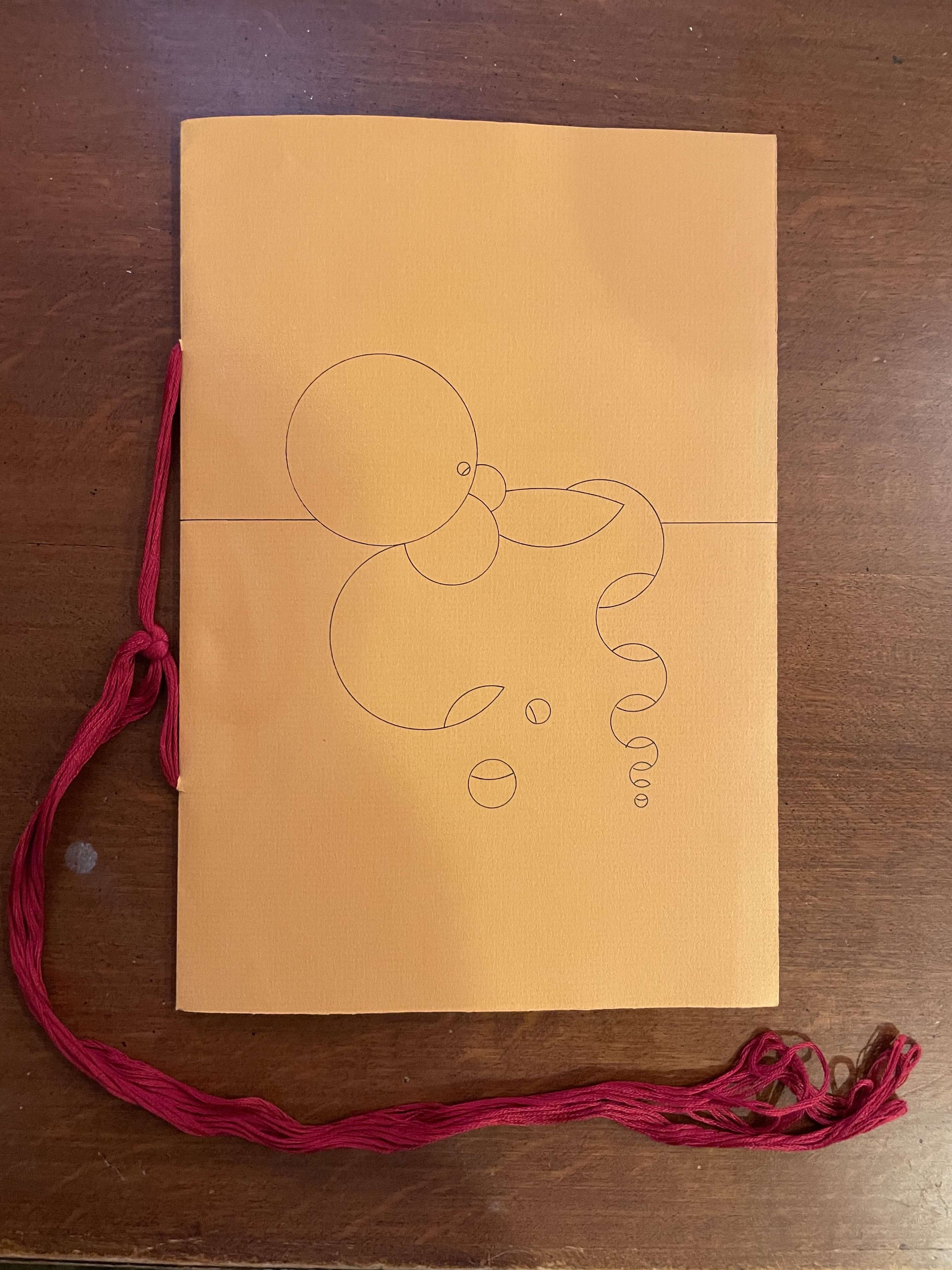
Above and below are some images of the little Psalm 139 pamphlet I created in the autumn of 1977 using a circle template, a rapidograph pen, an old-fashioned typewriter, and charcoal paper, along with a binding of stranded thread.


The above images are copyright, © Stephen Holmgren 2023. This post is based on a little pamphlet featuring Psalm 139:1-17, which I made while staying at the Pension Colorado in central Florence during the fall semester of 1977 while on a study abroad program through St Olaf College, in my sophomore year. I also acknowledge the probable influence of Alexander Calder’s mobiles.

Christo and Jeanne-Claude: Landscape Artists with Vision

Surrounded Islands in Biscayne Bay, ‘wrapped,’ 1983


Having in prior posts featured an introduction to three landscape artists beginning with Andres Amador, today I would like to focus on the earlier work by a couple who gained recognition through the unexpected character of their joint projects.

“Christo and Jeanne-Claude described the myriad elements that brought the projects to fruition as integral to the artwork itself, and said their projects contained no deeper meaning than their immediate aesthetic impact; their purpose being simply for joy, beauty, and new ways of seeing the familiar.” [Wikipedia]

I am grateful for Wikipedia’s succinct summary of Christo and Jeanne-Claude’s shared-aim for their joint work, and especially for that phrase, “their projects contained no deeper meaning than their immediate aesthetic impact…” Modern art in its many forms has been subject to much misunderstanding, as viewers have often looked within it for ‘meaning’ and ‘a higher purpose’ where none has been intended. I have previously featured the work of Alexander Calder and look forward to presenting the work of other 20th century (and later) artists, who have offered us the sheer beauty of non-representative paintings and sculptures.

Christo and Jeanne-Claude’s collaborative work has long struck me as epitomizing this approach to the exploration of beauty. They risked appearing to have trivialized their engagement with the natural world as well as with well-known works of architecture. But they also helped us see familiar and unfamiliar things in different ways, and with new appreciation.

Most significant was their consistent effort to make their projects not only self-funded, but as ecologically sensitive as possible, with their subsequent donation or recycled use of art installation materials. In my view, they did not seek to alter the landscapes or structures with which they worked in more than a very temporary way. And certainly not in any way that would compromise those beautiful places, but instead to enhance our regard for them.

I offer the photos below with appreciation for the simple joy that these prior installations may have brought to those who were able to be present at them, and for the beauty of the preserved digital images we still have of them. I wish I could have seen one myself, in context!

Valley Curtain, Colorado, 1972

Running Fence, Sonoma and Marin Counties, CA, reported as 24 miles long, 1976

Christo on Floating Piers, Lake Iseo, Italy, 2016, after Jeanne-Claude’s death in 2009

Hundreds if not thousands walked on the floating causeway to the island

Pont-Neuf bridge in Paris, ‘wrapped,’ 1985

The Arc-de-Triomphe in Paris, ‘wrapped,’ 2021

Andres Amador: Earthscape Artist

[If reading this by email, please tap the title at the top to open your browser for the best experience.]


Above we see a drone-based digital image of a pattern that a contemporary artist has inscribed upon the sand of a beach. He is also an academically trained scientist, who has employed his gifts in a particularly sensitive way.

Now, why are some or all of those details important? Because we see here the abilities of Andres Amador, someone whose public art work may lead us to wonder about how this artist could have accomplished all this. Not only in the image above, those presented below, as well as those widely available now on the internet.

Well, what would it take for you or me physically to be able to produce such an image upon the sand on a seaside beach? To my surprise, it is only geological timing (the tides); an appropriate location in relation to that matter of the tides; and then only a couple of simple tools. These would include some common and small garden rakes, and perhaps also – in relation to the circular-based patterns – a metal or wooden spike, a long rope, and some kind of carving or scraping tool at the end of that rope. The invention of the small drone with a camera has also been of help.

But, clearly, it takes more than physical circumstances, geography, and available tools. It also takes a scientifically trained sensibility as well as a developed intuitive creativity. What Andres Amador has accomplished and still produces is not in any way simple. And yet, he provides frequent teaching sessions, open to all, inviting others to do what he does. Insight about this is provided by a short but compelling video produced some years ago by KQED San Francisco (see link below). I think that one way to summarize a principal theme in his work is that he seeks to see things “whole,” which for some folks is related to seeing what is “holy.”

In that video, Amador describes two reference points, or two sorts of impulses within him, as sources for his earthscape art. “The two main directions that I go with, in the art, are {first} the geometric, which is very precise… So, it’s all about perfection.” Pattern can be imposed upon the ‘blank canvas’ of nature.

“The other {or second} side of it,” he says, “is the organic art, the art the feels like it is emerging from the location… the art that is telling me what to do next.” Pattern may therefore be in some sense received.

I find these two insights to be spiritually and theologically significant. We are able to impose pattern upon our lives, and often attempt to do this within the social world around us. At the same time, we may discern and receive pattern for our lives from within, whether from a divine or from a natural source, or through the gifts of others. Impose, and receive; both are important for our search to become whole.

God bless your continuing work, Andres, and especially for helping us perceive beauty in a fuller way.


Here is a link to the compelling KQED Andres Amador short video : https://www.kqed.org/arts/10134941/andres-amadors-earthscapes-art-that-goes-out-with-the-tide


Joining Mary’s Joy

[If reading this by email, please tap the title at the top to open your browser for the best experience.]

El Creco, The Annunciation (1600)


With three prior Annunciation images I have pointed to some aspects of the Annunciation to Mary: fear at an unexpected encounter with the divine presence; surprise and wonder about such a greeting; and, the opportunity to accept the significance of God’s visitation. Today, I want to highlight a fourth aspect of Mary’s experience of the Annunciation, her response of joy at having said, “Yes.”

It is not hard for us to admire Mary and her willing response to God’s initiative, at first in her life, and then in and for ours. But how easy is it for us to identify with Mary’s joy, reflected in the words we know as the Magnificat, her song of praise, with regard to the promise of Jesus’ birth?

For many of us, these 12 Holy Days may be a time in which we challenge ourselves to feel as ‘joyful’ as we think we should be – or, perhaps, to criticize ourselves for failing to experience the same. But what is ‘joy?’ I have an icon that depicts St. Thomas Aquinas, wherein he holds a text on which is printed, “Joy is the noblest human act.”

Joy at this time, as always, is not just a spontaneous feeling prompted by fleeting circumstances. Joy is actually an act, a choice, and a willing participation in divine initiative. For the word joy is related to the verb rejoice. God says to us during these 12 Holy Days – as God always does – I am come unto you to bless you, to bring you new life, to transform everything you think you know, and in ways you have yet to imagine.

Until we get to ‘the other side,’ and can ask Mary, herself, none of us will know what she really imagined would be part of her acceptance of God’s strange and unanticipated plan of redemption for our fallen and troubled world. What we can be most thankful for is at least one implied word that was part of Mary’s response to God’s initiative. She said, yes. With her beautiful example, and so many compelling artistic representations of the same, isn’t it a wonder why we so often find it hard to respond as she did.

In this last of the 12 Days of Christmas, let us say “yes” to God with Mary. And then, starting with the feast of the Epiphany, tomorrow, may we live into the real joy of that “yes.” Her uplifted hand, in El Greco’s painting above, says it all.

May our Lord, who was and is, and is to come, bless us and our loved ones during this holy time.


Saying “Yes” to the Gift

[If reading this by email, please tap the title at the top to open your browser for the best experience.]


The spirit of attentive openness is at the heart of a third aspect of Mary’s response to God’s call through the Angel Gabriel. God’s call often challenges us to live in a different way or try and be a different person, especially in our relationships with our family, our friends, and those with whom we work. Receiving this call, we can react at first in fear at what this call might mean in practice. We can also respond with uncertainty, wondering about our worthiness or suitability for what God may have in mind for us.

But we can also see that — in faith — we are able to go into the heart of our fear and find God’s power. Receiving God’s grace, we may move beyond relying on our own strength, and not depend upon our estimate of our own abilities and worthiness for what God may have in mind. We can then choose to respond to God’s gracious invitation into the Spirit’s redeeming work, just as Mary did, by saying, “Yes!” As John Lennon so simply captured the spirit of it, in the words of his famous song, “Let it be.” Or, as Mary said to God through the angel, “Behold the handmaid of the Lord; let it be unto me according to thy Word.”

This is the spirit of Mary’s response to the message of the angel as portrayed in the fourth Annunciation image I am sharing with you in these 12 Days of Christmas, in Trygve Skogrand’s photo-collage, pictured above. The artist has skillfully juxtaposed a traditional painted figure onto a contemporary scene. We see a simplicity and spirit of humility in Mary’s posture, as she kneels in her plain gown. In the plain ‘bed-sit’ room in which she prays, we notice her uplifted eyes. They are now focused on the divine source of the message she is receiving.

Attentiveness is key to meaningful perception, just as we found recently in the Gospel reading for the third Sunday in Advent. John the Baptizer sends his disciples to Jesus with what should be our most persistent question, “Are you the One?” Are you the One for whom we are looking, and whom we are awaiting? Notice Jesus’ response: “Go and tell John what you hear and see…” For they only hear and see if they are attentive. This is one reason why the Church commends to us the season of Advent, in addition to Christmas ~ to encourage our attentiveness, so that we can hear and see, and then accept God’s Word to us.

“Let it be as God would have it.” Let things be as God wills. Let God be God! Perhaps nothing is so hard in our lives as to say those words in faith and in humility. Our pride objects! Our desire to be at the center of reality intrudes. But to say, “Let it be…,” in faith and in humility, is to return to the Garden of Creation Grace. And it is also to begin to live forward into the fullness of the Kingdom, as God would have things be, and as God will have things be..

May our Lord, who was and is, and is to come, bless us and our loved ones during this holy time.


The image above is a detail of Trygve Skogrand’s photo-collage, Bedsit Annunciation (an image I have shared before). This post is adapted from a prior post based on my homily for the Third Sunday of Advent, December 15, 2019, which can be accessed by clicking here. The Revised Common Lectionary, which provides the readings for Sundays and other Holy Days, can be accessed by clicking here.

Celebrating the 12 Days

Brother Martin Erspamer, OSB


Having driven through my neighborhood yesterday and seeing two Christmas trees already put out onto the road edge, I am once again mindful of how the traditional Church calendar observes the Feast of the Incarnation of our Lord, or Christmas, for a full 12 days. I am therefore especially appreciative of the above image by Brother Martin Erspamer.

Martin Erspamer is a member of the Benedictine community at St. Meinrad’s Abbey in Indiana. His evocative black and white prints, sometimes referred to as ‘clip art,’ have been widely used on worship bulletins and in Sunday school materials.

The popularity of his images, and their widespread use in media such as Sunday bulletins, should not lead us to devalue the beauty of his handiwork, which evidences a studied sensitivity to medieval imagery as much as it does to the possession of a modern graphic artist’s temperament.

I especially like his image of Abram counting the stars, based on Genesis 15 (below). The image and its theme arises from God’s challenge to Abram to go out into the dark of the night and count the stars in the heavens – if he can. For one of God’s promises is that, while Abram is despairing of being without an heir, he will eventually have as many descendants as he can count the stars in the night sky.

Genesis presents three covenants between God and Abram, in chapters 12, 15, and 17, each of which is relevant to our celebration of these 12 Days of Christmas. In various ways, God promises Abram many descendants, a new land for him and those that would follow, and that through him a blessing would come to all the people of the world. This third promise, fulfilled for us in the child born in Bethlehem, is the most relevant to our observance of this holy time of the year.

From Psalm 147:

1 Hallelujah! How good it is to sing praises to our God! * how pleasant it is to honor him with praise!

2 The LORD rebuilds Jerusalem; * he gathers the exiles of Israel.

3 He heals the brokenhearted * and binds up their wounds.

4 He counts the number of the stars * and calls them all by their names.

5 Great is our LORD and mighty in power; * there is no limit to his wisdom.

6 The LORD lifts up the lowly, * but casts the wicked to the ground.


For those able to visit the Abbey, St. Meinrad’s has an exhibit of art by Brother Erspamer in the Archabbey Library Gallery until January 15:

The Delta Art of William Dunlap

Book cover of Dunlap’s 2006 retrospective art survey book


If Andrew Wyeth had migrated to the Delta region of Mississippi, some of his paintings may have turned out looking like those of William Dunlap. Folks not from the central deep South will usually associate that term, the ‘Delta,’ with the outflow of the great river south of New Orleans in several branched outlets. Yet, the term, the ‘Delta,’ in the mid and deep South refers to the region abutting the Mississippi River south of Memphis, bordered by Arkansas and Mississippi. Historically, and until the present, it has been characterized as one of the poorest regions of our nation and also known as the birthplace of the Blues, a fact which may not be coincidental. Lush with vegetation in a multitude of vibrant greens during the summer, the Delta has a stark beauty in the winter, especially where trees have been removed for farmland. Usually not cold enough for lasting snow, gray skies often complement the gray trunks and limbs of deciduous trees, as well as of cypresses in the swamps and by the river.

William Dunlap’s paintings, particularly the more recent ones, capture well the landscapes of this mostly rural part of ‘flyover’ America. As his artwork often depicts, the low-on-the-horizon winter sun pokes through bands of dark clouds, where in the evening a surprising warm glow can enliven an otherwise flat and bleak landscape. Dunlap lived in many places in the Old South while growing up, but the north central hill country of Mississippi, and Webster County, remained a homing point connected with his grandparents. Yet, I find his most evocative paintings are of the comparatively flat alluvial terrain on the east bank of ‘the American Nile’ south of Memphis.

Dunlap grew up feeling like he had lived in two eras of history, one being the late 19th century whose social legacy permeated the circumstances of his youth, and the other stemming from his having been born at the end of WWII, having come of age in the 1960’s. Images in many of his paintings reflect this paradoxical tension between old world cultural patterns and practices, and new world adventurous explorative freedom.

The dogs in his paintings reflect aspects of this dynamic. Dunlap’s grandfather bred and raised Walker hounds (most memorably represented in the top painting), which are often depicted as his central subjects within expansive landscapes. According to J. Richard Gruber, they are “used as a surrogate for man (and himself) in his works.” Here, in his choice of subject matter, we find another rural ‘old south’ in tension with an emerging new world. It is most markedly suggested in one of his paintings where he places a power plant cooling tower, releasing steam, behind a rural farmstead fronting an open field (not depicted).

This may help us appreciate the term Dunlap coined to describe his approach to painting, ‘hypothetical realism,’ a term which I think applies equally to the work of Georgia O’Keeffe. Remarkably, Dunlap basically taught himself to paint, and focussed his early work on Rembrandt and other ‘Old Masters,’ while also displaying the evident influence of modern masters such as Larry Rivers, Jasper Johns and Robert Rauschenberg. The effect of some of these more recent artists’ work can be seen in two of the paintings above, by the visual inclusion in the skyline of the regional names, Delta and Arkansas, in label-stylized fonts preferred by many Pop Art painters. Once again, we encounter a dynamic interplay between historically traditional approaches to representational painting and the 20th century reactionary revolt against them.

Dunlap is a truly gifted painter, both in terms of what he has been able to accomplish, but also in terms of his encompassing creative vision. Internet images, upon which I have relied here, only begin to suggest the expanse of his creative perspective.


For those who might want to see more of Dunlaps paintings, as well as learn more about him and them, I commend his coffee table book, Dunlap (which, through Amazon and or other sources may still be available, and which provides a much more accessible resource for appreciating the painter’s work:  (https://smile.amazon.com/Dunlap-William/dp/1578069041/ref=sr_1_5?crid=1YS7GNY6ZE2AS&keywords=dunlap+william+dunlap&qid=1654915393&s=books&sprefix=%2Cstripbooks%2C91&sr=1-5).

The Beauty of a Horse


Arthur Kern, Silent Myth (2006)

Those who know Grand Rapids, Michigan, and who appreciate sculpture, will be familiar with Meijer Gardens. A principal monument among their collection of sculptures is the impressively large rendering of Leonardo DaVinci’s horse, by the artist Nina Akamu. As remarkable in size as that sculpture is, it is a fine example of how so many artists have been fascinated by the equine form. Consider among others, the ancient Etruscan horses; the ceramic figurines from the Chinese Ming dynasty; as well as Degas’ rendering of lithe race horses, or the roughly contemporary western bronzes of Frederick Remington and Charles Russell. In all these, this historically important animal companion to both our human community and our many activities has so often received sculptural tribute through artistic imagination.

Recently, I had the wholly unexpected opportunity to discover the powerful work of a 90 year old Louisiana sculptor, whose output until 2016 had largely been out of the public eye for over 30+ years. The Callan Contemporary Gallery in New Orleans has until late April an impressive show of 18 cast resin sculptures almost all featuring horses with riders, or with some representation of a human form. Two of the works are at a stunning life size, while the rest are roughly around twelve inches in height and width. I was not previously familiar with the artist’s work, and was bowled over by its beauty. Here is an example of a smaller work:

Here is another:

And another:

Wherein does that beauty lie? I think it is found in Kern’s studied sensitivity to the anatomic beauty of horses, while he also takes obvious liberty in moving beyond literalistic portrayal of particular equine breeds. Though some observers use the term ‘surrealist’ to describe his approach, I prefer the admittedly cumbersome phrase, ‘representationally explorative.’ Further, Kern’s employment of a lost wax process for producing the molds has given him an opportunity to play with the plasticity of the resin in those molds, as well as to manipulate the coloring of the results. And because of his employment of this casting process, originally used for bronze sculptures, each of the pieces in this show is one of a kind, and not an example of a numbered series.

Just as compelling is the knowledge that after a successful career as a painter and professor of art, Kern then burned his remaining paintings, and moved to a largely hermit life as a sculptor, working privately without any assistants while casting in several cases significantly large works at his home or in his garage. The series of horse sculptures, among other works, is the fruit of several decades of dedicated work, outside the notice of the commercial art world.

It is not evident whether Kern’s loving regard for the human and animal form reflects a religious or spiritual appreciation for the source of the beauty they represent. Yet, his sensitivity to these forms evidences a spirit of positive regard for the world around us that parallels voices of praise that we hear in the Psalms and in many other passages of Scripture. Men and women, throughout history, have loved and admired the form and structure of so many examples of ‘flora and fauna,’ and that of the horse in particular. To me that is surely due to the way that our appreciation for what enriches our lives reflects the transcending and loving regard of our Creator, Redeemer, and Sanctifier, for both us and all of Creation.


Photographs are by the author (all rights reserved) with permission from the gallery. Arthur Kern, Horses, at the Callan Contemporary Gallery in New Orleans until April 23. I encourage you to seek images of and reflections upon his work on the internet. Here is a link to the exhibit: https://www.callancontemporary.com/artists/arthur-kern

The Beauty of Now


Rembrandt’s paintings are so often moving, and speak well of the Dutch genius who created them. When many of his contemporaries sought to portray people and events with greater realism, even if with much feeling, Rembrandt often put the ‘feeling’ side of his work first.

Rembrandt shows his sensitivity to an aspect of the anticipated birth of John the Baptizer. John’s parents were old and despaired about ever having a son who might carry on their name. The artist depicts the aged priest, Zachariah, leaning on a young attendant upon hearing that Mary has arrived. He portrays Elizabeth as also showing her years as she greets her relative with warm regard. Though Mary bears within her womb the holy child of God, she appears humbled in the presence of Elizabeth, perhaps awed at how the grace of God could touch both of their lives in such an unexpected way. Light shines on the two of them, just as it should, given the way that Luke highlights this holy aspect of their shared story. Thankfulness and quiet joy suffuse the scene like the warm light at its center.

Waiting and anticipation are themes we associate with the beautiful season of Advent. In one sense, these two words suggest we already know what we are anticipating, for what we are awaiting. By contrast, Luke’s story about the Visitation suggests a variation on those themes. “Expect the un-expected,” it seems to say, to us who live a multitude of centuries later. And this is especially hard for us to do, in a culture that is so dependent upon the precise measurement of time, and upon the predictability of events in the natural order of things.

Let’s notice this about Elizabeth and Mary, and about John the Baptist who is not yet born. Luke portrays them as living in the moment, as living in God’s time rather than simply in human calendar time. When Elizabeth hears Mary’s voice, John leaps in her womb. Luke then says that Elizabeth is filled with the Holy Spirit, and she exclaims with a loud cry, “Blessed are you among women, Mary, and blessed is the fruit of your womb.” Neither John nor Jesus are yet born, and so neither mother has yet received the assurance and peace that will come from seeing them safely delivered. And yet, in this moment, both women are filled with joy ~ joy about the fulfillment of God’s promises!

Elizabeth’s son, John, and Mary’s son, Jesus, would never be closer to the two women. And, in Luke’s telling, their quiet joy reflects their awareness of this, that now, in this moment, God is truly present, imparting grace and fulfilling promises. The same is true for us.


Rembrandt van Rijn: The Visitation (1640), Detroit Institute of Arts {many images online}

See Luke 1:41-42: “When Elizabeth heard Mary’s greeting, the child leapt in her womb. And Elizabeth was filled with the Holy Spirit and exclaimed with a loud cry, ‘Blessed are you among women, and blessed is the fruit of your womb.” Context: Luke 1:39-56. This Gospel reading is appointed for the 4th Sunday in Advent, Year C, which features the Visitation of Mary to her relative, Elizabeth.