Anglican

Fully Alive: The Beauty of Human Nature

A photo of a print given to us years ago


Those familiar with my writing and ministry may not be surprised by how I choose to address the theme of beauty in relation to the human nature we all share.

My response is captured in a quote with words I have long loved and have frequently cited. The quote is from the second century Christian theologian and Bishop of Lyons (in present-day France), Irenaeus. “The glory of God is the human person fully alive.” To which he added, “and to be alive consists in beholding God.”

What an audacious statement! I believe that the fundamental insight here, latent within Irenaeus’s words, stems from the Gospel of John, with whose author Irenaeus likely had a personal connection. That would have been through Polycarp, Bishop of Smyrna (presently, Izmir, Turkey), the city where Ireaneaus was born. One writer has described Irenaeus as the spiritual grandson of the apostle John.

Another calligraphy print, this one featured on the website of Holy Cross Monastery

What does it mean for any one of us to be ‘fully alive’? I believe that the Gospel writer, John, would respond by echoing words from Paul, whose letters frequently employ the phrase, “in Christ.” Through Baptism, we come to be in Christ. Through Baptism, we are re-born in Christ; we live in Christ – and he in us – and we will leave this mortal life in Christ. Indeed, in John’s  compelling witness to Jesus’ teaching, we are told that those who believe in Jesus have already died, and now, will never die! All of the Gospel readings appointed for funerals in The Book of Common Prayer are from John. This is the Gospel that is so centered upon the themes of God’s incarnation within our shared human nature, giving us God-given light, and eternal life.

Words found in the daily pattern for Morning and Evening Prayer, as well as in the Eucharistic pattern used on most Sundays in Episcopal Churches, help amplify this point but in a subtle way. These several patterns for corporate and individual prayer include forms for confession. Using these forms, and after we acknowledge our sin, we pray that we may delight in God’s will , and walk in God’s ways. In the absolution that follows, we hear these remarkable words:

Almighty God, have mercy on you, forgive you all your sins through our Lord Jesus Christ, strengthen you in all goodness, and by the power of the Holy Spirit keep you in eternal life.

In words that may be easy to overlook, we pray that by Holy Spirit power, God will “keep us in eternal life”! Being fully alive involves delighting in God’s will, walking in God’s ways, and being kept by God in eternal life.

Christians believe that the beauty of our human nature was and is found in the Gospel Jesus, and as the Risen Christ comes to be found in us. Our human nature, created in the image and likeness of God, and transformed to become an icon of Christ, is therefore all about the fulfillment of our divinely-given and imbued potential. When by grace we see it happen in people’s lives, it is a beautiful thing to behold.

Yet, human nature, being still what it is, prompts us to look for beauty in outward terms when we view others, as well as ourselves. Jesus, as the Gospels imply, always looked for beauty within – the kind of beauty it was his vocation to share and re-enable in us. This is what we should be looking for, both within ourselves and in others.

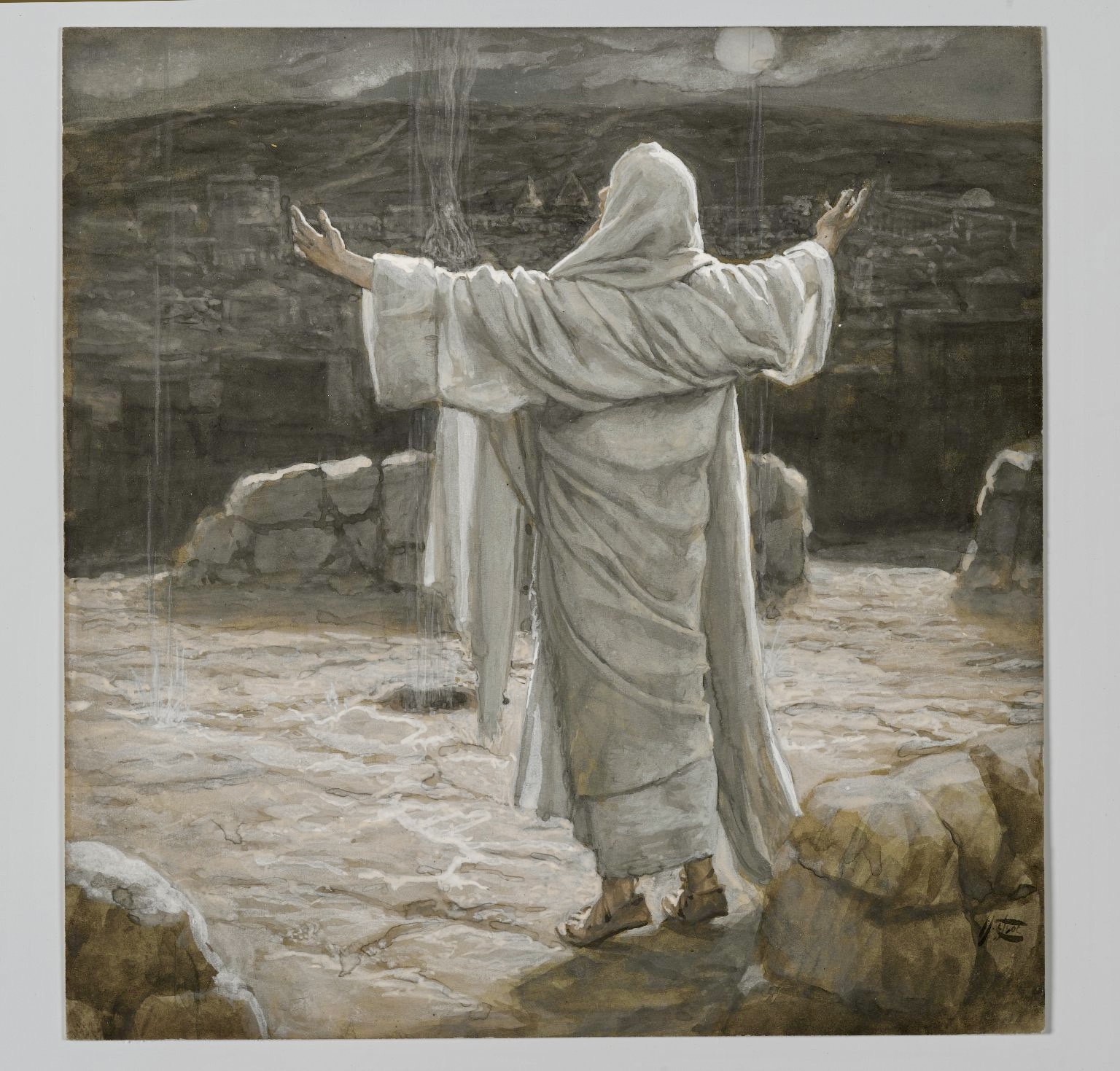
The archetypal biblical example of the glory of God beautifully manifest in human nature is found in the Gospel Transfiguration stories. James Tissot, one of my favorite painters, offers us glimpses of Jesus manifesting this same glory on several occasions, a glory that was otherwise often hidden within him.

James Tissot, Jesus Goes Up Onto A Mountain to Pray

Tissot, Jesus Being Ministered to by the Angels

Paul’s remarkable words to the Corinthians bring these themes together nicely. For we want to be among those who are:

seeing the light of the gospel of the glory of Christ, who is the image of God… For God, who said, “Let light shine out of darkness,” has shone in our hearts to give the light of the knowledge of the glory of God in the face of Jesus Christ.”

And, by God’s generous grace, the same may be seen in our faces, as well.


Note: Kenneth Kirk, the esteemed 20th century Bishop of Oxford, and former Regius Professor of Moral Theology at the historic university in that city, titled one of his still-used books (The Vision of God) based on the Irenaeus quote, featured above. Kirk presents Irenaeus’ words in this (now dated) way: “The glory of God is a living man, and the life of man is the vision of God.”

Memorial Day: Finding Beauty in Remembering

For this Memorial Day, I am re-posting part of a piece first published in January.

The grave of Hamilton Sawyer, U.S.C.T. (a Civil War casualty)


A few months ago, I found an unanticipated beauty in a wintry place a short drive from my home. Port Hudson National Cemetery is easy to overlook, though one of many created by the Federal government during the Civil War to provide for proper burial of the Union dead. It helps us remember those who lost their lives during a prolonged siege along the Mississippi River in 1863.

Among several thousand headstones, some include the initials, U.S.C.T. Wondering about them, I discovered they signify membership in a former United States Colored Troops regiment. Hamilton Sawyer (died 2 Feb 1864), and Samuel Daniels (died 19 Jan 1864), were two of many young men about whom history seems to have preserved only these bare facts. And yet, as a nation we remember them. Away from home and family at the time of their deaths, they surrendered their lives to help secure freedoms already declared, yet far from actualized in the lives of so many. Obviously, no contemporary visitor to the cemetery could have known either of these men. But we can – if we choose to – remember their names, and for what they died. The beauty of remembering lies in how we make present what we value.

Not everyone appreciates the beauty we find in a National Cemetery. Though these burial grounds were created and are maintained to honor those who have served in our nation’s military, these settings do not celebrate armed conflict. Instead, they venerate the commitment of many fellow Americans to serve our country and its founding principles, and commemorate their willingness to put the interests of the wider community before those of self. Most of us can recognize this commitment and willingness, even if we are not all moved to prioritize these things among our choices.

Praiseworthy themes often characterize eulogies offered at funerals. On such occasions, people usually identify and highlight the admirable traits of those who have died, whose lives we seek to honor through acts of remembrance. When done well, eulogies provide portraits of people’s lives conveying an appreciation for ways that certain moral principles and spiritual values have been lived out by them. These occasions would be drab and shallow if they merely recalled how a person consistently obeyed civil laws or always observed proper manners and social etiquette. By contrast, we touch upon beauty as we seek to remember people when they were at their best. For as Irenaeus put it, “The glory of God is the human person fully alive.” This is how we desire to be remembered.

Here is something to notice. There is a discernible symmetry between the way different baptismal candidates wear similar white robes, the way that variously styled caskets are covered at separate events by the same pall, and the way our burial liturgies – sacred and secular – ‘clothe’ our departed with the same words, on occasion after occasion. We find a pattern similar to these examples at our National Cemeteries, in how formerly high ranking officers and the lowest ranking enlisted men and women all have essentially the same headstones. In life and in death, we are – in the end – all one. Remembering the people whom the stones commemorate, even those we did not know, makes bigger our appreciation for the beauty of God’s world, and our own place within it.

To remember, and be remembered, can be holy acts. In remembering – even with regret-tinged memories – we reflect our desire for things to become whole, and brought to their fulfillment by God.


Historical note regarding Port Hudson:

From the above information plaque: “In May 1963, Union Gen. Nathaniel Banks landed 30,000 soldiers at Bayou Sara north of Port Hudson {at St. Francisville}. A force of 7,500 men commanded by Confederate Gen. Franklin Gardner held the Mississippi River stronghold. General Banks’ May 27 assault on Port Hudson failed and nearly 2,000 soldiers died. Among them were 600 men from two black regiments–the 1st and 3rd Louisiana Native Guards.* The Port Hudson engagement was among the first opportunities for black soldiers to fight in the Civil War. Their determination proved to the North that they could and would ably serve the Union Cause.”

“Among those buried {at Port Hudson} are 256 men who served in the United States Colored Troops (USCT).”

*Additional note from an informative Wikipedia article: “The 1st Louisiana Native Guard was one of the first all-black regiments in the Union Army. Based in New Orleans, Louisiana, it played a prominent role in the Siege of Port Hudson. Its members included a minority of free men of color from New Orleans; most were African-American former slaves who had escaped to join the Union cause and gain freedom.”

Port Hudson National Cemetery on a summer day

Note: blog settings have been changed to provide more opportunity to offer comments, using the link below.

Pointing Toward Perception

If reading this by email, please tap the title at the top to open your browser for the best experience. Then, clicking individual pictures will reveal higher resolution images.


We live in a world filled with “data.” Disconnected bits of information, especially in great quantity, overwhelm our ability to see and to think. Accumulating additional data or more information does not produce knowledge. Knowledge has to do with seeing the connections between bits of information. When we see the connections, we begin to see a picture, we begin to hear a story, and we gain understanding as well as wisdom.

The unrecognized fellow traveler on the road to Emmaus asks the two disciples, ‘what are all these things you are talking about?’ The answer he receives from them amounts to information. But his question is pointed toward understanding, especially in relation to ‘the big picture. He is challenging them to discover something bigger. He is really asking something like this: ‘All these things’ that have happened… What do they have to do with what God has been up to, all along?”

Here is a basic Christian truth that we find in the Emmaus Road story: Things take on meaning in relation to the risen Jesus. It happens when we see events in our lives in relation to him. It happens also with things like bread and wine as we gather at table. And it happens with people like you and me as we gather in community.

Jesus helps our perception on the road to Emmaus, and reveals something even more profound at the inn. This ‘inn,’ unlike the one where he was born, has many rooms, many mansions. When we see things like past events and the bread in relation to him, we discern more about what they were or are, and what they yet can become. When we see ourselves in relation to him, we better discern who we really are, and who we are called to be.

Prayerfully, we can look around, between things, and within. We can look for the connections. When we do, we see and discern. We see more because we see more wholly. Then we see the holy.


The above painting, Supper at Emmaus (1958), is by Ceri Richards, and is used by permission from the Trustees of the Methodist Modern Art Collection (UK). The penciled notation at the base of this guache painting on paper suggests that it was intended as a study for an altarpiece painting for the chapel of St. Edmund Hall (or College), at Oxford, England. The Emmaus story can be found in Luke 24:13-35, and it is a traditional Eastertide Gospel reading.

This post is adapted from one first published in 2014.

Rousseau and Wilderness: Redemption in Nature?

If reading this by email, please tap the title at the top to open your browser for the best experience. Then, clicking individual pictures will reveal higher resolution images.

Henri Rousseau, The Dream (detail), 1910


What does it mean for God’s grace to be present in nature? Or God’s mission of Redemption to be at work in what Christians view as a fallen Creation? The Gospel for this coming Sunday, with Jesus tempted in the wilderness, might prompt us to think about such things. An unexpected way to do this is to juxtapose Mark’s surprisingly brief ‘temptation narrative’ with Rousseau’s jungle-like images of a state of nature.

How shall we understand Mark’s account of Jesus’ being tested in an inhospitable place? And how does Rousseau conceive of the natural state of what Christians think of as Creation? A painting by Rousseau helps set the scene:

The Sleeping Gypsy, 1907

In light of it, we can consider the two verses that Mark devotes to Jesus’ temptation:

The Spirit immediately drove him out into the wilderness. And he was in the wilderness forty days, being tempted by Satan. And he was with the wild animals, and the angels were ministering to him.

Only two verses are accorded by Mark to this rather pivotal event, to which Matthew devotes 11, and to which Luke gives 12. The way that Matthew and Luke refer to the wilderness of the temptation suggests that it is a hostile context for Jesus’ encounter with the Tempter. In both of these longer Gospel texts, three principal temptations are identified, which occur following Jesus’ forty days of fasting. The three were: to feed himself, to become a wonder-worker, and to receive the adulation of the world’s kingdoms. Matthew adds that Jesus received the ministration of angels following – rather than during – his period of trial.

Whereas Matthew and Luke present the wilderness as an unpromising environment for Jesus’ challenging encounter with his adversary, Mark’s spare account of the event and its setting allows for a rather different reading. We can pose the matter in the form of two questions shaped by Matthew and Luke’s narratives.

Does Mark present the wilderness temptation of Jesus as being in a difficult place due to the presence of the Tempter and because it is filled with prowling and potentially dangerous wild beasts?

Man Attacked by a Jaguar, 1910

Or, does Jesus’ desert encounter in Mark represent not so much the threatening last gasps of a rebellious and dying world, but the first breaths of a life-giving new one, just now coming to be?

The Waterfall, 1910

Rousseau’s painting of the sleeping woman and the nearby lion, above, provides an image of harmonious coexistence in a place shared by a human being and the proverbial king of beasts (an ‘alpha predator’). In other words, Rousseau – in some of his paintings – portrays an ideal image of the original state of nature, the biblical Eden, before nature became ‘red in tooth and claw.’

A Woman Walking in an Exotic Forest, 1905

If so, then Mark’s statements that Jesus “was with the wild animals,” and also that “the angels were ministering to him,” may reflect what Christians have come to think of as ‘the peaceable Kingdom’ and ‘the New Creation.’ Which then suggests that – in Mark – the wilderness was good place despite the presence of the Tempter.

I am drawn to how Rousseau depicts the natural beauty of what we often describe as ‘wild nature,’ portraying it in both inviting and in cautionary ways. He paints it as a context of harmonious interrelation between human beings and animals in a shared environment. He also paints it as being a context where animals are a threat to one another and to humankind. Rousseau’s painting of Eve hints at both possibilities, where she is charmed by the serpent:

Eve, 1907

In the painting below, which complements his image above, another ‘Eve’ charms the serpent. Rousseau fills the beautiful canvas with a limited color palette, largely green, expressing the same dimension of ambiguity. A woman plays a flute while a serpent is draped upon her shoulders and others hang from the trees or rise up from the ground:

The Snake Charmer (detail), 1907

Looking at Rousseau’s many jungle-like ‘exotic landscapes,’ one notices the evocative presence of mystery. The viewer does not immediately know what lurks in the shadows, beneath and behind dense and dark foliage, in scenes often featuring bright flowers or fruit in the foreground. And upon discerning animals and also humans among all the growing things in the thicket between the trees, we can’t be sure whether what we encounter is friend or foe.

Jaguar Attacking a Horse, 1910

Exotic Landscape, 1910

In these and other scenes, Rousseau portrays an invitingly beautiful world, but one that is not without the possibility of misadventure and harm. I may not want to live in some of these scenes. But I find joy living with their beauty. For they help me appreciate a new way of reading and thinking about Mark’s brief account of Jesus’ temptation ‘in the wilderness.’ Jesus possibly could have repeated the great mistake made by Adam in the old Eden. But in not doing so, ’the second Adam’ became the door to a new Eden, and our ‘ark’ to the New Creation.


Note: blog settings have been changed to provide more opportunity to offer comments, using the link below.

Finding Beauty in Remembering

If reading this by email, please tap the title at the top to open your browser for the best experience. Then, clicking individual pictures will reveal higher resolution images.

The grave of Hamilton Sawyer, U.S.C.T. (a Civil War casualty)


I found an unanticipated beauty in a wintry place a short drive from my home. Port Hudson National Cemetery is easy to overlook, though one of many created by the Federal government during the Civil War to provide for proper burial of the Union dead. It helps us remember those who lost their lives during a prolonged siege along the Mississippi River in 1863.

Among several thousand headstones, some include the initials, U.S.C.T. Wondering about them, I discovered they signify membership in a former United States Colored Troops regiment. Hamilton Sawyer (died 2 Feb 1864), and Samuel Daniels (died 19 Jan 1864), were two of many young men about whom history seems to have preserved only these bare facts. And yet, as a nation we remember them. Away from home and family at the time of their deaths, they surrendered their lives to help secure freedoms already declared, yet far from actualized in the lives of so many. Obviously, no contemporary visitor to the cemetery could have known either of these men. But we can – if we choose to – remember their names, and for what they died. The beauty of remembering lies in how we make present what we value.

Not everyone appreciates the beauty we find in a National Cemetery. Though these burial grounds were created and are maintained to honor those who have served in our nation’s military, these settings do not celebrate armed conflict. Instead, they venerate the commitment of many fellow Americans to serve our country and its founding principles, and commemorate their willingness to put the interests of the wider community before those of self. Most of us can recognize this commitment and willingness, even if we are not all moved to prioritize these things among our choices.

Praiseworthy themes often characterize eulogies offered at funerals. On such occasions, people usually identify and highlight the admirable traits of those who have died, whose lives we seek to honor through acts of remembrance. When done well, eulogies provide portraits of people’s lives conveying an appreciation for ways that certain moral principles and spiritual values have been lived out by them. These occasions would be drab and shallow if they merely recalled how a person consistently obeyed civil laws or always observed proper manners and social etiquette. By contrast, we touch upon beauty as we seek to remember people when they were at their best. For as Irenaeus put it, “The glory of God is the human person fully alive.” This is how we desire to be remembered.

Because of this holy desire, we choose patterns for Christian burial that anchor our remembrance of persons in the body of Christ, in the Eucharistic context of God’s redemptive work. Eucharistic remembering is both holy and thankful remembering. As such, we include an appropriate Gospel reading, and offer reflection upon it. Making connections between enduring Gospel truths and how they have become actual in the dear but transitory aspects of a deceased person’s life, is most fitting. For the sake of those gathered, the focus of a funeral homily will then best be upon what the Resurrection of our Lord has made real for all people.

To honor someone in this liturgical way upon his or her death is genuine remembering, and reflects our natural and common desire to respect a person’s unique memory. In the proverbial Anglican “both-and” way, we can keep a focus on the Resurrection, as we also express our regard for the deceased. We do this by centering our liturgical observance upon the Gospel, while focusing our intentional gathering before and after the funeral liturgy upon the person being remembered. For these different but interrelated aspects of the day belong together.

Here is something else to notice. There is a discernible symmetry between the way different baptismal candidates wear similar white robes, the way that variously styled caskets are covered at separate events by the same pall, and the way our burial liturgies – sacred and secular – ‘clothe’ our departed with the same words, on occasion after occasion. We find a pattern similar to these examples at our National Cemeteries, in how formerly high ranking officers and the lowest ranking enlisted men and women all have essentially the same headstones. In life and in death, we are – in the end – all one. Remembering the people whom the stones commemorate, even those we did not know, makes bigger our appreciation for the beauty of God’s world, and our own place within it.

To remember, and be remembered, can be holy acts. In remembering – even with regret-tinged memories – we reflect our desire for things to become whole, and brought to their fulfillment by God.


Historical note regarding Port Hudson:

From the above information plaque: “In May 1963, Union Gen. Nathaniel Banks landed 30,000 soldiers at Bayou Sara north of Port Hudson {at St. Francisville}. A force of 7,500 men commanded by Confederate Gen. Franklin Gardner held the Mississippi River stronghold. General Banks’ May 27 assault on Port Hudson failed and nearly 2,000 soldiers died. Among them were 600 men from two black regiments–the 1st and 3rd Louisiana Native Guards.* The Port Hudson engagement was among the first opportunities for black soldiers to fight in the Civil War. Their determination proved to the North that they could and would ably serve the Union Cause.”

“Among those buried {at Port Hudson} are 256 men who served in the United States Colored Troops (USCT).”

*Additional note from an informative Wikipedia article: “The 1st Louisiana Native Guard was one of the first all-black regiments in the Union Army. Based in New Orleans, Louisiana, it played a prominent role in the Siege of Port Hudson. Its members included a minority of free men of color from New Orleans; most were African-American former slaves who had escaped to join the Union cause and gain freedom.”

Port Hudson National Cemetery on a summer day

Note: blog settings have been changed to provide more opportunity to offer comments, using the link below.

The Beauty of John’s Revelation

[If reading this by email, please tap the title at the top to open your browser for the best experience. Then, clicking individual pictures will reveal higher resolution images.

Christ Pantocrator ceiling mosaic from the Hagia Sophia, Istanbul


Advent beckons! Or does it? Isn’t something profoundly new lying just around the corner? Or shall we simply drift into another season of the old and familiar that might or might not live up to our expectations?

This calendar year, with a full week between Thanksgiving weekend and Advent Sunday, we have an ample opportunity to ponder questions like these. If such have recently occurred to you – or seem relevant now – I have a suggestion. It is prompted by a question recently put to me. What book or devotional might I recommend for Advent? My suggestion for Advent reading is John’s Revelation! It is the last book of the Bible, but arguably the first book for a new era, as we begin a new church year. And Revelation makes for unexpectedly good reading during these days of increasing darkness, at least as daylight hours are typically reckoned.

The best way that I know for begining to appreciate John’s Revelation, and read it for personal enrichment, is to engage it guided by Eugene Peterson, translator of The Message version of the Bible. Peterson helps us by making the texts of Scripture accessible and familiar-sounding. He is especially helpful in steering us around or away from what is ironically a rather modern and limited way of reading the biblical text. With him, we can avoid a literalism overlaid by misguided assumptions regarding prophecy and history. For Revelation does not contain a code to be deciphered but a message of love to be received, however strange John’s language and imagery may strike us at first.

John’s Revelation is metaphorical poetry that speaks truth, rather than something like a roadmap conveying predicted facts about what lies ahead. And so, it is not about how or when ‘the End’ will come, as if John’s book was and is about the terminus or stopping point of history and of all that we know. Instead, and in a rather more profound way, we might with John begin to see something new: how the end or point of fulfillment for all of history and of God’s purposes have in some sense already arrived!

In these weeks of shortened daylight hours and increasing chill, the prospect of reading Revelation may seem antithetical to a hopeful anticipation of Christmas. Cheerful music, warm lighting on dark and cold evenings, and holiday treats on the table, are all attractive and good things for us to enjoy at this time of the year.

But if we have any sense that there is something wrong with the present state of our world, whether with things near or far away, ignoring or being in denial about such are not our only alternatives when it comes to how we might approach each new day. A new phase in salvation history has dawned, and does not simply lie ahead in an undefinable future that is beyond our grasp. Yet begining to see this new phase in God’s ongoing work of Redemption may take the work of imagination, a praying imagination as Peterson puts it, in order to see the real beauty that now surrounds us, and which can be found within.

The beauty of the face of ‘the coming One’ is already here to be seen. We don’t have to travel back in history to a stable in Bethlehem, nor do we need to try and peer ahead to some kind of future cosmic crisis to see his arrival. For he is here with everyone. And he can be seen in the faces of those who through their Baptism bear the intimacy of his beautiful presence.


Eugene Peterson’s book on John’s Revelation, Reversed Thunder: The Revelation of John & the Praying Imagination, is in print and available from book sellers. I am pleased that Amazon has announced the future release of a Kindle (ebook) as well as an audio version from Audible.


Thankful for a Holy Place

[If reading this by email, please tap the title at the top to open your browser for the best experience. Then, clicking individual pictures will reveal higher resolution images.


One of my joys in retirement is once again to live near and be able to serve occasionally at Grace Church in St. Francisville, Louisiana. For many years it has been a ‘home away from home,’ not least because our three sons and their families live not far from it, and because many dear friends are members of the congregation and in the community.

Like so many, we are gathering this week with family as we celebrate Thanksgiving. High on our list of things for which we give thanks is having five of our granddaughters living within about a ten minute walk from our house, and our sixth granddaughter and her brother just a couple of hours away in New Orleans.

Among our grandchildren is one whose remains lie under one of the stones in our beautiful and historic cemetery. It is an especially meaningful place for us to stop and linger in the quiet, especially at holiday times like this. When in late 2007 I was called away to serve elsewhere, the blessed folks of Grace provided us with a burial plot in the rector’s portion of the cemetery. We give thanks for it as one of the most touching gifts we have ever received.

Some may have a hard time imagining how a cemetery, a place associated with death, could be replete with signs of life. And yet, it is. These evident signs of life transcend the presence of the church building and its related Christian symbols, like the crosses and inscriptions found on the monuments. I marvel at the live oaks with their long draping limbs, and how they stay green year-long, often supporting gangly strands of gray-green Spanish moss. More subtle are the fuzzy growths on the upper surfaces of those limbs, which appear to be a blend of moss and ivy. Their common name is resurrection fern, which in dry spells has an ochre color, but which then miraculously transforms into a deep green after an overnight rain.

My former church office looks out upon the cemetery ground in which are buried the remains of dear Lucy, a deacon our parish sponsored for ordination. Every time I walk the paths between alternating old and newer stones, I am mindful of her resting place and those of other friends and acquaintances, with whom we share in the communion of saints. Now, we also go there to visit ‘one of our own,’ in that most personal sense of the phrase. Some day, under one of these magnificent oaks, my remains, as well as Martha’s, will lie next to those of our granddaughter.

To muse upon these things during Thanksgiving week may strike some as dark and sad. Yet, a walk among the remembrance stones of this holy place reminds me of the life-giving texts we encounter every year on All Saints, and in our Eastertide lectionary readings. For, in one way or another, we are all called to visit that rocky ‘garden’ tomb, to find it empty and ponder its significance. There is undeniable beauty in the stories about what then became a holy place.

The beauty of the good news concerning that empty tomb is so much more than a wonder-story about a lucky man whose experience might inspire us. A man who, despite the worst that this world can do to a ‘good’ person, somehow managed to escape into something better. The Gospel story is also the ground for our hope, our hope for ourselves and our loved ones. Can that empty tomb then help us recognize how, in similar places reminiscent of death, we can find signs of new life? Yes. For our cemeteries are places where we seek to remember and honor our loved ones, with whom – in Christ – we are still connected. Here, in these places of burial, we can give thanks that through God’s love we are destined for more than we can now see or imagine.


The photo above depicts the cemetery of Grace Episcopal Church in St. Francisville, Louisiana. The church was founded in 1827, and the present building was completed by 1860. Three years later it was damaged by cannon fire from Union gunboats on the nearby Mississippi River, whose sailors were using our church tower to target the Courthouse across the street. (photo by Stephen Holmgren)

Do We Give Thanks In Darkness?

[If reading this by email, please tap the title at the top to open your browser for the best experience. Then, clicking individual pictures will reveal higher resolution images.]

Rembrandt, Paul in Prison (1627)

The troubling darkness of October 7 lingers. The following is my recent homily, offering reflection on how we can respond to a time like this.


We are always prone to being unsettled or troubled by unexpected challenges, whether nearby or far away. Since we believe in an almighty and loving God, unanticipated darkness, sorrow, and anger can confuse and upset us. For the people of Israel and Gaza, and those who care for them, October 7 and the days since have been filled with the news of much evil and much suffering. But, if ‘God is love,’ and the giver of all good gifts, as Christians believe, two questions we cannot easily answer will bother us: How can God allow natural and moral evil to happen? And why does God tolerate the suffering of his creatures, and especially of people made in his image?

When facing questions like these, I like to turn to some of Paul’s words in Philippians that we have heard in our recent Sunday lectionary readings: “God… is at work in you, enabling you both to will and to work for his good pleasure” (2:13). These words may be hard to accept — and hard to live by — especially if we are discouraged or fearful about what is happening around us. Yes, we hear Paul in Scripture say that God is at work in us. But we may not feel like it’s actually true. Indeed, we may find it hard to believe that it could be true. Yet, Paul wrote these words while he was in prison.

This is what we need to remember: Our feelings are fickle! Our moods and general equilibrium are subject to the ups and downs of our circumstances. Things happen to us, which are not of our own choosing. Feelings are the same way. They also ‘happen to us.’ The difference between what happens to me, and what I choose for myself, is very significant. I can’t do much to change events in the world. And I have difficulty keeping the emotions stirred by them from affecting me. But I can reflect on how I respond to them, in terms of what I decide, and what I choose for myself.

So, instead of dwelling on feelings of discouragement, inadequacy and aloneness, I have another choice. I can choose to remember Paul’s words, and repeat them to myself: ‘God is at work within me. God is at work within me. God is at work within me, both to will and to work for his good pleasure.’

This insight helps us hear, consider, and then perhaps accept, Paul’s challenging words to us. He is saying something much more profound than “be happy,” or “be cheerful!” Instead, Paul is urging us to make a choice, a decision to rejoice and give thanks, even if we may not feel like it. “Rejoice in the Lord always,” he says (4:4), which is different from saying, “always be happy about the world.” It often seems impossible to be thankful for or about the condition of the world. But, we can still be thankful for the Lord who overcomes disorder, and who in the end makes things right. Paul says that the Lord is near, and so we should not worry about anything. Believing that the Lord is near takes precedence over anxiety and concern about what is amiss. Believing that the Lord is near is a choice we make, and not a feeling we wait for.

The imprisoned Paul teaches us how another willed-decision accompanies relying on the Lord’s nearness. In all circumstances, we can — by prayer — let our requests be made known to God with thanksgiving (4:6). This is equally a result of choice, rather than depending on how we feel. When we make this conscious choice to give thanks in all circumstances (rather than for them), Paul tells us that the peace of God, which surpasses all understanding, will guard our hearts and our minds in Christ Jesus (4:7).

Therefore, confidence, reassurance and peace are not simply feelings that may or may not happen to us. They are, instead, the result of willed-decision-making. So, Paul asks us to keep on doing these things, and that as we do them, the peace of God will be with us.

When I dwell upon what I fear, on what makes me angry or depressed, I give in to feelings that happen to me, especially in relation to circumstances I cannot change. But Paul asks us to do the opposite. Instead of dwelling on the negative, he urges us to reflect on what is positive. Think instead, Paul says, about whatever is true, honorable and just: about whatever is pure, commendable and worthy of praise (4:8). And he urges this based on choices we can make.

Notice what Paul is not saying as he urges us onward. He is not saying, ‘hope for’ good things, which might happen someday. He is saying think about the good that is already true, and happening right now.

In an accompanying lectionary Gospel reading, Jesus says that God’s kingdom ‘is like a king who gave a wedding banquet for his son.’ We have all been invited to this wedding banquet, and we are participating in it in our lives today. Again and again, the servants of the king go out and call people to respond to the king’s invitation. But like so many of those in Jesus’ story, we let other things get in the way.

Among what gets in the way are things we worry about, or we feel pressure to get done. Our attention shifts from the wedding invitation, and gets centered on our calendar, and on our ‘to do’ list. Then we get distracted by our anxiety.

Again and again God’s invitation arrives, through the King’s written Word, and through the voices of the King’s servants who call us. But other things press against and bend our priorities, and these other things shape our lives… even though we have been invited to a wedding! We are invited to a celebration and a feast! Joy is written into the invitation. But rather than let God’s joy touch our hearts, strangely, we let lesser things inhabit our imaginations. Many gifts and wedding favors are given to those who come to this wedding supper. Yet, in time, the wedding begins to feel like a ‘work-day,’ when so much seems to be asked of us. We then shrug off the invitation-bearers, as if they are a nuisance, rather than bearers of a joyful message.

So, we should remind ourselves of Paul’s words. For he says,”Rejoice in the Lord always; again, I say Rejoice… The Lord is near.” As Eugene Peterson translates the words that follow, Paul also says this: “Don’t fret or worry. Instead of worrying, pray. Let petitions and praises shape your worries into prayers, letting God know your concerns.”

Worries can be fashioned into prayers, and concerns can be shaped into praises. We can voice our concerns to the Beloved. It’s a choice! But our natural inclination lets worries and concerns drift into complaints and laments. Yet, we can choose! We can choose to rejoice, and to pray, and to praise. Of course, it may seem perverse to try and give thanks for the things that cause us worry and concern. But that is not what Paul is encouraging us to do. We can still give thanks in the midst of those things. We can give thanks that, despite troubles, we have been included in the wedding supper of the Lamb. We give thanks that we have become members of the Bride of Christ. We have been joined to the Beloved, whose wedding banquet we are part of today. Thanks be to God!

The Beauty of Trinitarian Life

[If reading this by email, please tap the title at the top to open your browser for the best experience.]

Brother Robert Lentz, Holy Trinity


Here is a Robert Lentz icon-styled painting that blends an historic approach to portraying the Holy Trinity with an inclusion of modern astronomical imagery. The facial depiction of the first two members of the Holy Trinity are presented in a very traditional way, while the images of the galaxies very obviously depend upon telescopic photography.

The most significant truth expressed within this composition by Lentz is that all three members of the Holy Trinity were and are involved in Creation, both in terms of the primal event, as well as in an ongoing divine presence within the whole of the cosmos, a theme found in John’s Gospel as well as in Paul’s letter to the Colossians among other biblical texts.

If there is any drawback to Lentz’s composition it is one shared with just about every Trinity-themed painting of which I am aware. To put it plainly, Lentz depicts the members of the Holy Trinity as ‘them,’ as objects of our subjectivity, as divine persons we contemplate, hold in regard, and with whom we contemplate or entertain relational involvement.

What this approach lacks, perhaps of necessity in a two dimensional medium, is an expression of the equally important and sometimes non-experiential truth that we are also the objects of the divine subjectivity, and how – after Baptism – we are inseparable from involvement with and in the Trinitarian life of God.

The simplest way to help make this evident can be found in all six of the Eucharistic Prayers in The Book of Common Prayer, as well as in many of the Collects. We pray to the Father, through the Son, in the Holy Spirit. And so, whether we are conscious of it or not, we are to live as we pray, to the Father, through the Son, in the Holy Spirit.

We should no longer try to depict the Holy Trinity through two dimensional imagery, much less with diagrams, or with objects like a three-leaf clover. For in each of these cases, we render the grace-filled context of our new and relational, post-Baptismal, life as if the grounding source for our being, and our life in Christ, was somehow external to us, and something which we might still have a need to approach.

Yet, through Christ and in the Holy Spirit, the Father is now in us, and we are in him. He is closer to us than we are to ourselves. This is the great mystery, the paradox, and the beauty of Trinitarian life in Christ after Baptism.

The Mystery of Pentecost

[If reading this by email, please tap the title at the top to open your browser for the best experience.]

Giotto, Pentecost (Scrovegni (or Arena) Chapel, Padua)


Once again we turn to Giotto, who helps put a ‘human face’ on a supernaturally-charged event. As we observed with his fresco depicting the Ascension of Jesus, Giotto’s Pentecost painting evidences the influence of medieval and Eastern Orthodox iconography (e.g., the gold-leaf halos). Yet, his work distinctively moved away from a primary absorption with portraying aspects of the eternal so as to display an appreciation for daily human life and activity. One mark of this is his employment of architectural perspective in his composition of the scene. In addition, each of the faces in this Scrovegni Chapel fresco are recognizably distinct from one another, with some of them reflecting a genuine regard for individual personality and temperament.

Here we can also notice Giotto’s attention to the biblical text. This scene portraying the gift of the Holy Spirit follow’s Luke rather than John. In John’s Gospel, on the evening of the day of the discovery of his Resurrection – the Risen Jesus enters the private room where the disciples are hiding fearfully behind a locked door. He breathes on them his Holy Spirit and implies that his Ascension has already occurred.

Luke, as Giotto faithfully portrays, describes the disciples being gathered together 50 days after the Resurrection on the Jewish feast of Pentecost. As Luke reports in the last two verses of his Gospel, after witnessing Jesus’ Ascension the disciples “worshiped him and returned to Jerusalem with great joy, and were continually in the temple blessing God.” Luke then commences his second book, Acts, with a parallel account of Jesus’ Ascension, and the selection process of Matthias as a replacement for the traitor, Judas. Having returned joyfully to Jerusalem, the disciples have been visiting the Temple daily, where they blessed and worshipped God in a public setting.

Luke’s Pentecost assembly differs markedly from John’s account of the fearful disciples on the afternoon of the first day of the new week, forty nine days before. For on Pentecost, into their midst and visibly upon their heads, came the Holy Spirit filling each of them with its power and presence.

Many visitors to Jerusalem for the great feast became aware of what had occurred, and were perplexed, marveling at the unexpected spectacle of how each of them heard the men from the north country speak in their own separate and distinct languages. The legacy of the tower of Babel had been overcome.

Peter quickly helped account for what was happening in light of Scriptures familiar to those gathered, which were fulfilled in and through Jesus’ death and resurrection. God was now doing a new thing, yet something promised long before.

How contrary to the spirit of Jesus’ ‘high priestly prayer, in John 17, and to the witness to the power and presence of the Holy Spirit at Pentecost, is our frequent experience of the Church throughout the world in our present day. Despite moving words centered on unity and a commonality of mission that we hear and recite in the baptismal rite, we are more often confronted with evidence of difference and division among Christians of varying denominations and cultural backgrounds. Perhaps it is because we let our own concepts of our mission and ministries take precedence over our awareness of and belief in the primacy of Christ’s continuing mission and ministry.

And so, we forget to marvel at what came about through the embodied presence of God. A divinely appointed and inspired country rabbi, who had recruited 12 unlikely followers, met persecution and a tragic death at the hands of a corrupt earthly empire. Yet, in the power of the Holy Spirit, over the course of a few centuries he transformed a sizable portion of the known world into the New Israel, his beloved community and family.