Author: Stephen Holmgren

I have been an Episcopal priest for thirty eight years, having served in parishes and in academia. My interests include art and theology, liturgy and spirituality, and I love to go sailing whenever I can.

Memorial Day: Finding Beauty in Remembering

For this Memorial Day, I am re-posting part of a piece first published in January.

The grave of Hamilton Sawyer, U.S.C.T. (a Civil War casualty)


A few months ago, I found an unanticipated beauty in a wintry place a short drive from my home. Port Hudson National Cemetery is easy to overlook, though one of many created by the Federal government during the Civil War to provide for proper burial of the Union dead. It helps us remember those who lost their lives during a prolonged siege along the Mississippi River in 1863.

Among several thousand headstones, some include the initials, U.S.C.T. Wondering about them, I discovered they signify membership in a former United States Colored Troops regiment. Hamilton Sawyer (died 2 Feb 1864), and Samuel Daniels (died 19 Jan 1864), were two of many young men about whom history seems to have preserved only these bare facts. And yet, as a nation we remember them. Away from home and family at the time of their deaths, they surrendered their lives to help secure freedoms already declared, yet far from actualized in the lives of so many. Obviously, no contemporary visitor to the cemetery could have known either of these men. But we can – if we choose to – remember their names, and for what they died. The beauty of remembering lies in how we make present what we value.

Not everyone appreciates the beauty we find in a National Cemetery. Though these burial grounds were created and are maintained to honor those who have served in our nation’s military, these settings do not celebrate armed conflict. Instead, they venerate the commitment of many fellow Americans to serve our country and its founding principles, and commemorate their willingness to put the interests of the wider community before those of self. Most of us can recognize this commitment and willingness, even if we are not all moved to prioritize these things among our choices.

Praiseworthy themes often characterize eulogies offered at funerals. On such occasions, people usually identify and highlight the admirable traits of those who have died, whose lives we seek to honor through acts of remembrance. When done well, eulogies provide portraits of people’s lives conveying an appreciation for ways that certain moral principles and spiritual values have been lived out by them. These occasions would be drab and shallow if they merely recalled how a person consistently obeyed civil laws or always observed proper manners and social etiquette. By contrast, we touch upon beauty as we seek to remember people when they were at their best. For as Irenaeus put it, “The glory of God is the human person fully alive.” This is how we desire to be remembered.

Here is something to notice. There is a discernible symmetry between the way different baptismal candidates wear similar white robes, the way that variously styled caskets are covered at separate events by the same pall, and the way our burial liturgies – sacred and secular – ‘clothe’ our departed with the same words, on occasion after occasion. We find a pattern similar to these examples at our National Cemeteries, in how formerly high ranking officers and the lowest ranking enlisted men and women all have essentially the same headstones. In life and in death, we are – in the end – all one. Remembering the people whom the stones commemorate, even those we did not know, makes bigger our appreciation for the beauty of God’s world, and our own place within it.

To remember, and be remembered, can be holy acts. In remembering – even with regret-tinged memories – we reflect our desire for things to become whole, and brought to their fulfillment by God.


Historical note regarding Port Hudson:

From the above information plaque: “In May 1963, Union Gen. Nathaniel Banks landed 30,000 soldiers at Bayou Sara north of Port Hudson {at St. Francisville}. A force of 7,500 men commanded by Confederate Gen. Franklin Gardner held the Mississippi River stronghold. General Banks’ May 27 assault on Port Hudson failed and nearly 2,000 soldiers died. Among them were 600 men from two black regiments–the 1st and 3rd Louisiana Native Guards.* The Port Hudson engagement was among the first opportunities for black soldiers to fight in the Civil War. Their determination proved to the North that they could and would ably serve the Union Cause.”

“Among those buried {at Port Hudson} are 256 men who served in the United States Colored Troops (USCT).”

*Additional note from an informative Wikipedia article: “The 1st Louisiana Native Guard was one of the first all-black regiments in the Union Army. Based in New Orleans, Louisiana, it played a prominent role in the Siege of Port Hudson. Its members included a minority of free men of color from New Orleans; most were African-American former slaves who had escaped to join the Union cause and gain freedom.”

Port Hudson National Cemetery on a summer day

Note: blog settings have been changed to provide more opportunity to offer comments, using the link below.
Pentecost: The Beauty of Unity Amidst Diversity

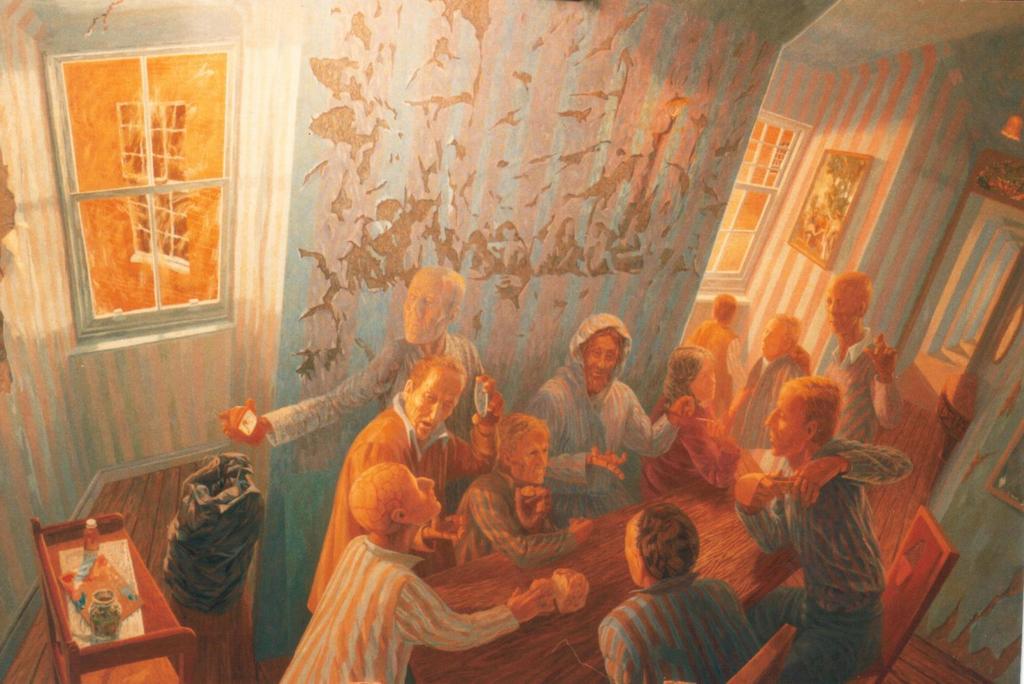
Peter Warden, Pentecost (1985)


Paul’s stirring words to the Ephesians assert an abiding truth: “There is one Body and one Spirit; there is one hope in God’s call to us; One Lord, One Faith, One Baptism, One God and Father of all.” Paul was focused on the God-given and true things that unite us, that hold us together, and which give us life. Yet, in contemporary American culture, everything now seems to center on how we differ from one another. How might we hold both insights together?

Some years ago, I discovered Peter Warden’s wonderful contemporary painting about the post-Resurrection Pentecost event, which reflects the presence of such differences among us as people. Warden’s painting is based on the well-know story from Acts, chapter 2. The painter portrays the disciples together in their upper room retreat. But, in this case, the first Christian community is gathered in a 20th Century Scottish attic! The painting seems to capture the disciples just at the moment when the mighty Spirit-wind and tongues of fire appear. In other words, the disciples – as Warden depicts them – are not yet bound together, and not yet ready for mission.

Though they are in the same room, these disciples show few signs of unity. They react against one another, as much as they may talk together. Notice how this is suggested by the alternating warm/cool color palette that Warden has used. We also want to notice the suggestively peeling wallpaper behind the group. Can you see the pattern that the artist has created with the lower part of the rendering of the wallpaper?

If you look closely, you can see how Warden has used his depiction of that scrappy wallpaper to suggest Leonardo Da Vinci’s famous painting of the last supper. Da Vinci’s painting has also suffered the fate of being on a peeling wall. Peter Warden portrays a group of people with a shared history, who were brought together by Jesus at their earlier supper with him. But now, after his death, they find themselves regressing, regressing to their before-knowing-Jesus identities, and falling back upon their differences from one another.

Yet, as the painting’s title suggests, in just this moment God’s Holy Spirit finds them. Just as, through the Church, God’s Spirit finds us. When God’s Spirit finds us, we are grafted into the Body of Christ. In the process, we come to perceive who we really are. For we receive a new baptismal identity in Christ.

Our new identity builds upon and transforms the uniqueness of our natural, biological-identity. Our baptismal-identity emphasizes a new way of seeing ourselves in relation to others. Now, we also celebrate what we share and have in common, rather than simply emphasize our practical awareness regarding how we are unique and different from others.

Through hearing and reading Scripture, and in our fellowship with others in Jesus’ beloved community, we learn something very important. It has to do with this matter of our identity. We learn that the “Who am I?” question cannot rightly be answered apart from the “Who are we?” question. And, in turn, the “Who are we?” question cannot rightly be answered apart from another question: “Who are we made to be?” Once we ask, “Who are we made to be?”, we are on the threshold of discovering, perhaps for the first time in our lives, who we are meant to be and become, both as individuals, and in community.

Here is the truth of the great feast of Pentecost: God’s Spirit has come down! God’s Spirit has come down upon, and within, people who are sometimes alienated, and who often fall short of God’s mission. Preoccupied with ourselves and our own pursuits, we are gifted with the experience of transformation. We are drawn into relationship. As we are, we find meaning and we find purpose. We discover who we are, as we discern what we are called to be and do together. The mission of God brings both mercy and meaning. In it, we discover a shared life in God’s Spirit-shaped Kingdom.

John Nava, Pentecost, 2012


The quote from Ephesians is from the Book of Common Prayer Baptismal Rite adaptation of Ephesians 4:4-6. I have featured Peter Warden’s Pentecost painting once before, though without reflective comment, in a post offering Family Devotions during Covid, on May 30, 2020.

Further note: last week I was fortunate to walk down the same central street in ancient Ephesus upon which Paul surely often walked, while – according to Acts – he was there for two years. In writing the words quoted above, Paul was likely responding to the Ephesians’ devotion to the fertility mother goddess, Artemis, and the great temple they had built in dedication to her.

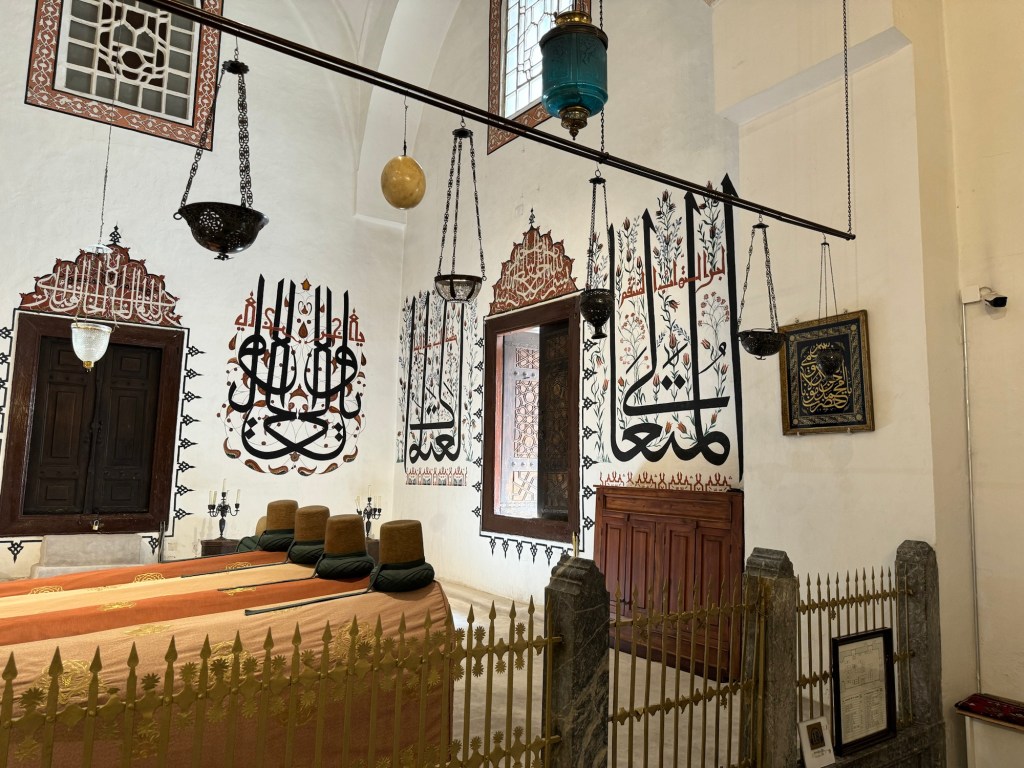
The Mystic Rumi’s Burial Place

The burial place of the mystical Sufi poet, Rumi, in Konya, Turkey

Here are some photos from a recent visit to the mausoleum of the mystic Sufi poet, known in the West as Rumi. It is a very holy place for many who visit there.

The honorary coffin cover, sitting far above the entombed remains of the mystic Rumi
A Persian style multi-faceted dome in the same building
An interior view showing some of the remarkable calligraphy on the wall surfaces
A broader interior view
An original 13th century silver door
A replica small space in the courtyard adjacent to the mausoleum

Encountered Beauty / 8May24

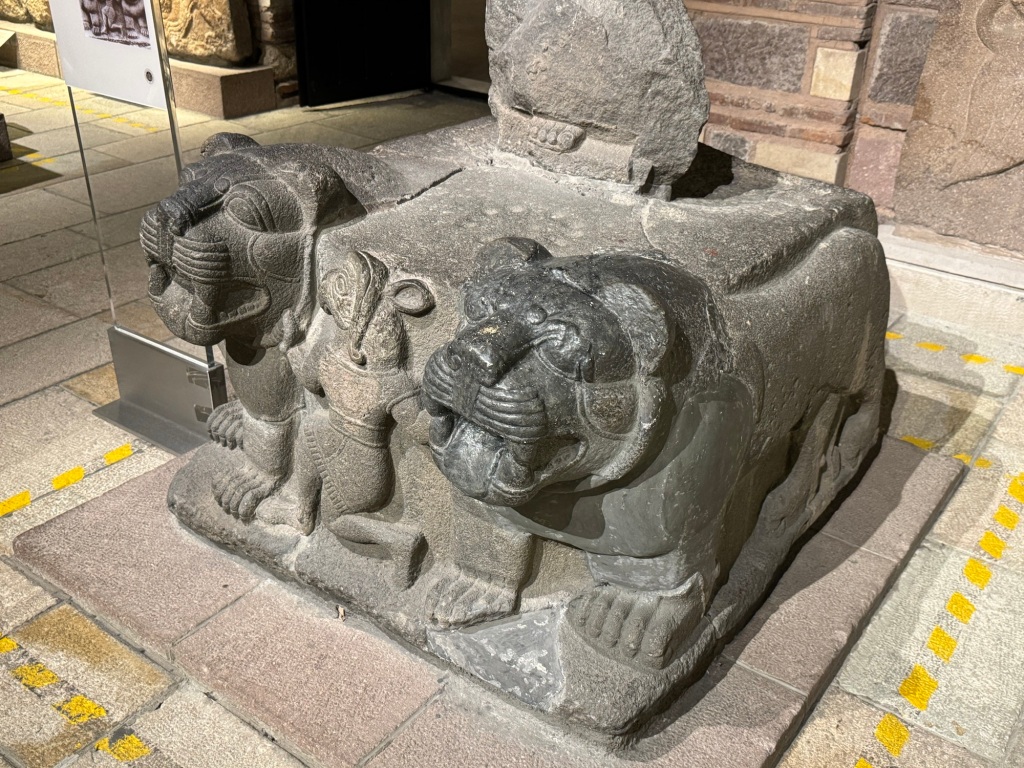
Hittite Lions, Ankara Archaeological Museum

This is the first of a series of occasional posts featuring images of encounters with beauty while traveling. Today’s post features images – of things both ancient and modern – from Ankara, Turkey.

Under the leadership of the founder of modern Turkey, Ataturk, the preservation of historically significant archaeological artifacts was provided for in the renovated remains of an ancient fortress in Ankara. This is where the Hittite Lions, from about the time of the Exodus (pictured above), are now located (in the Museum of Anatolian Civilizations).

Upon Ataturk’s death, an architectural design competition was initiated for a proper mausoleum for the remains of the beloved national founder. One feature of the magnificent resulting structure and grounds incorporates an abiding tribute to the Hittite history of lion gates and their statuary (below).

The Ataturk mausoleum is a beautiful mid-twentieth century structure, both modern in design and yet incorporating echoes of historic Turkish architecture. The travertine stone employed for the exterior gives the imposing building complex a warmth it otherwise would not likely have.

Ataturk Mausoleum, exterior, and bas relief sculptural panel

The mausoleum complex serves as more than a memorial to the national founder who is interred there, and is a focal point of national pride in remembrance of the Turkish War of Independence, so linked with Ataturk. To this end, evocative statues are located at the end of a long terrace (below).

A tribute to the woman who were a part of the Turkish War of Independence
Another bas relief sculptural panel from the Ataturk Mausoleum
A mausoleum breezeway

I found the Ataturk Mausoleum to be a beautiful example of public architecture, a place that well serves large crowds on important occasions while possessing welcoming proportions and pleasing textures.

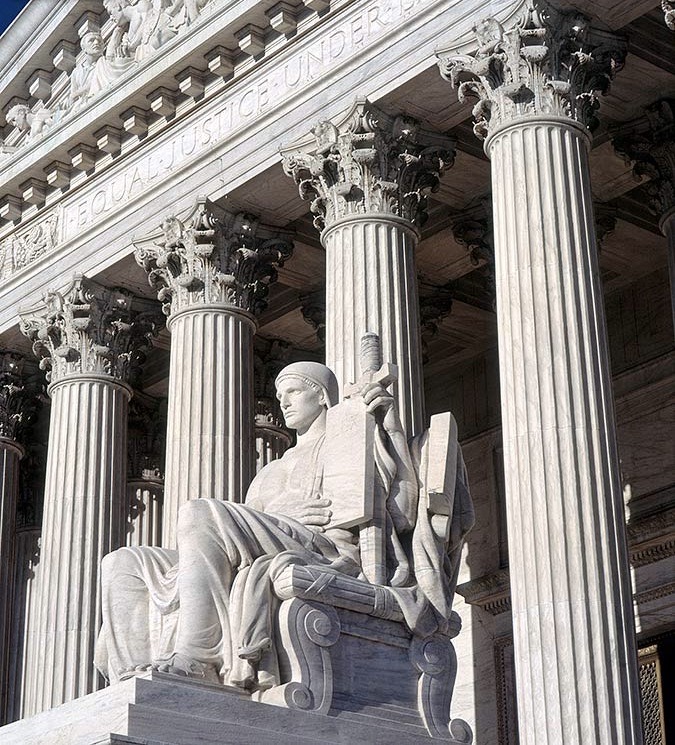
Justice Embodies Beauty

If reading this by email, please tap the title at the top to open your browser for the best experience. Then, clicking individual pictures will reveal higher resolution images.


Among the over-used and under-defined words prevalent in everyday conversation is that of ‘justice.’

There are at least three facets of justice long recognized in the western ethical tradition. The formal names for them are distributive, commutative, and social justice. It is important to distinguish them because the word justice is often used as if its meaning is confined to merely one or another of what are at least three of its facets.

Distributive justice can be simply defined as fairness in terms of results or outcomes. In a game of Monopoly, but also in processes or in policies of a more serious kind, the winner is generally determined by who has the most at the end of play. In current conversations where the concept of “equity” is invoked, distributive justice is often the reference point for evaluations of fairness as to social outcomes.

A second aspect of a Monopoly game then comes into consideration. In the way the game was played, did all players follow the same rules, especially in achieving the results they attained? This is what is meant by commutative justice.

The third commonly recognized facet of justice is social justice. With a game of Monopoly, the concept can be expressed in the form of a further question. Were all those who wanted to play the game provided a fair opportunity to participate?

As may be apparent here, these three facets of justice can be, and often are, interrelated. Indeed, the beauty that can be found in the idea of justice often appears when these several facets, among possible others, receive appropriate attention.

Clearly, beauty is never a merely visual phenomenon, recognizing that we find it in ideas expressed in poems, and in observations made by philosophers. The beauty I find in the concept of justice lies in the multifaceted nature of the idea, and in how it can bring enrichment to human relationships and communities.

One example can help make the point. In terms of the relationship between communities and individuals, justice is often expressed in terms of what communities owe to individuals, especially so that the needs of the latter are not overlooked or denied by the former. Yet defined merely in this mono-directional way diminishes the concept of justice when what individuals may owe to communities does not receive comparable consideration. There is beauty to be found in a two-way symmetry of respect and positive regard between individuals and their communities.

Justice along with beauty are significant aspects of human flourishing, given how both contribute to our wellbeing as people made in the image and likeness of God. We find beauty when we discern what appears to be a ‘right relation’ between or among parts or aspects of a work of art or architecture, as well as among members of a community. Thinking carefully about such perceptions of right relation can enhance our comprehension of beauty in daily life and work, and our practice of the virtue of justice in our social affiliations.

The Eastertide “vine and the branches” Gospel reading can deepen our appreciation for this fundamental dimension of justice conceived of as right relation. The ‘right relation’ of the branches to the vine is predicated on the revealed, and literally embodied, right relation between the True Vine and its branches, and their living connection in him.

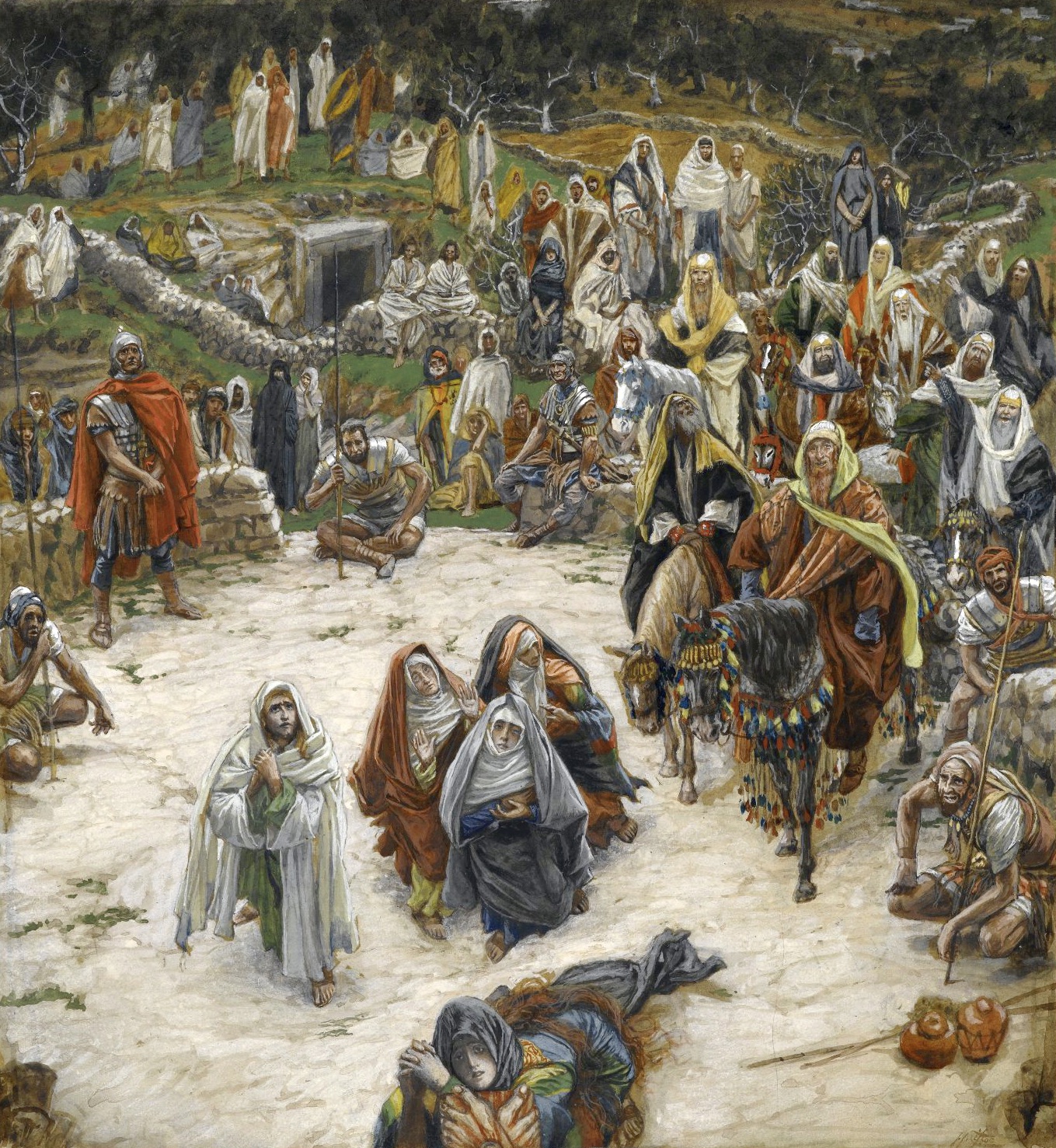
James Tissot, What Our Lord Saw from the Cross

We should not overlook how metaphors based on justice play a significant role in the Bible, especially in the New Testament, regarding our relationship with God. Self-justification often forms an unattractive feature of our relationship with others. Yet, it has no appropriate role in our relationship with God. We may try to secure right relation with others through self-justification, but only God makes us right with God. Since our practice of the virtue of justice has no role in securing our standing before God, we can only seek in humility to reflect our gratitude for God’s generous and unmerited favor.

Paraphrasing Paul, we have been made ambassadors of the one who embodied the beauty of reconciliation, or of graced right relation.

Contradiction, and the Beauty of Paradox and Metaphor

If reading this by email, please tap the title at the top to open your browser for the best experience. Then, clicking individual pictures will reveal higher resolution images.


An observation, a statement, or even a casual comment, may strike us as involving what we call a contradiction. A contradiction involves at least two mutually exclusive claims. Something cannot be both true and false, we like to think.

Yet, with things like photos, we can observe that they may be both light and dark, or both clear and fuzzy looking. Or regarding a poem, we might say it is both meaningful as well as obscure in its meaning. Claims regarding contradiction therefore call for precision, and awareness of context.

One way of viewing objects of attention, and the appearance of contradiction, is to say these things involve paradox. A picture or a description of it , or a picture’s characterization, may also be termed as paradoxical.

Then there are metaphors, which can be beautiful. Especially when – with unanticipated insight – they juxtapose ideas that otherwise would seem to form unlikely pairings. Such metaphors can help us to perceive how apparently contradictory statements, observations, or claims, can each be true.

Not all metaphors do this. But metaphors help our perception and understanding. For this reason, metaphors play a significant role in the Bible, and not in just in the scriptures holy to the Judeo-Christian tradition.

From pastoral experience, I know that various selections from the Bible can strike readers and hearers as involving contradiction. Moving beyond a simple conclusion – that what has been read or heard is contradictory – can be a challenge, and this calls for intentionality. For beauty is not always immediately discerned. The challenge lies in learning to perceive how the same reading may involve paradox as well as metaphor, and that these aspects of the text are intended to be illuminative.

One of the divinely intended purposes of the Bible is to help us perceive, to perceive more than we do now, and therefore to perceive more wholly. The primary purpose of the Bible – and of, we may charitably assume, the sacred scriptures of any religious tradition – is to help us perceive what is holy.

Robert Lentz, The Holy Trinity (featuring Creation, and astronomical images)

These insights may therefore be just as important for Christians as they read the scriptures of other peoples, as they are for when we read the Bible.

For there is one God, who in love shares self and wisdom with the whole cosmos.

Here is a relevant paradox. God may in love share self and wisdom with all the peoples of the world. Yet, it may be that God does not share self in the same way with all people, nor the same wisdom. If this is so, then the reason why ultimately lies in the inscrutable wisdom of God. Yet, possible reasons for why God does or does not share self and wisdom in the same way with different people are suggested in our own scriptures.

Perceiving this, we are moved to listen and read the Bible, and especially our lectionary readings from it, attentively and with a well-founded expectation of spiritual fulfillment.


The Beauty of Faithful and Determined Courage

If reading this by email, please tap the title at the top to open your browser for the best experience. Then, clicking individual pictures will reveal higher resolution images.


Remarkably, Violet Jessop survived life-threatening illnesses during her childhood, having contracted both typhoid and tuberculosis. This was in a time of pre-modern medicine, when – in her weakened condition – both diseases (and others) could easily have taken her life. Then, as a young woman, she lost her mother to illness. Becoming her family’s primary income earner, she followed in her mother’s steps by serving as what was then called a stewardess on ocean liners. This position combined the roles of nurse and personal attendant, most likely assisting with the health and other needs of passengers traveling in First Class.

This choice of employment in a relatively modest role led to her unexpectedly remembered place in history. She survived not only the sinking of the fated Titanic (1912), but also the demise of the Titanic’s sister ship, the Britannic, in 1916. The Britannic was serving as a hospital ship when it struck a mine in the Aegean Sea. Before the sinking of those two ships, she had earlier survived the feared near-sinking of the eldest nautical sibling of the Titanic, the Olympic. In 1911, the Olympic accidentally struck the British warship, HMS Hawke, and was significantly damaged.

Many of us, if we had faced her circumstances following her rescue from the Olympic, might have reevaluated our occupational choices and instead sought a similar role to her ship-borne duties but one safely on land. Jessop, as we learn, chose otherwise. Upon the completion of repairs to the Olympic, she returned to her role on that ship, where she served until she was transferred to the Titanic the following year.

The Olympic (left) and the Titanic in Belfast on March 2, 1912

Courage, self-possession, duty to her family’s needs, and a continued desire to serve others, clearly numbered among Violet Jessop’s attributes. Perhaps easy to overlook, in this time of our social history, is another feature of Jessop’s character, her abiding religious faith and practice. Courage (or Fortitude), and Faith, are two of the virtues commended in the Christian tradition, and both were a practiced part of Violet Jessop’s spiritual life. Earlier on the morning of the Britannic’s sinking, while following her regular pattern, Jessop had attended mass on the ship in the company of medical staff and other caregivers.

The Britannic seen while serving as a hospital ship during World War I

Upon the Britannic’s encounter with a German mine, causing it to sink in less than an hour, Jessop’s lifeboat was pulled toward the still-turning propellers and into their direct path, crushing the boat and killing some of its occupants. She suffered a skull fracture, and was cared for by doctors with whom she had earlier been present at morning worship.

The size and kind of propellers that nearly took Jessop’s life

In spite of all this – including surviving three disasters at sea – Violet Jessop continued to work on ships for the rest of her career, and died in England at the age of 83.

In the life and experiences of Violet Jessop, we find a beautiful example of a congruence between her Baptismal vocation – one shared by all who have found new life through the font – and her chosen occupation in its serial settings upon the waves. In her later years, Jessop told a friend what had helped her survive and get beyond the multiple challenges she had faced. She summed it up by saying, “[It was] just the will to live. And a huge chunk of faith in divine intervention.”


Pointing Toward Perception

If reading this by email, please tap the title at the top to open your browser for the best experience. Then, clicking individual pictures will reveal higher resolution images.


We live in a world filled with “data.” Disconnected bits of information, especially in great quantity, overwhelm our ability to see and to think. Accumulating additional data or more information does not produce knowledge. Knowledge has to do with seeing the connections between bits of information. When we see the connections, we begin to see a picture, we begin to hear a story, and we gain understanding as well as wisdom.

The unrecognized fellow traveler on the road to Emmaus asks the two disciples, ‘what are all these things you are talking about?’ The answer he receives from them amounts to information. But his question is pointed toward understanding, especially in relation to ‘the big picture. He is challenging them to discover something bigger. He is really asking something like this: ‘All these things’ that have happened… What do they have to do with what God has been up to, all along?”

Here is a basic Christian truth that we find in the Emmaus Road story: Things take on meaning in relation to the risen Jesus. It happens when we see events in our lives in relation to him. It happens also with things like bread and wine as we gather at table. And it happens with people like you and me as we gather in community.

Jesus helps our perception on the road to Emmaus, and reveals something even more profound at the inn. This ‘inn,’ unlike the one where he was born, has many rooms, many mansions. When we see things like past events and the bread in relation to him, we discern more about what they were or are, and what they yet can become. When we see ourselves in relation to him, we better discern who we really are, and who we are called to be.

Prayerfully, we can look around, between things, and within. We can look for the connections. When we do, we see and discern. We see more because we see more wholly. Then we see the holy.


The above painting, Supper at Emmaus (1958), is by Ceri Richards, and is used by permission from the Trustees of the Methodist Modern Art Collection (UK). The penciled notation at the base of this guache painting on paper suggests that it was intended as a study for an altarpiece painting for the chapel of St. Edmund Hall (or College), at Oxford, England. The Emmaus story can be found in Luke 24:13-35, and it is a traditional Eastertide Gospel reading.

This post is adapted from one first published in 2014.

The Believing Eleven

If reading this by email, please tap the title at the top to open your browser for the best experience. Then, clicking individual pictures will reveal higher resolution images.

Peter Paul Rubens, The Rockox Altarpiece, 1613-1615 (center panel)


It is evening on the day of Resurrection-discovery. John tells us that ten of the disciples are hiding behind a secured door out of fear. Judas is deceased, and Thomas is away.

Jesus suddenly appears to the unprepared disciples, and shares with them his peace. He shows them his hands and his side, and then – as a direct consequence of seeing the places on his body associated with his death – the ten disciples rejoice when they see their Lord. In other words, their recognition of him, and that he was somehow alive again, brings them joy by restoring their belief in him.

When hearing this story from John’s Gospel on the second Sunday of Easter, we may be prone to considering it apart from what happens just before it. The disciples, who are hiding out of fear, have already received an eye-witness to the resurrection of Jesus. Mary Magdalene, to whom Jesus revealed himself at the tomb that morning, had come and told the ten the Lord was alive, and that he had appeared to her. Clearly, and prior to Jesus’ unexpected appearance, the ten disciples are still doubting her personal witness. Even after receiving what should have been trusted testimony from Mary Magdalene, a fellow follower of Jesus.

So why – in popular imagination – isn’t this well-known Gospel reading from John 20 commonly referred to as the “doubting disciples” reading? Why should Thomas be singled out, when his joyful recognition of the risen Jesus depended on nothing more or less than what the 10 had needed, and received, before him?

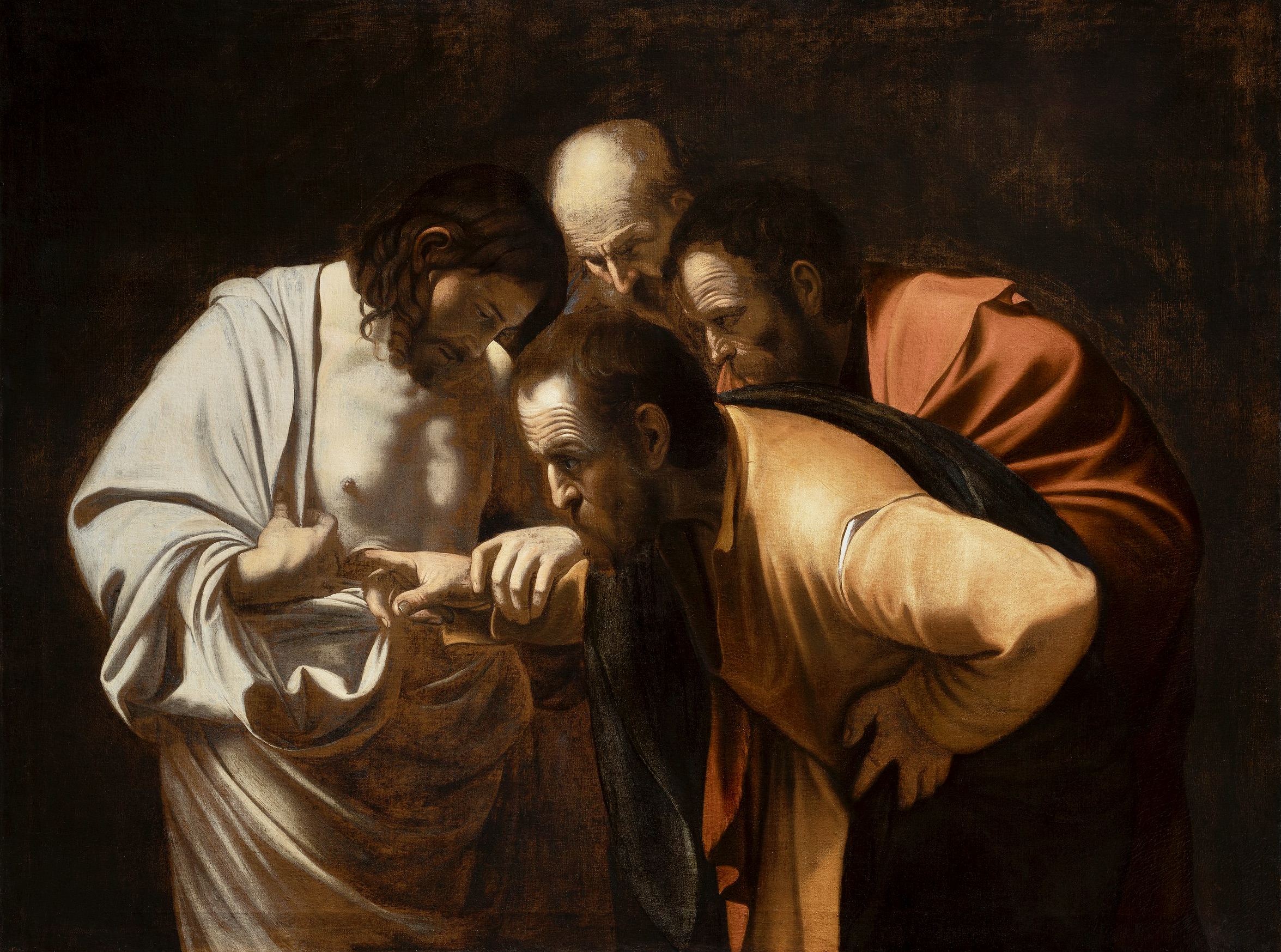
And why have so many painters in the Western tradition privileged Thomas’ purported unbelief in the Risen Lord, rather than depict the earlier reluctance of the ten others to arrive at joyful confidence about the Lord’s astonishing return? Apparently, in many painters’ eyes (especially Caravaggio), more visual drama was to be found in images of a doubter’s hand placed within an open wound.

Caravaggio, Doubting Thomas, 1601 (a famous traditional presentation of the event in John 20)

A further detail to notice, which our familiarity with so many paintings helps to obscure, has to do with how Thomas responds to Jesus. According to John, Jesus appears to the not-yet-believing ten, and – unbidden – shows them his hands and his side. Seeing the traces of his wounds on his risen body brings them joy. Jesus then appears unexpectedly a week later, this time showing himself to the one not present on the prior occasion. And just as he had done previously, Jesus offers Thomas the same opportunity he had provided to the others.

We should therefore not be misled by Thomas’ oft-quoted comment to the other disciples, prior to his own epiphany, about what he needed in order to believe. According to the text, Jesus – upon appearing in the same house a second time – bids Thomas to touch him. Yet, Thomas immediately responds to Jesus’ words without any mention in the Gospel of him having physical contact with the risen Lord’s wounds. Jesus then asks Thomas a rhetorical question, “Have you believed because you have seen me?” Naturally, Thomas’ implied answer is ‘yes.’

For all these reasons, we will do better to find a different and more positive descriptive phrase by which to refer to this well-known passage from John 20. “Jesus meets the disciples according to their needs,” though wordy, would do better.

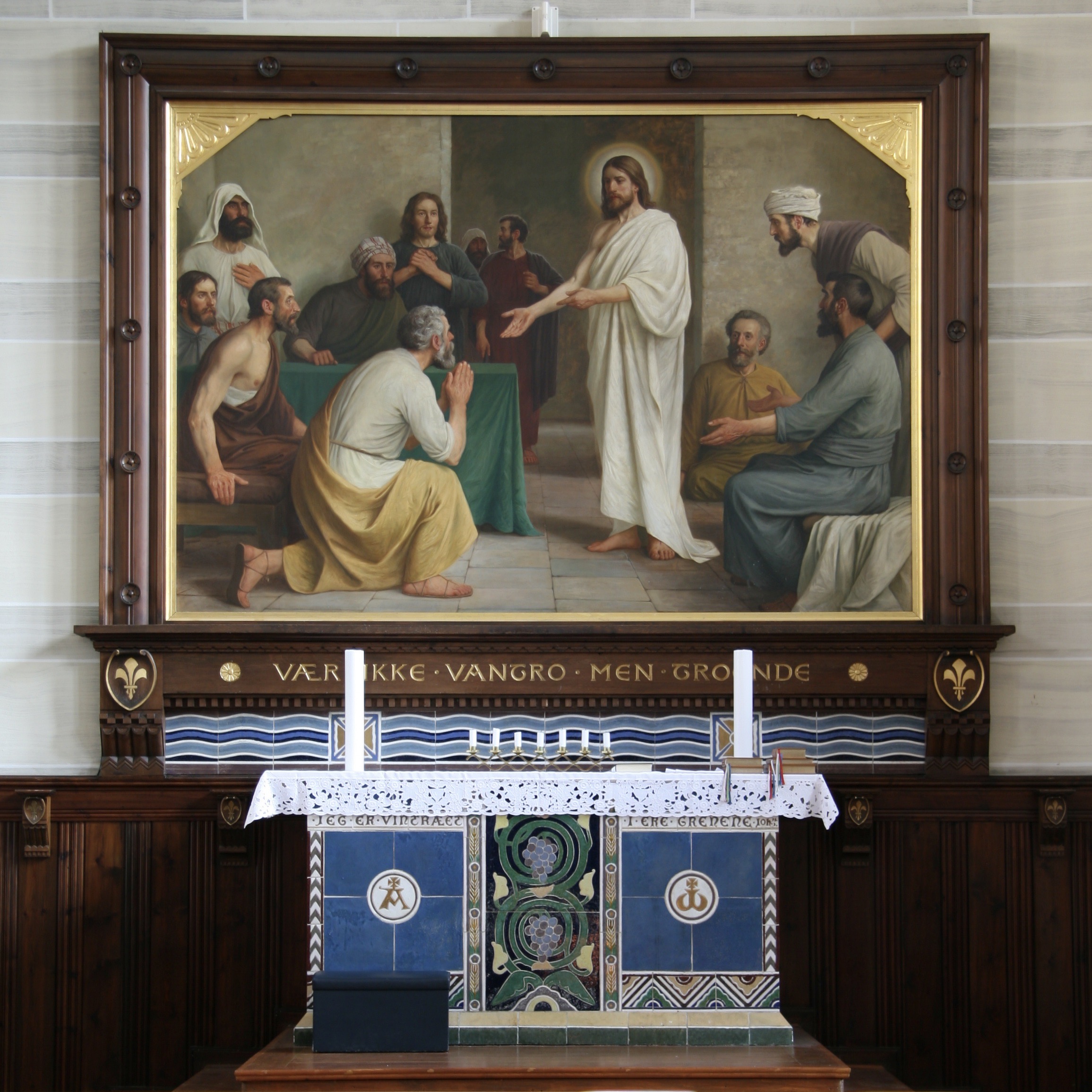
P. Steffensen’s altarpiece painting behind the altar of Zion Lutheran Church, Copenhagen


This post is based on the traditional Gospel reading for the second Sunday of Easter (April 7 in 2024), John 20:19-31. The story within it concludes with these words: “Jesus said to Thomas, ‘Have you believed because you have seen me? Blessed are those who have not seen and yet have believed’.”

Note: The altarpiece paintings by P. Steffensen and Rubens provide an interesting counterpoint to the prevailing tendency of painters to focus on Thomas placing his hand in the side of the Risen Jesus.


I Will Take You To Myself

If reading this by email, please tap the title at the top to open your browser for the best experience. Then, clicking individual pictures will reveal higher resolution images.

Fra Angelico, Noli me tangere


In the intimacy of his physical embodiment, the disciples and the holy women want to hold on to Jesus. It is the only way they have known him.

Mary is then found by the One she is looking for, in the garden by the tomb, on what becomes the Resurrection-discovery morning.

”Don’t try to cling to me,” he tells her, for he has not yet ascended to where he promises to take us.

We want to hang onto to how we have best known him. He promises to hold us to himself in what will be an even greater intimacy.

It is just beginning. Alleluia!


Jesus said to her, “Do not cling to me, for I have not yet ascended to the Father; but go to my brothers and say to them, ‘I am ascending to my Father and your Father, to my God and your God.’” (John 20:17)

“And if I go and prepare a place for you, I will come again and will take you to myself, that where I am you may be also.” (John 14:3)