Giving thanks to God

… always and everywhere …

(An earlier than usual post — for your Thanksgiving Week!)

A lively celebration of the Eucharist, or The Great Thanksgiving, at St. Gregory of Nyssa Episcopal Church, San Francisco

It is right, and a good and joyful thing, always and everywhere to give thanks to you, Father Almighty, Creator of heaven and earth.” So begins the body of one of the Eucharistic Prayers in The Book of Common Prayer, as used in Episcopal Churches for the celebration of Holy Communion. “Always and everywhere” – these words regarding giving thanks remind us of the characteristic posture of the Church, and of all of its members, whether at worship in their parishes or at work or play in the world around them.

When Baptized Christians gather for a celebration of the Lord’s Supper, they remember that “the Lord Jesus on the night when he was betrayed took bread, and when he had given thanks (eucharistesas / εὐχαριστήσας), he broke it, and said, ‘This is my body which is for you. Do this in remembrance of me’ (1 Corinthians 11:23-24).” What we as Christians do in a formal way, when gathered for the Eucharist, enacts our normative way of shaping our whole lives. Which is always and everywhere to offer thanks to God for mercy and grace, and for God’s love poured into our hearts by the Holy Spirit. For we seek to live as we pray: Offering thanks to the Father, through the Son, in the power of the Holy Spirit.

“Give thanks in all circumstances; for this is the will of God in Christ Jesus for you.” Paul shares this counsel in his first letter to the Thessalonians (5:18). These words are sometimes mis-remembered as saying, “for all circumstances.” The difference between the two prepositions, in and for, is significant. In our daily rounds, it is very difficult for most of us to be thankful for adverse circumstances and experiences, and we find it hard to reconcile their occurrence with the oversight of a loving God.

Yet Paul believed in the doctrine that we call Providence. He firmly believed that the evil conditions and events that we experience in this life are not in themselves acts of God, imposed upon us by the divine will. Instead, they are things that are allowed to occur by a God who loves us and who intends our good. This is clearly a mystery to us, on this side of the veil separating us from the eternal.*
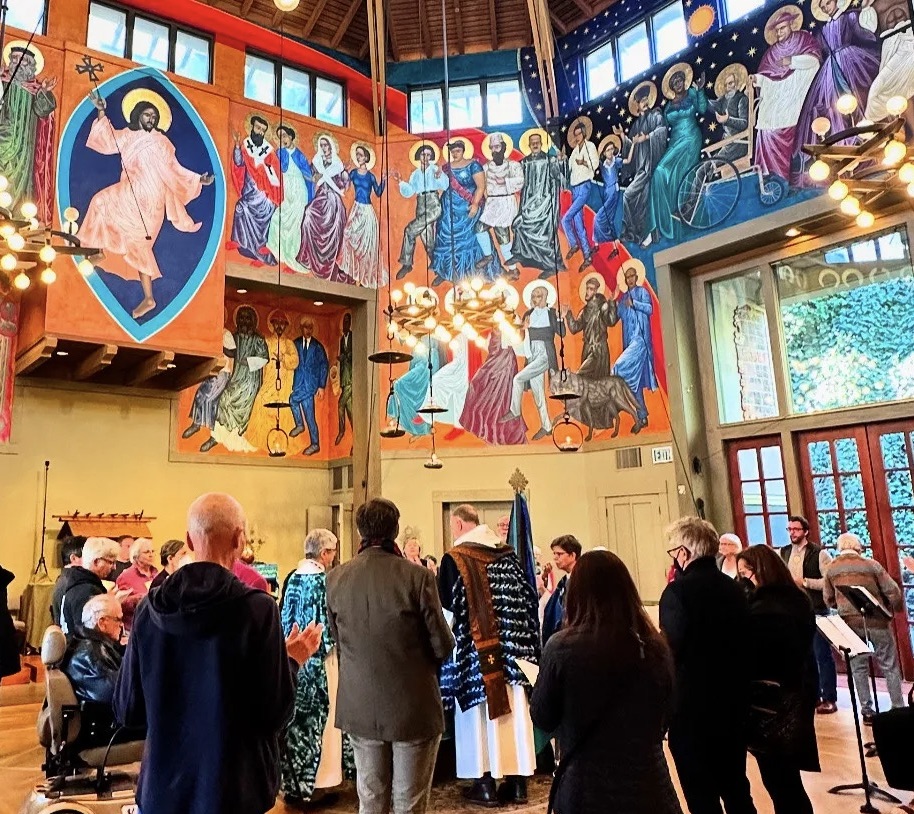
Another Eucharist at St Gregory of Nyssa

As we well know, the society in which we live in the United States sets aside one day of the year as a public holiday that is called Thanksgiving Day. Its history lies in a presidential proclamation by Abraham Lincoln. Yet, regardless of the circumstances of its origin, the day is widely celebrated by many who are unfamiliar with its history, and who may identify with traditions, practices, and holidays passed on from other cultures. This is only proper, as giving thanks is a universally human act. The people and circumstances, and the particular reasons for it, may all differ. Yet, the spirit of the act is the same.

I have heard it explained, that the sanctuary candle we see in the sanctuary of some churches is to remind us that God is present. The implication of this explanation might be misconstrued in such a way as to suggest that God’s presence elsewhere might not be as assured. Yet, the explanation can also be understood positively, as saying something like this: “This candle is here to assure us of God’s presence. We keep a candle here lit perpetually to remind us that God is always and everywhere present, even in the darkness or when we are alone elsewhere.”

Celebrating Thanksgiving Day can bring with it a similarly positive understanding. We give thanks formally, as a nation of many peoples, on one day of the civil year as reminder that giving thanks should be natural for us every day of the year. And the thanks we should offer are for the good things we enjoy with those whom we know and love, but also for things, people, and even institutions, about which we may be indifferent or even disapproving.
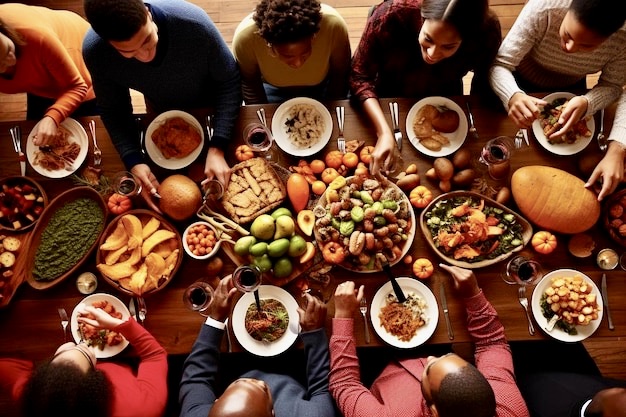
Gathering for a shared meal in the context of a spirit of thanks

In this spirit, I would like to share a prayer found in The Book of Common Prayer, that is principally used in the closing portion of the rites for Morning and Evening Prayer. It is therefore not specifically designated for use in observance of our national celebration of Thanksgiving Day, though it could be. This is a prayer intended for use everyday, and is a fine one for us to use at our celebrations this week:

Almighty God, Father of all mercies,
we your unworthy servants give you humble thanks
for all your goodness and loving-kindness
to us and to all whom you have made.
We bless you for our creation, preservation,
and all the blessings of this life;
but above all for your immeasurable love
in the redemption of the world by our Lord Jesus Christ;
for the means of grace, and for the hope of glory.
And, we pray, give us such an awareness of your mercies,
that with truly thankful hearts we may show forth your praise, not only with our lips, but in our lives,
by giving up our selves to your service,
and by walking before you
in holiness and righteousness all our days;
through Jesus Christ our Lord,
to whom, with you and the Holy Spirit,
be honor and glory throughout all ages. Amen.


*A note about the distinction offered above, regarding what God allows: Readers may wish to consider the way that Aristotle, and others since, have distinguished various dimensions of the idea of ‘cause,’ or causation (four dimensions have been articulated in the Western tradition). “Efficient cause” is the familiar form of the word cause, as in causing a row of dominos to cascade forward. “Final cause” can be conceptually helpful, especially as we think about God drawing persons and events toward their fulfillment in Christ. In this sense of the word cause, instead of our thinking of God as pushing events forward, some of them good and some perhaps bad in our eyes, God summons, and pulls toward the future, those people and things that may be made whole in Christ (ie, those that are open and willing recipients of his Grace), to their true end.

Do We Give Thanks In Darkness?

[If reading this by email, please tap the title at the top to open your browser for the best experience. Then, clicking individual pictures will reveal higher resolution images.]

Rembrandt, Paul in Prison (1627)

The troubling darkness of October 7 lingers. The following is my recent homily, offering reflection on how we can respond to a time like this.


We are always prone to being unsettled or troubled by unexpected challenges, whether nearby or far away. Since we believe in an almighty and loving God, unanticipated darkness, sorrow, and anger can confuse and upset us. For the people of Israel and Gaza, and those who care for them, October 7 and the days since have been filled with the news of much evil and much suffering. But, if ‘God is love,’ and the giver of all good gifts, as Christians believe, two questions we cannot easily answer will bother us: How can God allow natural and moral evil to happen? And why does God tolerate the suffering of his creatures, and especially of people made in his image?

When facing questions like these, I like to turn to some of Paul’s words in Philippians that we have heard in our recent Sunday lectionary readings: “God… is at work in you, enabling you both to will and to work for his good pleasure” (2:13). These words may be hard to accept — and hard to live by — especially if we are discouraged or fearful about what is happening around us. Yes, we hear Paul in Scripture say that God is at work in us. But we may not feel like it’s actually true. Indeed, we may find it hard to believe that it could be true. Yet, Paul wrote these words while he was in prison.

This is what we need to remember: Our feelings are fickle! Our moods and general equilibrium are subject to the ups and downs of our circumstances. Things happen to us, which are not of our own choosing. Feelings are the same way. They also ‘happen to us.’ The difference between what happens to me, and what I choose for myself, is very significant. I can’t do much to change events in the world. And I have difficulty keeping the emotions stirred by them from affecting me. But I can reflect on how I respond to them, in terms of what I decide, and what I choose for myself.

So, instead of dwelling on feelings of discouragement, inadequacy and aloneness, I have another choice. I can choose to remember Paul’s words, and repeat them to myself: ‘God is at work within me. God is at work within me. God is at work within me, both to will and to work for his good pleasure.’

This insight helps us hear, consider, and then perhaps accept, Paul’s challenging words to us. He is saying something much more profound than “be happy,” or “be cheerful!” Instead, Paul is urging us to make a choice, a decision to rejoice and give thanks, even if we may not feel like it. “Rejoice in the Lord always,” he says (4:4), which is different from saying, “always be happy about the world.” It often seems impossible to be thankful for or about the condition of the world. But, we can still be thankful for the Lord who overcomes disorder, and who in the end makes things right. Paul says that the Lord is near, and so we should not worry about anything. Believing that the Lord is near takes precedence over anxiety and concern about what is amiss. Believing that the Lord is near is a choice we make, and not a feeling we wait for.

The imprisoned Paul teaches us how another willed-decision accompanies relying on the Lord’s nearness. In all circumstances, we can — by prayer — let our requests be made known to God with thanksgiving (4:6). This is equally a result of choice, rather than depending on how we feel. When we make this conscious choice to give thanks in all circumstances (rather than for them), Paul tells us that the peace of God, which surpasses all understanding, will guard our hearts and our minds in Christ Jesus (4:7).

Therefore, confidence, reassurance and peace are not simply feelings that may or may not happen to us. They are, instead, the result of willed-decision-making. So, Paul asks us to keep on doing these things, and that as we do them, the peace of God will be with us.

When I dwell upon what I fear, on what makes me angry or depressed, I give in to feelings that happen to me, especially in relation to circumstances I cannot change. But Paul asks us to do the opposite. Instead of dwelling on the negative, he urges us to reflect on what is positive. Think instead, Paul says, about whatever is true, honorable and just: about whatever is pure, commendable and worthy of praise (4:8). And he urges this based on choices we can make.

Notice what Paul is not saying as he urges us onward. He is not saying, ‘hope for’ good things, which might happen someday. He is saying think about the good that is already true, and happening right now.

In an accompanying lectionary Gospel reading, Jesus says that God’s kingdom ‘is like a king who gave a wedding banquet for his son.’ We have all been invited to this wedding banquet, and we are participating in it in our lives today. Again and again, the servants of the king go out and call people to respond to the king’s invitation. But like so many of those in Jesus’ story, we let other things get in the way.

Among what gets in the way are things we worry about, or we feel pressure to get done. Our attention shifts from the wedding invitation, and gets centered on our calendar, and on our ‘to do’ list. Then we get distracted by our anxiety.

Again and again God’s invitation arrives, through the King’s written Word, and through the voices of the King’s servants who call us. But other things press against and bend our priorities, and these other things shape our lives… even though we have been invited to a wedding! We are invited to a celebration and a feast! Joy is written into the invitation. But rather than let God’s joy touch our hearts, strangely, we let lesser things inhabit our imaginations. Many gifts and wedding favors are given to those who come to this wedding supper. Yet, in time, the wedding begins to feel like a ‘work-day,’ when so much seems to be asked of us. We then shrug off the invitation-bearers, as if they are a nuisance, rather than bearers of a joyful message.

So, we should remind ourselves of Paul’s words. For he says,”Rejoice in the Lord always; again, I say Rejoice… The Lord is near.” As Eugene Peterson translates the words that follow, Paul also says this: “Don’t fret or worry. Instead of worrying, pray. Let petitions and praises shape your worries into prayers, letting God know your concerns.”

Worries can be fashioned into prayers, and concerns can be shaped into praises. We can voice our concerns to the Beloved. It’s a choice! But our natural inclination lets worries and concerns drift into complaints and laments. Yet, we can choose! We can choose to rejoice, and to pray, and to praise. Of course, it may seem perverse to try and give thanks for the things that cause us worry and concern. But that is not what Paul is encouraging us to do. We can still give thanks in the midst of those things. We can give thanks that, despite troubles, we have been included in the wedding supper of the Lamb. We give thanks that we have become members of the Bride of Christ. We have been joined to the Beloved, whose wedding banquet we are part of today. Thanks be to God!

The Beauty of Turning Back


Ten lepers at the edge of a village call out to Jesus, who is on his way toward Jerusalem. They say what we would say when faced with a hopeless situation. The lepers stand at a distance because they are required to protect others from their ritual ‘un-cleanness’ and disease. With both hope and desperation, they cry out: “Jesus, Master, have mercy on us!”

Seeing them, Jesus simply says, “Go, and show yourselves to the priests!” The ten then turn, and do what Jesus says. Why? Why do they do that? Just because he told them to? No ~ it’s because they accept and believe what Jesus says.

According to Mosaic Law, only priests could certify that someone was ritually clean and free of disease. The sole reason for the ten to show themselves to the priests would be to present evidence that they were healed! Going to the priests would imply they believed their healing was already happening, if not complete. By turning to go, all ten showed that they believed what Jesus’ word would accomplish. And Luke tells us that as they went, all ten were cleansed.

Imagine being in their place. Surely, having been healed, every one of them was filled with overwhelming joy! James Christensen’s painting, Ten Lepers, captures the moment beautifully. I love how the artist portrays the ten, and especially the one who turns back. Bubbling with excitement about what the priests’ certification would mean for their lives, the ten would have run to be reunited with their families and former homes. All ten would have been filled with thanks and praise for the great gift they had received. We therefore miss the point of this story if we think only one of them, the Samaritan, was thankful.

Listen to how Luke tells it: “One of them, when he saw that he was healed, turned back, praising God with a loud voice. And he fell on his face at Jesus’ feet, giving him thanks.” By turning back, he humbly manifests a sign of repentance. Then, by falling down, he embodies a sign of worship. So, this man who turned back wasn’t just thankful in general about being healed. He came back to give particular thanks to the source of his healing. Luke leaves us to imagine his words, which must have been something like, “Praise you, O Lord, for your mighty work in my life!”

Falling down at Jesus’ feet was an act of worship. This is what we do when we bow in humility before God. It’s how we acknowledge our unworthiness, giving thanks for undeserved grace and mercy. The Greek verb Luke uses to describe what this man does at Jesus’ feet, is “eucharisteo”… In other words, he fell down in “Eucharist” at Jesus’ feet ~ where he responds with great thanksgiving!


The image above is of James C. Christensen’s painting, Ten Lepers. This post is based on my homily for Sunday, October 13, 2019, which can be accessed by clicking hereOther homilies of mine may be accessed by clicking here. The Revised Common Lectionary, which specifies the readings for Sundays and other Holy Days, can be accessed by clicking here.