Creation

God’s Handiwork Inspires Ours

Stones found on a northern Lake Michigan beach

Labor Day is around the corner and some of us may receive and enjoy a day off from work. What we call retirement, a stage in life I am presently enjoying, tends to represent leaving work behind. Yet these and related ideas rest upon a common assumption, that work is different from, and in some ways inimical to, enjoying fulfillment in life.

I find a biblically based theological insight helpful when thinking about work. As with many matters that can be looked at from the perspective of Christian moral theology, our view of work can be enhanced by making reference to four specific reference points. These are, first, what we have learned about God’s purposes in Creation for this or that aspect of our lives; then, what impact sin associated with our Fall has had upon what we are thinking about; third, how God’s ongoing work of Redemption has restored and or transformed the matter presently under consideration; and fourth, to ask what future – if any – does this aspect of our lives have in Christ. 

Work provides a wonderful topic for engaging in this fourfold inquiry. Based on our common way of thinking about work, it may be hard for us to consider the meaning of work from any other vantage point than of attributing its role in our lives to the Fall and to the ongoing effects of human sin. Yet, we can also learn from many who have come before us who have distinguished work from toil. This can help us see how forms of labor, and pejorative associations the word may have for us, are surely due to our proclivity to link such activity with burdensome unpleasant duties.

For what we may overlook is the biblical view of how God has shared stewardship responsibility for aspects of Creation with us, as beings created in God’s image and likeness. This was symbolized by the way that our mythic forebears (Adam and Eve) were given their ‘work’ of naming the animals as a path toward fulfillment. It was not until their expulsion from the Garden that the first human beings are described as prone to acts characteristic of sin. Thereupon, in biblical theology, our heavenly ‘work’ of praise, and of divinely-invited participation in God’s Creation stewardship, ceased to be pleasingly ready pathways toward human fulfillment, and became energy draining and spirit-diminishing activities – such as we tend to find them to be now.

A growing segment of the wider Christian community shows signs of acknowledging how God’s work of Redemption is ongoing, quite aside from its ‘once and for all time’ episodic saving events. The pattern and purpose remains the same – nothing fundamentally new is added, nothing old of lasting value taken away. Preeminent remains God’s abiding purpose for us to become and be God-like in God-intended ways. For, as Athanasius taught us, the Son of God became the Son of Man, so that the children of men and women could become the children of God. Work – not toil nor burdensome labor but creative and fulfilling work – remains a vital part of our holy path toward wholeness.

And to remind us of this abiding truth, the loving Creator has spread around us an uncountable abundance. These are the signs of outpoured and participatory grace, some of them very small, like stepped-upon seashore pebbles and tiny blossoms among hurried-by roadside weeds.

Too quickly we dismiss the significance of our our small acts of selfless giving, not to be counted by us, but adding up to so much more than we imagine in the life-growth of others. This is our holy ‘work,’ overlooked but important stepping stones on our path toward living into the godly fullness with which Christ fills us.

If on our daily course our mind

Be set, to hallow all we find,

New treasures still, of countless price,

God will provide for sacrifice.

Old friends, old scenes, will lovelier be,

As more of heaven in each we see:

Some softening gleam of love and prayer

Shall dawn on every cross and care.

[John Keble, “Morning,” from The Christian Year]

Earl Young’s Boulder Park Charlevoix Houses

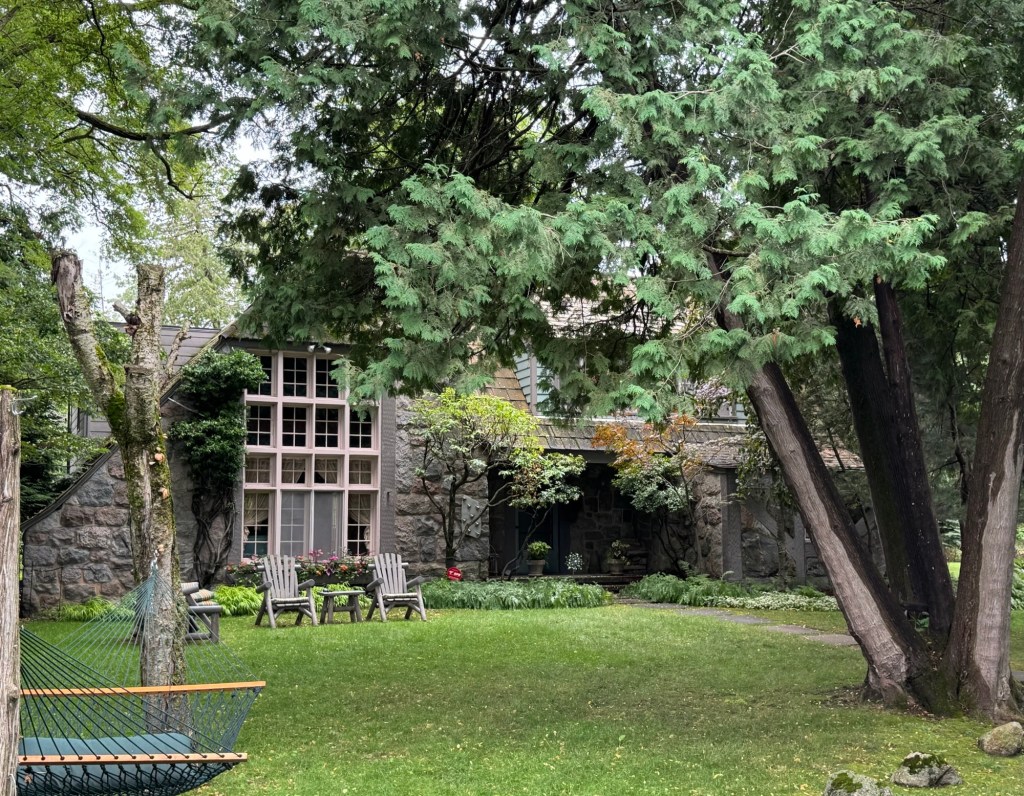
Earl Young’s Boulder Manor, built for himself, as seen on a recent day

Summer visitors to Charlevoix encounter at least two things about the area: first, that this part of Michigan is a haven for boat lovers and especially cruisers on the Great Lakes; and, second, that the city of Charlevoix is the home of Earl Young’s so-called ‘mushroom houses.’ The first observation regarding boats and the appealingly clear lake water is easily recognized. The second association with the area takes a bit of discernment, usually gained from seeing brochures or the small electric carts evident in town bearing the label, “Mushroom Houses Tours.”

A pleasant walk around Charlevoix while viewing the many houses that Earl Young designed and built in the community reveals that his approach to home design was not uniform, and that his work avoided that to which the wider community has also not succumbed – becoming a caricature of itself. For he could have approached his design work in such a way as simply to repeat and imitate prior successes, pressing forward as so many architects have done to inaugurate a particular and distinctive style in home design. Instead, Young consistently displayed his overriding commitment to his chosen materials – stone and stone-related products. Therefore, when at the age of 35 in 1924, and in buying a tract of land adjacent to the Lake Michigan shoreline, he built ten houses with enough variation among them that later homes constructed by others are frequently confused with those of his own design. Young gave the tract along with its homes the fitting label of Boulder Park.

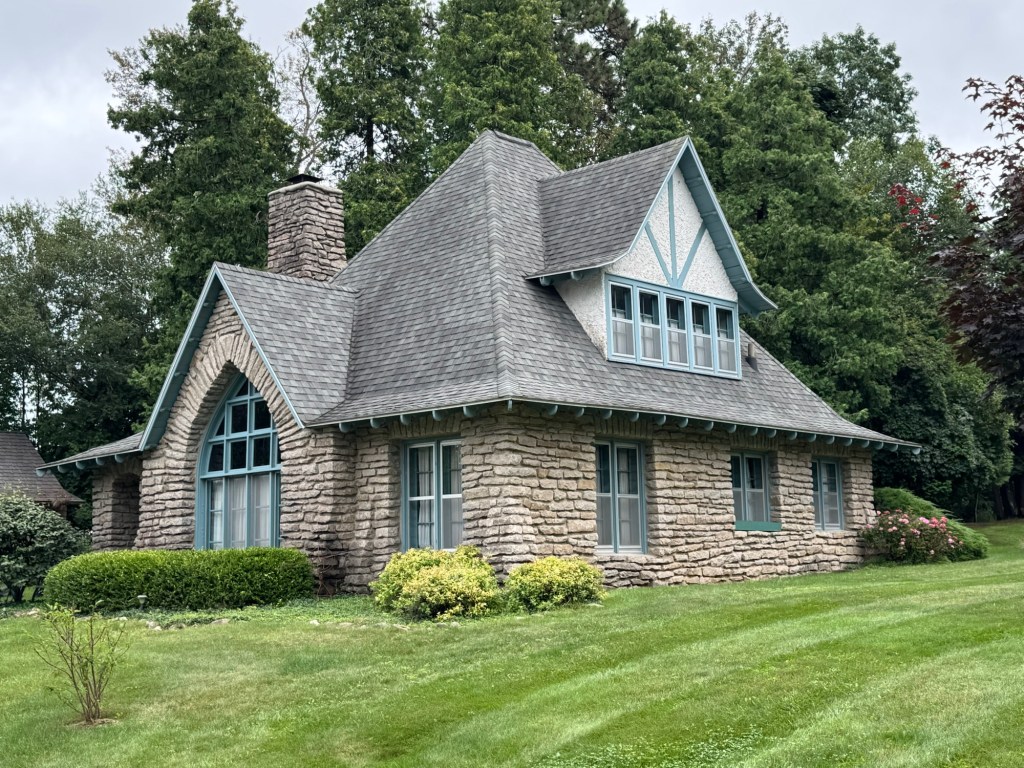
The Owl House, named for the arched front windows

This variability in the architectural character of the Boulder Park homes helps us to begin to recognize how the common ascription to Earl Young, of being the mushroom house architect, is in some ways a misnomer for him. A few of his houses nicely justify the label, given their firm rootedness to their sites, their often low or extending rooflines with irregular surfaces, and his heavy use of large stones and boulders in a number of them. Yet, Young was equally comfortable specifying limestone cut in horizontal block slabs and even commercially available brick or block products with which to construct walls with traditional uniformly-spaced layers of mortar. We may not be enamored with the some of the results of his work, but I think most of us can identify with Young’s lifelong intention to remain true to his materials and to the sites in which he set them.

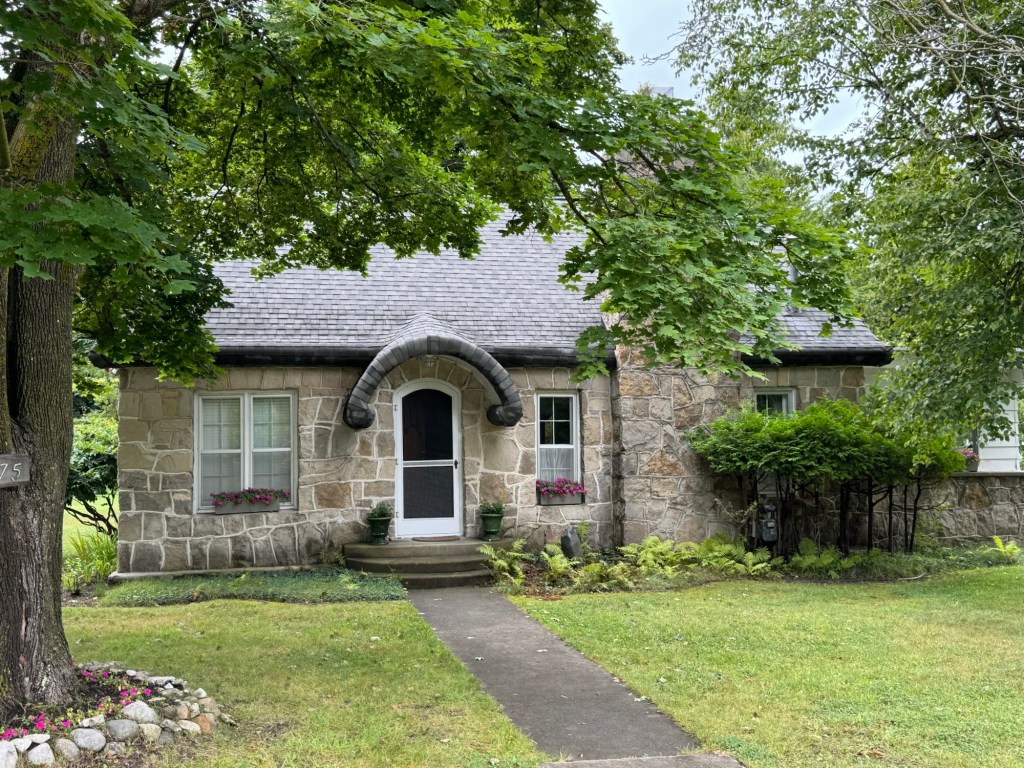
A 1929 limestone cottage in Boulder Park, known for the rolled edges of the eaves

Two neighboring homes in Boulder Park illustrate Young’s consistency of intent, and flexibility with regard to ‘style.’ Boulder Manor, built in 1928 (displayed at the top of this post), sits in close proximity to the Pagoda House, built in 1934, seen below.

The Pagoda House

My favorite among the Boulder Park houses is the home that Young built for himself, called Boulder Manor (top photo). It is constructed with massive pieces of stone and boulders from the area, and features a matching smaller playhouse for his daughters that has a working fireplace.

Rear view of Boulder Manor along with the playhouse for the Young’s daughters

In some ways Earl Young was a bundle of contradictions, an idiosyncratic visionary who was known to tell some clients what they needed in terms of a home, and yet also one who could reside with an out of town family for a considerable period of time so as to get to know how they lived before designing a home for them. He had a consistent love of rough, ‘undressed’ stone to be used as found, and at the same time a willingness to use stone in a very conventional way. Young was famous for wanting to do virtually everything ‘his way,’ often to the consternation of others, including town leaders. And yet, one house of his in Boulder Park was the result of a client convincing him to build a home based on a design plan found in a women’s magazine, the 1933 Enchanted Cottage with its very English-looking windows (seen below).

The Enchanted Cottage

The best introduction to Earl Young’s Charlevoix houses is a widely available book by the photographer, Mike Barton, titled, Mushroom Houses of Charlevoix. Filled with color photographs, and documenting every one of Young’s structures built in his home town, the book provides superb photographs, and better ones than I am able to provide.

The Beauty of Trinitarian Life

[If reading this by email, please tap the title at the top to open your browser for the best experience.]

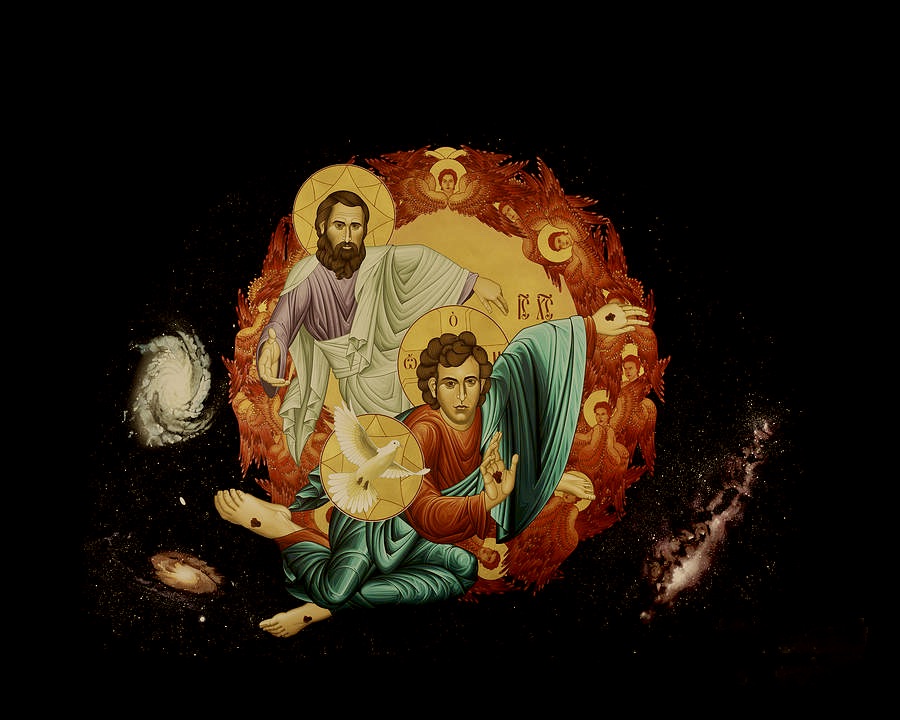
Brother Robert Lentz, Holy Trinity


Here is a Robert Lentz icon-styled painting that blends an historic approach to portraying the Holy Trinity with an inclusion of modern astronomical imagery. The facial depiction of the first two members of the Holy Trinity are presented in a very traditional way, while the images of the galaxies very obviously depend upon telescopic photography.

The most significant truth expressed within this composition by Lentz is that all three members of the Holy Trinity were and are involved in Creation, both in terms of the primal event, as well as in an ongoing divine presence within the whole of the cosmos, a theme found in John’s Gospel as well as in Paul’s letter to the Colossians among other biblical texts.

If there is any drawback to Lentz’s composition it is one shared with just about every Trinity-themed painting of which I am aware. To put it plainly, Lentz depicts the members of the Holy Trinity as ‘them,’ as objects of our subjectivity, as divine persons we contemplate, hold in regard, and with whom we contemplate or entertain relational involvement.

What this approach lacks, perhaps of necessity in a two dimensional medium, is an expression of the equally important and sometimes non-experiential truth that we are also the objects of the divine subjectivity, and how – after Baptism – we are inseparable from involvement with and in the Trinitarian life of God.

The simplest way to help make this evident can be found in all six of the Eucharistic Prayers in The Book of Common Prayer, as well as in many of the Collects. We pray to the Father, through the Son, in the Holy Spirit. And so, whether we are conscious of it or not, we are to live as we pray, to the Father, through the Son, in the Holy Spirit.

We should no longer try to depict the Holy Trinity through two dimensional imagery, much less with diagrams, or with objects like a three-leaf clover. For in each of these cases, we render the grace-filled context of our new and relational, post-Baptismal, life as if the grounding source for our being, and our life in Christ, was somehow external to us, and something which we might still have a need to approach.

Yet, through Christ and in the Holy Spirit, the Father is now in us, and we are in him. He is closer to us than we are to ourselves. This is the great mystery, the paradox, and the beauty of Trinitarian life in Christ after Baptism.

A Covenant with the Cosmos

Edward_Hicks_-_Peaceable_Kingdom_1834_b


“He was in the wilderness forty days, tempted by Satan; and he was with the wild beasts; and the angels waited on him.” (Mark 1:13)

Unlike Israel’s forty years of temptation in the wilderness, Mark’s account of Jesus’ forty days is not colored by looming adversity, where his comfort and safety are obviously at risk. For this reason, we should be careful not to read into Mark’s spare account details we learn from Matthew and Luke. Mark doesn’t portray this time as resembling Adam and Eve’s life after Eden, or Israel’s challenges in the wilderness, where serpents and wild beasts were an active threat. Instead, Mark’s account of Jesus’ forty days in the wilderness appears to echo Adam and Eve’s experience while they were still in Eden, and to fulfill Isaiah 11’s prediction of the peaceable kingdom.

Behold! In Mark’s wilderness story, we see a portent of the New Creation, where we will be at one with God’s Creation, and live in harmony with its beauty and ordered rhythms. Angels wait upon us, and we become aware of them. Why? Because as Jesus says in the first words of his mission: “The time is fulfilled, and the Kingdom of God has come near!” The age has been inaugurated when, as 1 Peter says, angels, authorities, and powers are all made subject to him.

As God’s Kingdom breaks into this world through the mission of Jesus, we should expect to see its presence and power. And we should be moved to live in harmony with its purposes. How do we know these purposes? We learn about them in God’s words to Noah and his family when they emerge from the ark. For forty days, they journeyed through the ‘wilderness’ of the flood, living side by side with all the animals in the ark, both wild and domestic. This poetic image of the ark with its inhabitants, journeying through the flood, provides a potent metaphor for the New Creation, for the Kingdom and for the Church.

Especially fitting are God’s words to Noah once he sets foot on land. God says, “I am establishing my covenant with you… and with every living creature that is with you, the birds, the domestic animals, and every animal of the earth with you.” Genesis describes this as a covenant between God and the earth, an “everlasting covenant between God and every living creature.”

God still “so loves the world,” with all its wonder and fine beauty.


Edward Hicks, The Peaceable Kingdom (1834).  To see the homily from which the above text is excerpted, please click here. See Isaiah 11:1-9, as well as Genesis 9:8-17.

Creation as Revelation

1024px-NautilusCutawayLogarithmicSpiral-cc license


“Ever since the creation of the world God’s eternal power and divine nature, invisible though they are, have been understood and seen through the things he has made.” Writing to the Romans, Paul suggests that all people have an opportunity to learn about God through our experience of the world. Visible beauty speaks of invisible mystery. Some call this common grace, and others refer to general revelation.

We learn about God in other ways that complement the ‘special’ revelation given to Israel and in Christ. This ‘general’ revelation from God through nature provides true knowledge even if it is not saving knowledge. Saving knowledge comes to us solely through special revelation. Therefore, to say that all can learn from God through his Creation does not imply that all will be saved. Only that all may experience delight and wonder from him.

“The heavens declare the glory of God, and the firmament shows his handiwork.” Psalm 19 celebrates how the beautiful ordering of the world reflects our Creator and speaks of his purposes. We find this ancient insight at the heart of a modern prayer:

“Almighty and everlasting God, you made the universe with all its marvelous order, its atoms, worlds, and galaxies, and the infinite complexity of living creatures: Grant that, as we probe the mysteries of your creation, we may come to know you more truly, and more surely fulfill our role in your eternal purpose…”

When Paul visited Athens and spoke to civic leaders at the Areopagus, he built his message on a similar assumption. Having found an altar dedicated “to an unknown God,” Paul revealed to his listeners the identity of the deity whose existence they had implicitly acknowledged. According to Paul, the Creator had fashioned the world in such a way that all people “would search for God and perhaps grope for him and find him.” Though the Athenians did not yet know the God of Creation by name, they had already encountered him.

Regardless of their inclination or efforts to discern deity, Paul tells the Athenians that God “is not far from each one of us. For ‘In him we live and move and have our being’.” Remarkably, within this statement, Paul quotes one of their poets to make a theological observation, and in the process identifies himself with his listeners.

The God in whom we all live reveals his divinity in the beauty and patterns of creation.


See Romans 1:19-20, Psalm 19, and Acts 17:16-34, which is the first reading appointed for the 6th Sunday of Easter, Year A. The Prayer is found in The Book of Common Prayer, page 827. (Note: Beginning the week of May 25, I may post less frequently during the summer.)

The nautilus photograph is from Wikimedia Commons. For more on the logarithmic spiral discerned in the nautilus shell, and reflection on how the spiral may be diagramed in relation to the golden ratio proportion, see the web page <http://www.goldennumber.net/nautilus-spiral-golden-ratio/&gt; by Gary Meisner.