Baptism and Baptismal Identity

Fully Alive: The Beauty of Human Nature

A photo of a print given to us years ago


Those familiar with my writing and ministry may not be surprised by how I choose to address the theme of beauty in relation to the human nature we all share.

My response is captured in a quote with words I have long loved and have frequently cited. The quote is from the second century Christian theologian and Bishop of Lyons (in present-day France), Irenaeus. “The glory of God is the human person fully alive.” To which he added, “and to be alive consists in beholding God.”

What an audacious statement! I believe that the fundamental insight here, latent within Irenaeus’s words, stems from the Gospel of John, with whose author Irenaeus likely had a personal connection. That would have been through Polycarp, Bishop of Smyrna (presently, Izmir, Turkey), the city where Ireaneaus was born. One writer has described Irenaeus as the spiritual grandson of the apostle John.

Another calligraphy print, this one featured on the website of Holy Cross Monastery

What does it mean for any one of us to be ‘fully alive’? I believe that the Gospel writer, John, would respond by echoing words from Paul, whose letters frequently employ the phrase, “in Christ.” Through Baptism, we come to be in Christ. Through Baptism, we are re-born in Christ; we live in Christ – and he in us – and we will leave this mortal life in Christ. Indeed, in John’s  compelling witness to Jesus’ teaching, we are told that those who believe in Jesus have already died, and now, will never die! All of the Gospel readings appointed for funerals in The Book of Common Prayer are from John. This is the Gospel that is so centered upon the themes of God’s incarnation within our shared human nature, giving us God-given light, and eternal life.

Words found in the daily pattern for Morning and Evening Prayer, as well as in the Eucharistic pattern used on most Sundays in Episcopal Churches, help amplify this point but in a subtle way. These several patterns for corporate and individual prayer include forms for confession. Using these forms, and after we acknowledge our sin, we pray that we may delight in God’s will , and walk in God’s ways. In the absolution that follows, we hear these remarkable words:

Almighty God, have mercy on you, forgive you all your sins through our Lord Jesus Christ, strengthen you in all goodness, and by the power of the Holy Spirit keep you in eternal life.

In words that may be easy to overlook, we pray that by Holy Spirit power, God will “keep us in eternal life”! Being fully alive involves delighting in God’s will, walking in God’s ways, and being kept by God in eternal life.

Christians believe that the beauty of our human nature was and is found in the Gospel Jesus, and as the Risen Christ comes to be found in us. Our human nature, created in the image and likeness of God, and transformed to become an icon of Christ, is therefore all about the fulfillment of our divinely-given and imbued potential. When by grace we see it happen in people’s lives, it is a beautiful thing to behold.

Yet, human nature, being still what it is, prompts us to look for beauty in outward terms when we view others, as well as ourselves. Jesus, as the Gospels imply, always looked for beauty within – the kind of beauty it was his vocation to share and re-enable in us. This is what we should be looking for, both within ourselves and in others.

The archetypal biblical example of the glory of God beautifully manifest in human nature is found in the Gospel Transfiguration stories. James Tissot, one of my favorite painters, offers us glimpses of Jesus manifesting this same glory on several occasions, a glory that was otherwise often hidden within him.

James Tissot, Jesus Goes Up Onto A Mountain to Pray

Tissot, Jesus Being Ministered to by the Angels

Paul’s remarkable words to the Corinthians bring these themes together nicely. For we want to be among those who are:

seeing the light of the gospel of the glory of Christ, who is the image of God… For God, who said, “Let light shine out of darkness,” has shone in our hearts to give the light of the knowledge of the glory of God in the face of Jesus Christ.”

And, by God’s generous grace, the same may be seen in our faces, as well.


Note: Kenneth Kirk, the esteemed 20th century Bishop of Oxford, and former Regius Professor of Moral Theology at the historic university in that city, titled one of his still-used books (The Vision of God) based on the Irenaeus quote, featured above. Kirk presents Irenaeus’ words in this (now dated) way: “The glory of God is a living man, and the life of man is the vision of God.”

The Beauty of Hagia Sophia, and the Greek Cross

If reading this by email, please tap the title at the top to open your browser for the best experience. Then, clicking individual pictures will reveal higher resolution images.

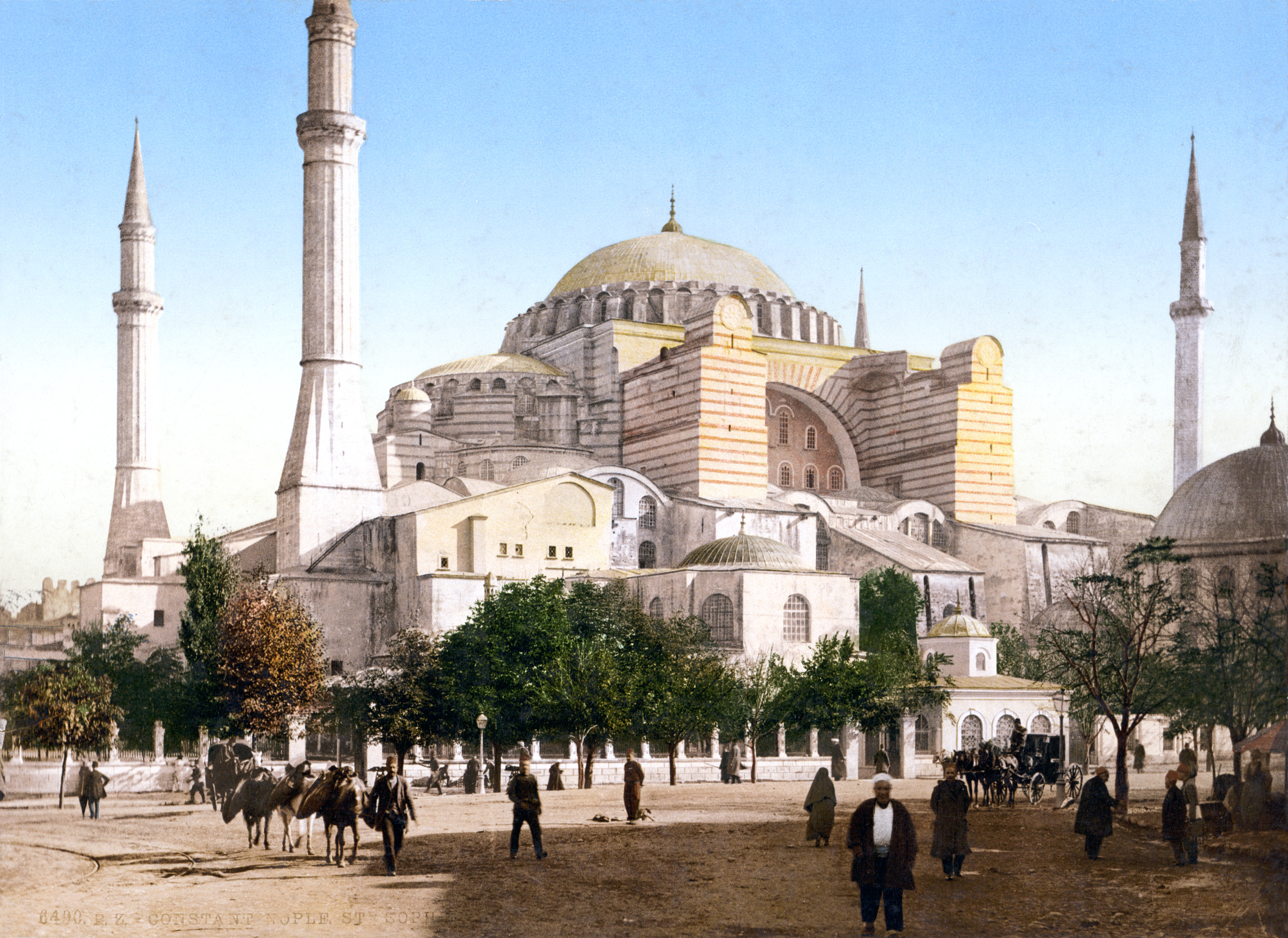
Hagia Sophia (late 19th century photo), showing a later-added (and no-longer-extant) marble paneled exterior


The first great church in Christendom, and the largest for a thousand years, was the Hagia Sophia in Istanbul. Many people think of this building as a mosque, the role in which it served from the Ottoman conquest of Constantinople in 1453 until it became a museum in 1935. The addition of minarets reinforces this historic identification of the building with Islam, and those tower-like structures once again serve (since 2020) as a means to broadcast the daily multiple summons to Muslims to attend the designated times of prayer.

This stunning building’s historical association with two of the worlds most prominent monotheistic religions has given rise to a paradox. The architectural form many of us readily associate with Islamic mosques, epitomized by present-day Hagia Sophia, is a form derived from a Christian house of worship. Most mosques, including those recently built around the world, have a structure reminiscent of this building, constructed under the reign of Justinian as the principal Christian cathedral of the late Roman or Byzantie empire, between 532 and 537 A.D.

Hagia Sophia as it sits today in modern Istanbul

The earliest Christian gathering places, before Christianity was officially recognized in the Roman Empire, were often in synagogues or in private homes as well as in safe outdoor places. Once Christians could build and maintain churches without interference, a common stylistic choice was to adopt the Roman basilica style of building, long used in Roman cities as locations for offices, courts, and for other public and business functions. They were usually designed with a rectagular floor plan, containing a central nave, accompanied by side aisles that were separated by columns supporting the central ceiling and roof.

Roof coverings over the side aisles were built at a lower height, allowing for clerestory windows in the nave above them, illuminating the central area. At one end was an apse, covered by a half or semi-dome. At the center of the apse was a dais where in Roman buildings magistrates sat, and which in later churches provided seating for the clergy.

Longitudinal plan for the Basilica of Maxentius and Constantine, Rome

Noticing how the above described spatial arrangement continues to be evident in modern churches helps us appreciate the significance of Justinian’s innovative plan for the Hagia Sophia. For the longitudinal Roman-derived spatial arrangement, evident in the basilica plan above, led in the West to the the placement of altars as well as the clergy attending them at one end of the building. Over time, these longitudinal basilica plans influenced Western medieval architects to design Gothic churches and cathedrals based loosely on the Latin cross, where the longitudinal length of the nave replicates the tall upright base of the cross, upholding the horizontal arms.

A common floor plan for Western, Latin, longitudinal church design (entrance at the west end; altar placed in the apse at the east end; nave is shaded)

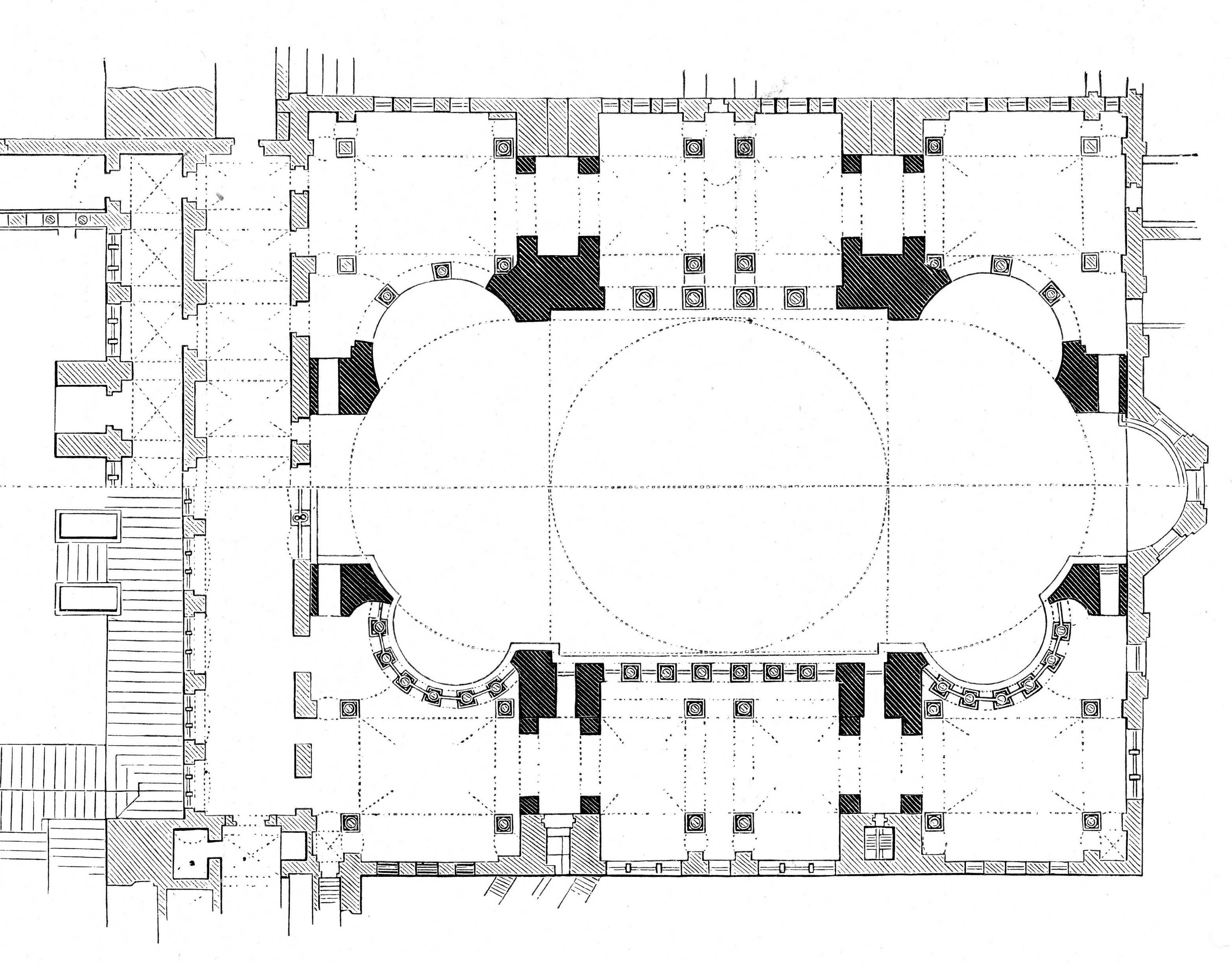
By contrast, Justinian’s Hagia Sophia plan, widely influential in the Christian East, and subsequently adopted in Islamic architecture for mosques, is based on what is commonly called the Greek cross, where each of the four ‘arms’ of the cross are of equal length. Plans based upon the Greek Cross therefore lend themselves a to placement within a square and or a circle, rather than within a rectangle. They also provide scope for the placement of a large dome over the central and main part of the building.

Plan of Hagia Sophia (with an apse, but with a spatial arrangement based upon an equal-armed cross)

The effect of this Greek Cross-based development in church architecture has a symbolic significance in the liturgical use of buildings based upon it. The altar, even if placed near to one end of the building, sits more closely toward the center of the structure and within the resulting worship space. To be sure, the liturgical use of such church buildings in earlier centuries, and the theological views of those who worshipped in them, often implied hierarchical understandings of church membership, something common in the Latin West, as well. [Imagine what was subtly – if not intentionally – communicated when clergy were observed sitting in the places associated in the prior realm with public officials and the exercise of their offices.]

Yet, it is interesting to observe how a preference for Greek Cross (or circular) shaped building plans has received increased attention in modern liturgical renewal. This is because liturgical spaces based on such plans lend themselves more readily to a revived understanding of the Eucharist as an activity of the whole church, and not just of some who are designated if not also elevated to lead it, and provide its benefits.


In a subsequent post I will reflect on some further architectural features of Hagia Sophia and of designs based upon it.


Pentecost: The Beauty of Unity Amidst Diversity

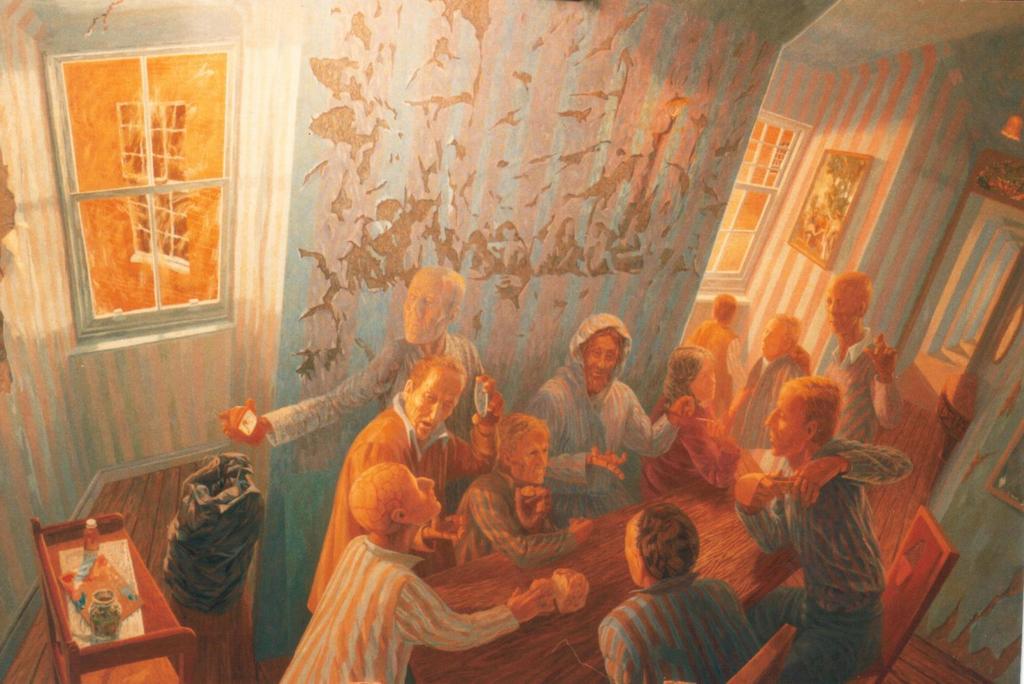
Peter Warden, Pentecost (1985)


Paul’s stirring words to the Ephesians assert an abiding truth: “There is one Body and one Spirit; there is one hope in God’s call to us; One Lord, One Faith, One Baptism, One God and Father of all.” Paul was focused on the God-given and true things that unite us, that hold us together, and which give us life. Yet, in contemporary American culture, everything now seems to center on how we differ from one another. How might we hold both insights together?

Some years ago, I discovered Peter Warden’s wonderful contemporary painting about the post-Resurrection Pentecost event, which reflects the presence of such differences among us as people. Warden’s painting is based on the well-know story from Acts, chapter 2. The painter portrays the disciples together in their upper room retreat. But, in this case, the first Christian community is gathered in a 20th Century Scottish attic! The painting seems to capture the disciples just at the moment when the mighty Spirit-wind and tongues of fire appear. In other words, the disciples – as Warden depicts them – are not yet bound together, and not yet ready for mission.

Though they are in the same room, these disciples show few signs of unity. They react against one another, as much as they may talk together. Notice how this is suggested by the alternating warm/cool color palette that Warden has used. We also want to notice the suggestively peeling wallpaper behind the group. Can you see the pattern that the artist has created with the lower part of the rendering of the wallpaper?

If you look closely, you can see how Warden has used his depiction of that scrappy wallpaper to suggest Leonardo Da Vinci’s famous painting of the last supper. Da Vinci’s painting has also suffered the fate of being on a peeling wall. Peter Warden portrays a group of people with a shared history, who were brought together by Jesus at their earlier supper with him. But now, after his death, they find themselves regressing, regressing to their before-knowing-Jesus identities, and falling back upon their differences from one another.

Yet, as the painting’s title suggests, in just this moment God’s Holy Spirit finds them. Just as, through the Church, God’s Spirit finds us. When God’s Spirit finds us, we are grafted into the Body of Christ. In the process, we come to perceive who we really are. For we receive a new baptismal identity in Christ.

Our new identity builds upon and transforms the uniqueness of our natural, biological-identity. Our baptismal-identity emphasizes a new way of seeing ourselves in relation to others. Now, we also celebrate what we share and have in common, rather than simply emphasize our practical awareness regarding how we are unique and different from others.

Through hearing and reading Scripture, and in our fellowship with others in Jesus’ beloved community, we learn something very important. It has to do with this matter of our identity. We learn that the “Who am I?” question cannot rightly be answered apart from the “Who are we?” question. And, in turn, the “Who are we?” question cannot rightly be answered apart from another question: “Who are we made to be?” Once we ask, “Who are we made to be?”, we are on the threshold of discovering, perhaps for the first time in our lives, who we are meant to be and become, both as individuals, and in community.

Here is the truth of the great feast of Pentecost: God’s Spirit has come down! God’s Spirit has come down upon, and within, people who are sometimes alienated, and who often fall short of God’s mission. Preoccupied with ourselves and our own pursuits, we are gifted with the experience of transformation. We are drawn into relationship. As we are, we find meaning and we find purpose. We discover who we are, as we discern what we are called to be and do together. The mission of God brings both mercy and meaning. In it, we discover a shared life in God’s Spirit-shaped Kingdom.

John Nava, Pentecost, 2012


The quote from Ephesians is from the Book of Common Prayer Baptismal Rite adaptation of Ephesians 4:4-6. I have featured Peter Warden’s Pentecost painting once before, though without reflective comment, in a post offering Family Devotions during Covid, on May 30, 2020.

Further note: last week I was fortunate to walk down the same central street in ancient Ephesus upon which Paul surely often walked, while – according to Acts – he was there for two years. In writing the words quoted above, Paul was likely responding to the Ephesians’ devotion to the fertility mother goddess, Artemis, and the great temple they had built in dedication to her.

The Beauty of Kingdom Potential


What has Jim Janknegt depicted with his painting? Right away, we can see that he portrays the Kingdom mustard seed parable in Mark’s Gospel. With his focus on this parable, we should remember that the Gospels include two kinds of mustard seed teaching. One is in Jesus’ parable ~ about the huge potential of what God can do with apparently small bits of the Kingdom. Jesus’ other teaching is about the tremendous potential of what we might accomplish through personal believing, especially given how personal faith can otherwise be deficient or defective.

To help recognize this difference, between Jesus’ Kingdom parable and his other teaching referring to the size of our personal believing, consider what we see in Janknegt’s painting. In the foreground we see things we usually think of as being big ~ like big cities, their large buildings and the businesses they house. Dwarfing them is a great tree, which may represent the ‘Tree of Life.’ Like the small mustard seed, the great tree that it becomes represents what the Spirit is doing with God’s Kingdom.

Notice the community for which the great tree provides a place of habitation ~ a community characterized by many birds, including both a beautiful peacock and a spoonbill, an owl and a descending dove. In traditional mythology, birds represent communication between the realm of the sky and the realm of the land, or between the heavenly sphere and that of the earth. The Tree of Life provides a context for this communication, and for the Kingdom community that God’s Spirit nurtures between the two.

If we ever worry or despair about the smallness of our faith, we should remember Jesus’ emphasis upon the huge potential of God’s Kingdom power. The seed of this Kingdom potential is planted within us at our Baptism.


This post is based on my homily for Sunday, June 17, 2018. Jim Janknegt’s painting, Worlds Smallest Seed, is used here with his permission. {Editorial note: I preached on this Gospel reading, and referenced Janknegt’s evocative painting again on Sunday, Jun 16, 2024. Here is a link to my reflections on the same Gospel reading.}