Art

Learning from Mary’s Attentive Openness


Perhaps people living at the time of our Lord’s first coming were in some important ways like us. They may have been just as prone to orienting their security and sense of wellbeing around material concerns, while being generally indifferent to the spiritual life. Yet, in this season of Advent when many sing “O come, O come Emmanuel,” it is easy to imagine the people of Roman-occupied Palestine crying out with longing for the God of Israel to draw near in power. Even so, God chose an out of the way place in which to appear among us, incarnate in human form. Paradoxically, for this and other reasons, the arrival of the Holy One was largely overlooked. At least until his person and message provoked enough reactivity to cause the authorities to have to deal with him. Otherwise, the periodic waves of public attention that he received were most often inspired by the miraculous works of mercy attributed to him. While he encountered significant examples of deference to the revealed Law among his contemporaries, lived-adherence to God’s hope-shaping promises appeared to be rare.

This is why the Lectionary features a particular aspect of the Christian Gospel story at this time of the year. It does this by presenting some notable counter-examples to what may have been – in the first century – a widespread indifference to or loss of confidence in God’s promises. We learn about Zechariah, the father of the ‘forerunner,’ John the Baptizer, and about Elizabeth, John’s mother, who was a cousin of Mary and another woman that would bear a promised child. These three stand out for having been open in heart and mind to the heavenly glory that God was about to reveal in the midst of the lives of his wayward children.

In particular we remember the spirit of attentiveness that we find displayed in a third aspect of Mary’s response to God’s call through the Angel Gabriel. God’s call often challenges us to live in a different way; or to try and be a different person, especially in our relationships with our family, our friends, and those with whom we work. Receiving this call, we can react at first in fear at what this call will mean in practice. We can also respond with uncertainty, wondering about our worthiness or suitability for what God may have in mind for us. We have reflected on these themes in the last two web posts on this site.

But we can also see that —in faith— we are able to go into the heart of our fear, and find God’s power. Receiving God’s grace, we may move beyond relying on our own strength, and resist depending upon our estimate of our own abilities and worthiness for what God may have in mind. And we can choose to respond to God’s gracious invitation to participate in the Spirit’s redeeming work, just as Mary did, by saying, “Yes!” As John Lennon so simply captured the spirit of it, in the words of his famous song, “Let it be!” As Mary said to God through the Angel, “Behold the handmaid of the Lord; let it be unto me according to thy Word.”

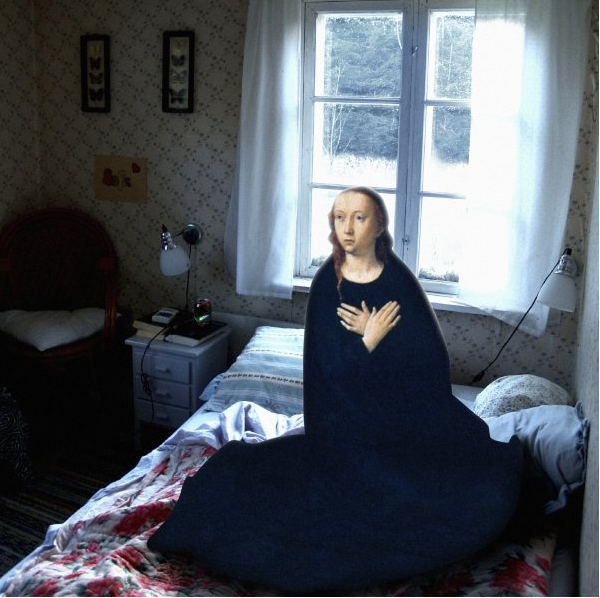
This is the spirit of Mary’s response to the message of the angel as portrayed in the third image I am sharing with you this Advent ~ Trygve Skogrand’s photo-collage, pictured above. The artist has skillfully placed a traditional painted figure onto a contemporary scene, juxtaposing an image of something old within a contemporary setting. We see a simplicity and spirit of humility in Mary’s posture, as she kneels in her plain gown. In the plain ‘bed-sit’ room in which she prays, we notice her uplifted eyes. They are now focused on the divine source of the message she is receiving.

Attentiveness is key to meaningful perception, just as we find in the Gospel reading for the third Sunday in Advent. John the Baptizer sends his disciples to Jesus with what should be our most persistent question ~ “Are you the One?” ‘Are you the One for whom we are looking, and whom we are awaiting?’ Notice Jesus’ response: “Go and tell John what you hear and see…” For they only hear and see if they are attentive. This is one reason why the Church sets aside this season of Advent ~ to encourage our attentiveness, so that we can hear and see, and then accept God’s Word to and for us.

“Let it be as God would have it.” Let things be as God wills. Let God be God! Perhaps nothing will be so hard in our lives, as to say those words in faith and in humility. Our pride objects. Our desire to be at the center of reality intrudes. But to say, “Let it be…,” in faith and in humility, is to return to the grace of the Garden of Creation. And it is also to begin to live forward into the fullness of the Kingdom, manifest in the New Jerusalem, as God will have things be.


The image above is a detail of Trygve Skogrand’s photo-collage, Bedsit Annunciation (one of my favorite artistic renderings of the Annunciation). This post is based on my homily for the Third Sunday of Advent, December 15, 2019, which can be accessed by clicking here.

Being Open to God’s Word of Hope


We may remember some pivotal moments from within the sweep of the Old Testament: God’s call to Moses from within the burning bush; God’s call to Isaiah in the Temple; and God’s later call to Jeremiah. In each of these encounters, a divine invitation accompanied by a word of hope comes to those whom God calls to be prophets. When this happens, they react in a similar way. Each of them responds with fear, just like the reaction we saw last week in Simone Martini’s Annunciation painting of Mary’s encounter with the Angel Gabriel. In these call passages, we also hear about Moses, Isaiah, and Jeremiah responding in a related way: each of them is overwhelmed by a sense of unworthiness at being called to serve the Lord. For in our hearts and our minds, we as God’s people do not always hear or receive what the Lord intends to be a word of hope as a hopeful message. And when challenged to participate in God’s ongoing mission, we fear our inadequacy in being able to respond positively.

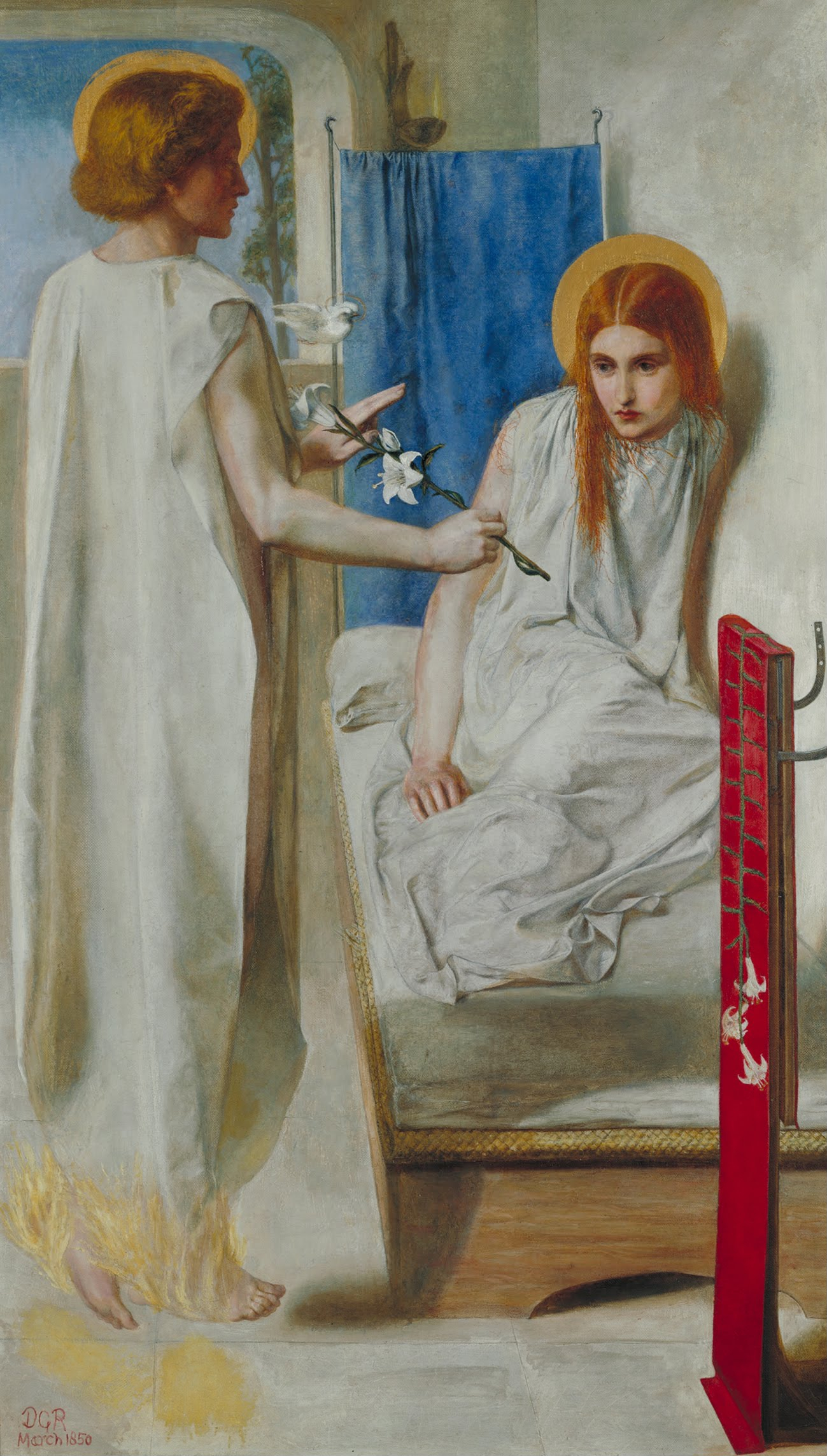
During this season of Advent I am once again reflecting on four Annunciation paintings. Here, I invite you to consider Dante Gabriel Rossetti’s depiction of the angel’s visitation to Mary, calling her to be a servant in God’s ongoing work of redemption. Observe how Rossetti portrays Mary’s response to the angel, and its contrast with Simone Martini’s painting (included below). In Martini’s Annunciation, we see an image portraying fear – Mary clutching the top of her cloak turning away from the angel and yet not able to take her eyes off the divine messenger. In Rossetti’s Annunciation (above), we see Mary looking in a different direction. Her gaze is off into the middle distance, and we can tell that she is not looking at anything in particular, ‘out there.’ Instead, she is looking within.

Here, we can make a common mistake, based on the self-absorption that is so much a part of the fallen humanity we share. For the angel’s announcement amounted to something even more dismaying than the news that Mary would bear a son as a result of this visitation rather than through the circumstances of a conventional marriage. That alone would cause confused wonder about how much this unexpected development would alter her life. But what we usually overlook is how she was being invited to become a feature in someone else’s story! As things emerged, the challenge of this momentary encounter did not so much concern how the coming of this child might alter her life, in part by diminishing her reputation. But rather, the real challenge came later as something else became clear. The coming of this child became the story for even more astonishing reasons. Mary then had to reckon with how her life and its circumstances would be significant for this child and the message of his story.

As the Annunciation helps us to perceive, when encountering the holiness, righteousness, and purity of God, we may experience not only fear about change that might lie ahead. Very likely we will also feel a sense of our own unworthiness. Perceiving the glory of God, we will become more aware of what within us falls short of God’s glory. When the Spirit invites us to experience a process of transformation back toward God’s own likeness, we are called to face and then set aside all that stands in the way of this positive change. In the Gospels we learn how God’s Word came through John the Baptizer’s ministry as a call to repent. We hear the same call to turn toward renewal in our own day. And – in the process – we learn how Mary and then the Baptizer responded. The story is not about us. It is about the Coming One.

Notice what Rossetti depicts in the angel’s hand. When inviting Mary to bear the Word of God for the sake of the world, the angel holds lilies. Lilies are a sign of the resurrection. We also see the prominent red sash that Mary may have been stitching. It bears an image of the same lilies, along with a vine that may recall the ‘Tree of Jesse’ motif (inspired by Isaiah 11). But here they are set against a red background – a sign of the passion that lies ahead. This suggests the path of suffering which the ‘Son of Man’ must walk so that we might experience the restoration and transformation of our fallen nature into his greater likeness.


 The image at the top is a detail of Dante Gabriel Rossetti’s painting, The Annunciation. This post is an adaptation of a post I first published in 2019, and is based on my homily for the second Sunday of Advent, December 8, 2019, which can be accessed by clicking here. Simone Martini’s Annunciation, referenced in the text above, is shown below.

Fearing an Unexpected Holy Invitation

Advent can be a providential season for reflecting on how the Holy Spirit invites us to go to a new place for the sake of God’s Kingdom. There is no question that this can happen at least spiritually, whether we hear the call or not. The real question, when it does happen, is how we will respond to God’s holy invitation.

This is the season when we focus especially on how God’s Kingdom enters the world in a new way. We look back to the earthly kingdom of Israel, and her difficulty fulfilling her spiritual vocation. We also look back to the promised first coming of the Messiah, who was to bring God’s Kingdom into the world with power. During Advent, we also look forward, to the Messiah’s coming again in glory. But here is a crucial fact about the first coming of the Messiah: Without Mary’s acceptance of God’s overture, there would have been no Jesus of Nazareth. In order for God’s great “YES” to us in Jesus to become manifest, Mary had to say “yes” to God.

As Luke tells the story, God’s call to Mary embodies God’s holiness and righteousness. In like manner, our encounter with God’s presence and holy invitation causes everything in us that is less than godly to undergo judgment. The bright light of God’s glory illumines all the dark corners of the world ~ and all the dark corners in our lives. The purity of God shows up all that is less than pure.

Our reaction to all this may involve at least one thing: fear! God’s call comes to us as Good News. And yet, we experience God’s call for us to become new persons, and do new things, as a fearful invitation. For me, it has involved a call to consider moving away from one beloved church and congregation to what I could only hope would be another. For both you and for me, it may be a call to go and speak to someone with whom we have a disagreement, or to reconcile with someone whom we have failed to forgive. When God calls us to new life, by inviting us to do something challenging, our first reaction is often fear. We think of all the things we are afraid might happen: like losing the security of a familiar home and community; or setting aside our own pride and sense of right; and opening ourselves in vulnerability to being hurt by another person.

In the above detail of Simone Martini’s Annunciation, we see what may have been Mary’s first response to the presence of the holy angel. Gabriel comes to her sharing God’s good news about a child she will bear, who will bring salvation for the world. And in Martini’s image of the event, Mary draws back in fear at the message, frightened about what it might mean for her and her life. We all know the end of the story, how it all turned out for good. But in that moment, as may happen for us, God’s call surely had a frightening aspect to it. Because a change to something always means a change from something else, from where we started.

Martini’s painting reminds me of spiritual advice I received years ago ~ spiritual advice that gave me the courage to leave a tenured faculty position at one of our seminaries and return to parish ministry. The prospect of this change, for which I had a sense of call, was frightening. And the good advice I received was this: When you go toward the heart of your fear in faith, God will meet you there with power.

We know that this is what Mary did. For she moved beyond her reaction to the seeming strangeness of the angel’s greeting, not knowing what it would mean for her. She then opened herself to embrace the angel’s message and all that it would entail for her ~ and for the world.


It was my CREDO Institute team leader and colleague, (The Rev. Dr.) Bob Hansel, who offered the wonderful spiritual advice that I share above. I continue to benefit from it. The image at the top is a detail of Simone Martini’s painting, The Annunciation (a painting I have shared before). This post is adapted from one that first appeared here in 2019, and is based on my homily for the first Sunday of Advent, December 1, 2019, which can be accessed by clicking here.

Wrestling With God

Marc Chagall, Jacob Wrestles with the Angel (and receives a blessing)

Recently, the Lectionary included a familiar reading from Genesis (chapter 32). It describes Jacob’s dilemma concerning his brother, Essau, from whom he is alienated. Alone at night in the wilderness, Jacob lays down on the ground and places his head upon a stone to sleep. In the darkness, Jacob then contends with an angel in what becomes a wrestling match that lasts through much of the night.

In parsing the elements of this deeply symbolic story, we must remember that in much of the Old Testament, angels appear and act as divine representatives. They also function as a literary device where the angelic figure is a stand-in for God. This is why it is appropriate to read this passage as a story about Jacob wrestling with God, as well as the more literal reading of it as an account of his wrestling with an angelic being. In either case, we are right to understand that the story portrays Jacob’s struggle to discern, and then accept, God’s will for him and for his future.

We are told that Jacob is fearful about meeting Esau, who is traveling with a large band of men. For, as we may remember, Jacob has wronged his brother by ‘stealing’ Esau’s birthright blessing, which Esau was to have received from their father, Isaac. As recorded in a well-known earlier story, Jacob had deceived their aged father by masquerading as his twin brother, who was only-minutes-older than him, thus receiving the blessing that Isaac had intended for Esau.

Now, with our modern understanding of psychology, contemporary readers of the nighttime angelic wrestling story may prefer to understand it as simply a symbolic portrayal of Jacob’s wrestling with his conscience. Though partly true, accepting such a univocal reading of the story comes at the expense of a profound dimension of the narrative. For this episode is what students of the Bible call a ‘theophany,’ a story about divine self-revelation, as Jacob himself (as well as the narrator) understood it to be.

So how might we appreciate this story of a nighttime struggle, involving unresolved aspects of a particular person’s history having to do with family relationships, as well as recording a pivotal moment within his long term quest for divine guidance?

I find it helpful to read the story within the following interpretive framework. When we refer to ‘struggling with God,’ I believe that what we often mean is our struggle to accept what we perceive to be (or suspect is) God’s will for us. As such, it has much to do with our understanding of prayer.

Jacob Wrestling With the Angel (attribution uncertain)

As I noted in a recent post, our Prayer Book teaches us that prayer is first of all a matter of responding to God. Responding to God, and responding to our perception of God’s will for us, are not often automatic or straightforward activities. Our natural disposition may be to fall back into thinking of prayer as enacting our desire to bring God’s will into accord with our own wants and hopes. For our prayers may often take this form. Yet, prayer is most holy when prayer is pursued in a way where we give ourselves up to an acceptance of our real need, not our wants. This is to accept our basic need for our wills to be brought into accord with the divine will. When this comes to be our more usual pattern of response to God, we are less likely to find ourselves having the feeling that we are struggling with God, and more likely to experience the peace of living harmoniously with God’s hopes and plans for us.

Alexander Louis Leloir, Jacob Wrestling with the Angel

When the Genesis story refers to Jacob’s having prevailed we will do better than to settle for the conclusion that he has ‘won’ or achieved a goal. Jacob hung on to the angel; he did not let go. And in the process he came to have a limp, the struggle having dislocated aspects of his prior way of being. The limp was therefore less a sign of an injury and more a sign of a deep change within him, and within his mode of engaging the world that lay before him. Jacob could then utter his famous words: “For I have seen God face to face, and yet my life has been delivered.” Encountering God’s awesome and holy presence did not consume him as fire would dry tinder. Instead, Jacob was transformed, and received a new name, Israel.

Responding to God – and God’s will for us – with acceptance, will likely disrupt aspects of our present ways of living. And we may feel that some important parts of our lives, even of ourselves, have been dislocated in the process. But if we cling to God, even through the feeling of struggle, with the aim of coming to be more fully in accord with God, and God’s ways, we will be blessed, just as Jacob was.


Note: among the many symbolic elements in Chagall’s painting, shown at the top, you might see if you can discern elements of the larger context of Jacob’s story, including those related to Joseph, in Genesis.

Reinhold Marxhausen and Finding Beauty

Reinhold Marxhausen

I am currently leading an adult learning group on the theme of Art, Beauty, and Transcendence. Some wonderful observations were offered by my fellow learners at our first session. After inviting our participants to introduce themselves and share a recollection of a memorable encounter with Beauty, I provided a discussion prompt: Is Beauty essential, or is it a luxury? We seemed to share a consensus that it is an essential part of our lives. And then a participant said, “I find Beauty everywhere!”

Hearing this, I thought of Reinhold Marxhausen, a remarkable artist and teacher who had a vision for how we all might approach our daily encounter with our ordinary, everyday circumstances. His captivating approach to life impacted many people beyond the classroom and studio – me among them. Here is one way to sum up the vision he shared with others: “Beauty can be found everywhere – you just need to look for it!” So simple is this message that I am sure it has more often been dismissed than pursued as a practice. 

Marxhausen in his studio workshop

Reinhold Marxhausen did not just send folks away to try this on their own; it became his mission to show people how to do it. This is made clear in a video of his appearance on the David Letterman show, with the interviewer doing a great job of giving rein to the artist’s creative spark and communicative abilities. Marxhausen‘s Letterman show appearance can be found on YouTube.

Reinhold Marxhausen on the David Letterman show, March 25, 1986

I continue to be intrigued by what Marxhausen’s abiding belief implies- that Beauty is found, in addition to how we are led to it by others, or more simply that it is something we just designate for ourselves. These are three different ways that we might encounter Beauty as a feature in our lives, if not as something even more profound for how we view our lives and the world.

Readers of my posts in this space will be familiar with the parallel I have discerned between the three principal forms of jurisprudence (or theories about the source of Law, and three main sources for our concept of the Good in our understanding of ethics. Found, received, and or made, are the three terms I use to summarize these three approaches to where Law comes from, as well as for sources of our notion(s) of the Good. In offering this summary, I do not exclude the possibility of other sources for Law and or the Good.

More expansively, according to the first view (1), Law and the Good are entities written into the structure of ‘reality.’ As such, these things are ‘there’ for us to find. Another possibility (2), sees Law and the Good as worthy principles we receive from those who have come before us, as things commended to us by longstanding traditions. We sometimes describe them as things that have stood the test of time. A third possibility (3) is that Law as well as the Good are sets of principles about which we come to agreement, or decide upon and enact for ourselves and others. Hence they are things of our crafting, things that we ‘make,’ as we project our preferences outward upon the world. Formal labels for these three approaches include natural law or Creation order (1), historicism or common law (2), and positivism or civil law (3). 

Here is something I want to stress: we are rarely consistent in how we think, perceive, and understand important aspects of our lives. We should therefore anticipate an overlap between these several conceptual categories for how we think about Law and about ethics.  In other words, a ‘both-and’ approach regarding them may be much more appropriate than seeing them in an ‘either/or’ way.

So, is Beauty amenable to a similar analysis? I think it is. For Beauty is found (1); we also discern Beauty in the company of others and through their guidance (2); and we surely fashion notions about what is beautiful through personal preference and decision-making (3). 

If you believe you have ‘found’ Beauty at some or at many points in your life experience, would you be content to accept the proposition that your encounter with Beauty is actually reducible to the social impact of others upon your perception, and or that it was and is merely the result of personal preference and choice?

The Beauty of Witness

Memorial sculpture commemorating the Martyrs of Memphis

This week, on September 9, we observed a significant date on our personal calendar by celebrating the birthday of one of our sons. September 9 was already a notable date for us beginning some years before his birth, after our move to Memphis in the summer of 1983. During those years, the date became associated with an addition to the Episcopal Church Calendar that has readings appointed for it in our Lectionary. September 9 is designated as the feast of The Martyrs of Memphis: Constance, Thecla, Ruth, Frances, Charles Parsons, and Louis Schuyler.

To those unfamiliar with its history, the official title for this feast day may suggest dramatic images of early Christian saints contending with ferocious animals and or human adversaries in the name of the Faith. Which then raises questions about whether, perhaps, the Memphis in question was the one in ancient Egypt. Yet, the name designation for this day can be instructive for all of us because it may remind us of something we once learned – that the etymological root of the word martyr lies in the ancient Greek word meaning ‘witness.’ Hence, those persons we commemorate on the Church’s Calendar because of their examples of Faith are remembered for being especially compelling witnesses to God’s redemptive mission in Christ, regardless of whether they faced circumstances that might have led to a heroic death.

The Martyrs of Memphis provides an occasion for us to remember the men and women who remained in Memphis to minister to those with whom they faced together the ravages of a severe Yellow Fever epidemic, from which they could have fled to safer places elsewhere. Unknown to them was the fact that this horrible plague was a mosquito-borne infectious virus, and not something arising from ‘swamp vapors’ or bad city air. Among the faithful persons who succumbed to the fever, and who are remembered on the feast day of September 9, are the four women named in the feast’s title who were community members of the Sisters of St. Mary, Father Charles Parsons, the last remaining Episcopal priest in the city, and Father Louis Schuyler, who came as a volunteer from New Jersey to take Parsons’ place and join the Sisters in ministry.

Monument by Harris Sorrelle, in the Memphis Martyrs Park, overlooking the Mississippi River

Words from the collect (or principal prayer) for the feast day of the Martyrs of Memphis capture well why these particular individuals are named among so many others – known and unknown – who shared their faith as well as fate: “We give you thanks and praise, O God of compassion, for the heroic witness of the Martyrs of Memphis, who, in a time of plague and pestilence, were steadfast in their care for the sick and dying, and loved not their own lives, even unto death…”

The generic character of the title for this significant feast day was chosen to help us also remember that the number of those who died in the epidemic, not only in Memphis, but up and down the Mississippi River and beyond, numbered in the thousands. Memphis’s historic Elmwood Cemetery, its oldest, has a particularly moving monument that complements the contemporary riverside sculptural composition by Harris Sorrelle (displayed above). At Elmwood, instead of having an impact upon the use of anonymous and aptly dark-colored figurative silhouettes, as Sorrelle’s sculpture does, the cemetery monument provides just paragraphs of words, stating in plain but moving terms the reality that lies below where cemetery visitors walk (as the following image attests). As the Elmwood monument notes, at least 1,400 Yellow Fever victims are buried in nearby unmarked mass graves.

Martyrs monument in Elmwood Cemetery (clicking the photo will provide an expanded view of it)

The faithful witness of those who died ministering to and with others among the Yellow Fever victims in Memphis in the 1870’s can have the effect of prompting us to reflect on the very different circumstances in which we live, with our advances in medicine, healthcare, and social services. Nevertheless, the COVID crisis of 2020, and its lingering legacy, can also remind us of our mortality, our higher calling to seek godly life in its fulness, and to be faithful companions with and to those less fortunate than ourselves.

A state-provided historical marker that includes use of the word ‘martyr’

Additional note: a tragic-comic aspect of the Yellow Fever’s impact upon Memphis was another pre-scientific belief (in addition to the ‘swamp vapors’ theory regarding its origin) amongst those who remained in the city. It is said that those who seemed to have the lowest mortality rate were corpulent men who smoked cigars, the smoke from which may have warded off the mosquitos responsible for the plague’s transmission.

Beauty & “The God of Wes Anderson”

This is a reprint of a review article by Germẚn Saucedo, titled “The God of Wes Anderson.” It is reprinted here with permission from the author, and from the publisher of the journal, First Things, where it first appeared.

A scene from Wes Anderson’s new film, The Phoenician Scheme

The God of Francis Thompson is a stubborn God. In his seminal poem “The Hound of Heaven,” a soul is on the run from God: “I fled Him, down the nights and down the days; / I fled Him, down the arches of the years.” The “hound” is persistent, however, and is always pursuing with “unhurrying chase, / And unperturbèd pace, / Deliberate speed, majestic instancy.” Who is this God whose love for us is so passionate and resolute, who will forgive even the gravest of sins and chase us to the ends of the world?

The God of Francis Thompson is the God that operates in Wes Anderson’s latest feature, The Phoenician Scheme. The film follows Anatole “Zsa-Zsa” Korda (Benicio del Toro), an industrialist and morally bankrupt magnate in the style of J. Paul Getty or Aristotle Onassis who, after surviving yet another mysterious assassination attempt, decides to call upon his estranged daughter Liesl (Mia Threapleton), a novice “sister of the cloth.” He intends not only to bequeath his vast fortune to her, but also to enlist her in completing the “most important project of [his] lifetime,” the “Korda Land and Sea Phoenician Infrastructure Scheme.”

Many films have been accused of being “God-haunted,” hinting at the presence of God through the subtleties of the plot or the visuals. The Phoenician Scheme is more than “God-haunted”; he is very much present in the film. He is, in fact, played by Bill Murray. After a plane crash at the beginning of the movie, Korda briefly finds himself in heaven. There, he runs into his grandmother, who fails to recognize the man he has become. Time and time again, as assassins seek to end his life, Korda finds himself at the pearly gates. Each time, he is found lacking.

In the Confessions, St. Augustine famously recounts his youthful desire for the Lord to “Give me chastity and continence, but not yet.” While amusing, this sentiment is spiritually disordered. Many of us live lives apart from God, hoping we can outmaneuver him at the last second, “lest he come suddenly and find you asleep.” Similarly, Korda realizes that he has delayed repentance and conversion until the last minute.

The “hound” is never far away, however. He manifests himself through Liesl who, despite practically being abandoned by Korda, has managed to become a pious nun. While reluctant to enter her father’s world of opulence and luxury, she nevertheless decides to play the role Korda has set for her, seeing potential spiritual fruits from the venture, and quickly begins the work of saving Korda’s soul. She easily forgives his past injustices toward her, brings love to the lives of Korda’s nine neglected sons, and attempts to humanize his enterprise. Liesl also attempts to evangelize the children’s tutor and her father’s new administrative assistant, Bjørn.

Korda’s journey to save his infrastructure project brings him ever closer to God. Liesl’s influence and example, as well as a confrontation with his past (and some amount of self-interest), leads him—along with his nine sons—to be baptized into the Catholic Church. In a defining act of selflessness, Korda gives up his fortune to cover the funding deficit of his major project and save it.

Wes Anderson’s films are often dismissed as mere aesthetic exercises, lacking narrative substance. His protagonists are usually “bourgeois with bourgeois problems,” while his visuals are frequently labeled as “twee” and “quirky.” Unlike the realism of directors like Ermanno Olmi, whose slow and contemplative style focused on the material reality of the lower classes, Anderson’s work is often seen as overly stylized and detached from reality.

But this surface-level reading could not be further from the truth. For Anderson, it seems, beauty is reality. To borrow Keats’s famous verse, “Beauty is truth, truth beauty”; and it is through beauty that God makes himself known to us. When Liesl attempts to exit her father’s opulent world and take her vows as a nun, her mother superior declines, pointing to her love of lavishness—including a bejeweled pipe and diamond-encrusted rosary gifted by Korda, which Anderson commissioned from Dunhill and Cartier—as evidence of her lack of religious vocation. But she does not scold her for loving beautiful things. In fact, she comforts Liesl by saying that God glorifies himself with the lavish and palatial, as not everyone was meant to live in poverty.

In a Q&A at a New York screening of the film, Wes Anderson reflected briefly on the ability of rich magnates to do good, especially in today’s world. The artist has a similar potential. In Thompson’s poem, the “hound” claims that “[N]one but I makes much of naught.” While our riches and our art may amount to nothing, once offered up to God, they can become instruments of his love and mercy. God will never stop his pursuit of us in part because he, unlike the world, knows our full potential. Korda—like us—is thrown lifeline after lifeline, which can only be taken on God’s terms, not ours.

Unlike Korda, we should not wait for brushes with death and brief visits to the pearly gates to turn around and deliver the “hound” from his incessant chase. Every moment is an opportunity to do so. The curious and wonderful thing about the God of Francis Thompson, the God of Wes Anderson, is that he’s real, and he is always seeking us.

A promotional poster for Anderson’s new film

Note: Germẚn Saucedo serves as a Junior Fellow at First Things. I requested permission to reprint his review article because it seems so fitting to the material I explore on this website. I am grateful for this fine piece. I particularly appreciate Saucedo’s statement, based on a quote from Keats: “For Anderson, it seems, beauty is reality… and it is through beauty that God makes himself known to us.”

A Tao of Seeing: Reflections Inspired by Feng Shui

Michael Pollan’s writer’s hut, intentionally situated by a boulder on the brow of a hill

Recently, I observed my middle son moving a black plastic pond module around in a small space in his New Orleans courtyard. As he moved the container that would soon have fish in it, he tried situating the vessel in various ways, in relation to a tree, a fence, some potted plants, and an existing low stone wall. He is not a student or practitioner of feng shui, but I believe I was seeing some of those principles at work in his decision-making.

Western readers may have heard of feng shui, the Asian philosophical approach to discerning the unseen forces that affect objects and their balance in nature. It gives attention to the metaphysical or non-material energies thought to be at work upon or within the world around us. We might say that this approach provides a Tao of seeing, or a natural way of perceiving within and around surface phenomena to the underlying dynamisms that are believed to affect what happens in nature.

This notion that there are unseen forces at work in the world is an idea that is receiving something of a revival in Western Christian spirituality. This is noticeable when people refer to a concept attributable to the Celtic tradition, in which it has become common to refer to “thin places. “ These are places where the veil between the material and the ethereal or the heavenly seems temporarily dissolved. Another parallel here between East and West may lie in the quest within Christian spirituality for the goal of harmony and balance between people and the created world.

However, my reflections here constitute an aesthetic rather than a philosophical or historical inquiry. I am interested in the dynamics of movement we perceive in the circumstances that we encounter, and less in the metaphysical forces or energies that may be present within them. At the outset, however, I want acknowledge how a nuanced Asian approach can be an authentic route toward a culturally-informed appreciation of the phenomena we encounter, especially from a historically Asian perspective.

As we look at paintings in the context of Western culture, one factor we discern assesses composition and attends to the way our seeing is drawn from one part of a larger image to another. This dynamic is often an artist-intended aspect of an overall composition. Sight lines in garden design and arrangement provide another example, as does the architectural arrangement of space in buildings.

Attention given by Western designers to feng shui is sometimes criticized as being a superficial application of historically and philosophically nuanced ideas. But I want to give credit to ways in which our sensitivity toward perceiving movement and direction is a genuine factor that is available for analysis and articulation. We notice this when we encounter both two dimensional compositions as well as three dimensional spaces and the objects we find in them. We can always come to know more about what we see.  Because what we see is something that is there, not simply what we believe, or are disposed or inclined to see.

An Asian garden said to be designed according to feng shui principles

Motion, balance between forces, spatial arrangement of objects, and the dynamic relationships that are visible because they exist between and among these variables, continue to grab my interest. Contrasts between colors and textures, as well as between sizes and shapes, play a significant role.  Additionally, the perceived difference between what is natural and things that are humanly fashioned is equally significant, as is our perception of the criteria for what constitutes that which we consider to be natural. These are among the factors that help account for our sensitivity towards and interest in these many observable variables, and our common quest for purpose and meaning in the contexts where we find ourselves.

Motions and balance as we find these factors in Wassily Kandinsky’s painting, Several Circles

Painters, sculptors, and architects, seriously consider these factors within visual and spatial compositions. The painter, Wassily Kandinsky, and the architect, Frank Lloyd Wright, provide two examples of those who also perceived a spiritual dimension within their creative work.

If so, we –  as caring lay observers of the world and of the things and places among which we find ourselves – should give deference to this evident fact. For we can all be thoughtful, as people often are inclined to be, about what we see, touch, and experience when we interact with visual phenomena.

I find myself increasingly sensitive to these aspects of our appreciation for Beauty, and endeavor to be more mindful about them. I am intrigued by possible parallels that may exist between Eastern metaphysical interpretations of visual phenomena and more familiar approaches to what we see that are shaped by Western aesthetics. Especially as these familiar approaches are described and developed within our artistic and architectural best practices.

The Challenge Posed by Eric Gill

If reading this by email, please tap the title at the top to open your browser for the best experience. Then, clicking individual pictures will reveal higher resolution images.

Eric Gill, Christ Crowned


To my mind, some of the most beautiful work in the area of graphic art was created by the British artist and craftsman, Eric Gill. The intractable problem posed by Eric Gill is not a legacy of his artistic output, but of his personal life. Largely unknown to those outside his family until about 50 years after his death, Eric Gill – by admission in his own unpublished writings – had engaged in personal behavior of a kind that most people would find not only abhorrent but, increasingly, as also criminal.

This is related to the larger problem posed by the work of artists, musicians, and architects whose work is seen as having been collaborative with tyrannical regimes (eg., the Third Reich, the Soviet Union). How do we view beauty in art that either depicts or is simply associated in some way with sin or with evil? (This is a matter I have previously tried to understand in relation to Picasso’s great painting, Guernica.)

To cite Scripture to the effect that “all have sinned,” may help us begin to locate the terrain upon which we need to address the problems stemming from Eric Gill’s biography, but it is not in any way to excuse his conduct. Though all sin is bad, and equally problematic in the eyes of God, not all sin is equal in its damaging effect upon others, and upon ourselves. The traditional distinction in moral theology between mortal and venial sins provides one way to try to parse some of these differences, while not excusing any forms or examples of sin, whether in ourselves or among others.

My purpose here is to invite reflection upon how we might appreciate Eric Gill’s religious art, as many did for several generations, without having our view of the merit of his work diminished by our moral evaluation of troubling ethical choices he made, and the lapses from good moral judgment they represent. In other words, and as an amateur student of the arts while also being a retired parish priest and former professor of moral theology, I wish to present some examples of Eric Gill’s art, letting his work speak for itself apart from ethical consideration of his personal life, and without ignoring the problems associated with the latter.

Perhaps my theme here can be summed up in this way: I invite you to benefit from the beauty of what Eric Gill created without asking you to overlook what we have learned about his private life. And I offer this invitation aware that some will not find it possible to accept.

A sculpted carving by Eric Gill above the altar of the Chapel of St George and the English Martyrs, Westminster Cathedral, London
Eric Gill, Crucifixion
Eric Gill, sculpted relief panel from a series of the Stations of the Cross, Westminster Cathedral, London

As we consider some of his art, we should not overlook Eric Gill’s impact, at least indirectly, upon much of the daily life of the population of Great Britain (and elsewhere), in the form of three type faces he created. The most well-known is Gill Sans, named after its designer, and evident at almost every Tube stop in London. An effort to erase his work from the public eye, and replace it with alternatives, would require removing virtually every train station sign in Britain. It could be done. Should it?

Three fonts designed by Eric Gill

To put the problem I have raised here most bluntly, how can we appreciate the beauty in the holy art created by someone who behaved in a way most people would describe as sinful? I do not have a ready answer to this question. Note that, in what I have written above about Gill’s behavior, I have not gone into detail. Would that make a difference? If so, in what way?

And even if we refuse to give any amount of attention to Eric Gill’s artwork, we must still grapple with a timeless question: are there any unforgivable sins? Is anyone, because of his or her behavior, beyond the power of God’s redeeming love? Is it not likely that someone having Gill’s religious inclination also possesses a glimmer of moral awareness such that he or she might be open to repentance when – at the end of life – the person faces the awesome and undiminished light of God’s truth-seeking love?

Here is one thing that we can do: pray for the repose of the soul of Eric Gill, and for God’s Providential mercy.

In beginning to approach the questions I have raised here, I would start with some of the distinctions I shared above. I do not think we can deny this reality – that we, as people who are created in the image and likeness of God, and who have lost that likeness through the Fall and human sin, still bear God’s image however marred it may be by the corruption resulting from our sins. And, that we are still capable while in this life of acts and works of uplifting beauty.

The Kelpies: Canal-Side Art and Engineering

If reading this by email, please tap the title at the top to open your browser for the best experience. Then, clicking individual pictures will reveal higher resolution images.

The Kelpies sculptures by Andy Scott

The Kelpies in evening light


If ever there was a reason to take a narrow boat journey, especially in Scotland, an engineering marvel will reward those who travel in that region by such means. Two magnificent large scale sculptures called the Kelpies commemorate the horses that once pulled cargo canal boats along what are still called towpaths. This monument straddling the Firth and Clyde Canal, northwest of Edinburgh, is comprised of twin large scale structures that are said to be the largest equine sculptures in the world. Just under 100’ tall, and each weighing over 300 tons, the structures were built of steel, partly in deference to the historic steel industry in Scotland.

With an interior armature made of construction-steel beams prefabricated elsewhere, the sculptures were assembled on site with the assistance of large cranes and then clad with stainless steel plates. Aside from their resulting durability and their efficient use of materials, the Kelpies’ engineering design permits dramatic interior lighting, especially effective in the evening and early morning hours.

The Kelpies sit adjacent to a newly created canal lock and basin in the Helix Park, and serve as symbolic sentinels in a newly created juncture between the Union Canal and the River Carron.

Boats can be seen on the River Carron in the background

A lighting engineer adjusts an interior light in one of the Kelpies

Stainless steel plates being added to the structural armature

Some people have suggested that the two sculptures are based upon a pair of draft horses of the type that may once have been used on the Firth and Clyde Canal. In my observation, Clydesdale and other draft horses tend to be gentle and of a mild temperament. They are rather stocky in appearance, not only in their bodies but also in their necks and heads. Draft horses are certainly capable of running, and I am sure that some have been known to kick, especially if they have been mistreated. But draft horses can also look as if they embody a spirit of docile resignation to their tasks.

The artist’s design for these Kelpies reminds me not of those lovable working companions, the Clydesdales, but instead look like Arabians or the Mustangs and other wild horses one sees in the American West, spirited, lean, and untamed. I am glad the Kelpies appear this way, as I think they are inspirational, rising up hugely as they do at Helix Park. These horses, especially the one on the right, look as if they have not only been ‘given their head,’ they seem never to have surrendered themselves to our governance. This is only fitting, given the mythological source of the Kelpie name. Kelpies were said to be the spirits of streams that when ridden, might carry their riders down to a tempestuous demise in the depths. As such, we can not only admire their beauty, but these Kelpies can remind us of the canals and those who died building them, the canals’ unromantic industrial past, and those who toiled at canal-side factories in what William Blake – in his poem commonly known as “Jerusalem” – memorably termed Britain’s “dark Satanic Mills.”

Nina Akamu, The American Horse

Another large scale equine sculpture may come to mind when viewing the Scottish Kelpies, inspired by Leonardo da Vinci’s drawing of a large horse monument, designed for the Duke of Milan. A modern day sculpture, based on Leonardo’s drawings, can be found at the Meijer Gardens, in Grand Rapids, Michigan, as well as one cast for the city of Milan. Nina Akamu’s, The American Horse, expresses a similar kind of energetic vitality such as we find in Andy Scott’s great figures along the Firth and Clyde Canal. 24 feet high, Akamu’s strong and vigorous impression of a horse has something of the bone structure and mass of a Clydesdale, and every bit of the spirit that we find in Scott’s two stirring examples.