Anglican

Being Open to God’s Word of Hope


We may remember some pivotal moments from within the sweep of the Old Testament: God’s call to Moses from within the burning bush; God’s call to Isaiah in the Temple; and God’s later call to Jeremiah. In each of these encounters, a divine invitation accompanied by a word of hope comes to those whom God calls to be prophets. When this happens, they react in a similar way. Each of them responds with fear, just like the reaction we saw last week in Simone Martini’s Annunciation painting of Mary’s encounter with the Angel Gabriel. In these call passages, we also hear about Moses, Isaiah, and Jeremiah responding in a related way: each of them is overwhelmed by a sense of unworthiness at being called to serve the Lord. For in our hearts and our minds, we as God’s people do not always hear or receive what the Lord intends to be a word of hope as a hopeful message. And when challenged to participate in God’s ongoing mission, we fear our inadequacy in being able to respond positively.

During this season of Advent I am once again reflecting on four Annunciation paintings. Here, I invite you to consider Dante Gabriel Rossetti’s depiction of the angel’s visitation to Mary, calling her to be a servant in God’s ongoing work of redemption. Observe how Rossetti portrays Mary’s response to the angel, and its contrast with Simone Martini’s painting (included below). In Martini’s Annunciation, we see an image portraying fear – Mary clutching the top of her cloak turning away from the angel and yet not able to take her eyes off the divine messenger. In Rossetti’s Annunciation (above), we see Mary looking in a different direction. Her gaze is off into the middle distance, and we can tell that she is not looking at anything in particular, ‘out there.’ Instead, she is looking within.

Here, we can make a common mistake, based on the self-absorption that is so much a part of the fallen humanity we share. For the angel’s announcement amounted to something even more dismaying than the news that Mary would bear a son as a result of this visitation rather than through the circumstances of a conventional marriage. That alone would cause confused wonder about how much this unexpected development would alter her life. But what we usually overlook is how she was being invited to become a feature in someone else’s story! As things emerged, the challenge of this momentary encounter did not so much concern how the coming of this child might alter her life, in part by diminishing her reputation. But rather, the real challenge came later as something else became clear. The coming of this child became the story for even more astonishing reasons. Mary then had to reckon with how her life and its circumstances would be significant for this child and the message of his story.

As the Annunciation helps us to perceive, when encountering the holiness, righteousness, and purity of God, we may experience not only fear about change that might lie ahead. Very likely we will also feel a sense of our own unworthiness. Perceiving the glory of God, we will become more aware of what within us falls short of God’s glory. When the Spirit invites us to experience a process of transformation back toward God’s own likeness, we are called to face and then set aside all that stands in the way of this positive change. In the Gospels we learn how God’s Word came through John the Baptizer’s ministry as a call to repent. We hear the same call to turn toward renewal in our own day. And – in the process – we learn how Mary and then the Baptizer responded. The story is not about us. It is about the Coming One.

Notice what Rossetti depicts in the angel’s hand. When inviting Mary to bear the Word of God for the sake of the world, the angel holds lilies. Lilies are a sign of the resurrection. We also see the prominent red sash that Mary may have been stitching. It bears an image of the same lilies, along with a vine that may recall the ‘Tree of Jesse’ motif (inspired by Isaiah 11). But here they are set against a red background – a sign of the passion that lies ahead. This suggests the path of suffering which the ‘Son of Man’ must walk so that we might experience the restoration and transformation of our fallen nature into his greater likeness.


 The image at the top is a detail of Dante Gabriel Rossetti’s painting, The Annunciation. This post is an adaptation of a post I first published in 2019, and is based on my homily for the second Sunday of Advent, December 8, 2019, which can be accessed by clicking here. Simone Martini’s Annunciation, referenced in the text above, is shown below.

Fearing an Unexpected Holy Invitation

Advent can be a providential season for reflecting on how the Holy Spirit invites us to go to a new place for the sake of God’s Kingdom. There is no question that this can happen at least spiritually, whether we hear the call or not. The real question, when it does happen, is how we will respond to God’s holy invitation.

This is the season when we focus especially on how God’s Kingdom enters the world in a new way. We look back to the earthly kingdom of Israel, and her difficulty fulfilling her spiritual vocation. We also look back to the promised first coming of the Messiah, who was to bring God’s Kingdom into the world with power. During Advent, we also look forward, to the Messiah’s coming again in glory. But here is a crucial fact about the first coming of the Messiah: Without Mary’s acceptance of God’s overture, there would have been no Jesus of Nazareth. In order for God’s great “YES” to us in Jesus to become manifest, Mary had to say “yes” to God.

As Luke tells the story, God’s call to Mary embodies God’s holiness and righteousness. In like manner, our encounter with God’s presence and holy invitation causes everything in us that is less than godly to undergo judgment. The bright light of God’s glory illumines all the dark corners of the world ~ and all the dark corners in our lives. The purity of God shows up all that is less than pure.

Our reaction to all this may involve at least one thing: fear! God’s call comes to us as Good News. And yet, we experience God’s call for us to become new persons, and do new things, as a fearful invitation. For me, it has involved a call to consider moving away from one beloved church and congregation to what I could only hope would be another. For both you and for me, it may be a call to go and speak to someone with whom we have a disagreement, or to reconcile with someone whom we have failed to forgive. When God calls us to new life, by inviting us to do something challenging, our first reaction is often fear. We think of all the things we are afraid might happen: like losing the security of a familiar home and community; or setting aside our own pride and sense of right; and opening ourselves in vulnerability to being hurt by another person.

In the above detail of Simone Martini’s Annunciation, we see what may have been Mary’s first response to the presence of the holy angel. Gabriel comes to her sharing God’s good news about a child she will bear, who will bring salvation for the world. And in Martini’s image of the event, Mary draws back in fear at the message, frightened about what it might mean for her and her life. We all know the end of the story, how it all turned out for good. But in that moment, as may happen for us, God’s call surely had a frightening aspect to it. Because a change to something always means a change from something else, from where we started.

Martini’s painting reminds me of spiritual advice I received years ago ~ spiritual advice that gave me the courage to leave a tenured faculty position at one of our seminaries and return to parish ministry. The prospect of this change, for which I had a sense of call, was frightening. And the good advice I received was this: When you go toward the heart of your fear in faith, God will meet you there with power.

We know that this is what Mary did. For she moved beyond her reaction to the seeming strangeness of the angel’s greeting, not knowing what it would mean for her. She then opened herself to embrace the angel’s message and all that it would entail for her ~ and for the world.


It was my CREDO Institute team leader and colleague, (The Rev. Dr.) Bob Hansel, who offered the wonderful spiritual advice that I share above. I continue to benefit from it. The image at the top is a detail of Simone Martini’s painting, The Annunciation (a painting I have shared before). This post is adapted from one that first appeared here in 2019, and is based on my homily for the first Sunday of Advent, December 1, 2019, which can be accessed by clicking here.

… always and everywhere …

(An earlier than usual post — for your Thanksgiving Week!)

A lively celebration of the Eucharist, or The Great Thanksgiving, at St. Gregory of Nyssa Episcopal Church, San Francisco

It is right, and a good and joyful thing, always and everywhere to give thanks to you, Father Almighty, Creator of heaven and earth.” So begins the body of one of the Eucharistic Prayers in The Book of Common Prayer, as used in Episcopal Churches for the celebration of Holy Communion. “Always and everywhere” – these words regarding giving thanks remind us of the characteristic posture of the Church, and of all of its members, whether at worship in their parishes or at work or play in the world around them.

When Baptized Christians gather for a celebration of the Lord’s Supper, they remember that “the Lord Jesus on the night when he was betrayed took bread, and when he had given thanks (eucharistesas / εὐχαριστήσας), he broke it, and said, ‘This is my body which is for you. Do this in remembrance of me’ (1 Corinthians 11:23-24).” What we as Christians do in a formal way, when gathered for the Eucharist, enacts our normative way of shaping our whole lives. Which is always and everywhere to offer thanks to God for mercy and grace, and for God’s love poured into our hearts by the Holy Spirit. For we seek to live as we pray: Offering thanks to the Father, through the Son, in the power of the Holy Spirit.

“Give thanks in all circumstances; for this is the will of God in Christ Jesus for you.” Paul shares this counsel in his first letter to the Thessalonians (5:18). These words are sometimes mis-remembered as saying, “for all circumstances.” The difference between the two prepositions, in and for, is significant. In our daily rounds, it is very difficult for most of us to be thankful for adverse circumstances and experiences, and we find it hard to reconcile their occurrence with the oversight of a loving God.

Yet Paul believed in the doctrine that we call Providence. He firmly believed that the evil conditions and events that we experience in this life are not in themselves acts of God, imposed upon us by the divine will. Instead, they are things that are allowed to occur by a God who loves us and who intends our good. This is clearly a mystery to us, on this side of the veil separating us from the eternal.*

Another Eucharist at St Gregory of Nyssa

As we well know, the society in which we live in the United States sets aside one day of the year as a public holiday that is called Thanksgiving Day. Its history lies in a presidential proclamation by Abraham Lincoln. Yet, regardless of the circumstances of its origin, the day is widely celebrated by many who are unfamiliar with its history, and who may identify with traditions, practices, and holidays passed on from other cultures. This is only proper, as giving thanks is a universally human act. The people and circumstances, and the particular reasons for it, may all differ. Yet, the spirit of the act is the same.

I have heard it explained, that the sanctuary candle we see in the sanctuary of some churches is to remind us that God is present. The implication of this explanation might be misconstrued in such a way as to suggest that God’s presence elsewhere might not be as assured. Yet, the explanation can also be understood positively, as saying something like this: “This candle is here to assure us of God’s presence. We keep a candle here lit perpetually to remind us that God is always and everywhere present, even in the darkness or when we are alone elsewhere.”

Celebrating Thanksgiving Day can bring with it a similarly positive understanding. We give thanks formally, as a nation of many peoples, on one day of the civil year as reminder that giving thanks should be natural for us every day of the year. And the thanks we should offer are for the good things we enjoy with those whom we know and love, but also for things, people, and even institutions, about which we may be indifferent or even disapproving.

Gathering for a shared meal in the context of a spirit of thanks

In this spirit, I would like to share a prayer found in The Book of Common Prayer, that is principally used in the closing portion of the rites for Morning and Evening Prayer. It is therefore not specifically designated for use in observance of our national celebration of Thanksgiving Day, though it could be. This is a prayer intended for use everyday, and is a fine one for us to use at our celebrations this week:

Almighty God, Father of all mercies,
we your unworthy servants give you humble thanks
for all your goodness and loving-kindness
to us and to all whom you have made.
We bless you for our creation, preservation,
and all the blessings of this life;
but above all for your immeasurable love
in the redemption of the world by our Lord Jesus Christ;
for the means of grace, and for the hope of glory.
And, we pray, give us such an awareness of your mercies,
that with truly thankful hearts we may show forth your praise, not only with our lips, but in our lives,
by giving up our selves to your service,
and by walking before you
in holiness and righteousness all our days;
through Jesus Christ our Lord,
to whom, with you and the Holy Spirit,
be honor and glory throughout all ages. Amen.


*A note about the distinction offered above, regarding what God allows: Readers may wish to consider the way that Aristotle, and others since, have distinguished various dimensions of the idea of ‘cause,’ or causation (four dimensions have been articulated in the Western tradition). “Efficient cause” is the familiar form of the word cause, as in causing a row of dominos to cascade forward. “Final cause” can be conceptually helpful, especially as we think about God drawing persons and events toward their fulfillment in Christ. In this sense of the word cause, instead of our thinking of God as pushing events forward, some of them good and some perhaps bad in our eyes, God summons, and pulls toward the future, those people and things that may be made whole in Christ (ie, those that are open and willing recipients of his Grace), to their true end.

The Beauty of ‘Something Further’

An interior dome, Etchmiadzin Cathedral, Armenia

{This past week I had the honor of offering a homily at the funeral of my longtime friend, Tom, a neurosurgeon and person of faith. What follows is a portion of my homily.}

People in our culture who have been trained in the sciences and who work in medicine can face a particular challenge. They can find it hard to grapple with the intangible aspects of the spiritual life. Walker Percy is a great example of someone who overcame this apparent divide. For Percy, like Tom, was very smart and educated in the medical arts. Like Tom, Percy came to see something very important: we rely upon science to explain too much of the world. And, if we are honest and sensitive in our inquiry, we come to see how – through science alone – we cannot understand ourselves.

Tom, with his advanced work in surgery and in neurology, knew far more about our brains than most of us will ever know. And yet, he also was quite aware of the limits to such knowledge. He was sensitive to how ‘our minds,’ though inextricably connected to our brains, always somehow transcend what we know about brain function. And therefore, despite our continuing advances in understanding neurophysiology, there remains this ineffable, something further, about what it means to human, this thing that non-specialists like the rest of us, as well as priests and pastors, call our souls.

Walker Percy might have put it in terms like this: We can learn the names and composition of the myriad of chemicals that are a part of human brain function. And therefore, as conscious subjects, we can approach our brains as objects of study. Yet, paradoxically, we, as the subjects of our studies, can never really know ourselves as the objects of our studies. There will always be something beyond, something further and equally real about ourselves, even if not fully measurable. And this ‘something further,’ believers call our souls. For even the most brilliant neurologist, even the most perceptive psychologist, can never really know him or herself, just as I – at least in this life, on this side of the veil – can never really know myself. Only God can. And only God does.

Etchmiadzin Cathedral

Physicians can map how our physical bodies eventually fail us when we get older, and cease to function ably as before. But what our physicians and scientists cannot map – at least not yet – is how our consciousness can survive this breakdown in our physiological function. Yet, somehow we continue in self-awareness, and in our awareness of others, especially that great Other One. And we will probably never be able to map, in terms we understand, how we come to have conscious contact with our Creator and Redeemer. For our conscious contact with God happens through God’s loving embrace of us. This is the embrace into which we have all been received – even if we are not conscious of it, and especially when we have not chosen to refuse it.

Tom consciously chose to recognize and accept this embrace. And he put his trust in it, even if – as an accomplished scientist – he could not explain it. For that, we honor him and his memory, as we continue to have fellowship with him in the Communion of Saints. And as we share with him in our celebration of the Eucharist. For just as our Lord Jesus continues to be present with us, and in us, so all the saints – both Tom and ourselves – and all the faithful departed stand before the throne of the Lamb. In Christ, we are joined together, so that we, too, might also be lost in wonder, thanks, and praise.

Tom knew and believed all this. And that is why we are here today. We can honor Tom for his contributions to the sciences and to the practice of medicine. Here, in this church and in this community of faith, we can join others in honoring what God has done in Tom’s life and work. And more especially, we are here today to honor what God is still doing in Tom’s continuing life. For Tom’s life and consciousness continue, even now, in and through God’s loving Grace and favor. His death is the veil that only appears to separate him from us. It disguises the way he is still really connected with us through his Baptism and ours, into Christ’s death and Resurrection.

Chora Church, Istanbul

Most enduring is this truth. And it is a truth for all of us to embrace: we have continuing fellowship with Tom, through Christ, in the power of the Holy Spirit. Thanks be to God!

The Act of Joy

An icon of Thomas Aquinas, by Nicholas Markell

A joy that many of us have occasion to experience – either directly or through friends and extended family – accompanies time with young children. Preschool and kindergarten teachers are by the nature of their work in the most favorable position to have this opportunity. The experience of joy we associate with time given in this way stands out for me because it is a shared joy – one shared with and inspired by those young ones who exemplify this virtue. For me, this experience has been awakened especially by my interaction with my granddaughters.

I have written previously about activities that I have enjoyed with our grandson. He shares being a grandchild of ours with six young ‘ladies’ in various stages of growing maturity. Here, I find myself musing about the wonder I have experienced with our granddaughters, who have been the source of some unique experiences for me. Having grown up with three brothers and no sisters, and having three sons and no daughters, I am encountering and learning things with my granddaughters for which I have not previously had the opportunity to experience first hand.

Among our granddaughters is one whom I like to describe as being ebullient. For she just naturally models energetic cheerfulness. She has her challenges, as we all do. But she approaches each new day’s activities with a joyfulness and positive spirit that are infectious. Though being a patient and engaging grandfather is still a growth point for me, I delight in her youthful exuberance.

An image that reminds me of my granddaughters among autumn leaves

I have mentioned before an icon of St. Thomas Aquinas that I particularly value (shown above). I have seen this image attributed to Brother Robert Lentz, but now believe it is by Nicholas Markell. This icon shows Blessed Thomas holding a small plaque with the following words: “Joy is the noblest human act.”

For many of us, joy is a welcome feeling and as such we think of it as something ‘that happens to us.’ Like love and forgiveness, joy therefore is generally an experience we anticipate receiving passively, and an experience for whose value we often rely upon feelings as our guide.

The beauty of Markell’s icon, and the quotation it features, is the reminder it provides that joy is also something we choose, something we do, and not simply something that we happen to feel. We rejoice; we can choose to enjoy; and we are able to express our joy about things we encounter or experiences that we have with others.

We experience joy when we read good books with our grandchildren

We live in a culture that tends to distrust expressions of joy, even though most people we know – and us with them – are sadly in want of it. Perhaps it’s because we encounter so few examples of spontaneous, genuine, and selfless joy, inspired by what we see around us. Is this because there is less beauty in the world these days, or are we less prepared to perceive it? My reflection and training incline me toward the latter belief. 

Joy is not one of the seven formally identified virtues taught to us by the greater Christian Tradition (among then, faith, hope, charity {or love}, prudence, justice, temperance and fortitude {or courage}). Yet, the traditional listing of virtues is not meant to exclude naming others, but rather to help us perceive their common source as well as their unity, being gifts given to us through Creation and through Redemption. Like other virtues, joy is a human capacity and a strength that we can develop through practice.

The rite for Holy Baptism in The Book of Common Prayer includes words that are prayed over candidates after they are baptized. Some of these words are particularly appropriate when thinking about the joy we often see expressed by children, but are also about something that we pray will be given to adult candidates for Baptism. In the rite, the officiant asks God to give the newly baptized persons “an inquiring and discerning heart, the courage to will and to persevere, a spirit to know and to love you, and the gift of joy and wonder in all your works.”

Here we discern a principal attribute of Beauty. In Beauty, among God’s works, we find a repository of joy and a source of wonder. For the beauty that we find in the world embodies and expresses our Father’s love for his Creation. Encountering this love brings us joy as we perceive its source and embrace him.

Today, I am thinking about the joy that each of my grandchildren encourages me to experience with them. I notice the natural joy that many children seem more able to find than do adults of my age. More readily, children delight in the world around them and in the experiences they are blessed to have. At the same time, and especially in this next phase of my life, I am reminded that joy – like Beauty, Goodness, and Truth – is not simply passively experienced. More importantly, joy is something that I want to – and can – practice.

So, with my grandchildren, I choose joy!

I close with a prayer attributed to St Francis, which speaks of joy as something we can contribute to a needy world:

Lord, make us instruments of your peace. Where there is
hatred, let us sow love; where there is injury, pardon; where
there is discord, union; where there is doubt, faith; where
there is despair, hope; where there is darkness, light; where
there is sadness, joy
. Grant that we may not so much seek to
be consoled as to console; to be understood as to understand;
to be loved as to love. For it is in giving that we receive; it is
in pardoning that we are pardoned; and it is in dying that we
are born to eternal life. Amen.

Nature & Grace, and What We May Learn About Beauty

Found Beauty: a colorful palette in front of a local garden store

I continue to be grateful for things I have learned from my former teaching colleague, Ralph McMichael. Among the insights I have gained from him is one way to sum up some basic understandings that people have of the relationship between Nature and Grace. Whether by these names or not, we all seem to have a concept of this relationship. Nature, an all embracing category, is the common term widely used to refer to what Jews and Christians call Creation. Grace is a term that some use to refer to the presence of the supernatural realm, as it may touch upon or be found in Nature.

There are many ways of thinking about the relationship between these terms, and what they represent. Among them are four basic concepts or models of the interaction between them, which Ralph McMichael often presented in his teaching at the seminary. His articulation of these four ways can be summed up with four words: Compatible; Opposition; Identification; and Fusion. The most common understanding of the interaction between the supernatural realm and the natural world is represented by the first two terms. I will explain.

Many of us were raised in social environments where this interaction was seen as one in which the supernatural, or Grace, only episodically touches aspects of the natural world, or Nature. Based on the first model, some of us tend to see this interaction as involving the compatible yet occasional way that Grace touches Nature. It touches Nature here and there, unpredictably ‘gracing’ the natural realm in which we find ourselves. In this first model, Grace is a friendly presence to and upon those beings or things that it visits, making up for something of value that we seek or yearn for. 

In the second model of the relationship between Nature and Grace, the latter is once again seen as episodic, touching Nature just as unpredictably. But, in this case, Grace – although sometimes also friendly – can appear to be incompatible with some things it touches. In this view, while Grace may be friendly to Nature, aspects of Nature may be unfriendly to Grace, and opposed to it!

Found Beauty: Boat rudder in clear northern water

The third model for understanding the relationship between Nature and Grace might not be as familiar to many of us, and it may represent a reaction to the perceived inadequacy of the first two models. This third view has affinities with what is called pantheism, the view that Nature and Grace are so intertwined that they are indistinguishable. In this view, there is no separation between sacred and profane, or between God and the world, for – despite appearances and sometimes contrary experience – the two ideas or things are really one. Hence, according to this third mode of approaching the question, Nature is Grace.

McMichael referred to the fourth model as the Fusion model, one that he and many ‘catholic-minded’ thinkers commend. In this model, rather than seeing Nature and Grace identified as one entity, Nature is best seen as infused by Grace. With this understanding, we can see Nature and Grace as distinguishable but also as inseparable. Nature is graced. A theological extension of this idea is for us to say that ‘there is no place where God is not.’

In offering McMichael’s four models for understanding the relationship between Nature and Grace, I realize that I have presented a conceptually-dense set of ideas. Yet, I encourage you to consider them – and muse about them – for I believe you will come to recognize how you – like me – often assume one or more of them. Sometimes we think with these four models in overlapping ways, or at other times inconsistently when viewing one set of circumstances followed by another.

Found Beauty: A rainbow breaks through a late evening storm

These four models, because they so fundamentally shape our world-view, continue to play a role in my reflection upon Art, Beauty, and the theme of Transcendence. I invite you to join me in reflecting on how these models for understanding the relationship between Nature and Grace might inform our thinking about Beauty, its presence in the world around us, and how Beauty is a fundamental aspect of our experience of the natural realm in which we find ourselves every day.

Here is one way to apply McMichael’s four models to how we think about Beauty:

  • Beauty graces Nature episodically, in a compatible way.
  • Beauty appears in Nature episodically, and challenges that which is other than beautiful.
  • Nature is identified with Beauty.
  • Nature is infused with Beauty, and thoroughly permeated by it.

If we identify with the fourth view, as presented here, we of course need to do some thinking about those circumstances when we are confronted by an encounter with ugliness, as well as with evil. We must then try to explain our experiences of these latter real aspects of what we encounter. Here, both-and thinking will serve us in a way that either/or thinking will prove unsatisfactory. And, hence, we must be sure to distinguish the Identification model (which tends toward pantheism) from the Fusion model (which can be consistent with traditional theism).

Found Beauty: A quiet early morning at the same marina

Additional note: the photos included in this post were taken in Charlevoix, Michigan, in the summer of 2025

A Church by Errol Barron in Gulfport

St Peter’s by the Sea, Gulfport, MS, designed by Errol Barron

Errol Barron’s work as an artist may be familiar to readers of this website based on some of his evocative New Orleans water color paintings previously featured here. His paintings of that city as well as of Tulane University, where he has taught for many years, provide strong indications that he is more than a skilled painter and draftsman, but also a trained architect. He has taught generations of architectural students at Tulane, and he has practiced his profession to great effect not only in this region but also overseas, with some houses of his located in Greece. Given Barron’s evident sensitivity to historical architecture and design features characteristic of this region, I was surprised to learn about a notable but unexpected feature of his resume. He worked for seven years with Paul Rudolph, architect of the well-known and oft-criticized Boston Government Services Center and a partial inspiration for the movie, The Brutalist.

St Peter’s by the Sea, interior

I was recently delighted to discover the Episcopal church in Gulfport, Mississippi, St. Peter’s by the Sea, and that Errol Barron was its architect. It is a gem of a church, and a very successful design that incorporates traditional ecclesiastical elements associated with European Gothic churches along with features reflecting contemporary liturgical renewal. I have heard people refer to this style of church building as Carpenter Gothic, and as Southern Gothic, and the labels seem to fit well. The worship space exudes an appreciation for traditional forms while harmoniously blending them with a contemporary focus upon light, color, and the greater participation of worshippers in flowing open spaces.

The main altar with the ornamental rood screen

Visitors to the Washington National Cathedral, and similar churches of Gothic-revival style, may recognize the particular heritage that stands behind the floor plan of St Peter by the Sea. At the National Cathedral, and in its medieval forebears (such as London’s Westminster Abbey), an arched stone ‘rood screen’ separates the chancel and choir (beyond the screen) from the nave where the congregation is seated. When, in the 1960’s, the liturgical renewal movement began to influence changes in the worship arrangements of these buildings, a new main altar was often then placed in the nave, on the congregation’s side of the rood screen. Smaller gatherings for weekday services could still occur in the choir side of that screen, while Sunday gatherings for the principal Eucharist would be celebrated in the nave, with the clergy, altar, and liturgical action proximate and visible to the congregation.

A view of the ceiling and woodwork above the choir

Though St Peter’s by the Sea is a comparatively recent building, its design reflects something of the historical sequence described above. Instead of an imposing stone rood screen, shielding the chancel and choir spaces beyond, Barron has designed an ornamental arched screen of light-colored wood that suggests rather than imposes separate areas within the overall space. This allows the evocative blue canopy of the ceiling over the chancel to draw one’s eyes forward, toward the visible clear windows at the liturgical ‘east end’ of that space behind the chapel altar, facing the seashore.

Further, the notably narrow, even sharp-looking, wooden ‘spires’ protruding above where the choir chairs are placed enhance the upward sense of lift in the nave, complemented by the radiant cream and white color scheme above where the congregation sits. Light pours in through clear windows above, while delicately fashioned and dangling wrought iron fixtures provide supplemental illumination for evening services and in poor weather.

A view toward the nave from the choir, through the rood screen

On the Sunday of my recent visit, I was told that the congregation numbered about 145, and I estimate that the nave would comfortably seat about 200 people, though it could probably accommodate more. With the Gothic-inspired longitudinal floorplan, evident when one approaches the exterior of the building, a visitor might expect a rather narrow and linear worship space. Such an initial impression of the likely effect of the interior spatial arrangement is overcome by a number of subtle but effective design choices made by the architect and those who worked with him.

Accompanying the verticality of the large open area above the center of the nave are the seating areas adjoining the side aisles, taking the places of side chapels found in many medieval Gothic churches. The relatively low height of the box pews enhances the sense of horizontal width created by these adjacent seating areas, which provide relatively unobstructed views of the altar and lecterns. I also found the acoustics within the worship space to be well-suited for music as well as for public reading and speaking.

I am drawn to the ethos of historical churches; I am enthused by many examples of modern architecture; and I appreciate the fruits of the liturgical renewal movement. In my experience, a successful blend of these three things is not always found in contemporary buildings designed for worship and intended for the enhancement of congregational life. In his design for St. Peter’s by the Sea, in Gulfport, Mississippi, and in his supervision of its restoration after Hurricane Katrina, Errol Barron has achieved just such of a desirable synthesis.

A representative side window incorporating stained glass window fragments recovered after Hurricane Katrina

Our Prayers and God’s Blessing

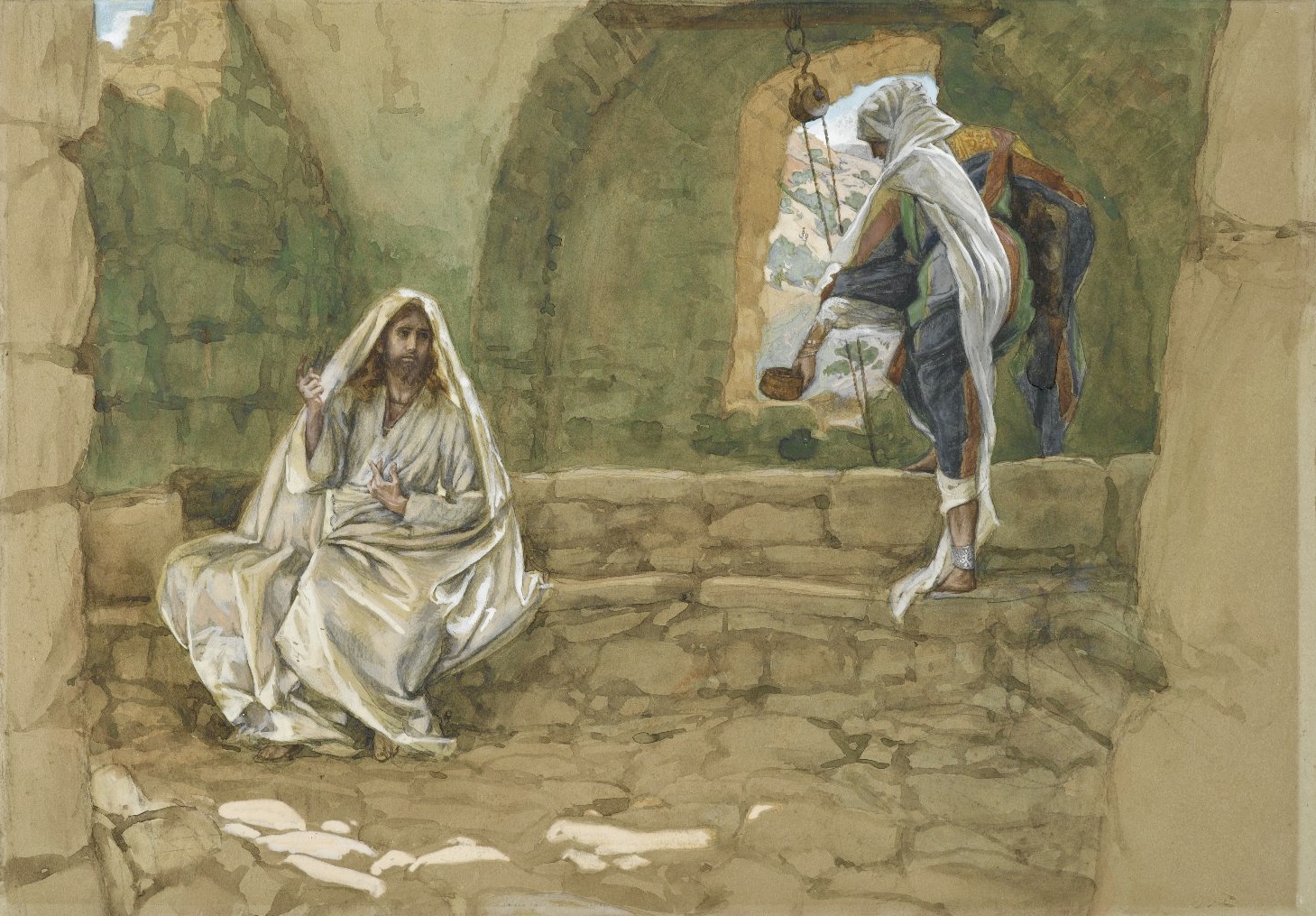
Christ Retreats to the Mountain to Pray, by James Tissot

I have become fond of quoting a particular question and response found in the Catechism included in our Book of Common Prayer. The question is straightforward: “What is prayer?” The first part of the extended answer to this question is also put plainly, and it is instructive. “Prayer is responding to God.”

Consider the significance of those words. If we gained our concept of prayer during childhood, we probably still think about this activity in the same terms – terms which are rather different from the way that the Prayer Book Catechism sets forward its definition. For it seems almost universal that we associate our concept of prayer with ’petition.’ Petition is the formal name for prayers that ask, in which we make our personal requests to God. ‘Intercession’ is what we call the prayers that we offer for other persons and their needs. The frequency with which we might engage in these two forms of prayer may help explain why we are so accustomed to seeking what we call “answers to prayer.” If answers to prayers are sought, it suggests that prayers are posed to God by us unidirectionally, as questions and or as requests.

Yet, our Catechism begins its teaching about prayer by characterizing this activity as one in which we respond to God, rather than one in which we envision God responding to us and to our concerns!

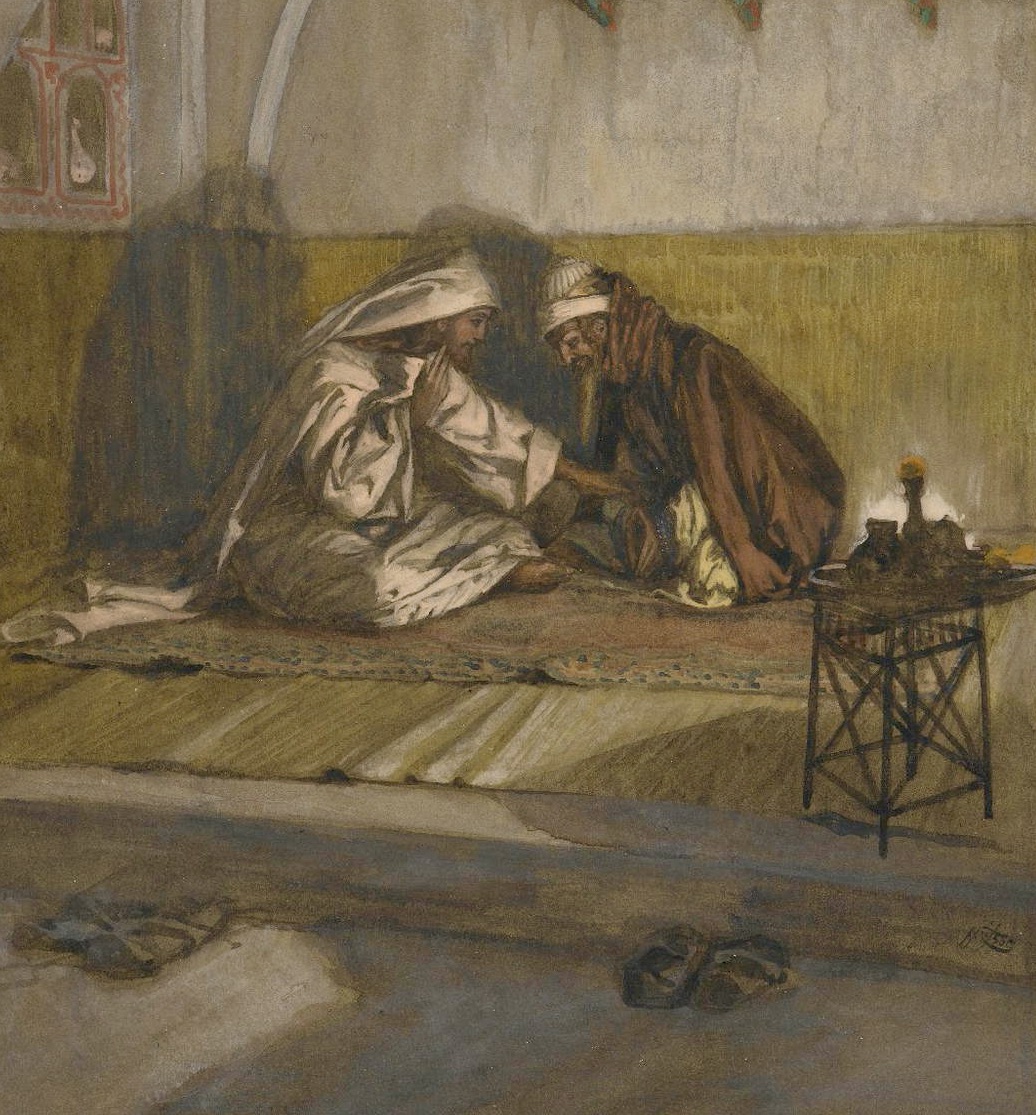
St. James the Less (at prayer), by James Tissot

Putting the matter very simply, the Prayer Book presents prayer as something that is God-centered, God-initiated, and as God-enabled. Such a notion of prayer is fully biblical and properly theological. Yet, we like to be ‘in the driver’s seat.’ Habitually, we think of prayer as something we initiate, and for which we supply the purpose and direction. But if prayer is to be centered upon communion with God, then it ought also to be the other way around, so as to follow the words of Jesus. For he taught us to address “our Father in heaven” by saying “thy will be done.” When we follow his teaching, instead of so often asking God to please do what we want, we are more willing to let God be quietly present and foremost in our consciousness.

The Vision of Zechariah (while at prayer in the Temple), by James Tissot

In a similar way, I think we habitually also misperceive the nature of divine blessing. Two examples of blessing that admittedly are not everyday occurrences, but which sometimes receive mention in discussions about blessing, can help make the point. These examples are provided by occasions when our chaplains are asked to offer prayers for, and pronounce blessings at, the launching of military ships and submarines, or to offer similar words over the participants and their hounds at fox hunts. Such prayers should not be seen as providing sanction for or as necessarily implying divine approval of whatever we ask on such occasions. Blessings in such contexts can instead be understood as words that we offer so that what is prayed for might be in accord with God’s will, rather than as words offered in support of purposes that we prefer and will into effect. Therefore, prayers offered for persons seeking public office, or who serve in that capacity, would best be shaped according to this understanding.

In view of these observations, blessing as a spiritual activity can be defined in the following way. For those who desire a blessing in the context of the church, a bishop or priest might say words of this kind: “May God’s will be furthered in your life, to the end that our Lord’s revealed and known purposes may be brought to their fulfillment in you, and for you.”

Here, the parallel we can discern between engaging in prayer, and offering blessings, provides insight. If prayer begins with responding to God, rather than with inviting God to respond to us, then surely words of blessing pronounced by our clergy are equally contingent upon the revealed direction of God’s purposes rather than those of our own. Therefore, we should always seek to offer prayers and blessings that are in accord with God’s known will, with the aim that our wills and desires might be in harmony with those of our Lord. Prayers and blessings are most genuine when we are most open to letting God be God.

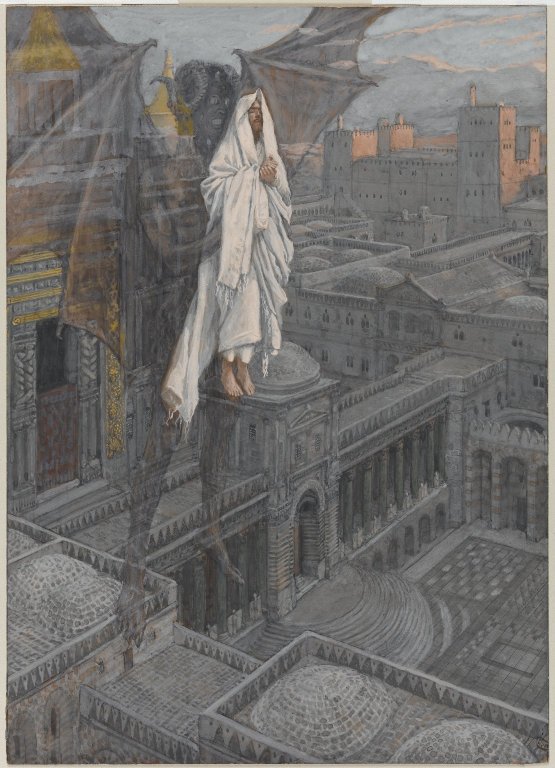
James Tissot, Christ Goes Up Alone onto a Mountain (detail)

The Beauty of Witness

Memorial sculpture commemorating the Martyrs of Memphis

This week, on September 9, we observed a significant date on our personal calendar by celebrating the birthday of one of our sons. September 9 was already a notable date for us beginning some years before his birth, after our move to Memphis in the summer of 1983. During those years, the date became associated with an addition to the Episcopal Church Calendar that has readings appointed for it in our Lectionary. September 9 is designated as the feast of The Martyrs of Memphis: Constance, Thecla, Ruth, Frances, Charles Parsons, and Louis Schuyler.

To those unfamiliar with its history, the official title for this feast day may suggest dramatic images of early Christian saints contending with ferocious animals and or human adversaries in the name of the Faith. Which then raises questions about whether, perhaps, the Memphis in question was the one in ancient Egypt. Yet, the name designation for this day can be instructive for all of us because it may remind us of something we once learned – that the etymological root of the word martyr lies in the ancient Greek word meaning ‘witness.’ Hence, those persons we commemorate on the Church’s Calendar because of their examples of Faith are remembered for being especially compelling witnesses to God’s redemptive mission in Christ, regardless of whether they faced circumstances that might have led to a heroic death.

The Martyrs of Memphis provides an occasion for us to remember the men and women who remained in Memphis to minister to those with whom they faced together the ravages of a severe Yellow Fever epidemic, from which they could have fled to safer places elsewhere. Unknown to them was the fact that this horrible plague was a mosquito-borne infectious virus, and not something arising from ‘swamp vapors’ or bad city air. Among the faithful persons who succumbed to the fever, and who are remembered on the feast day of September 9, are the four women named in the feast’s title who were community members of the Sisters of St. Mary, Father Charles Parsons, the last remaining Episcopal priest in the city, and Father Louis Schuyler, who came as a volunteer from New Jersey to take Parsons’ place and join the Sisters in ministry.

Monument by Harris Sorrelle, in the Memphis Martyrs Park, overlooking the Mississippi River

Words from the collect (or principal prayer) for the feast day of the Martyrs of Memphis capture well why these particular individuals are named among so many others – known and unknown – who shared their faith as well as fate: “We give you thanks and praise, O God of compassion, for the heroic witness of the Martyrs of Memphis, who, in a time of plague and pestilence, were steadfast in their care for the sick and dying, and loved not their own lives, even unto death…”

The generic character of the title for this significant feast day was chosen to help us also remember that the number of those who died in the epidemic, not only in Memphis, but up and down the Mississippi River and beyond, numbered in the thousands. Memphis’s historic Elmwood Cemetery, its oldest, has a particularly moving monument that complements the contemporary riverside sculptural composition by Harris Sorrelle (displayed above). At Elmwood, instead of having an impact upon the use of anonymous and aptly dark-colored figurative silhouettes, as Sorrelle’s sculpture does, the cemetery monument provides just paragraphs of words, stating in plain but moving terms the reality that lies below where cemetery visitors walk (as the following image attests). As the Elmwood monument notes, at least 1,400 Yellow Fever victims are buried in nearby unmarked mass graves.

Martyrs monument in Elmwood Cemetery (clicking the photo will provide an expanded view of it)

The faithful witness of those who died ministering to and with others among the Yellow Fever victims in Memphis in the 1870’s can have the effect of prompting us to reflect on the very different circumstances in which we live, with our advances in medicine, healthcare, and social services. Nevertheless, the COVID crisis of 2020, and its lingering legacy, can also remind us of our mortality, our higher calling to seek godly life in its fulness, and to be faithful companions with and to those less fortunate than ourselves.

A state-provided historical marker that includes use of the word ‘martyr’

Additional note: a tragic-comic aspect of the Yellow Fever’s impact upon Memphis was another pre-scientific belief (in addition to the ‘swamp vapors’ theory regarding its origin) amongst those who remained in the city. It is said that those who seemed to have the lowest mortality rate were corpulent men who smoked cigars, the smoke from which may have warded off the mosquitos responsible for the plague’s transmission.

God’s Handiwork Inspires Ours

Stones found on a northern Lake Michigan beach

Labor Day is around the corner and some of us may receive and enjoy a day off from work. What we call retirement, a stage in life I am presently enjoying, tends to represent leaving work behind. Yet these and related ideas rest upon a common assumption, that work is different from, and in some ways inimical to, enjoying fulfillment in life.

I find a biblically based theological insight helpful when thinking about work. As with many matters that can be looked at from the perspective of Christian moral theology, our view of work can be enhanced by making reference to four specific reference points. These are, first, what we have learned about God’s purposes in Creation for this or that aspect of our lives; then, what impact sin associated with our Fall has had upon what we are thinking about; third, how God’s ongoing work of Redemption has restored and or transformed the matter presently under consideration; and fourth, to ask what future – if any – does this aspect of our lives have in Christ. 

Work provides a wonderful topic for engaging in this fourfold inquiry. Based on our common way of thinking about work, it may be hard for us to consider the meaning of work from any other vantage point than of attributing its role in our lives to the Fall and to the ongoing effects of human sin. Yet, we can also learn from many who have come before us who have distinguished work from toil. This can help us see how forms of labor, and pejorative associations the word may have for us, are surely due to our proclivity to link such activity with burdensome unpleasant duties.

For what we may overlook is the biblical view of how God has shared stewardship responsibility for aspects of Creation with us, as beings created in God’s image and likeness. This was symbolized by the way that our mythic forebears (Adam and Eve) were given their ‘work’ of naming the animals as a path toward fulfillment. It was not until their expulsion from the Garden that the first human beings are described as prone to acts characteristic of sin. Thereupon, in biblical theology, our heavenly ‘work’ of praise, and of divinely-invited participation in God’s Creation stewardship, ceased to be pleasingly ready pathways toward human fulfillment, and became energy draining and spirit-diminishing activities – such as we tend to find them to be now.

A growing segment of the wider Christian community shows signs of acknowledging how God’s work of Redemption is ongoing, quite aside from its ‘once and for all time’ episodic saving events. The pattern and purpose remains the same – nothing fundamentally new is added, nothing old of lasting value taken away. Preeminent remains God’s abiding purpose for us to become and be God-like in God-intended ways. For, as Athanasius taught us, the Son of God became the Son of Man, so that the children of men and women could become the children of God. Work – not toil nor burdensome labor but creative and fulfilling work – remains a vital part of our holy path toward wholeness.

And to remind us of this abiding truth, the loving Creator has spread around us an uncountable abundance. These are the signs of outpoured and participatory grace, some of them very small, like stepped-upon seashore pebbles and tiny blossoms among hurried-by roadside weeds.

Too quickly we dismiss the significance of our our small acts of selfless giving, not to be counted by us, but adding up to so much more than we imagine in the life-growth of others. This is our holy ‘work,’ overlooked but important stepping stones on our path toward living into the godly fullness with which Christ fills us.

If on our daily course our mind

Be set, to hallow all we find,

New treasures still, of countless price,

God will provide for sacrifice.

Old friends, old scenes, will lovelier be,

As more of heaven in each we see:

Some softening gleam of love and prayer

Shall dawn on every cross and care.

[John Keble, “Morning,” from The Christian Year]