Community

The Beauty of Hospice Care

Faith Hospice at Trillium Woods

Having worked in a variety of church-related contexts for over four decades, I have become familiar with the importance of having a clear vision of one’s mission. In my experience, people are motivated by inspiring mission statements, and especially when they are enacted with cheerful efficacy. As advocates of Appreciative Inquiry maintain, a focus on what is working well builds energy and promotes a sense of well-being among participants.

As I reflect on the most compelling examples of institutions, facilities, or programs that I have encountered, the hospice movement in healthcare stands out. Whereas medical practice has increasingly become directed towards problem-solving and the alleviation of various conditions, along with our growing interest in future-oriented health maintenance, hospice care tends to be focused on a wholistic approach to the present well-being of a person. And I have found that hospice advocates and caregivers to be among the most positively mission-focused people I have met.

Aside from occasional background reading and some videos on the topic of hospice care, my experience over the years with this life-enhancing approach to being with other people was relatively brief. But then, it was unexpectedly transformed by a full and meaningful month of time spent with my dad, beginning with the discovery of his having a malignant brain tumor and ending with his peaceful death. He died surrounded by his four sons, in a remarkable facility dedicated solely to hospice care.
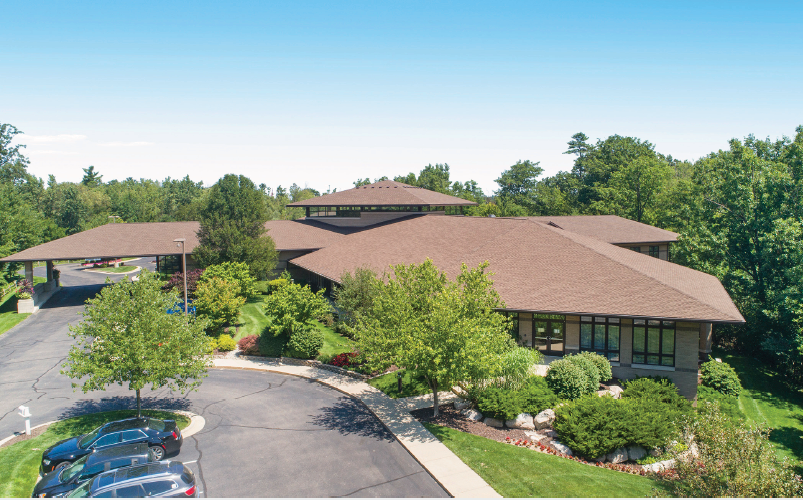
Arial view of the Trillium Woods location

I am particularly grateful for my dad’s opportunity to have been admitted to the Faith Hospice inpatient care facility at Trillium Woods in Grand Rapids, Michigan. Through my parish ministry, I knew about hospice care being provided at home and in other settings, but I had not had any personal experience with a residential facility built and maintained solely for hospice care. My dad’s move to Trillium Woods happened four days after his admission to hospital ER, on a cold, mid-December day. The hospice became his new temporary home, and we soon discovered how it was an unanticipated but blessed answer to prayer for him as well as for our family.

December is a tender time for families caring for or mourning loved ones, and we found that Faith Hospice staff members were especially sensitive to our emotions as the Christmas holiday season came into its fullness. We were impressed by the generously sized and attractively decorated room they were able to provide for my dad and the other patients, which included a comfortable sitting area, a bed area, and large windows and a door leading onto a beautiful terrace. Equally impressive was the rest of the facility, which had large lounge areas, a dining room and adjacent kitchen, and a well-designed chapel. Being able to have our family Christmas dinner there at the hospice (as well as other meals) was a comfort, and allowed us to focus on my dad and his care, and to be less absorbed with our own daily concerns.

A hospice patient’s room like the one my dad was in

Most significant to us was the dedicated staff, who were sensitive and attentive to each subtle stage in the process of my dad reckoning with and moving toward his impending death. Like them, my dad showed himself to be strong in faith, and fully at peace with seeing his final illness as a facet of God’s merciful Providence. Thankfully, he showed no signs of being in denial about what was happening to him. I attribute this to his decades of ministry as an ordained pastoral counselor, and as one who lived his faith while commending it to others.
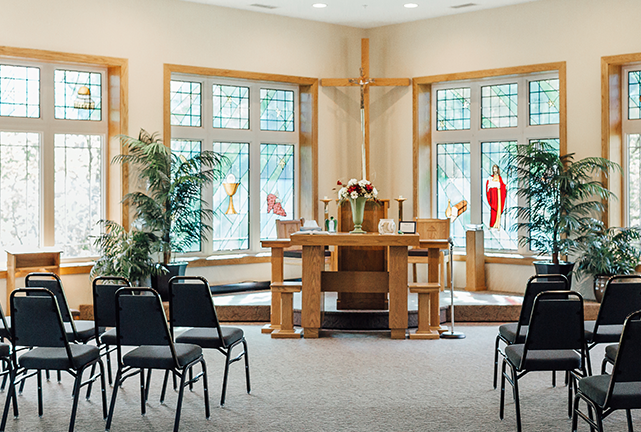
The Chapel at Trillium Woods

During the process of my dad’s dying, I marveled at the ministry of Faith Hospice at Trillium Woods, and wondered about how many other such facilities exist around the country and elsewhere. I continue to wonder about this, and imagine that such a place is more often desired than found, being the kind of facility that everyone would want to have available should they need it.

The phrase, “the end of life,” is often used to refer to what hospice care is focused upon. Taken simply and literally, these words refer to the termination point we come to in the course of our physical embodiment. Yet, as I like to remember, our English word ‘end’ does not simply connote a terminus but also a point of fulfillment and the realization of purpose. In my experience of the hospice care that was offered to my dad and our family at Trillium Woods, I encountered a culture of ministry oriented toward lifting our eyes to a broader horizon of meaning for daily life. In this, I found the facility was aptly named as Faith Hospice, for clearly a grounded Christian Faith lay at the heart of the mission enacted on a daily basis at Trillium Woods.

Note: I have no official connection with Faith Hospice at Trillium Woods but only my personal experience of holy care from the folks there. With them, we journeyed through our final month with a family member amidst a loving community. More about this ministry and facility can be found by clicking here.

The Believing Eleven

If reading this by email, please tap the title at the top to open your browser for the best experience. Then, clicking individual pictures will reveal higher resolution images.

Peter Paul Rubens, The Rockox Altarpiece, 1613-1615 (center panel)


It is evening on the day of Resurrection-discovery. John tells us that ten of the disciples are hiding behind a secured door out of fear. Judas is deceased, and Thomas is away.

Jesus suddenly appears to the unprepared disciples, and shares with them his peace. He shows them his hands and his side, and then – as a direct consequence of seeing the places on his body associated with his death – the ten disciples rejoice when they see their Lord. In other words, their recognition of him, and that he was somehow alive again, brings them joy by restoring their belief in him.

When hearing this story from John’s Gospel on the second Sunday of Easter, we may be prone to considering it apart from what happens just before it. The disciples, who are hiding out of fear, have already received an eye-witness to the resurrection of Jesus. Mary Magdalene, to whom Jesus revealed himself at the tomb that morning, had come and told the ten the Lord was alive, and that he had appeared to her. Clearly, and prior to Jesus’ unexpected appearance, the ten disciples are still doubting her personal witness. Even after receiving what should have been trusted testimony from Mary Magdalene, a fellow follower of Jesus.

So why – in popular imagination – isn’t this well-known Gospel reading from John 20 commonly referred to as the “doubting disciples” reading? Why should Thomas be singled out, when his joyful recognition of the risen Jesus depended on nothing more or less than what the 10 had needed, and received, before him?

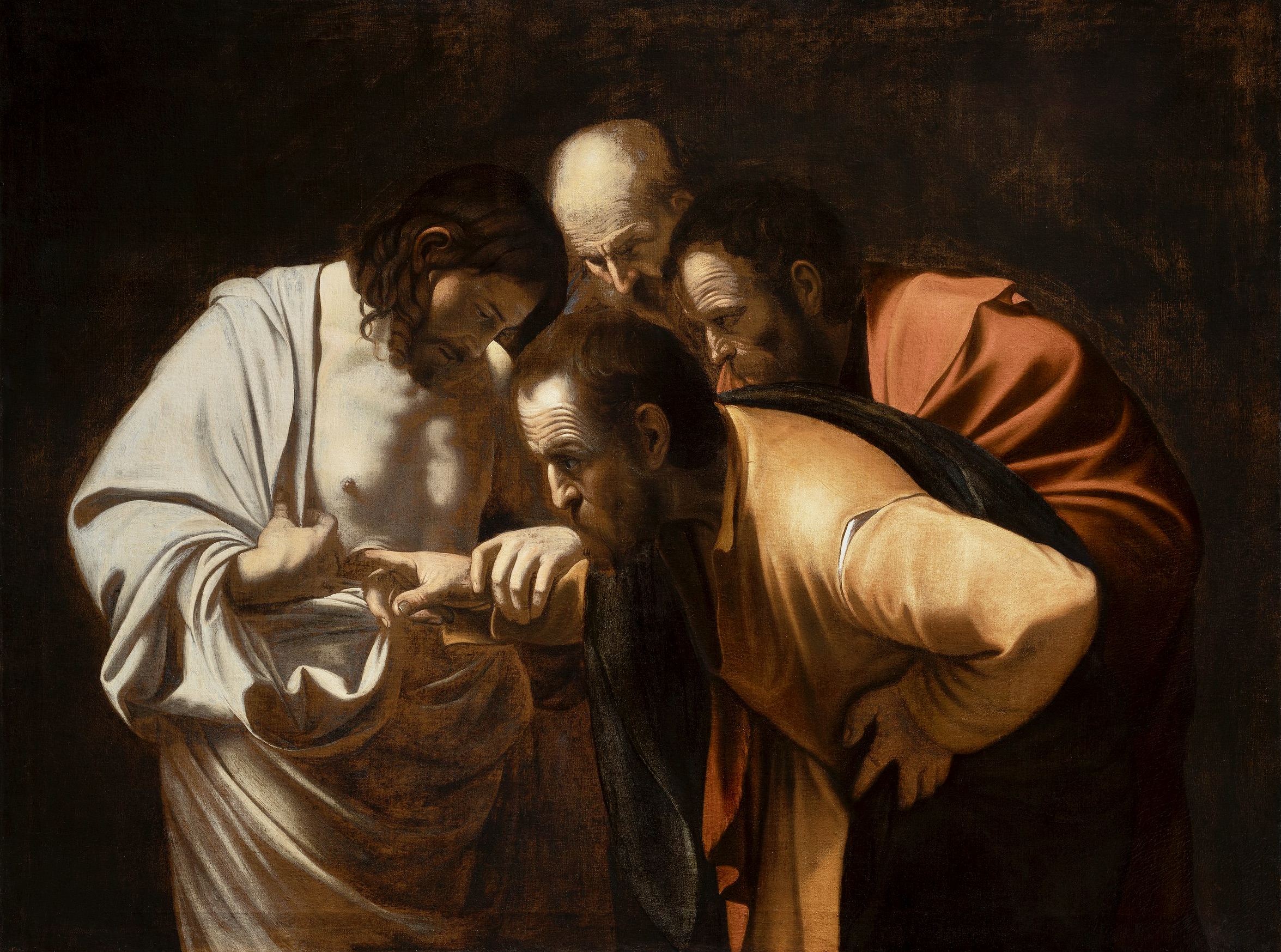
And why have so many painters in the Western tradition privileged Thomas’ purported unbelief in the Risen Lord, rather than depict the earlier reluctance of the ten others to arrive at joyful confidence about the Lord’s astonishing return? Apparently, in many painters’ eyes (especially Caravaggio), more visual drama was to be found in images of a doubter’s hand placed within an open wound.

Caravaggio, Doubting Thomas, 1601 (a famous traditional presentation of the event in John 20)

A further detail to notice, which our familiarity with so many paintings helps to obscure, has to do with how Thomas responds to Jesus. According to John, Jesus appears to the not-yet-believing ten, and – unbidden – shows them his hands and his side. Seeing the traces of his wounds on his risen body brings them joy. Jesus then appears unexpectedly a week later, this time showing himself to the one not present on the prior occasion. And just as he had done previously, Jesus offers Thomas the same opportunity he had provided to the others.

We should therefore not be misled by Thomas’ oft-quoted comment to the other disciples, prior to his own epiphany, about what he needed in order to believe. According to the text, Jesus – upon appearing in the same house a second time – bids Thomas to touch him. Yet, Thomas immediately responds to Jesus’ words without any mention in the Gospel of him having physical contact with the risen Lord’s wounds. Jesus then asks Thomas a rhetorical question, “Have you believed because you have seen me?” Naturally, Thomas’ implied answer is ‘yes.’

For all these reasons, we will do better to find a different and more positive descriptive phrase by which to refer to this well-known passage from John 20. “Jesus meets the disciples according to their needs,” though wordy, would do better.

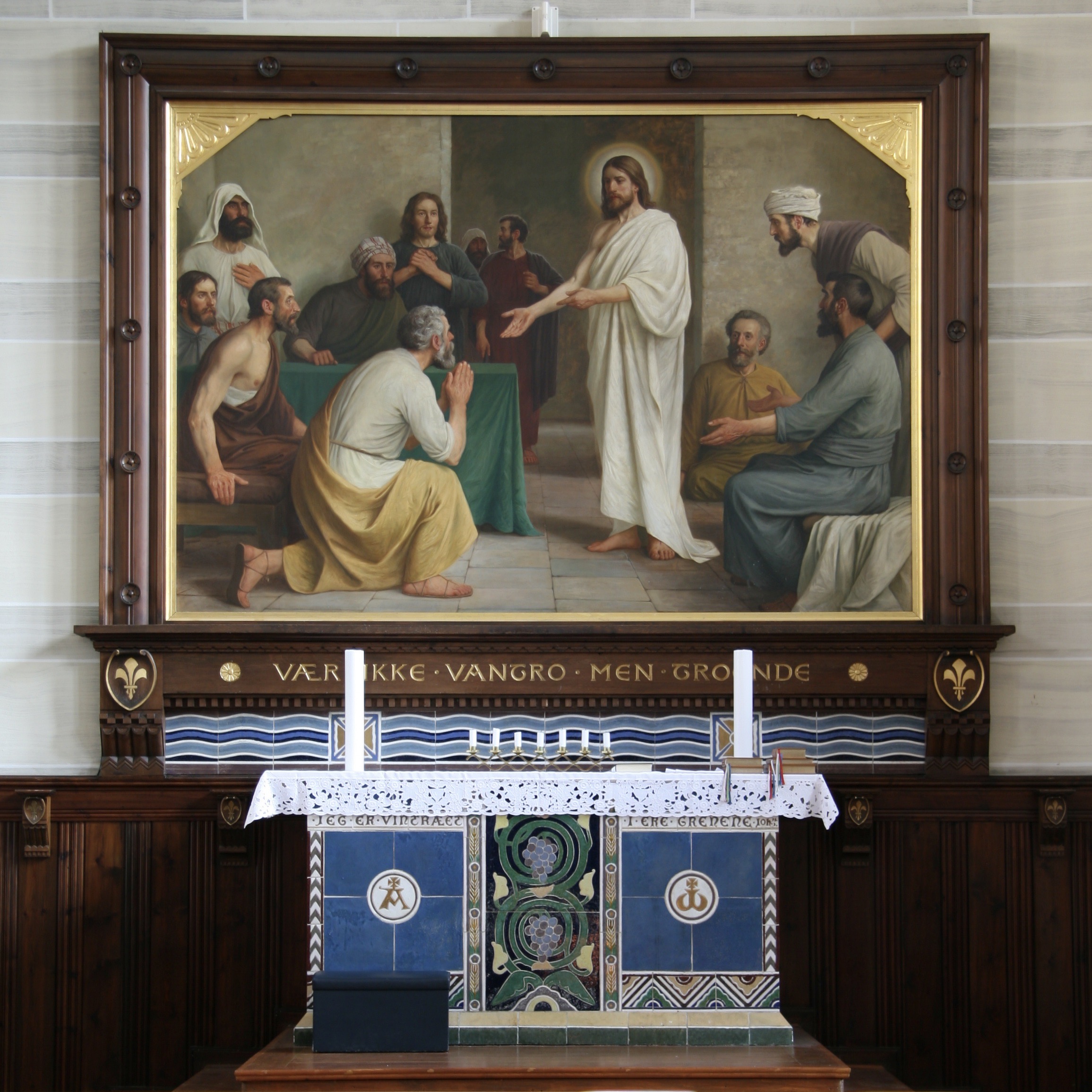
P. Steffensen’s altarpiece painting behind the altar of Zion Lutheran Church, Copenhagen


This post is based on the traditional Gospel reading for the second Sunday of Easter (April 7 in 2024), John 20:19-31. The story within it concludes with these words: “Jesus said to Thomas, ‘Have you believed because you have seen me? Blessed are those who have not seen and yet have believed’.”

Note: The altarpiece paintings by P. Steffensen and Rubens provide an interesting counterpoint to the prevailing tendency of painters to focus on Thomas placing his hand in the side of the Risen Jesus.


Beauty in Parallel Revisited

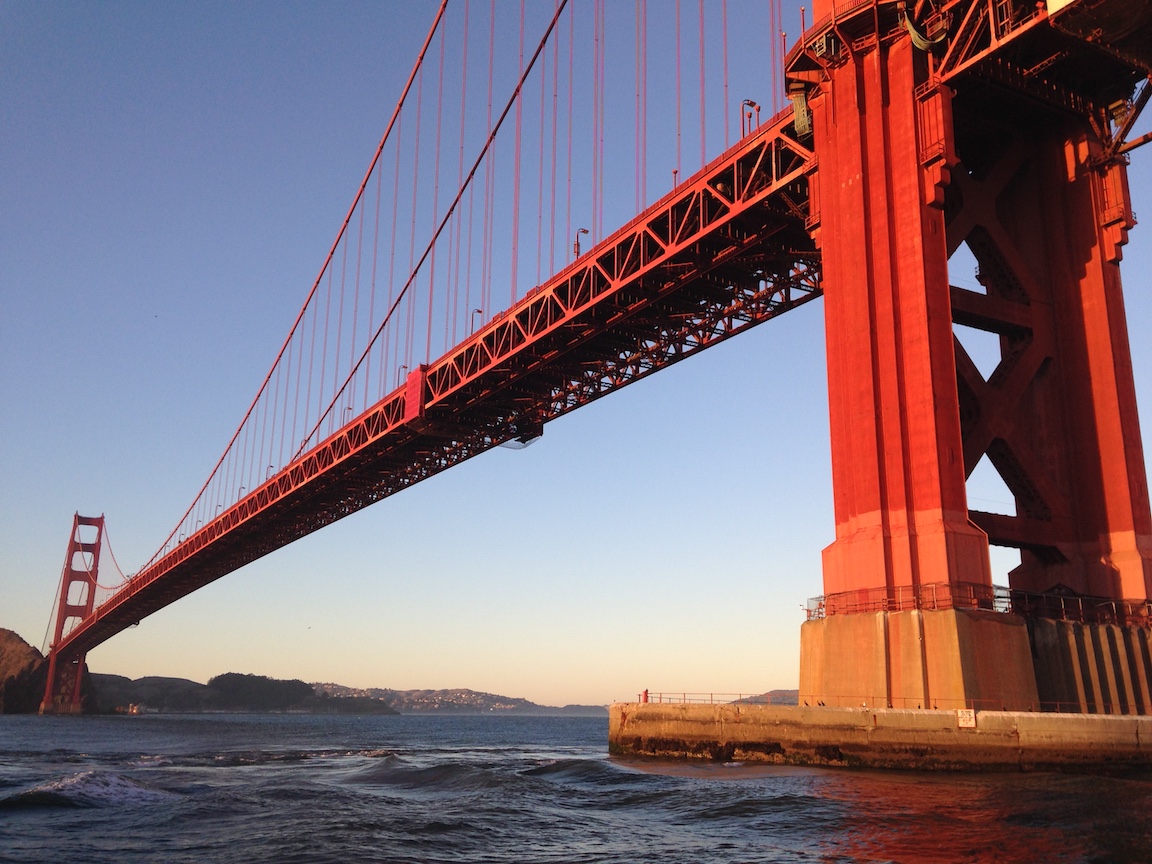
golden_gate_bridge_pillar-smaller-copy

Perhaps the only thing more memorable than driving over the Golden Gate Bridge may be to pass under it on an ocean-going ship. I was lucky enough to have that experience five times before I was a teenager.

Many of us assume the name for this bridge is related to its warm color. But the name comes from the ocean straight over which it stands, and not from the Gold Rush. Rather than mimicking gold, the bridge’s official color—“International Orange”—was chosen to contrast with fog. A story is told about when that color was first applied. Painters dabbed splotches of it on the heads of curious seagulls. Pretty soon, Bay Area birdwatchers reported a new bird species, which was called the California Red-Headed seagull!

Until 1964, the Golden Gate Bridge had the longest main span in the world. Yet, its basic design isn’t unique. We know this from other suspension bridges, which are found all over the world. Bridges of this kind have two main towers, steadied in place by their suspension cables, which are anchored in the ground. From their anchor points, these substantial cables ascend to the top of the towers, and then gently descend again to the center of the bridge. From that low point, they again soar up, to the top of the opposite tower. The slightly arched roadway across is literally suspended from these main cables, by small support cables that hang from them. Here, in the beauty of this simple design, we find a helpful spiritual and liturgical metaphor.

Reflect for a moment about two significant Sundays in the church year. One is the last Sunday after Epiphany, or Transfiguration Sunday, which we observed 10 days ago. The other is Easter Day, which lies ahead. Transfiguration Sunday is the last Sunday before this season of Lent, and Easter Day is the first Sunday after Lent. Both Sundays are as important with regard to our identity as they are to that of Jesus. For in his Transfiguration and in his Resurrection, Jesus does not simply reveal who he really is. He also reveals the fulfillment of our vocation to be fully human, in him.

Imagine these two Sundays on the Church calendar as being like the two towers of the Golden Gate Bridge. Transfiguration Sunday, coming just before Lent, is like the south tower of the Golden Gate bridge, on the busy urban, San Francisco, side of the straight. And, Easter Sunday is like the north tower of that bridge, on the less familiar and historically rural side of that navigational channel. The season of Lent stretches between these two Sundays like the main span of that bridge, taking us from what we think we know to that which may yet to be disclosed to us.

Here is the crucial part ~ every year we need to make this liturgical crossing, from our sharing in the vision of the Transfiguration, to our participation in the joy of Easter Resurrection. And like the great towers of a suspension bridge, Transfiguration Sunday and Easter Sunday uphold us all the way across our Lenten journey over what sometimes may seem like dark, cold, and turbulent waters around us.


This posting is a revised version of a post I first published in 2017, and is based on my recent homily for the Last Sunday after the Epiphany, which explores the parallel between the revelation of glory that we see in the Transfiguration, and the glory we see in the Resurrection (click here for a link to it).

Pentecost!


“… they were all together in one place. And suddenly from heaven there came a sound like the rush of a violent wind, and it filled the entire house… Divided tongues, as of fire, appeared among them, and a tongue rested on each of them. All of them were filled with the Holy Spirit and began to speak in other languages, as the Spirit gave them ability.”

We have a challenge imagining this moment. Because our culture emphasizes the particularity of personal experience and our differences, rather than what is shared between us. We hear talk about diversity and inclusion, which might reflect a positive regard for community. But it may also reflect an assumption that, apart from our efforts to bring people together, we are separate and disconnected. We hear that, on the day of Pentecost, some people in that room dramatically experienced God’s power. Yet, we may be surprised to hear that all of them did, together!

This may be because we don’t appreciate how community is vital to individual human flourishing. We often want freedom for ourselves without personal accountability to others. And, we desire private opportunities without public responsibilities. Being in community with other people may seem occasionally beneficial, especially when it is on our terms. But we tend not to see it as essential to our lives.

Evangelical Christians rightly emphasize a personal relationship with God, through Christ, in the power of the Holy Spirit. And many in the broader Catholic tradition rightly point to how we grow in our relationship with God through community. So, we may think of this as an either/or choice. Yet, the New Testament treats our relationship with God as both personal and communal. Scripture encourages us to see how God is at work nurturing the lives of particular persons as well as transforming the health of whole communities.

We have lost at least one insight by moving from the King James translation to modern versions of the Bible. It centers on the difference between “ye” and “you.” Except in the American South, in modern American English, we don’t distinguish between you, plural, and you, singular. And so, when Jesus says, in the King James version of Mt. 5:48, “be ye perfect,” the contemporary NRSV translation has it as simply, “be perfect…” (meaning whole or complete). In other words, “you, be perfect!’ A modern ‘Southern’ translation would say, “y’all be perfect,” making clear that Jesus is not just speaking to individuals.

This can help us notice a paradox. We know how Episcopalians and other mainline Protestant Christians are sometimes uncomfortable when our brothers and sisters in Christ talk about ‘accepting Jesus as our personal savior.’ And yet, many of us along with other ‘mainline Christians’ assume that religion is always a personal and private matter. In other words, both evangelical and non-evangelical Christians often privilege the same assumption, that our faith is largely private, even if we don’t speak about it differently from each other.

All this is important as we celebrate the feast of Pentecost. Just like the feast of the Resurrection, Pentecost is first about God’s missional community before it is about the experience of individual members.


The image above is Bonnie Van Voorst’s painting, Pentecost. This post is based on my homily for Pentecost Sunday, June 9, 2019, which can be accessed by clicking here.  Other homilies of mine may be accessed by clicking here. The Revised Common Lectionary, which specifies the readings for Sundays and other Holy Days, can be accessed by clicking here.


Bonnie Van Voorst offers these thoughts regarding her evocative painting, Pentecost:

“At the bottom of the painting, blues, browns, and greens represent humanity. Above, blue, gold, and red symbolize the Trinity–blue for Christ’s immanence, gold for the Father’s transcendence, and red for the work of the Holy Spirit. “And the Father, as he had promised, gave [Jesus] the Holy Spirit to pour out upon us, just as you see and hear today.” (Acts 2:33) The red descends to earth, settling on God’s people as they are filled with the Holy Spirit.”

Her painting has the evocative quality of many of those by Makoto Fujimura.


The Beauty of Kingdom Potential


What has Jim Janknegt depicted with his painting? Right away, we can see that he portrays the Kingdom mustard seed parable in Mark’s Gospel. With his focus on this parable, we should remember that the Gospels include two kinds of mustard seed teaching. One is in Jesus’ parable ~ about the huge potential of what God can do with apparently small bits of the Kingdom. Jesus’ other teaching is about the tremendous potential of what we might accomplish through personal believing, especially given how personal faith can otherwise be deficient or defective.

To help recognize this difference, between Jesus’ Kingdom parable and his other teaching referring to the size of our personal believing, consider what we see in Janknegt’s painting. In the foreground we see things we usually think of as being big ~ like big cities, their large buildings and the businesses they house. Dwarfing them is a great tree, which may represent the ‘Tree of Life.’ Like the small mustard seed, the great tree that it becomes represents what the Spirit is doing with God’s Kingdom.

Notice the community for which the great tree provides a place of habitation ~ a community characterized by many birds, including both a beautiful peacock and a spoonbill, an owl and a descending dove. In traditional mythology, birds represent communication between the realm of the sky and the realm of the land, or between the heavenly sphere and that of the earth. The Tree of Life provides a context for this communication, and for the Kingdom community that God’s Spirit nurtures between the two.

If we ever worry or despair about the smallness of our faith, we should remember Jesus’ emphasis upon the huge potential of God’s Kingdom power. The seed of this Kingdom potential is planted within us at our Baptism.


This post is based on my homily for Sunday, June 17, 2018. Jim Janknegt’s painting, Worlds Smallest Seed, is used here with his permission. {Editorial note: I preached on this Gospel reading, and referenced Janknegt’s evocative painting again on Sunday, Jun 16, 2024. Here is a link to my reflections on the same Gospel reading.}

Beauty in Parallel

golden_gate_bridge_pillar-smaller-copy

Perhaps the only thing more memorable than driving over the Golden Gate Bridge may be to pass under it on an ocean-going ship. I was lucky enough to have that experience five times before I was a teenager.

Many of us assume the name for this bridge is related to its warm color. But the name comes from the ocean straight over which it stands, though it does not derive from the Gold Rush. Rather than mimicking gold, the bridge’s official color—“International Orange”—was chosen to contrast with fog. A story is told about when that color was first applied. Painters dabbed splotches of it on the heads of curious seagulls. Pretty soon, Bay Area birdwatchers reported a new bird species, which was called the California Red-Headed seagull!

Until 1964, the Golden Gate Bridge had the longest main span in the world. Yet, its basic design isn’t unique. We know this from other suspension bridges, which are found all over the world. Bridges of this kind have two main towers, steadied in place by their suspension cables, which are anchored in the ground. From their anchor points, these substantial cables ascend to the top of the towers, and then gently descend again to the center of the bridge. From that low point, they again soar up, to the top of the opposite tower. The slightly arched roadway across is literally suspended from these main cables, by small support cables that hang from them. Here, in the beauty of this simple design, we find a helpful spiritual and liturgical metaphor.

Reflect for a moment about two significant Sundays in the church year. One is the last Sunday after Epiphany, or Transfiguration Sunday, and the other is Easter Day. Transfiguration Sunday is the last Sunday before Lent, and Easter Day is the first Sunday after Lent. Imagine these two Sundays on the Church calendar as being like the two towers of the Golden Gate Bridge. Transfiguration Sunday, coming just before Lent, is like the south tower of the Golden Gate bridge, on the urban, San Francisco, side of the straight. And, Easter Sunday is like the north tower of that bridge, on the less familiar and historically rural side of that navigational channel. The season of Lent stretches between these two Sundays like the main span of a bridge. Here is the crucial part ~ every year we need to make this liturgical crossing. And, like the great towers of a bridge, Transfiguration Sunday and Easter Sunday uphold us all the way across our Lenten journey.


This posting is based on my homily for the Last Sunday after the Epiphany, which explores the parallel between the revelation of glory that we see in the Transfiguration, and the glory we see in the Resurrection (click here for a link to it).

Beauty in Community

Pentecost_CELPentecost[1]_buildfaith.org


A collection of individuals fills this painting, signifying Mary and the first followers of Jesus. They are looking in different directions at the moment when the great whooshing wind and the flames of the Holy Spirit come down upon them. Caught up in the movement of the wind and flames, they are pushed forward into a celebration that is turned outward, and toward the darkness that lies beyond. The fire of the Spirit blows in and through them, not just around and over them. And they are swept forward into the future, in common mission.

We have a challenge imagining this moment. Our culture emphasizes the particularity of personal experience, and differences between us. We hear much talk about diversity and inclusion, which might reflect a positive regard for community. But it may also reflect an assumption that, apart from our efforts to bring people together, we are separate and disconnected. Perhaps, on the day of Pentecost, some of the people dramatically experienced God’s power. But we may be surprised to hear that all of them did, and together!

We don’t appreciate how community is vital to individual human flourishing. We often want individual freedom without personal accountability to others, and individual opportunity without personal responsibility. Being in community with other people may seem to be occasionally beneficial, especially when it is on our terms. But we don’t see it as essential to our lives.

In the ancient biblical vision, we are created in community, and we are redeemed in community. Whether we experience it or not, after Baptism God abidingly dwells between us and within us. There is no distance between us and God, even if we perceive a disconnection within ourselves. Whether we are conscious of it or not, God pours out grace to us in revelation and in inspiration. This is why God encourages us to open ourselves in prayer to his abundant gifts. All are blessed, for all receive a full measure of the Holy Spirit in Baptism. And all are commissioned by the fire of the Holy Spirit to engage in mission wherever we are, at home, at school, at work or at play. All are called to share in the beauty of Christ in community.


The Pentecost painting is found on the website, http://www.buildfaith.org. See Acts 2 for the Pentecost story.

Common Beauty

Rossano_Gospels_Last_Supper


We have many ties with others through birth and our families. We find we are connected with one another by bonds that are not of our own making.

Like the links we have with our families into which we are born or adopted, our relationships with other members of the Body of Christ are also given to us. These relationships are a reality we find rather than one we construct, for they are not products of our acts of willing.

Though we discern the reality of these given birth and baptismal connections between us, we easily fall into patterns of thought that suggest otherwise. When asked who we are, we often answer in ways that ignore these received relationships. We forget that, especially after Baptism, who we are can never rightly be described without also referring to whom we are for.

Acts 2 describes the post-resurrection community as having four shared attributes : common worship, common practices, common goods, and common witness.* Members of this community could share “all things” because they already shared the most important thing, the beauty of new life in the risen Jesus.

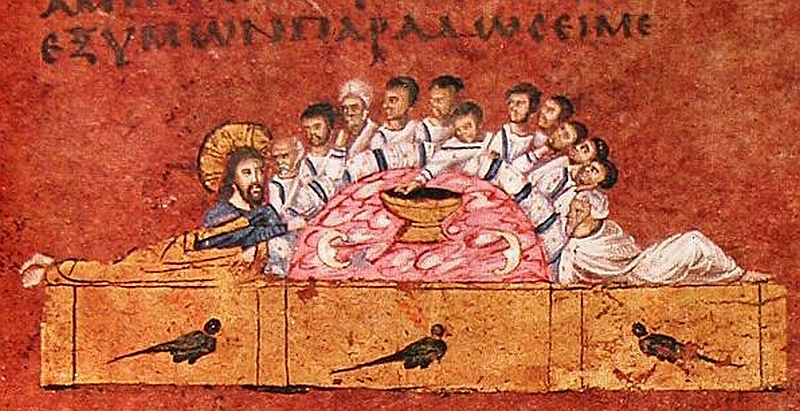
The Rossano Gospels depict Jesus with the disciples at the last supper, reclining in ancient mediterranean style. The image of circular fellowship applies equally to their life together after the resurrection and ascension. They shared their lives at the table of Eucharist and at tables of fellowship, which became visible symbols of everything else they shared.

Judas is shown leaning out from the pattern of this circle, fulfilling Jesus’ prediction about the one who would dip in the bowl after him. Judas’ stance mirrors his refusal to share the common purse with which he has been entrusted, and his disinclination to share common worship and common witness to Jesus’ power among them.

Common beauty is within us and around us. Seeing each other as joined in the risen Lord is directly correlated with seeing the risen Lord in each other. By sharing union with him, and through discerning his beauty in one another, we are more likely to share everything else.


The image above is from the Rossano Gospels, 6th century A.D. *Robert W. Wall offers this insight.