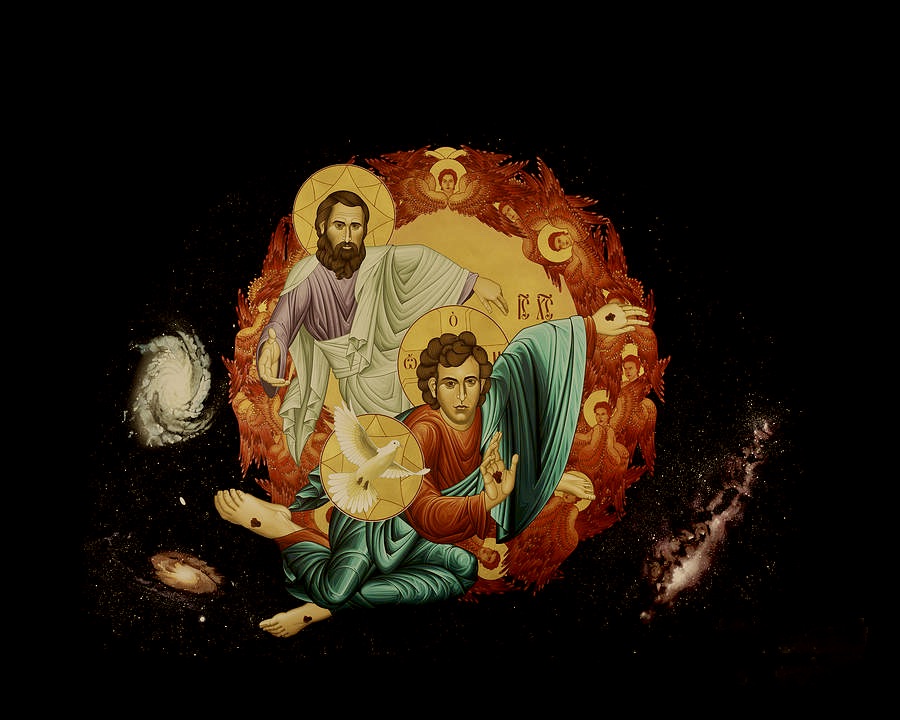
Worship

Through Death Into New Life

Peter Koenig, Christ as Second Moses


A perennial theme in the New Testament and in Christian reflection concerns how we are called to live through death into new life. When we die to our worldly attachments, and their hold upon us, we open ourselves to a greater life beyond. As the Christ our Passover canticle from The Book of Common Prayer puts it,

Christ being raised from the dead will never die again; *
death no longer has dominion over him.
The death that he died, he died to sin, once for all; *
but the life he lives, he lives to God.
So also consider yourselves dead to sin, *
and alive to God in Jesus Christ our Lord.

Peter Koenig’s painting, centered on themes within this Easter season, expresses this motif in a particularly evocative way. Just as Moses led the people of Israel through the waters of death into a new covenant life with God, so Christ leads us through and to the same. This happens for us liturgically in the rite of Baptism. As Koenig explores this idea, he not only depicts Christ parting the waters but also shows the water emerging from the Lord’s side. This reflects John’s account of how blood and water came forth from Jesus’ side on the cross, but also suggests how water from the rock in the wilderness brought life to God’s people during Israel’s wandering toward the Promised Land. The “Thanksgiving over the Water,” in The Prayer Book Baptismal Rite articulates these ideas in a compact way:

We thank you, Almighty God, for the gift of water. Over it the Holy Spirit moved in the beginning of creation. Through it you led the children of Israel out of their bondage in Egypt into the land of promise. In it your Son Jesus received the baptism of John and was anointed by the Holy Spirit as the Messiah, the Christ, to lead us, through his death and resurrection, from the bondage of sin into everlasting life.

We thank you, Father, for the water of Baptism. In it we are buried with Christ in his death. By it we share in his resurrection. Through it we are reborn by the Holy Spirit.

Notice how, in the painting at the top, Peter Koenig portrays the crucified and risen Christ before what appears to be a darkened tomb filled with people. As we hear Isaiah quoted in Advent, “The people who walked in darkness have seen a great light; those who dwelt in a land of deep darkness, on them has light shone.” Christ leads the way, and makes possible our journey from the darkness of death into our new covenant life with God.

The two side paintings that accompany Koenig’s Christ as Second Moses artfully yet powerfully suggest the drama within the Exodus account of Israel’s Red Sea Crossing. The chariots of Pharaoh succumb to the waters of death while Israel is safely delivered on dry ground to their Covenant encounter with God at Sinai. Another canticle from The Prayer Book puts it well:

I will sing to the Lord, for he is lofty and uplifted; *
the horse and its rider has he hurled into the sea.
The Lord is my strength and my refuge; *
the Lord has become my Savior.
This is my God and I will praise him, *
the God of my people and I will exalt him.
The Lord is a mighty warrior; *
Yahweh is his Name.
The chariots of Pharaoh and his army has he hurled into the sea; *
the finest of those who bear armor have been drowned in the Red Sea.
The fathomless deep has overwhelmed them; *
they sank into the depths like a stone.
Your right hand, O Lord, is glorious in might; *
your right hand, O Lord, has overthrown the enemy.

Most of us have the blessing of not facing the equivalent of Pharaoh’s army. But we do have an enemy. And our enemy is the darkness and death of loving self and this world, even to the contempt of God, when God bids us to love him, even to the contempt of self and this world. When we live as we pray, to the Father, through the Son, and in the Spirit, we experience new life.


The above painting is Peter Koenig’s, Christ as the Second Moses, also known as The Rainbow Resurrection (used by permission of the artist). The final paragraph contains a paraphrase of St. Augustine concerning how we love God, from The City of God (Book 14, chapter 28).

What does it mean to touch – and be touched?

[If reading this by email, please tap the title at the top to open your browser for the best experience.]

An image provided by the Jesuits of Ireland


Many of us are sacramental Christians. For us, what is tangible —that is, what we can touch— is often our doorway to the intangible. And so, practical material things having spiritual meaning can become our doorway to immaterial things that are spiritual and mystical.This is especially true in the Eucharist, but also in Baptism. In these rites, we touch, and are touched.

This is one reason why Jesus was so influential in the lives of the original 12 disciples. To see him, to touch him, and to hear him speak ~ these had been critically important experiences for them. Even before his death, they began to sense that knowing Jesus was in some way an entrance into deeper truth and greater life. But this also made it harder for them to deal with his empty tomb, when they had to face his apparent disappearance and absence. With their loss of immediacy with Jesus, fear was added to their sadness. Then, they hid behind locked doors in the crowded Holy City. What should we to make of their experience in that room, especially as we hear about it in John’s Gospel?

Visitors to this blog know I like to find images from art to help us hear the Gospel. This is because artists can help us see and notice things that might otherwise escape our attention. And yet, works of art can also sometimes lead us to mishear what a Gospel reading actually says. This is especially true of the annual day when we hear about Thomas and the other 10 disciples who are hiding after Jesus’ death. As always, we need to engage this Gospel with discernment. For it is really about all of the doubting disciples, as well as about how they all came to believe. Unfortunately, most paintings of this event mis-portray what John actually says, and what he doesn’t say. The classic picture is the one by the famous painter, Caravaggio. He portrays Thomas not only peering closely at Jesus’ side; but also shows him with his fingers poked into Jesus’ spear-wound. (Note also the one above.)

Why are such images misleading? It’s because paintings and labels like these lead us to overlook or misperceive some very important details within the story. For though Thomas has been invited to touch Jesus, John does actually describe him as doing so. (Also, note how Bible editors sometimes steer readers toward certain conclusions by editorial headings before paragraphs.)

First, we find ten of the disciples hiding behind locked doors out of fear. Consider how Jesus had more than once told them to fear not! And at the Last Supper, he had already given them ‘his peace.’ Rather than remember what Jesus had shared with them, as well as his miracles, the remaining disciples have succumbed to fear. Even though Mary Magdalene had already told them she had seen the Lord. How can these facts be squared with any other description than that the ten behind locked doors are doubting, as well?

Second, observe how John describes Jesus’ initial appearance to the ten, when he finds them fearful and doubting. At first, they do not recognize Jesus. It is only after he shows them his hands and his side that they then recognize him, and rejoice at his presence. When they see him, then they believe, and not before. And so, once again, Jesus leaves them with his peace, and now gives them his Spirit.

Notice what the others say to Thomas when he then arrives: “We have seen the Lord” ~ the very same witness Mary had earlier given to them, but without having had much prior effect. Thomas naturally replies to them by saying something like this: ‘Look, I haven’t see him, like you guys have. And so, just like you, I won’t likely believe until I see him, as well.” Thomas’ statement to them therefore does not need to be heard as him setting the conditions for his belief. It may simply be a practical prediction of fact, opening a doorway to his and their later way of experiencing Jesus sacramentally. And, as N.T. “Tom” Wright observes, in John’s Gospel Thomas was the first to call Jesus “God.”


See John’s Gospel, chapter 20, for this story in its wider context. To see the homily/sermon on which this text is based, please click here.

Beauty Over the Reality of Chaos

[If reading this by email, please tap the title at the top to open your browser for the best experience.]

Peter Koenig, Good Shepherd Resurrection


The Resurrection of Jesus is all about grounded hope, and the strength to persevere in the face of adversity. Peter Koenig’s Good Shepherd Resurrection provides a compelling image of its power. The painting builds upon ancient biblical imagery of chaos manifest as a sea monster, and acknowledges how death and resistance to the will of God in the order of Creation pervade the world. The painting is brilliant in its conception, precisely because it is so counter to our culture-bound world of Easter bunnies, daffodils, and pastel-colored candy.

The Resurrection of Jesus is not mainly about hopeful feelings, a positive attitude and self-improvement, even though it can enable these things. His Resurrection is really about the defeat of evil and death, and triumph over pain and suffering. We may not immediately experience that defeat and triumph in our every moment of need. But, we live by Easter faith, and not by Easter feelings.

Peter Koenig risks showing us the Risen Lord stepping out of the mouth of a sea monster. The fresh water from his side recalls the water he made into wine, his crucifixion, and also -much earlier- the water from the rock in the wilderness. All these give us fresh water that fulfills genuine human need, as compared with the inhospitable salt water in which the dragon finds its abode. Every one of us is the lamb, held safely upon his shoulders, as he carries us out of the jaws of death into the new life where he is preeminent.

To me, this is real hope. Precisely because it is hope that deals with where we are now, rather than hope for something that might be, some day, somewhere. Both you and I want the kind of hope that squarely addresses all the things we’ve been worried about this last month. We all want hope that squarely confronts all the things we fear might go wrong in the coming month. And that is the kind of real hope that God brings to us in Jesus’ resurrection.


It pleases me once again to feature Peter Koenig’s painting, Good Shepherd Resurrection. This painting continues to give me confidence and courage. Click here to visit the website where this and other paintings by him may be viewed, or search his name on the internet. To see my Easter homily from which this is adapted, please click here. For background, see Revelation 12 and or do an internet search for biblical texts related to the words dragon, Rahab (i.e., Job 26:12-13 & Isaiah 51:9-10), Leviathan (i.e., Job 3:8, Psalm 74:13-14 & Isaiah 27:1), the deep, etc.

Entry Into Jerusalem

[If reading this by email, please tap the title at the top to open your browser for the best experience.]

James Tissot, The Procession in the Streets of Jerusalem


This coming Sunday will be Palm Sunday in the Church’s western calendar, when we commemorate Jesus’ triumphal entry into Jerusalem. The day will also mark the beginning of our observance of Holy Week and the Passion of our Lord.

In James Tissot’s painting (above), look at the crowd of excited people he portrays, who await and greet Jesus’ entry into the Holy City. Two things are obvious about the arrival of this rabbi from the north in Jerusalem. We notice the huge and enthusiastic crowd. And, we notice the object of their attention, Jesus, who is riding on a donkey. At first, we naturally assume an affinity between the crowd and Jesus. The crowd is joyful about Jesus precisely because he is the answer to their questions, and the apparent solution to their concerns. Who he is seems to fit neatly with who they are, and with where they want to go. After all, who wouldn’t be happy when long-nurtured hopes and expectations are about to be fulfilled.

As Matthew describes the scene, the crowd responds to Jesus’ arrival in two ways, both of which evoke historic precedent. We learn from 2 Kings about the followers of Jehu. When they learn he has been anointed king, they spread their cloaks for him to walk on. And in 2 Maccabees, we learn how Judas Maccabaeus was greeted upon arriving in Jerusalem, after defeating Israel’s enemies. The people honored him by waving palm branches in the air. To clinch the point, Matthew want us to know that when Jesus arrived in Jerusalem, the crowd’s dramatic response was a fulfillment of God’s word through the prophets: “”Tell the daughter of Zion, look, your king is coming to you, humble, and mounted on a donkey, and on a colt, the foal of a donkey.”

In other words, as Matthew describes Jesus’ arrival in the city, the crowd’s greeting of him suggested a similar hope, that he might vanquish the repressive powers causing God’s people to suffer. This Nazarene might be the one to make God’s Kingdom present in their time. These observations can help us appreciate how Jesus was greeted when he entered Jerusalem, and how he was viewed soon after. For, like so many leaders in history, he was the object of an immense amount of hopeful projection. And yet, he did not arrive as a warrior on a horse.

Look again at this crowd in Tissot’s wonderful painting of Jesus’ arrival. How many in this crowd are looking directly at him? And of those, how many actually see him, and for who he is rather than for what he represents among their pre-existing desires? Look at how many in the crowd are carried away by the moment. They are excited by imagined possibilities, rather than by the Kingdom concretely at hand. This situation is not merely of historical interest, nor is it primarily about other people, living at another time. Jesus’ arrival in Jerusalem is also about us. His arrival invites us to consider our own hopes and expectations as we greet Him with palms and walk along beside him this Holy Week.


This image is from James Tissot’s painting, The Entry Into the City. I am indebted to N.T. Wright for the specific references to earlier biblical precedents regarding the way Jesus was greeted upon his arrival in Jerusalem.

The Beauty of Psalm 139

[If reading this by email, please tap the title at the top to open your browser for the best experience.]


Frank Lloyd Wright is known primarily for the huge scope of his architectural work, and perhaps secondarily for the furnishings he designed for his buildings, which include everything from furniture to lamps to tableware. Less well-known are Wright’s graphic designs which were materialized in tapestries, wall panels, carpets, and in stained glass windows.

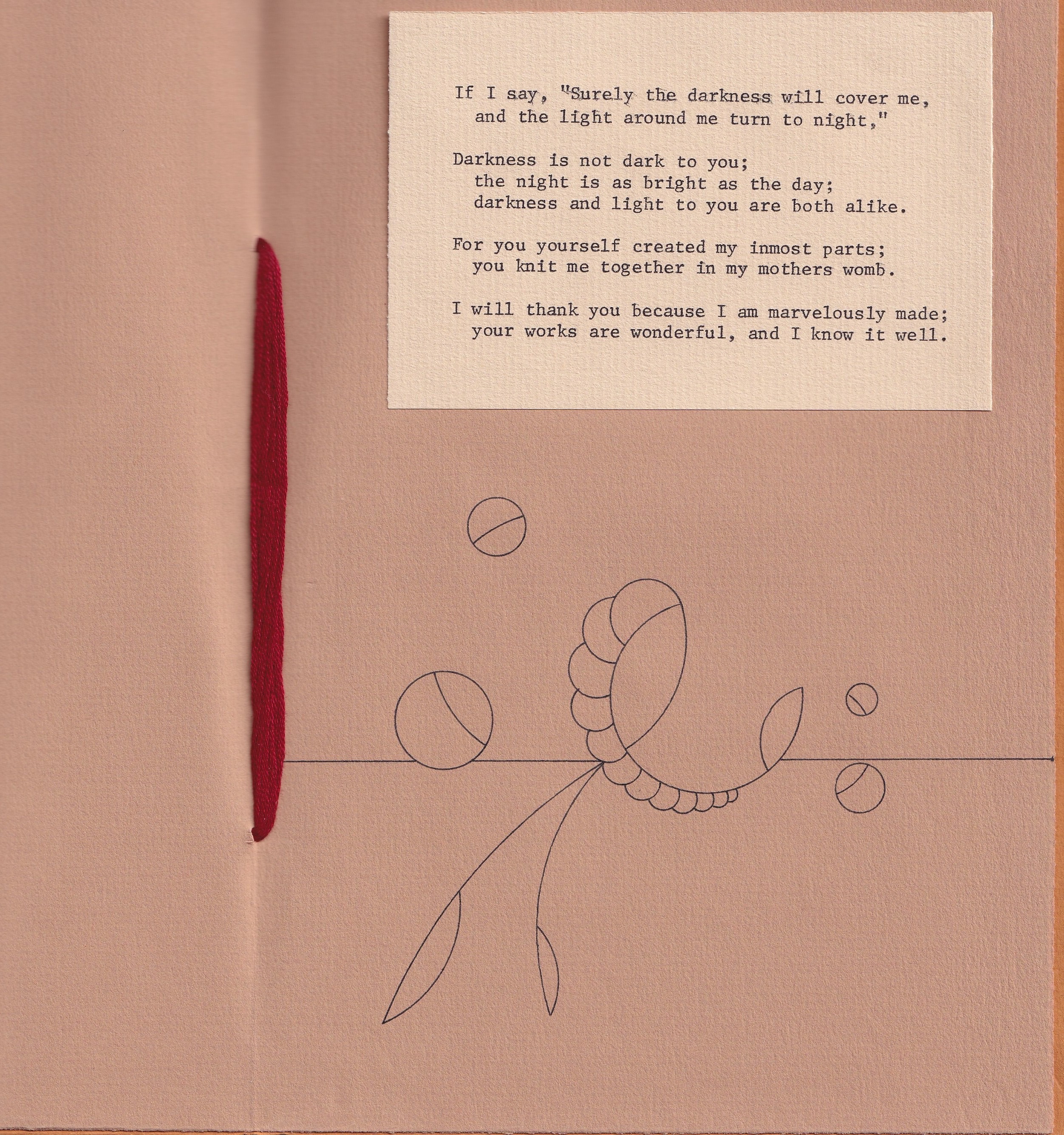
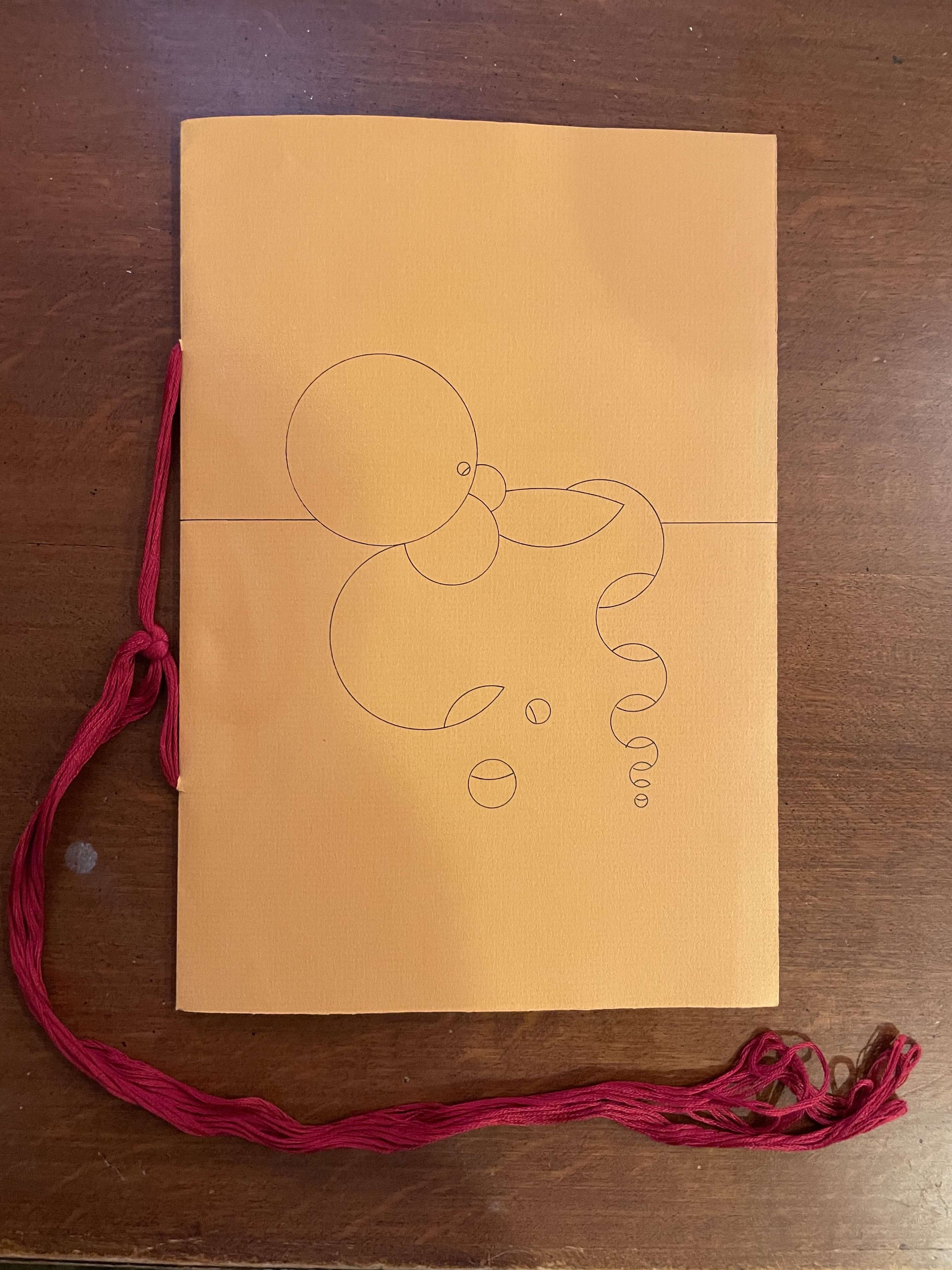
Just as I was strongly influenced by Wright’s architectural work when I aspired to follow him into the practice of his vocation, my design vision was just as impacted by his graphic work. In my case, this influence was not manifest in plans for such things as tapestries or windows, but in designs for paper products such as cards and stationary, and for handmade pamphlets. Among these were one featuring text from Psalm 139 (:1-17), and another text from the Song of Songs.

Above and below are some images of the little Psalm 139 pamphlet I created in the autumn of 1977 using a circle template, a rapidograph pen, an old-fashioned typewriter, and charcoal paper, along with a binding of stranded thread.


The above images are copyright, © Stephen Holmgren 2023. This post is based on a little pamphlet featuring Psalm 139:1-17, which I made while staying at the Pension Colorado in central Florence during the fall semester of 1977 while on a study abroad program through St Olaf College, in my sophomore year. I also acknowledge the probable influence of Alexander Calder’s mobiles.

Beauty in Parallel Revisited

golden_gate_bridge_pillar-smaller-copy

Perhaps the only thing more memorable than driving over the Golden Gate Bridge may be to pass under it on an ocean-going ship. I was lucky enough to have that experience five times before I was a teenager.

Many of us assume the name for this bridge is related to its warm color. But the name comes from the ocean straight over which it stands, and not from the Gold Rush. Rather than mimicking gold, the bridge’s official color—“International Orange”—was chosen to contrast with fog. A story is told about when that color was first applied. Painters dabbed splotches of it on the heads of curious seagulls. Pretty soon, Bay Area birdwatchers reported a new bird species, which was called the California Red-Headed seagull!

Until 1964, the Golden Gate Bridge had the longest main span in the world. Yet, its basic design isn’t unique. We know this from other suspension bridges, which are found all over the world. Bridges of this kind have two main towers, steadied in place by their suspension cables, which are anchored in the ground. From their anchor points, these substantial cables ascend to the top of the towers, and then gently descend again to the center of the bridge. From that low point, they again soar up, to the top of the opposite tower. The slightly arched roadway across is literally suspended from these main cables, by small support cables that hang from them. Here, in the beauty of this simple design, we find a helpful spiritual and liturgical metaphor.

Reflect for a moment about two significant Sundays in the church year. One is the last Sunday after Epiphany, or Transfiguration Sunday, which we observed 10 days ago. The other is Easter Day, which lies ahead. Transfiguration Sunday is the last Sunday before this season of Lent, and Easter Day is the first Sunday after Lent. Both Sundays are as important with regard to our identity as they are to that of Jesus. For in his Transfiguration and in his Resurrection, Jesus does not simply reveal who he really is. He also reveals the fulfillment of our vocation to be fully human, in him.

Imagine these two Sundays on the Church calendar as being like the two towers of the Golden Gate Bridge. Transfiguration Sunday, coming just before Lent, is like the south tower of the Golden Gate bridge, on the busy urban, San Francisco, side of the straight. And, Easter Sunday is like the north tower of that bridge, on the less familiar and historically rural side of that navigational channel. The season of Lent stretches between these two Sundays like the main span of that bridge, taking us from what we think we know to that which may yet to be disclosed to us.

Here is the crucial part ~ every year we need to make this liturgical crossing, from our sharing in the vision of the Transfiguration, to our participation in the joy of Easter Resurrection. And like the great towers of a suspension bridge, Transfiguration Sunday and Easter Sunday uphold us all the way across our Lenten journey over what sometimes may seem like dark, cold, and turbulent waters around us.


This posting is a revised version of a post I first published in 2017, and is based on my recent homily for the Last Sunday after the Epiphany, which explores the parallel between the revelation of glory that we see in the Transfiguration, and the glory we see in the Resurrection (click here for a link to it).

The Beauty of ‘Nothing’ (as we observe Ash Wednesday)

photos_ashes-05


This past Sunday, using the metaphor of the twin towers of a suspension bridge, I invited our local congregation to explore a pairing of two Sundays in the calendar, Transfiguration Sunday and Easter Sunday. These are the interrelated Sundays immediately before and after Lent. Ash Wednesday and the beginning of Lent present us with a similar opportunity. Here, we can explore the relationship between Ash Wednesday and Easter Sunday. With this second comparison between liturgical days, instead of noticing a parallel, we can observe an evident paradox.

On Easter Sunday, we face an unusual challenge. We must take the finding of an absence, and discern within it a presence. Something that was known, seen and touched, became as if it was nothing. And so, we are challenged to see how an empty tomb could at the same time be full of meaning. Even though Mary Magdalene and the disciples found nothing in the tomb, they came away with the conviction that something profound was there.

Consider, then, this remarkable contrast. In the metaphors at the heart of the Ash Wednesday liturgy, we observe inverse phenomena. What would Ash Wednesday be without ashes? Ashes constitute a biblical image with a long and vivid history. And our tactile liturgical use of this common material plays a central role in our services on the first day of Lent. Yet, this liturgical presence of ashes is meant to represent an absence. A dish full of ashes in my hand represents something larger, which is empty. Something (the sign of the cross) is marked with ash on parishioners’ foreheads, and it symbolizes the starkness of nothing, or, literally, no thing.

So, the Sunday of joyful resurrection presence provides the reverse of the Wednesday of regrettable absence. Though it wouldn’t sound as good, Ash Wednesday could instead be called, “Absence Wednesday,” “Empty Wednesday,” or “Nothing Wednesday.” This is because the ashes at the heart of the liturgy for this day symbolize an absence, an emptiness, or a ‘nothing.’ I don’t mean that the ashes are empty of meaning. It’s just that what they represent is literally nothing. Ashes represent nothing of value, nothing of worth. And that is what makes them special! We put ashes on our foreheads to remind us that, on our own and relying on ourselves, we are nothing of value, nothing of worth. No matter how hard we try, we don’t give meaning and value to ourselves. Only God does that.

Our lives can sometimes feel like they are full of “nothings,” as if all that we do only amounts to ashes or dust. All too quickly, we forget that dust and ashes are the building blocks of God’s creation of human beings. They are the building blocks of God’s Kingdom. When we think about something we have done, and are tempted to say, “O, it’s really nothing at all,” let’s remember what God can do with ‘nothing’.


This posting is a slightly altered republication of a post from March 2017. It is based on a homily for Ash Wednesday that I have frequently offered, the most recent text of which can be found by clicking here.

Witness of the Magi

[If reading this by email, please tap the title at the top to open your browser for the best experience.]

Peter Koenig, panel from his Christmas-Epiphany triptych


“When the wise men from the East … set out… there, ahead of them, went the star that they had seen at its rising, until it stopped over the place where the child was. When they saw that the star had stopped, they were overwhelmed with joy. On entering the house, they saw the child with Mary his mother; and they knelt down and paid him homage. Then, opening their treasure chests, they offered him gifts of gold, frankincense, and myrrh. And having been warned in a dream not to return to Herod, they left for their own country by another road (from Matthew 2:1-12, the Gospel for this day).”

Peter Koenig, in a painting I much admire in relation to this present season, not only presents the visit by and the adoration of the Magi, as well as their presentation of gifts. He also helps us discern how our celebration of Christmas and Epiphany anticipates our observance of Holy Week and Easter.

As we know from hymns and readings, the visitors from the East brought costly offerings, including gold, incense, and myrrh. This much is obvious from a first look at Koenig’s imagery. Much more subtle are additional features of his painting that should also attract our attention. Based on the imagery in Genesis 3, note the serpent under Mary’s foot. Note also how the Christ child is wrapped in what appears to be fabric prefiguring his eventual burial shrouds. Behind the figures in the painting, we see an anticipation of the empty tomb with its stone covering rolled away. And, in front it, we seen an image of the cross portrayed as also being the tree of life, bearing the vine from which will come the cup of salvation.

O God, by the leading of a star you manifested your only Son to the peoples of the earth: Lead us, who know you now by faith, to your presence, where we may see your glory face to face; through Jesus Christ our Lord, who lives and reigns with you and the Holy Spirit, one God, now and for ever. Amen. (from The Book of Common Prayer)

May our Lord, who was and is, and is to come, bless us and our loved ones during this holy time.

Joining Mary’s Joy

[If reading this by email, please tap the title at the top to open your browser for the best experience.]

El Creco, The Annunciation (1600)


With three prior Annunciation images I have pointed to some aspects of the Annunciation to Mary: fear at an unexpected encounter with the divine presence; surprise and wonder about such a greeting; and, the opportunity to accept the significance of God’s visitation. Today, I want to highlight a fourth aspect of Mary’s experience of the Annunciation, her response of joy at having said, “Yes.”

It is not hard for us to admire Mary and her willing response to God’s initiative, at first in her life, and then in and for ours. But how easy is it for us to identify with Mary’s joy, reflected in the words we know as the Magnificat, her song of praise, with regard to the promise of Jesus’ birth?

For many of us, these 12 Holy Days may be a time in which we challenge ourselves to feel as ‘joyful’ as we think we should be – or, perhaps, to criticize ourselves for failing to experience the same. But what is ‘joy?’ I have an icon that depicts St. Thomas Aquinas, wherein he holds a text on which is printed, “Joy is the noblest human act.”

Joy at this time, as always, is not just a spontaneous feeling prompted by fleeting circumstances. Joy is actually an act, a choice, and a willing participation in divine initiative. For the word joy is related to the verb rejoice. God says to us during these 12 Holy Days – as God always does – I am come unto you to bless you, to bring you new life, to transform everything you think you know, and in ways you have yet to imagine.

Until we get to ‘the other side,’ and can ask Mary, herself, none of us will know what she really imagined would be part of her acceptance of God’s strange and unanticipated plan of redemption for our fallen and troubled world. What we can be most thankful for is at least one implied word that was part of Mary’s response to God’s initiative. She said, yes. With her beautiful example, and so many compelling artistic representations of the same, isn’t it a wonder why we so often find it hard to respond as she did.

In this last of the 12 Days of Christmas, let us say “yes” to God with Mary. And then, starting with the feast of the Epiphany, tomorrow, may we live into the real joy of that “yes.” Her uplifted hand, in El Greco’s painting above, says it all.

May our Lord, who was and is, and is to come, bless us and our loved ones during this holy time.


Saying “Yes” to the Gift

[If reading this by email, please tap the title at the top to open your browser for the best experience.]


The spirit of attentive openness is at the heart of a third aspect of Mary’s response to God’s call through the Angel Gabriel. God’s call often challenges us to live in a different way or try and be a different person, especially in our relationships with our family, our friends, and those with whom we work. Receiving this call, we can react at first in fear at what this call might mean in practice. We can also respond with uncertainty, wondering about our worthiness or suitability for what God may have in mind for us.

But we can also see that — in faith — we are able to go into the heart of our fear and find God’s power. Receiving God’s grace, we may move beyond relying on our own strength, and not depend upon our estimate of our own abilities and worthiness for what God may have in mind. We can then choose to respond to God’s gracious invitation into the Spirit’s redeeming work, just as Mary did, by saying, “Yes!” As John Lennon so simply captured the spirit of it, in the words of his famous song, “Let it be.” Or, as Mary said to God through the angel, “Behold the handmaid of the Lord; let it be unto me according to thy Word.”

This is the spirit of Mary’s response to the message of the angel as portrayed in the fourth Annunciation image I am sharing with you in these 12 Days of Christmas, in Trygve Skogrand’s photo-collage, pictured above. The artist has skillfully juxtaposed a traditional painted figure onto a contemporary scene. We see a simplicity and spirit of humility in Mary’s posture, as she kneels in her plain gown. In the plain ‘bed-sit’ room in which she prays, we notice her uplifted eyes. They are now focused on the divine source of the message she is receiving.

Attentiveness is key to meaningful perception, just as we found recently in the Gospel reading for the third Sunday in Advent. John the Baptizer sends his disciples to Jesus with what should be our most persistent question, “Are you the One?” Are you the One for whom we are looking, and whom we are awaiting? Notice Jesus’ response: “Go and tell John what you hear and see…” For they only hear and see if they are attentive. This is one reason why the Church commends to us the season of Advent, in addition to Christmas ~ to encourage our attentiveness, so that we can hear and see, and then accept God’s Word to us.

“Let it be as God would have it.” Let things be as God wills. Let God be God! Perhaps nothing is so hard in our lives as to say those words in faith and in humility. Our pride objects! Our desire to be at the center of reality intrudes. But to say, “Let it be…,” in faith and in humility, is to return to the Garden of Creation Grace. And it is also to begin to live forward into the fullness of the Kingdom, as God would have things be, and as God will have things be..

May our Lord, who was and is, and is to come, bless us and our loved ones during this holy time.


The image above is a detail of Trygve Skogrand’s photo-collage, Bedsit Annunciation (an image I have shared before). This post is adapted from a prior post based on my homily for the Third Sunday of Advent, December 15, 2019, which can be accessed by clicking here. The Revised Common Lectionary, which provides the readings for Sundays and other Holy Days, can be accessed by clicking here.