Theological Reflection

The Beauty of Asking “Why?”

If reading this by email, please tap the title at the top to open your browser for the best experience. Then, clicking individual pictures will reveal higher resolution images.

Back cover photo from Natural Sustenance: Selected Poems, by Nick Fleck


“Why?” It all started in a seemingly innocuous way. “What do you want from this course,” he asked. A brave one among us ventured the answer that some of us were thinking, but were not honest enough to say: “an ‘A’.” Our English teacher, Nick Fleck, responded to my classmate in a neutral way, with a further question, “Why?” Our fellow aspirant to higher grades began to offer pretty typical answers, unoriginal and unsurprising. “I want a high GPA. (Why?)… I want to get into a good college. (Why?)… I want to get into a ranked law school. (Why?)… I want a good job at a high powered law firm. (Why?)…”

Gradually the pauses before our classmate’s answers became longer. And while his responses still sounded plausible, they seemed less and less assured. That first class session set the tone for the rest of term, as over time Nick prodded all of us to articulate answers to questions like these. And nudged us toward answers that were more and more our own, and less dependent on our peers, our parents’ expectations, and our perceptions of the uncertain world outside our rural New England prep school.

Why? The question at first provides an invitation to share acquired knowledge, display settled opinions, and voice aspirations. But the question can also be unsettling, especially when we begin to run out of platitudes and ‘safe’ answers that don’t require self examination or being open to adopt a different perspective.

I can’t fully explain why, out of a class of some 350 or so fellow graduates, I was one of only 3 or 4 who did not go directly on to college. But Nick Fleck’s persistence in challenging us to think for ourselves played a big part in it. Temperamentally, I was and am a self-learner, which disposed me toward pursuing that risky path (“…in a blind career…,” as in a line from a poem Nick had us read). Naive self-confidence also bolstered my willingness to undertake a journey on what appeared to be a largely untested road. I wanted to be an architect and to make art, and those whom I most admired had embarked upon their careers in earlier times by this same route through apprenticeship and self-study.

Having been so consistently asked why, I made the question my own and began asking it in a self-referential way. Why did I want so strongly to embrace and try to create what was beautiful? Why was this important to me… and to others apparently walking the same path? Why was I then beginning to wonder whether this was good and, if so, to what end? And why then was I going on to ponder what was good for its own sake as compared to things of passing significance?

Within a year, after living in New York City seeking non-existent apprentice drafting positions during the ‘oil crisis,’ I returned hesitantly to formal schooling. My college art studies were interrupted by another sideline, driving a forklift in a warehouse freezer for six months as a Teamster. Then, surely to my parents’ relief, asking why led me on a more traditional path, from art history to classics and medieval studies, during which I experienced an unanticipated spiritual conversion. All the while I was living with the same question: why?

Nick Fleck was not a religious man in any sense that I could discern, though he was clearly attuned to the ethical principles exemplified in Thoreau’s writing, and latent in poems he would have us read. I think it greatly surprised him when, returning for our 25th reunion, I gave him credit for setting me on the path that led to my conversion, ordination, theological studies, seminary teaching, and parochial work – experiences not readily familiar to him. But he was the one who persistently asked why, and who invited us to own the question for ourselves.

This week I realize that Nick’s great question was at the heart of the Disciples’ questions when Jesus predicted his forthcoming suffering and death. Nick’s question is simple, and perfect for Lenten reflection.


I was happy to see an article in the Greenfield Recorder noting how Nick Fleck had founded the Northfield (Mass.) Bird Club and was still active in leading bird walks. I trust that he continues to write and share his poetry, and help open new worlds to young persons. He helped us to discover the power latent in the word, “why,” especially when posed as a question.

The recent movie, The Holdovers, was partly filmed at my school, Northfield Mt. Hermon, and is set in exactly the time period I was there. During those years, I was in the chapel depicted within the movie a couple of times each week for required assembly gatherings. Seeing my school again during my 50th graduation anniversary year has obviously brought back memories.

A recent gathering in Northfield Mt. Hermon’s Memorial Chapel.


Note: blog settings have been changed to provide more opportunity to offer comments, using the link below.

Rousseau and Wilderness: Redemption in Nature?

If reading this by email, please tap the title at the top to open your browser for the best experience. Then, clicking individual pictures will reveal higher resolution images.

Henri Rousseau, The Dream (detail), 1910


What does it mean for God’s grace to be present in nature? Or God’s mission of Redemption to be at work in what Christians view as a fallen Creation? The Gospel for this coming Sunday, with Jesus tempted in the wilderness, might prompt us to think about such things. An unexpected way to do this is to juxtapose Mark’s surprisingly brief ‘temptation narrative’ with Rousseau’s jungle-like images of a state of nature.

How shall we understand Mark’s account of Jesus’ being tested in an inhospitable place? And how does Rousseau conceive of the natural state of what Christians think of as Creation? A painting by Rousseau helps set the scene:

The Sleeping Gypsy, 1907

In light of it, we can consider the two verses that Mark devotes to Jesus’ temptation:

The Spirit immediately drove him out into the wilderness. And he was in the wilderness forty days, being tempted by Satan. And he was with the wild animals, and the angels were ministering to him.

Only two verses are accorded by Mark to this rather pivotal event, to which Matthew devotes 11, and to which Luke gives 12. The way that Matthew and Luke refer to the wilderness of the temptation suggests that it is a hostile context for Jesus’ encounter with the Tempter. In both of these longer Gospel texts, three principal temptations are identified, which occur following Jesus’ forty days of fasting. The three were: to feed himself, to become a wonder-worker, and to receive the adulation of the world’s kingdoms. Matthew adds that Jesus received the ministration of angels following – rather than during – his period of trial.

Whereas Matthew and Luke present the wilderness as an unpromising environment for Jesus’ challenging encounter with his adversary, Mark’s spare account of the event and its setting allows for a rather different reading. We can pose the matter in the form of two questions shaped by Matthew and Luke’s narratives.

Does Mark present the wilderness temptation of Jesus as being in a difficult place due to the presence of the Tempter and because it is filled with prowling and potentially dangerous wild beasts?

Man Attacked by a Jaguar, 1910

Or, does Jesus’ desert encounter in Mark represent not so much the threatening last gasps of a rebellious and dying world, but the first breaths of a life-giving new one, just now coming to be?

The Waterfall, 1910

Rousseau’s painting of the sleeping woman and the nearby lion, above, provides an image of harmonious coexistence in a place shared by a human being and the proverbial king of beasts (an ‘alpha predator’). In other words, Rousseau – in some of his paintings – portrays an ideal image of the original state of nature, the biblical Eden, before nature became ‘red in tooth and claw.’

A Woman Walking in an Exotic Forest, 1905

If so, then Mark’s statements that Jesus “was with the wild animals,” and also that “the angels were ministering to him,” may reflect what Christians have come to think of as ‘the peaceable Kingdom’ and ‘the New Creation.’ Which then suggests that – in Mark – the wilderness was good place despite the presence of the Tempter.

I am drawn to how Rousseau depicts the natural beauty of what we often describe as ‘wild nature,’ portraying it in both inviting and in cautionary ways. He paints it as a context of harmonious interrelation between human beings and animals in a shared environment. He also paints it as being a context where animals are a threat to one another and to humankind. Rousseau’s painting of Eve hints at both possibilities, where she is charmed by the serpent:

Eve, 1907

In the painting below, which complements his image above, another ‘Eve’ charms the serpent. Rousseau fills the beautiful canvas with a limited color palette, largely green, expressing the same dimension of ambiguity. A woman plays a flute while a serpent is draped upon her shoulders and others hang from the trees or rise up from the ground:

The Snake Charmer (detail), 1907

Looking at Rousseau’s many jungle-like ‘exotic landscapes,’ one notices the evocative presence of mystery. The viewer does not immediately know what lurks in the shadows, beneath and behind dense and dark foliage, in scenes often featuring bright flowers or fruit in the foreground. And upon discerning animals and also humans among all the growing things in the thicket between the trees, we can’t be sure whether what we encounter is friend or foe.

Jaguar Attacking a Horse, 1910

Exotic Landscape, 1910

In these and other scenes, Rousseau portrays an invitingly beautiful world, but one that is not without the possibility of misadventure and harm. I may not want to live in some of these scenes. But I find joy living with their beauty. For they help me appreciate a new way of reading and thinking about Mark’s brief account of Jesus’ temptation ‘in the wilderness.’ Jesus possibly could have repeated the great mistake made by Adam in the old Eden. But in not doing so, ’the second Adam’ became the door to a new Eden, and our ‘ark’ to the New Creation.


Note: blog settings have been changed to provide more opportunity to offer comments, using the link below.

Finding Beauty in Remembering

If reading this by email, please tap the title at the top to open your browser for the best experience. Then, clicking individual pictures will reveal higher resolution images.

The grave of Hamilton Sawyer, U.S.C.T. (a Civil War casualty)


I found an unanticipated beauty in a wintry place a short drive from my home. Port Hudson National Cemetery is easy to overlook, though one of many created by the Federal government during the Civil War to provide for proper burial of the Union dead. It helps us remember those who lost their lives during a prolonged siege along the Mississippi River in 1863.

Among several thousand headstones, some include the initials, U.S.C.T. Wondering about them, I discovered they signify membership in a former United States Colored Troops regiment. Hamilton Sawyer (died 2 Feb 1864), and Samuel Daniels (died 19 Jan 1864), were two of many young men about whom history seems to have preserved only these bare facts. And yet, as a nation we remember them. Away from home and family at the time of their deaths, they surrendered their lives to help secure freedoms already declared, yet far from actualized in the lives of so many. Obviously, no contemporary visitor to the cemetery could have known either of these men. But we can – if we choose to – remember their names, and for what they died. The beauty of remembering lies in how we make present what we value.

Not everyone appreciates the beauty we find in a National Cemetery. Though these burial grounds were created and are maintained to honor those who have served in our nation’s military, these settings do not celebrate armed conflict. Instead, they venerate the commitment of many fellow Americans to serve our country and its founding principles, and commemorate their willingness to put the interests of the wider community before those of self. Most of us can recognize this commitment and willingness, even if we are not all moved to prioritize these things among our choices.

Praiseworthy themes often characterize eulogies offered at funerals. On such occasions, people usually identify and highlight the admirable traits of those who have died, whose lives we seek to honor through acts of remembrance. When done well, eulogies provide portraits of people’s lives conveying an appreciation for ways that certain moral principles and spiritual values have been lived out by them. These occasions would be drab and shallow if they merely recalled how a person consistently obeyed civil laws or always observed proper manners and social etiquette. By contrast, we touch upon beauty as we seek to remember people when they were at their best. For as Irenaeus put it, “The glory of God is the human person fully alive.” This is how we desire to be remembered.

Because of this holy desire, we choose patterns for Christian burial that anchor our remembrance of persons in the body of Christ, in the Eucharistic context of God’s redemptive work. Eucharistic remembering is both holy and thankful remembering. As such, we include an appropriate Gospel reading, and offer reflection upon it. Making connections between enduring Gospel truths and how they have become actual in the dear but transitory aspects of a deceased person’s life, is most fitting. For the sake of those gathered, the focus of a funeral homily will then best be upon what the Resurrection of our Lord has made real for all people.

To honor someone in this liturgical way upon his or her death is genuine remembering, and reflects our natural and common desire to respect a person’s unique memory. In the proverbial Anglican “both-and” way, we can keep a focus on the Resurrection, as we also express our regard for the deceased. We do this by centering our liturgical observance upon the Gospel, while focusing our intentional gathering before and after the funeral liturgy upon the person being remembered. For these different but interrelated aspects of the day belong together.

Here is something else to notice. There is a discernible symmetry between the way different baptismal candidates wear similar white robes, the way that variously styled caskets are covered at separate events by the same pall, and the way our burial liturgies – sacred and secular – ‘clothe’ our departed with the same words, on occasion after occasion. We find a pattern similar to these examples at our National Cemeteries, in how formerly high ranking officers and the lowest ranking enlisted men and women all have essentially the same headstones. In life and in death, we are – in the end – all one. Remembering the people whom the stones commemorate, even those we did not know, makes bigger our appreciation for the beauty of God’s world, and our own place within it.

To remember, and be remembered, can be holy acts. In remembering – even with regret-tinged memories – we reflect our desire for things to become whole, and brought to their fulfillment by God.


Historical note regarding Port Hudson:

From the above information plaque: “In May 1963, Union Gen. Nathaniel Banks landed 30,000 soldiers at Bayou Sara north of Port Hudson {at St. Francisville}. A force of 7,500 men commanded by Confederate Gen. Franklin Gardner held the Mississippi River stronghold. General Banks’ May 27 assault on Port Hudson failed and nearly 2,000 soldiers died. Among them were 600 men from two black regiments–the 1st and 3rd Louisiana Native Guards.* The Port Hudson engagement was among the first opportunities for black soldiers to fight in the Civil War. Their determination proved to the North that they could and would ably serve the Union Cause.”

“Among those buried {at Port Hudson} are 256 men who served in the United States Colored Troops (USCT).”

*Additional note from an informative Wikipedia article: “The 1st Louisiana Native Guard was one of the first all-black regiments in the Union Army. Based in New Orleans, Louisiana, it played a prominent role in the Siege of Port Hudson. Its members included a minority of free men of color from New Orleans; most were African-American former slaves who had escaped to join the Union cause and gain freedom.”

Port Hudson National Cemetery on a summer day

Note: blog settings have been changed to provide more opportunity to offer comments, using the link below.
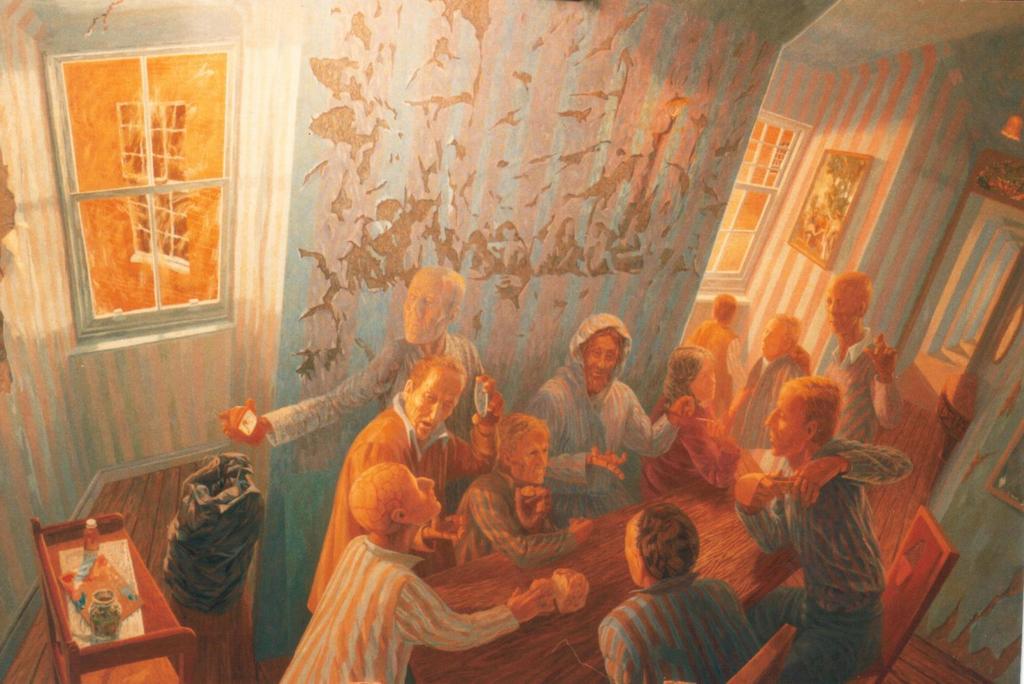
Celebrating the 12 Days

Brother Martin Erspamer, OSB


Having driven through my neighborhood yesterday and seeing two Christmas trees already put out onto the road edge, I am once again mindful of how the traditional Church calendar observes the Feast of the Incarnation of our Lord, or Christmas, for a full 12 days. I am therefore especially appreciative of the above image by Brother Martin Erspamer.

Martin Erspamer is a member of the Benedictine community at St. Meinrad’s Abbey in Indiana. His evocative black and white prints, sometimes referred to as ‘clip art,’ have been widely used on worship bulletins and in Sunday school materials.

The popularity of his images, and their widespread use in media such as Sunday bulletins, should not lead us to devalue the beauty of his handiwork, which evidences a studied sensitivity to medieval imagery as much as it does to the possession of a modern graphic artist’s temperament.

I especially like his image of Abram counting the stars, based on Genesis 15 (below). The image and its theme arises from God’s challenge to Abram to go out into the dark of the night and count the stars in the heavens – if he can. For one of God’s promises is that, while Abram is despairing of being without an heir, he will eventually have as many descendants as he can count the stars in the night sky.

Genesis presents three covenants between God and Abram, in chapters 12, 15, and 17, each of which is relevant to our celebration of these 12 Days of Christmas. In various ways, God promises Abram many descendants, a new land for him and those that would follow, and that through him a blessing would come to all the people of the world. This third promise, fulfilled for us in the child born in Bethlehem, is the most relevant to our observance of this holy time of the year.

From Psalm 147:

1 Hallelujah! How good it is to sing praises to our God! * how pleasant it is to honor him with praise!

2 The LORD rebuilds Jerusalem; * he gathers the exiles of Israel.

3 He heals the brokenhearted * and binds up their wounds.

4 He counts the number of the stars * and calls them all by their names.

5 Great is our LORD and mighty in power; * there is no limit to his wisdom.

6 The LORD lifts up the lowly, * but casts the wicked to the ground.


For those able to visit the Abbey, St. Meinrad’s has an exhibit of art by Brother Erspamer in the Archabbey Library Gallery until January 15:

The Beauty of His Continuing Presence


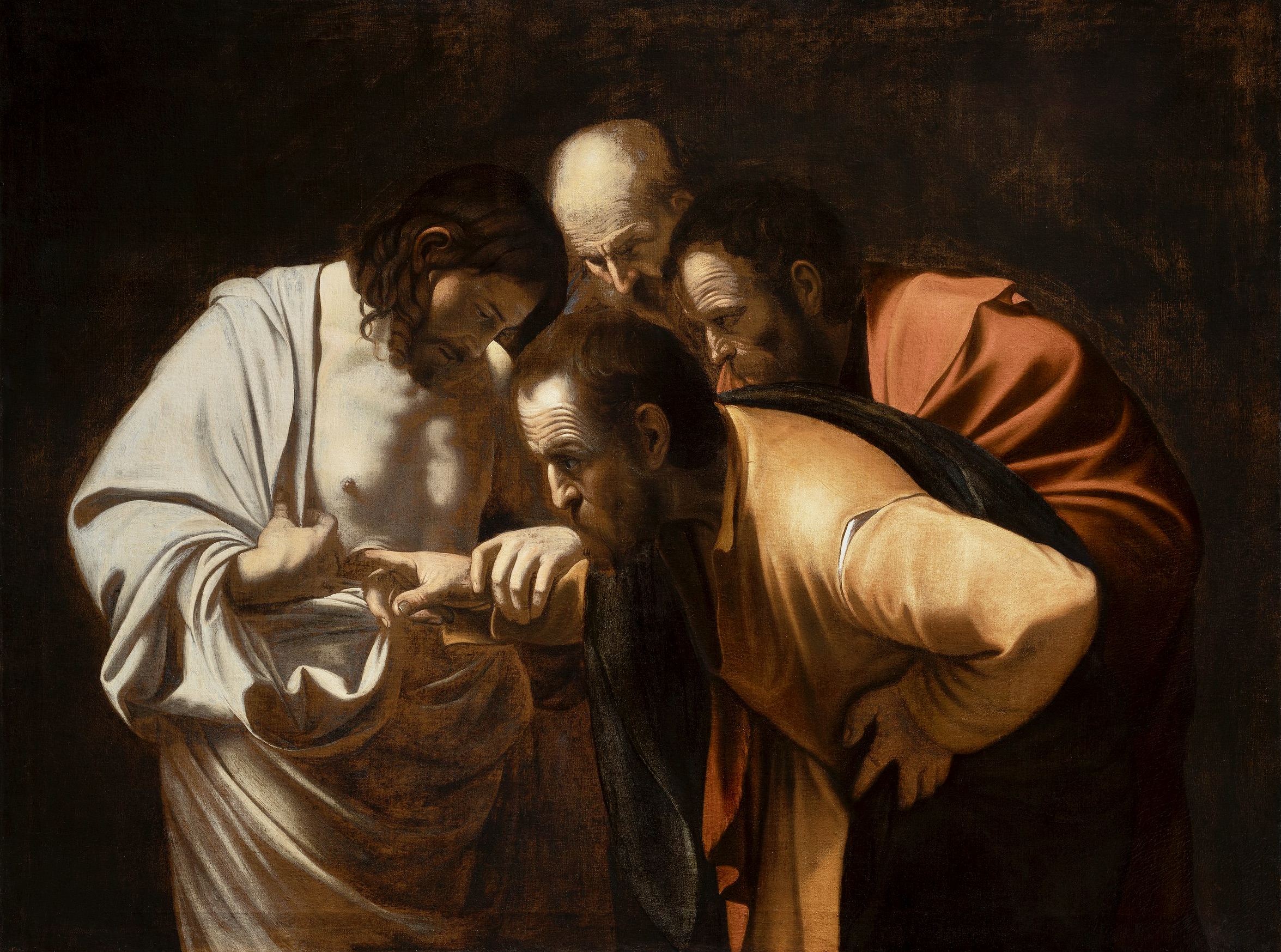
The most well-known painting of ‘Doubting’ Thomas and his encounter with the Risen Jesus may be the one by Caravaggio. And yet, paintings like his are misleading, as is referring to Thomas as ‘the doubter.’ Why? Because paintings and labels like these lead us to overlook or misperceive some very important details within John’s Gospel story. Rembrandt’s painting of the event (above) helps us notice the difference.

As John tells it, we first find ten of the disciples hiding behind locked doors out of fear. Consider how, during Jesus’ ministry with them, he had more than once told them to fear not. And at the Last Supper, he had given them ‘his peace.’ Yet, rather than remember what Jesus had shared with them, as well as his miracles, all of them have succumbed to fear. Even though Mary Magdalene that morning had already told them that she had seen the Lord. How can these details be squared with any other description than that the ten behind locked doors are doubting, as well?

Second, observe how John’s Gospel describes Jesus’ initial appearance to the ten, when he finds them fearful and doubting. At first, they do not recognize him. It is only after Jesus shows them his hands and his side that they then recognize him, and rejoice at his presence. When they see him, then they believe, and not before. So, once again, Jesus leaves them with his peace. And now, he gives them his Spirit.

Notice what the ten say to Thomas when he then arrives: “We have seen the Lord” ~ the very same witness Mary had earlier offered to them without having had much effect. Thomas naturally replies by saying something like this: ‘Look, I haven’t see him, like you guys just did— and so, just like you, I won’t be able to believe until I see him, either.” Thomas’ statement to them therefore does not need to be heard as him setting the conditions for his belief. It may simply be a practical prediction of fact.

We need to be equally perceptive about John’s description of Jesus’ later visit to that same locked room. It is a week later when Jesus returns to the eleven, among whom Thomas is present. It is vital to notice what Jesus says to Thomas. It’s even more important to observe how John describes Thomas’ response. Jesus invites Thomas to touch him and to believe. But the Gospel does not say that Thomas has any physical contact with Jesus. It does not tell us that he reaches out, or that he makes an effort to touch Jesus. Instead, and just as Jesus gives him credit for doing, he sees, and then he believes. Just like the prior experience of the other ten!

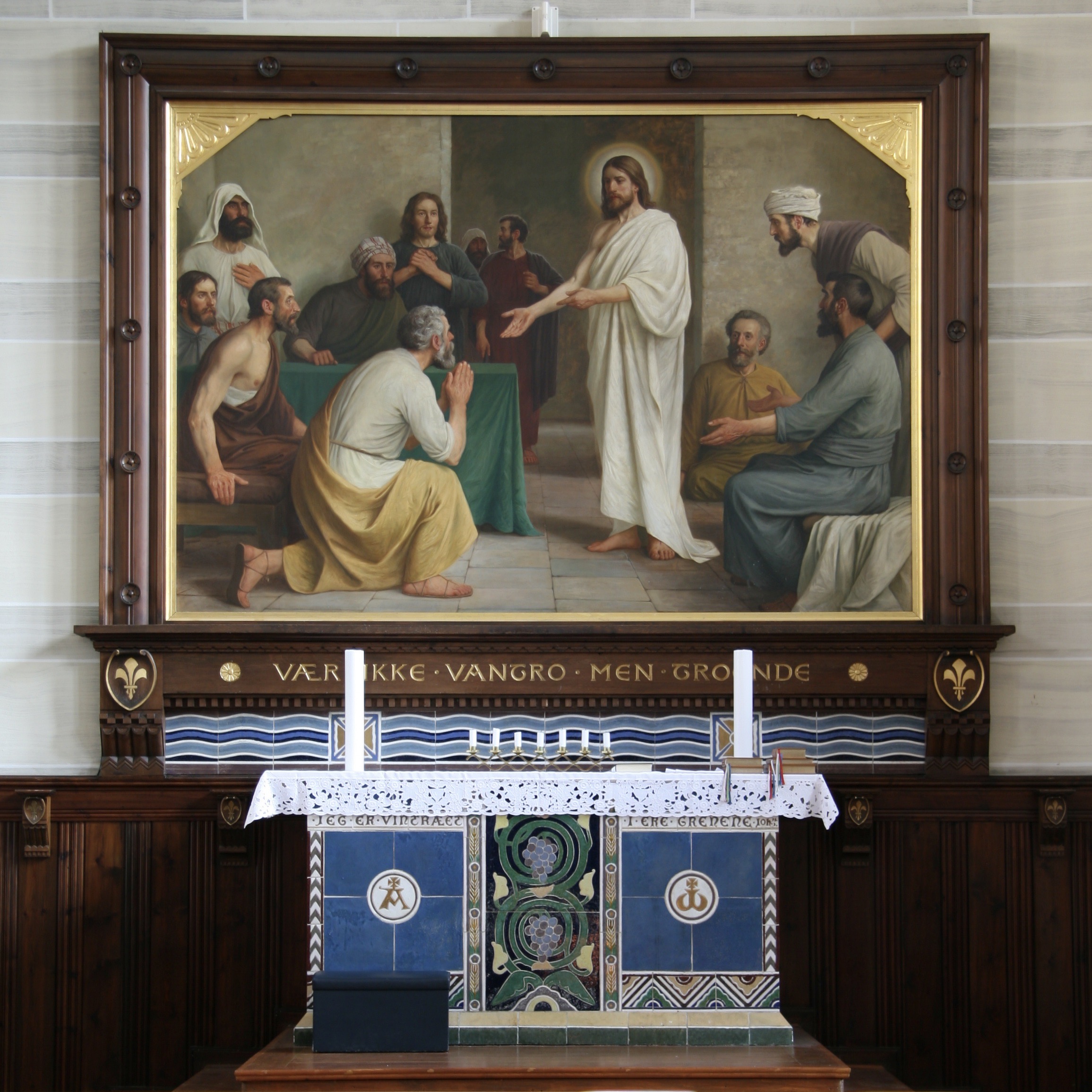
Rembrandt’s image, like the painting by Carl Bloch, is faithful both to what John tells us, and to what he does not. Observing this, we should refer to this story in John’s Gospel in a different way ~ ‘the doubting disciples, and how they all came to believe.’


The above image is of Rembrandt’s (I think mis-titled) painting, The Incredulity of Saint Thomas. This post is based on my homily for Easter 2, April 28, 2019, which can be accessed by clicking here.  Other homilies of mine may be accessed by clicking here. The Revised Common Lectionary, which specifies the readings for Sundays and other Holy Days, can be accessed by clicking here.

Beauty in Parallel

golden_gate_bridge_pillar-smaller-copy

Perhaps the only thing more memorable than driving over the Golden Gate Bridge may be to pass under it on an ocean-going ship. I was lucky enough to have that experience five times before I was a teenager.

Many of us assume the name for this bridge is related to its warm color. But the name comes from the ocean straight over which it stands, though it does not derive from the Gold Rush. Rather than mimicking gold, the bridge’s official color—“International Orange”—was chosen to contrast with fog. A story is told about when that color was first applied. Painters dabbed splotches of it on the heads of curious seagulls. Pretty soon, Bay Area birdwatchers reported a new bird species, which was called the California Red-Headed seagull!

Until 1964, the Golden Gate Bridge had the longest main span in the world. Yet, its basic design isn’t unique. We know this from other suspension bridges, which are found all over the world. Bridges of this kind have two main towers, steadied in place by their suspension cables, which are anchored in the ground. From their anchor points, these substantial cables ascend to the top of the towers, and then gently descend again to the center of the bridge. From that low point, they again soar up, to the top of the opposite tower. The slightly arched roadway across is literally suspended from these main cables, by small support cables that hang from them. Here, in the beauty of this simple design, we find a helpful spiritual and liturgical metaphor.

Reflect for a moment about two significant Sundays in the church year. One is the last Sunday after Epiphany, or Transfiguration Sunday, and the other is Easter Day. Transfiguration Sunday is the last Sunday before Lent, and Easter Day is the first Sunday after Lent. Imagine these two Sundays on the Church calendar as being like the two towers of the Golden Gate Bridge. Transfiguration Sunday, coming just before Lent, is like the south tower of the Golden Gate bridge, on the urban, San Francisco, side of the straight. And, Easter Sunday is like the north tower of that bridge, on the less familiar and historically rural side of that navigational channel. The season of Lent stretches between these two Sundays like the main span of a bridge. Here is the crucial part ~ every year we need to make this liturgical crossing. And, like the great towers of a bridge, Transfiguration Sunday and Easter Sunday uphold us all the way across our Lenten journey.


This posting is based on my homily for the Last Sunday after the Epiphany, which explores the parallel between the revelation of glory that we see in the Transfiguration, and the glory we see in the Resurrection (click here for a link to it).

The Beauty of His Community

Art_James He Qi_The Doubt of St.Thomas_large


I love how artists help us read and hear Scripture in new ways. Occasionally, they help us perceive aspects of biblical texts for the first time. Paradoxically, in one case artworks have nurtured a mis-hearing of the Gospel. For all the paintings of Thomas that I know refer to him as having doubt, and portray the resolve of that doubt as coming from his touching the side or hands of the risen Jesus. But look closely at John’s Gospel. In his visit to the room where the disciples have been hiding, the risen Jesus does not directly attribute ‘doubt’ to Thomas. Instead, and perhaps with his prior visit to the other disciples in mind, he merely tells Thomas not to doubt. Nor does John describe Thomas as taking up Jesus’ invitation to touch him. Jesus credits Thomas for believing after seeing him, rather than after touching him. He then encourages the kind of belief that does not rest upon seeing.

Notice how the other ten disciples are hiding in fear, rather than joyfully confident, when Jesus comes to where they have locked themselves in. They are described as rejoicing only after Jesus shows them his hands and his side. In other words, Thomas is not unique and different from the other disciples, and benefits from exactly the same experience that transformed them from people fearfully hiding into those who are rejoicing. Their joyful confidence is reflected in their words to Thomas when he later arrives. They say, “We have seen the Lord.” Their joy is the direct result of seeing Jesus’ hands and side, the very things Thomas says will be key to his own believing. So, the ten did not believe until they saw; and Thomas will not believe until he sees. What they received, he, too, will receive. As will we, who—like Thomas—were not initially in that room. The history of art obscures this important point.

Here are two safe things we can say and accept as true. The risen Lord continues to disclose himself with signs. And, the Lord reveals himself in community, and always for the sake of his community. For his community is fellowship within the new covenant of reconciliation. As John writes in his first Epistle, “We declare to you what we have seen and heard so that you also may have fellowship with us.” Fellowship with this community, is fellowship in and with the Risen Lord.


James He Qi, The Doubt of St. Thomas (He Qi © 2014 All Rights Reserved); used with permission. I think of it as portraying the community faith of Thomas. See John 20:19-31, and 1 John 1:1-2:2. Click here for a link to my Sunday homily, which explores the impact of the resurrection upon the disciples.

A Strange Beauty

Stanley_Spencer_the_crucifixion_1958


An encounter with true beauty can be troubling, especially if we have settled for so much less. It may be our sensitivity to the juxtaposition of opposites, and their apparent lack of resolve. At times we hope for the triumph of good over evil, that beauty will overcome darkness, and serenity displace antagonism. But we cannot find it within ourselves to do more than hope. We cannot achieve the redemptive resolution for which we haltingly reach out our hands and hearts.

It is not an accident that the figure of Jesus recedes into the background of this painting, while those who oppose and crucify him grab our visual interest. Stanley Spencer, who adopted what he called a neo-primitive style, was far too gifted a colorist, and master of light and dark, to let that happen unawares. As Spencer has rendered him, Jesus’ skin tone and color match the wood of the cross, and also the clothing of the man with the hammer swung over his head, as well as much of the sky and of the ground below… including the tunic of Mary Magdalene, prostrate on the ground. This forms a compelling visual symbol of his Jesus’ total identification with us in his incarnation, and his complete joining with us, and with our world of tearing hurts and suffering.

In fact, it is precisely because —in Spencer’s composition and coloring— Jesus could blend in so well with the background of everyday life, that those who opposed him could literally gain the upper hand, with hammers and nails. But this is only the marvel of the incarnation of our God in Jesus, that the fullness of divinity could be so thoroughly joined to the incompleteness of humanity. As the Gospels attest, it was a joining so thorough that many did not notice or have regard for his divinity. When we do notice that thorough joining, when we come face to face with the truths it represents, we have either one or the other of two reactions. When we get close enough to see —to really see him— there are only two responses. We throw ourselves down in humility before him. Or, we seek to throw him down, to humble him before us.

These paradoxes are brought to their greatest prominence when, as he predicted, he is lifted up. His lifting up is his glorification, and the glorification of God within him. Yet his lifting up is on a cross, and in the agony of a humiliating public execution. Here we see a ‘strange beauty’ — the strange beauty of the Lord — a beauty for which museums better prepare us than do our malls. Let us “behold the fair beauty of the Lord, and seek him in his temple.” We will find him! We will find him in the “temple” he promised to raise in three days.


The painting above is The Crucifixion, 1958, by Stanley Spencer. This reflection is based on my homily for Good Friday, which also makes reference to Charles Wesley’s text, “Lo! He comes, with clouds descending.” Click here for a link to this homily.

Toward a “Catholic” Vision [part 2]

EucharistAtStGregoryOfNyssa_med


In part 1, I shared how Ralph McMichael offers this brief but evocative definition of the word “catholic.”

Catholic means the whole truth, about the whole God, for the whole world.

Ralph’s concise definition calls for intentional follow-through. When we hear ‘catholic’ in conversation, we should anticipate and hope for an encompassing understanding of this word. This can be a first step in helping us to aim at a holistic (and therefore holy) vision of the world.

The challenge I find in Ralph’s definition is for all of us who are baptized to be “catholic” in a genuinely biblical, apostolic and ecclesial way. This means seeking and finding wholeness and holiness within the vocation we have received together in Baptism.

Embracing a larger concept of what it means to have a catholic vision opens us to
a more expansive vision of God’s Mission throughout the world. Jesus has embraced and empowered all of us to go out as grace-enabled participants in God’s continuing mission to redeem and transform the world.

We desire ‘wholeness.’ Encouraged by the culture around us, we think of achieving wholeness as our project, as our task to fulfill, or the solution to our therapeutic needs. Approached in a more encompassing way, wholeness is reconnected with God’s Mission in the world, rather than reduced to being a feature of our personal lives. God nurtures this greater wholeness through our life in community. We express God’s Mission best when we celebrate the Eucharist together.

God’s Mission is always greater than we can ask or imagine. It is not just for us, for our families and friends. God’s Mission enables us to live into the whole truth about the whole God for the whole world. As we live forward, into this wider vision, we will find that it involves beauty and goodness, as well as our perennial concern for what is true.

On this, his feast day, we can join St. Richard of Chichester (d. 1253) in his prayer, “Day by day, dear Lord, of thee three things I pray: to see thee more clearly, love thee more dearly, [and] follow thee more nearly, day by day.”


{St. Richard’s words are quoted from Hymn 654, The Hymnal 1982 / the photo above, from a Eucharist at St. Gregory of Nyssa, San Francisco, is by Mark Pritchard, (c) Attribution-NonCommercial-ShareAlike License}

Toward a “Catholic” Vision [part 1]

OLYMPUS DIGITAL CAMERA


In an earlier age, having catholic tastes or a catholic perspective meant breadth in one’s approach to the world and to objects of interest within it. A “catholic” vision would therefore be expressed in terms of what it includes rather than what it does not.

We live in an age when words and ideas are prone to partisan and ideological interpretation. Too easily, we settle for narrow and limited meaning. When we now hear the word “catholic,” we assume the reference is to an institutional branch of Christianity. Though we find the word “catholic” in the universally accepted Apostles’ Creed, we allow lesser concerns to shape our concept of what it means for the Church to be catholic.

My friend and former teaching colleague, Ralph McMichael, offers this brief but evocative definition of the word:

Catholic means the whole truth, about the whole God, for the whole world.

His definition may help us reclaim the word, so that even ‘free church’ believers might be comfortable using it. Catholic has to do with the whole, with what is universal.

A catholic vision will include all that is beautiful and all that is good, as well as all that is true. Arguably, anything less falls short of being catholic.

I am continually challenged not to settle for less than this encompassing and holistic vision.