Painting

The Beauty of Audubon’s Birds


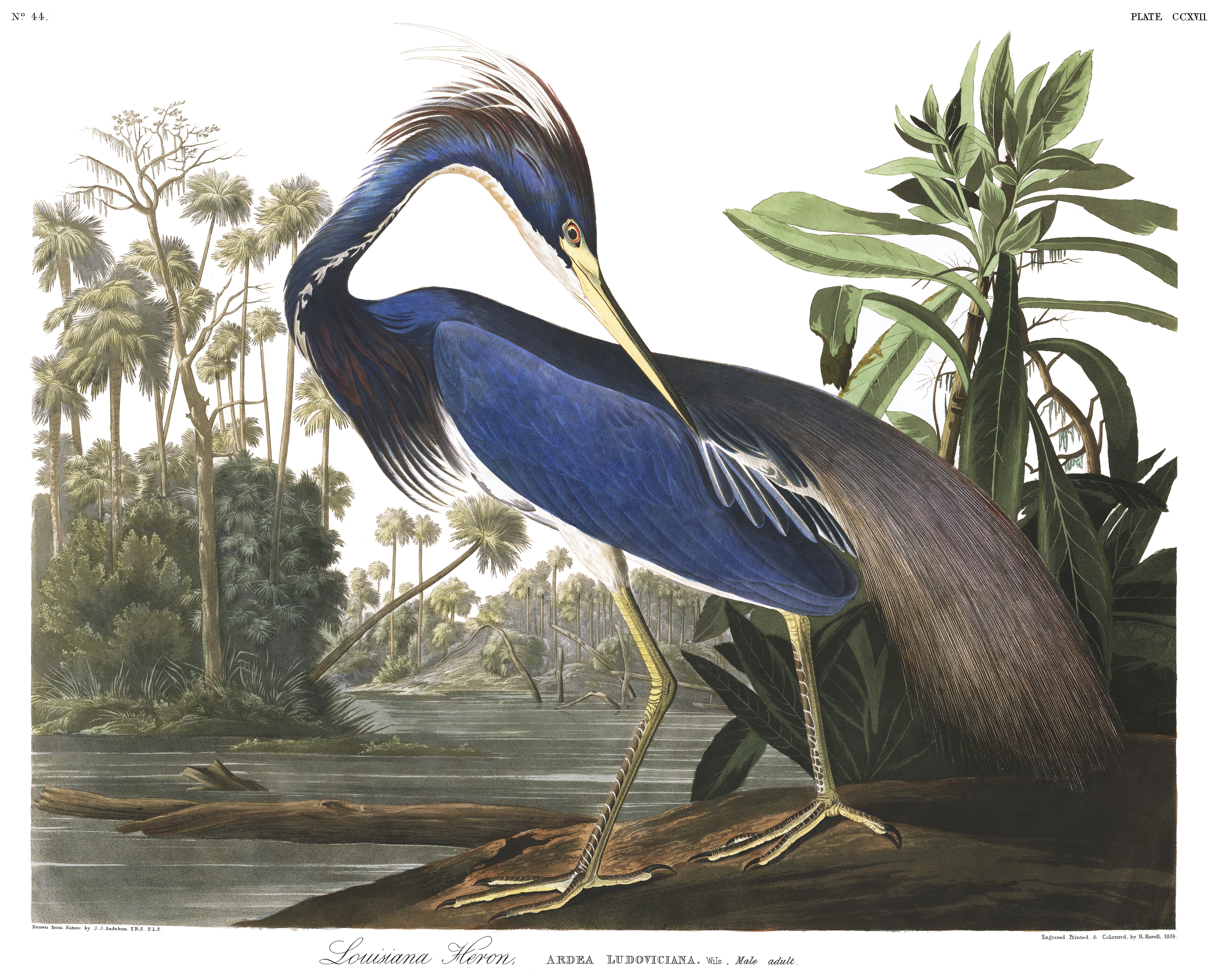
This past weekend, West Feliciana Parish (a Louisiana county) hosted the first of what is hoped will be an Annual John James Audubon Symposium. As with so many other events of this kind, COVID delayed the celebration of the 200th anniversary of the 1821 summer during which Audubon painted a large number of his famous bird pictures here in the St. Francisville area of Louisiana. Feliciana is a Spanish and Latin-derived word which means happy, and Audubon -we are told- was indeed well-pleased and contented by his time here to study and portray an amazing number of birds that still inhabit this region, whether by seasonal migration or by providing year-round company to local human residents.

The inspiration for this festival was provided in large part by local and regional historian, David Floyd, whose recent premature death added a special poignancy to the symposium. He had provided a succinct but heartfelt introduction to a beautiful little booklet, titled Audubon & Louisiana: 200 Year Love Story. David’s nuanced sense of Audubon’s place in the history of this region, and his perhaps Audubon-inspired vision for the future was captured for us by the author and presenter, Danny Heitman. Heitman noted how often David would begin a sentence with the word, imagine. “Imagine this…” or “imagine that…,” David would often say, and then invite a sense of possibility within his listeners. This led Heitman to observe something that may have been true of both David Floyd and John James Audubon. It is how a genuine sense of wonder about the world around us instills a sincere humility, and how both then lead to wisdom.

Danny Heitman’s book, A Summer of Birds: John James Audubon at Oakley House, is focused on that seminal 1821 summer during which Audubon discovered and then came to love West Feliciana Parish. During his presentation, Heitman commended three themes that help us appreciate the unique sensitivity of Audubon’s perception and artistic vision that so profoundly shaped his subsequent life’s work.

For Audubon, ‘nature was a verb,’ and something to be portrayed as alive with activity rather than displayed in a static, ‘pinned butterfly,’ way. In so many Audubon paintings, we find the birds pursuing what they might prey upon, or eluding what may be seeking to pursue them.

Second, and especially as assisted by his young associate, James Mason, Audubon was as attentive to the characteristic flora where he found his birds as he was to the birds themselves. Thus, the plants, shrubs and trees of this region are an intrinsic part of each composition.

And third, Audubon’s paintings were huge in size, and dramatic in the extent of their detail and range of color, and thus very compelling to viewers when they were first displayed. One contemporary commentator has likened their effect upon folks in early 19th century London as likely to have been akin to the remarkable effect upon first time viewers of movies in modern IMAX theaters.

We can be grateful, on this extended bicentennial celebration of Audubon’s summer at Oakley, for guides like David Floyd and Danny Heitman. For they help us see, and perceive more appreciatively, the immensely beautiful 200 year old bird paintings of John James Audubon as assisted by James Mason.


Pictured above is Audubon’s painting of the Louisiana or Tricolored Heron.

The Beauty of Picasso’s Guernica


It was probably in the summer of 1974 when I first stood before this remarkably stirring painting, Guernica, by Pablo Picasso (at MOMA, NYC). His fullest creative talents, as well as sensitivity to many aspects of our common human condition, came together to help him produce this recognized masterpiece. Not the least of the key features of this painting was his decision to render the composition in black, white and shades of grey.

Remember that he was ‘Pablo,’ not ‘Pierre,’ Picasso -that he was a Spaniard by birth, and in important ways, by self-identification.

In the context in which I compose these words, with Russia presently invading Ukraine, Picasso’s painting, and National Geographic’s somewhat unexpected reference to it at this moment, I am once again reminded of my recent visit to the Calder and Picasso exhibit at MFAH (Museum of Fine Arts, Houston). The image below, featured early in the walk through of that exhibit, shows Calder standing in front on Picasso’s Guernica, looking at his own contribution to the Spanish Pavilion for the 1937 Paris International World’s Fair.

Noting these precedents, I want to raise a question, which cannot simply or quickly be answered. What is the role of art, and of our exploration of beauty, in relation to the reality of evil?

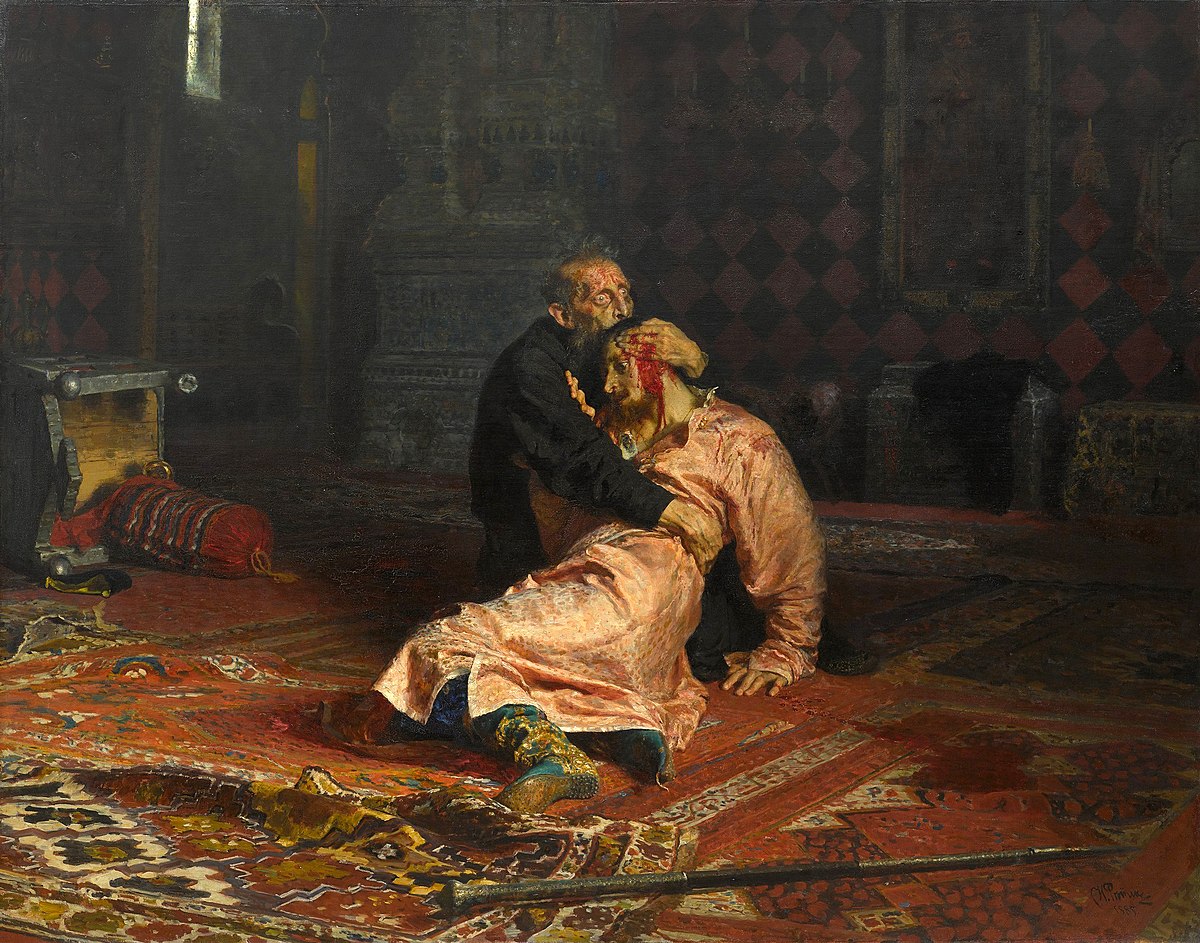
A powerful example of a response to this question is provided by Illya Repin’s painting, Ivan the Terrible and his Son Ivan (1581). A more recent example is Francisco de Goya’s 1814 painting, The Third of May. And, of course, so many portrayals of the crucifixion of Jesus.

A partial answer to the question I have posed is to say at least this: art and the exploration of beauty has the potential to remind us of our common humanity, and especially of the ideals we attach to our best and shared perceptions of what it means to be human – even in the face of evil and of death.

Picasso’s Guernica provides a compelling example of a good answer to this question.

The Beauty of Now


Rembrandt’s paintings are so often moving, and speak well of the Dutch genius who created them. When many of his contemporaries sought to portray people and events with greater realism, even if with much feeling, Rembrandt often put the ‘feeling’ side of his work first.

Rembrandt shows his sensitivity to an aspect of the anticipated birth of John the Baptizer. John’s parents were old and despaired about ever having a son who might carry on their name. The artist depicts the aged priest, Zachariah, leaning on a young attendant upon hearing that Mary has arrived. He portrays Elizabeth as also showing her years as she greets her relative with warm regard. Though Mary bears within her womb the holy child of God, she appears humbled in the presence of Elizabeth, perhaps awed at how the grace of God could touch both of their lives in such an unexpected way. Light shines on the two of them, just as it should, given the way that Luke highlights this holy aspect of their shared story. Thankfulness and quiet joy suffuse the scene like the warm light at its center.

Waiting and anticipation are themes we associate with the beautiful season of Advent. In one sense, these two words suggest we already know what we are anticipating, for what we are awaiting. By contrast, Luke’s story about the Visitation suggests a variation on those themes. “Expect the un-expected,” it seems to say, to us who live a multitude of centuries later. And this is especially hard for us to do, in a culture that is so dependent upon the precise measurement of time, and upon the predictability of events in the natural order of things.

Let’s notice this about Elizabeth and Mary, and about John the Baptist who is not yet born. Luke portrays them as living in the moment, as living in God’s time rather than simply in human calendar time. When Elizabeth hears Mary’s voice, John leaps in her womb. Luke then says that Elizabeth is filled with the Holy Spirit, and she exclaims with a loud cry, “Blessed are you among women, Mary, and blessed is the fruit of your womb.” Neither John nor Jesus are yet born, and so neither mother has yet received the assurance and peace that will come from seeing them safely delivered. And yet, in this moment, both women are filled with joy ~ joy about the fulfillment of God’s promises!

Elizabeth’s son, John, and Mary’s son, Jesus, would never be closer to the two women. And, in Luke’s telling, their quiet joy reflects their awareness of this, that now, in this moment, God is truly present, imparting grace and fulfilling promises. The same is true for us.


Rembrandt van Rijn: The Visitation (1640), Detroit Institute of Arts {many images online}

See Luke 1:41-42: “When Elizabeth heard Mary’s greeting, the child leapt in her womb. And Elizabeth was filled with the Holy Spirit and exclaimed with a loud cry, ‘Blessed are you among women, and blessed is the fruit of your womb.” Context: Luke 1:39-56. This Gospel reading is appointed for the 4th Sunday in Advent, Year C, which features the Visitation of Mary to her relative, Elizabeth.

The Beauty of Autumn Glory


In Western Michigan, the leaves at this time of year are usually beautiful. On the relatively few sunny days we’ve had, some of the leaves have been striking. But even against a foggy or rainy sky, the bright leaves provide a lovely metaphor. Like a choral concert featuring many voices, the leaves show their individual colors together in a stunning overall performance. I always love the deep reds of the maples. But the brilliant yellows and oranges of the birches, cottonwoods and hickories provide strong complementary support. Since these lively colors among the leaves are less common down south, we always put some in the mail to our kids in Louisiana.

As I think about this fall display, I remember something I heard years ago. We think of the bright colors as suddenly appearing in the autumn. But, apparently, those bright colors in the leaves have been there all along! It’s just that, at this time of year, the predominant green color fades away. When it does, it reveals the other brilliant colors latent in the body of the leaves. Either way, we don’t see the bright colors until autumn. And from the leaves’ first emergence as buds in the spring, we see only suggestions of what will come later. Sometimes the buds show hints of red and yellow. But soon, most of them bear variations of green, some light and pale, and others dark and rich-looking.

We can find a further extension of this metaphor in the form of a reflective contrast. On one hand, we appreciate the leaves at the end of their growing season. Yet, we often have a less-than-poetic view of ourselves as we approach the end of our own ‘growing season.’ Regarding the autumn display of color, people of faith rightly echo words from the Psalms, when we speak of fall leaves as ‘singing out praise’ to the creator. The leaves are doing what they were made to do. They are true to their own nature in each of the four seasons. And they come into their full glory in the fall.

And yet, when we think about ‘the autumn’ of our physically embodied lives, we consider it to be a time of decline and loss rather than one of gain, or as a time for giving glory. Suppose someone asks us to think about examples of people who give glory to God just by being who they are. We are likely to think of young folks in the ‘springtime’ of life, physically fit, professionally accomplished, with lots of time for achievement ahead. But why don’t we perceive the fullness of age as the time when we grow into wholeness, into the beauty of maturity, and when we embody received wisdom and grace? Why is autumn no longer a ready metaphor for when we as human beings come into our own glory?

The gloriously colored leaves falling from the trees at this time of year do not attain their beauty through anything they do. They come into their glory as a result of what happens to them. This follows from how God has made them, and from what God has put into them. This is perhaps the most significant meaning we can find in these leaves coming into their glory at the end of their lives. It gives us a different way to think about how we move into and through the ‘autumn season’ of our lives. For we now share in the beauty of the Communion of Saints not through anything we have done, nor by our strength, but through God’s graceful embrace of our weakness.

This past Sunday -All Saints Sunday- many people across the Church received a new birth through being joined with our Lord’s death and resurrection. They became new buds grafted onto the Tree of Life. In the youngest ones, we can only imagine how —some day— they will reflect Christ’s glory in their maturity. For we don’t yet see how they will become like the brightly colored leaves on autumn trees. But on All Saints, all the newly baptized emerge as flowering buds on the Tree of Life. May we join them in glorifying God through every season of our lives.


The image above is of an untitled Coco Treppendahl painting portraying the beauty of autumn leaves. This post is based on my homily for All Saints Sunday, November 3, 2019, which can be accessed by clicking hereOther homilies of mine may be accessed by clicking here. The Revised Common Lectionary, which specifies the readings for Sundays and other Holy Days, can be accessed by clicking here.

The Beauty of His Continuing Presence


The most well-known painting of ‘Doubting’ Thomas and his encounter with the Risen Jesus may be the one by Caravaggio. And yet, paintings like his are misleading, as is referring to Thomas as ‘the doubter.’ Why? Because paintings and labels like these lead us to overlook or misperceive some very important details within John’s Gospel story. Rembrandt’s painting of the event (above) helps us notice the difference.

As John tells it, we first find ten of the disciples hiding behind locked doors out of fear. Consider how, during Jesus’ ministry with them, he had more than once told them to fear not. And at the Last Supper, he had given them ‘his peace.’ Yet, rather than remember what Jesus had shared with them, as well as his miracles, all of them have succumbed to fear. Even though Mary Magdalene that morning had already told them that she had seen the Lord. How can these details be squared with any other description than that the ten behind locked doors are doubting, as well?

Second, observe how John’s Gospel describes Jesus’ initial appearance to the ten, when he finds them fearful and doubting. At first, they do not recognize him. It is only after Jesus shows them his hands and his side that they then recognize him, and rejoice at his presence. When they see him, then they believe, and not before. So, once again, Jesus leaves them with his peace. And now, he gives them his Spirit.

Notice what the ten say to Thomas when he then arrives: “We have seen the Lord” ~ the very same witness Mary had earlier offered to them without having had much effect. Thomas naturally replies by saying something like this: ‘Look, I haven’t see him, like you guys just did— and so, just like you, I won’t be able to believe until I see him, either.” Thomas’ statement to them therefore does not need to be heard as him setting the conditions for his belief. It may simply be a practical prediction of fact.

We need to be equally perceptive about John’s description of Jesus’ later visit to that same locked room. It is a week later when Jesus returns to the eleven, among whom Thomas is present. It is vital to notice what Jesus says to Thomas. It’s even more important to observe how John describes Thomas’ response. Jesus invites Thomas to touch him and to believe. But the Gospel does not say that Thomas has any physical contact with Jesus. It does not tell us that he reaches out, or that he makes an effort to touch Jesus. Instead, and just as Jesus gives him credit for doing, he sees, and then he believes. Just like the prior experience of the other ten!

Rembrandt’s image, like the painting by Carl Bloch, is faithful both to what John tells us, and to what he does not. Observing this, we should refer to this story in John’s Gospel in a different way ~ ‘the doubting disciples, and how they all came to believe.’


The above image is of Rembrandt’s (I think mis-titled) painting, The Incredulity of Saint Thomas. This post is based on my homily for Easter 2, April 28, 2019, which can be accessed by clicking here.  Other homilies of mine may be accessed by clicking here. The Revised Common Lectionary, which specifies the readings for Sundays and other Holy Days, can be accessed by clicking here.

The Beauty of Our Return


I share with you an unusual set of images from James Tissot. They represent his transition from a French and English society painter to being a visual communicator of the Gospel. They are three of his four paintings depicting The Prodigal Son in Modern Life. How beautifully he evokes the son’s presumptuous ascendancy over his father’s legacy. Then, the son’s foolhardy journey into adventures of his own making. And, third, his return home to his father’s good favor. One key to the subtlety of these three paintings is to notice the older brother in the first painting where he is sitting by his wife. He is musing about distant possibilities for himself, just as his more impetuous brother is beginning to act upon a similarly fanciful vision. In the third image, we observe the stoic and prideful older brother standing by his wife, reluctant to approach and embrace his just-returned sibling.

As Tissot show us, wise readers notice in Luke’s story that we hear about two lost sons, not just the one who went to a far-off land. The older brother couldn’t recognize how his own life was gifted, having entered into an abundant legacy that had also become his. This may be true for us, as well. So, we need to be thoughtful about how we refer to this un-named parable. To say it’s about the prodigal son overlooks how it’s also about the presumptuous older brother, as well as about the ever-loving father.

When we focus on the younger son in Jesus’ parable, we become more sensitive to how it may help check us from wandering away from God and from God’s ways. For we find in this story an account of what it’s like to come to our senses, in circumstances that could kill us spiritually and physically. It speaks about what it means to ‘return home.’ But as dramatic as experiences like this can be, they stand out because they are occasional or singular.

Seeing this parable as also about the grumbling older brother helps us notice how significant it is for other times in our lives. This is not just a Gospel about looking back to what was, and has been. This is a Gospel about living forward, toward the future God is even now preparing for us.

We are called to the feast! We gather on Sundays for the same feast about which we hear in Luke’s Gospel parable. Our Eucharist is our celebration of the return of lost ones, both ourselves and others. Henri Nouwen’s great insight about this Gospel passage, and Rembrandt’s painting of it, is this: having once been the younger brother who has experienced the grace of returning home, we are all called to become the father in the story! In other words, we are called to become people who receive others, embracing those who return some time after we do. Let us eat and celebrate! For like us, our later-returning brothers and sisters were dead and are alive again; like us, they were lost, and now are found!


The above paintings are from James Tissot’s, The Prodigal Son in Modern Life, three of his four paintings depicting Jesus’ famous parable in Luke 15. This post is based on my homily for Sunday, March 31, 2019, which can be accessed by clicking here.  Other homilies of mine may be accessed by clicking here. The Revised Common Lectionary, which specifies the readings for Sundays and other Holy Days, can be accessed by clicking here.

The Beauty of Kingdom Potential


What has Jim Janknegt depicted with his painting? Right away, we can see that he portrays the Kingdom mustard seed parable in Mark’s Gospel. With his focus on this parable, we should remember that the Gospels include two kinds of mustard seed teaching. One is in Jesus’ parable ~ about the huge potential of what God can do with apparently small bits of the Kingdom. Jesus’ other teaching is about the tremendous potential of what we might accomplish through personal believing, especially given how personal faith can otherwise be deficient or defective.

To help recognize this difference, between Jesus’ Kingdom parable and his other teaching referring to the size of our personal believing, consider what we see in Janknegt’s painting. In the foreground we see things we usually think of as being big ~ like big cities, their large buildings and the businesses they house. Dwarfing them is a great tree, which may represent the ‘Tree of Life.’ Like the small mustard seed, the great tree that it becomes represents what the Spirit is doing with God’s Kingdom.

Notice the community for which the great tree provides a place of habitation ~ a community characterized by many birds, including both a beautiful peacock and a spoonbill, an owl and a descending dove. In traditional mythology, birds represent communication between the realm of the sky and the realm of the land, or between the heavenly sphere and that of the earth. The Tree of Life provides a context for this communication, and for the Kingdom community that God’s Spirit nurtures between the two.

If we ever worry or despair about the smallness of our faith, we should remember Jesus’ emphasis upon the huge potential of God’s Kingdom power. The seed of this Kingdom potential is planted within us at our Baptism.


This post is based on my homily for Sunday, June 17, 2018. Jim Janknegt’s painting, Worlds Smallest Seed, is used here with his permission. {Editorial note: I preached on this Gospel reading, and referenced Janknegt’s evocative painting again on Sunday, Jun 16, 2024. Here is a link to my reflections on the same Gospel reading.}

The Beauty of His Community

Art_James He Qi_The Doubt of St.Thomas_large


I love how artists help us read and hear Scripture in new ways. Occasionally, they help us perceive aspects of biblical texts for the first time. Paradoxically, in one case artworks have nurtured a mis-hearing of the Gospel. For all the paintings of Thomas that I know refer to him as having doubt, and portray the resolve of that doubt as coming from his touching the side or hands of the risen Jesus. But look closely at John’s Gospel. In his visit to the room where the disciples have been hiding, the risen Jesus does not directly attribute ‘doubt’ to Thomas. Instead, and perhaps with his prior visit to the other disciples in mind, he merely tells Thomas not to doubt. Nor does John describe Thomas as taking up Jesus’ invitation to touch him. Jesus credits Thomas for believing after seeing him, rather than after touching him. He then encourages the kind of belief that does not rest upon seeing.

Notice how the other ten disciples are hiding in fear, rather than joyfully confident, when Jesus comes to where they have locked themselves in. They are described as rejoicing only after Jesus shows them his hands and his side. In other words, Thomas is not unique and different from the other disciples, and benefits from exactly the same experience that transformed them from people fearfully hiding into those who are rejoicing. Their joyful confidence is reflected in their words to Thomas when he later arrives. They say, “We have seen the Lord.” Their joy is the direct result of seeing Jesus’ hands and side, the very things Thomas says will be key to his own believing. So, the ten did not believe until they saw; and Thomas will not believe until he sees. What they received, he, too, will receive. As will we, who—like Thomas—were not initially in that room. The history of art obscures this important point.

Here are two safe things we can say and accept as true. The risen Lord continues to disclose himself with signs. And, the Lord reveals himself in community, and always for the sake of his community. For his community is fellowship within the new covenant of reconciliation. As John writes in his first Epistle, “We declare to you what we have seen and heard so that you also may have fellowship with us.” Fellowship with this community, is fellowship in and with the Risen Lord.


James He Qi, The Doubt of St. Thomas (He Qi © 2014 All Rights Reserved); used with permission. I think of it as portraying the community faith of Thomas. See John 20:19-31, and 1 John 1:1-2:2. Click here for a link to my Sunday homily, which explores the impact of the resurrection upon the disciples.

Beauty and Resurrection

Stanley Spencer_the-resurrection-reunion-of-families-1945

Stanley Spencer’s church cemetery visitors find themselves surprised by being found! They experience being found through a resurrection encounter with those who have gone before.

The resurrection of Jesus is not usually something we go looking for. The risen Jesus comes and finds us. This is the pattern we see in so many of the stories of Jesus’s first resurrection appearances to his friends and followers. The disciples and others don’t go looking for him except at first, when they go to the tomb. And even then, they are seeking Jesus’ mortal remains rather than his risen presence. He comes and finds them, just as he finds us, often in the context of fellowship. And like them, we are always surprised.

We don’t find the resurrection just as we don’t find God. Neither God nor the risen Jesus are lost, even if we may be. And so, we are found by both, and then we find ourselves as persons who have been found. This is instructive, for it corresponds with our apprehension of, and encounter with, beauty —which we also misleadingly credit ourselves with ‘finding.’ Really, beauty finds us. For our perception and recognition of beauty depends not on a ‘power’ that we possess to pursue and attain it, but rather on our ability to receive and recognize what is, and what is given. The same is true in our apprehension of, and encounter with, the grace of the resurrection.


Stanley Spencer, The Resurrection – Reunion of Families, 1945.

A Strange Beauty

Stanley_Spencer_the_crucifixion_1958


An encounter with true beauty can be troubling, especially if we have settled for so much less. It may be our sensitivity to the juxtaposition of opposites, and their apparent lack of resolve. At times we hope for the triumph of good over evil, that beauty will overcome darkness, and serenity displace antagonism. But we cannot find it within ourselves to do more than hope. We cannot achieve the redemptive resolution for which we haltingly reach out our hands and hearts.

It is not an accident that the figure of Jesus recedes into the background of this painting, while those who oppose and crucify him grab our visual interest. Stanley Spencer, who adopted what he called a neo-primitive style, was far too gifted a colorist, and master of light and dark, to let that happen unawares. As Spencer has rendered him, Jesus’ skin tone and color match the wood of the cross, and also the clothing of the man with the hammer swung over his head, as well as much of the sky and of the ground below… including the tunic of Mary Magdalene, prostrate on the ground. This forms a compelling visual symbol of his Jesus’ total identification with us in his incarnation, and his complete joining with us, and with our world of tearing hurts and suffering.

In fact, it is precisely because —in Spencer’s composition and coloring— Jesus could blend in so well with the background of everyday life, that those who opposed him could literally gain the upper hand, with hammers and nails. But this is only the marvel of the incarnation of our God in Jesus, that the fullness of divinity could be so thoroughly joined to the incompleteness of humanity. As the Gospels attest, it was a joining so thorough that many did not notice or have regard for his divinity. When we do notice that thorough joining, when we come face to face with the truths it represents, we have either one or the other of two reactions. When we get close enough to see —to really see him— there are only two responses. We throw ourselves down in humility before him. Or, we seek to throw him down, to humble him before us.

These paradoxes are brought to their greatest prominence when, as he predicted, he is lifted up. His lifting up is his glorification, and the glorification of God within him. Yet his lifting up is on a cross, and in the agony of a humiliating public execution. Here we see a ‘strange beauty’ — the strange beauty of the Lord — a beauty for which museums better prepare us than do our malls. Let us “behold the fair beauty of the Lord, and seek him in his temple.” We will find him! We will find him in the “temple” he promised to raise in three days.


The painting above is The Crucifixion, 1958, by Stanley Spencer. This reflection is based on my homily for Good Friday, which also makes reference to Charles Wesley’s text, “Lo! He comes, with clouds descending.” Click here for a link to this homily.