Giving Thanks

The Beautiful Feast of the Presentation

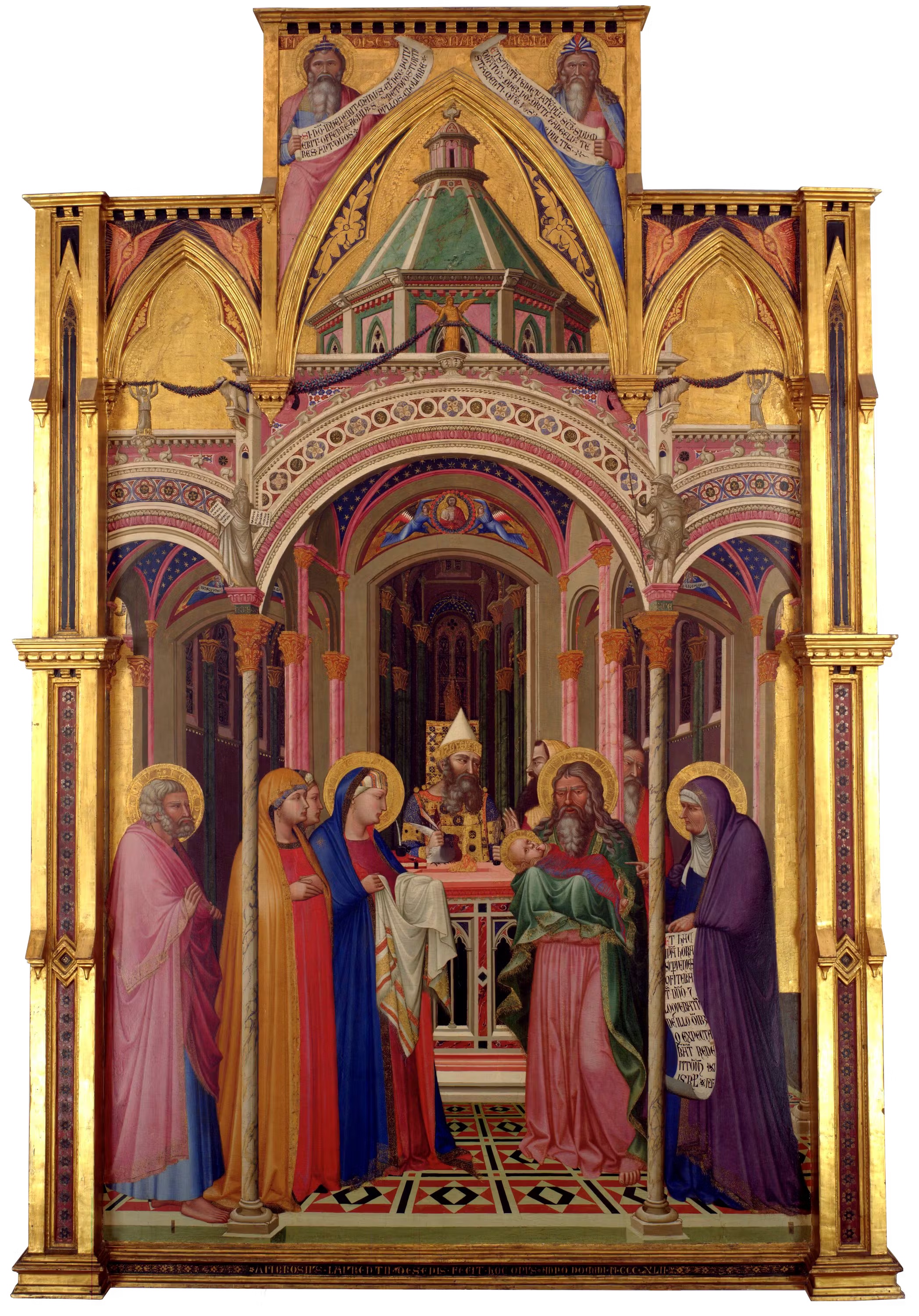
Ambrogio Lorenzetti (1319-1348), Presentation at the Temple

I can’t imagine ever forgetting the experience of holding our first child right after his birth. I’m sure no parent ever does. It was in a hospital in Oxford, England, where midwives assisted Martha. After the birth, they went off to make us a pot of tea, leaving us to enjoy our new baby. What I cannot account for is the mysterious sense of deference I felt toward the Creator in that moment. Not only of profound thanks, of course, but an urge to offer something to God. I believe this feeling is based upon an ancient impulse, latent within our souls. This impulse plays a significant role in the Bible, and particularly in our Gospel for this feast day. All this was made poignant for me when our son, Per, was baptized on February 2, the Presentation of our Lord at the Temple, a few months after his birth.

A way into the mystery of the beautiful Feast of the Presentation is to notice how, soon after Jesus’ birth, Mary and Joseph bring him to the Temple in Jerusalem. They present him to the Lord, offering a sacrifice according to the Law. Lorenzetti’s painting of this moment captures the ancient impulse to express thanks for God’s gifts, an impulse that still resonates within us in modern times.

The fuller significance of where the Presentation occurred is less obvious. In Genesis 22, we find a story curiously related to Luke’s story, one that should be remembered as ‘the test of Abraham.’ For Isaac was not actually sacrificed, even though the story centers on Abraham’s willingness to consider it. Genesis says it occurred at Moriah, and tells us that afterwards the place was called “the mount of the Lord.” An Old Testament text identifies the place with Jerusalem, and specifically, with the Temple Mount. In other words, Mary and Joseph take Jesus to the place where God directed Abraham to bring Isaac, the place where God himself provided a ram for sacrifice, instead of a child. And following holy tradition, Mary and Joseph provide a sacrificial offering of thanksgiving for their son in the same location where God himself would later provide another offering for sacrifice. For in Jerusalem, the Son of God, who is the Lamb of God, offered himself as an atonement sacrifice on behalf of the world.

We are not alone in finding the story about Abraham and Isaac, and aspects of ancient cultic practice, unsettling. In Jeremiah, God himself criticizes the “citizens of Judah and the inhabitants of Jerusalem [who]… offer up their sons and daughters to [the god] Molech.” God says, “I did not command them, nor did it enter my mind that they should do this abomination.” Consistent with this, the best way to read the Abraham story is in the context of ancient attitudes and practices. For it was not surprising that a local god should receive the first fruits from the field or flock, or even a firstborn child. The surprising thing in the Genesis story was not that God should propose the sacrifice of Isaac, but that God should intervene to prevent it!

For Abraham, God’s request was like what most gods asked for: ‘give me the first portion!’ But then, God showed Abraham something new: that his faith, trust, and obedience were more important than actually offering his first son. The holy law given to the Israelites showed the same thing. Just like the gods of other peoples, Israel’s God asked for the first portion. But following the pattern God showed Abraham, the Lord did not literally ask for the first child. Instead, He asked for a substitute.

Here is the logic: Since through Creation all things are God’s, God can ask for everything in return. Yet, God asks for only a part – the first part. Asking for the first part is like asking for a symbolic gift: it acknowledges that the whole flock and the whole field is God’s. But as a symbol of the larger part that we get to keep, we offer the smaller part as a token gift to God, from whom all things come. That’s what the offering of the ram was for. It was a sign of God’s kindness that he would ask for a ram instead of a child, and later let poor folks offer doves instead of a ram.

Following this tradition, Mary and Joseph come to the Temple to make their own offering. As is true of all children, their first-born child belongs to God. As a sign of this spiritual truth, they offer to God a substitute for the baby Jesus.

Here we see the mystical connection between the Presentation of Jesus in the Temple, and the meaning of sacrifice in ancient culture. It also helps us see the mystical connection of Jesus’ Presentation at the Temple with what sacrifice means for us and for our future. The first crop, the first lamb, is valued because it symbolizes all that will follow. When God asks us for a tithe, his message is not: “Here, give me a tenth, and I don’t care what you do with the rest!” No! Instead, God’s message is this: “Bring me the first tenth, as a symbol of the nine tenths that also belong to me, but which I give to you. And please use what is left in a way that is consistent with your gift of the first tenth!”
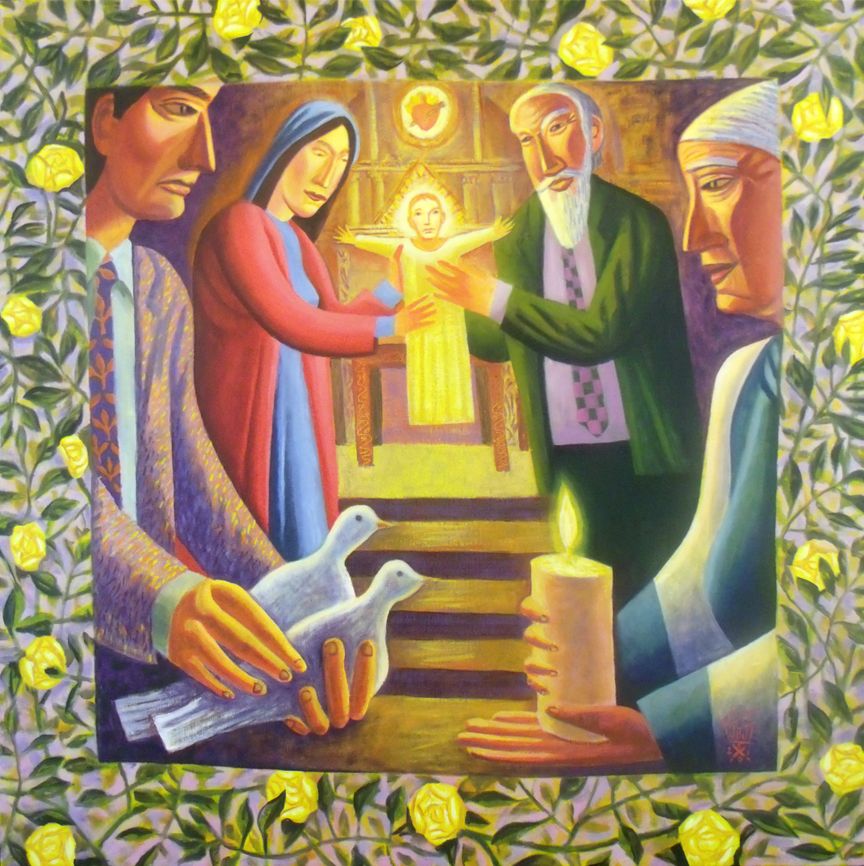
A contemporary interpretation of the Presentation of our Lord at the Temple, depicting Simeon and Anna, by Texas artist, Jim Janknegt

Note: see Luke 2:22-28 to find the Gospel account of Mary and Joseph presenting Jesus in the Temple on the 40th day after his birth. Luke gives particular attention to the appearance of the aged man, Simeon, and of the prophetess, Anna, who play significant roles in the story.

… always and everywhere …

(An earlier than usual post — for your Thanksgiving Week!)

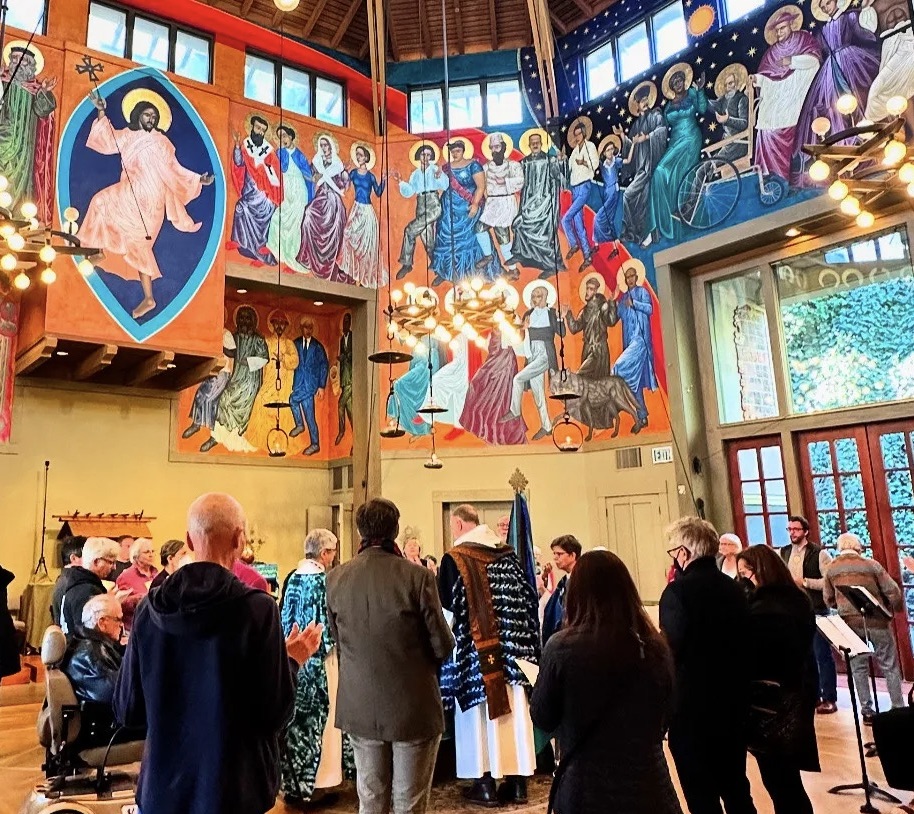
A lively celebration of the Eucharist, or The Great Thanksgiving, at St. Gregory of Nyssa Episcopal Church, San Francisco

It is right, and a good and joyful thing, always and everywhere to give thanks to you, Father Almighty, Creator of heaven and earth.” So begins the body of one of the Eucharistic Prayers in The Book of Common Prayer, as used in Episcopal Churches for the celebration of Holy Communion. “Always and everywhere” – these words regarding giving thanks remind us of the characteristic posture of the Church, and of all of its members, whether at worship in their parishes or at work or play in the world around them.

When Baptized Christians gather for a celebration of the Lord’s Supper, they remember that “the Lord Jesus on the night when he was betrayed took bread, and when he had given thanks (eucharistesas / εὐχαριστήσας), he broke it, and said, ‘This is my body which is for you. Do this in remembrance of me’ (1 Corinthians 11:23-24).” What we as Christians do in a formal way, when gathered for the Eucharist, enacts our normative way of shaping our whole lives. Which is always and everywhere to offer thanks to God for mercy and grace, and for God’s love poured into our hearts by the Holy Spirit. For we seek to live as we pray: Offering thanks to the Father, through the Son, in the power of the Holy Spirit.

“Give thanks in all circumstances; for this is the will of God in Christ Jesus for you.” Paul shares this counsel in his first letter to the Thessalonians (5:18). These words are sometimes mis-remembered as saying, “for all circumstances.” The difference between the two prepositions, in and for, is significant. In our daily rounds, it is very difficult for most of us to be thankful for adverse circumstances and experiences, and we find it hard to reconcile their occurrence with the oversight of a loving God.

Yet Paul believed in the doctrine that we call Providence. He firmly believed that the evil conditions and events that we experience in this life are not in themselves acts of God, imposed upon us by the divine will. Instead, they are things that are allowed to occur by a God who loves us and who intends our good. This is clearly a mystery to us, on this side of the veil separating us from the eternal.*

Another Eucharist at St Gregory of Nyssa

As we well know, the society in which we live in the United States sets aside one day of the year as a public holiday that is called Thanksgiving Day. Its history lies in a presidential proclamation by Abraham Lincoln. Yet, regardless of the circumstances of its origin, the day is widely celebrated by many who are unfamiliar with its history, and who may identify with traditions, practices, and holidays passed on from other cultures. This is only proper, as giving thanks is a universally human act. The people and circumstances, and the particular reasons for it, may all differ. Yet, the spirit of the act is the same.

I have heard it explained, that the sanctuary candle we see in the sanctuary of some churches is to remind us that God is present. The implication of this explanation might be misconstrued in such a way as to suggest that God’s presence elsewhere might not be as assured. Yet, the explanation can also be understood positively, as saying something like this: “This candle is here to assure us of God’s presence. We keep a candle here lit perpetually to remind us that God is always and everywhere present, even in the darkness or when we are alone elsewhere.”

Celebrating Thanksgiving Day can bring with it a similarly positive understanding. We give thanks formally, as a nation of many peoples, on one day of the civil year as reminder that giving thanks should be natural for us every day of the year. And the thanks we should offer are for the good things we enjoy with those whom we know and love, but also for things, people, and even institutions, about which we may be indifferent or even disapproving.

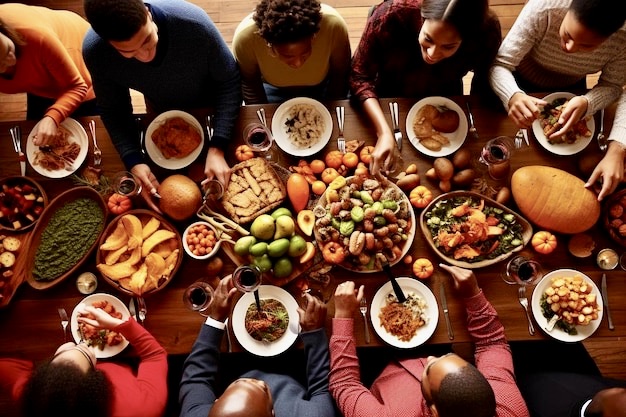
Gathering for a shared meal in the context of a spirit of thanks

In this spirit, I would like to share a prayer found in The Book of Common Prayer, that is principally used in the closing portion of the rites for Morning and Evening Prayer. It is therefore not specifically designated for use in observance of our national celebration of Thanksgiving Day, though it could be. This is a prayer intended for use everyday, and is a fine one for us to use at our celebrations this week:

Almighty God, Father of all mercies,
we your unworthy servants give you humble thanks
for all your goodness and loving-kindness
to us and to all whom you have made.
We bless you for our creation, preservation,
and all the blessings of this life;
but above all for your immeasurable love
in the redemption of the world by our Lord Jesus Christ;
for the means of grace, and for the hope of glory.
And, we pray, give us such an awareness of your mercies,
that with truly thankful hearts we may show forth your praise, not only with our lips, but in our lives,
by giving up our selves to your service,
and by walking before you
in holiness and righteousness all our days;
through Jesus Christ our Lord,
to whom, with you and the Holy Spirit,
be honor and glory throughout all ages. Amen.


*A note about the distinction offered above, regarding what God allows: Readers may wish to consider the way that Aristotle, and others since, have distinguished various dimensions of the idea of ‘cause,’ or causation (four dimensions have been articulated in the Western tradition). “Efficient cause” is the familiar form of the word cause, as in causing a row of dominos to cascade forward. “Final cause” can be conceptually helpful, especially as we think about God drawing persons and events toward their fulfillment in Christ. In this sense of the word cause, instead of our thinking of God as pushing events forward, some of them good and some perhaps bad in our eyes, God summons, and pulls toward the future, those people and things that may be made whole in Christ (ie, those that are open and willing recipients of his Grace), to their true end.