English

A Church by Errol Barron in Gulfport

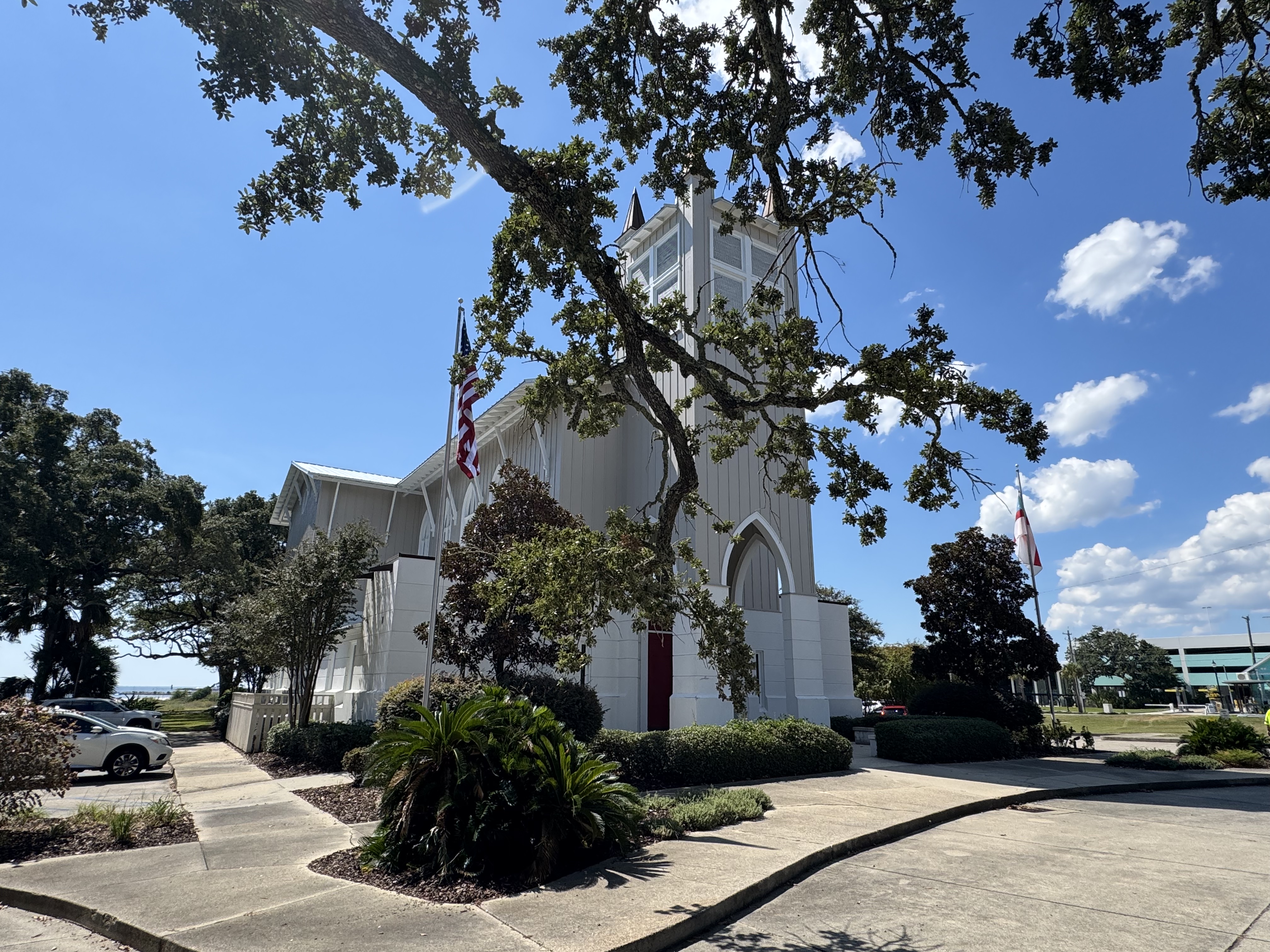
St Peter’s by the Sea, Gulfport, MS, designed by Errol Barron

Errol Barron’s work as an artist may be familiar to readers of this website based on some of his evocative New Orleans water color paintings previously featured here. His paintings of that city as well as of Tulane University, where he has taught for many years, provide strong indications that he is more than a skilled painter and draftsman, but also a trained architect. He has taught generations of architectural students at Tulane, and he has practiced his profession to great effect not only in this region but also overseas, with some houses of his located in Greece. Given Barron’s evident sensitivity to historical architecture and design features characteristic of this region, I was surprised to learn about a notable but unexpected feature of his resume. He worked for seven years with Paul Rudolph, architect of the well-known and oft-criticized Boston Government Services Center and a partial inspiration for the movie, The Brutalist.

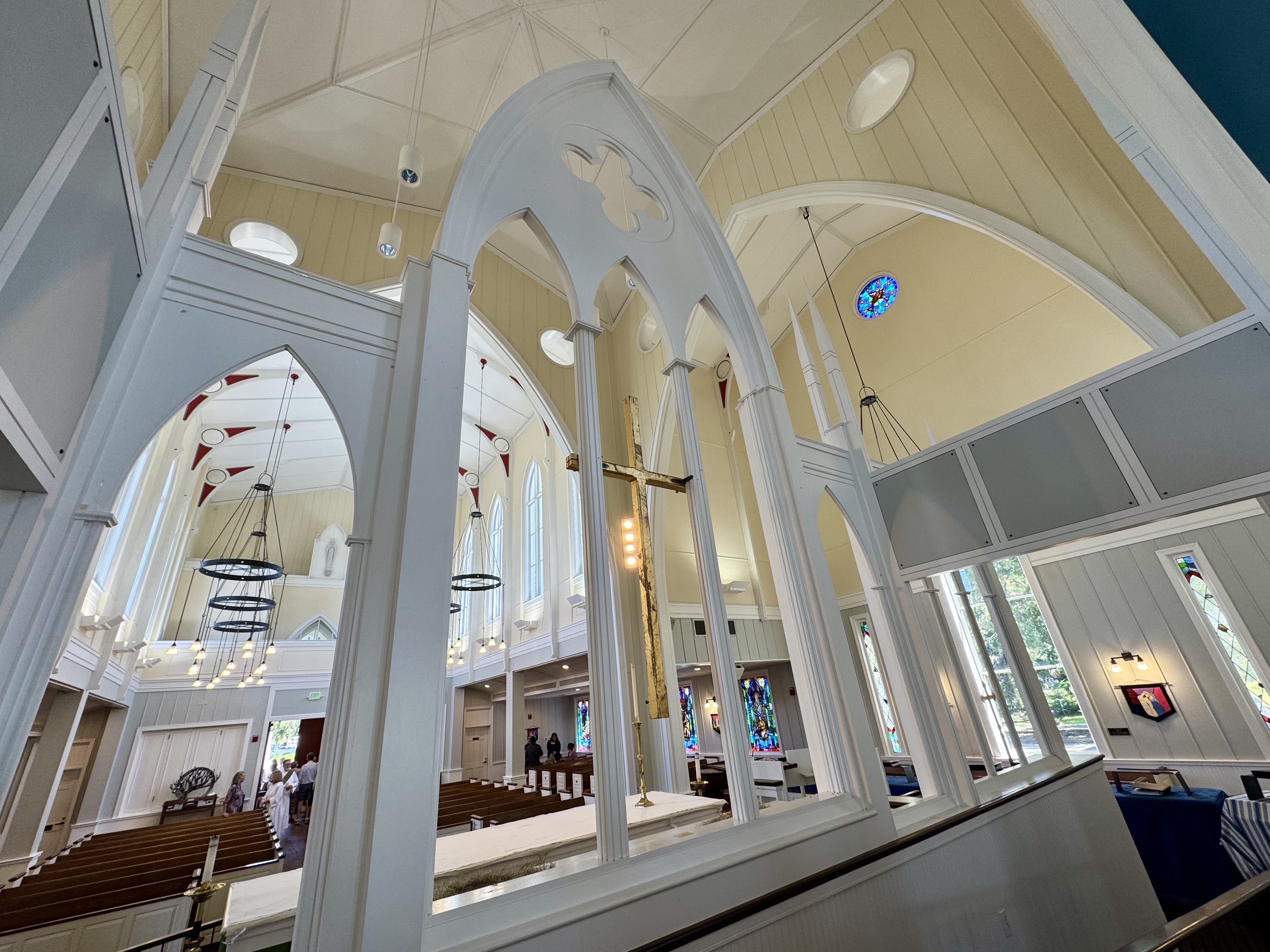
St Peter’s by the Sea, interior

I was recently delighted to discover the Episcopal church in Gulfport, Mississippi, St. Peter’s by the Sea, and that Errol Barron was its architect. It is a gem of a church, and a very successful design that incorporates traditional ecclesiastical elements associated with European Gothic churches along with features reflecting contemporary liturgical renewal. I have heard people refer to this style of church building as Carpenter Gothic, and as Southern Gothic, and the labels seem to fit well. The worship space exudes an appreciation for traditional forms while harmoniously blending them with a contemporary focus upon light, color, and the greater participation of worshippers in flowing open spaces.

The main altar with the ornamental rood screen

Visitors to the Washington National Cathedral, and similar churches of Gothic-revival style, may recognize the particular heritage that stands behind the floor plan of St Peter by the Sea. At the National Cathedral, and in its medieval forebears (such as London’s Westminster Abbey), an arched stone ‘rood screen’ separates the chancel and choir (beyond the screen) from the nave where the congregation is seated. When, in the 1960’s, the liturgical renewal movement began to influence changes in the worship arrangements of these buildings, a new main altar was often then placed in the nave, on the congregation’s side of the rood screen. Smaller gatherings for weekday services could still occur in the choir side of that screen, while Sunday gatherings for the principal Eucharist would be celebrated in the nave, with the clergy, altar, and liturgical action proximate and visible to the congregation.

A view of the ceiling and woodwork above the choir

Though St Peter’s by the Sea is a comparatively recent building, its design reflects something of the historical sequence described above. Instead of an imposing stone rood screen, shielding the chancel and choir spaces beyond, Barron has designed an ornamental arched screen of light-colored wood that suggests rather than imposes separate areas within the overall space. This allows the evocative blue canopy of the ceiling over the chancel to draw one’s eyes forward, toward the visible clear windows at the liturgical ‘east end’ of that space behind the chapel altar, facing the seashore.

Further, the notably narrow, even sharp-looking, wooden ‘spires’ protruding above where the choir chairs are placed enhance the upward sense of lift in the nave, complemented by the radiant cream and white color scheme above where the congregation sits. Light pours in through clear windows above, while delicately fashioned and dangling wrought iron fixtures provide supplemental illumination for evening services and in poor weather.

A view toward the nave from the choir, through the rood screen

On the Sunday of my recent visit, I was told that the congregation numbered about 145, and I estimate that the nave would comfortably seat about 200 people, though it could probably accommodate more. With the Gothic-inspired longitudinal floorplan, evident when one approaches the exterior of the building, a visitor might expect a rather narrow and linear worship space. Such an initial impression of the likely effect of the interior spatial arrangement is overcome by a number of subtle but effective design choices made by the architect and those who worked with him.

Accompanying the verticality of the large open area above the center of the nave are the seating areas adjoining the side aisles, taking the places of side chapels found in many medieval Gothic churches. The relatively low height of the box pews enhances the sense of horizontal width created by these adjacent seating areas, which provide relatively unobstructed views of the altar and lecterns. I also found the acoustics within the worship space to be well-suited for music as well as for public reading and speaking.

I am drawn to the ethos of historical churches; I am enthused by many examples of modern architecture; and I appreciate the fruits of the liturgical renewal movement. In my experience, a successful blend of these three things is not always found in contemporary buildings designed for worship and intended for the enhancement of congregational life. In his design for St. Peter’s by the Sea, in Gulfport, Mississippi, and in his supervision of its restoration after Hurricane Katrina, Errol Barron has achieved just such of a desirable synthesis.

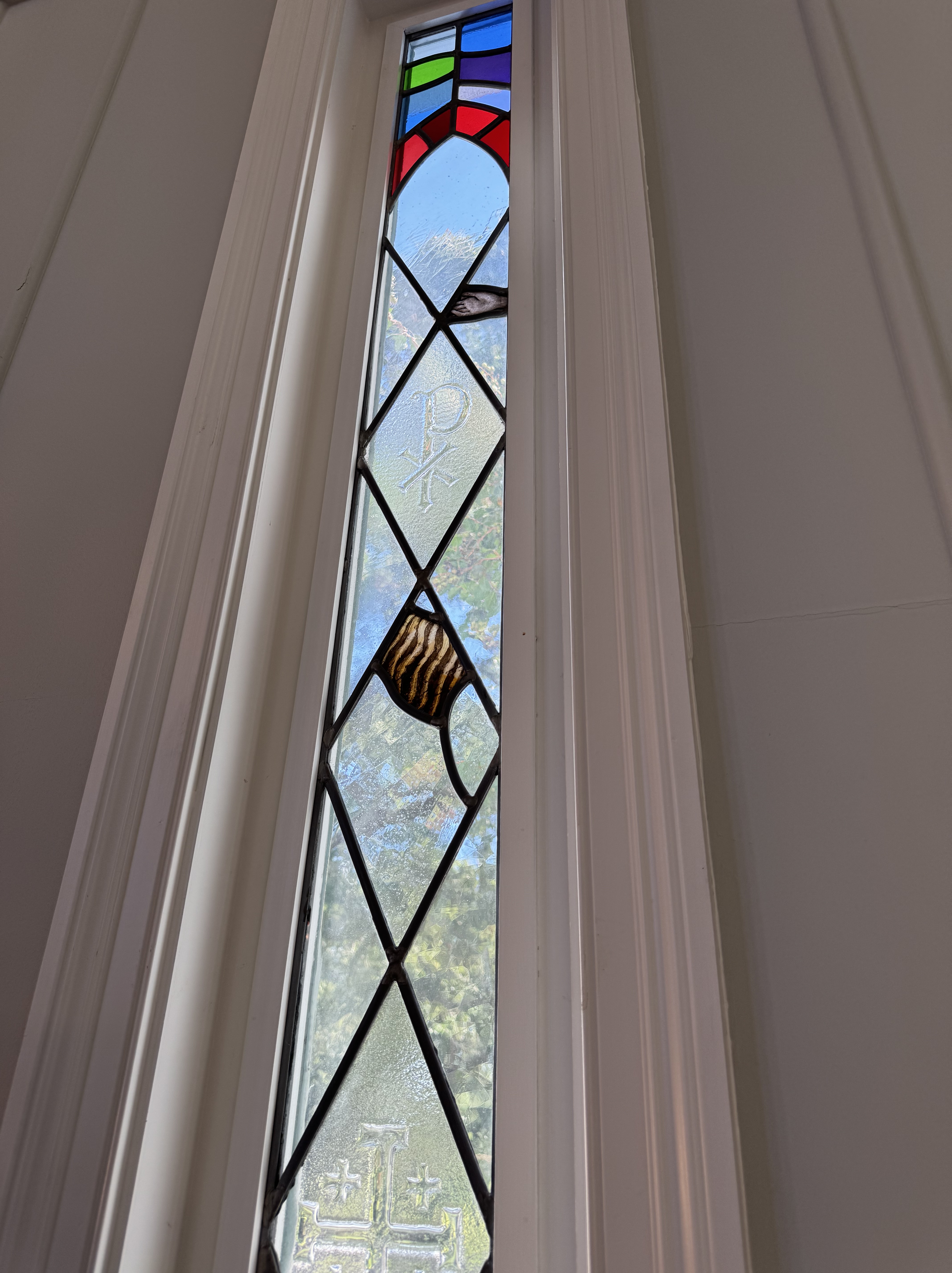
A representative side window incorporating stained glass window fragments recovered after Hurricane Katrina

Good Friday 2025

If reading this by email, please tap the title at the top to open your browser for the best experience. Then, clicking individual pictures will reveal higher resolution images.

Stanley Spencer, The Cruicifixion (1958)


(I am offering here my Good Friday homily for this year, based on one previously shared)

In the passion reading we have just heard, we are reminded of the dark spectacle of what human cruelty can accomplish. With Jesus, it was a vain attempt to obliterate the most beautiful human being who ever lived. Thank God, we have no photographs of the horrifying things that were done to him, but only paintings. But consider this paradox: the beauty of art has provided a way for us to a reflect on one of the darkest examples of human violence.

Paintings of our Lord’s Passion seem divided into two broad groups. There are those concerned to portray the grim reality of Roman execution. And, there are those inclined to explore and express the inner redemptive significance of what happened.

At the center of any portrayal of the Crucifixion of Jesus is an inescapable fact ~ it was an act of political and judicial violence, where the forces of earthly injustice pretended to act in the name of human truth. The corollary to this is how Jesus’ subsequent Resurrection restored heavenly justice in the name of divine truth. Paintings of Jesus’ Crucifixion, and those of his Resurrection, usually give attention to his wounded body, even though his wounds then appear transformed on the Third Day. After all, this is one way the disciples recognize him after his death. How the death-marked body of Jesus looked after his resurrection, also provides a preview of his appearance at the end of time.

Charles Wesley’s Advent hymn, “Lo! he comes, with clouds descending” offers words that also apply to Good Friday.

“Every eye shall now behold him,
robed in dreadful majesty;
those who set at nought and sold him,
pierced and nailed him to the tree,
deeply wailing, deeply wailing…
shall the true Messiah see.

Those dear tokens of his passion
still his dazzling body bears,
cause of endless exultation
to his ransomed worshippers;
with what rapture, with what rapture
gaze we on those glorious scars!”

It is natural to imagine how the people directly responsible for Jesus’ death, from Judas and the high priests, to Herod and Pilate, might be overcome with grief at the triumphal Second Coming of the Lord. Those who pierced him might feel themselves pierced by awakened guilt and remorse. Indeed, for every one of us, seeing the fruit of our mischief and misdeeds can provoke us to tears.

But I think Wesley was getting at more than repentance and contrition. Surely, seeing the full beauty of the glory of our Lord, with his wounds transfigured, will also summon our tears — but with tears of joy. Wesley, prayerfully and with sensitivity, has given voice to the profound power of beauty. Especially when it is discerned in the most unexpected of places – in the face and body of the crucified One. Love… the most profound love beyond human imagining, is manifest in the face and gestures of the crucified messiah. For he reaches out his hands even to forgive those who have tortured and sought to kill him. This is the most beautiful thing we could ever see.

As we pray in a Morning Prayer collect, “Lord Jesus Christ, you stretched out your arms of love on the hard wood of the cross that everyone might come within the reach of your saving embrace…”

Perceiving all this helps us make sense of the paradox at the heart of Jesus’ Crucifixion. For, in it, we perceive the dramatic juxtaposition of serenity with antagonism, of beauty with its dark opposite, and of moral good with apparent evil. We can see this in two paintings I have included with your worship bulletin: Hieronymus Bosch’ painting of Christ Carrying the Cross, and Stanley Spencer’s 1958 painting, The Crucifixion. Looking at them, I encourage you to join me in asking an awkward question: with which person or persons in these paintings do we identify?

Hieronymus Bosch, Christ Carrying the Cross

Though some 500 years apart, both painters portray the tranquil appearance of the peaceful heart of Jesus, even in the face of vicious hostility. And like Bosch, Spencer helps us see what the beautiful One in our midst sometimes provokes. Especially when the shining light of his presence exposes the dark shadows within and around us. For his light sometimes prompts fierce anger and envy, as well as a callous indifference to cruelty and suffering. Things of which we are all capable. And we are likely to have much invested in denying this ugly truth. Strangely, when confronted face to face with the divine opposite of our perversity, we will either fight the light that we encounter, or surrender to it. The Passion narratives give us examples of those who resisted and even fought against the Light of the World. For we sometimes fight against the disturbing possibility that Jesus will conquer our pervasive ungodliness. And so, consciously or not, we try to do away with his godliness.

An encounter with true beauty can be unsettling and troubling, especially if we have already settled for so much less. We may often hope for the triumph of good over evil, that beauty will overcome darkness, and serenity will displace antagonism. But we cannot find it within ourselves to do more than hope. We cannot achieve the redemptive resolution for which we haltingly reach out with our feeble hands and hearts.

It is not an accident that the figure of Jesus in Stanley Spencer’s painting visually recedes in the foreground, while those who oppose and crucify him grab our interest and attention. Spencer, after mastering traditional realism, adopted what he called a neo-primitive style. He was a gifted colorist, and highly proficient with composition. And so, as Spencer has rendered him, Jesus’ skin tone and color roughly match that of the wood of the cross, as well as the clothing of the man with the hammer swung over his head. Spencer’s rendering of the Lord’s skin tone and color also match much of the sky and the ground below… including the tunic of Mary Magdalene, prostrate at the foot of the cross. This forms a compelling visual symbol. For Jesus totally identified with us, in his Incarnation, and in his Crucifixion. His crucifixion symbolizes his complete joining with us, and with our world of wrenching hurts and suffering.

In fact —as we see in Spencer’s composition and coloring— it is precisely because Jesus blended in so well with everyday life, that those who opposed him could literally gain the upper hand, ultimately with hammers and nails. (For he did not call down an army of angels to help him, as he could have.) But this is the marvel of the incarnation of our God in Jesus. The fullness of divinity thoroughly became joined with our fallen humanity. As the Gospels attest, this joining was so complete that many did not notice or have regard for his divinity. When we do notice his total identification with us, when we come face to face with the truth it represents, we have either one or the other of two reactions. We throw ourselves down in humility before him. Or, we seek to throw him down, to humble him before us.

These paradoxes are brought to their greatest prominence when, as he predicted, he is lifted up. His lifting up is his glorification, and the glorification of God within him. Yet his lifting up is on a cross, and in the agony of a humiliating public execution. Here we see the ‘strange beauty’ of our Lord — a beauty for which churches and museums better prepare us than do our malls and most TV shows.

So, let us “behold the fair beauty of the Lord, and … seek him in his temple.” We will find him! We will find him in the “temple” that he promised to raise in three days.


Additional note: Those interested in further reflection on some of the Holy Week themes raised here might wish to read my prior post, “What God Can Do, and Is Doing.”

Pointing Toward Perception

If reading this by email, please tap the title at the top to open your browser for the best experience. Then, clicking individual pictures will reveal higher resolution images.


We live in a world filled with “data.” Disconnected bits of information, especially in great quantity, overwhelm our ability to see and to think. Accumulating additional data or more information does not produce knowledge. Knowledge has to do with seeing the connections between bits of information. When we see the connections, we begin to see a picture, we begin to hear a story, and we gain understanding as well as wisdom.

The unrecognized fellow traveler on the road to Emmaus asks the two disciples, ‘what are all these things you are talking about?’ The answer he receives from them amounts to information. But his question is pointed toward understanding, especially in relation to ‘the big picture. He is challenging them to discover something bigger. He is really asking something like this: ‘All these things’ that have happened… What do they have to do with what God has been up to, all along?”

Here is a basic Christian truth that we find in the Emmaus Road story: Things take on meaning in relation to the risen Jesus. It happens when we see events in our lives in relation to him. It happens also with things like bread and wine as we gather at table. And it happens with people like you and me as we gather in community.

Jesus helps our perception on the road to Emmaus, and reveals something even more profound at the inn. This ‘inn,’ unlike the one where he was born, has many rooms, many mansions. When we see things like past events and the bread in relation to him, we discern more about what they were or are, and what they yet can become. When we see ourselves in relation to him, we better discern who we really are, and who we are called to be.

Prayerfully, we can look around, between things, and within. We can look for the connections. When we do, we see and discern. We see more because we see more wholly. Then we see the holy.


The above painting, Supper at Emmaus (1958), is by Ceri Richards, and is used by permission from the Trustees of the Methodist Modern Art Collection (UK). The penciled notation at the base of this guache painting on paper suggests that it was intended as a study for an altarpiece painting for the chapel of St. Edmund Hall (or College), at Oxford, England. The Emmaus story can be found in Luke 24:13-35, and it is a traditional Eastertide Gospel reading.

This post is adapted from one first published in 2014.

Resurrection Finds Us

[If reading this by email, please tap the title at the top to open your browser for the best experience.]

Stanley Spencer, Resurrection, Tidying (1945)


Stanley Spencer’s church cemetery visitors find themselves surprised by being found! They experience being found through a resurrection encounter with those who have gone before.

The resurrection of Jesus is not usually something we go looking for. The risen Jesus comes and finds us. This is the pattern we see in so many of the stories of Jesus’s first resurrection appearances to his friends and followers. The disciples and others don’t go looking for him except at first, when they go to the tomb. And even then, they are seeking Jesus’ mortal remains rather than his risen presence. He comes and finds them, just as he finds us, often in the context of fellowship. And like them, we are always surprised.

We don’t find the resurrection just as we don’t find God. Neither God nor the risen Jesus are lost, even if we may be. And so, we are found by both, and then we find ourselves as persons who have been found. This is instructive, for it corresponds with our apprehension of and encounter with beauty, which we also misleadingly credit ourselves with ‘finding.’ Really, beauty finds us. For our perception and recognition of beauty depends not on a ‘power’ that we possess to pursue and attain it, but rather on our ability to receive and recognize what is, and what is given. The same is true in our apprehension of and encounter with the grace of the resurrection.

Motivated by our sense of need, we seek to find something or someone to fill the hole at the center of our lives. Though it is a challenge for many of us, being open to being found by the Risen Lord not only meets our need, but can fill us with great joy.

Alleluia. Christ is Risen!


Stanley Spencer’s, Resurrection, Tidying, is one of a large series of paintings based on the theme of Resurrection, which span the years of his mature work.

Beauty Springeth Out of Naught

The Queen’s coffin is borne into St. George’s Chapel, Windsor


Once again, to my delight, the Robert Bridges’ text, “All my hope on God is founded,” set to Herbert Howells’ tune, Michael, was a musical selection for the Committal Service for the late Queen, this time as part of a liturgy in the more intimate setting of  St George’s Chapel, Windsor. This is a hymn tune and text that might deepen your spiritual life. It certainly has had this effect upon me.

One of the striking lines in Bridges’ remarkable hymn text, sung by the whole congregation at the Queen’s Service of Committal, is this: “God’s great goodness aye endureth, deep his wisdom, passing thought: splendour, light, and life attend him, beauty springeth out of naught.”

That line wonderfully honors the biblical account in Genesis of God’s creation of the vastly beautiful universe out of nothing, as well as the glory of the Lord’s resurrection after crucifixion from an empty tomb. It provides an encouraging reminder that even when we feel most empty, or when circumstances seem most unpromising, God brings light in the darkness, and creates beauty where ugliness seems to prevail.

Bridges’ compelling hymn text complements all that has been said in honor of the late Queen’s reliance upon her faith, her life of duty and service, and self-sacrifice. Indeed, the role of faith in her life, and her unhesitating devotion to it, are the kinds of attributes that later lead those who propose additions to the Church’s calendar to consider someone like Elizabeth II for such a fitting remembrance.

For all her hope on God was founded, and she exemplified the beauty of a well-lived public life. She might well have protested that it was an apparent ‘beauty sprung out of naught,’ but the recent fortnight of observances and demonstrations of respect show that most think and believe otherwise.This fits with how -as a sincere Christian- she truly believed that Grace provides where human limitations fall short.

Here is the full text of the hymn. Verse 2 was omitted at the Queen’s Committal service, perhaps out of sensitivity regarding her solemn commitment to upholding the institution of the monarchy. But I very much doubt that the Queen had any hesitation about the generic point of those words.

All my hope on God is founded;
he doth still my trust renew.
Me through change and chance he guideth,
only good and only true.
God unknown,
he alone
calls my heart to be his own.

Human pride and earthly glory,
sword and crown betray his trust;
what with care and toil he buildeth,
tower and temple, fall to dust.
But God’s power,
hour by hour,
is my temple and my tower.

God’s great goodness aye endureth,
deep his wisdom, passing thought:
splendour, light, and life attend him,
beauty springeth out of naught.
Evermore
from his store
new-born worlds rise and adore.

Daily doth th’ Almighty giver
bounteous gifts on us bestow;
his desire our soul delighteth,
pleasure leads us where we go.
Love doth stand
at his hand;
joy doth wait on his command.

Still from earth to God eternal
sacrifice of praise be done,
high above all praises praising
for the gift of Christ his Son.
Christ doth call
one and all:
ye who follow shall not fall.

Based on its inclusion in the September 9 Service of Remembrance (along with an anthem setting by Howells), and it having been featured again at the September 19 Committal service, this hymn was surely one of the Queen’s favorites. For we are told that she selected all the music and other liturgical and ceremonial details for these recent services. With its lyrical melody, and its positive and faith-stirring text, so fitting to the Queen and her life, “All my hope on God is founded” is another treasure among works offered for Anglican worship and liturgy.


The photos above are screen capture images from the Royal Family’s YouTube channel recording of the Committal Service for Her Majesty The Queen.

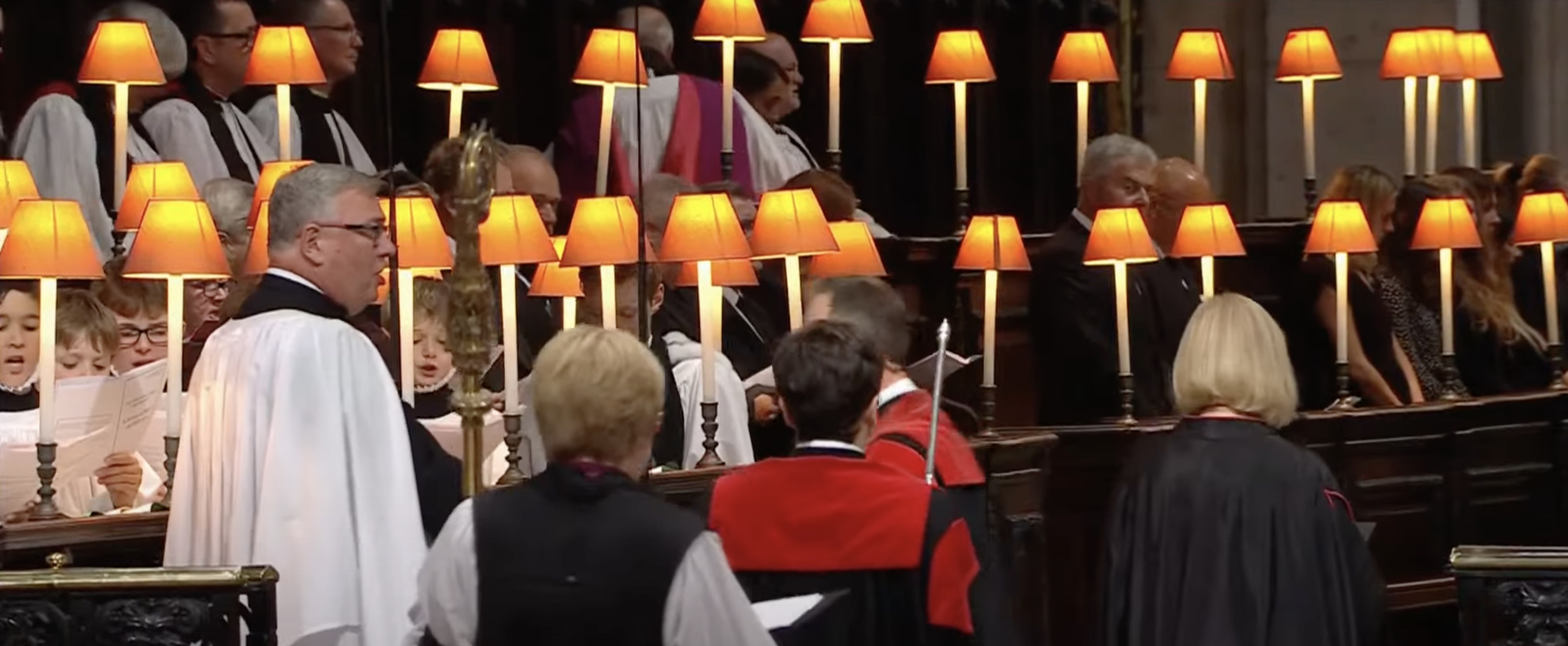
The Truth Within Beauty


There is something remarkable about traditional English and Anglican choral music. We hear it in the sustained notes sung without vibrato, and the full throated melodical willingness almost to shout out the most stirring words in beloved anthems.

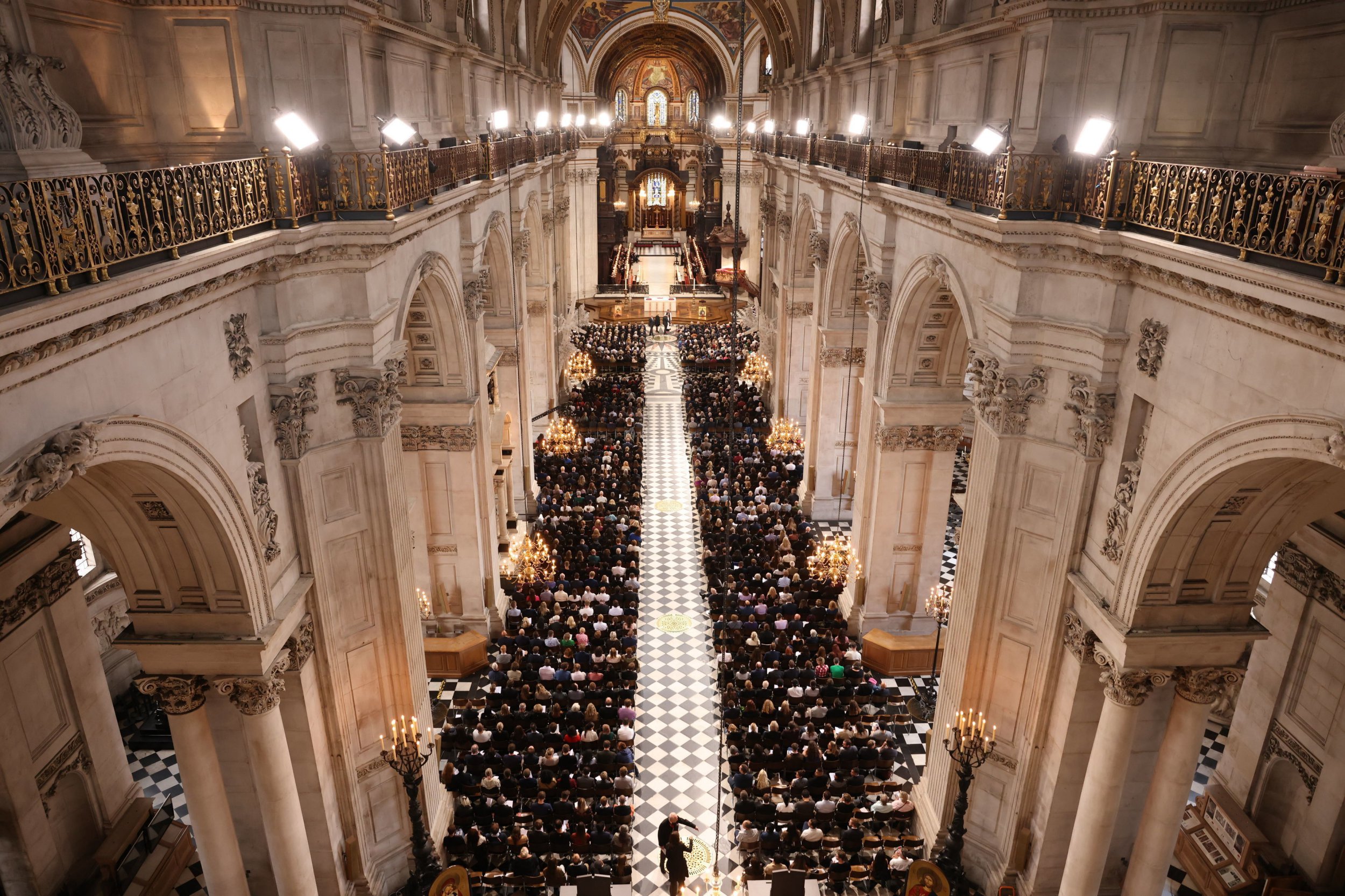
For me, this was most movingly displayed in the recent Service of Prayer and Reflection on the Queen’s Life, broadcast from St Paul’s Cathedral, London, following the televised address by the new King Charles.

The beautifully lyrical Herbert Howells tune, Michael, set for the processional hymn, was a most appropriate way to begin this liturgy remembering Elizabeth. Especially with its text, so meaningful for the occasion (“All my hope on God is founded…”). And then, to my further wonder, the first anthem was also a stirring setting by Howells, and sung in the most inspiring way by the cathedral choristers.

Having lived almost six years in England, all of it at Oxford, with the opportunity to hear Evensong sung by equally gifted choirs on a daily basis during term, has surely disposed me to a particular bias. English Anglicans can do liturgy and ceremony in the most superior and yet also spiritually evocative way, especially when it is non-politicized. We have much to learn from them on this side of ‘the pond.’

Perhaps it is first a willingness – by some of the most reticent people I have lived and worked with – to reach for and grasp at transcendence. And then, to express that desire and its fulfillment in worship, in a way that is so compelling for many. Witness two thousand seats filled on short notice in a first come, first served way for the Prayer and Reflection service for Queen Elizabeth. Many of those among the congregation appeared moved by the experience though it was also apparent that not all were familiar with Anglican hymns or forms of worship.

I would suggest that it was, and will remain, in large part the capacity of music – and music well-composed and well-prepared – which draws people into the power of beauty, and which also creates experiences of transcendence and of truth. Yet it is also the power of the word, both in the form of the words of the liturgies as well as in the Word as presented in Scripture. Well-chosen and well-presented biblical and liturgical texts, as well as those prepared for proclamation, allow people unfamiliar with the Christian faith and its customary practices to find themselves stirred. For this preparation and these practices invite others to be curious about the transcendent motivation behind and accounting for these remarkable occasions of public worship.

I have no doubt that the Queen’s upcoming funeral will provide no less of such an experience.


The above photos are screen captures of images from the UK’s Sky News streaming rebroadcast of the Service of Prayer and Reflection on the Queen’s Life, from St. Paul’s Cathedral, London (https://www.youtube.com/watch?v=KgOridFp7Do). Here is a link to the full text of that service (C ofE_Anglican_service_of_prayer_and_reflection_1)

I offer this with grateful thanks for the music ministry of John Hamersma, Mary Hamersma Baas, and Benita Woltersdorf-Fredlund, whose ministries have not only enriched my life and those of many others, but also have changed and affirmed our lives forward in a most positive way.