If reading this by email, please tap the title at the top to open your browser for the best experience. Then, clicking individual pictures will reveal higher resolution images.

Stanley Spencer, The Cruicifixion (1958)
(I am offering here my Good Friday homily for this year, based on one previously shared)
In the passion reading we have just heard, we are reminded of the dark spectacle of what human cruelty can accomplish. With Jesus, it was a vain attempt to obliterate the most beautiful human being who ever lived. Thank God, we have no photographs of the horrifying things that were done to him, but only paintings. But consider this paradox: the beauty of art has provided a way for us to a reflect on one of the darkest examples of human violence.
Paintings of our Lord’s Passion seem divided into two broad groups. There are those concerned to portray the grim reality of Roman execution. And, there are those inclined to explore and express the inner redemptive significance of what happened.
At the center of any portrayal of the Crucifixion of Jesus is an inescapable fact ~ it was an act of political and judicial violence, where the forces of earthly injustice pretended to act in the name of human truth. The corollary to this is how Jesus’ subsequent Resurrection restored heavenly justice in the name of divine truth. Paintings of Jesus’ Crucifixion, and those of his Resurrection, usually give attention to his wounded body, even though his wounds then appear transformed on the Third Day. After all, this is one way the disciples recognize him after his death. How the death-marked body of Jesus looked after his resurrection, also provides a preview of his appearance at the end of time.
Charles Wesley’s Advent hymn, “Lo! he comes, with clouds descending” offers words that also apply to Good Friday.
“Every eye shall now behold him,
robed in dreadful majesty;
those who set at nought and sold him,
pierced and nailed him to the tree,
deeply wailing, deeply wailing…
shall the true Messiah see.
Those dear tokens of his passion
still his dazzling body bears,
cause of endless exultation
to his ransomed worshippers;
with what rapture, with what rapture
gaze we on those glorious scars!”
It is natural to imagine how the people directly responsible for Jesus’ death, from Judas and the high priests, to Herod and Pilate, might be overcome with grief at the triumphal Second Coming of the Lord. Those who pierced him might feel themselves pierced by awakened guilt and remorse. Indeed, for every one of us, seeing the fruit of our mischief and misdeeds can provoke us to tears.
But I think Wesley was getting at more than repentance and contrition. Surely, seeing the full beauty of the glory of our Lord, with his wounds transfigured, will also summon our tears — but with tears of joy. Wesley, prayerfully and with sensitivity, has given voice to the profound power of beauty. Especially when it is discerned in the most unexpected of places – in the face and body of the crucified One. Love… the most profound love beyond human imagining, is manifest in the face and gestures of the crucified messiah. For he reaches out his hands even to forgive those who have tortured and sought to kill him. This is the most beautiful thing we could ever see.
As we pray in a Morning Prayer collect, “Lord Jesus Christ, you stretched out your arms of love on the hard wood of the cross that everyone might come within the reach of your saving embrace…”
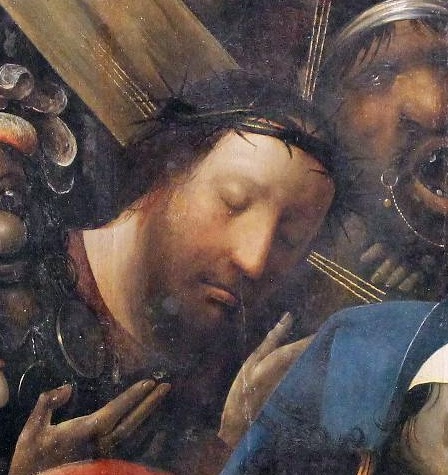
Perceiving all this helps us make sense of the paradox at the heart of Jesus’ Crucifixion. For, in it, we perceive the dramatic juxtaposition of serenity with antagonism, of beauty with its dark opposite, and of moral good with apparent evil. We can see this in two paintings I have included with your worship bulletin: Hieronymus Bosch’ painting of Christ Carrying the Cross, and Stanley Spencer’s 1958 painting, The Crucifixion. Looking at them, I encourage you to join me in asking an awkward question: with which person or persons in these paintings do we identify?

Hieronymus Bosch, Christ Carrying the Cross
Though some 500 years apart, both painters portray the tranquil appearance of the peaceful heart of Jesus, even in the face of vicious hostility. And like Bosch, Spencer helps us see what the beautiful One in our midst sometimes provokes. Especially when the shining light of his presence exposes the dark shadows within and around us. For his light sometimes prompts fierce anger and envy, as well as a callous indifference to cruelty and suffering. Things of which we are all capable. And we are likely to have much invested in denying this ugly truth. Strangely, when confronted face to face with the divine opposite of our perversity, we will either fight the light that we encounter, or surrender to it. The Passion narratives give us examples of those who resisted and even fought against the Light of the World. For we sometimes fight against the disturbing possibility that Jesus will conquer our pervasive ungodliness. And so, consciously or not, we try to do away with his godliness.
An encounter with true beauty can be unsettling and troubling, especially if we have already settled for so much less. We may often hope for the triumph of good over evil, that beauty will overcome darkness, and serenity will displace antagonism. But we cannot find it within ourselves to do more than hope. We cannot achieve the redemptive resolution for which we haltingly reach out with our feeble hands and hearts.
It is not an accident that the figure of Jesus in Stanley Spencer’s painting visually recedes in the foreground, while those who oppose and crucify him grab our interest and attention. Spencer, after mastering traditional realism, adopted what he called a neo-primitive style. He was a gifted colorist, and highly proficient with composition. And so, as Spencer has rendered him, Jesus’ skin tone and color roughly match that of the wood of the cross, as well as the clothing of the man with the hammer swung over his head. Spencer’s rendering of the Lord’s skin tone and color also match much of the sky and the ground below… including the tunic of Mary Magdalene, prostrate at the foot of the cross. This forms a compelling visual symbol. For Jesus totally identified with us, in his Incarnation, and in his Crucifixion. His crucifixion symbolizes his complete joining with us, and with our world of wrenching hurts and suffering.
In fact —as we see in Spencer’s composition and coloring— it is precisely because Jesus blended in so well with everyday life, that those who opposed him could literally gain the upper hand, ultimately with hammers and nails. (For he did not call down an army of angels to help him, as he could have.) But this is the marvel of the incarnation of our God in Jesus. The fullness of divinity thoroughly became joined with our fallen humanity. As the Gospels attest, this joining was so complete that many did not notice or have regard for his divinity. When we do notice his total identification with us, when we come face to face with the truth it represents, we have either one or the other of two reactions. We throw ourselves down in humility before him. Or, we seek to throw him down, to humble him before us.
These paradoxes are brought to their greatest prominence when, as he predicted, he is lifted up. His lifting up is his glorification, and the glorification of God within him. Yet his lifting up is on a cross, and in the agony of a humiliating public execution. Here we see the ‘strange beauty’ of our Lord — a beauty for which churches and museums better prepare us than do our malls and most TV shows.
So, let us “behold the fair beauty of the Lord, and … seek him in his temple.” We will find him! We will find him in the “temple” that he promised to raise in three days.
Additional note: Those interested in further reflection on some of the Holy Week themes raised here might wish to read my prior post, “What God Can Do, and Is Doing.”





















 Toward Beauty