Holy Week

Beauty Over the Reality of Chaos

[If reading this by email, please tap the title at the top to open your browser for the best experience.]

Peter Koenig, Good Shepherd Resurrection


The Resurrection of Jesus is all about grounded hope, and the strength to persevere in the face of adversity. Peter Koenig’s Good Shepherd Resurrection provides a compelling image of its power. The painting builds upon ancient biblical imagery of chaos manifest as a sea monster, and acknowledges how death and resistance to the will of God in the order of Creation pervade the world. The painting is brilliant in its conception, precisely because it is so counter to our culture-bound world of Easter bunnies, daffodils, and pastel-colored candy.

The Resurrection of Jesus is not mainly about hopeful feelings, a positive attitude and self-improvement, even though it can enable these things. His Resurrection is really about the defeat of evil and death, and triumph over pain and suffering. We may not immediately experience that defeat and triumph in our every moment of need. But, we live by Easter faith, and not by Easter feelings.

Peter Koenig risks showing us the Risen Lord stepping out of the mouth of a sea monster. The fresh water from his side recalls the water he made into wine, his crucifixion, and also -much earlier- the water from the rock in the wilderness. All these give us fresh water that fulfills genuine human need, as compared with the inhospitable salt water in which the dragon finds its abode. Every one of us is the lamb, held safely upon his shoulders, as he carries us out of the jaws of death into the new life where he is preeminent.

To me, this is real hope. Precisely because it is hope that deals with where we are now, rather than hope for something that might be, some day, somewhere. Both you and I want the kind of hope that squarely addresses all the things we’ve been worried about this last month. We all want hope that squarely confronts all the things we fear might go wrong in the coming month. And that is the kind of real hope that God brings to us in Jesus’ resurrection.


It pleases me once again to feature Peter Koenig’s painting, Good Shepherd Resurrection. This painting continues to give me confidence and courage. Click here to visit the website where this and other paintings by him may be viewed, or search his name on the internet. To see my Easter homily from which this is adapted, please click here. For background, see Revelation 12 and or do an internet search for biblical texts related to the words dragon, Rahab (i.e., Job 26:12-13 & Isaiah 51:9-10), Leviathan (i.e., Job 3:8, Psalm 74:13-14 & Isaiah 27:1), the deep, etc.

Beauty in Holy Week

[If reading this by email, please tap the title at the top to open your browser for the best experience.]

Stanley Spencer, The Crucifixion (1958)


During this Holy Week I find myself reflecting on the paradox at the heart of Jesus’ Crucifixion. In it we perceive a dramatic juxtaposition of serenity with antagonism, of beauty with its dark opposite, and of moral good with apparent evil.

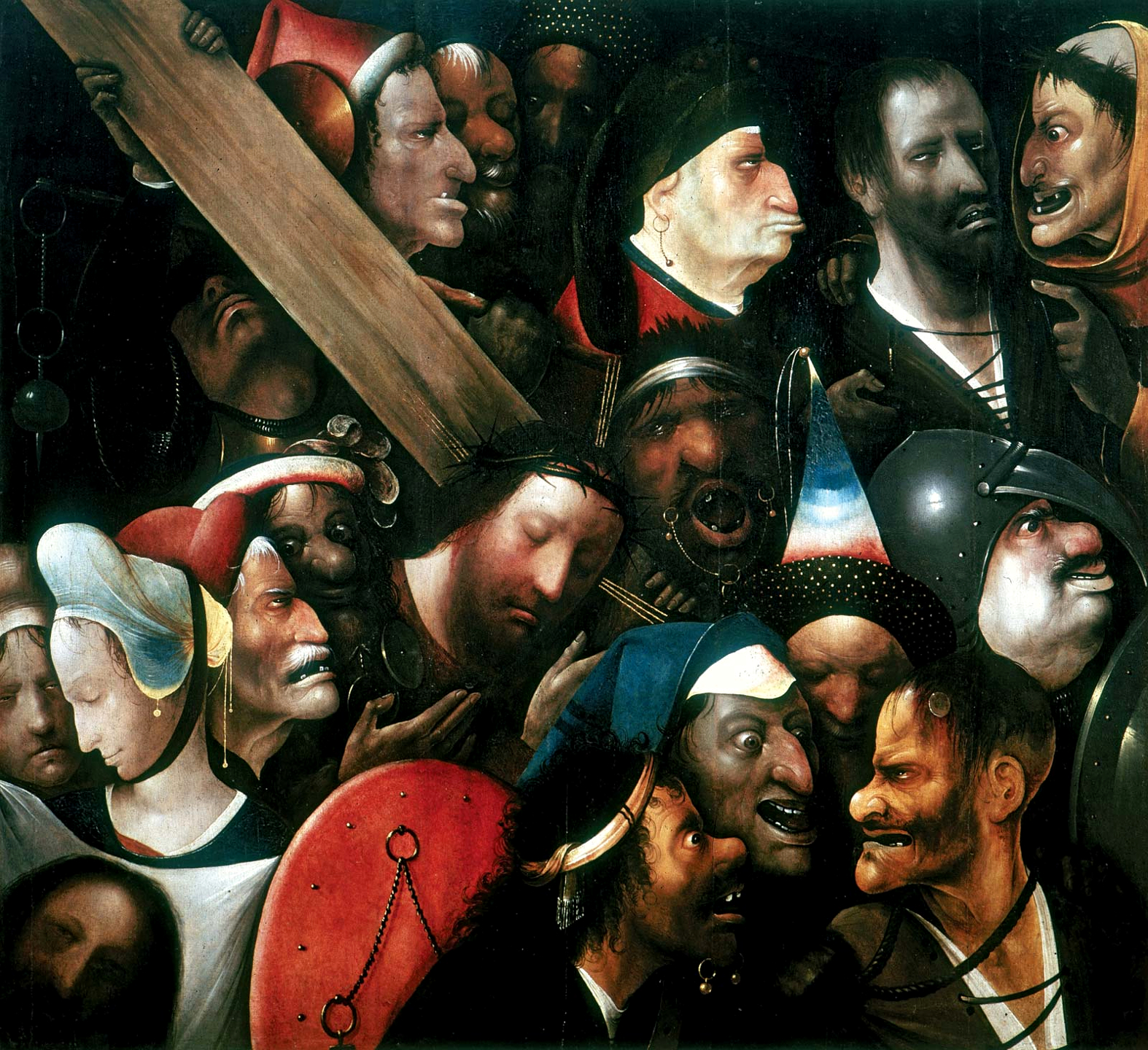
We can see this in a remarkable parallel between two paintings that were completed some 500 years apart: Hieronymus Bosch’s (attributed), Christ Carrying the Cross (1510-35), shown below, and Stanley Spencer’s, Crucifixion (1958). Both portray the tranquil visage and peaceful heart of Jesus, even in the face of vicious hostility.

Like Bosch, Spencer helps us see what the beautiful One in our midst sometimes provokes. Especially when the shining light of his presence exposes the dark shadows within and around us. For his light sometimes prompts fierce anger and envy, as well as a callous indifference to cruelty and suffering. Things of which we are all capable. And we are likely to have much invested in denying that ugly truth. Strangely, when confronted face to face with a divinity that is the opposite of our perversity, we will either fight the light that we encounter, or surrender to it. The Passion narratives give us examples of those who resisted and even fought against the Light of the World. Especially against the disturbing possibility that Jesus might conquer their pervasive ungodliness.  And so, they sought to do away with his godliness.

An encounter with true beauty can be unsettling and troubling, especially if we have already settled for so much less. It may be our sensitivity to the same juxtaposition of opposites I have noted, and their apparent lack of resolve. We often hope for the triumph of good over evil, that beauty will overcome darkness, and serenity displace antagonism. But we cannot find it within ourselves to do more than hope. We cannot achieve the redemptive resolution for which we haltingly reach out with our feeble hands and hearts.

It is not an accident that the Christ figure in Stanley Spencer’s painting recedes visually in the foreground, while those who oppose and crucify him grab our interest. Spencer, after mastering traditional realism, adopted what he called a neo-primitive style. He was a gifted colorist, and highly proficient with composition. And so, as Spencer has rendered him, Jesus’ skin tone and color roughly match that of the wood of the cross, as well as the clothing of the man with the hammer swung over his head. Spencer’s rendering of the Lord’s skin tone and color also matches much of the sky and the ground below, including the tunic of Mary Magdalene, prostrate at the foot of the cross. This forms a compelling visual symbol of Jesus’ total identification with us, in his Incarnation and in his Crucifixion. It symbolizes his complete joining with us, and with our world of tearing hurts and suffering.

In fact —as we see in Spencer’s composition and coloring— it is precisely because Jesus blended in so well with everyday life, that those who opposed him could literally gain the upper hand, ultimately with hammers and nails. But this is the marvel of the incarnation of our God in Jesus, that the fullness of divinity could be so thoroughly joined to our fallen humanity. As the Gospels attest, this joining was so complete that many did not notice or have regard for his divinity. When we do notice his total identification with us, when we come face to face with the truth it represents, we have either one or the other of two reactions. We throw ourselves down in humility before him. Or, we seek to throw him down, to humble him before us.

Spencer at work on his Crucifixion

Entry Into Jerusalem

[If reading this by email, please tap the title at the top to open your browser for the best experience.]

James Tissot, The Procession in the Streets of Jerusalem


This coming Sunday will be Palm Sunday in the Church’s western calendar, when we commemorate Jesus’ triumphal entry into Jerusalem. The day will also mark the beginning of our observance of Holy Week and the Passion of our Lord.

In James Tissot’s painting (above), look at the crowd of excited people he portrays, who await and greet Jesus’ entry into the Holy City. Two things are obvious about the arrival of this rabbi from the north in Jerusalem. We notice the huge and enthusiastic crowd. And, we notice the object of their attention, Jesus, who is riding on a donkey. At first, we naturally assume an affinity between the crowd and Jesus. The crowd is joyful about Jesus precisely because he is the answer to their questions, and the apparent solution to their concerns. Who he is seems to fit neatly with who they are, and with where they want to go. After all, who wouldn’t be happy when long-nurtured hopes and expectations are about to be fulfilled.

As Matthew describes the scene, the crowd responds to Jesus’ arrival in two ways, both of which evoke historic precedent. We learn from 2 Kings about the followers of Jehu. When they learn he has been anointed king, they spread their cloaks for him to walk on. And in 2 Maccabees, we learn how Judas Maccabaeus was greeted upon arriving in Jerusalem, after defeating Israel’s enemies. The people honored him by waving palm branches in the air. To clinch the point, Matthew want us to know that when Jesus arrived in Jerusalem, the crowd’s dramatic response was a fulfillment of God’s word through the prophets: “”Tell the daughter of Zion, look, your king is coming to you, humble, and mounted on a donkey, and on a colt, the foal of a donkey.”

In other words, as Matthew describes Jesus’ arrival in the city, the crowd’s greeting of him suggested a similar hope, that he might vanquish the repressive powers causing God’s people to suffer. This Nazarene might be the one to make God’s Kingdom present in their time. These observations can help us appreciate how Jesus was greeted when he entered Jerusalem, and how he was viewed soon after. For, like so many leaders in history, he was the object of an immense amount of hopeful projection. And yet, he did not arrive as a warrior on a horse.

Look again at this crowd in Tissot’s wonderful painting of Jesus’ arrival. How many in this crowd are looking directly at him? And of those, how many actually see him, and for who he is rather than for what he represents among their pre-existing desires? Look at how many in the crowd are carried away by the moment. They are excited by imagined possibilities, rather than by the Kingdom concretely at hand. This situation is not merely of historical interest, nor is it primarily about other people, living at another time. Jesus’ arrival in Jerusalem is also about us. His arrival invites us to consider our own hopes and expectations as we greet Him with palms and walk along beside him this Holy Week.


This image is from James Tissot’s painting, The Entry Into the City. I am indebted to N.T. Wright for the specific references to earlier biblical precedents regarding the way Jesus was greeted upon his arrival in Jerusalem.

Finding Beauty During Holy Week

James Tissot, The Resurrection


I had the privilege of seeing the original of this image by James Tissot at a recent exhibit of his work in San Francisco. I have known about this painting for some time, but was struck by how relatively small it is (image size approximately 8″ x 12″). Given the size, Tissot’s attention to detail is astonishing, especially when seen alongside his large oil paintings.

Like the one above, Tissot’s biblical paintings were largely done with opaque water color paint (now commonly termed “gouache” paint) and graphite on textured gray paper. This sets the water color paintings apart from his oil paintings in terms of their technical quality and pictorial finish. Nevertheless, they are in some ways more remarkable because Tissot was using the less forgiving medium of water colors instead of oil paints, which provide greater flexibility for painting over unsatisfactory or undesired results.

Choosing a single image for consideration in the context of Holy Week presents a certain challenge. For which of the events that we commemorate this week provides the most suitable reference point for our reflection? Considering this question, and possible answers to it, can help us gain insight about how we understand Holy Week in relation to Easter and more specifically whether we view the Passion (the arrest, trial, torture, and crucifixion) of Jesus as an essential part of the Easter story.

We know that it is not just among Christians, but also among Jews and Muslims, that notable differences concerning belief and practice exist among pious adherents of a shared religious tradition. A significant variable for Christians concerns how -in our prayers, worship and practices this week- we approach the relative significance of the key liturgical ‘moments’ that we commemorate during the ‘Holy Three Days’ (or Paschal Triduum). According to the biblical concept of time, these three days commence at sundown on what we now call Maundy Thursday. And so, the first ‘day’ includes remembrance of the Last Supper, Jesus’ arrest and trial, as well as his Good Friday crucifixion. The second ‘day’ then begins on Good Friday evening, just after when Jesus would have been buried. And the third begins after sundown on Holy Saturday evening, and includes the twenty four hours during which Jesus’ resurrection occurred and his empty tomb was then discovered.

When considering the significance of the events we commemorate at this time of the year, some Christians think primarily in terms of Easter Sunday and what Jesus’ resurrection will mean for them. Many others include in their reflection a spiritual consideration of the events we associate with Maundy Thursday and Good Friday. The broader ‘catholic’ liturgical tradition reflects this wider perspective in the liturgies appointed for Palm Sunday at the beginning of Holy Week. For example, The Book of Common Prayer liturgy for Palm Sunday commemorates Jesus’ journey on a donkey down from the Mount of Olives and his entrance into the Holy City, which leads to his ‘cleansing of the Temple’ and the subsequent conflict this provoked. A central feature of the Palm Sunday liturgy is a reading of the full Passion narrative from one of the first three Gospels. John’s Passion narrative is always read every year on Good Friday. And, on both Palm Sunday and Good Friday, the Passion story often incorporates readers who give voice to individual parts within the narrative.

In light of these observations, and as we prepare to enter the ‘Holy Three Days,’ I invite you to consider Tissot’s painting titled, The Resurrection. As you view and reflect on it, here are some details you may want to take into account:

  • Tissot portrays the moment of Jesus’ resurrection at night (rather than ‘Sunday morning,’ with lanterns partially illuminating the scene
  • Matthew’s Gospel mentions Joseph of Arimathea placing Jesus’ body “in his own new tomb, which he had hewn in the rock;” Tissot adds a dressed stone frame around the tomb entrance
  • though the crucifixion was enacted by Roman soldiers, Matthew suggests that the guard of soldiers sent to the tomb belong to the chief priests and the Pharisees and are primarily local citizens
  • the risen Lord still bears the marks of his torture and execution, though his wounds are transformed into points of light
  • diaphanous angels appear on the righthand side of the tomb opening

These and other observations about this resurrection painting make it relevant to our observance of Holy Week, as well as to Easter. I offer this image and these comments as a way into the mystery of this week.


The image above is James Tissot’s painting, The Resurrection, which with many of his other biblical paintings is part of the collection of the Brooklyn Museum.

The Beauty and Danger of Anticipation

Art_James Tissot_The Procession in the Streets of Jerusalem


Look at this crowd: in James Tissot’s painting, excited people await and greet Jesus’ entry into Jerusalem. Two things are obvious about his arrival in the city. We notice the huge and enthusiastic crowd. And, we notice the object of their attention, Jesus riding on a donkey. At first, we naturally assume an affinity between these two things. The crowd is joyful about Jesus precisely because he is the answer to their questions, and the apparent solution to their concerns. Who he is seems to fit neatly with who they are, and with where they want to go. After all, who wouldn’t be happy when long-nurtured hopes and expectations are about to be fulfilled.

As Matthew describes the scene, the crowd responds to Jesus’ arrival in two ways, both of which evoke historic precedent. We learn from 2 Kings about the followers of Jehu ~ when they learn he has been anointed king, they spread their cloaks for him to walk on.1 And in 2 Maccabees, we learn how Judas Maccabaeus was greeted upon arriving in Jerusalem, after defeating Israel’s enemies. The people honored him by waving palm branches in the air. To clinch the point, Matthew want us to know this: that when Jesus arrived in Jerusalem, the crowd’s dramatic response was a fulfillment of God’s word through the prophet Zechariah: “”Tell the daughter of Zion, Look, your king is coming to you, humble, and mounted on a donkey, and on a colt, the foal of a donkey.” 
And the people shouted, “Hosanna to the Son of David!”

In other words, as Matthew describes Jesus’ arrival in the city, the crowd’s greeting of him suggested a similar hope, that he might vanquish the repressive powers causing God’s people to suffer. This Nazarene might be the one to make God’s Kingdom present in their time. These observations can help us appreciate how Jesus was greeted when he arrived in Jerusalem, and how he was viewed soon after. For, like many leaders in history, he was the object of an immense amount of hopeful projection.

Consider again at the crowd in Tissot’s wonderful painting of Jesus’ arrival. How many of them are looking directly at him? And of those, how many actually see him, and for who he is rather than for what he represents among their pre- existing desires? Notice how many in the crowd are carried away by the moment. They are excited by imagined possibilities, rather than by the Kingdom concretely at hand. This situation is not merely of historical interest, nor is it primarily about other people, living at another time. Jesus’ arrival in Jerusalem is also about us, and about why we are drawn to worship during Holy Week. For his arrival invites us to consider our intentions this week, as we greet with palms our Lord’s arrival. And it prompts us to consider how we might best walk with him through the rest of the week.


This image is from James Tissot’s painting, The Procession in the Streets of Jerusalem. I am indebted to N.T. Wright regarding the specific references to earlier biblical precedents for the way Jesus was greeted upon his arrival in Jerusalem. This reflection is based on my sermon for Palm Sunday, which may be accessed by clicking here.

Holy Week and the Good Samaritan

Art_Tissot_The Good Samaritan

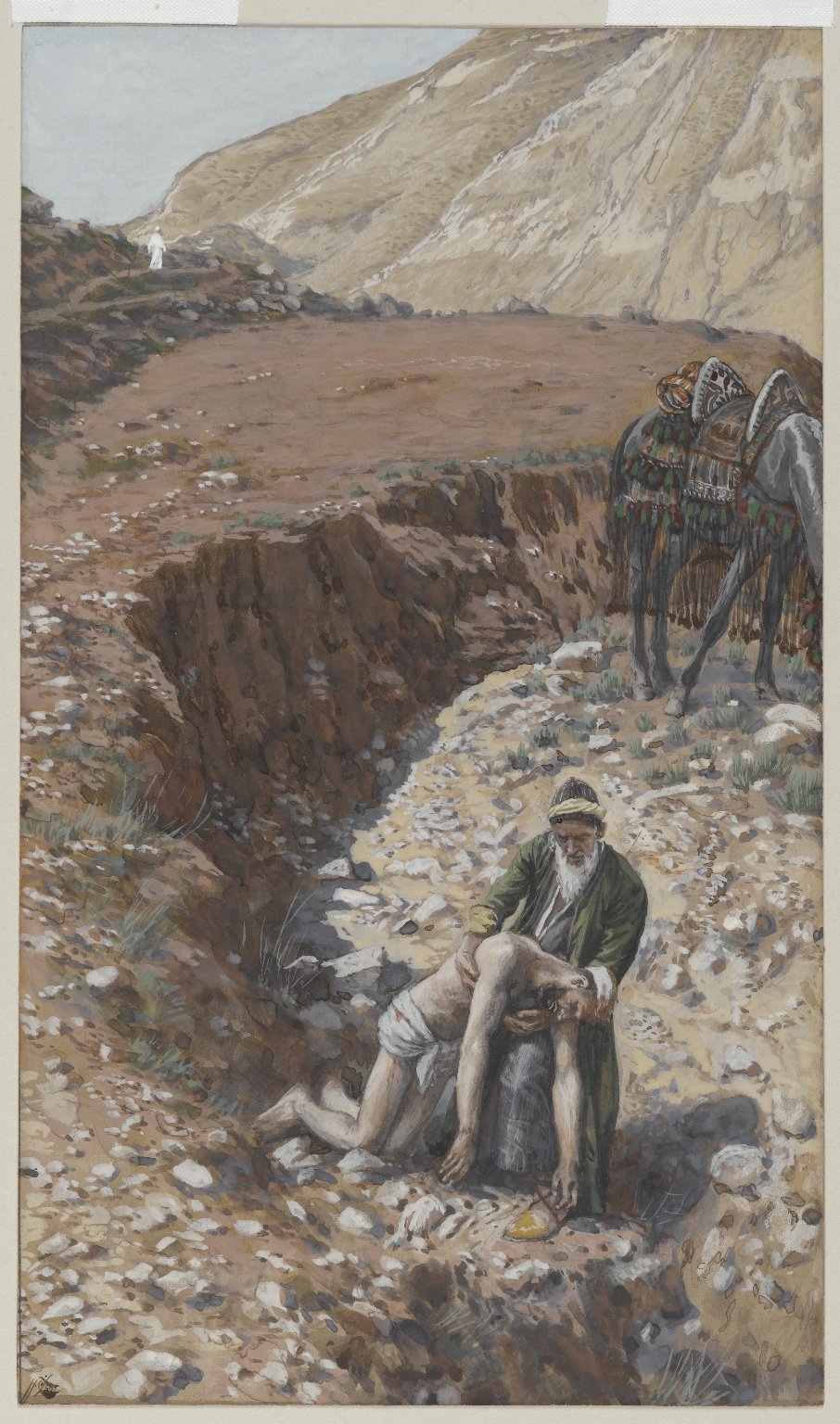
In telling his story about the Good Samaritan, Jesus was answering the question, “who is my neighbor?” At first, it may seem he was teaching us about how to live in God’s Kingdom. Cautioned by the negative example of the priest and Levite who pass by on the other side of the road, we should follow that of the charitable Samaritan who provides hospitality. But we can also hear the story as telling us something essential about God’s own charity and hospitality, and about Jesus’ role as God’s Messiah.

We are like the traveler in Jesus’ story who has been set upon. We often feel injured by life’s misfortunes, and the bad things that have happened to us through no fault of our own. Yet, God has not left us alone, to try and sort everything out. Instead, God in Jesus has come right to our point of need, and has ministered to us personally.

The mystery at the heart of Holy Week is this: God did not bypass the world’s need and suffering. Instead, in Jesus, God deliberately and willingly entered into the heart of the world’s darkness to offer the gift of light. God in Jesus took on every limitation we experience, and every pain we can endure. Why? So as to transform these real things from within.

Because God in Jesus did not bypass our world’s need and suffering, we shouldn’t bypass the way God entered into these everyday challenges. In God and with God, we have the holy opportunity to experience how the Spirit transforms our hurts and sorrows, and the emptiness of much of our lives. We see this particularly vividly in our services on Palm Sunday, Maundy Thursday and Good Friday.

Let us be with Jesus as he walks into Jerusalem to receive praise, and face scorn. Let’s be with him as he reclines with his friends for their last meal together. We can be with him as he enters the garden, prayerfully shaping his final resolve to live and die within God’s will. And we can be with him as he allows himself to be put to death on the cross for the sake of the world’s need and suffering.

As we walk through Holy Week with our brothers and sisters in Christ, we can rediscover how God has entered into, and transformed, our needy world.


The Good Samaritan image above is by James Tissot. Notice the figure in the upper left corner, who bypasses the traveler in need. Holy Week will be observed in most Western Christian churches this year during the week of April 9-15.

Our Beauty in His Eyes

Art_Tissot_Brooklyn_Museum_-_What_Our_Lord_Saw_from_the_Cross_(Ce_que_voyait_Notre-Seigneur_sur_la_Croix)_360KB

We are accustomed to looking up at him on the cross. Good Friday may prompt us, at least for a moment, to allow a reverse in the direction of the gaze.

For we are the objects of his attention, and of his love. If we discern anything about the meaning of Holy week, and the events within it, it is this: He acted for us, and not for himself. And God was in him, as he did so.

James Tissot pictures Jesus’ view from the cross on that dark afternoon, two thousand years ago. Just below his feet, he saw Mary Magdalene, prostrate with grief, showing her love for him. Just behind her, cloaked in dark blue and white, is his mother, hand across her heart, experiencing the sorrow it had been predicted she would endure. And to the left of Mary, in Jesus’ vision, we see the beloved disciple, John, in a white outer cloak over a green tunic. These three, and the two others behind Mary, are sympathetic figures. They have come to be by him in his darkest hour.

Others in Jesus’ field of vision may vary in their sympathies with his suffering. The Roman soldier cloaked in red could be the centurion, about whom we read in the Passion narratives. Standing by the cross, Tissot depicts him with a pained look on his face. He is beginning to realize that Jesus was innocent of the charges brought against him. By contrast, the two other soldiers near him appear either puzzled or disgusted by the whole situation.

As we survey this scene portraying Jesus’ field of vision from the cross, we cannot miss the group of men on horseback in the middle-ground. They are Scribes or Sadducees, those with power and wealth in the city, who had argued for his crucifixion. Some are shown taunting him. Some appear self-satisfied. And at least one is looking up at the darkening sky, which is already putting the upper edge of the scene in shadow.

He has acted for all these people, and especially for the ones who have turned against him. He looks upon them with love, and with a plea for God’s forgiveness. He knows what is in people’s hearts. What we so often forget is that he knows us better than we know ourselves. We may not understand how he knows us; but we do know that he knows us. We know that he loves us. And this is enough.

This is not a time for us to ponder the unknowability of God. This is a time to focus on our vulnerability, and our total knowability in God’s eyes. It is a time in which to contemplate the complete self-revealing of God, by Christ, for us. And to remember that he did this on a cross.


James Tissot, What Our Lord Saw From the Cross. For a link to my Good Friday homily, from which this is adapted, please click here.