Art

Two Architects Build Houses for Themselves

Frank Lloyd Wright’s Taliesin East, entry courtyard

Frank Lloyd Wright and Philip Johnson number among the most well known American architects of the 20th century. Both are remembered for their many commissions by others, for buildings constructed both in the United States and overseas. Notably, each of these men designed a house for himself and each reflects something of the respective architect’s vision for an ideal domestic building. The results differ dramatically and beg for some explanation, especially in the case of Philip Johnson’s Glass House.
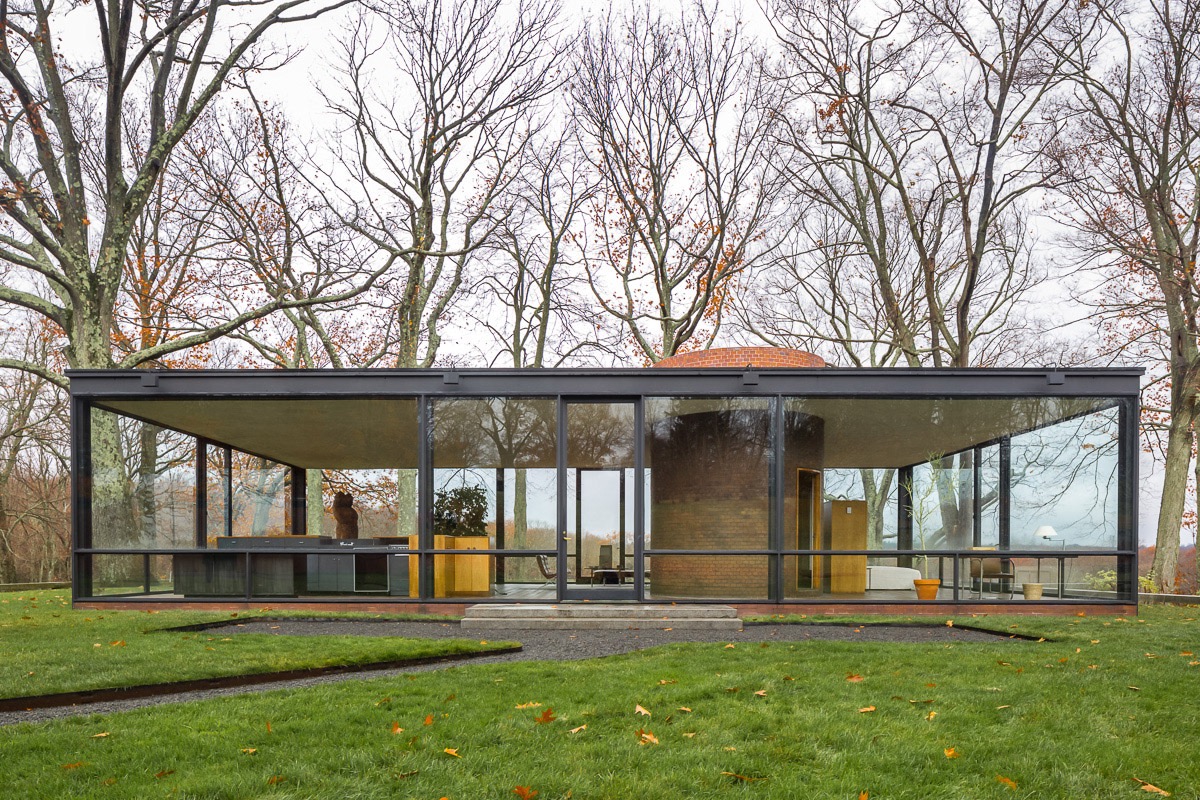
Philip Johnson, Glass House, exterior

To help appreciate the theoretical basis for these vastly differing houses, I find it helpful to draw upon a distinction made by the earthscape artist, Andres Amador (featured in a prior post). Speaking about his temporary compositions ‘sketched’ upon large stretches of beach areas at low tide, Amador refers to some of his works as “geometric” and others as “organic.” The geometric works display a quality readily suggested by the name for them, and reflect Amador’s training in math as an engineer. The organic works arise, he says, from the site, and he suggests that these pieces communicate their form to him. For me, Amador’s distinction can also be referred to as the distinction between pattern that is ‘received,’ as compared with pattern that is ‘imposed.’

Amador’s distinction between the organic patterns that arise from the site, and the geometric patterns that result from conceptual pre-planning, can assist us in perceiving some themes that are implied by the architectural designs produced by Wright and Johnson for their homes. In the case of Wright, he built Taliesin on family property in Spring Green, Wisconsin, in an area where he grew up and with which he had a deep attachment. Like much of his other work, Wright wanted Taliesin to appear as if it was an extension of the materials and features of the site in which it is placed, being an ‘organic’ development of a human habitation within a natural setting. Wright’s intent is evident in the way that the horizontal bands of stucco on the facade, as well as of the limestone in the foundation and walls of the building, parallel and mirror the layers of stone found on the site.
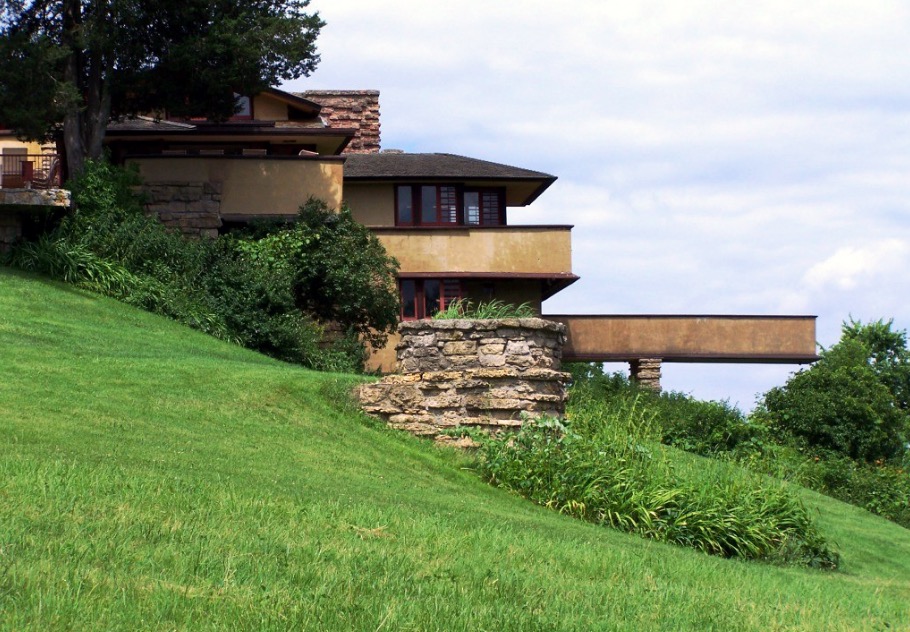
Exterior elevation of the house, as if emerging from the site (photos above and below)

While Philip Johnson’s architectural practice was located in New York City, he planned to build a house for himself and weekend guests in nearby New Canaan, Connecticut. Johnson’s Glass House clearly reflects his indebtedness to the work of Ludwig Mies van der Rohe, and the European modernist movement in architecture generally known as the International Style. Employing Andres Amador’s distinction, the Glass House clearly embodies a geometric conceptual basis, with the result that the building does not so much emerge from the site but instead sits upon it as an imposed human-made form. The carefully clipped and very flat lawn, and the linear walkways serve to emphasize the distinction between the structure and its natural surroundings. This leaves the Glass House appearing to be like a sculptural object that has been placed on a plaza, or like a vase on a smooth table-top, rather than as something arising from within its setting.

The Glass House, exterior view (above), and interior view (below)

Brief attention to the history of these two buildings provides further insight. Wright lived at Taliesin much of his life, while also retreating to Taliesin West in the Arizona desert during the winter months. Over the years, he gathered a sizable community of apprentices who lived and worked with him at both locations. To this day, the architectural fellowship that is part of his legacy maintains both homes and studios. By contrast, though Philip Johnson first lived part-time in the Glass House himself, he soon discovered how it was largely unsuitable for that purpose, other than for entertaining guests in the living and dining areas of the structure. Given the sudden notoriety of the house, the constant presence of unwelcome visitors and architecture-minded prowlers made it problematic for every exterior surface of the house to be comprised of glass. Johnson soon made it a habit to stay in the adjacent bunker-like Brick House, designed for the site as a guest house, when spending time in New Canaan.

Obviously, it is easy to stress the marked differences between these houses designed and built by Wright and Johnson for themselves. Andres Amador’s dual approach to his earthscapes may help provide a reminder of the way that both-and thinking can aid how we consider certain objects of interest. Wright’s organic home and studio, emerging within and receiving inspiration from its site, and Johnson’s temporarily lived-in Glass House, imposed as a geometric sculpture upon its site, share a common distinction. Regardless of functional considerations, each house has its own way of displaying beauty, and both remain among a small list of internationally recognized architectural achievements of historic significance.


Note: A short introductory video about Andres Amador and his work, giving examples from both of the geometric and organic categories, introduced above, has been produced by KQED of San Francisco. It can be found on YouTube ( https://youtu.be/T_tIG5mo1DM?si=0MkjxkTEK48eC-aV ).

Taliesin East has been named a UNESCO World Heritage Site, and the Glass House is a National Historic Landmark.

Andy Warhol visits the Glass House

A Church by Errol Barron in Gulfport

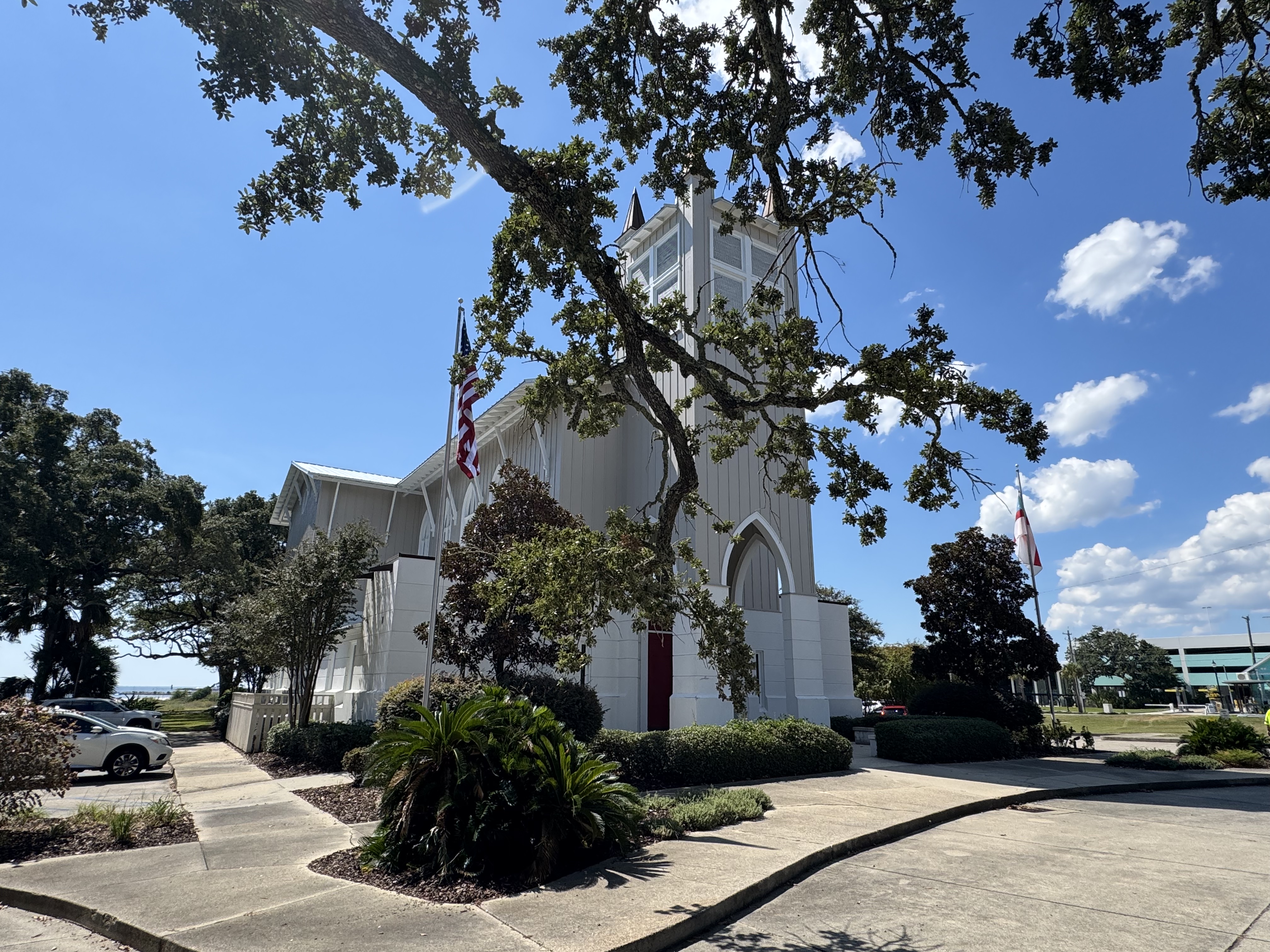
St Peter’s by the Sea, Gulfport, MS, designed by Errol Barron

Errol Barron’s work as an artist may be familiar to readers of this website based on some of his evocative New Orleans water color paintings previously featured here. His paintings of that city as well as of Tulane University, where he has taught for many years, provide strong indications that he is more than a skilled painter and draftsman, but also a trained architect. He has taught generations of architectural students at Tulane, and he has practiced his profession to great effect not only in this region but also overseas, with some houses of his located in Greece. Given Barron’s evident sensitivity to historical architecture and design features characteristic of this region, I was surprised to learn about a notable but unexpected feature of his resume. He worked for seven years with Paul Rudolph, architect of the well-known and oft-criticized Boston Government Services Center and a partial inspiration for the movie, The Brutalist.

St Peter’s by the Sea, interior

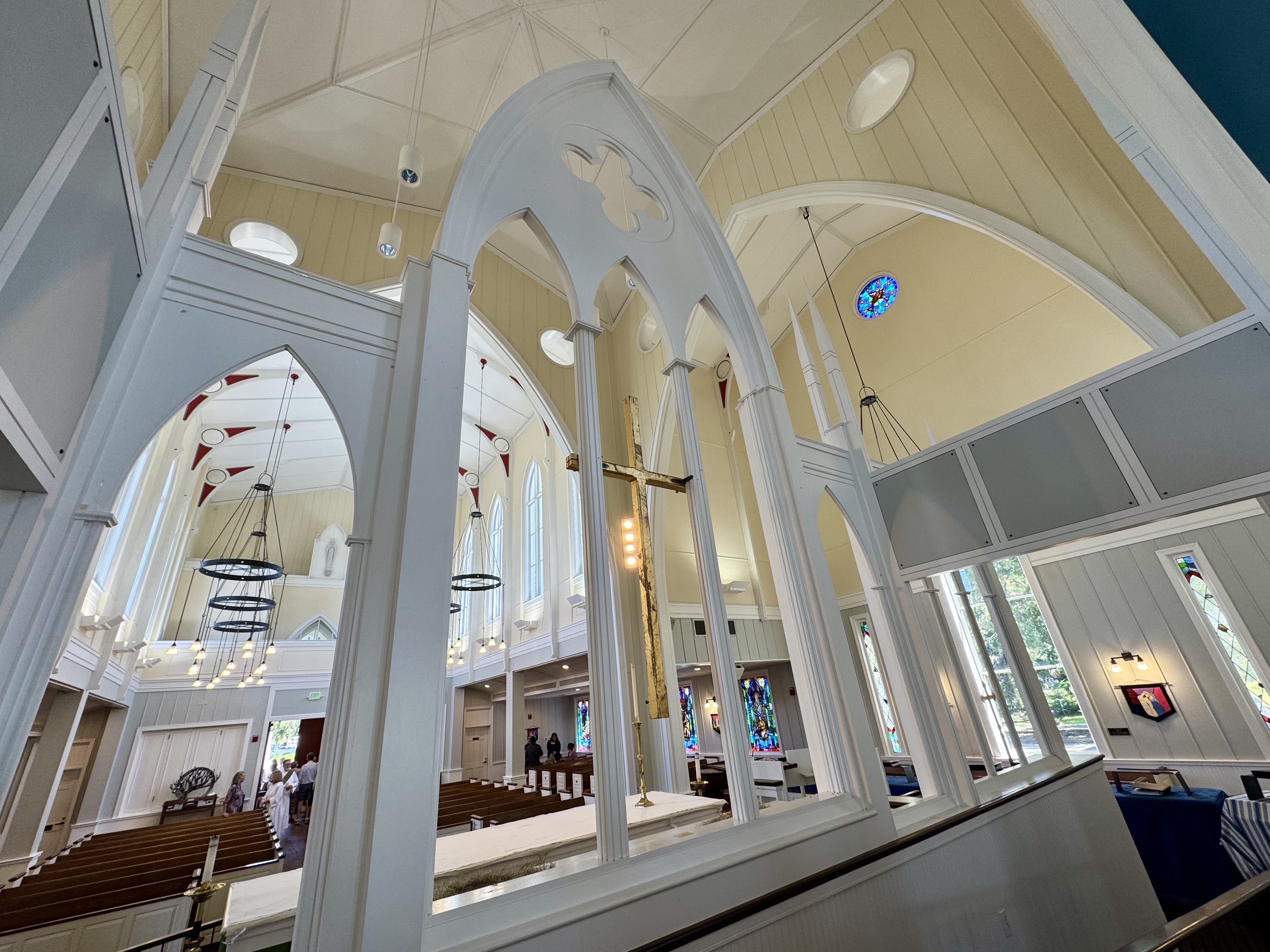
I was recently delighted to discover the Episcopal church in Gulfport, Mississippi, St. Peter’s by the Sea, and that Errol Barron was its architect. It is a gem of a church, and a very successful design that incorporates traditional ecclesiastical elements associated with European Gothic churches along with features reflecting contemporary liturgical renewal. I have heard people refer to this style of church building as Carpenter Gothic, and as Southern Gothic, and the labels seem to fit well. The worship space exudes an appreciation for traditional forms while harmoniously blending them with a contemporary focus upon light, color, and the greater participation of worshippers in flowing open spaces.

The main altar with the ornamental rood screen

Visitors to the Washington National Cathedral, and similar churches of Gothic-revival style, may recognize the particular heritage that stands behind the floor plan of St Peter by the Sea. At the National Cathedral, and in its medieval forebears (such as London’s Westminster Abbey), an arched stone ‘rood screen’ separates the chancel and choir (beyond the screen) from the nave where the congregation is seated. When, in the 1960’s, the liturgical renewal movement began to influence changes in the worship arrangements of these buildings, a new main altar was often then placed in the nave, on the congregation’s side of the rood screen. Smaller gatherings for weekday services could still occur in the choir side of that screen, while Sunday gatherings for the principal Eucharist would be celebrated in the nave, with the clergy, altar, and liturgical action proximate and visible to the congregation.

A view of the ceiling and woodwork above the choir

Though St Peter’s by the Sea is a comparatively recent building, its design reflects something of the historical sequence described above. Instead of an imposing stone rood screen, shielding the chancel and choir spaces beyond, Barron has designed an ornamental arched screen of light-colored wood that suggests rather than imposes separate areas within the overall space. This allows the evocative blue canopy of the ceiling over the chancel to draw one’s eyes forward, toward the visible clear windows at the liturgical ‘east end’ of that space behind the chapel altar, facing the seashore.

Further, the notably narrow, even sharp-looking, wooden ‘spires’ protruding above where the choir chairs are placed enhance the upward sense of lift in the nave, complemented by the radiant cream and white color scheme above where the congregation sits. Light pours in through clear windows above, while delicately fashioned and dangling wrought iron fixtures provide supplemental illumination for evening services and in poor weather.

A view toward the nave from the choir, through the rood screen

On the Sunday of my recent visit, I was told that the congregation numbered about 145, and I estimate that the nave would comfortably seat about 200 people, though it could probably accommodate more. With the Gothic-inspired longitudinal floorplan, evident when one approaches the exterior of the building, a visitor might expect a rather narrow and linear worship space. Such an initial impression of the likely effect of the interior spatial arrangement is overcome by a number of subtle but effective design choices made by the architect and those who worked with him.

Accompanying the verticality of the large open area above the center of the nave are the seating areas adjoining the side aisles, taking the places of side chapels found in many medieval Gothic churches. The relatively low height of the box pews enhances the sense of horizontal width created by these adjacent seating areas, which provide relatively unobstructed views of the altar and lecterns. I also found the acoustics within the worship space to be well-suited for music as well as for public reading and speaking.

I am drawn to the ethos of historical churches; I am enthused by many examples of modern architecture; and I appreciate the fruits of the liturgical renewal movement. In my experience, a successful blend of these three things is not always found in contemporary buildings designed for worship and intended for the enhancement of congregational life. In his design for St. Peter’s by the Sea, in Gulfport, Mississippi, and in his supervision of its restoration after Hurricane Katrina, Errol Barron has achieved just such of a desirable synthesis.

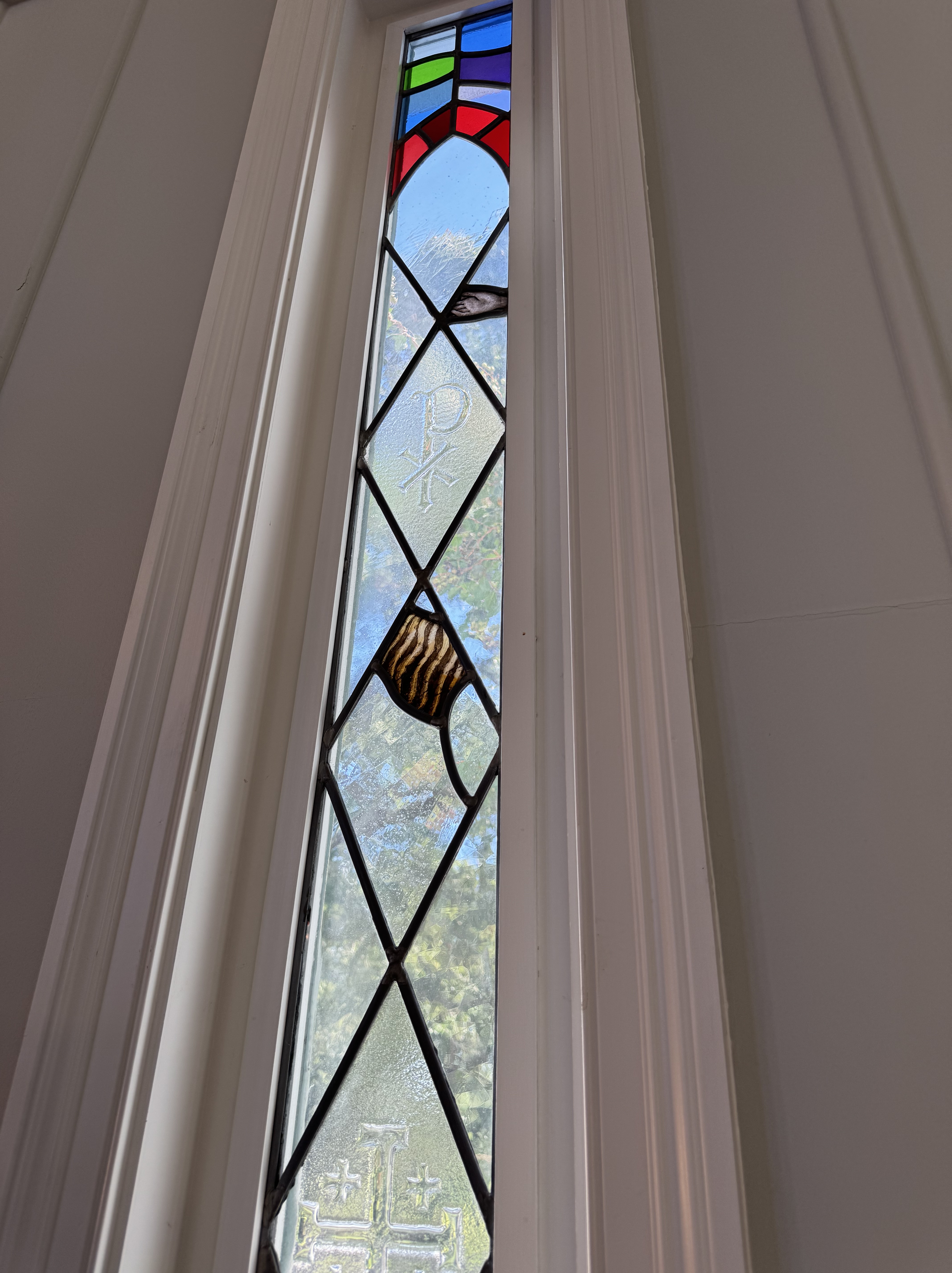
A representative side window incorporating stained glass window fragments recovered after Hurricane Katrina

The Challenge Posed by Eric Gill

If reading this by email, please tap the title at the top to open your browser for the best experience. Then, clicking individual pictures will reveal higher resolution images.

Eric Gill, Christ Crowned


To my mind, some of the most beautiful work in the area of graphic art was created by the British artist and craftsman, Eric Gill. The intractable problem posed by Eric Gill is not a legacy of his artistic output, but of his personal life. Largely unknown to those outside his family until about 50 years after his death, Eric Gill – by admission in his own unpublished writings – had engaged in personal behavior of a kind that most people would find not only abhorrent but, increasingly, as also criminal.

This is related to the larger problem posed by the work of artists, musicians, and architects whose work is seen as having been collaborative with tyrannical regimes (eg., the Third Reich, the Soviet Union). How do we view beauty in art that either depicts or is simply associated in some way with sin or with evil? (This is a matter I have previously tried to understand in relation to Picasso’s great painting, Guernica.)

To cite Scripture to the effect that “all have sinned,” may help us begin to locate the terrain upon which we need to address the problems stemming from Eric Gill’s biography, but it is not in any way to excuse his conduct. Though all sin is bad, and equally problematic in the eyes of God, not all sin is equal in its damaging effect upon others, and upon ourselves. The traditional distinction in moral theology between mortal and venial sins provides one way to try to parse some of these differences, while not excusing any forms or examples of sin, whether in ourselves or among others.

My purpose here is to invite reflection upon how we might appreciate Eric Gill’s religious art, as many did for several generations, without having our view of the merit of his work diminished by our moral evaluation of troubling ethical choices he made, and the lapses from good moral judgment they represent. In other words, and as an amateur student of the arts while also being a retired parish priest and former professor of moral theology, I wish to present some examples of Eric Gill’s art, letting his work speak for itself apart from ethical consideration of his personal life, and without ignoring the problems associated with the latter.

Perhaps my theme here can be summed up in this way: I invite you to benefit from the beauty of what Eric Gill created without asking you to overlook what we have learned about his private life. And I offer this invitation aware that some will not find it possible to accept.

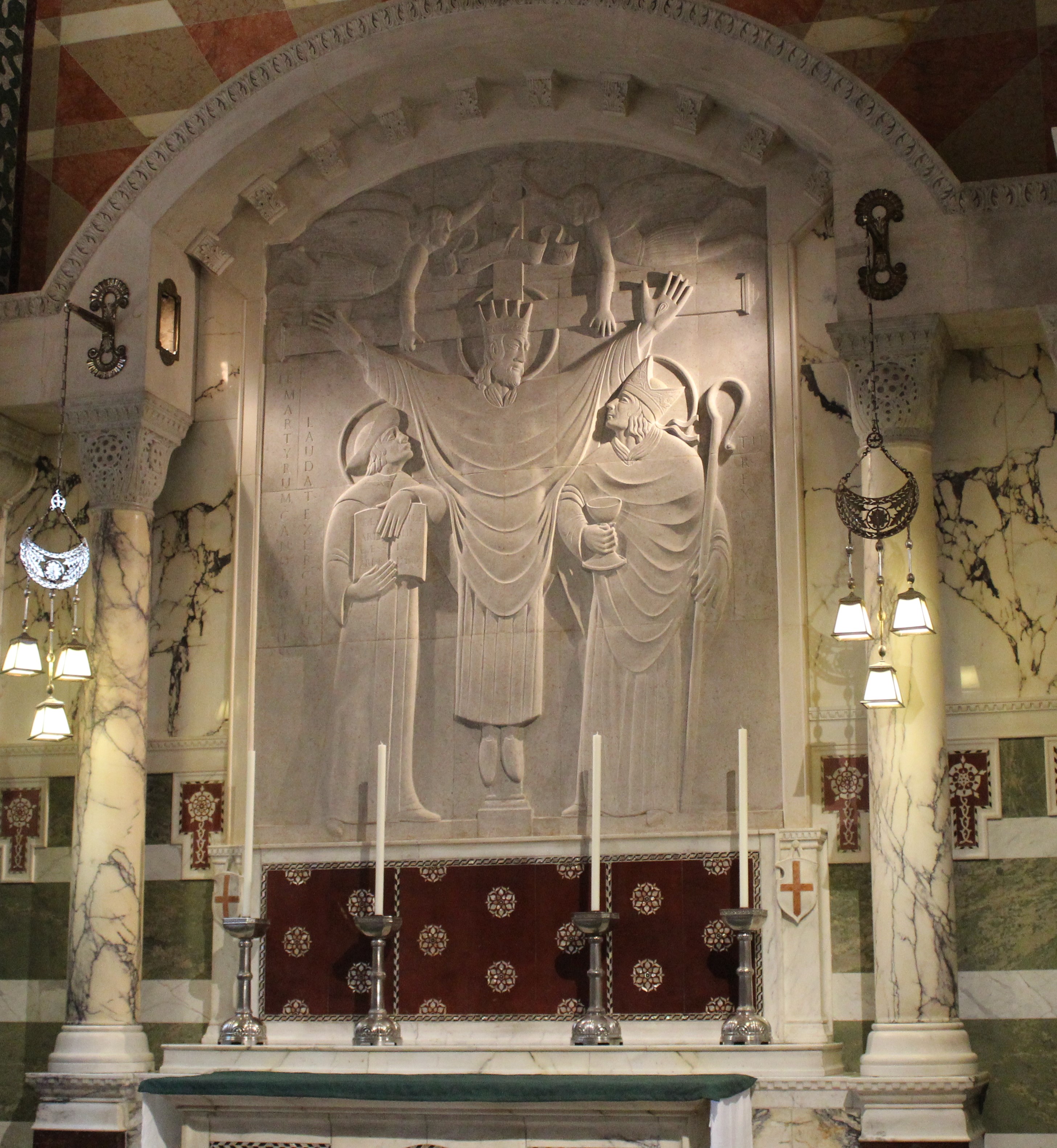
A sculpted carving by Eric Gill above the altar of the Chapel of St George and the English Martyrs, Westminster Cathedral, London
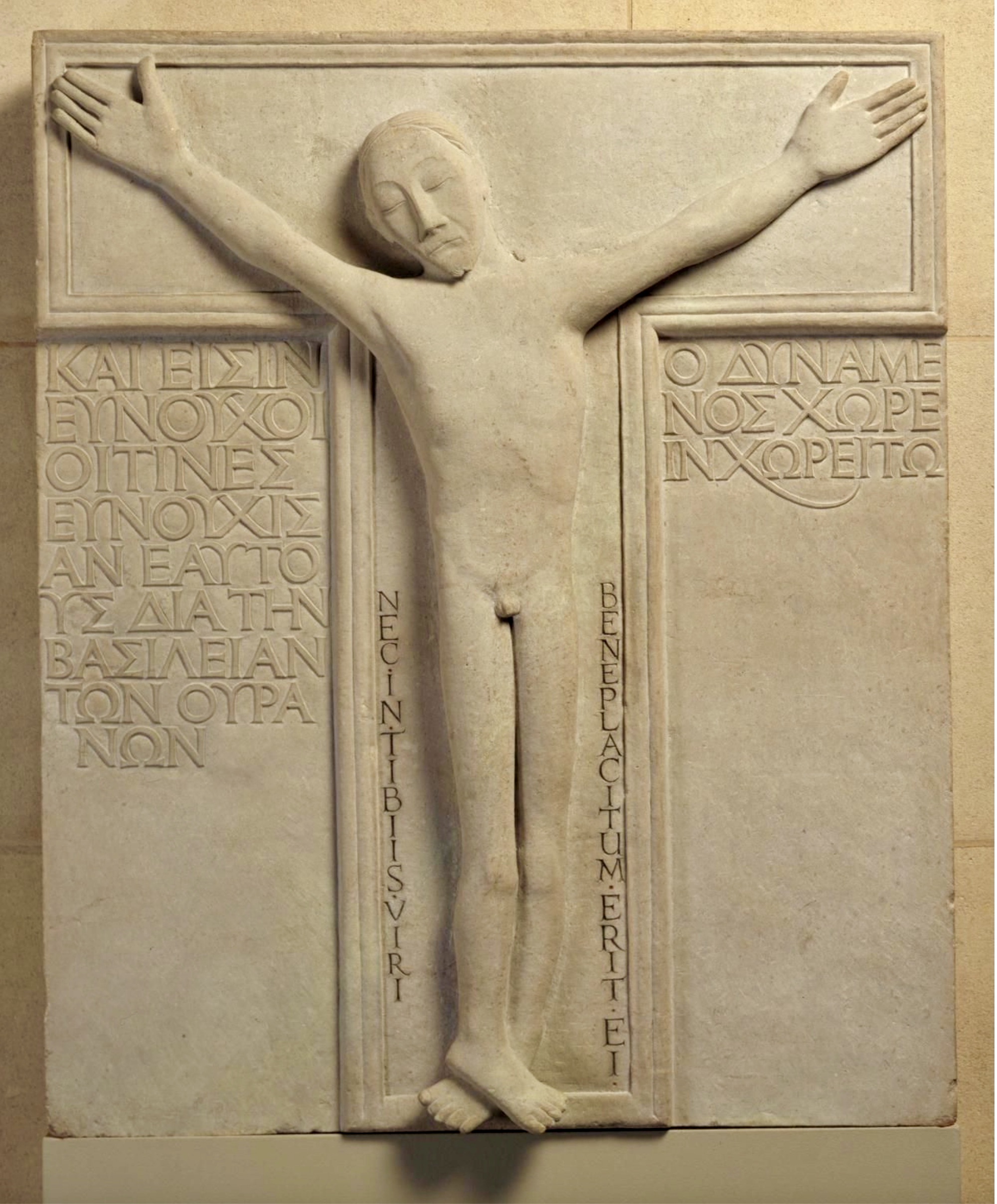
Eric Gill, Crucifixion
Eric Gill, sculpted relief panel from a series of the Stations of the Cross, Westminster Cathedral, London

As we consider some of his art, we should not overlook Eric Gill’s impact, at least indirectly, upon much of the daily life of the population of Great Britain (and elsewhere), in the form of three type faces he created. The most well-known is Gill Sans, named after its designer, and evident at almost every Tube stop in London. An effort to erase his work from the public eye, and replace it with alternatives, would require removing virtually every train station sign in Britain. It could be done. Should it?

Three fonts designed by Eric Gill

To put the problem I have raised here most bluntly, how can we appreciate the beauty in the holy art created by someone who behaved in a way most people would describe as sinful? I do not have a ready answer to this question. Note that, in what I have written above about Gill’s behavior, I have not gone into detail. Would that make a difference? If so, in what way?

And even if we refuse to give any amount of attention to Eric Gill’s artwork, we must still grapple with a timeless question: are there any unforgivable sins? Is anyone, because of his or her behavior, beyond the power of God’s redeeming love? Is it not likely that someone having Gill’s religious inclination also possesses a glimmer of moral awareness such that he or she might be open to repentance when – at the end of life – the person faces the awesome and undiminished light of God’s truth-seeking love?

Here is one thing that we can do: pray for the repose of the soul of Eric Gill, and for God’s Providential mercy.

In beginning to approach the questions I have raised here, I would start with some of the distinctions I shared above. I do not think we can deny this reality – that we, as people who are created in the image and likeness of God, and who have lost that likeness through the Fall and human sin, still bear God’s image however marred it may be by the corruption resulting from our sins. And, that we are still capable while in this life of acts and works of uplifting beauty.