A Strange Beauty

Stanley_Spencer_the_crucifixion_1958


An encounter with true beauty can be troubling, especially if we have settled for so much less. It may be our sensitivity to the juxtaposition of opposites, and their apparent lack of resolve. At times we hope for the triumph of good over evil, that beauty will overcome darkness, and serenity displace antagonism. But we cannot find it within ourselves to do more than hope. We cannot achieve the redemptive resolution for which we haltingly reach out our hands and hearts.

It is not an accident that the figure of Jesus recedes into the background of this painting, while those who oppose and crucify him grab our visual interest. Stanley Spencer, who adopted what he called a neo-primitive style, was far too gifted a colorist, and master of light and dark, to let that happen unawares. As Spencer has rendered him, Jesus’ skin tone and color match the wood of the cross, and also the clothing of the man with the hammer swung over his head, as well as much of the sky and of the ground below… including the tunic of Mary Magdalene, prostrate on the ground. This forms a compelling visual symbol of his Jesus’ total identification with us in his incarnation, and his complete joining with us, and with our world of tearing hurts and suffering.

In fact, it is precisely because —in Spencer’s composition and coloring— Jesus could blend in so well with the background of everyday life, that those who opposed him could literally gain the upper hand, with hammers and nails. But this is only the marvel of the incarnation of our God in Jesus, that the fullness of divinity could be so thoroughly joined to the incompleteness of humanity. As the Gospels attest, it was a joining so thorough that many did not notice or have regard for his divinity. When we do notice that thorough joining, when we come face to face with the truths it represents, we have either one or the other of two reactions. When we get close enough to see —to really see him— there are only two responses. We throw ourselves down in humility before him. Or, we seek to throw him down, to humble him before us.

These paradoxes are brought to their greatest prominence when, as he predicted, he is lifted up. His lifting up is his glorification, and the glorification of God within him. Yet his lifting up is on a cross, and in the agony of a humiliating public execution. Here we see a ‘strange beauty’ — the strange beauty of the Lord — a beauty for which museums better prepare us than do our malls. Let us “behold the fair beauty of the Lord, and seek him in his temple.” We will find him! We will find him in the “temple” he promised to raise in three days.


The painting above is The Crucifixion, 1958, by Stanley Spencer. This reflection is based on my homily for Good Friday, which also makes reference to Charles Wesley’s text, “Lo! He comes, with clouds descending.” Click here for a link to this homily.
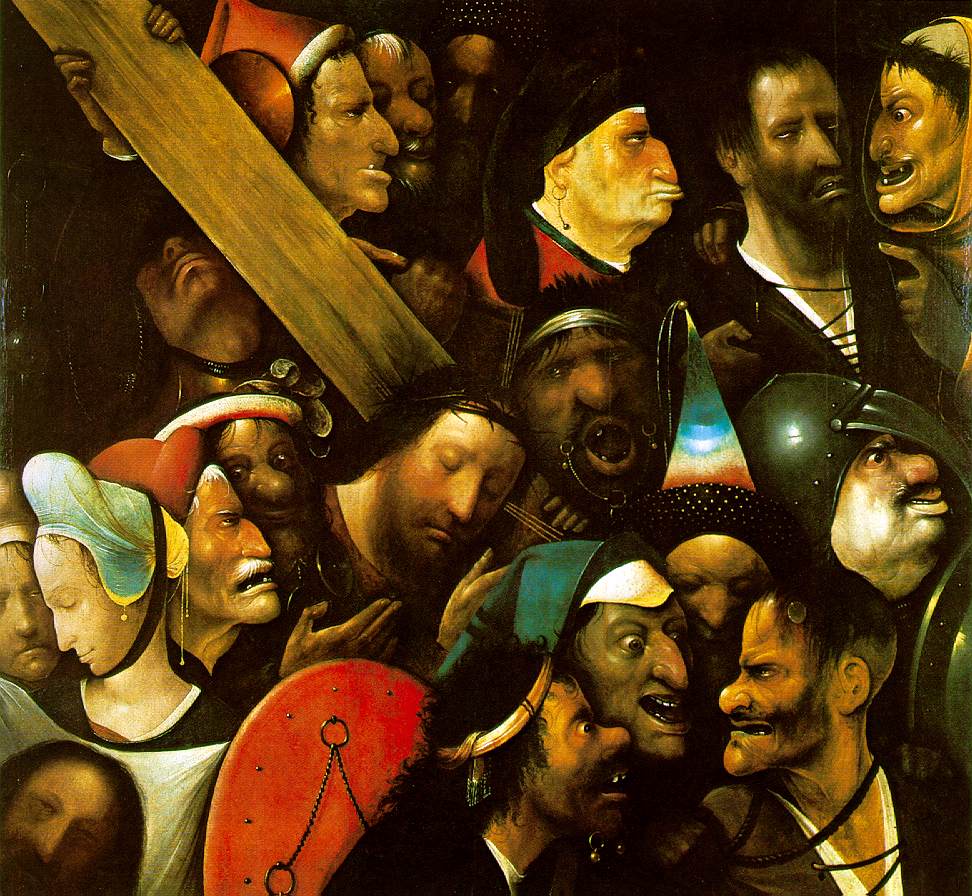
Hieronymus Bosch and the Beauty of Holy Week

Bosch- Hieronymus- Christ carrying the Cross - 1515 - Biggest copy


Hieronymus Bosch has succeeded in portraying something few other painters have come near achieving. He beautifully and compelling conveys the peaceful heart of Jesus, content to accept and receive all our scorn and its resulting pain. Bosch has captured the pure heart of Jesus, a vision of which Gandhi, Martin Luther King and Jonathan Daniels were given a glimpse, and which shaped how they lived as well as how they died.

With sustained attention to the composition of the painting you will notice a significant detail. The faces of seventeen people appear in the painting, not counting Jesus nor his image on the legendary Veronica’s towel. Seventeen people who are part of the crowd, and not one of them is looking at Jesus! Not even the man with the orange hat in the left center of the painting. Though he is facing Jesus, his eyes are turned upward toward the man with whom he is apparently talking. A crowd full of agitated people, with Jesus in the middle, and not one of them is focused on him. In other words, all of them are focused on their own concerns and purposes. Though Jesus came into a world so in need of him, and into a city filled with human problems, the people around him are heedless to his significance. And yet, for them, for those who are happy to push him to his death, he will carry his cross.

As I reflect on this painting, I am challenged to consider which persons in Bosch’s crowd best represent me. And then, I am moved to think about how Jesus provided God’s self-portrait for the world.

Ask yourself: Do I embrace Jesus in the same way Bosch portrays Jesus holding his cross? Are my eyes usually focused on other people, and on other things, rather than on him? How often do I let pettiness, anger, jealousy and boredom take center stage in my attention, rather than a vision of the peaceful heart of Jesus? It helps to remember that, no matter what, he holds on to us just like he holds that cross.


The above painting is Christ Carrying the Cross, by Hieronymus Bosch, 1515. For my Palm Sunday homily, which makes reference to this painting, click here.

Fully Alive

Byzantine Imago Dei


An early Christian bishop, St. Irenaeus, left a saying dear to many: the glory of God is the human person fully alive.

We are called to be fully alive, and to realize God’s glory in our own being. To be fully alive is a gift rather than an attainment, and means experiencing an integration of body and mind, as well as heart and spirit. Such a synthesis is uniquely human. Angels lack bodies, and animals lack God’s breath or spirit within them.

When fully alive, we reflect how we were created in God’s image and likeness. We have lost likeness with God, yet God’s image remains within us. God seeks to restore us to likeness with him through his redemptive mission, to transform us and all Creation toward our End in him.

We explore varying interests and concerns on our journeys toward wholeness, and holiness. We recognize we are drawn to beauty. We sense what is right and good in our interaction with others. We become aware of our spiritual growth when we discern how truth involves more than analytical knowledge, and requires divine wisdom.

Some people conceive of beauty, goodness and truth as involving a hierarchical journey, where we ascend from beauty through the good toward truth. Thinking in this ‘layered’ way can have a negative consequence ~ leaving beauty behind.

Why? If pursuing the good takes us beyond beauty, and our desire for truth takes us beyond exploring the good, we may wrongly think that wholeness involves forgetting beauty. Mistakenly, we will conclude that growth toward inward beauty is not essential to our wholeness in God. We are then less able to accept genuinely godly art, music or literature.

The events we commemorate liturgically during Holy Week are not an optional overlay on what God has done for us in Creation. The redemptive mission of God, manifest on the Cross and in the Resurrection, makes possible being fully alive. We are restored and transformed through a beautiful self-offering, made by the One through whom all things were made. True human beauty cannot be grasped without a vision of divine glory, revealed fully in the face of Jesus.


[In relation to the above, see Gen. 1:26-8, for how we were created in God’s own image and likeness, and Gen. 2:7, for how, among all creatures, we are uniquely “in-breathed” with God’s breath/spirit (same word in Hebrew). In Christian doctrine, angels are spiritual persons without bodies; we are spiritual persons with bodies; animals are embodied but –however intelligent– are without a “spiritual” nature.]

Beauty and Authority

Transfiguration300dpi

A noticeable antipathy toward “authority” pervades our culture. We think of authority as external to us, and as having the capacity to constrain our free choices and self-expression. Modern and ancient examples support this impression. Think of recent stories about the Port Authority of NY & NJ and the closure of traffic lanes leading to a major bridge. Or the Gospel centurion who referred to himself as “a man under authority,” who also had soldiers under him.

Given this, it may seem incongruous to mention the words “beauty” and “authority” in the same breath. But then, compare these sentences: “I was arrested by the authorities;” and, “I was arrested by her beauty.” Beauty has authority!

Years after studying with Oliver O’Donovan, I remain curious about an insight he offers concerning authority. Put in my own words, an authority is something that makes our responses or actions intelligible. When we defer to an older person, we are responding in part to the authority of age. If we set aside a long-held idea when presented with a compelling reason to see the matter differently, we respond to the authority of truth. The natural authority of beauty functions in a similar way. By selecting a stunning handmade cross for our church rather than one from a religious supply catalogue, we are responding to the authority of beauty.

These examples help us recognize how authority functions internally within us as we respond to the world. Authority is not simply a feature of our encounter with various officials and institutions, and it does more than compel. Authority invites responses by summoning our attention and prompting our discernment. This concept of authority imbues a prayer for the feast of The Transfiguration:

“O God, who on the holy mount revealed… your well-beloved Son, wonderfully transfigured, in raiment white and glistening: Mercifully grant that we, being delivered from the disquietude of this world, may by faith behold the King in his beauty…”

The beauty of the King arouses our deference by his appearance. As we look at him more and more, we disregard competing objects of attention. Beholding the fair beauty of the Lord, we will seek him in his temple  (Ps 27).

The above painting, Transfiguration (2003), by Armando Alemdar Ara, is reproduced with permission from the artist. The prayer is a collect in the Book of Common Prayer, p. 243.

Toward a “Catholic” Vision [part 2]

EucharistAtStGregoryOfNyssa_med


In part 1, I shared how Ralph McMichael offers this brief but evocative definition of the word “catholic.”

Catholic means the whole truth, about the whole God, for the whole world.

Ralph’s concise definition calls for intentional follow-through. When we hear ‘catholic’ in conversation, we should anticipate and hope for an encompassing understanding of this word. This can be a first step in helping us to aim at a holistic (and therefore holy) vision of the world.

The challenge I find in Ralph’s definition is for all of us who are baptized to be “catholic” in a genuinely biblical, apostolic and ecclesial way. This means seeking and finding wholeness and holiness within the vocation we have received together in Baptism.

Embracing a larger concept of what it means to have a catholic vision opens us to
a more expansive vision of God’s Mission throughout the world. Jesus has embraced and empowered all of us to go out as grace-enabled participants in God’s continuing mission to redeem and transform the world.

We desire ‘wholeness.’ Encouraged by the culture around us, we think of achieving wholeness as our project, as our task to fulfill, or the solution to our therapeutic needs. Approached in a more encompassing way, wholeness is reconnected with God’s Mission in the world, rather than reduced to being a feature of our personal lives. God nurtures this greater wholeness through our life in community. We express God’s Mission best when we celebrate the Eucharist together.

God’s Mission is always greater than we can ask or imagine. It is not just for us, for our families and friends. God’s Mission enables us to live into the whole truth about the whole God for the whole world. As we live forward, into this wider vision, we will find that it involves beauty and goodness, as well as our perennial concern for what is true.

On this, his feast day, we can join St. Richard of Chichester (d. 1253) in his prayer, “Day by day, dear Lord, of thee three things I pray: to see thee more clearly, love thee more dearly, [and] follow thee more nearly, day by day.”


{St. Richard’s words are quoted from Hymn 654, The Hymnal 1982 / the photo above, from a Eucharist at St. Gregory of Nyssa, San Francisco, is by Mark Pritchard, (c) Attribution-NonCommercial-ShareAlike License}

Toward a “Catholic” Vision [part 1]

OLYMPUS DIGITAL CAMERA


In an earlier age, having catholic tastes or a catholic perspective meant breadth in one’s approach to the world and to objects of interest within it. A “catholic” vision would therefore be expressed in terms of what it includes rather than what it does not.

We live in an age when words and ideas are prone to partisan and ideological interpretation. Too easily, we settle for narrow and limited meaning. When we now hear the word “catholic,” we assume the reference is to an institutional branch of Christianity. Though we find the word “catholic” in the universally accepted Apostles’ Creed, we allow lesser concerns to shape our concept of what it means for the Church to be catholic.

My friend and former teaching colleague, Ralph McMichael, offers this brief but evocative definition of the word:

Catholic means the whole truth, about the whole God, for the whole world.

His definition may help us reclaim the word, so that even ‘free church’ believers might be comfortable using it. Catholic has to do with the whole, with what is universal.

A catholic vision will include all that is beautiful and all that is good, as well as all that is true. Arguably, anything less falls short of being catholic.

I am continually challenged not to settle for less than this encompassing and holistic vision.

Nature is Graced

John_Keble_ color

On this day, the anniversary of his death, Anglicans and Episcopalians remember the saintly John Keble, a priest and poet, and theologian (1792-1866). He is associated with what came to be called the “Oxford Movement” and the Catholic Revival in the Anglican Communion. For Keble, this meant something more like high principles rather than what we now call ‘high church,’ for he had little interest in outward things like elaborate liturgy or clerical dress. More important to Keble was a sacramental view of Creation and a regard for the way that God infuses the whole world with grace.

He is also remembered as the author of The Christian Year, a collection of poems written in relation to the Scripture texts appointed in the Prayer Book lectionary for Sundays.

Fragments from two of his poems for the Epiphany season evoke Keble’s regard for God’s generous gifts of grace within and through the natural world around us.

From a poem for The First Sunday after the Epiphany:

Soft as Memnon’s harp at morning,
To the inward ear devout,
Touched by light, with heavenly warning
Your transporting chords ring out.
Every leaf in every nook,
Every wave in every brook,
Chanting with a solemn voice,
Minds us of our better choice.

From a poem for The Fourth Sunday after Epiphany:

When souls of highest birth
Waste their impassioned might on dreams of earth,
He opens Nature’s book,
And on His glorious Gospel bids them look,
Till, by such chords as rule the choirs above,
Their lawless cries are tuned to hymns of perfect love.

The Arms of Love

Today we commemorate Charles Henry Brent, who in 1902 was called from a slum parish in Boston to serve as Missionary Bishop of the Philippines, arriving on the same ship as William Howard Taft, the territorial Governor and future President. Brent’s missionary vision was evident in his sustained commitment to minister to those at the margins, his work toward ecumenical unity among churches, and his pastoral oversight as a bishop. A much loved prayer written by Brent is now one of the prayers for mission in the Book of Common Prayer:

Lord Jesus Christ, you stretched out your arms of love on the hard wood of the cross that everyone might come within the reach of your saving embrace: So clothe us in your Spirit that we, reaching forth our hands in love, may bring those who do not know you to the knowledge and love of you; for the honor of your Name. (BCP:101)

Through our small hands, his great arms of love still reach out to embrace the world, and touch everything within it. Through our hands those arms of love transform our work and our play, so that small activities and projects become part of his greater and divine work of love.

Not just through the hands of the priest who reaches out to hold a baby at the font, but also through the hands of a neonatal nurse who tends a newborn in the hospital; the hands of a teacher who writes a supportive comment on a young students worksheet, and a parent who tucks a child into bed at night.

The Lord of glory stretches out arms of love through the hands of painters who help us see light, the hands of poets who put down patterns of words to help us perceive what is true, and the hands of musicians who express harmonies rooted in a beauty more profound than we can create by ourselves.

I hope you see glimpses of those great arms of love at work through your hands.

(Shown above is John Singer Sargent’s bronze casting of a plaster study he did (around 1900) in preparation for his mural series at the Boston Public Library. Both the Hirshorn Museum in Washington and the Tate in London have examples.)

Annunciation

Simone_Martini_Annunciation_Detail

Today we celebrate the feast of the Annunciation to Mary. The angel of God brought her “good news” ~ but news she could hardly have understood at the time. She would bear a child, who would be called Son of the Most High. I have always loved Annunciation paintings, and this one by Simone Martini (from 1333), in particular.

When the angel appeared to Mary, she encountered God’s holiness and righteousness. Like so many times in history, God’s presence pushes everything else into clarity. The bright light of Glory throws into relief all the dark places in the world – all the hidden corners of our lives. We usually react to this with disquiet and concern. We hear that God’s word comes as Good News. And yet we experience God’s call to become a new person, or do a new thing, as a fearful invitation!

For me, it has been a call to move from one beloved congregation to what I could only hope would be another. For both you and me, it will be a call to speak to someone with whom we have a misunderstanding, or forgive someone whom we have failed to forgive. When God calls us to new life, we are often afraid. We think of what we fear might happen: like losing a familiar home and community; or setting aside our pride, and opening ourselves to being hurt again.

Look at how Martini portrays Mary’s response to the angel! Gabriel visits her with holy news about the child she will bear, who will bring salvation to the world. Mary draws back from his message, fearful about what it might mean. We know it turns out for good. But at first, God’s call can frighten us. A change to something new, always means a change from where we started.

The scene reminds me of spiritual advice I received years ago – advice that helped me be willing to leave a tenured seminary position and return to parish ministry. I had a sense of call, but the prospect of this change was frightening. A wise friend said to me, “when you go toward the heart of your fear in faith, God will always meet you there with power.”

A Season of Glory!

Walking forward through Lent, with a vision of the Transfiguration behind us and a vision of the Resurrection before us, we journey through a landscape of Glory! Only recently have I come to view this season in this way. Long has it seemed dreary and gloomy, a series of weeks more characterized by what is not than by what is.

But now, I relish the drab Lenten array fabric and the absence of ornament, a spoken liturgy and the Psalm chanted in a minor key. I sense I am getting closer. I am seeing more of the world in a more-whole way, which gives me hope that I will see more of the world –including myself and others– in a holy way.

As Gerard Manley Hopkins reminds us, “Christ plays in ten thousand places, Lovely in limbs, and lovely in eyes not his, To the Father through the features of men’s faces.”  [Hopkins: As Kingfishers Catch Fire]

So often Jesus bids us to behold! He invites us to see. We can open the eyes of our hearts to see through love. Willa Cather put this memorably, through the words of Father Vaillant, her slightly fictionalized portrayal of Archbishop Lamy of Santa Fe (in Death Comes for the Archbishop). “The Miracles of the Church seem to me to rest not so much upon faces or voices or healing power coming suddenly near to us from afar off, but upon our perceptions being made finer, so that for a moment our eyes can see and our ears hear what is there about us always.”

This is a season to see more clearly, and dearly, what is there about us always.