Theology

Beauty in Holy Week

[If reading this by email, please tap the title at the top to open your browser for the best experience.]

Stanley Spencer, The Crucifixion (1958)


During this Holy Week I find myself reflecting on the paradox at the heart of Jesus’ Crucifixion. In it we perceive a dramatic juxtaposition of serenity with antagonism, of beauty with its dark opposite, and of moral good with apparent evil.

We can see this in a remarkable parallel between two paintings that were completed some 500 years apart: Hieronymus Bosch’s (attributed), Christ Carrying the Cross (1510-35), shown below, and Stanley Spencer’s, Crucifixion (1958). Both portray the tranquil visage and peaceful heart of Jesus, even in the face of vicious hostility.
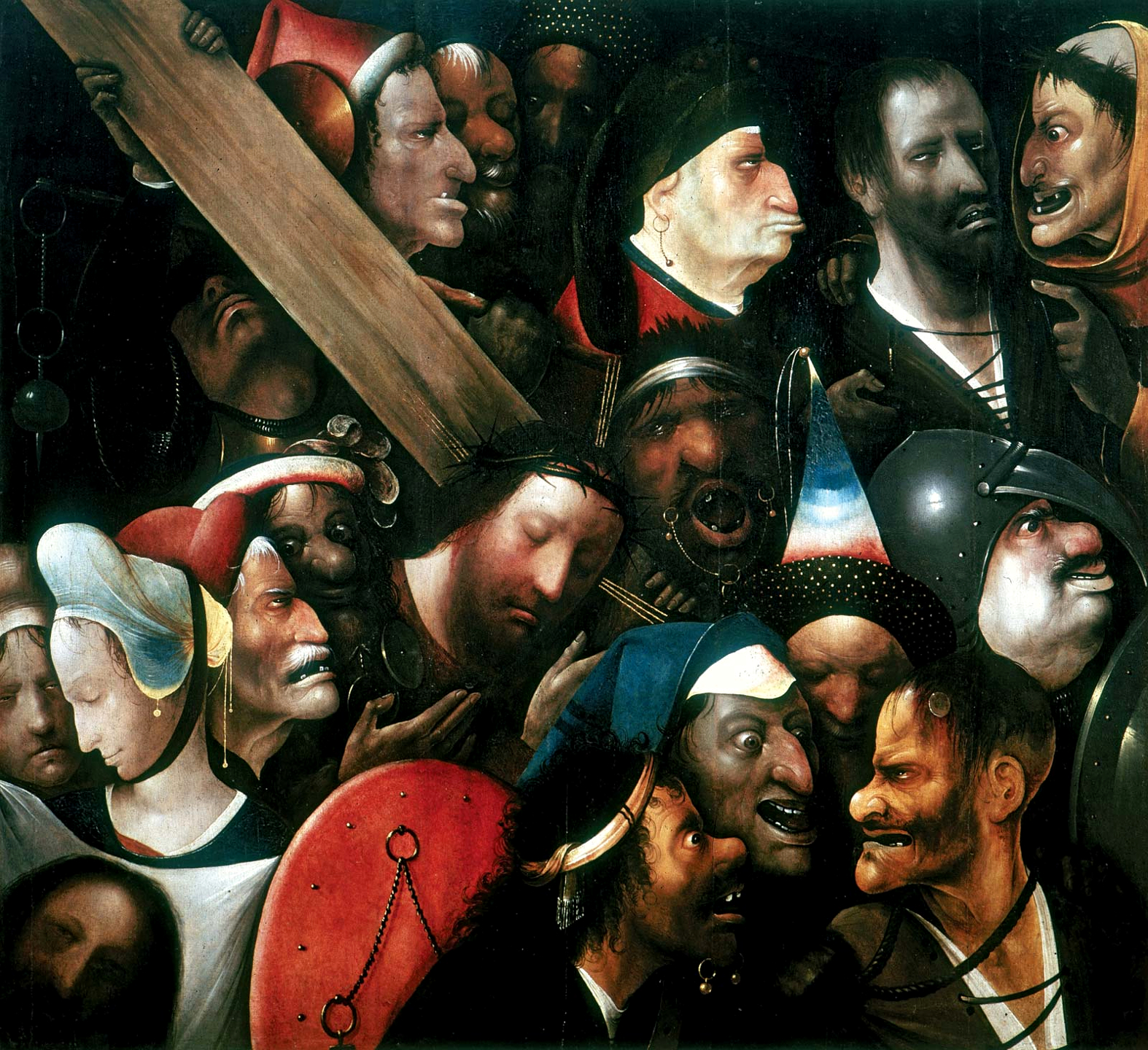
Like Bosch, Spencer helps us see what the beautiful One in our midst sometimes provokes. Especially when the shining light of his presence exposes the dark shadows within and around us. For his light sometimes prompts fierce anger and envy, as well as a callous indifference to cruelty and suffering. Things of which we are all capable. And we are likely to have much invested in denying that ugly truth. Strangely, when confronted face to face with a divinity that is the opposite of our perversity, we will either fight the light that we encounter, or surrender to it. The Passion narratives give us examples of those who resisted and even fought against the Light of the World. Especially against the disturbing possibility that Jesus might conquer their pervasive ungodliness.  And so, they sought to do away with his godliness.

An encounter with true beauty can be unsettling and troubling, especially if we have already settled for so much less. It may be our sensitivity to the same juxtaposition of opposites I have noted, and their apparent lack of resolve. We often hope for the triumph of good over evil, that beauty will overcome darkness, and serenity displace antagonism. But we cannot find it within ourselves to do more than hope. We cannot achieve the redemptive resolution for which we haltingly reach out with our feeble hands and hearts.

It is not an accident that the Christ figure in Stanley Spencer’s painting recedes visually in the foreground, while those who oppose and crucify him grab our interest. Spencer, after mastering traditional realism, adopted what he called a neo-primitive style. He was a gifted colorist, and highly proficient with composition. And so, as Spencer has rendered him, Jesus’ skin tone and color roughly match that of the wood of the cross, as well as the clothing of the man with the hammer swung over his head. Spencer’s rendering of the Lord’s skin tone and color also matches much of the sky and the ground below, including the tunic of Mary Magdalene, prostrate at the foot of the cross. This forms a compelling visual symbol of Jesus’ total identification with us, in his Incarnation and in his Crucifixion. It symbolizes his complete joining with us, and with our world of tearing hurts and suffering.

In fact —as we see in Spencer’s composition and coloring— it is precisely because Jesus blended in so well with everyday life, that those who opposed him could literally gain the upper hand, ultimately with hammers and nails. But this is the marvel of the incarnation of our God in Jesus, that the fullness of divinity could be so thoroughly joined to our fallen humanity. As the Gospels attest, this joining was so complete that many did not notice or have regard for his divinity. When we do notice his total identification with us, when we come face to face with the truth it represents, we have either one or the other of two reactions. We throw ourselves down in humility before him. Or, we seek to throw him down, to humble him before us.

Spencer at work on his Crucifixion


Beauty in Parallel Revisited

golden_gate_bridge_pillar-smaller-copy

Perhaps the only thing more memorable than driving over the Golden Gate Bridge may be to pass under it on an ocean-going ship. I was lucky enough to have that experience five times before I was a teenager.

Many of us assume the name for this bridge is related to its warm color. But the name comes from the ocean straight over which it stands, and not from the Gold Rush. Rather than mimicking gold, the bridge’s official color—“International Orange”—was chosen to contrast with fog. A story is told about when that color was first applied. Painters dabbed splotches of it on the heads of curious seagulls. Pretty soon, Bay Area birdwatchers reported a new bird species, which was called the California Red-Headed seagull!

Until 1964, the Golden Gate Bridge had the longest main span in the world. Yet, its basic design isn’t unique. We know this from other suspension bridges, which are found all over the world. Bridges of this kind have two main towers, steadied in place by their suspension cables, which are anchored in the ground. From their anchor points, these substantial cables ascend to the top of the towers, and then gently descend again to the center of the bridge. From that low point, they again soar up, to the top of the opposite tower. The slightly arched roadway across is literally suspended from these main cables, by small support cables that hang from them. Here, in the beauty of this simple design, we find a helpful spiritual and liturgical metaphor.

Reflect for a moment about two significant Sundays in the church year. One is the last Sunday after Epiphany, or Transfiguration Sunday, which we observed 10 days ago. The other is Easter Day, which lies ahead. Transfiguration Sunday is the last Sunday before this season of Lent, and Easter Day is the first Sunday after Lent. Both Sundays are as important with regard to our identity as they are to that of Jesus. For in his Transfiguration and in his Resurrection, Jesus does not simply reveal who he really is. He also reveals the fulfillment of our vocation to be fully human, in him.

Imagine these two Sundays on the Church calendar as being like the two towers of the Golden Gate Bridge. Transfiguration Sunday, coming just before Lent, is like the south tower of the Golden Gate bridge, on the busy urban, San Francisco, side of the straight. And, Easter Sunday is like the north tower of that bridge, on the less familiar and historically rural side of that navigational channel. The season of Lent stretches between these two Sundays like the main span of that bridge, taking us from what we think we know to that which may yet to be disclosed to us.

Here is the crucial part ~ every year we need to make this liturgical crossing, from our sharing in the vision of the Transfiguration, to our participation in the joy of Easter Resurrection. And like the great towers of a suspension bridge, Transfiguration Sunday and Easter Sunday uphold us all the way across our Lenten journey over what sometimes may seem like dark, cold, and turbulent waters around us.


This posting is a revised version of a post I first published in 2017, and is based on my recent homily for the Last Sunday after the Epiphany, which explores the parallel between the revelation of glory that we see in the Transfiguration, and the glory we see in the Resurrection (click here for a link to it).

The Beauty of ‘Nothing’ (as we observe Ash Wednesday)

photos_ashes-05


This past Sunday, using the metaphor of the twin towers of a suspension bridge, I invited our local congregation to explore a pairing of two Sundays in the calendar, Transfiguration Sunday and Easter Sunday. These are the interrelated Sundays immediately before and after Lent. Ash Wednesday and the beginning of Lent present us with a similar opportunity. Here, we can explore the relationship between Ash Wednesday and Easter Sunday. With this second comparison between liturgical days, instead of noticing a parallel, we can observe an evident paradox.

On Easter Sunday, we face an unusual challenge. We must take the finding of an absence, and discern within it a presence. Something that was known, seen and touched, became as if it was nothing. And so, we are challenged to see how an empty tomb could at the same time be full of meaning. Even though Mary Magdalene and the disciples found nothing in the tomb, they came away with the conviction that something profound was there.

Consider, then, this remarkable contrast. In the metaphors at the heart of the Ash Wednesday liturgy, we observe inverse phenomena. What would Ash Wednesday be without ashes? Ashes constitute a biblical image with a long and vivid history. And our tactile liturgical use of this common material plays a central role in our services on the first day of Lent. Yet, this liturgical presence of ashes is meant to represent an absence. A dish full of ashes in my hand represents something larger, which is empty. Something (the sign of the cross) is marked with ash on parishioners’ foreheads, and it symbolizes the starkness of nothing, or, literally, no thing.

So, the Sunday of joyful resurrection presence provides the reverse of the Wednesday of regrettable absence. Though it wouldn’t sound as good, Ash Wednesday could instead be called, “Absence Wednesday,” “Empty Wednesday,” or “Nothing Wednesday.” This is because the ashes at the heart of the liturgy for this day symbolize an absence, an emptiness, or a ‘nothing.’ I don’t mean that the ashes are empty of meaning. It’s just that what they represent is literally nothing. Ashes represent nothing of value, nothing of worth. And that is what makes them special! We put ashes on our foreheads to remind us that, on our own and relying on ourselves, we are nothing of value, nothing of worth. No matter how hard we try, we don’t give meaning and value to ourselves. Only God does that.

Our lives can sometimes feel like they are full of “nothings,” as if all that we do only amounts to ashes or dust. All too quickly, we forget that dust and ashes are the building blocks of God’s creation of human beings. They are the building blocks of God’s Kingdom. When we think about something we have done, and are tempted to say, “O, it’s really nothing at all,” let’s remember what God can do with ‘nothing’.


This posting is a slightly altered republication of a post from March 2017. It is based on a homily for Ash Wednesday that I have frequently offered, the most recent text of which can be found by clicking here.

Andres Amador: Earthscape Artist

[If reading this by email, please tap the title at the top to open your browser for the best experience.]


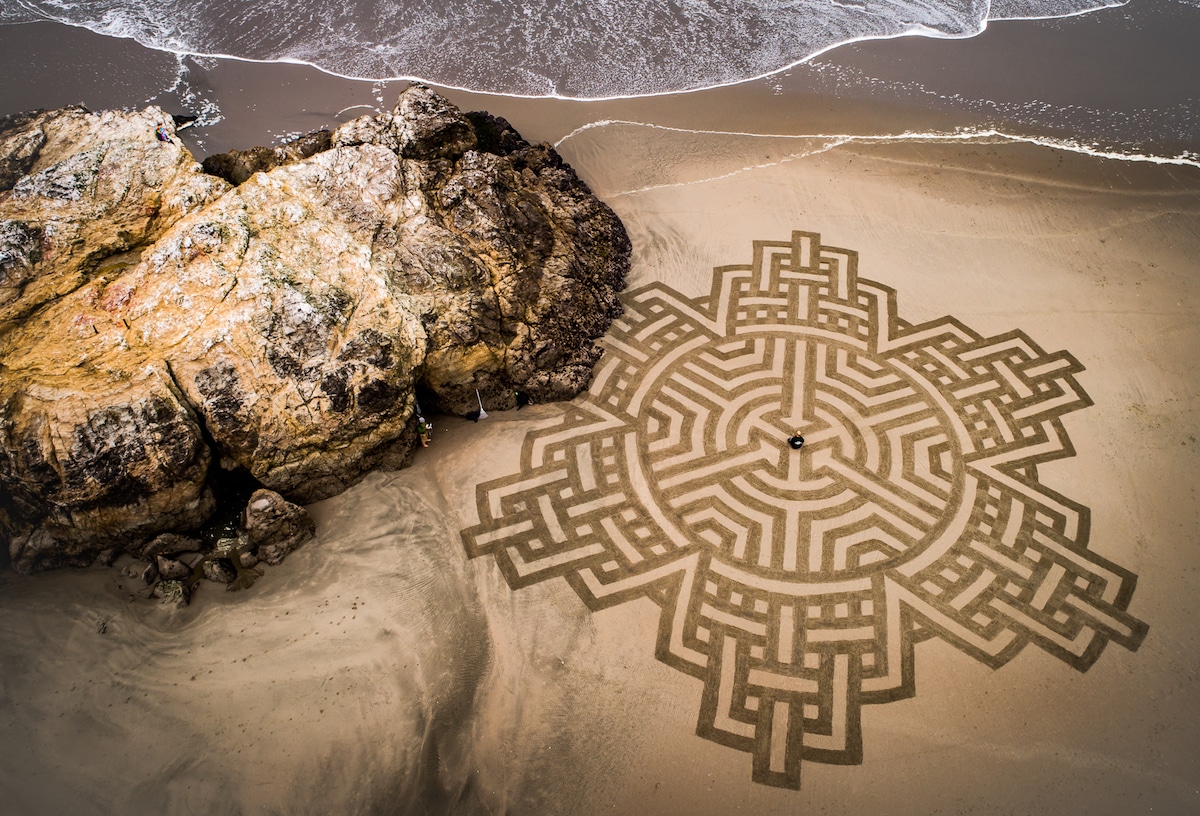
Above we see a drone-based digital image of a pattern that a contemporary artist has inscribed upon the sand of a beach. He is also an academically trained scientist, who has employed his gifts in a particularly sensitive way.

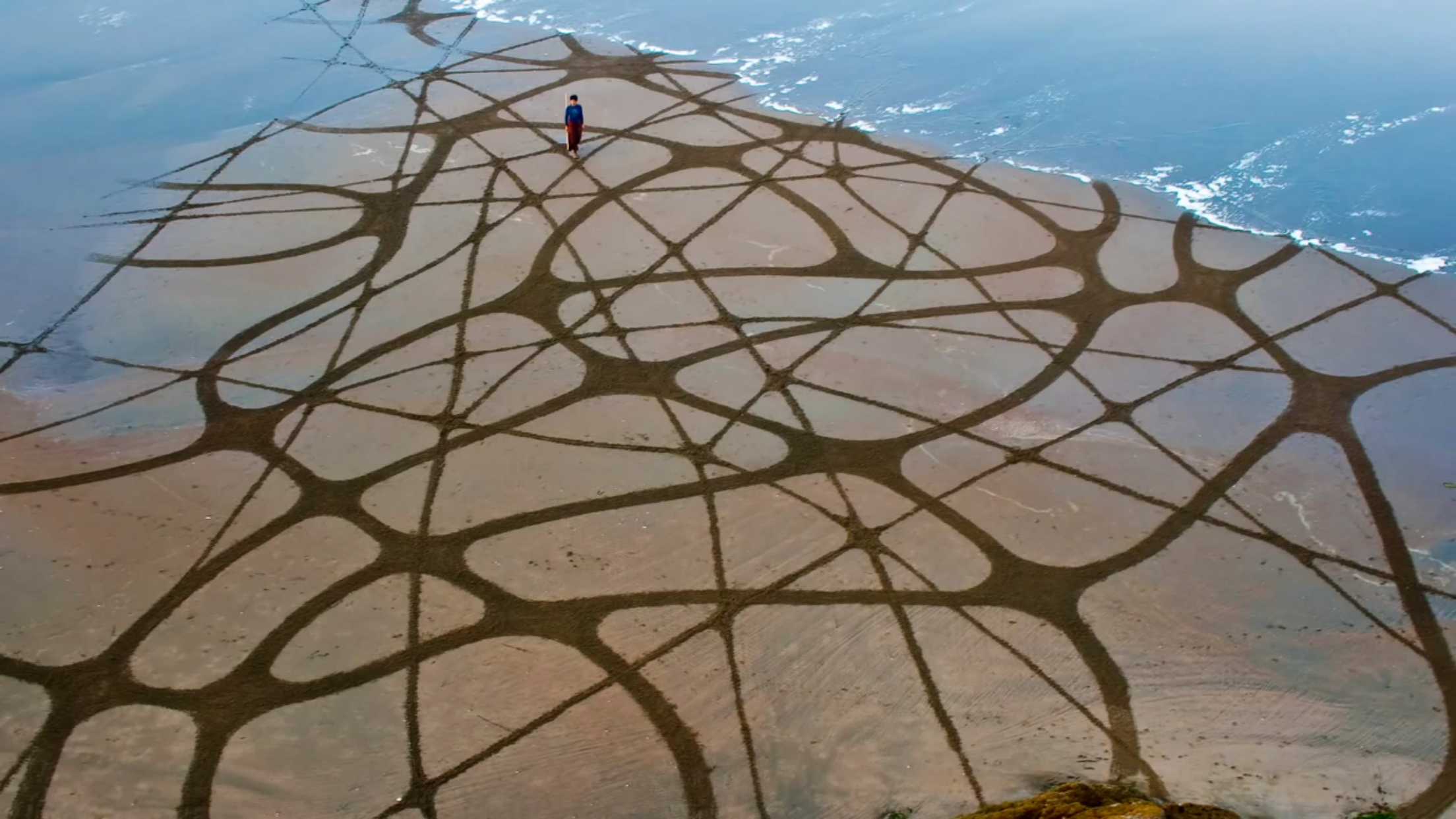
Now, why are some or all of those details important? Because we see here the abilities of Andres Amador, someone whose public art work may lead us to wonder about how this artist could have accomplished all this. Not only in the image above, those presented below, as well as those widely available now on the internet.

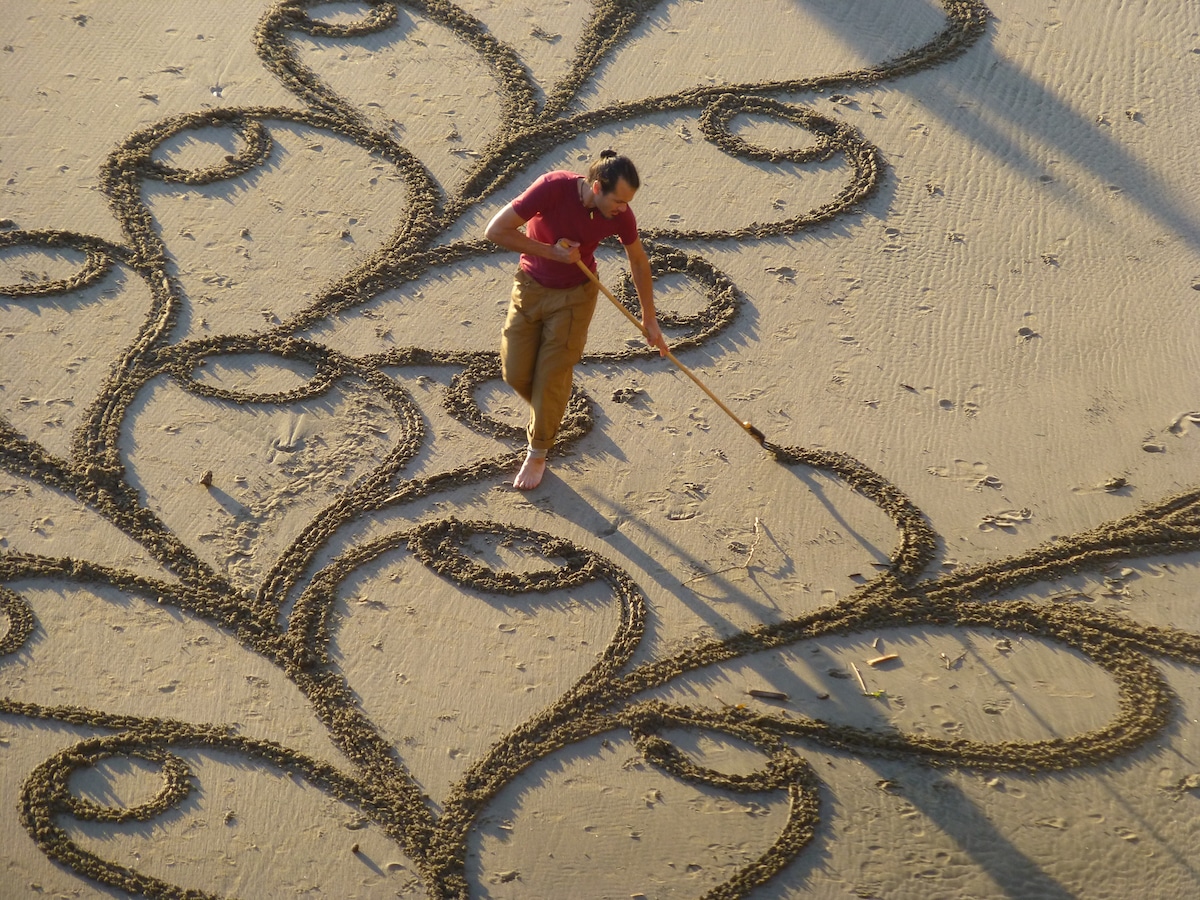
Well, what would it take for you or me physically to be able to produce such an image upon the sand on a seaside beach? To my surprise, it is only geological timing (the tides); an appropriate location in relation to that matter of the tides; and then only a couple of simple tools. These would include some common and small garden rakes, and perhaps also – in relation to the circular-based patterns – a metal or wooden spike, a long rope, and some kind of carving or scraping tool at the end of that rope. The invention of the small drone with a camera has also been of help.

But, clearly, it takes more than physical circumstances, geography, and available tools. It also takes a scientifically trained sensibility as well as a developed intuitive creativity. What Andres Amador has accomplished and still produces is not in any way simple. And yet, he provides frequent teaching sessions, open to all, inviting others to do what he does. Insight about this is provided by a short but compelling video produced some years ago by KQED San Francisco (see link below). I think that one way to summarize a principal theme in his work is that he seeks to see things “whole,” which for some folks is related to seeing what is “holy.”

In that video, Amador describes two reference points, or two sorts of impulses within him, as sources for his earthscape art. “The two main directions that I go with, in the art, are {first} the geometric, which is very precise… So, it’s all about perfection.” Pattern can be imposed upon the ‘blank canvas’ of nature.

“The other {or second} side of it,” he says, “is the organic art, the art the feels like it is emerging from the location… the art that is telling me what to do next.” Pattern may therefore be in some sense received.

I find these two insights to be spiritually and theologically significant. We are able to impose pattern upon our lives, and often attempt to do this within the social world around us. At the same time, we may discern and receive pattern for our lives from within, whether from a divine or from a natural source, or through the gifts of others. Impose, and receive; both are important for our search to become whole.

God bless your continuing work, Andres, and especially for helping us perceive beauty in a fuller way.


Here is a link to the compelling KQED Andres Amador short video : https://www.kqed.org/arts/10134941/andres-amadors-earthscapes-art-that-goes-out-with-the-tide


Epiphany-Sensitive Landscape Artists

[If reading this by email, please tap the title at the top to open your browser for the best experience.]

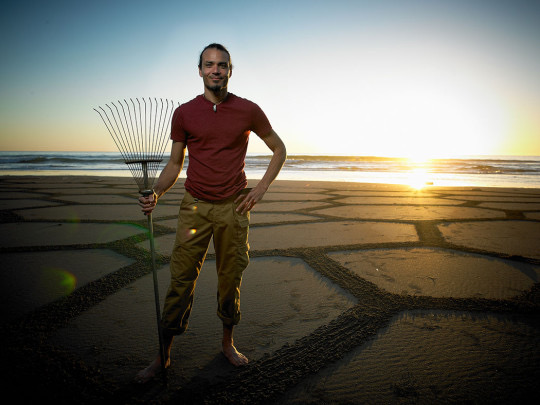
Andres Amador

Christo, after the death of his wife, Jeanne-Claude

On the Sundays following the feast of the Epiphany (January 6), the western Church historically has focussed on God’s self-disclosure through nature. We find this theme expressed in the Epiphany Day Gospel featuring the visit of the Magi, or Wise Men, from the East. They followed the appearance of a star in the sky to find our Savior at his birthplace. Note how this contrasts with stories about guidance provided by the messages of angels, whether in dreams or as on occasions of personal divine revelation.

One of my favorite examples of this theme can be found in some verses by the Anglican priest, theologian, and poet, John Keble, for a Sunday in this Epiphany-tide:

When souls of highest birth
Waste their impassioned might on dreams of earth,
He opens Nature’s book,
And on His glorious Gospel bids them look,
Till, by such chords as rule the choirs above,
Their lawless cries are tuned to hymns of perfect love.

In my next two posts on this blog I will feature the landscape-based artwork of Andres Amador, as well as that of Christo and his late wife and collaborator, Jeanne-Claude. Amador is known for his ephemeral raked sand projects, and Christo with Jeanne-Claude are remembered mainly for their draped or wrapped fabric installations. Though the work of these three has taken very different forms, they have demonstrated a common and notable commitment to environmental sensitivity despite the fact that their projects have involved only temporary alterations of various landscapes or structures.

Among agnostic, secular, and even atheistic artists, many seem to recognize the power of the sublime in Nature. But also notice how even the pious John Keble – with his high sense of the authority of Scripture – was willing to describe the natural world around us as God’s “Glorious Gospel,” and as “Nature’s book,” written by the divine Author of Creation.

I have no basis for evaluating whether there is any theological grounding for Amador’s, or Christo and Jeanne-Claude’s world-views. Partly because such is not suggested nor asked for. Yet, I find the work of these three artists not only aesthetically pleasing, but also as theologically significant.

Why? Because God is either everywhere present in reality, however we conceive of it, and whether we are conscious of it, or God is not. I am convinced of the ‘yes’ answer. And so, for me, God is surely the source of the Beauty everywhere present in the cosmos. For traditional believers, there is no place where God is not.

Beauty can be found in this observation itself. There may be a transcendent source for the abundant beauty we enjoy in the world, and in people around us. But if there is, it does not require us to acknowledge it. The beauty we find everywhere – God’s beauty, I say – stands for itself. Remarkable!


Once again, I wish to credit my friend and former colleague, the Rev. Ralph McMichael, Ph.D., for his succinct and helpful delineation of ways of understanding the relation between nature and grace, in his teaching and writing. In this regard, his essay, significant to me within the book he edited, Creation and Liturgy: Studies in Honor of H. Boone Porter, continues to be very helpful. He is also the author of The Eucharistic Faith, a first volume of a new Eucharist-based systematic theology.

Joining Mary’s Joy

[If reading this by email, please tap the title at the top to open your browser for the best experience.]

El Creco, The Annunciation (1600)


With three prior Annunciation images I have pointed to some aspects of the Annunciation to Mary: fear at an unexpected encounter with the divine presence; surprise and wonder about such a greeting; and, the opportunity to accept the significance of God’s visitation. Today, I want to highlight a fourth aspect of Mary’s experience of the Annunciation, her response of joy at having said, “Yes.”

It is not hard for us to admire Mary and her willing response to God’s initiative, at first in her life, and then in and for ours. But how easy is it for us to identify with Mary’s joy, reflected in the words we know as the Magnificat, her song of praise, with regard to the promise of Jesus’ birth?

For many of us, these 12 Holy Days may be a time in which we challenge ourselves to feel as ‘joyful’ as we think we should be – or, perhaps, to criticize ourselves for failing to experience the same. But what is ‘joy?’ I have an icon that depicts St. Thomas Aquinas, wherein he holds a text on which is printed, “Joy is the noblest human act.”

Joy at this time, as always, is not just a spontaneous feeling prompted by fleeting circumstances. Joy is actually an act, a choice, and a willing participation in divine initiative. For the word joy is related to the verb rejoice. God says to us during these 12 Holy Days – as God always does – I am come unto you to bless you, to bring you new life, to transform everything you think you know, and in ways you have yet to imagine.

Until we get to ‘the other side,’ and can ask Mary, herself, none of us will know what she really imagined would be part of her acceptance of God’s strange and unanticipated plan of redemption for our fallen and troubled world. What we can be most thankful for is at least one implied word that was part of Mary’s response to God’s initiative. She said, yes. With her beautiful example, and so many compelling artistic representations of the same, isn’t it a wonder why we so often find it hard to respond as she did.

In this last of the 12 Days of Christmas, let us say “yes” to God with Mary. And then, starting with the feast of the Epiphany, tomorrow, may we live into the real joy of that “yes.” Her uplifted hand, in El Greco’s painting above, says it all.

May our Lord, who was and is, and is to come, bless us and our loved ones during this holy time.


The Beauty of Christ the King

Windows over the chapel altar; Church of the Incarnation, Highlands, NC


I wonder if you were looking forward as much as I was to the the new season of The Crown. As we saw in September, while viewing the various events related to the Queen’s funeral, the British Royal Family is a source of enduring fascination for many of us. And yet, I think we -as Americans- have a hard time imagining what it means to live within a monarch’s sovereignty. Since the founding of our country as a republic, the framework for our government has made it difficult for us to understand the significance of having a king or a queen. Especially when these roles are transmitted through heredity, rather than resulting from whom we designate through our political will.

All this is especially significant for us this week, having celebrated the feast of Christ the King this past Sunday. For consciously or not, we are prone to an ancient heresy. It is this: in believing that Jesus was an ordinary and yet a particularly spiritual human being who, by faithfully serving as the Messiah, was then somehow ‘promoted.’ That is, promoted above and beyond his human family, to achieve a semi-divine status. It is easy to mis-read the passion narratives at the end of the Gospels and come to this misunderstanding. For in one way or another, the Gospel writers – especially John’s Gospel – portray Jesus’ Crucifixion, and his subsequent Resurrection and Ascension, as the sequence of his royal ‘coronation.’

Yet, in a monarchy like that of Britain, coronation does not suddenly make the forthcoming king or queen into something that he or she was not before then. Instead, a traditional coronation is an act of public declaration of what he or she has always been, even if only implicitly.

In other words, through a public ceremony of coronation we do not make kings or queens. As we will see next year with King Charles, who we should note is already king, his future coronation will recognize in an official public way how he has already begun to fulfill his sovereign role. This is very important for how we appreciate ‘the mock coronation’ of Jesus in Luke’s Gospel (23:33-43).

As Luke tells us in this passage, Jesus is crucified under an inscription that Pilate had written, “Jesus of Nazareth, the King of the Judeans.”* The crowd at the place of the crucifixion protests the inscription. And following their lead, the soldiers mock him, saying, “If you are the King of the Judeans, save yourself!” They mock him while ironically mimicking the words of Satan during Jesus’ temptations in the wilderness.

The irony here is that, so far as we know, Jesus never directly said of himself, “I am the King of the Judeans,” which would have implied being a legitimate descendant and heir to the thrones of David and Solomon. But he died for having assumed this identity, an identity that was revealed in his teaching and in his works, and in his selfless fulfillment of the Scriptures.

Among the many things for which we can be thankful this week is the following fact. No one in the crowd at Jerusalem two thousand years ago, and none of us, makes or declares him to be the King. What we can affirm in faith is that his royal identity has always been in and with him. This fact has been revealed by God, whom he called his Father. For Jesus to be King in the sense of being the Messiah, the Son of God, means that he lived into the reality of God’s own abiding kingship of Israel.

May you and your loved ones have a blessed Thanksgiving.


This post is based on my homily for this past Sunday, the Feast of Christ the King, which may be accessed by clicking here. I took the above photo (note the crown above Jesus’ head) after the first Eucharist celebrated by the Rev. Kellan Day in that chapel in 2019, and someone whose path to ordination I and my former parish endorsed most enthusiastically. I offer this post with continuing thanks for her recognized gifts for ministry.

*  “Judeans” is how N.T. Wright translates the word more traditionally rendered as “Jews,” with “Jews” being a contemporary translation that for readers may be misleading.

Note: John’s Gospel has the significant series of “I am” statements by Jesus, which may imply that he claimed legitimate succession from David and Solomon, but which do not approach anything like the political sounding self-identification that later condemned him.

The Beauty of Kingdom Potential


What has Jim Janknegt depicted with his painting? Right away, we can see that he portrays the Kingdom mustard seed parable in Mark’s Gospel. With his focus on this parable, we should remember that the Gospels include two kinds of mustard seed teaching. One is in Jesus’ parable ~ about the huge potential of what God can do with apparently small bits of the Kingdom. Jesus’ other teaching is about the tremendous potential of what we might accomplish through personal believing, especially given how personal faith can otherwise be deficient or defective.

To help recognize this difference, between Jesus’ Kingdom parable and his other teaching referring to the size of our personal believing, consider what we see in Janknegt’s painting. In the foreground we see things we usually think of as being big ~ like big cities, their large buildings and the businesses they house. Dwarfing them is a great tree, which may represent the ‘Tree of Life.’ Like the small mustard seed, the great tree that it becomes represents what the Spirit is doing with God’s Kingdom.

Notice the community for which the great tree provides a place of habitation ~ a community characterized by many birds, including both a beautiful peacock and a spoonbill, an owl and a descending dove. In traditional mythology, birds represent communication between the realm of the sky and the realm of the land, or between the heavenly sphere and that of the earth. The Tree of Life provides a context for this communication, and for the Kingdom community that God’s Spirit nurtures between the two.

If we ever worry or despair about the smallness of our faith, we should remember Jesus’ emphasis upon the huge potential of God’s Kingdom power. The seed of this Kingdom potential is planted within us at our Baptism.


This post is based on my homily for Sunday, June 17, 2018. Jim Janknegt’s painting, Worlds Smallest Seed, is used here with his permission. {Editorial note: I preached on this Gospel reading, and referenced Janknegt’s evocative painting again on Sunday, Jun 16, 2024. Here is a link to my reflections on the same Gospel reading.}