Spirtituality

Lo! He Comes with Clouds Descending (The Beauty of His Return)

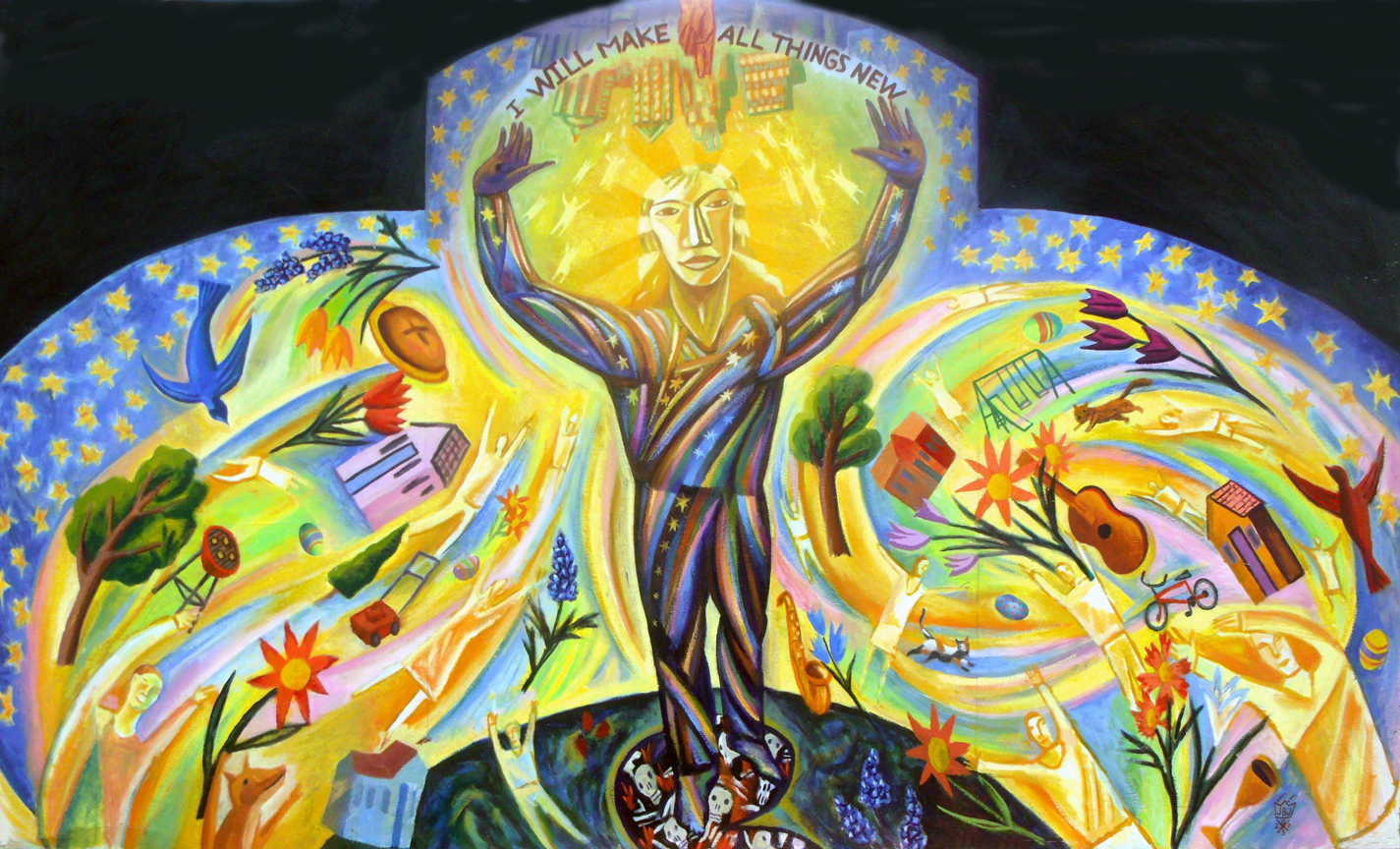
Jim Janknegt: I will make all things new (2005)


The title of this post comes from Charles Wesley’s hymn-text adaptation of words from Revelation that refer to the Second Coming of Christ in glory: “Behold, he is coming with the clouds, and every eye will see him, even those who pierced him, and all tribes of the earth will wail on account of him” (Rev 1:7). In this first week of Advent, and perhaps having sung Wesley’s hymn on Sunday, we need to explore what this ‘wailing’ may involve.

Many people today regard the Second Coming as something prompting fear about a Final Judgment. This may be one cause for the wailing that Wesley anticipates. Though texts in Revelation, as well as in the Gospels, certainly involve this theme, Revelation’s author is also very clear in expressing a faith that Christ’s return will involve restoration, the fulfillment of promises, and the beauty of shared glory. Hence, the wailing may also reflect holy sorrow stemming from a deepened awareness of personal sin, accompanied by ‘tears of joy’ over being forgiven.

Wesley’s verse 2 of his hymn predicts the first dimension of wailing: “Every eye shall now behold him, robed in dreadful majesty; those who set at nought and sold him, pierced, and nailed him to the tree, deeply wailing, … shall the true Messiah see.” Verse 3 describes the second dimension: “Those dear tokens of his passion still his dazzling body bears, cause of endless exultation to his ransomed worshipers; with what rapture, … gaze we on those glorious scars!”

Words in Revelation, preceding and following its prediction about how “all tribes of the earth will wail,” provide a foundation for hope. The author says at the beginning of this last book of the Bible (1:4-5), “Grace to you and peace from him who is and who was and who is to come, and from … Jesus Christ the faithful witness, the firstborn of the dead…” And then (in 1:8) we find, “‘I am the Alpha and the Omega,’ says the Lord God, ‘who is and who was and who is to come…’”

These words are echoed near the end of Revelation, where we find a description of the New Jerusalem and a renewed Creation. Among them are these: “And he who was seated on the throne said, ‘Behold, I am making all things new'” (21:5).

Jim Jaknegt’s painting, I will make all things new, expressively captures the positive dimension of these themes and the ground for hope that lies in the beauty of the Lord’s return. All things! That is a phrase worth exploring in terms of quite a number of biblical texts, especially Paul’s letter to the Colossians.

In the first chapter, Paul writes, “For by him all things were created, in heaven and on earth, visible and invisible, whether thrones or dominions or rulers or authorities—all things were created through him and for him. And he is before all things, and in him all things hold together” (1:16-17). Paul then indicates (1:19-20) the ground for hope regarding “all things,” which Janknect suggestively depicts: “For in him all the fullness of God was pleased to dwell, and through him to reconcile to himself all things, whether on earth or in heaven…”  God’s ultimate goal in all this is reconciliation rather than condemnation, even though people who dismiss God’s ongoing work of reconciliation may find themselves brought to sadness.

Notice the pronounced swirling motion in Janknegt’s painting, as all things are caught up into the returned Lord’s orbit. But all people? For unlike flora and fauna, as well as inanimate objects, human beings made in God’s image and likeness possess the freedom of will either to accept or to refuse God’s initiatives to reconcile us into divine intimacy. This is why there may be at least two dimensions to the wailing that the Lord’s return is likely to initiate. For grief over sin may bear fruit in repentance.

We should therefore note the words of invitation at the end of Revelation: “‘Surely I am coming soon.’ Amen. Come, Lord Jesus!” (Rev 22:20)


Jim Janknegt is a painter who is based in the Austin, Texas, area, who has produced a remarkably large body of work based on biblical themes and imagery. The website featuring his work can be found at http://bcartfarm.com/ I have admired, and with his permission have featured, his images for many years. Lo! He comes with clouds descending appears as Hymn 57 in The Episcopal Church’s The Hymnal 1982.


The Beauty of Christ the King

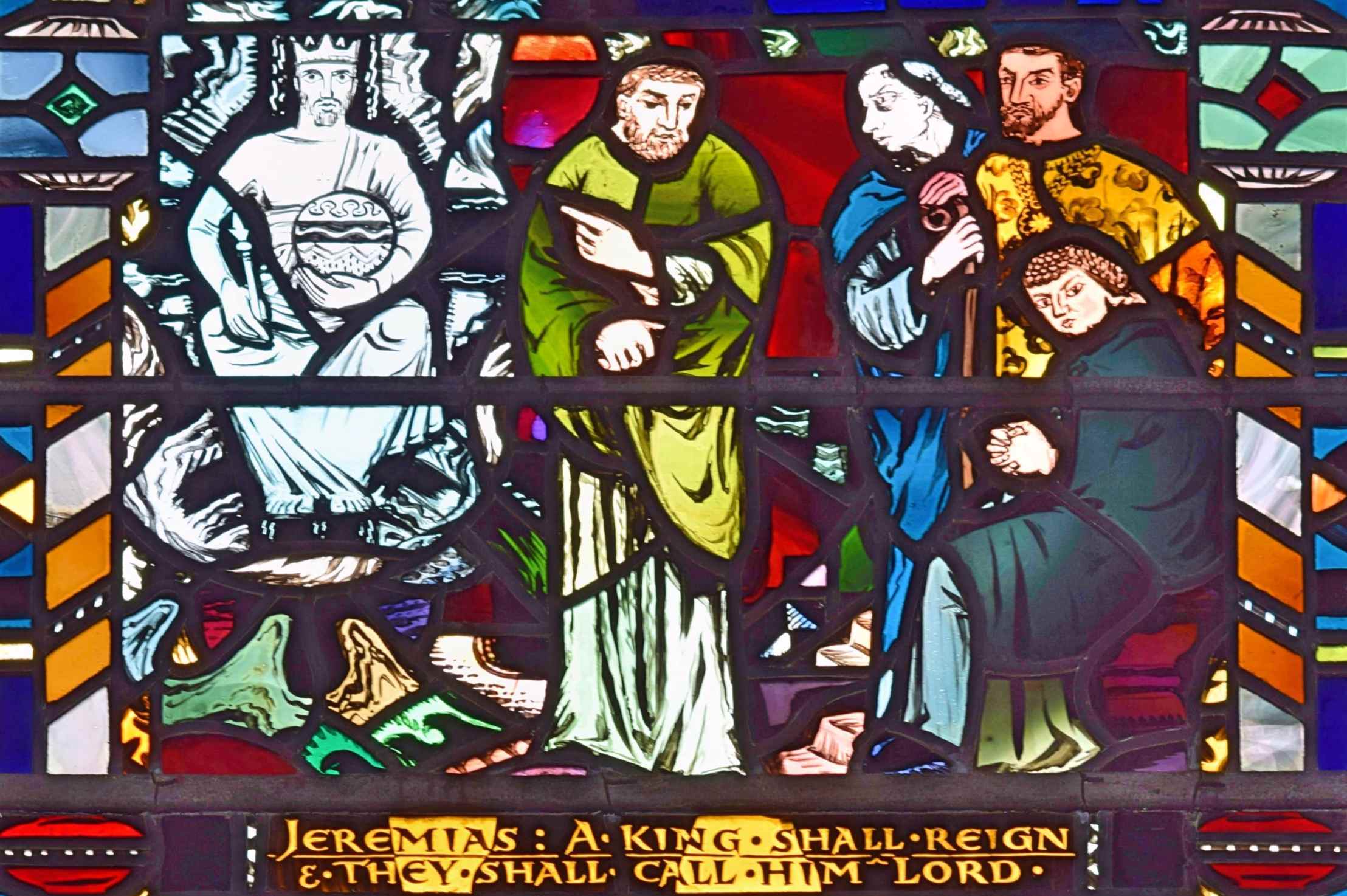
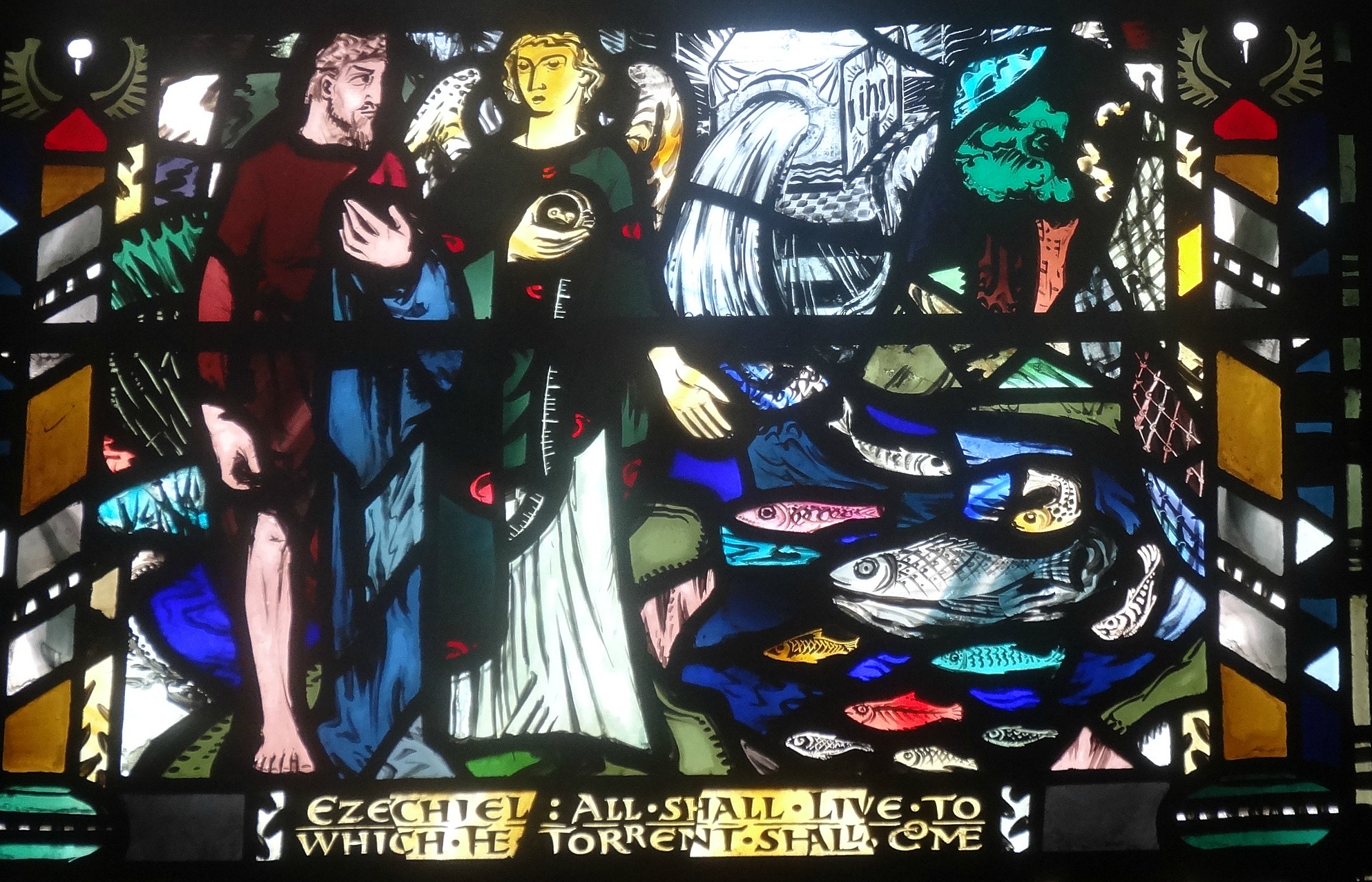
Windows over the chapel altar; Church of the Incarnation, Highlands, NC


I wonder if you were looking forward as much as I was to the the new season of The Crown. As we saw in September, while viewing the various events related to the Queen’s funeral, the British Royal Family is a source of enduring fascination for many of us. And yet, I think we -as Americans- have a hard time imagining what it means to live within a monarch’s sovereignty. Since the founding of our country as a republic, the framework for our government has made it difficult for us to understand the significance of having a king or a queen. Especially when these roles are transmitted through heredity, rather than resulting from whom we designate through our political will.

All this is especially significant for us this week, having celebrated the feast of Christ the King this past Sunday. For consciously or not, we are prone to an ancient heresy. It is this: in believing that Jesus was an ordinary and yet a particularly spiritual human being who, by faithfully serving as the Messiah, was then somehow ‘promoted.’ That is, promoted above and beyond his human family, to achieve a semi-divine status. It is easy to mis-read the passion narratives at the end of the Gospels and come to this misunderstanding. For in one way or another, the Gospel writers – especially John’s Gospel – portray Jesus’ Crucifixion, and his subsequent Resurrection and Ascension, as the sequence of his royal ‘coronation.’

Yet, in a monarchy like that of Britain, coronation does not suddenly make the forthcoming king or queen into something that he or she was not before then. Instead, a traditional coronation is an act of public declaration of what he or she has always been, even if only implicitly.

In other words, through a public ceremony of coronation we do not make kings or queens. As we will see next year with King Charles, who we should note is already king, his future coronation will recognize in an official public way how he has already begun to fulfill his sovereign role. This is very important for how we appreciate ‘the mock coronation’ of Jesus in Luke’s Gospel (23:33-43).

As Luke tells us in this passage, Jesus is crucified under an inscription that Pilate had written, “Jesus of Nazareth, the King of the Judeans.”* The crowd at the place of the crucifixion protests the inscription. And following their lead, the soldiers mock him, saying, “If you are the King of the Judeans, save yourself!” They mock him while ironically mimicking the words of Satan during Jesus’ temptations in the wilderness.

The irony here is that, so far as we know, Jesus never directly said of himself, “I am the King of the Judeans,” which would have implied being a legitimate descendant and heir to the thrones of David and Solomon. But he died for having assumed this identity, an identity that was revealed in his teaching and in his works, and in his selfless fulfillment of the Scriptures.

Among the many things for which we can be thankful this week is the following fact. No one in the crowd at Jerusalem two thousand years ago, and none of us, makes or declares him to be the King. What we can affirm in faith is that his royal identity has always been in and with him. This fact has been revealed by God, whom he called his Father. For Jesus to be King in the sense of being the Messiah, the Son of God, means that he lived into the reality of God’s own abiding kingship of Israel.

May you and your loved ones have a blessed Thanksgiving.


This post is based on my homily for this past Sunday, the Feast of Christ the King, which may be accessed by clicking here. I took the above photo (note the crown above Jesus’ head) after the first Eucharist celebrated by the Rev. Kellan Day in that chapel in 2019, and someone whose path to ordination I and my former parish endorsed most enthusiastically. I offer this post with continuing thanks for her recognized gifts for ministry.

*  “Judeans” is how N.T. Wright translates the word more traditionally rendered as “Jews,” with “Jews” being a contemporary translation that for readers may be misleading.

Note: John’s Gospel has the significant series of “I am” statements by Jesus, which may imply that he claimed legitimate succession from David and Solomon, but which do not approach anything like the political sounding self-identification that later condemned him.

The Challenge of Black Elk’s Visions

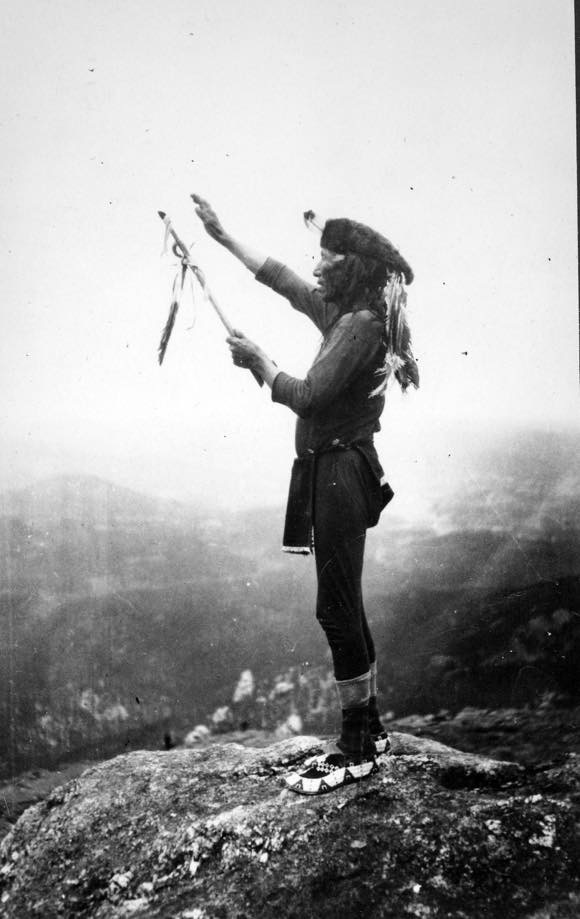
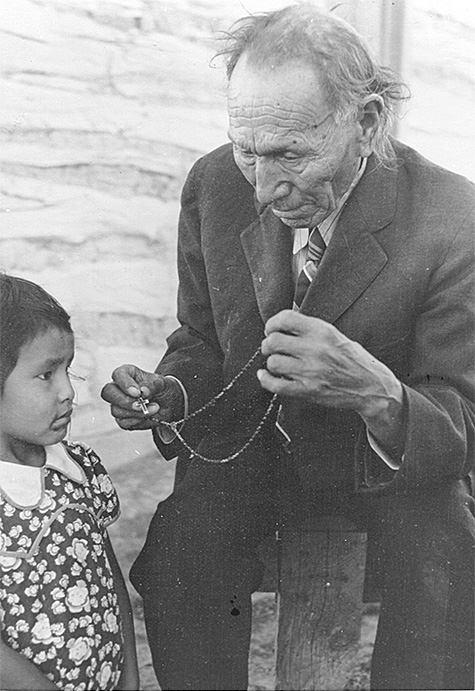
Black Elk on Harney Peak late in life

I first learned about Black Elk when asked to read the book, Black Elk Speaks, in a high school religion class. The book is the now well-known account of Black Elk’s spiritual experience as a Lakota youth, when at the age of nine he encountered life-changing visions while dangerously ill. It was written by John G. Neihardt, and it has been influential for many, but not without critical commentary regarding its historical accuracy. In my high school religion class we were asked to write an essay comparing Black Elk’s visions with those of the biblical prophet Ezekiel. To compare the two, given their significantly different temporal and cultural backgrounds, was and is a serious but also a notable challenge, and one still worth considering.

Here is the paradox that lies at the center of the question about Nicholas Black Elk (Nicholas being his baptismal name) and his identity, and one of the most beautiful persons about whom I have come to know through a book. He was present at and had vivid memories of both the battle of Little Bighorn as well as of what is rightly termed the massacre at Wounded Knee. In adult life, he was recognized and affirmed as what Anglo’s call a ‘medicine man’ among his own people. Yet, he was also received into the Roman Catholic Church and served in a distinguished way as a Catechist for that faith.

Here is a further paradox. Years ago, I met a former Episcopal Bishop of South Dakota, also a Lakota community member, who told me this. There were many baptized Episcopalians at the battle of Little Bighorn. And most of them were on the Native American side! To appreciate this comment may take some study, and perhaps deserves some reserve regarding the possibility of hyperbole. Yet, with due consideration of the history of Episcopal Church missions in Lakota territory, his view may well have some merit.

But, as the photo at the top suggests, near the end of his life, Black Elk still practiced the religion in which he had been nurtured as a child and youth. To me, this is part of the mysterious beauty of Black Elk. Perhaps it may also illustrate a documented propensity of some Native Americans to preserve an intense privacy about their culture while also realistically engaging with emerging external circumstances in a sincere way. Black Elk’s willingness to retain the spiritual world view of his childhood while accepting the Christian world view of his adult faith, in a both-and way, has not been without criticism. Yet, and maybe because I grew up in Japan, his example of ‘cultural engagement’ positively affects me.

Nicholas Black Elk serving as a catechist of the Roman Catholic Church

For Anglo and other non-Native Americans who wish to become more knowledgeable about the history of many of the peoples who populated this land before our arrival, Black Elk’s story is both informative and yet also challenging. Here is someone who engaged his spiritual life in a deeply serious and experiential way, and who was willing to reflect on its significance from more than one point of view. Whether we might identify with his personal commitments or not, many find Black Elk to be a compelling example of someone who takes his or her faith to be at the core of one’s life.

I continue to find him and his life story, while not easily understood, to be very moving. What I have come to learn about Black Elk has certainly impacted me. May God bless the memory of Nicholas Black Elk.

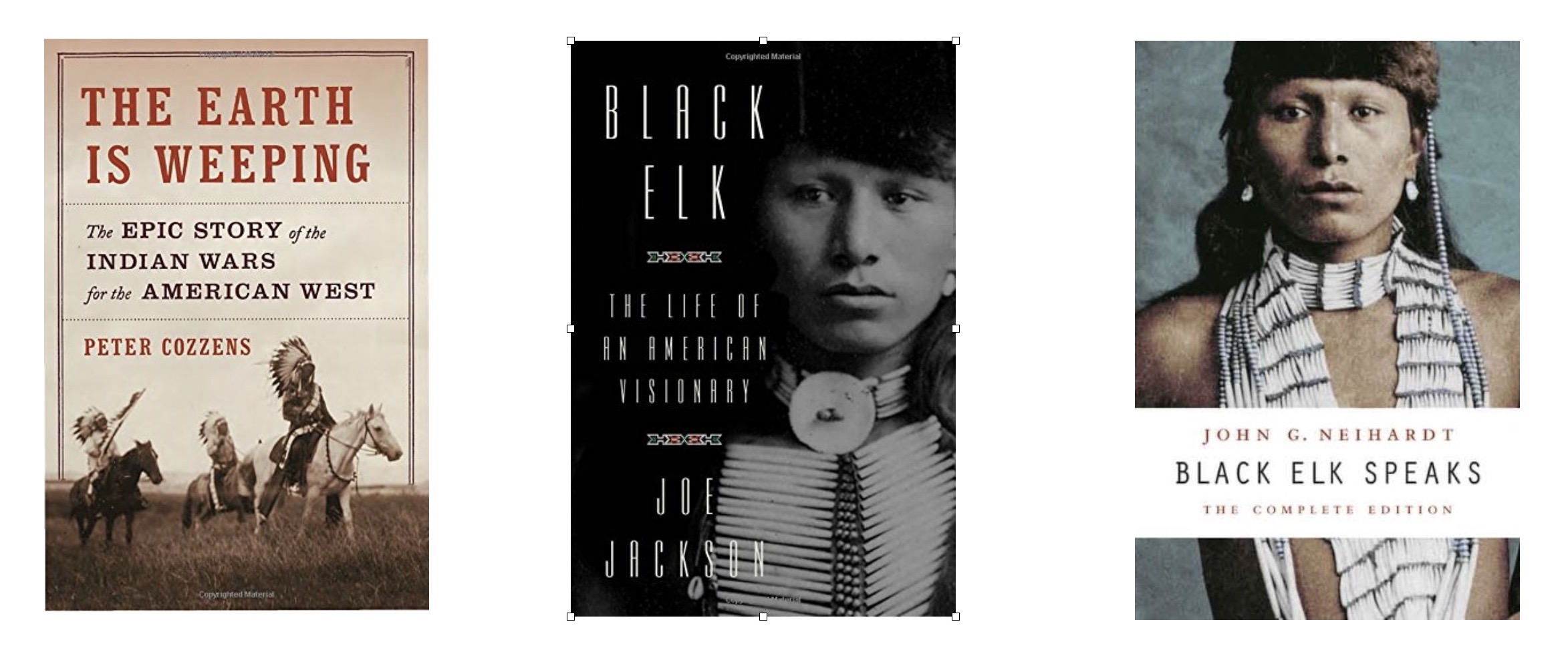
In addition to the books by Jackson and Neihardt, I warmly commend Peter Cozzen’s book, The Earth is Weeping.

Black Elk (on the left) photographed as a young man


I want to thank Martha, who is my editor. For anyone interested in the questions raised by the life and commitments of Black Elk, I recommend the following books: Black Elk: The Life of of an American Visionary, by Joe Jackson; Black Elk Speaks, by John G. Neighardt; and Nicholas Black Elk: Medicine Man, Missionary Mystic, by Michael F. Steltenkamp. Joe Jackson’s book provides a particularly compelling portrait of Black Elk. Peter Cozzen’s book, The Earth is Weeping: The Epic Story of the Indian Wars for the American West, provides the best overall historical background for a proper appreciation for Black Elk and his community’s story.

The Beauty of Le Corbusier’s Ronchamp Chapel


When I was in high school, while aspiring to be an architect as well as an artist, I and my closest friend admired the architectural work of Le Corbusier. Among the attributes of his work that we held high were these: attention to human proportion and scale; a sensitivity to architectural ideals while mindful of the needs for human community, both domestic and commercial; and an equal sensitivity to providing ‘beauty’ for those in financially marginalized and especially in urban contexts.

With my long-term love for the architecture of the American ‘Prairie School,’ and especially that of Frank Lloyd Wright, appreciating Le Corbusier’s very European modernist style, rather linear and grid-like, was something of a stretch. Perhaps a parallel might be how an admirer of Monet’s water lily paintings or of Whistler’s nocturnes might be surprised by a new delight in seeing some geometric abstract paintings by Piet Mondrian.

But then, after admiring Le Corbusier’s famous Villa Savoy, and his Marseilles Block (a combined apartment and business building), I discovered his Ronchamp Chapel (completed 1954). Though I have yet to see and walk through it, I have long sensed that this is a masterpiece, precisely because it is so counter-intuitive to the main body of Le Corbusier’s work. Whereas much of his architecture is analytic, geometric, and mathematically precise in his approach to it, Ronchamp provides an example of a lyrical and semi-mystical appreciation for form and space, as well as for light and color. And whereas much of Le Corbusier’s work can be seen as the fruit of a meditation upon classical antecedents, both Greek and Roman, Ronchamp Chapel seems to bear the spiritual imprint of the culture that we associate with the medieval centuries.

For me, the best examples of that latter point are the immensely thick side walls in certain parts of the chapel, where the light intrudes through very dense materials. This, of course, is a beautiful metaphor for my life and yours.

‘Glimpses of a deeper soul’ ~ this is a phrase that has come to me, time and again, when reflecting upon the lives of persons we become acquainted with in Scripture and Christian history, in secular fiction, as well as in daily church and public life. Especially in North America, we tend to chart our lives forward, in planned linear paths of progression, each step building upon the prior one toward a calculated and hoped-for end. And yet, despite all our planning, we may be open to, or unexpectedly experience, dreams and visions of something other, more amorphous. In such moments, we perceive to our surprise unanticipated images of what may be an attainable beauty, a beauty that none of us would have imagined in the ordinary run of things. For human creativity reflects divine creativity.

To Le Corbusier, perhaps his vision and design for the Ronchamp Chapel came as just such an unexpected surprise. For me, the wonder is that he allowed himself to let his imagination bear fruit in this remarkable plan and building. Despite his avowed atheistic concept of reality, his chapel centers on the transcendent and mystical, while also touching upon and embracing the local and material aspects of our lives.


Beauty in Parallel

golden_gate_bridge_pillar-smaller-copy

Perhaps the only thing more memorable than driving over the Golden Gate Bridge may be to pass under it on an ocean-going ship. I was lucky enough to have that experience five times before I was a teenager.

Many of us assume the name for this bridge is related to its warm color. But the name comes from the ocean straight over which it stands, though it does not derive from the Gold Rush. Rather than mimicking gold, the bridge’s official color—“International Orange”—was chosen to contrast with fog. A story is told about when that color was first applied. Painters dabbed splotches of it on the heads of curious seagulls. Pretty soon, Bay Area birdwatchers reported a new bird species, which was called the California Red-Headed seagull!

Until 1964, the Golden Gate Bridge had the longest main span in the world. Yet, its basic design isn’t unique. We know this from other suspension bridges, which are found all over the world. Bridges of this kind have two main towers, steadied in place by their suspension cables, which are anchored in the ground. From their anchor points, these substantial cables ascend to the top of the towers, and then gently descend again to the center of the bridge. From that low point, they again soar up, to the top of the opposite tower. The slightly arched roadway across is literally suspended from these main cables, by small support cables that hang from them. Here, in the beauty of this simple design, we find a helpful spiritual and liturgical metaphor.

Reflect for a moment about two significant Sundays in the church year. One is the last Sunday after Epiphany, or Transfiguration Sunday, and the other is Easter Day. Transfiguration Sunday is the last Sunday before Lent, and Easter Day is the first Sunday after Lent. Imagine these two Sundays on the Church calendar as being like the two towers of the Golden Gate Bridge. Transfiguration Sunday, coming just before Lent, is like the south tower of the Golden Gate bridge, on the urban, San Francisco, side of the straight. And, Easter Sunday is like the north tower of that bridge, on the less familiar and historically rural side of that navigational channel. The season of Lent stretches between these two Sundays like the main span of a bridge. Here is the crucial part ~ every year we need to make this liturgical crossing. And, like the great towers of a bridge, Transfiguration Sunday and Easter Sunday uphold us all the way across our Lenten journey.


This posting is based on my homily for the Last Sunday after the Epiphany, which explores the parallel between the revelation of glory that we see in the Transfiguration, and the glory we see in the Resurrection (click here for a link to it).

A Strange Beauty

Stanley_Spencer_the_crucifixion_1958


An encounter with true beauty can be troubling, especially if we have settled for so much less. It may be our sensitivity to the juxtaposition of opposites, and their apparent lack of resolve. At times we hope for the triumph of good over evil, that beauty will overcome darkness, and serenity displace antagonism. But we cannot find it within ourselves to do more than hope. We cannot achieve the redemptive resolution for which we haltingly reach out our hands and hearts.

It is not an accident that the figure of Jesus recedes into the background of this painting, while those who oppose and crucify him grab our visual interest. Stanley Spencer, who adopted what he called a neo-primitive style, was far too gifted a colorist, and master of light and dark, to let that happen unawares. As Spencer has rendered him, Jesus’ skin tone and color match the wood of the cross, and also the clothing of the man with the hammer swung over his head, as well as much of the sky and of the ground below… including the tunic of Mary Magdalene, prostrate on the ground. This forms a compelling visual symbol of his Jesus’ total identification with us in his incarnation, and his complete joining with us, and with our world of tearing hurts and suffering.

In fact, it is precisely because —in Spencer’s composition and coloring— Jesus could blend in so well with the background of everyday life, that those who opposed him could literally gain the upper hand, with hammers and nails. But this is only the marvel of the incarnation of our God in Jesus, that the fullness of divinity could be so thoroughly joined to the incompleteness of humanity. As the Gospels attest, it was a joining so thorough that many did not notice or have regard for his divinity. When we do notice that thorough joining, when we come face to face with the truths it represents, we have either one or the other of two reactions. When we get close enough to see —to really see him— there are only two responses. We throw ourselves down in humility before him. Or, we seek to throw him down, to humble him before us.

These paradoxes are brought to their greatest prominence when, as he predicted, he is lifted up. His lifting up is his glorification, and the glorification of God within him. Yet his lifting up is on a cross, and in the agony of a humiliating public execution. Here we see a ‘strange beauty’ — the strange beauty of the Lord — a beauty for which museums better prepare us than do our malls. Let us “behold the fair beauty of the Lord, and seek him in his temple.” We will find him! We will find him in the “temple” he promised to raise in three days.


The painting above is The Crucifixion, 1958, by Stanley Spencer. This reflection is based on my homily for Good Friday, which also makes reference to Charles Wesley’s text, “Lo! He comes, with clouds descending.” Click here for a link to this homily.

Toward a “Catholic” Vision [part 2]

EucharistAtStGregoryOfNyssa_med


In part 1, I shared how Ralph McMichael offers this brief but evocative definition of the word “catholic.”

Catholic means the whole truth, about the whole God, for the whole world.

Ralph’s concise definition calls for intentional follow-through. When we hear ‘catholic’ in conversation, we should anticipate and hope for an encompassing understanding of this word. This can be a first step in helping us to aim at a holistic (and therefore holy) vision of the world.

The challenge I find in Ralph’s definition is for all of us who are baptized to be “catholic” in a genuinely biblical, apostolic and ecclesial way. This means seeking and finding wholeness and holiness within the vocation we have received together in Baptism.

Embracing a larger concept of what it means to have a catholic vision opens us to
a more expansive vision of God’s Mission throughout the world. Jesus has embraced and empowered all of us to go out as grace-enabled participants in God’s continuing mission to redeem and transform the world.

We desire ‘wholeness.’ Encouraged by the culture around us, we think of achieving wholeness as our project, as our task to fulfill, or the solution to our therapeutic needs. Approached in a more encompassing way, wholeness is reconnected with God’s Mission in the world, rather than reduced to being a feature of our personal lives. God nurtures this greater wholeness through our life in community. We express God’s Mission best when we celebrate the Eucharist together.

God’s Mission is always greater than we can ask or imagine. It is not just for us, for our families and friends. God’s Mission enables us to live into the whole truth about the whole God for the whole world. As we live forward, into this wider vision, we will find that it involves beauty and goodness, as well as our perennial concern for what is true.

On this, his feast day, we can join St. Richard of Chichester (d. 1253) in his prayer, “Day by day, dear Lord, of thee three things I pray: to see thee more clearly, love thee more dearly, [and] follow thee more nearly, day by day.”


{St. Richard’s words are quoted from Hymn 654, The Hymnal 1982 / the photo above, from a Eucharist at St. Gregory of Nyssa, San Francisco, is by Mark Pritchard, (c) Attribution-NonCommercial-ShareAlike License}

Annunciation

Simone_Martini_Annunciation_Detail

Today we celebrate the feast of the Annunciation to Mary. The angel of God brought her “good news” ~ but news she could hardly have understood at the time. She would bear a child, who would be called Son of the Most High. I have always loved Annunciation paintings, and this one by Simone Martini (from 1333), in particular.

When the angel appeared to Mary, she encountered God’s holiness and righteousness. Like so many times in history, God’s presence pushes everything else into clarity. The bright light of Glory throws into relief all the dark places in the world – all the hidden corners of our lives. We usually react to this with disquiet and concern. We hear that God’s word comes as Good News. And yet we experience God’s call to become a new person, or do a new thing, as a fearful invitation!

For me, it has been a call to move from one beloved congregation to what I could only hope would be another. For both you and me, it will be a call to speak to someone with whom we have a misunderstanding, or forgive someone whom we have failed to forgive. When God calls us to new life, we are often afraid. We think of what we fear might happen: like losing a familiar home and community; or setting aside our pride, and opening ourselves to being hurt again.

Look at how Martini portrays Mary’s response to the angel! Gabriel visits her with holy news about the child she will bear, who will bring salvation to the world. Mary draws back from his message, fearful about what it might mean. We know it turns out for good. But at first, God’s call can frighten us. A change to something new, always means a change from where we started.

The scene reminds me of spiritual advice I received years ago – advice that helped me be willing to leave a tenured seminary position and return to parish ministry. I had a sense of call, but the prospect of this change was frightening. A wise friend said to me, “when you go toward the heart of your fear in faith, God will always meet you there with power.”