Spirtituality

Entry Into Jerusalem

[If reading this by email, please tap the title at the top to open your browser for the best experience.]

James Tissot, The Procession in the Streets of Jerusalem


This coming Sunday will be Palm Sunday in the Church’s western calendar, when we commemorate Jesus’ triumphal entry into Jerusalem. The day will also mark the beginning of our observance of Holy Week and the Passion of our Lord.

In James Tissot’s painting (above), look at the crowd of excited people he portrays, who await and greet Jesus’ entry into the Holy City. Two things are obvious about the arrival of this rabbi from the north in Jerusalem. We notice the huge and enthusiastic crowd. And, we notice the object of their attention, Jesus, who is riding on a donkey. At first, we naturally assume an affinity between the crowd and Jesus. The crowd is joyful about Jesus precisely because he is the answer to their questions, and the apparent solution to their concerns. Who he is seems to fit neatly with who they are, and with where they want to go. After all, who wouldn’t be happy when long-nurtured hopes and expectations are about to be fulfilled.

As Matthew describes the scene, the crowd responds to Jesus’ arrival in two ways, both of which evoke historic precedent. We learn from 2 Kings about the followers of Jehu. When they learn he has been anointed king, they spread their cloaks for him to walk on. And in 2 Maccabees, we learn how Judas Maccabaeus was greeted upon arriving in Jerusalem, after defeating Israel’s enemies. The people honored him by waving palm branches in the air. To clinch the point, Matthew want us to know that when Jesus arrived in Jerusalem, the crowd’s dramatic response was a fulfillment of God’s word through the prophets: “”Tell the daughter of Zion, look, your king is coming to you, humble, and mounted on a donkey, and on a colt, the foal of a donkey.”

In other words, as Matthew describes Jesus’ arrival in the city, the crowd’s greeting of him suggested a similar hope, that he might vanquish the repressive powers causing God’s people to suffer. This Nazarene might be the one to make God’s Kingdom present in their time. These observations can help us appreciate how Jesus was greeted when he entered Jerusalem, and how he was viewed soon after. For, like so many leaders in history, he was the object of an immense amount of hopeful projection. And yet, he did not arrive as a warrior on a horse.

Look again at this crowd in Tissot’s wonderful painting of Jesus’ arrival. How many in this crowd are looking directly at him? And of those, how many actually see him, and for who he is rather than for what he represents among their pre-existing desires? Look at how many in the crowd are carried away by the moment. They are excited by imagined possibilities, rather than by the Kingdom concretely at hand. This situation is not merely of historical interest, nor is it primarily about other people, living at another time. Jesus’ arrival in Jerusalem is also about us. His arrival invites us to consider our own hopes and expectations as we greet Him with palms and walk along beside him this Holy Week.


This image is from James Tissot’s painting, The Entry Into the City. I am indebted to N.T. Wright for the specific references to earlier biblical precedents regarding the way Jesus was greeted upon his arrival in Jerusalem.

The Beauty of the Song of Solomon, or the Song of Songs


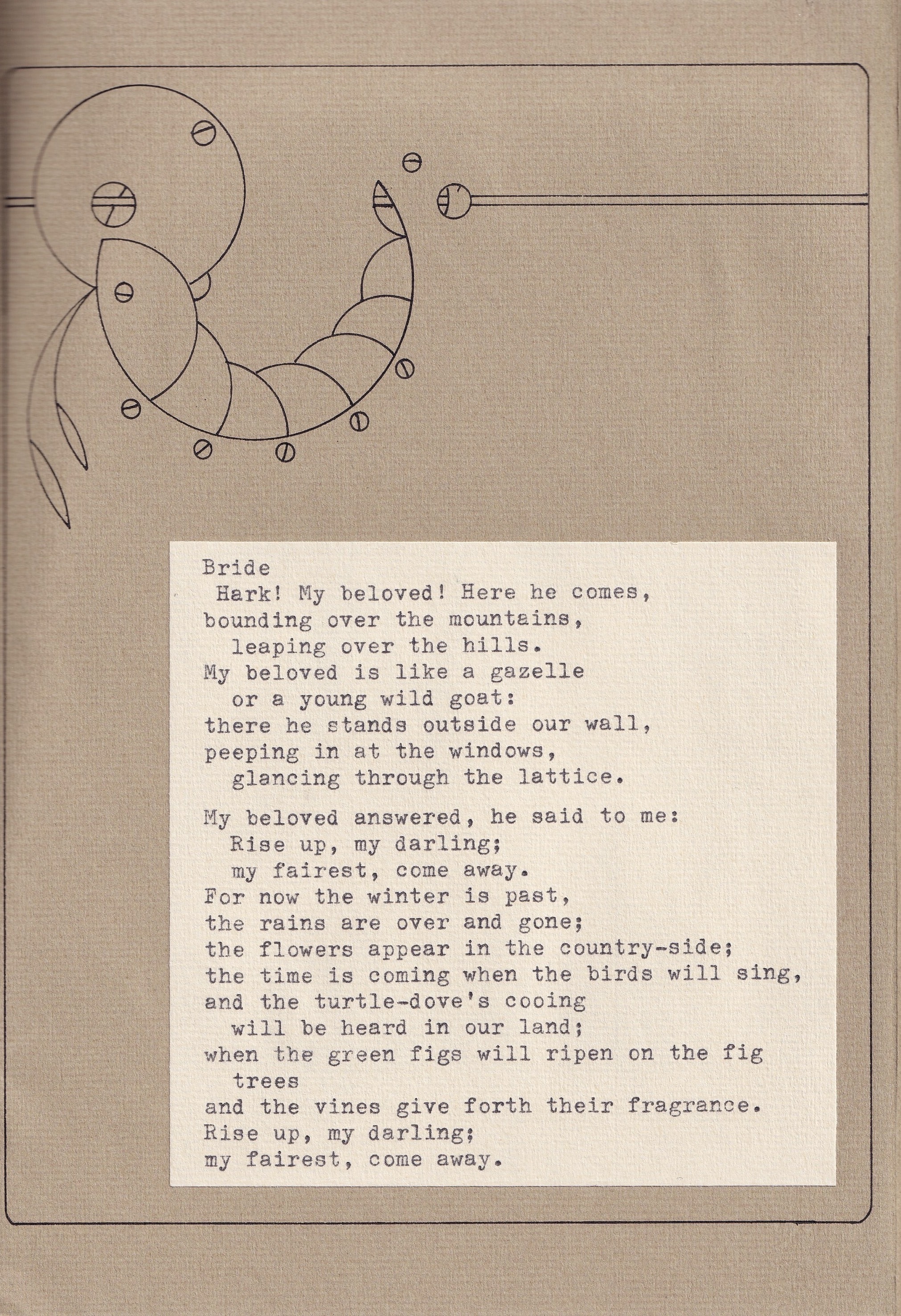
Here, I offer something most personal. Below are some pages from a project I prepared for and then sent to my beloved, in the autumn of 1977 (© Stephen Holmgren 2023), about 45 years ago. She was someone who I very much hoped might in the future be my betrothed. She was and is, Martha, to whom I sent this booklet in the autumn of 1977. Designed and composed in a pension in Florence, Italy, assisted by access to a manual typewriter at St James, the local Episcopal / Anglican parish in Florence, I prepared this multipage document, and sent it to Martha who was pursuing a study year in Taipei. Amazingly, it got there through international mail, and equally amazing is the fact that we still have the physical original of the little  booklet today. (God is good / all the time)

Of course, like all proponents of eternal love and affection, I have fallen short of living into the ideal. But, I still believe in it! Those of us who have entered into this particular covenant can admit this. Why? Because in the covenantal reality of Judaism, and then within Christianity, what we do, and perhaps more importantly what we have failed to do, is not the real issue. The real thing is the the One who grasps us, holds us, and saves us, always. And, the One who holds us together.

The Beauty of Psalm 139

[If reading this by email, please tap the title at the top to open your browser for the best experience.]


Frank Lloyd Wright is known primarily for the huge scope of his architectural work, and perhaps secondarily for the furnishings he designed for his buildings, which include everything from furniture to lamps to tableware. Less well-known are Wright’s graphic designs which were materialized in tapestries, wall panels, carpets, and in stained glass windows.

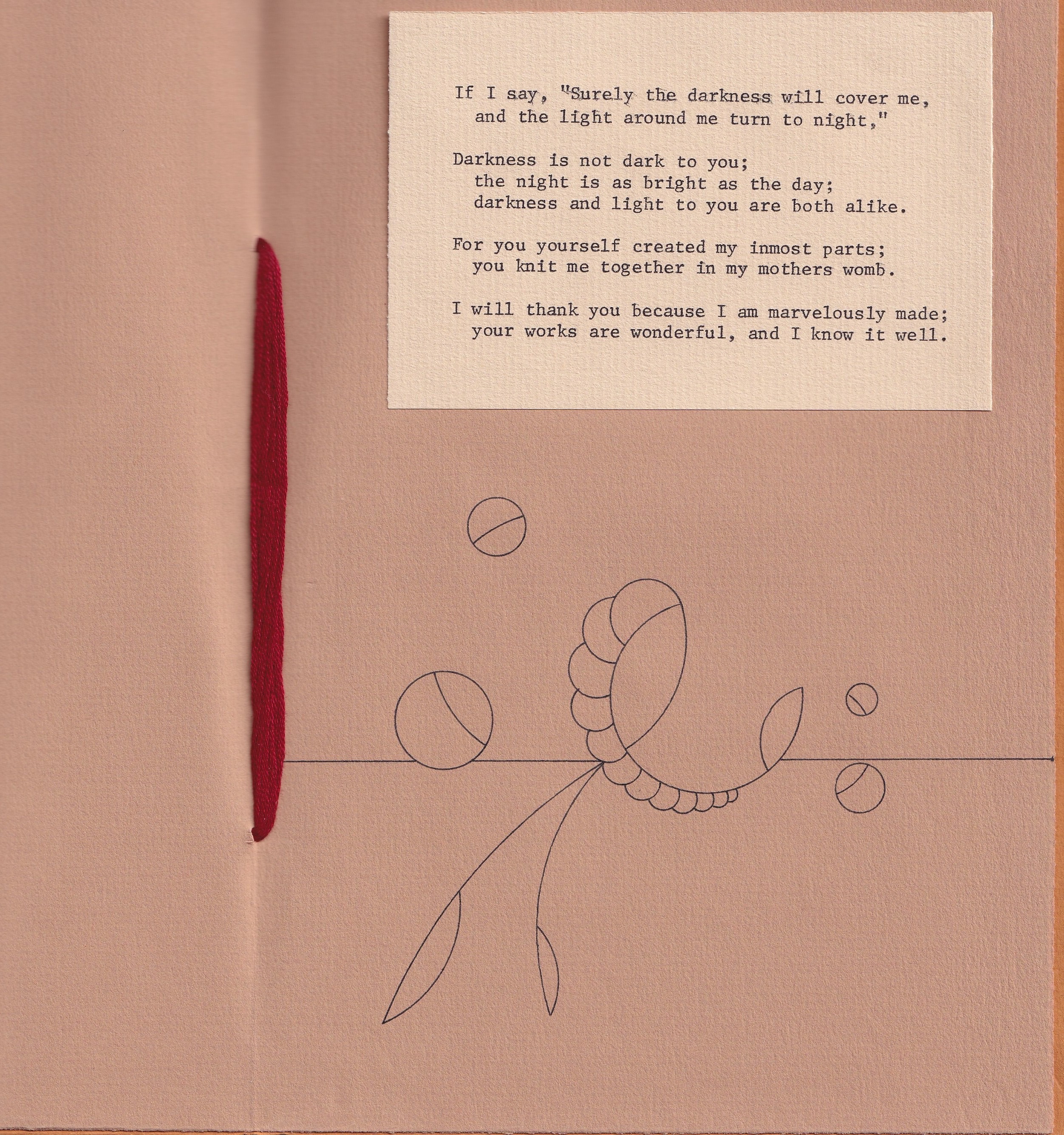
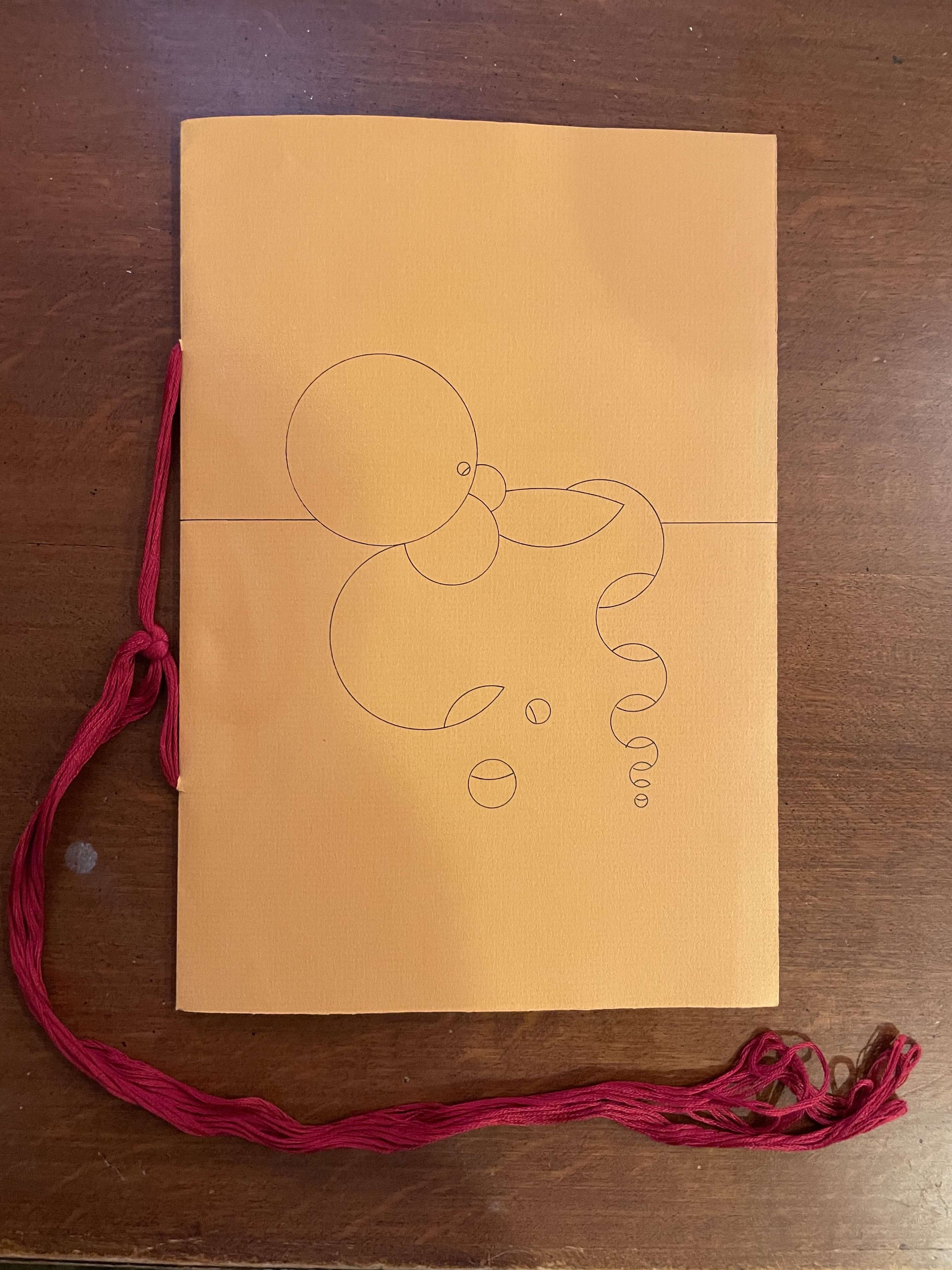
Just as I was strongly influenced by Wright’s architectural work when I aspired to follow him into the practice of his vocation, my design vision was just as impacted by his graphic work. In my case, this influence was not manifest in plans for such things as tapestries or windows, but in designs for paper products such as cards and stationary, and for handmade pamphlets. Among these were one featuring text from Psalm 139 (:1-17), and another text from the Song of Songs.

Above and below are some images of the little Psalm 139 pamphlet I created in the autumn of 1977 using a circle template, a rapidograph pen, an old-fashioned typewriter, and charcoal paper, along with a binding of stranded thread.


The above images are copyright, © Stephen Holmgren 2023. This post is based on a little pamphlet featuring Psalm 139:1-17, which I made while staying at the Pension Colorado in central Florence during the fall semester of 1977 while on a study abroad program through St Olaf College, in my sophomore year. I also acknowledge the probable influence of Alexander Calder’s mobiles.

Beauty in Parallel Revisited

golden_gate_bridge_pillar-smaller-copy

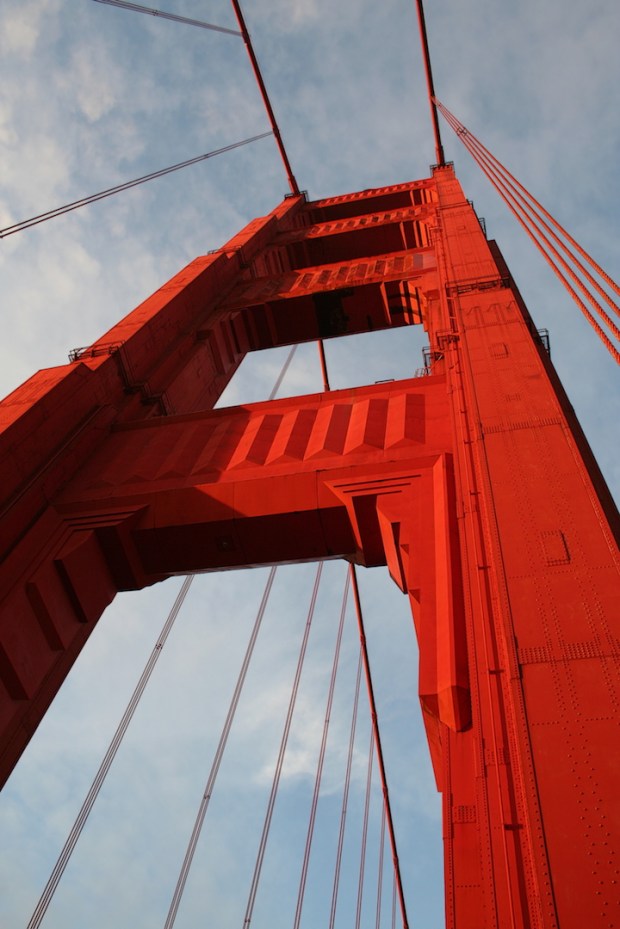
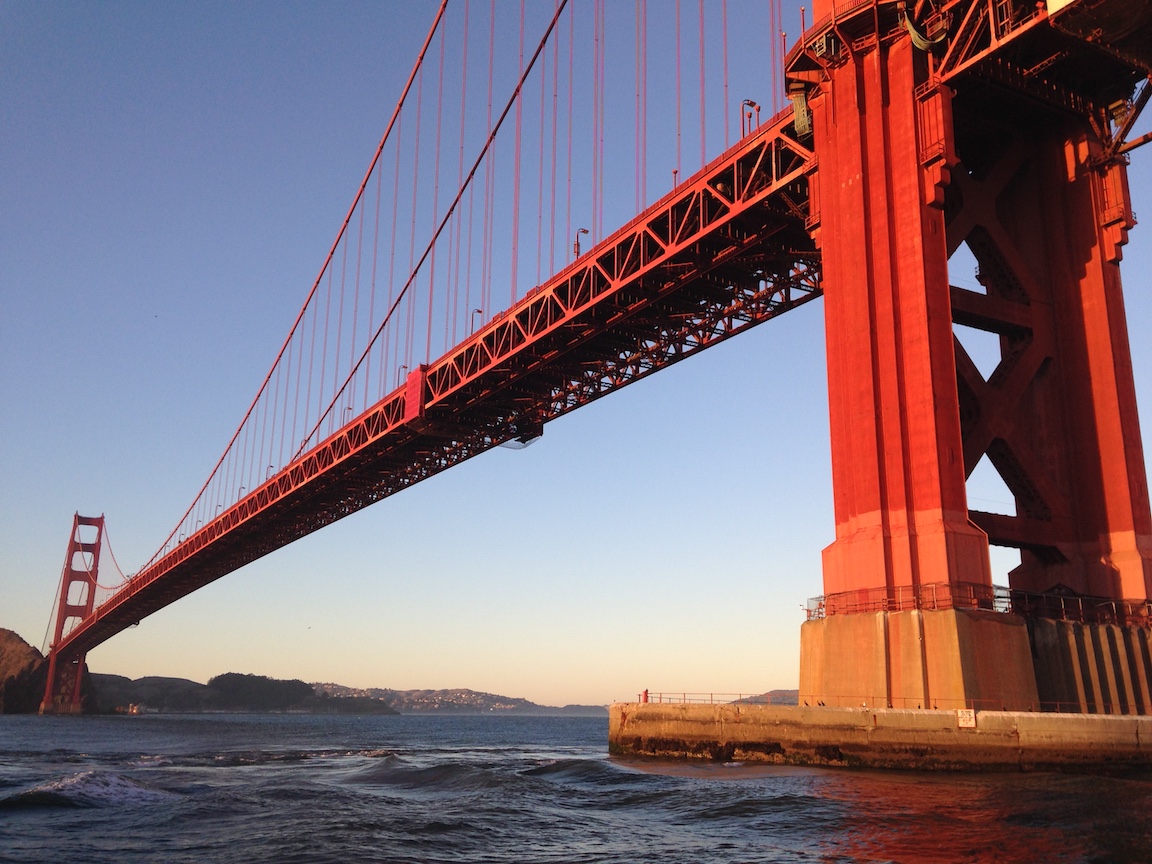
Perhaps the only thing more memorable than driving over the Golden Gate Bridge may be to pass under it on an ocean-going ship. I was lucky enough to have that experience five times before I was a teenager.

Many of us assume the name for this bridge is related to its warm color. But the name comes from the ocean straight over which it stands, and not from the Gold Rush. Rather than mimicking gold, the bridge’s official color—“International Orange”—was chosen to contrast with fog. A story is told about when that color was first applied. Painters dabbed splotches of it on the heads of curious seagulls. Pretty soon, Bay Area birdwatchers reported a new bird species, which was called the California Red-Headed seagull!

Until 1964, the Golden Gate Bridge had the longest main span in the world. Yet, its basic design isn’t unique. We know this from other suspension bridges, which are found all over the world. Bridges of this kind have two main towers, steadied in place by their suspension cables, which are anchored in the ground. From their anchor points, these substantial cables ascend to the top of the towers, and then gently descend again to the center of the bridge. From that low point, they again soar up, to the top of the opposite tower. The slightly arched roadway across is literally suspended from these main cables, by small support cables that hang from them. Here, in the beauty of this simple design, we find a helpful spiritual and liturgical metaphor.

Reflect for a moment about two significant Sundays in the church year. One is the last Sunday after Epiphany, or Transfiguration Sunday, which we observed 10 days ago. The other is Easter Day, which lies ahead. Transfiguration Sunday is the last Sunday before this season of Lent, and Easter Day is the first Sunday after Lent. Both Sundays are as important with regard to our identity as they are to that of Jesus. For in his Transfiguration and in his Resurrection, Jesus does not simply reveal who he really is. He also reveals the fulfillment of our vocation to be fully human, in him.

Imagine these two Sundays on the Church calendar as being like the two towers of the Golden Gate Bridge. Transfiguration Sunday, coming just before Lent, is like the south tower of the Golden Gate bridge, on the busy urban, San Francisco, side of the straight. And, Easter Sunday is like the north tower of that bridge, on the less familiar and historically rural side of that navigational channel. The season of Lent stretches between these two Sundays like the main span of that bridge, taking us from what we think we know to that which may yet to be disclosed to us.

Here is the crucial part ~ every year we need to make this liturgical crossing, from our sharing in the vision of the Transfiguration, to our participation in the joy of Easter Resurrection. And like the great towers of a suspension bridge, Transfiguration Sunday and Easter Sunday uphold us all the way across our Lenten journey over what sometimes may seem like dark, cold, and turbulent waters around us.


This posting is a revised version of a post I first published in 2017, and is based on my recent homily for the Last Sunday after the Epiphany, which explores the parallel between the revelation of glory that we see in the Transfiguration, and the glory we see in the Resurrection (click here for a link to it).

The Beauty of ‘Nothing’ (as we observe Ash Wednesday)

photos_ashes-05


This past Sunday, using the metaphor of the twin towers of a suspension bridge, I invited our local congregation to explore a pairing of two Sundays in the calendar, Transfiguration Sunday and Easter Sunday. These are the interrelated Sundays immediately before and after Lent. Ash Wednesday and the beginning of Lent present us with a similar opportunity. Here, we can explore the relationship between Ash Wednesday and Easter Sunday. With this second comparison between liturgical days, instead of noticing a parallel, we can observe an evident paradox.

On Easter Sunday, we face an unusual challenge. We must take the finding of an absence, and discern within it a presence. Something that was known, seen and touched, became as if it was nothing. And so, we are challenged to see how an empty tomb could at the same time be full of meaning. Even though Mary Magdalene and the disciples found nothing in the tomb, they came away with the conviction that something profound was there.

Consider, then, this remarkable contrast. In the metaphors at the heart of the Ash Wednesday liturgy, we observe inverse phenomena. What would Ash Wednesday be without ashes? Ashes constitute a biblical image with a long and vivid history. And our tactile liturgical use of this common material plays a central role in our services on the first day of Lent. Yet, this liturgical presence of ashes is meant to represent an absence. A dish full of ashes in my hand represents something larger, which is empty. Something (the sign of the cross) is marked with ash on parishioners’ foreheads, and it symbolizes the starkness of nothing, or, literally, no thing.

So, the Sunday of joyful resurrection presence provides the reverse of the Wednesday of regrettable absence. Though it wouldn’t sound as good, Ash Wednesday could instead be called, “Absence Wednesday,” “Empty Wednesday,” or “Nothing Wednesday.” This is because the ashes at the heart of the liturgy for this day symbolize an absence, an emptiness, or a ‘nothing.’ I don’t mean that the ashes are empty of meaning. It’s just that what they represent is literally nothing. Ashes represent nothing of value, nothing of worth. And that is what makes them special! We put ashes on our foreheads to remind us that, on our own and relying on ourselves, we are nothing of value, nothing of worth. No matter how hard we try, we don’t give meaning and value to ourselves. Only God does that.

Our lives can sometimes feel like they are full of “nothings,” as if all that we do only amounts to ashes or dust. All too quickly, we forget that dust and ashes are the building blocks of God’s creation of human beings. They are the building blocks of God’s Kingdom. When we think about something we have done, and are tempted to say, “O, it’s really nothing at all,” let’s remember what God can do with ‘nothing’.


This posting is a slightly altered republication of a post from March 2017. It is based on a homily for Ash Wednesday that I have frequently offered, the most recent text of which can be found by clicking here.

Christo and Jeanne-Claude: Landscape Artists with Vision

Surrounded Islands in Biscayne Bay, ‘wrapped,’ 1983


Having in prior posts featured an introduction to three landscape artists beginning with Andres Amador, today I would like to focus on the earlier work by a couple who gained recognition through the unexpected character of their joint projects.

“Christo and Jeanne-Claude described the myriad elements that brought the projects to fruition as integral to the artwork itself, and said their projects contained no deeper meaning than their immediate aesthetic impact; their purpose being simply for joy, beauty, and new ways of seeing the familiar.” [Wikipedia]

I am grateful for Wikipedia’s succinct summary of Christo and Jeanne-Claude’s shared-aim for their joint work, and especially for that phrase, “their projects contained no deeper meaning than their immediate aesthetic impact…” Modern art in its many forms has been subject to much misunderstanding, as viewers have often looked within it for ‘meaning’ and ‘a higher purpose’ where none has been intended. I have previously featured the work of Alexander Calder and look forward to presenting the work of other 20th century (and later) artists, who have offered us the sheer beauty of non-representative paintings and sculptures.

Christo and Jeanne-Claude’s collaborative work has long struck me as epitomizing this approach to the exploration of beauty. They risked appearing to have trivialized their engagement with the natural world as well as with well-known works of architecture. But they also helped us see familiar and unfamiliar things in different ways, and with new appreciation.

Most significant was their consistent effort to make their projects not only self-funded, but as ecologically sensitive as possible, with their subsequent donation or recycled use of art installation materials. In my view, they did not seek to alter the landscapes or structures with which they worked in more than a very temporary way. And certainly not in any way that would compromise those beautiful places, but instead to enhance our regard for them.

I offer the photos below with appreciation for the simple joy that these prior installations may have brought to those who were able to be present at them, and for the beauty of the preserved digital images we still have of them. I wish I could have seen one myself, in context!

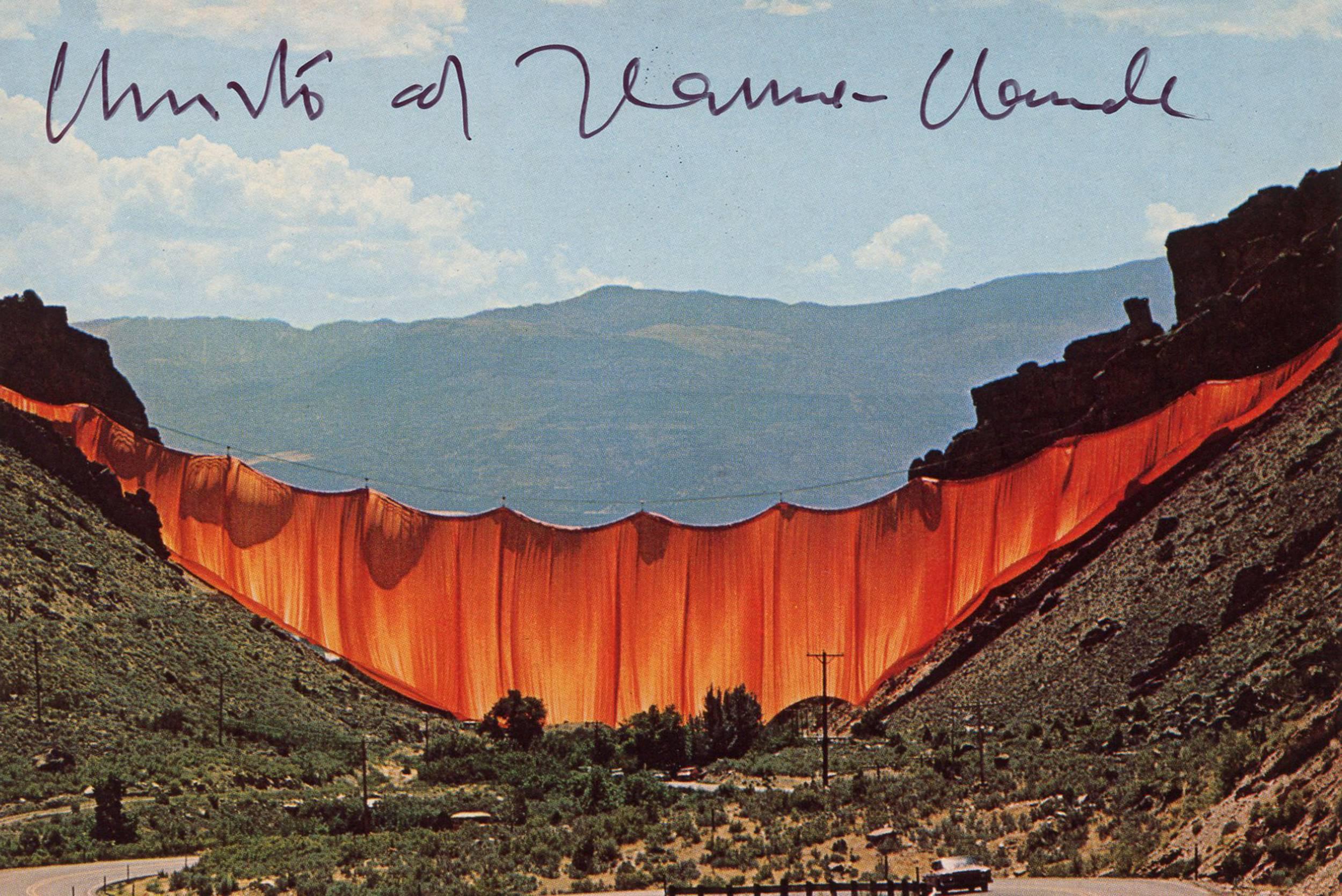
Valley Curtain, Colorado, 1972

Running Fence, Sonoma and Marin Counties, CA, reported as 24 miles long, 1976

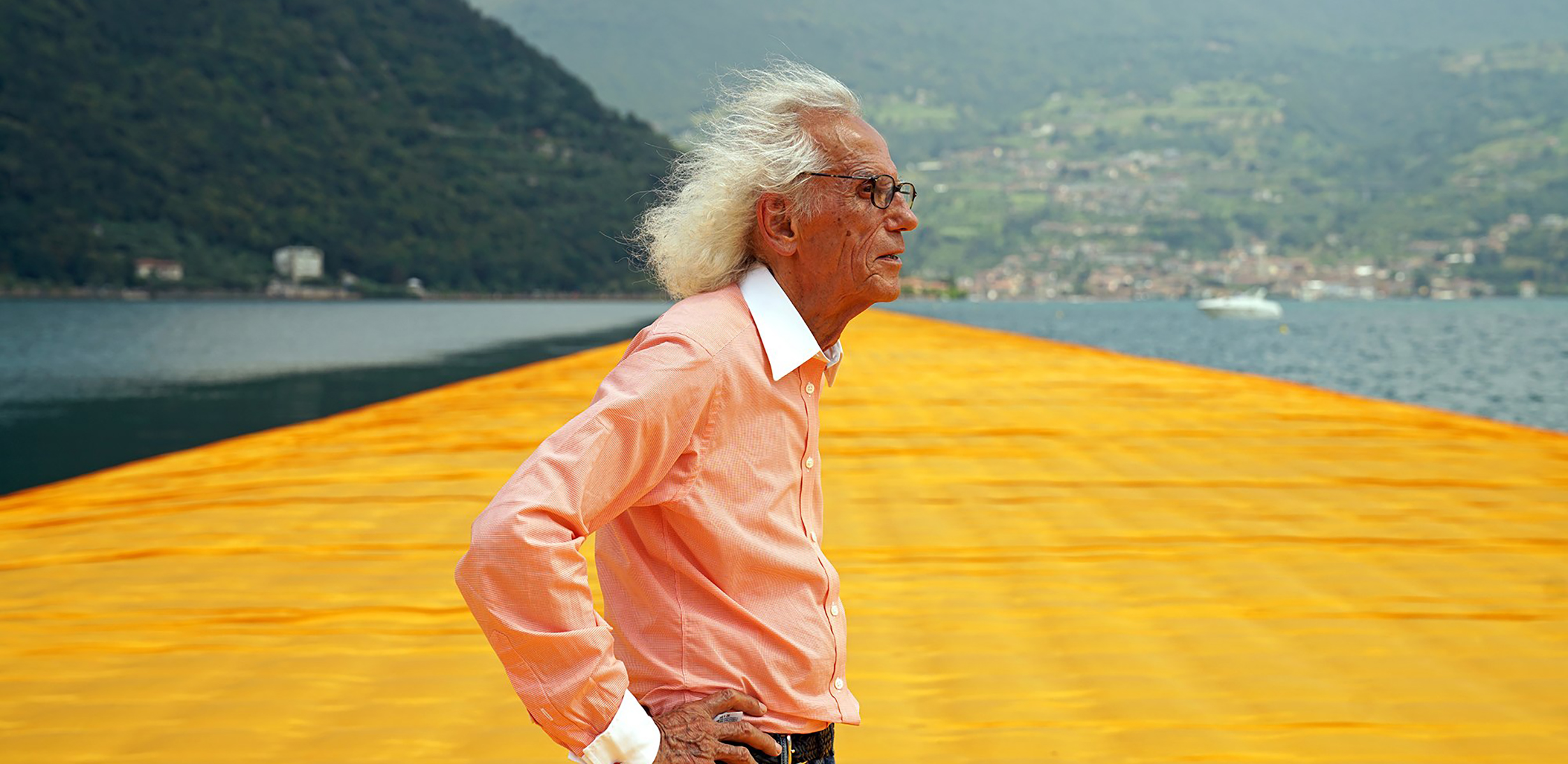
Christo on Floating Piers, Lake Iseo, Italy, 2016, after Jeanne-Claude’s death in 2009

Hundreds if not thousands walked on the floating causeway to the island

Pont-Neuf bridge in Paris, ‘wrapped,’ 1985

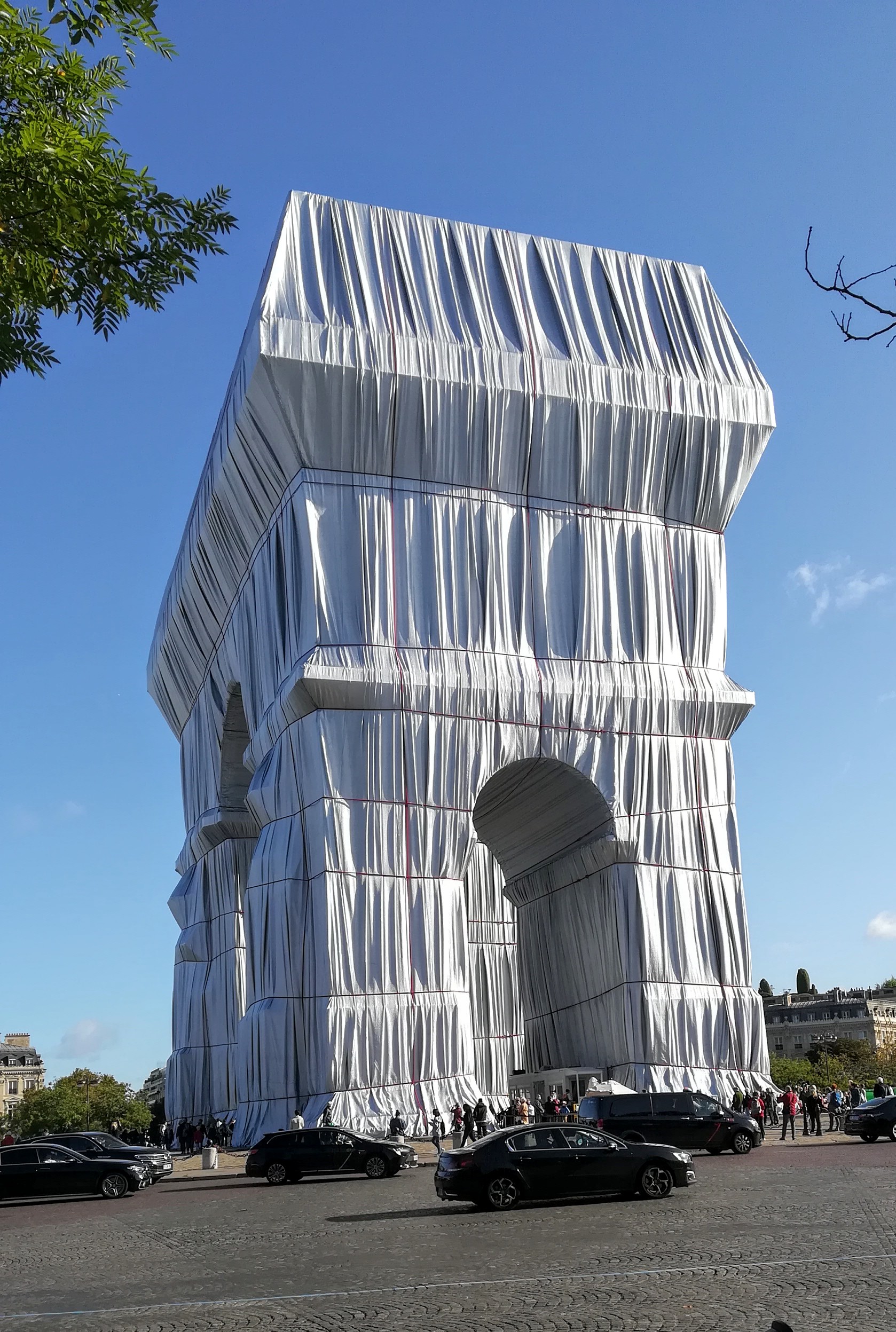
The Arc-de-Triomphe in Paris, ‘wrapped,’ 2021

Andres Amador: Earthscape Artist

[If reading this by email, please tap the title at the top to open your browser for the best experience.]


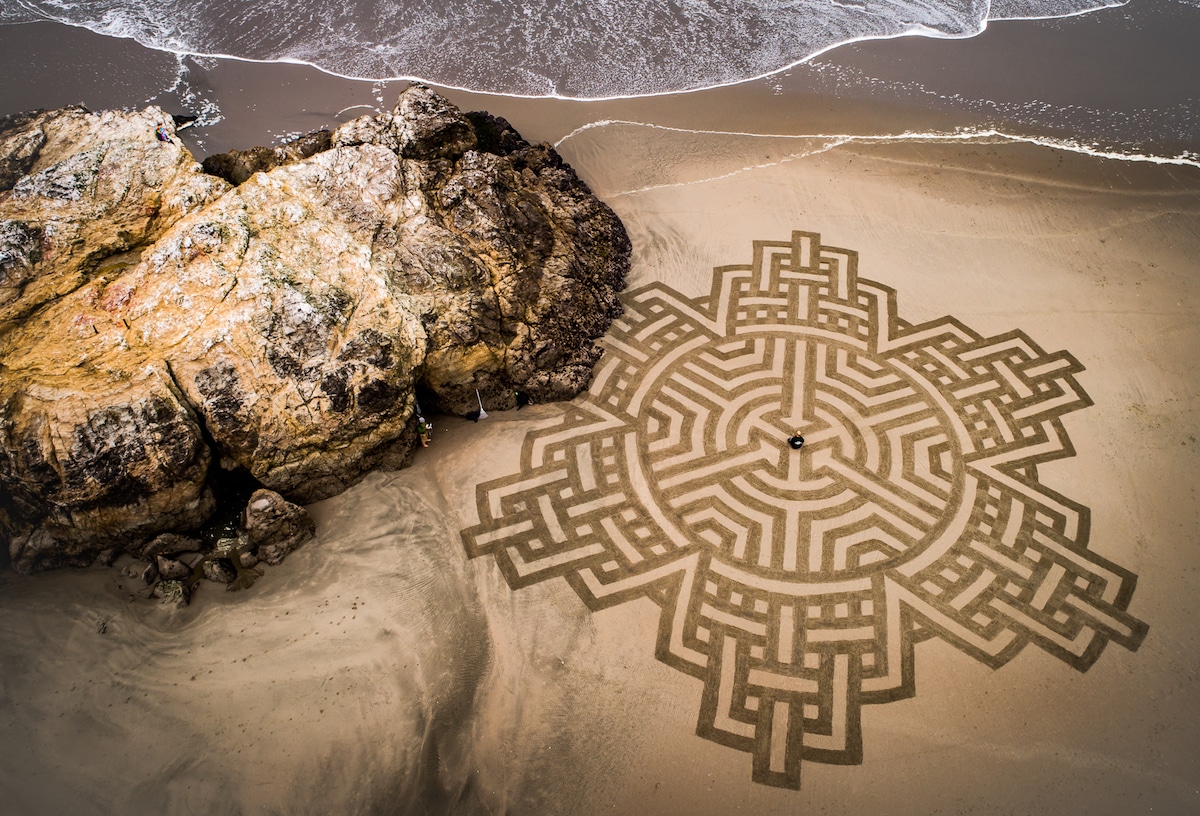
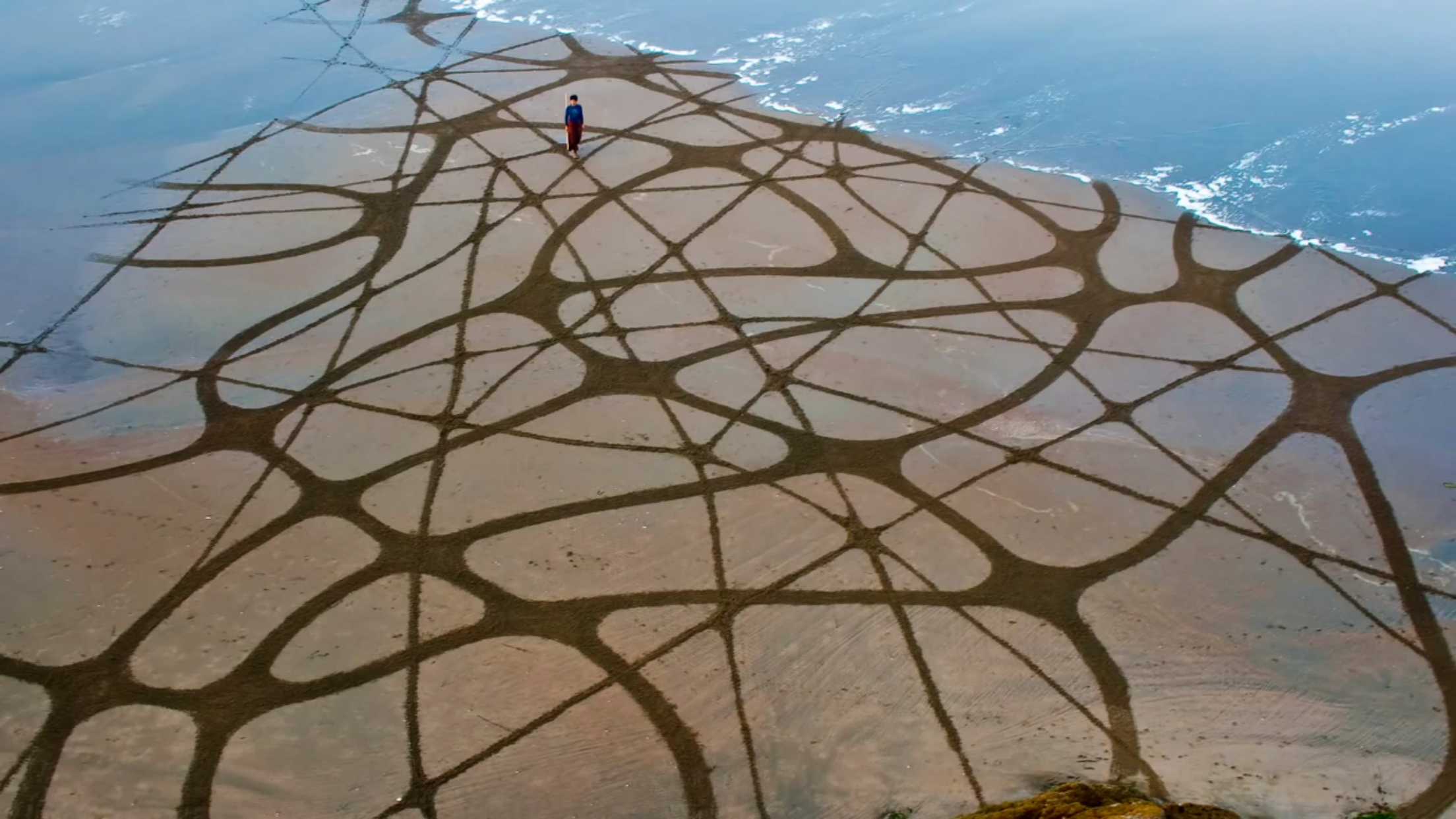
Above we see a drone-based digital image of a pattern that a contemporary artist has inscribed upon the sand of a beach. He is also an academically trained scientist, who has employed his gifts in a particularly sensitive way.

Now, why are some or all of those details important? Because we see here the abilities of Andres Amador, someone whose public art work may lead us to wonder about how this artist could have accomplished all this. Not only in the image above, those presented below, as well as those widely available now on the internet.

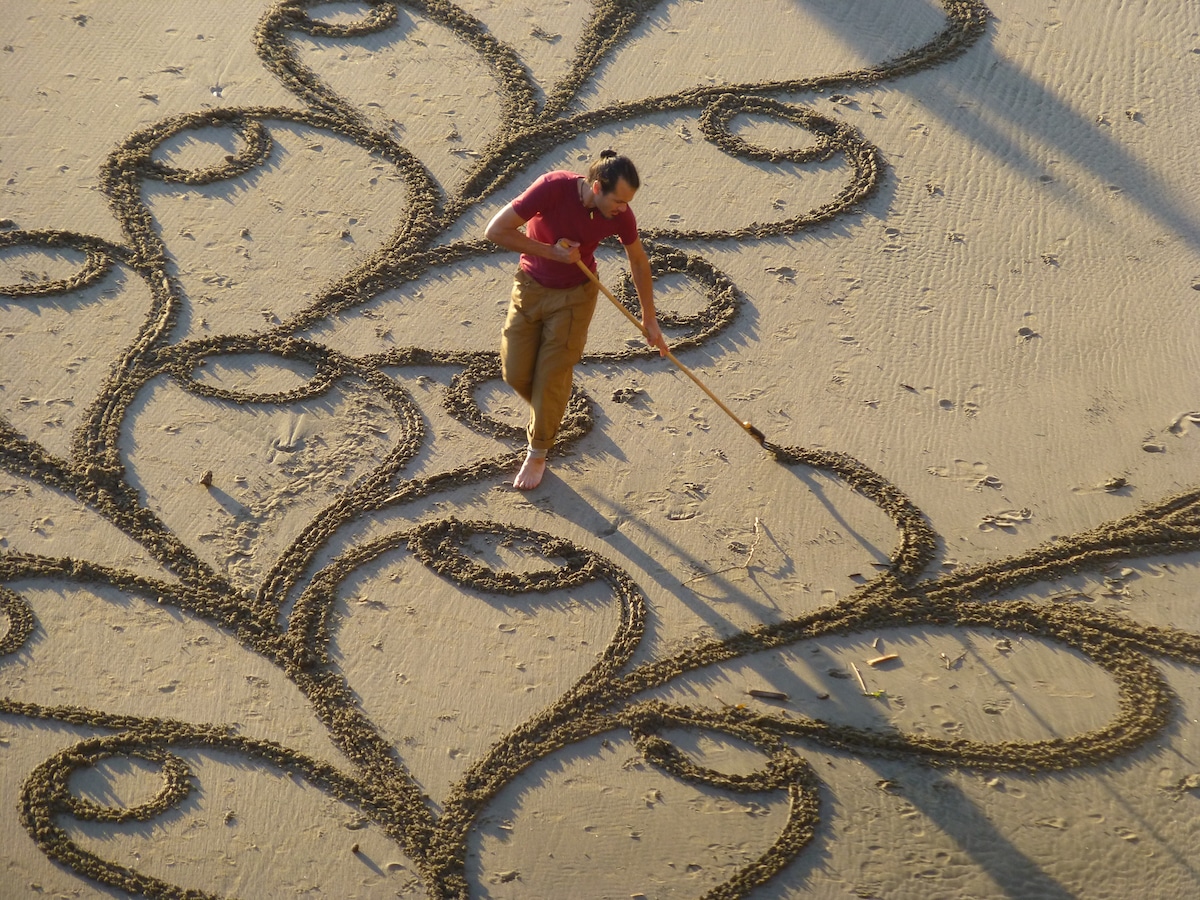
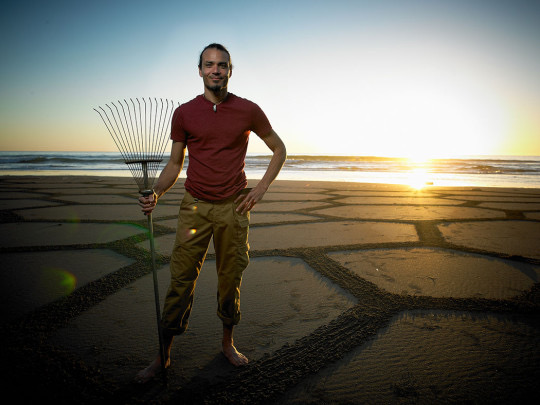
Well, what would it take for you or me physically to be able to produce such an image upon the sand on a seaside beach? To my surprise, it is only geological timing (the tides); an appropriate location in relation to that matter of the tides; and then only a couple of simple tools. These would include some common and small garden rakes, and perhaps also – in relation to the circular-based patterns – a metal or wooden spike, a long rope, and some kind of carving or scraping tool at the end of that rope. The invention of the small drone with a camera has also been of help.

But, clearly, it takes more than physical circumstances, geography, and available tools. It also takes a scientifically trained sensibility as well as a developed intuitive creativity. What Andres Amador has accomplished and still produces is not in any way simple. And yet, he provides frequent teaching sessions, open to all, inviting others to do what he does. Insight about this is provided by a short but compelling video produced some years ago by KQED San Francisco (see link below). I think that one way to summarize a principal theme in his work is that he seeks to see things “whole,” which for some folks is related to seeing what is “holy.”

In that video, Amador describes two reference points, or two sorts of impulses within him, as sources for his earthscape art. “The two main directions that I go with, in the art, are {first} the geometric, which is very precise… So, it’s all about perfection.” Pattern can be imposed upon the ‘blank canvas’ of nature.

“The other {or second} side of it,” he says, “is the organic art, the art the feels like it is emerging from the location… the art that is telling me what to do next.” Pattern may therefore be in some sense received.

I find these two insights to be spiritually and theologically significant. We are able to impose pattern upon our lives, and often attempt to do this within the social world around us. At the same time, we may discern and receive pattern for our lives from within, whether from a divine or from a natural source, or through the gifts of others. Impose, and receive; both are important for our search to become whole.

God bless your continuing work, Andres, and especially for helping us perceive beauty in a fuller way.


Here is a link to the compelling KQED Andres Amador short video : https://www.kqed.org/arts/10134941/andres-amadors-earthscapes-art-that-goes-out-with-the-tide


Epiphany-Sensitive Landscape Artists

[If reading this by email, please tap the title at the top to open your browser for the best experience.]

Andres Amador

Christo, after the death of his wife, Jeanne-Claude

On the Sundays following the feast of the Epiphany (January 6), the western Church historically has focussed on God’s self-disclosure through nature. We find this theme expressed in the Epiphany Day Gospel featuring the visit of the Magi, or Wise Men, from the East. They followed the appearance of a star in the sky to find our Savior at his birthplace. Note how this contrasts with stories about guidance provided by the messages of angels, whether in dreams or as on occasions of personal divine revelation.

One of my favorite examples of this theme can be found in some verses by the Anglican priest, theologian, and poet, John Keble, for a Sunday in this Epiphany-tide:

When souls of highest birth
Waste their impassioned might on dreams of earth,
He opens Nature’s book,
And on His glorious Gospel bids them look,
Till, by such chords as rule the choirs above,
Their lawless cries are tuned to hymns of perfect love.

In my next two posts on this blog I will feature the landscape-based artwork of Andres Amador, as well as that of Christo and his late wife and collaborator, Jeanne-Claude. Amador is known for his ephemeral raked sand projects, and Christo with Jeanne-Claude are remembered mainly for their draped or wrapped fabric installations. Though the work of these three has taken very different forms, they have demonstrated a common and notable commitment to environmental sensitivity despite the fact that their projects have involved only temporary alterations of various landscapes or structures.

Among agnostic, secular, and even atheistic artists, many seem to recognize the power of the sublime in Nature. But also notice how even the pious John Keble – with his high sense of the authority of Scripture – was willing to describe the natural world around us as God’s “Glorious Gospel,” and as “Nature’s book,” written by the divine Author of Creation.

I have no basis for evaluating whether there is any theological grounding for Amador’s, or Christo and Jeanne-Claude’s world-views. Partly because such is not suggested nor asked for. Yet, I find the work of these three artists not only aesthetically pleasing, but also as theologically significant.

Why? Because God is either everywhere present in reality, however we conceive of it, and whether we are conscious of it, or God is not. I am convinced of the ‘yes’ answer. And so, for me, God is surely the source of the Beauty everywhere present in the cosmos. For traditional believers, there is no place where God is not.

Beauty can be found in this observation itself. There may be a transcendent source for the abundant beauty we enjoy in the world, and in people around us. But if there is, it does not require us to acknowledge it. The beauty we find everywhere – God’s beauty, I say – stands for itself. Remarkable!


Once again, I wish to credit my friend and former colleague, the Rev. Ralph McMichael, Ph.D., for his succinct and helpful delineation of ways of understanding the relation between nature and grace, in his teaching and writing. In this regard, his essay, significant to me within the book he edited, Creation and Liturgy: Studies in Honor of H. Boone Porter, continues to be very helpful. He is also the author of The Eucharistic Faith, a first volume of a new Eucharist-based systematic theology.

Beauty in Potential

[If reading this by email, please tap the title at the top to open your browser for the best experience.]


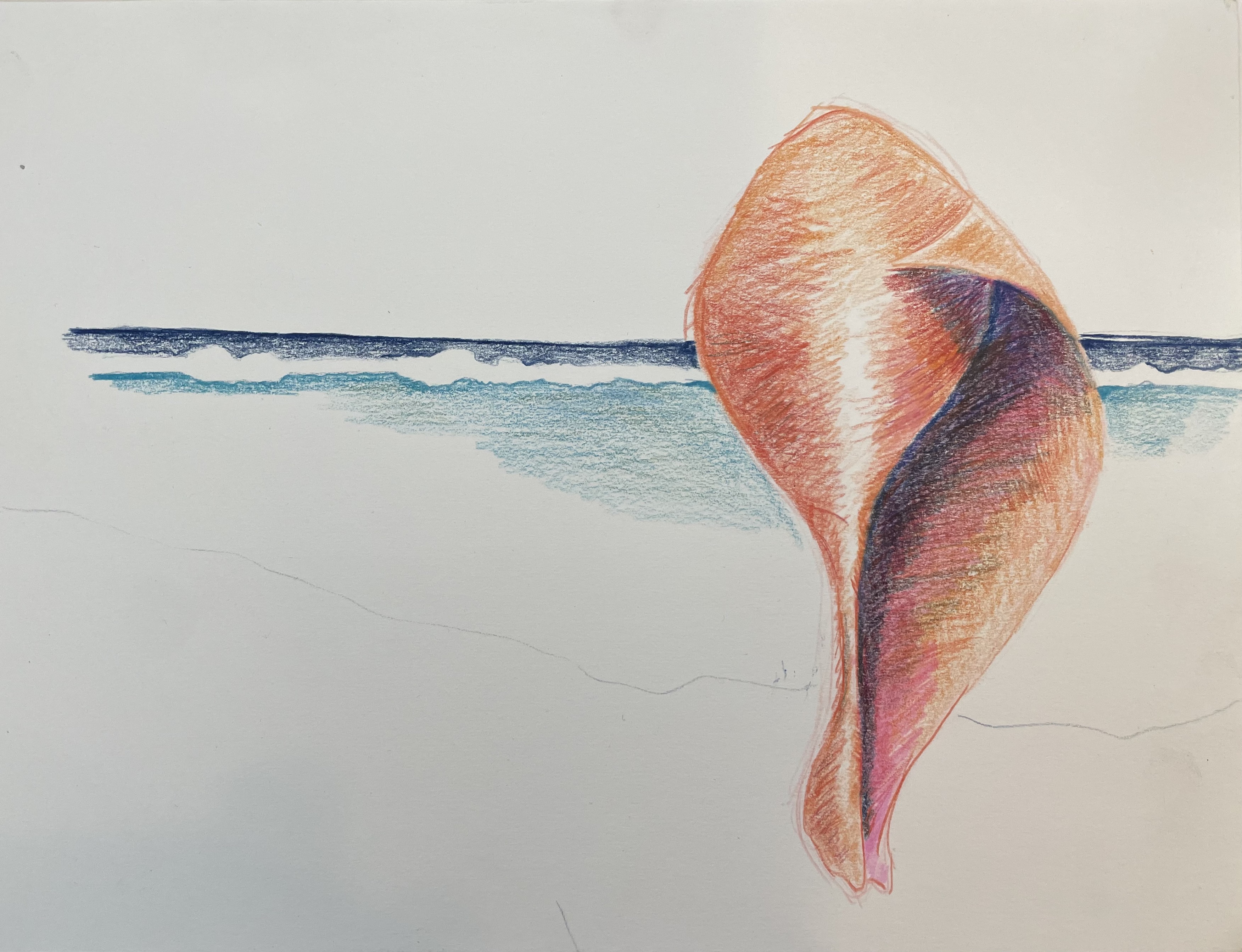
This week I take the risk of sharing with you some things that are more personal. I try to do that regularly, but not often in the form of sharing my own visual work.

While as an art student in college I became fascinated with the shapes and colors of various seashells, largely through the help of a coffee table book containing high quality photos of them. The above is an example of a colored pencil study of one that I did a few years later.

More recently I became familiar with the paintings of William Dunlap of the Delta region of northwest Mississippi. To Dunlap I attribute the phrase, ‘hypothetical realism,’ words which I think well describe many of Georgia O’Keeffe’s paintings. I understand Dunlap’s phrase as referring to a desire to capture seen and known objects in a realistic way, but in imagined settings. I think the influence of Georgia O’Keeffe is evident above in my own willingness to superimpose the beautiful form and color of a shell upon an imagined seascape setting, without any shadows cast by the former upon the latter.

Notice, also above, how I am by temperament a water colorist… meaning that I am inclined to start with light tones before the dark, not only with traditional water colors and colored pencils, but even with with oils and acrylics (heresy admitted!).

Then, in 2021 and after about 35 years of neglect, I made what felt like a brave decision to attend an artist’s retreat at a nearby Benedictine Abbey, which has an art studio. I share below my effort to revisit an earlier love, expressing by it something of an unfulfilled potential. The painting is still unfinished, and this time I have approached the subject with acrylics.

Perhaps these days following the Epiphany, and our observance of the Baptism of our Lord, can be for us a time to appreciate gifts we have been given, whether of the physical and material kind we tend to associate with Christmas, or of the more spiritual kinds we may associate with the Epiphany. Both call for appreciation. But the form that appreciation takes in each case, as well as the timing with which it occurs, may well differ.


Witness of the Magi

[If reading this by email, please tap the title at the top to open your browser for the best experience.]

Peter Koenig, panel from his Christmas-Epiphany triptych


“When the wise men from the East … set out… there, ahead of them, went the star that they had seen at its rising, until it stopped over the place where the child was. When they saw that the star had stopped, they were overwhelmed with joy. On entering the house, they saw the child with Mary his mother; and they knelt down and paid him homage. Then, opening their treasure chests, they offered him gifts of gold, frankincense, and myrrh. And having been warned in a dream not to return to Herod, they left for their own country by another road (from Matthew 2:1-12, the Gospel for this day).”

Peter Koenig, in a painting I much admire in relation to this present season, not only presents the visit by and the adoration of the Magi, as well as their presentation of gifts. He also helps us discern how our celebration of Christmas and Epiphany anticipates our observance of Holy Week and Easter.

As we know from hymns and readings, the visitors from the East brought costly offerings, including gold, incense, and myrrh. This much is obvious from a first look at Koenig’s imagery. Much more subtle are additional features of his painting that should also attract our attention. Based on the imagery in Genesis 3, note the serpent under Mary’s foot. Note also how the Christ child is wrapped in what appears to be fabric prefiguring his eventual burial shrouds. Behind the figures in the painting, we see an anticipation of the empty tomb with its stone covering rolled away. And, in front it, we seen an image of the cross portrayed as also being the tree of life, bearing the vine from which will come the cup of salvation.

O God, by the leading of a star you manifested your only Son to the peoples of the earth: Lead us, who know you now by faith, to your presence, where we may see your glory face to face; through Jesus Christ our Lord, who lives and reigns with you and the Holy Spirit, one God, now and for ever. Amen. (from The Book of Common Prayer)

May our Lord, who was and is, and is to come, bless us and our loved ones during this holy time.