Painting

The Beauty of Kingdom Potential


What has Jim Janknegt depicted with his painting? Right away, we can see that he portrays the Kingdom mustard seed parable in Mark’s Gospel. With his focus on this parable, we should remember that the Gospels include two kinds of mustard seed teaching. One is in Jesus’ parable ~ about the huge potential of what God can do with apparently small bits of the Kingdom. Jesus’ other teaching is about the tremendous potential of what we might accomplish through personal believing, especially given how personal faith can otherwise be deficient or defective.

To help recognize this difference, between Jesus’ Kingdom parable and his other teaching referring to the size of our personal believing, consider what we see in Janknegt’s painting. In the foreground we see things we usually think of as being big ~ like big cities, their large buildings and the businesses they house. Dwarfing them is a great tree, which may represent the ‘Tree of Life.’ Like the small mustard seed, the great tree that it becomes represents what the Spirit is doing with God’s Kingdom.

Notice the community for which the great tree provides a place of habitation ~ a community characterized by many birds, including both a beautiful peacock and a spoonbill, an owl and a descending dove. In traditional mythology, birds represent communication between the realm of the sky and the realm of the land, or between the heavenly sphere and that of the earth. The Tree of Life provides a context for this communication, and for the Kingdom community that God’s Spirit nurtures between the two.

If we ever worry or despair about the smallness of our faith, we should remember Jesus’ emphasis upon the huge potential of God’s Kingdom power. The seed of this Kingdom potential is planted within us at our Baptism.


This post is based on my homily for Sunday, June 17, 2018. Jim Janknegt’s painting, Worlds Smallest Seed, is used here with his permission. {Editorial note: I preached on this Gospel reading, and referenced Janknegt’s evocative painting again on Sunday, Jun 16, 2024. Here is a link to my reflections on the same Gospel reading.}
The Beauty of His Community

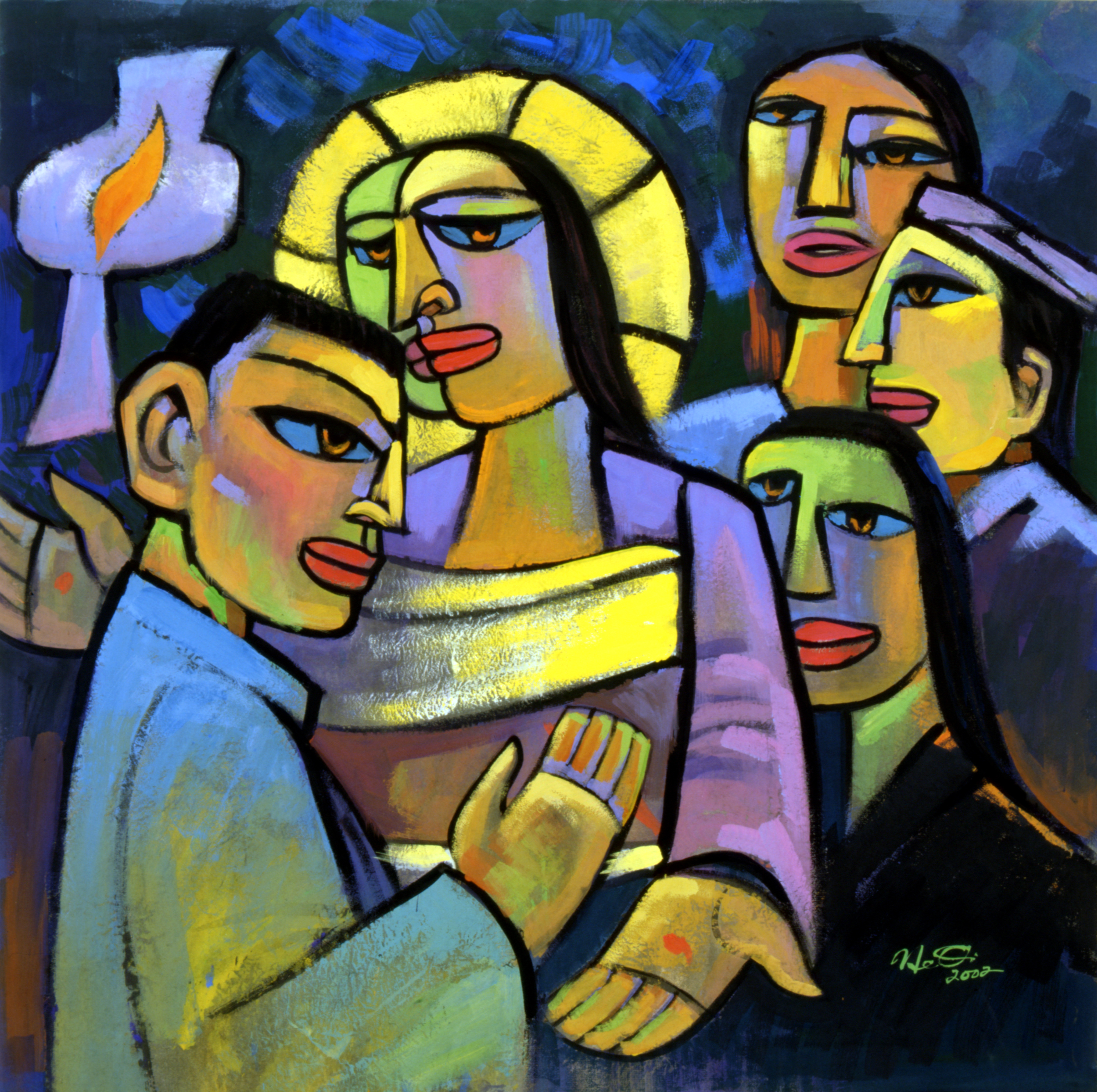
Art_James He Qi_The Doubt of St.Thomas_large


I love how artists help us read and hear Scripture in new ways. Occasionally, they help us perceive aspects of biblical texts for the first time. Paradoxically, in one case artworks have nurtured a mis-hearing of the Gospel. For all the paintings of Thomas that I know refer to him as having doubt, and portray the resolve of that doubt as coming from his touching the side or hands of the risen Jesus. But look closely at John’s Gospel. In his visit to the room where the disciples have been hiding, the risen Jesus does not directly attribute ‘doubt’ to Thomas. Instead, and perhaps with his prior visit to the other disciples in mind, he merely tells Thomas not to doubt. Nor does John describe Thomas as taking up Jesus’ invitation to touch him. Jesus credits Thomas for believing after seeing him, rather than after touching him. He then encourages the kind of belief that does not rest upon seeing.

Notice how the other ten disciples are hiding in fear, rather than joyfully confident, when Jesus comes to where they have locked themselves in. They are described as rejoicing only after Jesus shows them his hands and his side. In other words, Thomas is not unique and different from the other disciples, and benefits from exactly the same experience that transformed them from people fearfully hiding into those who are rejoicing. Their joyful confidence is reflected in their words to Thomas when he later arrives. They say, “We have seen the Lord.” Their joy is the direct result of seeing Jesus’ hands and side, the very things Thomas says will be key to his own believing. So, the ten did not believe until they saw; and Thomas will not believe until he sees. What they received, he, too, will receive. As will we, who—like Thomas—were not initially in that room. The history of art obscures this important point.

Here are two safe things we can say and accept as true. The risen Lord continues to disclose himself with signs. And, the Lord reveals himself in community, and always for the sake of his community. For his community is fellowship within the new covenant of reconciliation. As John writes in his first Epistle, “We declare to you what we have seen and heard so that you also may have fellowship with us.” Fellowship with this community, is fellowship in and with the Risen Lord.


James He Qi, The Doubt of St. Thomas (He Qi © 2014 All Rights Reserved); used with permission. I think of it as portraying the community faith of Thomas. See John 20:19-31, and 1 John 1:1-2:2. Click here for a link to my Sunday homily, which explores the impact of the resurrection upon the disciples.

Beauty and Resurrection

Stanley Spencer_the-resurrection-reunion-of-families-1945

Stanley Spencer’s church cemetery visitors find themselves surprised by being found! They experience being found through a resurrection encounter with those who have gone before.

The resurrection of Jesus is not usually something we go looking for. The risen Jesus comes and finds us. This is the pattern we see in so many of the stories of Jesus’s first resurrection appearances to his friends and followers. The disciples and others don’t go looking for him except at first, when they go to the tomb. And even then, they are seeking Jesus’ mortal remains rather than his risen presence. He comes and finds them, just as he finds us, often in the context of fellowship. And like them, we are always surprised.

We don’t find the resurrection just as we don’t find God. Neither God nor the risen Jesus are lost, even if we may be. And so, we are found by both, and then we find ourselves as persons who have been found. This is instructive, for it corresponds with our apprehension of, and encounter with, beauty —which we also misleadingly credit ourselves with ‘finding.’ Really, beauty finds us. For our perception and recognition of beauty depends not on a ‘power’ that we possess to pursue and attain it, but rather on our ability to receive and recognize what is, and what is given. The same is true in our apprehension of, and encounter with, the grace of the resurrection.


Stanley Spencer, The Resurrection – Reunion of Families, 1945.

A Strange Beauty

Stanley_Spencer_the_crucifixion_1958


An encounter with true beauty can be troubling, especially if we have settled for so much less. It may be our sensitivity to the juxtaposition of opposites, and their apparent lack of resolve. At times we hope for the triumph of good over evil, that beauty will overcome darkness, and serenity displace antagonism. But we cannot find it within ourselves to do more than hope. We cannot achieve the redemptive resolution for which we haltingly reach out our hands and hearts.

It is not an accident that the figure of Jesus recedes into the background of this painting, while those who oppose and crucify him grab our visual interest. Stanley Spencer, who adopted what he called a neo-primitive style, was far too gifted a colorist, and master of light and dark, to let that happen unawares. As Spencer has rendered him, Jesus’ skin tone and color match the wood of the cross, and also the clothing of the man with the hammer swung over his head, as well as much of the sky and of the ground below… including the tunic of Mary Magdalene, prostrate on the ground. This forms a compelling visual symbol of his Jesus’ total identification with us in his incarnation, and his complete joining with us, and with our world of tearing hurts and suffering.

In fact, it is precisely because —in Spencer’s composition and coloring— Jesus could blend in so well with the background of everyday life, that those who opposed him could literally gain the upper hand, with hammers and nails. But this is only the marvel of the incarnation of our God in Jesus, that the fullness of divinity could be so thoroughly joined to the incompleteness of humanity. As the Gospels attest, it was a joining so thorough that many did not notice or have regard for his divinity. When we do notice that thorough joining, when we come face to face with the truths it represents, we have either one or the other of two reactions. When we get close enough to see —to really see him— there are only two responses. We throw ourselves down in humility before him. Or, we seek to throw him down, to humble him before us.

These paradoxes are brought to their greatest prominence when, as he predicted, he is lifted up. His lifting up is his glorification, and the glorification of God within him. Yet his lifting up is on a cross, and in the agony of a humiliating public execution. Here we see a ‘strange beauty’ — the strange beauty of the Lord — a beauty for which museums better prepare us than do our malls. Let us “behold the fair beauty of the Lord, and seek him in his temple.” We will find him! We will find him in the “temple” he promised to raise in three days.


The painting above is The Crucifixion, 1958, by Stanley Spencer. This reflection is based on my homily for Good Friday, which also makes reference to Charles Wesley’s text, “Lo! He comes, with clouds descending.” Click here for a link to this homily.

Annunciation

Simone_Martini_Annunciation_Detail

Today we celebrate the feast of the Annunciation to Mary. The angel of God brought her “good news” ~ but news she could hardly have understood at the time. She would bear a child, who would be called Son of the Most High. I have always loved Annunciation paintings, and this one by Simone Martini (from 1333), in particular.

When the angel appeared to Mary, she encountered God’s holiness and righteousness. Like so many times in history, God’s presence pushes everything else into clarity. The bright light of Glory throws into relief all the dark places in the world – all the hidden corners of our lives. We usually react to this with disquiet and concern. We hear that God’s word comes as Good News. And yet we experience God’s call to become a new person, or do a new thing, as a fearful invitation!

For me, it has been a call to move from one beloved congregation to what I could only hope would be another. For both you and me, it will be a call to speak to someone with whom we have a misunderstanding, or forgive someone whom we have failed to forgive. When God calls us to new life, we are often afraid. We think of what we fear might happen: like losing a familiar home and community; or setting aside our pride, and opening ourselves to being hurt again.

Look at how Martini portrays Mary’s response to the angel! Gabriel visits her with holy news about the child she will bear, who will bring salvation to the world. Mary draws back from his message, fearful about what it might mean. We know it turns out for good. But at first, God’s call can frighten us. A change to something new, always means a change from where we started.

The scene reminds me of spiritual advice I received years ago – advice that helped me be willing to leave a tenured seminary position and return to parish ministry. I had a sense of call, but the prospect of this change was frightening. A wise friend said to me, “when you go toward the heart of your fear in faith, God will always meet you there with power.”