Painting

Once and For All

If reading this by email, please tap the title at the top to open your browser for the best experience. Then, clicking individual pictures will reveal higher resolution images.

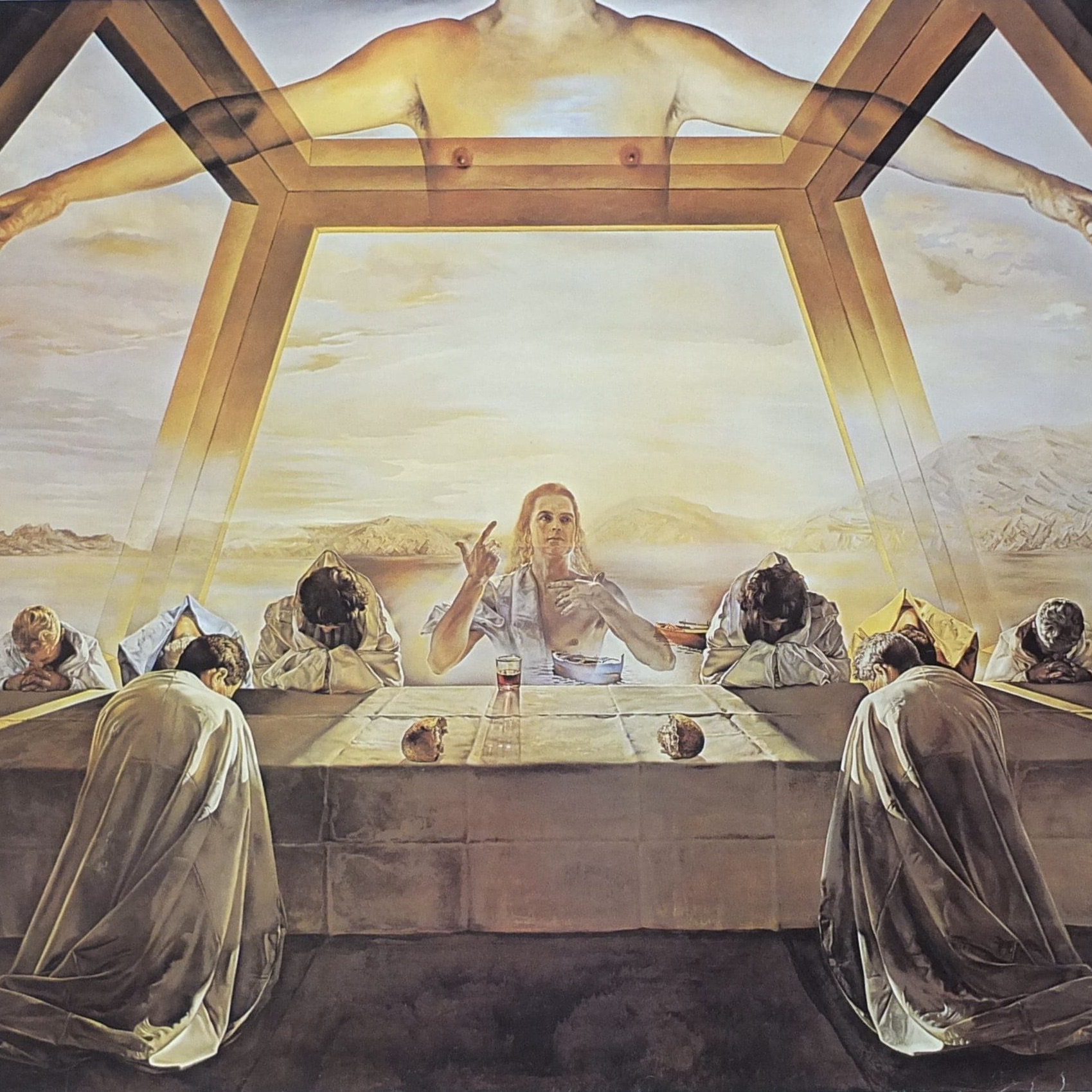
Salvador Dali, The Sacrament of the Last Supper (detail)


With his life, and in his death, Jesus offered himself. In accepting crucifixion, he offered himself and the whole Creation to the Father, in the Holy Spirit. He did this once and for all. Yet, in every Eucharist, and for all who remember him on any day, he continues to make present and real in our experience what he did, once and for all.

He acted, once and for all. Yet – and this is the paradox – he still acts for all… for all time, for all places and things, and for all people. What he is still doing now does not in any way signal an incompleteness to what he did then. For he continues to offer the gift of including us in what he did then, when he did what he did, once and for all.

So what does it mean for him to include us now, in what he did then? That is the question for the holy three days of our Paschal Triduum, which begins on Maundy Thursday evening.

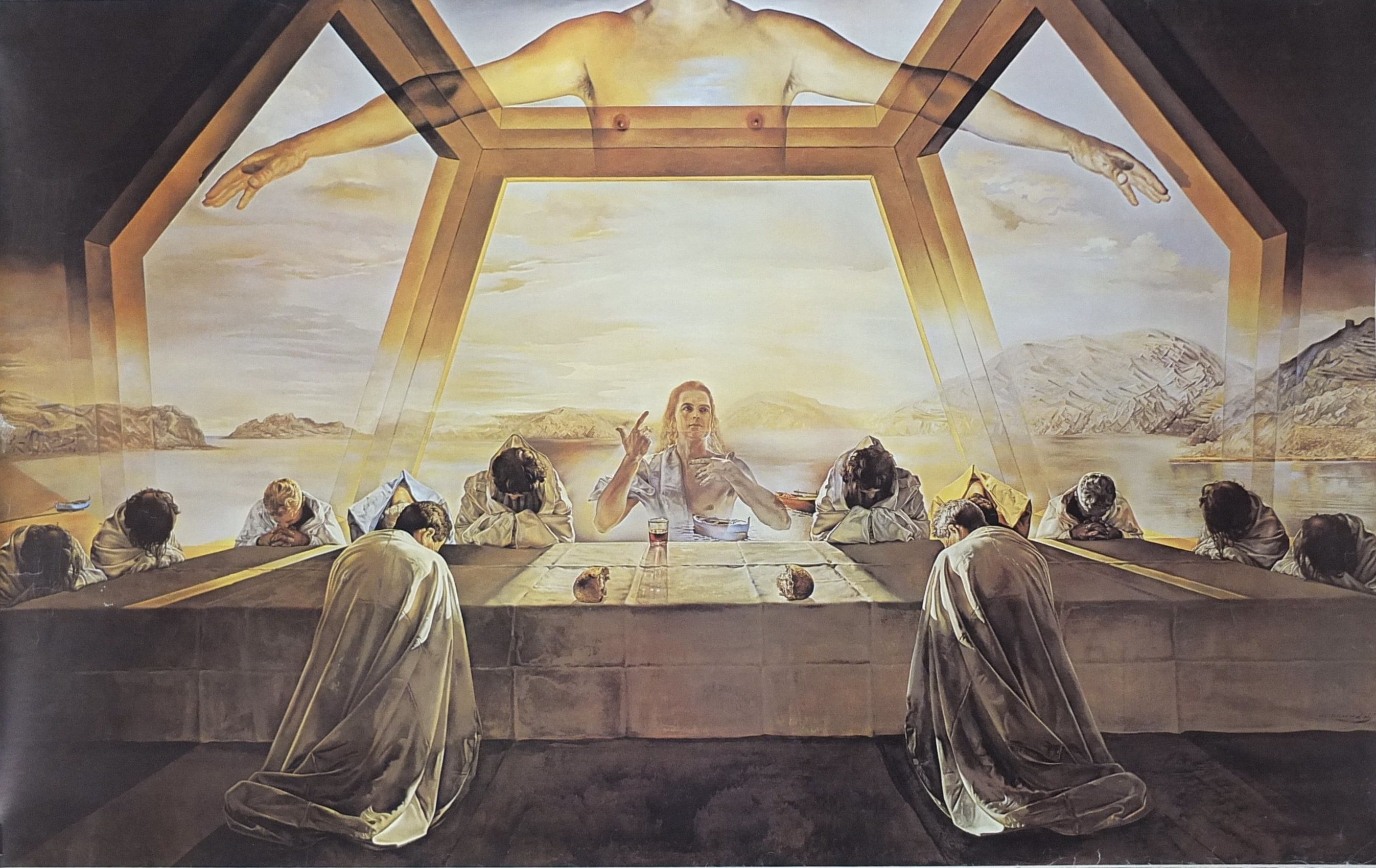
One way into the many answers to our question can be found in Salvador Dali’s painting, The Sacrament of the Last Supper. It is not a painting of, or about, the Last Supper. Instead, this is a painting inspired by the Last Supper, and by what it came to mean in the broader context of all that happened during those three days. For the painting is about the sacrament in which the Risen One now makes present the result of what happened on the Cross, in the Resurrection, and with the descent of the Holy Spirit.

The Book of Common Prayer service for Good Friday is in fact not a Eucharist, just as the Last Supper in that Upper Room was not a Eucharist. The Last Supper prefigured the Eucharist, but could not have been one. For Jesus had not yet died, nor yet Risen from the Tomb, and the Spirit had not yet descended at Pentecost. And neither are the sacramental services on Good Friday intended to be Eucharistic celebrations. For in the wisdom and tradition of the Church we do not celebrate the Eucharist on this most holy day, though we may receive the fruit of it, and all its benefits, when Communion is offered to us.

Instead, all our focus is upon Him, who died and rose again for us, once and for all.

These are some of the reasons why Dali paints the disciples as recognizable, physical, and historically-anchored, people. And why he yet paints our Lord as present in his mystical risen glory.

We gather in his name and in his presence on particular occasions, in particular places, at particular times. Yet he is now present at and on all occasions, in all places, and at all times. We – who are rooted in time and place – receive him who transcends and yet is present within all times and places. Grace infuses nature. The timeless One imbues time with glory.

The Sacrament of the Last Supper (full image)

On the cross, Jesus lifted up the whole Creation to his – and now our – Father, once and for all. Just as he lifted up our human nature in his Ascension, which in a sense then became our Ascension. And yet, he continues to lift up the whole Creation – including us, and including all the uncertain and unfinished aspects of our lives. So, the One who is the source of all purpose and meaning continues to bring meaning and purpose to us, and to all that we lay before him, here and now. Time and again, he brings completeness and wholeness to all that is lacking, so that we might live more fully in his glorious fulfillment of what it means to be human. For all this, we offer our deepest thanks and praise.

May these ‘holy three days’ (Maundy Thursday evening — Easter Eve) in the Church’s Christian observance of Passover be a time of blessing for us and our loved ones.


This post is adapted from my (2024) homily for Good Friday, which may be accessed by clicking here.

Note: blog settings have been changed to provide more opportunity to offer comments, using the link below.


Rousseau and Wilderness: Redemption in Nature?

If reading this by email, please tap the title at the top to open your browser for the best experience. Then, clicking individual pictures will reveal higher resolution images.

Henri Rousseau, The Dream (detail), 1910


What does it mean for God’s grace to be present in nature? Or God’s mission of Redemption to be at work in what Christians view as a fallen Creation? The Gospel for this coming Sunday, with Jesus tempted in the wilderness, might prompt us to think about such things. An unexpected way to do this is to juxtapose Mark’s surprisingly brief ‘temptation narrative’ with Rousseau’s jungle-like images of a state of nature.

How shall we understand Mark’s account of Jesus’ being tested in an inhospitable place? And how does Rousseau conceive of the natural state of what Christians think of as Creation? A painting by Rousseau helps set the scene:

The Sleeping Gypsy, 1907

In light of it, we can consider the two verses that Mark devotes to Jesus’ temptation:

The Spirit immediately drove him out into the wilderness. And he was in the wilderness forty days, being tempted by Satan. And he was with the wild animals, and the angels were ministering to him.

Only two verses are accorded by Mark to this rather pivotal event, to which Matthew devotes 11, and to which Luke gives 12. The way that Matthew and Luke refer to the wilderness of the temptation suggests that it is a hostile context for Jesus’ encounter with the Tempter. In both of these longer Gospel texts, three principal temptations are identified, which occur following Jesus’ forty days of fasting. The three were: to feed himself, to become a wonder-worker, and to receive the adulation of the world’s kingdoms. Matthew adds that Jesus received the ministration of angels following – rather than during – his period of trial.

Whereas Matthew and Luke present the wilderness as an unpromising environment for Jesus’ challenging encounter with his adversary, Mark’s spare account of the event and its setting allows for a rather different reading. We can pose the matter in the form of two questions shaped by Matthew and Luke’s narratives.

Does Mark present the wilderness temptation of Jesus as being in a difficult place due to the presence of the Tempter and because it is filled with prowling and potentially dangerous wild beasts?

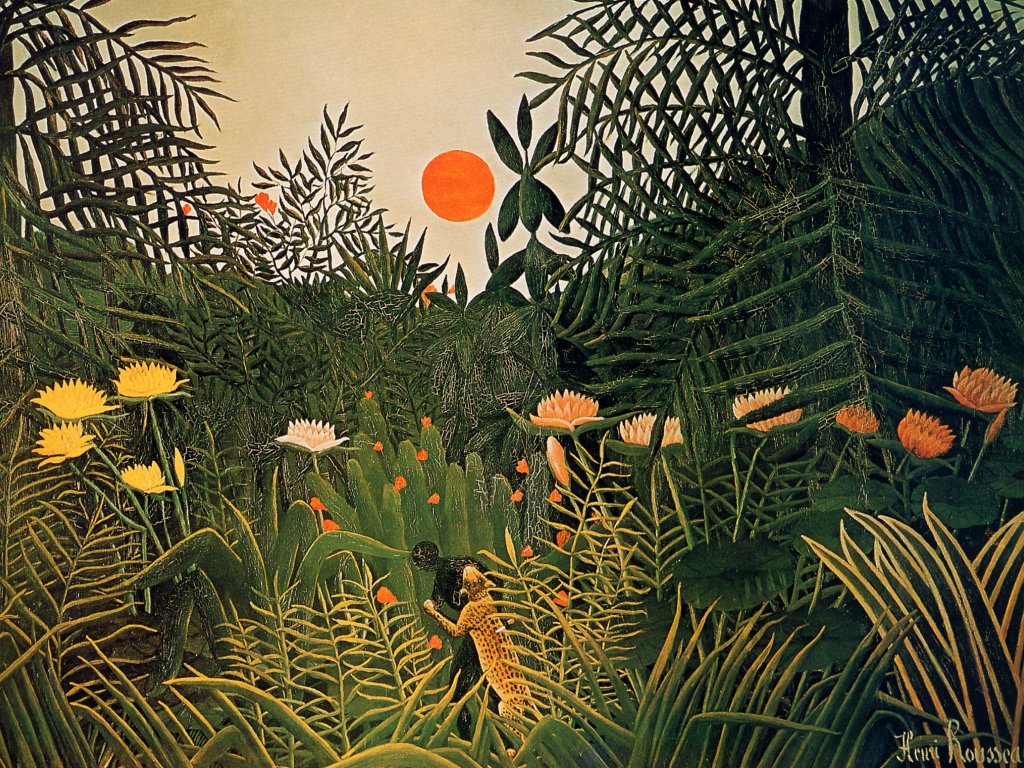
Man Attacked by a Jaguar, 1910

Or, does Jesus’ desert encounter in Mark represent not so much the threatening last gasps of a rebellious and dying world, but the first breaths of a life-giving new one, just now coming to be?

The Waterfall, 1910

Rousseau’s painting of the sleeping woman and the nearby lion, above, provides an image of harmonious coexistence in a place shared by a human being and the proverbial king of beasts (an ‘alpha predator’). In other words, Rousseau – in some of his paintings – portrays an ideal image of the original state of nature, the biblical Eden, before nature became ‘red in tooth and claw.’

A Woman Walking in an Exotic Forest, 1905

If so, then Mark’s statements that Jesus “was with the wild animals,” and also that “the angels were ministering to him,” may reflect what Christians have come to think of as ‘the peaceable Kingdom’ and ‘the New Creation.’ Which then suggests that – in Mark – the wilderness was good place despite the presence of the Tempter.

I am drawn to how Rousseau depicts the natural beauty of what we often describe as ‘wild nature,’ portraying it in both inviting and in cautionary ways. He paints it as a context of harmonious interrelation between human beings and animals in a shared environment. He also paints it as being a context where animals are a threat to one another and to humankind. Rousseau’s painting of Eve hints at both possibilities, where she is charmed by the serpent:

Eve, 1907

In the painting below, which complements his image above, another ‘Eve’ charms the serpent. Rousseau fills the beautiful canvas with a limited color palette, largely green, expressing the same dimension of ambiguity. A woman plays a flute while a serpent is draped upon her shoulders and others hang from the trees or rise up from the ground:

The Snake Charmer (detail), 1907

Looking at Rousseau’s many jungle-like ‘exotic landscapes,’ one notices the evocative presence of mystery. The viewer does not immediately know what lurks in the shadows, beneath and behind dense and dark foliage, in scenes often featuring bright flowers or fruit in the foreground. And upon discerning animals and also humans among all the growing things in the thicket between the trees, we can’t be sure whether what we encounter is friend or foe.

Jaguar Attacking a Horse, 1910

Exotic Landscape, 1910

In these and other scenes, Rousseau portrays an invitingly beautiful world, but one that is not without the possibility of misadventure and harm. I may not want to live in some of these scenes. But I find joy living with their beauty. For they help me appreciate a new way of reading and thinking about Mark’s brief account of Jesus’ temptation ‘in the wilderness.’ Jesus possibly could have repeated the great mistake made by Adam in the old Eden. But in not doing so, ’the second Adam’ became the door to a new Eden, and our ‘ark’ to the New Creation.


Note: blog settings have been changed to provide more opportunity to offer comments, using the link below.

Finding Beauty in Adversity

[If reading this by email, please tap the title at the top to open your browser for the best experience. Then, clicking individual pictures will reveal higher resolution images.

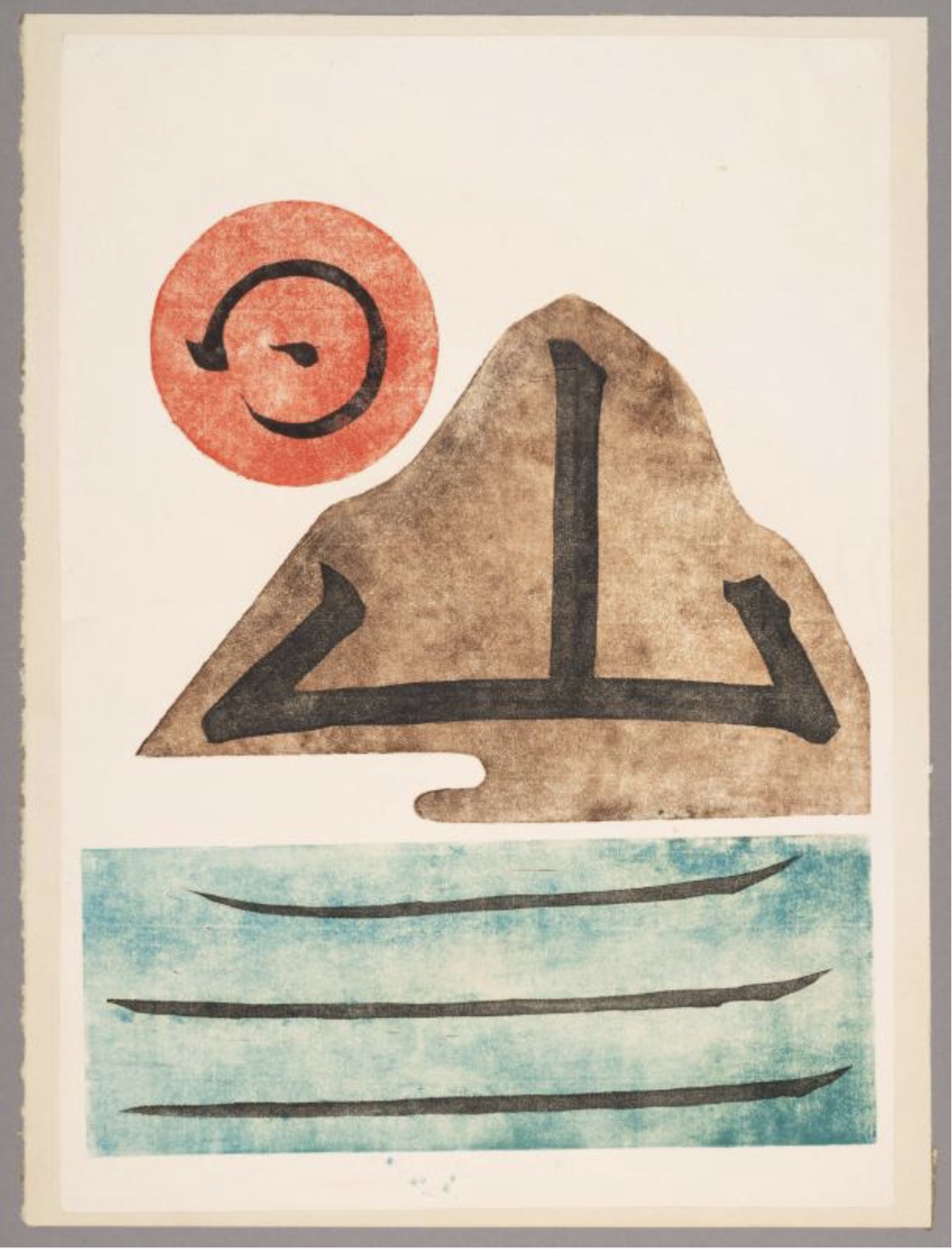
Henry Sugimoto, Untitled (Sun, Mountain and Clouds, Reflection on the Sea), ca 1965


I was delighted recently to discover the Japanese American National Museum (JANM), and their collection of artwork by Henry Sugimoto. Henry Sugimoto was born in Japan in 1900, the grandson of a samurai (Japanese military nobility) who most likely was alive at the time of the opening of Japan to commerce with the West by Commodore Perry in 1854. This fact, coupled with that of Sugimoto’s national heritage, would have made him – along with many others – suspect in American government eyes after Pearl Harbor.

Henry Sugimoto with his parents, before their immigration to the United States

Despite his father’s immigration to the United States before World War I, and their willingness to assimilate into American society and receive citizenship, the Sugimotos, like so many Japanese, found themselves rounded up in by our government in 1942. Henry’s family was sent away with one suitcase each from California to a detention camp in Arkansas. Such forced moves in many cases led to the unexpected forfeiture of family property and possessions. Henry Sugimoto lost a large collection of his artwork, auctioned off without his permission or knowledge while he – as an American citizen – was forcibly detained.

Self-Portrait in Camp, 1943

In JANM’s Sugimoto collection, we find several categories among his artwork. The largest is comprised of his oil paintings, many of which are skillfully rendered. I find some of them stylistically indebted to paintings that he studied in Paris by well-known late 19th and early 20th century Europeans.

Fresno Assembly Camp – Peaches, 1942

Others works, exhibiting a freer style he employed in his drawings and paintings of his fellow camp detainees, seem to reflect more of Sugimoto’s own painterly sensibility. Perhaps this was a visual artist’s equivalent of a writer coming to find his or her own voice.

The Mess Hall, 1942

Another significant body of work in the Sugimoto collection is composed of block prints. They include a few that reflect his travels to Europe and his life in New York City. Notable among his prints are his later black and white depictions of detainee life in the crudely appointed Japanese American ‘relocation centers.’ Gradually freed up from the constraints imposed by other employment, Sugimoto shows himself in his mature work to be an accomplished graphic artist, expressing an authentic personal vision.

Riverside Drive and Church (New York City), ca 1965

Back of WRA Truck, 1960’s

Thinking of Him, 1960’s

Other prints include some beautiful, and to my eyes, very Japanese-looking images with a modernist bent, characterized by an elegant simplicity of composition and color palette. The Sugimoto print shown at the top of a mountain set against the sea shadowed by a setting sun is suggestive of the famed Mt Fuji, visible from the Japanese coast. These later pieces by Sugimoto are my favorites among his artwork, and seem most reflective of an aesthetic sensibility associated with his native Japanese background.

Dawn (undated)

Gate of Yashiro (what may be the oldest Shinto shrine in Japan), undated

Untitled (color block print), undated

Though fully Americanized following his own immigration to America at the age of 18, Henry Sugimoto retained a deep sensitivity to the language, culture, and traditions of the land of his birth. One example of this can be found in another print featuring the setting sun and a mountain, like the image at the top of this page. The print below demonstrates how the Japanese Kanji character, Yama (for mountain, as in Fuji Yama), inspired his portrayal of a peak set against the evening sun, and reflected off the surface of the sea. Sugimoto’s interest in this word and its written form is surely no coincidence given that he was born and lived until he was 18 in Wakayama, Japan. Wakayama is the conjunction of the Japanese words for ‘mountain’ and ‘youthful.’

Untitled (featuring the Japanese pictographic Kanji character for Yama, or mountain), undated


These and other works by Sugimoto, along with biographical information, can be found on the website for the Japanese American National Museum (www.janm.org). The museum has an informative documentary video, Harsh Canvas: The Art & Life of Henry Sugimoto, which features his artistic work and introduces viewers to some of his family and to places where he lived and worked. It can be found on YouTube.

Comfort Ye My People

[If reading this by email, please tap the title at the top to open your browser for the best experience. Then, clicking individual pictures will reveal higher resolution images.

Marc Chagall, Memorial Window, All Saints Church, Tudeley, Tonbridge, UK


As a priest and from recent personal experience, I know how these weeks are a tender time for many of us. Especially for those who have lost loved ones at this time of year. Finding consolation and hope after losing the tangible nearness of a beloved family member or friend is hard at any time. Faced with such a loss or its memory around Christmas, how do we find comfort and reassurance in this season? Are “the hopes and fears of all the years” really met in Him, even now?

I find help with questions like these in what may seem an unlikely place: a beautiful window by an artist whose upbringing was shaped by Hasidic Judaism, placed over the altar of an Anglican church (shown above). It was designed by Marc Chagall for All Saints Church, Tudeley, in England.

Chagall was commissioned by a grieving couple to design this window as a memorial for their adult daughter who drowned in the sea. She is portrayed below the waves in the lower portion of the window, with what appears to be her grieving mother near her feet. We find here an unexpected coupling of images that frequently appear in Chagall’s work. Seeing his depiction of a crucified man juxtaposed with that of a mother and child surprises many Christians when they learn of Chagall’s Judaism.

The imagery in Chagall’s window may seem like an unusual choice for this holiday time. Yet, it fits. Though he often painted crucifixion images in his work, the artist had in mind the suffering of Jews through the centuries, and especially in his own time. In a similar way, he thought the portrayal of a mother and child, so familiar in Christian iconography, was a universal image within human experience. Chagall believed that the Christian conscience could be touched by familiar images from the Gospels, but which were also deeply resonant for Jews based on Hebrew Bible antecedents.

This is why I think that Chagall’s art might speak to us in this season. After all, the one whose birth we celebrate at this troubled time in the world awakens hope in us, hope for new life through the renewal of our shared humanity. Our Christmas hymns touch upon this theme. And, of course, the child born to Mary and Joseph was destined – as was prophesied – for the fall and rise of many (Luke 2:33-35).

Christian artists through the centuries have been captivated by many aspects of our Lord’s Nativity. Countless examples of their work have sought to express our impression of the circumstances of Jesus’ birth, and its significance for the world, not just for his immediate family. It is noteworthy how often depictions of the Annunciation, and of the Nativity contain noticeable hints of his later saving death, and resurrection. The inclusion of discernible palm fronds, passion flowers and of lilies in these works provide common examples of these visual hints of a veiled significance yet to be revealed.

Sadao Watanabe, Nativity Christmas card, with palms, lilies, and passion flowers

Both literally and conceptually, what we celebrate at Christmas is easier to ‘grasp’ than what we celebrate at Easter. We are more prepared for the presence of the Word made flesh in a manger than we are for the absence of the Word, said to be risen and ascended from an empty tomb. The comforting appeal of the Virgin Mary holding her newborn son in a stable contrasts with the mystery of another Mary later reaching out to try and hold the risen Jesus in a garden.

This Holy Child brought us the possibility of new life by overcoming the power of death. We celebrate his birth precisely because his death and resurrection provide the pathway to our own new birth. He was born and died as one of us. And so, in him, we die and rise again to the new life he shares with the world.

Mild he lays his glory by,
born that we no more may die,
born to raise us from the earth,
born to give us second birth.
Risen with healing in his wings,
Light and life to all he brings,
hail, the Sun of Righteousness!
hail, the heaven-born Prince of Peace!

Hark! the herald angels sing,
glory to the newborn King!


The hymn text is by Charles Wesley (Hark! the herald angels sing, verse 3).

Advent Annunciations: Elijah

[If reading this by email, please tap the title at the top to open your browser for the best experience. Then, clicking individual pictures will reveal higher resolution images.

Marc Chagall, Elijah Touched by an Angel


Surely God’s annunciation to Elijah would have come early in his ministry, or before he embarked upon his calling. To our surprise, God’s personal self-revealing to Elijah happens after – rather than before – a series of dramatic events at which Elijah acted powerfully in the Lord’s name.

The presence of the Lord within the prophet’s words and action had already made a powerful impression upon others. After meeting a personal representative sent out by the wicked Ahab to find him, Elijah confronted the king himself. Then followed Elijah’s contest with the prophets of Baal on Mt Carmel, when God mightily came down in fire upon the sacrifice Elijah had prepared.

Marc Chagall, Elijah on Mt. Carmel

It is only after these things, and after Ahab’s wife, Jezebel, threatened to kill Elijah within 24 hours, that he reacts with notable fear and doubt! He flees into the wilderness where he asks the Lord that he might die. Elijah is twice visited by an angel, who bids him to eat and drink what has been provided. Strengthened, Elijah proceeds – apparently on his own initiative – to “Horeb, the mount of God” (called Sinai in Exodus). He travels 40 days and nights to encounter God personally.

Retreating to the safety of a cave, Elijah is confronted by God in a way that prompts him to face his own fears. God says to him, “What are you doing here, Elijah?” The question contains an ambiguity regarding the words doing and here. For why is Elijah not doing what God has already commissioned him to do, which is prophetically to tell the truth in God’s name? And why is Elijah here, in this remote place after a flight of forty days?

James Tissot, Elijah in the Wilderness at Mt Horeb

Elijah answers God, saying, “I have been very jealous for the Lord… For the people of Israel have forsaken your covenant, thrown down your altars, and killed your prophets with the sword, and I, even I only, am left, and they seek my life…” All to which he has devoted himself, all for which he had worked, appears to have been for nought. What would be the point of going any further on his vocational path, or of continuing to live?

God answers his forlorn prophet in a remarkable way. God says to him ,“Go out and stand on the mount before the Lord.”

And behold, the Lord passed by, and a great and strong wind tore the mountains and broke in pieces the rocks before the Lord, but the Lord was not in the wind. And after the wind an earthquake, but the Lord was not in the earthquake. And after the earthquake a fire, but the Lord was not in the fire. And after the fire the sound of a low whisper. And when Elijah heard it, he wrapped his face in his cloak and went out and stood at the entrance of the cave.

Marc Chagall, Elijah’s Vision

God has spoken in a low whisper. Not in the hurricane with which God has just terrified the prophet. Nor in the calamity of a seismic disturbance. And not in a raging wildfire. God has revealed himself to Elijah in stillness and silence. Only then does God send him on to his mission.

To a people whose lives are troubled by extraordinary events and personal crises – us – God often chooses to reveal self in a similar fashion. Unlike Elijah, we have been given assurance that God is not only abidingly with us. As baptized people, God is in us, always. With so much drama around us, why should we expect God to reveal self, and God’s hopes for us, in some dramatic way? But to hear God as God often prefers to speak to us, we may need to find moments and places of quiet amidst all the noise in our lives. Advent helps us prepare to hear the gentle and quiet whisper of God’s voice.

How silently, how silently,
the wondrous gift is giv’n!
So God imparts to human hearts
the blessings of His heav’n.
No ear may hear His coming,
but in this world of sin,
where meek souls will receive Him still,
the dear Christ enters in.


Elijah (later seen as forerunner of the Messiah) and his cycle of stories can be found in 1 Kings 17:1 — 2 Kings 2:12. The episode on Mt. Horeb is found in 1 Kings 19. The hymn, O little town of Bethlehem (verse 3), is by Phillips Brooks.

Note: blog settings have been changed to provide more opportunity to offer comments, using the link below.

Advent Annunciations: Anne, Mother of Mary

[If reading this by email, please tap the title at the top to open your browser for the best experience. Then, clicking individual pictures will reveal higher resolution images.

Giotto, The Annunciation to St. Anne, Scrovegni Chapel, Padua


Without seeing the title of this fresco at the stunningly beautiful Scrovegni Chapel, in Padua, Italy, we might assume that it portrays the angel’s annunciation to the Virgin Mary. The parallels with traditional Annunciation iconography are readily evident. Yet Giotto also executed a series of panels there devoted to the life of St. Anne, Mary’s mother, who is shown in the fresco, above.

As with so many Marian annunciations, the scene is domestic, with Anne here suggested as having been occupied at home with her maid, preparing thread for stitching. Just as familiar paintings of Mary often show her at prayer, Giotto portrays Anne upon her knees with her hands clasped. But unlike familiar Marian parallels we do not see a devotional book open next to Anne. Just as later happens to her daughter, we see this grandmother-to-be of Jesus met by an angelic visitor who discloses an unexpected new role for her. Unlike her daughter Mary’s experience, Anne’s encounter with God’s Word to her is not recorded in canonical Scripture.

Interior of the Scrovegni Chapel

The frescos in the Scrovegni Chapel contain an interesting mix of images, with some portraying events in their presumed original historical context (such as the Nativity scenes), and others (like the annunciation to Anne) in buildings and settings more characteristic of Giotto’s own time and place, including the architecture of the chapel housing them. While he paints them this way, Giotto’s choices regarding imagery suggest that he seeks to be faithful to the supposition that Mary’s family came from an ordinary background. After all, Mary’s parents, named Anne and Joachim according to tradition, later allowed her to marry Joseph, a local builder; she was not betrothed to nobility. The painter, therefore, shows some restraint in his rendering of the context of Anne’s visitation. This simplicity in approach may also be due as much to Giotto’s early place in the historical development of European painting as it does his personal temperament.

In this remarkably large series of Scrovegni frescos, we can see that Giotto has discovered and effectively employs the technical skill of linear perspective. With some care, he depicts the stonework of Anne’s home and that of many other buildings as sculpturally ornamented. But rather than display undue deference to the known wealth and social position of his patron, he allows the particularity of the angel’s visitation to be what sets Anne apart from her contemporaries rather than the finery of her home’s appointments. An emerging humanism in painting is evident in Giotto’s artistic style, and he presents Anne as a distinctly recognizable person rather than as a merely symbolic religious figure. Though she appears to be a woman of some means, she is depicted as someone who could have been the neighbor or relative of many people of his community.

Here is one theme we find in Giotto’s fresco of Anne’s annunciation. All it takes to play a part in God’s unfolding plan of redemption for the world is an open heart and a spirit of willingness to say yes. What part we are to play, and its significance to and for others is, in the end, up to God – and probably not something to which we should give much thought. At least not in the way that we hope or imagine our personal skills and accomplishments might be thought of by others. Saving the whole world, even small parts of it, is God’s work and not our own.

And so, the key is what God might decide to do in and through us (while inviting our help), rather than what we might decide to do for God (while perhaps asking for divine help).

The mystery of this season of Advent centers upon how we are drawn into what God ‘has been up to’ for a very long time. In a season of growing astronomical darkness we are invited to seek the most significant source of light, the light of Christ. And at a time when the world around us seems more colored by signs of decay and dissolution, He in whom all things hold together comes anew to embrace us, and ever hold us fast. It may not be through an angel, but surely the One born among us calls all of us to share His love for the world.


Advent Annunciations: Joseph

[If reading this by email, please tap the title at the top to open your browser for the best experience. Then, clicking individual pictures will reveal higher resolution images.

James Tissot, The Anxiety of Saint Joseph


I often turn to Annunciation scenes during Advent. This may seem curious since we celebrate the Feast of the Annunciation on March 25, nine months before Christmas Day. Yet, the season of Advent marks the beginning of a new church year, which may signal a time for other new beginnings.

The Annunciation to Mary was of course unique. Yet, it is also symbolic of God’s self-disclosure and God’s loving communication of hopes and wishes to every one of us. God becomes present to us, and in us, so that we might begin a new life, and begin it again. “Always, we begin again” is a saying oft-attributed to St. Benedict. It can become true for every mindful believer.

For obvious reasons, the Annunciation to Mary has received an overwhelming amount of attention in the history of art. Less frequently explored for its artistic potential is God’s self-disclosure through an Angel to Joseph, in a dream, even though it is with this Joseph story that Matthew launches his extended narrative. Mary gave birth to Jesus, whereas Joseph is remembered for having had a less prominent role in the circumstances of our Lord’s arrival. Joseph then largely disappears from the Gospel narrative. Perhaps because God’s revelation came to him in a dream while asleep as compared with Mary’s conscious, apparently daytime reception of the angelic visitation, Joseph’s receipt of an annunciation has been easier to overlook.

Yet, Joseph must have played a more-than-passing role in the coming of the Messiah. He did this by his willing marriage to Mary, and by initially providing a safe deliverance for his family from the wicked Herod, to and from Egypt. Undoubtedly, he gave Jesus significant mentoring, though Scripture leaves any details about that for us to imagine. Communities certainly have a part in the formation and education of children and youth, often in unrecognized and unrewarded ways. But why do we so easily overlook what was surely Joseph’s pivotal role in helping the young Jesus learn so much about Scripture, and in acquainting the youth with the material for so many of his later parables?

If these things may be inferred from the Gospels regarding Joseph’s significant role in the circumstances of the birth and early life of Jesus, we should reflect on what may have accompanied Joseph’s readiness to act upon the angel’s annunciation to him. As he positively responded to the angel’s words, he is likely to have considered what heeding those words might entail.

James Tissot’s painting, titled The Anxiety of Joseph, suggests that Joseph’s acceptance of his calling may have involved thoughtful deliberation. Indeed, Joseph may have sincerely weighed in his mind the degree of hazard that might arise from acting in accord with God’s revealed will, especially when such action might defy religious and social convention. That he, like Mary, in effect said yes to his angelic instructions, and followed through affirmatively, does not necessarily mean he did so without hesitation.

Most of us are called by God to accept unheralded and easy-to-overlook roles in God’s still unfolding plan of redemption for the world. Inspiration regarding our calling might even come to us in a dream, making us more prone to discount its potential significance, or too quickly assess its likely merit and value in a misguided and worldly way. After all, who are we to think that we could have an impact upon the world in relation to God’s sovereign purposes?

It is often said that Mary is the ‘mother’ of the Church. Perhaps Joseph, in a similar way, can be said to be the ‘father’ of all believers, especially those like you and me.


Do We Give Thanks In Darkness?

[If reading this by email, please tap the title at the top to open your browser for the best experience. Then, clicking individual pictures will reveal higher resolution images.]

Rembrandt, Paul in Prison (1627)

The troubling darkness of October 7 lingers. The following is my recent homily, offering reflection on how we can respond to a time like this.


We are always prone to being unsettled or troubled by unexpected challenges, whether nearby or far away. Since we believe in an almighty and loving God, unanticipated darkness, sorrow, and anger can confuse and upset us. For the people of Israel and Gaza, and those who care for them, October 7 and the days since have been filled with the news of much evil and much suffering. But, if ‘God is love,’ and the giver of all good gifts, as Christians believe, two questions we cannot easily answer will bother us: How can God allow natural and moral evil to happen? And why does God tolerate the suffering of his creatures, and especially of people made in his image?

When facing questions like these, I like to turn to some of Paul’s words in Philippians that we have heard in our recent Sunday lectionary readings: “God… is at work in you, enabling you both to will and to work for his good pleasure” (2:13). These words may be hard to accept — and hard to live by — especially if we are discouraged or fearful about what is happening around us. Yes, we hear Paul in Scripture say that God is at work in us. But we may not feel like it’s actually true. Indeed, we may find it hard to believe that it could be true. Yet, Paul wrote these words while he was in prison.

This is what we need to remember: Our feelings are fickle! Our moods and general equilibrium are subject to the ups and downs of our circumstances. Things happen to us, which are not of our own choosing. Feelings are the same way. They also ‘happen to us.’ The difference between what happens to me, and what I choose for myself, is very significant. I can’t do much to change events in the world. And I have difficulty keeping the emotions stirred by them from affecting me. But I can reflect on how I respond to them, in terms of what I decide, and what I choose for myself.

So, instead of dwelling on feelings of discouragement, inadequacy and aloneness, I have another choice. I can choose to remember Paul’s words, and repeat them to myself: ‘God is at work within me. God is at work within me. God is at work within me, both to will and to work for his good pleasure.’

This insight helps us hear, consider, and then perhaps accept, Paul’s challenging words to us. He is saying something much more profound than “be happy,” or “be cheerful!” Instead, Paul is urging us to make a choice, a decision to rejoice and give thanks, even if we may not feel like it. “Rejoice in the Lord always,” he says (4:4), which is different from saying, “always be happy about the world.” It often seems impossible to be thankful for or about the condition of the world. But, we can still be thankful for the Lord who overcomes disorder, and who in the end makes things right. Paul says that the Lord is near, and so we should not worry about anything. Believing that the Lord is near takes precedence over anxiety and concern about what is amiss. Believing that the Lord is near is a choice we make, and not a feeling we wait for.

The imprisoned Paul teaches us how another willed-decision accompanies relying on the Lord’s nearness. In all circumstances, we can — by prayer — let our requests be made known to God with thanksgiving (4:6). This is equally a result of choice, rather than depending on how we feel. When we make this conscious choice to give thanks in all circumstances (rather than for them), Paul tells us that the peace of God, which surpasses all understanding, will guard our hearts and our minds in Christ Jesus (4:7).

Therefore, confidence, reassurance and peace are not simply feelings that may or may not happen to us. They are, instead, the result of willed-decision-making. So, Paul asks us to keep on doing these things, and that as we do them, the peace of God will be with us.

When I dwell upon what I fear, on what makes me angry or depressed, I give in to feelings that happen to me, especially in relation to circumstances I cannot change. But Paul asks us to do the opposite. Instead of dwelling on the negative, he urges us to reflect on what is positive. Think instead, Paul says, about whatever is true, honorable and just: about whatever is pure, commendable and worthy of praise (4:8). And he urges this based on choices we can make.

Notice what Paul is not saying as he urges us onward. He is not saying, ‘hope for’ good things, which might happen someday. He is saying think about the good that is already true, and happening right now.

In an accompanying lectionary Gospel reading, Jesus says that God’s kingdom ‘is like a king who gave a wedding banquet for his son.’ We have all been invited to this wedding banquet, and we are participating in it in our lives today. Again and again, the servants of the king go out and call people to respond to the king’s invitation. But like so many of those in Jesus’ story, we let other things get in the way.

Among what gets in the way are things we worry about, or we feel pressure to get done. Our attention shifts from the wedding invitation, and gets centered on our calendar, and on our ‘to do’ list. Then we get distracted by our anxiety.

Again and again God’s invitation arrives, through the King’s written Word, and through the voices of the King’s servants who call us. But other things press against and bend our priorities, and these other things shape our lives… even though we have been invited to a wedding! We are invited to a celebration and a feast! Joy is written into the invitation. But rather than let God’s joy touch our hearts, strangely, we let lesser things inhabit our imaginations. Many gifts and wedding favors are given to those who come to this wedding supper. Yet, in time, the wedding begins to feel like a ‘work-day,’ when so much seems to be asked of us. We then shrug off the invitation-bearers, as if they are a nuisance, rather than bearers of a joyful message.

So, we should remind ourselves of Paul’s words. For he says,”Rejoice in the Lord always; again, I say Rejoice… The Lord is near.” As Eugene Peterson translates the words that follow, Paul also says this: “Don’t fret or worry. Instead of worrying, pray. Let petitions and praises shape your worries into prayers, letting God know your concerns.”

Worries can be fashioned into prayers, and concerns can be shaped into praises. We can voice our concerns to the Beloved. It’s a choice! But our natural inclination lets worries and concerns drift into complaints and laments. Yet, we can choose! We can choose to rejoice, and to pray, and to praise. Of course, it may seem perverse to try and give thanks for the things that cause us worry and concern. But that is not what Paul is encouraging us to do. We can still give thanks in the midst of those things. We can give thanks that, despite troubles, we have been included in the wedding supper of the Lamb. We give thanks that we have become members of the Bride of Christ. We have been joined to the Beloved, whose wedding banquet we are part of today. Thanks be to God!

Transfigured By Beauty

[If reading this by email, please tap the title at the top to open your browser for the best experience. Then, clicking individual pictures will reveal higher resolution images.]

James Tissot, Jesus Goes Up Alone Onto A Mountain To Pray


In a painting whose title refers to one of Jesus’ common practices, James Tissot portrays him as caught up in prayer, an involvement he widely encouraged his followers to pursue. Regarding prayer, the Catechism in The Book of Common Prayer may surprise us. To the question, what is prayer, we find an answer which begins with these words: “Prayer is responding to God…” Jesus modeled a life wholly centered on responding to God, in heart and mind, in soul and body. On one occasion, he appeared transformed while at prayer. Over time, his followers discerned how God was fully present within him.

The story of his Transfiguration on a high mountain, reported in the first three Gospels and commemorated this past Sunday, provides a narrative demonstration of this truth. What Tissot depicts regarding Jesus when alone at prayer was later revealed semi-publicly on that mountain in the company of Peter, James, and John, as well as with the heavenly apparitions of Moses and Elijah. It was then fully revealed in Jesus’ Resurrection appearances.

Exodus 24 provides the background for this, and tells us something astonishing: “Moses and Aaron, Nadab and Abihu, and seventy of the elders of Israel went up {Mt. Sinai}, and they saw the God of Israel.” In Exodus 34, we learn that when Moses came down from the summit, “the skin of his face shone because he had been talking with God. When Aaron and all the Israelites saw Moses… they were afraid to come near him.” The text suggests that Moses then started putting a veil over his face for the sake of those who were unused to, or unprepared for, the glory and power of God’s immediate presence.

Paul, in 2 Corinthians, extends and also alters this idea of the veil. Instead of it being a means to protect people from a direct encounter with divine glory, the veil has become in Paul’s letter a kind of impediment. When our hearts and minds are not open to God, nor sensitive to God’s power, we become hardened. We become hardened in such a way that our hearts and minds are veiled, preventing us from perceiving God’s glory.

But Christ has set aside this veil. As a result, “all of us, with unveiled faces, {see} the glory of the Lord as though reflected in a mirror (2 Cor. 3:18).” And weare being transformed into the same image from one degree of glory to another, for this comes from the Lord, the Spirit.” Through prayer, we also are transformed.

Fra Angelico, The Transfiguration (San Marco, Florence)

The Transfiguration of Jesus is all about the unveiling of God’s glory. Jesus takes Peter, John and James up with him on a mountain to pray. While he is praying, the appearance of his face changes, as does his clothing. In contrast with the Exodus and Pauline images of light shining on a surface, Luke presents God’s glory as coming from within Jesus. In other words, he radiates God’s glory rather than reflecting it. Luke tells us that Moses and Elijah, who appear with him, appear in his glory. This may mean that Jesus has shared his glory with them in a way that prefigures what he will share with all of his followers after his Resurrection.

This should lead us to ask a good question: If we feel like there is a veil between us and the divine presence, where does this veil lie? Does God ‘hide’ behind a veil, either to protect us, or challenge us? Or is the veil within ourselves, formed by our spiritual blindness and our lack of openness to how the Holy Spirit imparts glory? Paul suggests that our experience may be like that of the earlier Israelites, for whom hard-heartedness caused them to be blind to the bright light of God’s glorious presence, whether in Moses’ face or when reading and hearing the Law. Hard-heartedness can be equally blinding for us, veiling the glory that is all around us.

And where, according to Paul, do we find this glory? We find it in the faces of everyone who has been open to God’s transforming Spirit. In other words, we can find it in each other, as well as in ourselves. For this reason it can be like looking into a mirror, as the glory that we will perceive in others is the same glory that they can perceive within us.

‘Beauty’ and Jackson Pollock

[If reading this by email, please tap the title at the top to open your browser for the best experience. Then, clicking individual pictures will reveal higher resolution images.]

The Fury, 1943


The name “Jackson Pollock” and the word “beauty” may seem to make for an unlikely pairing. For some, Pollock’s famous ‘drip’ paintings are not only an acquired taste but continue to be the butt of bad jokes about what happens when you give a chimp a pot of paint.

These observations may bring to mind the story about when the art critic, John Ruskin, accused the artist, James M. Whistler, of “flinging a pot of paint in the public’s face,” and the nerve of asking two hundred guineas for the result. Whistler – painting in ways ahead of his time – wanted viewers of the work in question not to consider it as a traditional representational painting but rather as an ‘artistic arrangement.’ When asked how long it had taken him to paint the canvas, Whistler frankly admitted that it was just a few hours. But then, he added, it had taken a lifetime of learning to create the work. Jackson Pollock likely felt the same about his drip paintings, which made him famous.

Some viewers of “modern art,” particularly the genre of art commonly labeled as abstract expressionism, may wonder if the abandonment of representation in painting (and in other art forms) simply provided license for less than skilled artists to create and financially benefit from work that ‘broke all the rules.’ Yet, and paradoxically, many of those whose work we associate with this kind of art received rigorous training in traditional methods of drawing and painting at the Art Students League in New York. In effect, they had learned the rules so that they could break them with integrity. Pollock was among those learners, when he had studied under the tutelage of Thomas Hart Benton. Pollock’s earliest remunerated work was in the form of murals featuring traditional imagery, commissioned by the Depression era WPA (the Works Progress Administration) for public buildings such as libraries and post offices.

I am comfortable employing the word beauty with which to characterize and describe some of Jackson Pollock’s drip paintings. Unlike the proverbial results of turning monkeys loose with pots of paint, or giving kindergarteners free rein with the same, Pollock’s mature work evidences an aesthetic intuition formed over years of persistent engagement with paint on flat surfaces.  Over time it yielded striking results. I find many of these paintings both intellectually stimulating and emotionally stirring.

What I am calling a formed intuition within the artist’s temperament bore fruit in the form of several perceivable variables among his drip paintings. First, we can appreciate the sophistication of his color choices. Despite an initial sense that these paintings contain a cacophony of clashing streaks of full spectrum color, closer inspection reveals that Pollock often employed a limited color palette in these works, sometimes with an almost Zen-like restraint. Second, he had an undeniable eye for composition. This is discernible within the apparent chaos on the surface of his drip paintings where pattern, unexpected order, and rhythm, can convey a sense of balance. Third, the well-documented energy the artist applied to the creation of these canvases is effectively communicated by the visual results he attained, which in my experience draw the viewer in to a deepened engagement with his vision.

Pollock at work.

Drip Painting (title?), 1951

Autumn Rhythm (Number 30), 1950. This composition, despite its energetic patterning, has a subtle tone due to the very limited and neutral color palette.

Number One, 1950 (Lavender Mist). Another subtle composition, in marked contrast to The Fury, depicted above. Viewers appreciating Lavender Mist, in a photo (below) showing the scale of many of Pollock’s drip paintings.

Number 14 (Gray), 1948. Paradoxically both lyrical and restrained, where movement displaces a perceived need for the addition of color.

This one (title and date uncertain) is also lyrically full of joyous movement but with color.


Pollock’s famous Number 11, (TheBlue Poles, 1952) on display.

Pollock in motion, creating an indelible image of vitality that continues to speak to and move people today.