Liturgy

Advent Annunciations: Anne, Mother of Mary

[If reading this by email, please tap the title at the top to open your browser for the best experience. Then, clicking individual pictures will reveal higher resolution images.

Giotto, The Annunciation to St. Anne, Scrovegni Chapel, Padua


Without seeing the title of this fresco at the stunningly beautiful Scrovegni Chapel, in Padua, Italy, we might assume that it portrays the angel’s annunciation to the Virgin Mary. The parallels with traditional Annunciation iconography are readily evident. Yet Giotto also executed a series of panels there devoted to the life of St. Anne, Mary’s mother, who is shown in the fresco, above.

As with so many Marian annunciations, the scene is domestic, with Anne here suggested as having been occupied at home with her maid, preparing thread for stitching. Just as familiar paintings of Mary often show her at prayer, Giotto portrays Anne upon her knees with her hands clasped. But unlike familiar Marian parallels we do not see a devotional book open next to Anne. Just as later happens to her daughter, we see this grandmother-to-be of Jesus met by an angelic visitor who discloses an unexpected new role for her. Unlike her daughter Mary’s experience, Anne’s encounter with God’s Word to her is not recorded in canonical Scripture.

Interior of the Scrovegni Chapel

The frescos in the Scrovegni Chapel contain an interesting mix of images, with some portraying events in their presumed original historical context (such as the Nativity scenes), and others (like the annunciation to Anne) in buildings and settings more characteristic of Giotto’s own time and place, including the architecture of the chapel housing them. While he paints them this way, Giotto’s choices regarding imagery suggest that he seeks to be faithful to the supposition that Mary’s family came from an ordinary background. After all, Mary’s parents, named Anne and Joachim according to tradition, later allowed her to marry Joseph, a local builder; she was not betrothed to nobility. The painter, therefore, shows some restraint in his rendering of the context of Anne’s visitation. This simplicity in approach may also be due as much to Giotto’s early place in the historical development of European painting as it does his personal temperament.

In this remarkably large series of Scrovegni frescos, we can see that Giotto has discovered and effectively employs the technical skill of linear perspective. With some care, he depicts the stonework of Anne’s home and that of many other buildings as sculpturally ornamented. But rather than display undue deference to the known wealth and social position of his patron, he allows the particularity of the angel’s visitation to be what sets Anne apart from her contemporaries rather than the finery of her home’s appointments. An emerging humanism in painting is evident in Giotto’s artistic style, and he presents Anne as a distinctly recognizable person rather than as a merely symbolic religious figure. Though she appears to be a woman of some means, she is depicted as someone who could have been the neighbor or relative of many people of his community.

Here is one theme we find in Giotto’s fresco of Anne’s annunciation. All it takes to play a part in God’s unfolding plan of redemption for the world is an open heart and a spirit of willingness to say yes. What part we are to play, and its significance to and for others is, in the end, up to God – and probably not something to which we should give much thought. At least not in the way that we hope or imagine our personal skills and accomplishments might be thought of by others. Saving the whole world, even small parts of it, is God’s work and not our own.

And so, the key is what God might decide to do in and through us (while inviting our help), rather than what we might decide to do for God (while perhaps asking for divine help).

The mystery of this season of Advent centers upon how we are drawn into what God ‘has been up to’ for a very long time. In a season of growing astronomical darkness we are invited to seek the most significant source of light, the light of Christ. And at a time when the world around us seems more colored by signs of decay and dissolution, He in whom all things hold together comes anew to embrace us, and ever hold us fast. It may not be through an angel, but surely the One born among us calls all of us to share His love for the world.


The Beauty of John’s Revelation

[If reading this by email, please tap the title at the top to open your browser for the best experience. Then, clicking individual pictures will reveal higher resolution images.

Christ Pantocrator ceiling mosaic from the Hagia Sophia, Istanbul


Advent beckons! Or does it? Isn’t something profoundly new lying just around the corner? Or shall we simply drift into another season of the old and familiar that might or might not live up to our expectations?

This calendar year, with a full week between Thanksgiving weekend and Advent Sunday, we have an ample opportunity to ponder questions like these. If such have recently occurred to you – or seem relevant now – I have a suggestion. It is prompted by a question recently put to me. What book or devotional might I recommend for Advent? My suggestion for Advent reading is John’s Revelation! It is the last book of the Bible, but arguably the first book for a new era, as we begin a new church year. And Revelation makes for unexpectedly good reading during these days of increasing darkness, at least as daylight hours are typically reckoned.

The best way that I know for begining to appreciate John’s Revelation, and read it for personal enrichment, is to engage it guided by Eugene Peterson, translator of The Message version of the Bible. Peterson helps us by making the texts of Scripture accessible and familiar-sounding. He is especially helpful in steering us around or away from what is ironically a rather modern and limited way of reading the biblical text. With him, we can avoid a literalism overlaid by misguided assumptions regarding prophecy and history. For Revelation does not contain a code to be deciphered but a message of love to be received, however strange John’s language and imagery may strike us at first.

John’s Revelation is metaphorical poetry that speaks truth, rather than something like a roadmap conveying predicted facts about what lies ahead. And so, it is not about how or when ‘the End’ will come, as if John’s book was and is about the terminus or stopping point of history and of all that we know. Instead, and in a rather more profound way, we might with John begin to see something new: how the end or point of fulfillment for all of history and of God’s purposes have in some sense already arrived!

In these weeks of shortened daylight hours and increasing chill, the prospect of reading Revelation may seem antithetical to a hopeful anticipation of Christmas. Cheerful music, warm lighting on dark and cold evenings, and holiday treats on the table, are all attractive and good things for us to enjoy at this time of the year.

But if we have any sense that there is something wrong with the present state of our world, whether with things near or far away, ignoring or being in denial about such are not our only alternatives when it comes to how we might approach each new day. A new phase in salvation history has dawned, and does not simply lie ahead in an undefinable future that is beyond our grasp. Yet begining to see this new phase in God’s ongoing work of Redemption may take the work of imagination, a praying imagination as Peterson puts it, in order to see the real beauty that now surrounds us, and which can be found within.

The beauty of the face of ‘the coming One’ is already here to be seen. We don’t have to travel back in history to a stable in Bethlehem, nor do we need to try and peer ahead to some kind of future cosmic crisis to see his arrival. For he is here with everyone. And he can be seen in the faces of those who through their Baptism bear the intimacy of his beautiful presence.


Eugene Peterson’s book on John’s Revelation, Reversed Thunder: The Revelation of John & the Praying Imagination, is in print and available from book sellers. I am pleased that Amazon has announced the future release of a Kindle (ebook) as well as an audio version from Audible.


A Building That Evokes Awe and Wonder

[If reading this by email, please tap the title at the top to open your browser for the best experience. Then, clicking individual pictures will reveal higher resolution images.


This is one of the most beautiful buildings in the world, and astonishingly it has survived twenty centuries since its construction during the great age of Rome, around 120 A.D. Replacing two earlier buildings lost to fire, this third one was built for the ages. After two thousand years, its coffered ceiling remains the largest unreinforced concrete dome in the world, and it continues to evoke awe and wonder among architects. The building is, of course, the Pantheon, whose formal Christian name is the Basilica of St. Mary and the Martyrs.

Unlike some buildings of equal stature and antiquity, the Pantheon has survived because it was consecrated as a church that has since been in continuous use. First built as a temple whose practices were anchored in pagan religious cults, its original Greek name suggests that the building was dedicated to a multitude of Roman God’s. Indeed, many modern visitors know the building only by its classical name rather than by its later Christian one, even though the transition from its original purpose for pagan worship to its current one occurred fourteen-hundred years ago!

Think about that for a moment. A pagan temple, apparently dedicated to a panoply of Roman deities, was then consecrated as a church, and renamed to commemorate Christian saints. The building’s earlier purpose and meaning was not seen as inimical to its later use for holy Christian worship.

For some of us, that is unimaginable! It seems more likely that the building would have been razed, and its materials reused to build an entirely new building for Christ-inspired liturgies. That such a removal and replacement did not happen represents courage, the courage of holy imagination turned loose to see what is good, positive, and hopeful, even amidst the remains of a decaying or already dead civilization.

The origin of the great feast of All Saints, that we celebrate on November 1 or the following Sunday, is identified by some historians with the re-dedication of the Pantheon for Christian worship, in the spring of the year 609 or 610. In its subsequent role, the building commemorates both Mary and remembered Christian witnesses to the Faith. Its new name may reinforce a misleading idea that saints like Mary, as well as the martyrs, are unique and special persons, marked out for attention because they are so different from us.

In the century after the Pantheon was consecrated as a church, the community of those honored on All Saints came to be seen as including all those who have ‘washed their robes in the blood of the lamb,’ to quote an All Saints lectionary reading from John’s Revelation. This fits well with the more expansive biblical understanding of saints. Because, in the New Testament, ‘saints’ are all the baptized; in other words, they are everyday members of the Church.

For example, at the opening of his letter to the Ephesians, Paul writes “to the saints who are in Ephesus, and are faithful in Christ Jesus.” Paul is referring not just to a select elite within that community; he is referring to all of them, who are – through Baptism – in Christ. Therefore, on All Saints, we commemorate not only saints who are remembered on particular feasts, but we celebrate all the baptized, including my granddaughter, Charlotte Mary, ‘Christened’ this past Sunday as she “put on Christ” and became a “child of God through faith (Gal 3:26-27).”

Here, among the tourists admiring beautiful ancient Roman architecture, and especially that great curved ceiling with its oculus or skylight, there are surely many saints to be found. We can hope they pause to pray in the midst of their visit and remember the ‘light of the world.’ Jesus, in John, refers to himself by these words. Perhaps to our surprise, Matthew quotes Jesus as saying that – after their call – his disciples share this remarkable identity and vocation with him.

Transfigured By Beauty

[If reading this by email, please tap the title at the top to open your browser for the best experience. Then, clicking individual pictures will reveal higher resolution images.]

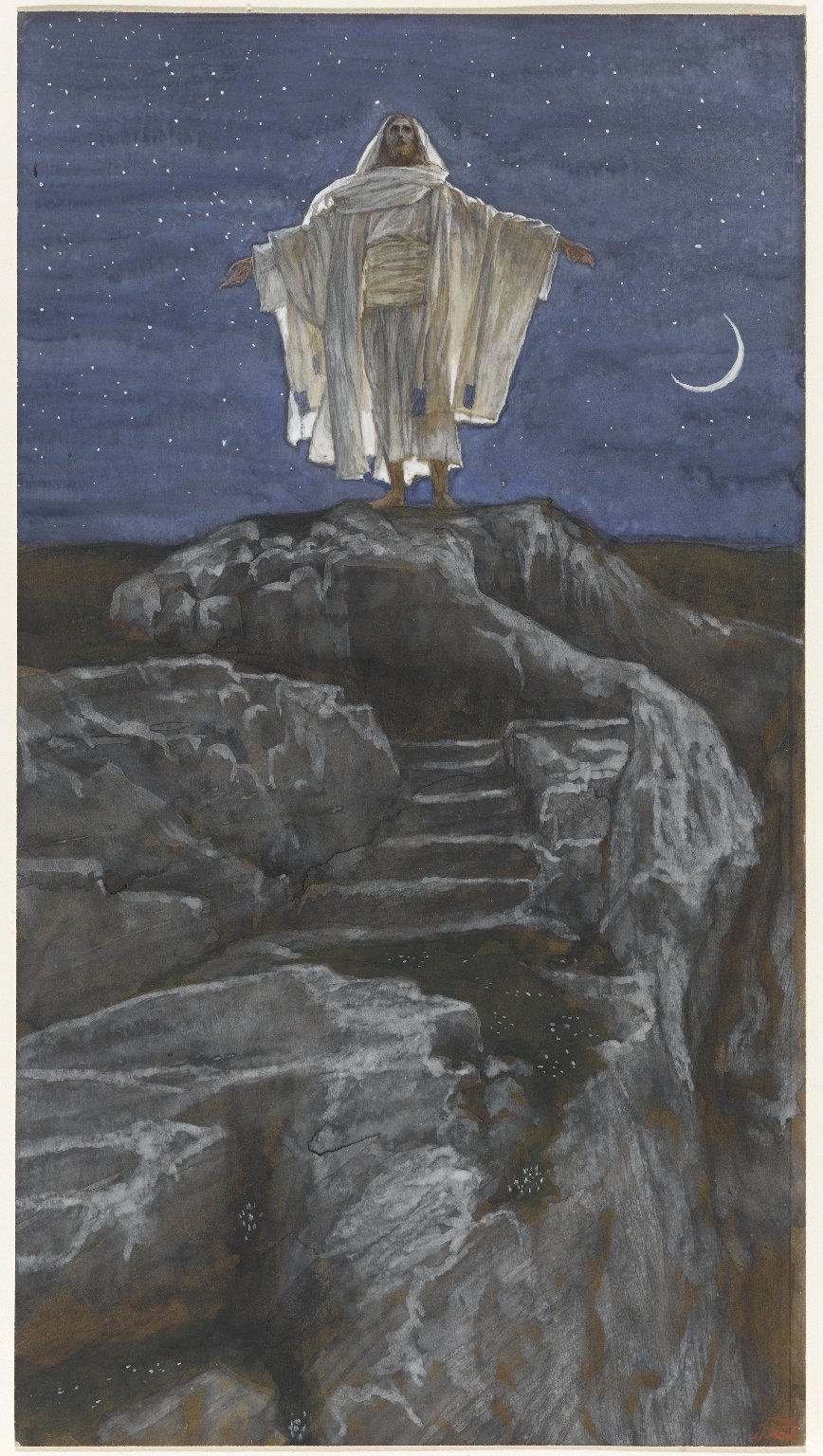
James Tissot, Jesus Goes Up Alone Onto A Mountain To Pray


In a painting whose title refers to one of Jesus’ common practices, James Tissot portrays him as caught up in prayer, an involvement he widely encouraged his followers to pursue. Regarding prayer, the Catechism in The Book of Common Prayer may surprise us. To the question, what is prayer, we find an answer which begins with these words: “Prayer is responding to God…” Jesus modeled a life wholly centered on responding to God, in heart and mind, in soul and body. On one occasion, he appeared transformed while at prayer. Over time, his followers discerned how God was fully present within him.

The story of his Transfiguration on a high mountain, reported in the first three Gospels and commemorated this past Sunday, provides a narrative demonstration of this truth. What Tissot depicts regarding Jesus when alone at prayer was later revealed semi-publicly on that mountain in the company of Peter, James, and John, as well as with the heavenly apparitions of Moses and Elijah. It was then fully revealed in Jesus’ Resurrection appearances.

Exodus 24 provides the background for this, and tells us something astonishing: “Moses and Aaron, Nadab and Abihu, and seventy of the elders of Israel went up {Mt. Sinai}, and they saw the God of Israel.” In Exodus 34, we learn that when Moses came down from the summit, “the skin of his face shone because he had been talking with God. When Aaron and all the Israelites saw Moses… they were afraid to come near him.” The text suggests that Moses then started putting a veil over his face for the sake of those who were unused to, or unprepared for, the glory and power of God’s immediate presence.

Paul, in 2 Corinthians, extends and also alters this idea of the veil. Instead of it being a means to protect people from a direct encounter with divine glory, the veil has become in Paul’s letter a kind of impediment. When our hearts and minds are not open to God, nor sensitive to God’s power, we become hardened. We become hardened in such a way that our hearts and minds are veiled, preventing us from perceiving God’s glory.

But Christ has set aside this veil. As a result, “all of us, with unveiled faces, {see} the glory of the Lord as though reflected in a mirror (2 Cor. 3:18).” And weare being transformed into the same image from one degree of glory to another, for this comes from the Lord, the Spirit.” Through prayer, we also are transformed.

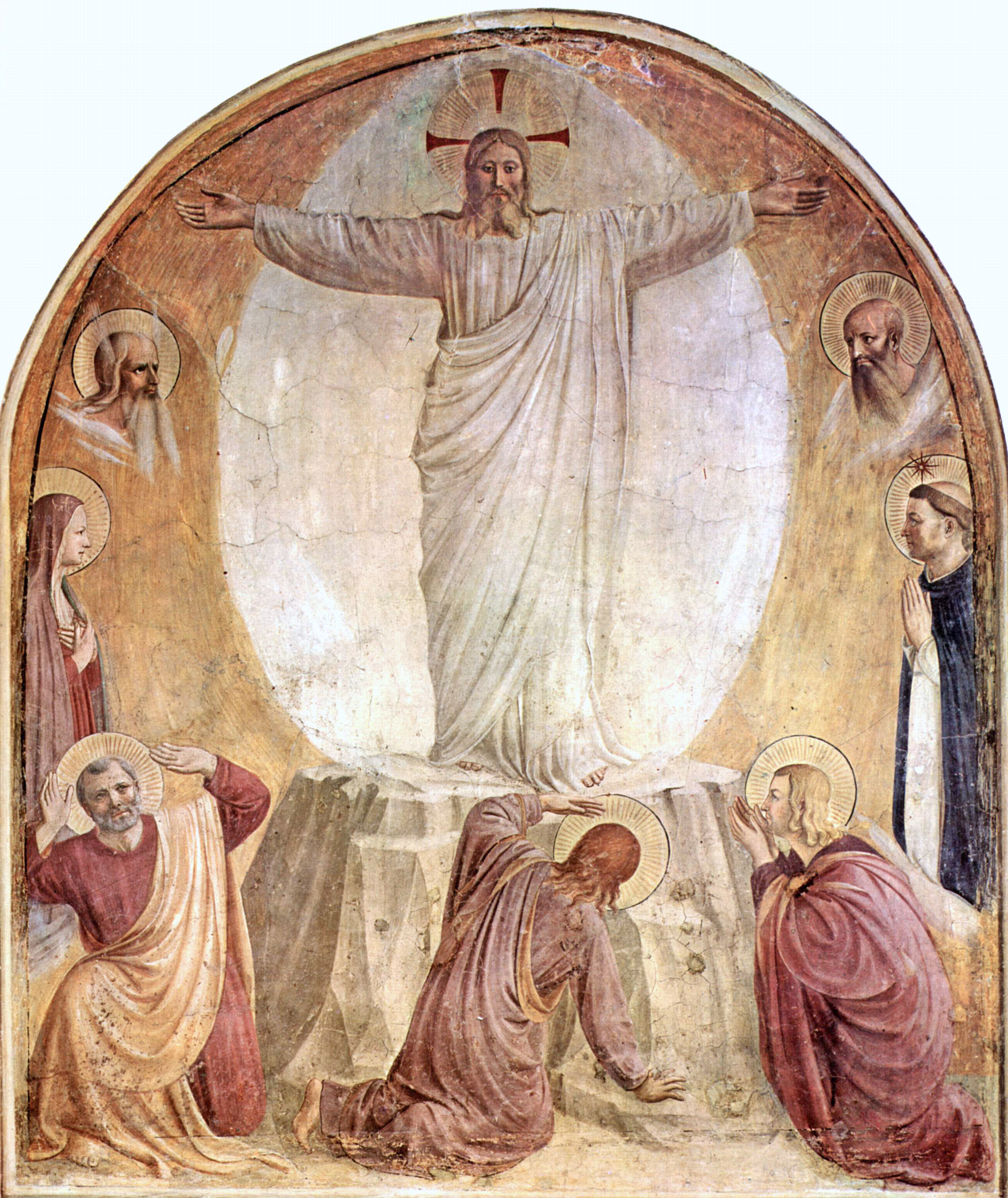
Fra Angelico, The Transfiguration (San Marco, Florence)

The Transfiguration of Jesus is all about the unveiling of God’s glory. Jesus takes Peter, John and James up with him on a mountain to pray. While he is praying, the appearance of his face changes, as does his clothing. In contrast with the Exodus and Pauline images of light shining on a surface, Luke presents God’s glory as coming from within Jesus. In other words, he radiates God’s glory rather than reflecting it. Luke tells us that Moses and Elijah, who appear with him, appear in his glory. This may mean that Jesus has shared his glory with them in a way that prefigures what he will share with all of his followers after his Resurrection.

This should lead us to ask a good question: If we feel like there is a veil between us and the divine presence, where does this veil lie? Does God ‘hide’ behind a veil, either to protect us, or challenge us? Or is the veil within ourselves, formed by our spiritual blindness and our lack of openness to how the Holy Spirit imparts glory? Paul suggests that our experience may be like that of the earlier Israelites, for whom hard-heartedness caused them to be blind to the bright light of God’s glorious presence, whether in Moses’ face or when reading and hearing the Law. Hard-heartedness can be equally blinding for us, veiling the glory that is all around us.

And where, according to Paul, do we find this glory? We find it in the faces of everyone who has been open to God’s transforming Spirit. In other words, we can find it in each other, as well as in ourselves. For this reason it can be like looking into a mirror, as the glory that we will perceive in others is the same glory that they can perceive within us.

And He Sent Out the Twelve

[If reading this by email, please tap the title at the top to open your browser for the best experience.]

James Tissot, The Ordaining of the Twelve Disciples


As Matthew tells the story, those who are called to follow Jesus are then sent out. Before they go, they are not only commissioned to represent him and his message; he shares with them portion of his remarkable power. According to Matthew, “… Jesus summoned his twelve disciples and gave them authority over unclean spirits, to cast them out, and to cure every disease and every sickness.” They have witnessed his teaching in what we know of as the Sermon on the Mount, which in the first Gospel runs over several chapters. Yet this moment is relatively early in the Gospel narrative, and it should surprise us that Jesus is so willing to let them go out on his behalf, and apart from him.

It is sometimes observed that with certain vocations one never really ‘retires” even if one ceases to be engaged in remunerated employment. This bears witness to the fact that through the calling that underlies all other callings, our baptismal vocation never has a terminus though it may come to greater fulfillment in life. Yet as we go through successive stages in our lives, we may be more open to being ‘sent out’ when we are younger even if we continue to be open to being ‘called’ – and, indeed, called anew – through our later years. My parents were relatively young when they were sent out as missionaries to Japan, living into a pattern that we can recognize in many spheres of our human communities such as in the Peace Corps and in Teach for America. Having myself been more recently retired, I find that I am now less inclined toward the opportunity of being sent out in and for the mission of the Kingdom though I still experience being called.

For reasons like these I tend to think that the twelve whom Jesus first called to be his disciples were  more likely to have been young rather than middle-aged. In that they may have had a greater openness to discipleship formation; they may have had a greater degree of idealism and more energy for a new kind of work; and they may simply have had the prospect of more years ahead with which to share with others what they would perceive and learn about God’s mission in and to his Creation.

It is a subtle point, but this may be why Tissot – following Matthew – portrays what is titled The Ordaining of the Twelve Disciples separately from a depiction of their initial experiences of being called. For this moment in their lives and in their time with him became the occasion of their formal participation in Jesus’ mission, even when they were not in proximity to him and his work. Jesus, as Matthew tells us,  had already gone “about all the cities and villages, teaching in their synagogues and proclaiming the good news of the kingdom, and curing every disease and every sickness.” And having commissioned the twelve, and given them his own authority, Jesus sent them “out with the following instructions: ‘… go to the lost sheep of the house of Israel. As you go, proclaim the good news, The Kingdom of heaven has come near. Cure the sick, raise the dead, cleanse the lepers, cast out demons’.”

When doing this, Jesus not only equips them for the mission upon which they are sent. He also forewarns them of the adversity they are likely to face, adversity which might involve betrayal, trials and flogging, being hated, and even being put to death. This is yet another reason why I tend to think of the disciples, at this point in their lives, as generally younger than older, just as we saw with Caravaggio’s likely portray of Matthew’s calling, last week.

As we get older, some but not all of us may be less open to being sent out, and less inclined to seek such an opportunity. But we should never cease to be open to ‘the call,’ and the varying ways it may be ever-renewed in our lives.


This posting is offered in relation to the readings appointed for Proper 6, Year A, in the Revised Common Lectionary for Sunday, June 18, 2023.

The Call of Matthew

[If reading this by email, please tap the title at the top to open your browser for the best experience.]

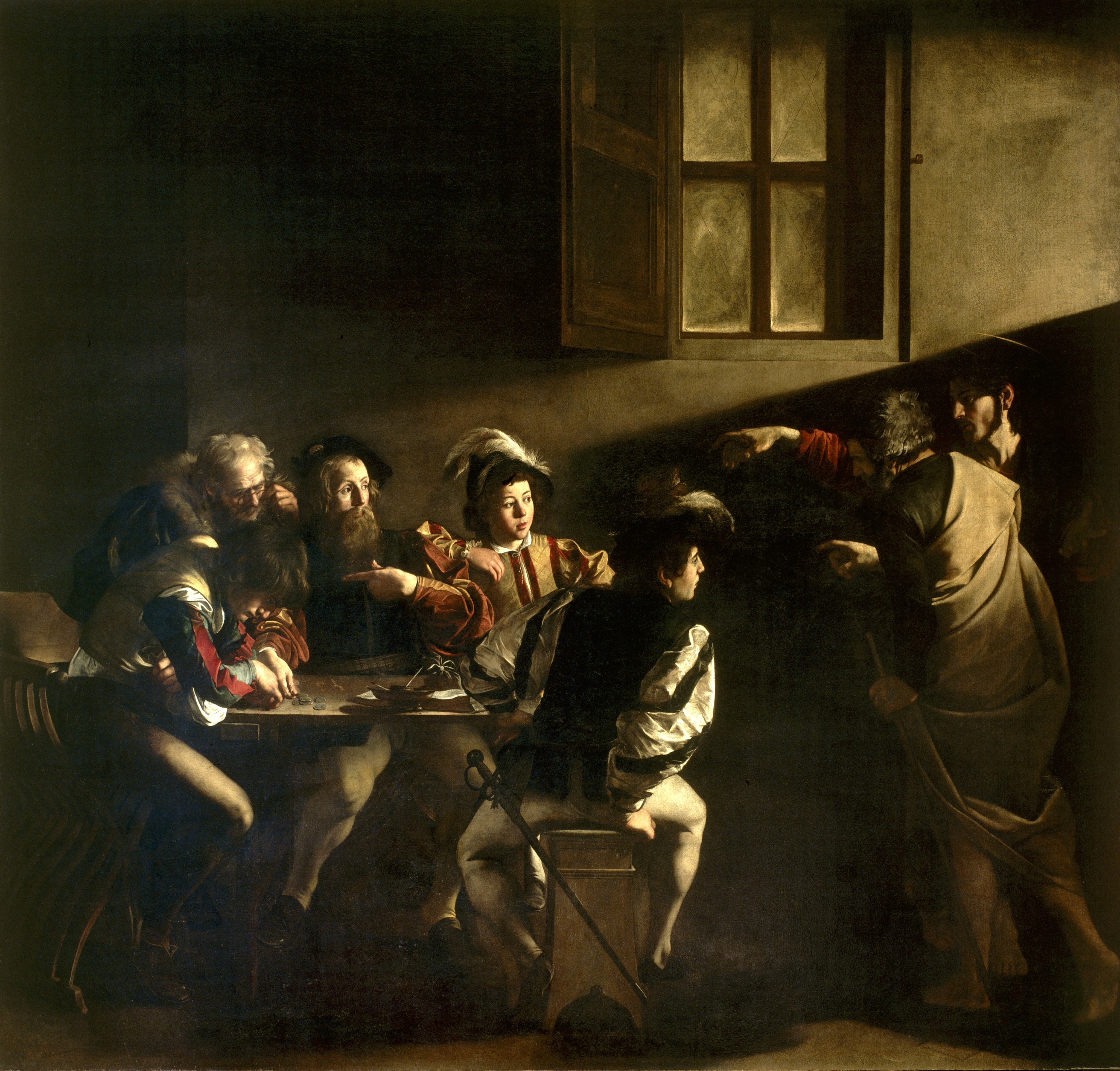
Caravaggio, The Call of St. Matthew (1619-1620)


Artists who portray biblical figures and events – particularly those who approach their work in a self-consciously Christian way – often feel free to explore the dynamics of Gospel scenes in a personal and imaginative manner. Some Gospel stories lend themselves to such an explorative approach. Other stories seem to prompt a portrayal of biblical persons and their circumstances in a more literal, text-dependent way.

The call of the tax collector in Matthew 9 provides a good basis for both, especially at the hands of the great early 17th century Italian painter, Caravaggio. Above, we see his painting of The Call of St Matthew, based on what may be a brief narrative self-portrait provided by the Gospel writer about his decision to respond to Jesus’ summons to follow him. Here, Caravaggio displays a fidelity to the biblical story even though the artist depicts the event with figures clothed in garments characteristic of his own time and place.

Several aspects of the painting should attract our attention. For they have the power to draw us into the scene and its place in the broader sweep of what some have called ‘the great story.’ The figure on the right side of the picture is obviously that of Jesus, who with bare feet has entered the place where the tax collector Matthew may be both entertaining himself as well as conducting his business. The room where the group of men are sitting is darkened, a detail that is surely symbolic given how light enters the room from the direction of Christ’s arrival. As Matthew’s Gospel quotes Isaiah (in chapter 5), “the people who sat in darkness have seen a great light, and for those who sat in the region and shadows of death light has dawned.”

Notice also Caravaggio’s sensitive rendering of Jesus’ outstretched hand. It is highly reminiscent of Michelangelo’s nearby Sistine Chapel ceiling panel depicting God’s act of creation and gift of life to Adam through a similarly depicted outstretched arm.

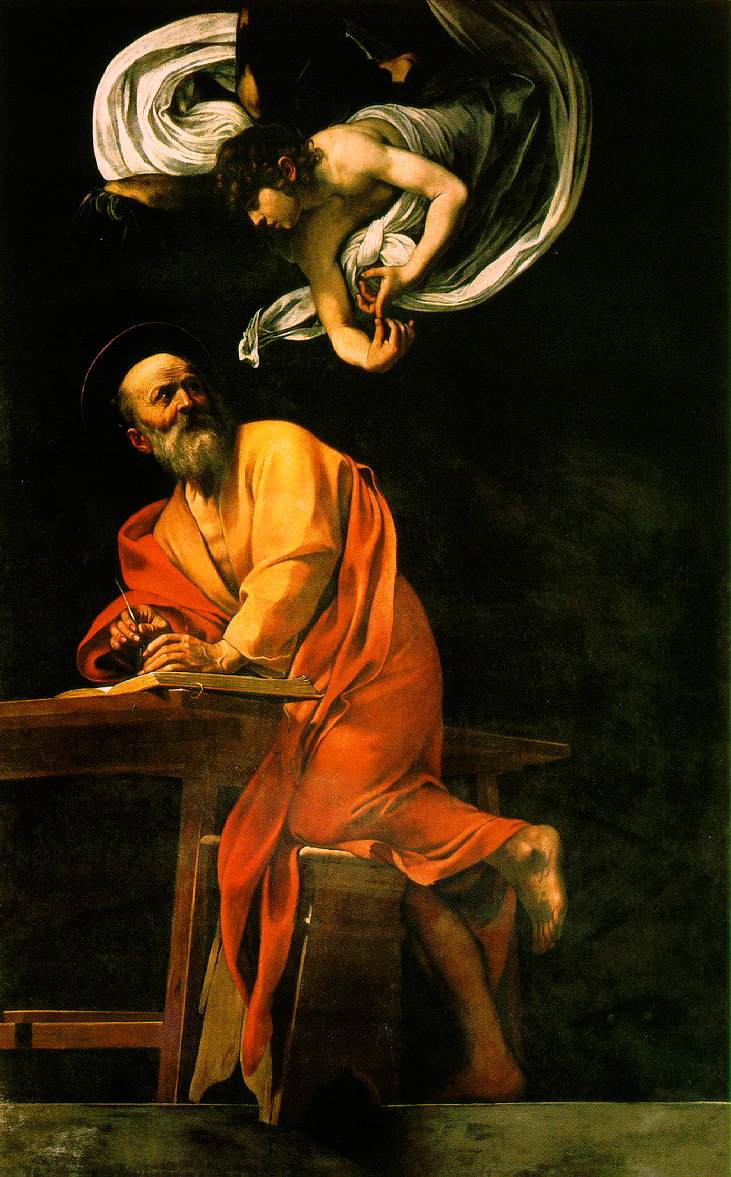
But which of the sitting men portrays Matthew? The answer is by no means obvious, and may be intentionally ambiguous. A ready candidate is the gentleman facing us, seated in the middle of the group, who appears to point to himself. By his gesture, he seems to ask in response to Christ’s summons, “Do you mean me?” His pointing hand, a visual echo of the pointing hand of Jesus, and the look on his face call attention to himself. Further, this bearded man bears a resemblance to the older-looking Matthew depicted in Caravaggio’s, The Inspiration of St Matthew (shown below).

Yet, another possible candidate for an identification with Matthew in this picture is the young man portrayed on the left side of the painting, whose head is bowed over and who is focused on some coins before him. In support of this identification is the presence of two other young men sitting at the opposite end of the table, whose gaze is fixed upon the unexpected visitor. By contrast with all three, Caravaggio may instead have intended to portray the mature Matthew in his accompanying The Inspiration of St Matthew painting, as well as in his The Martyrdom of St Matthew, both of which are located in the same church in Rome as The Call painting. For in the ‘call’ image, a young man is invited to leave his dubious present occupation and circumstances in order to follow Jesus, which seems most fitting. This invitation leads to a subsequent application of the maturing man’s talents in support of God’s mission, centered on the One whom he would come to recognize as the Messiah. As Caravaggio may have depicted in this scene, the potential consequences of accepting Jesus’ summons may just be dawning upon the young man.

Caravaggio’s paintings display a remarkable skill in rendering people and places in a most realistic way. His paintings are also highly regarded in recognition of his flair for dramatic pictorial compositions that feature a strong contrast between light and dark. He might have applied these skills primarily in the pursuit of fame and material wealth. Such intentions are likely to have numbered among his goals. Yet, Caravaggio’s work exhibits an undeniable spiritual sensitivity. This makes it most appropriate that we can view and appreciate his three St Matthew paintings together in a church in Rome rather than in a museum.

The Beauty of Trinitarian Life

[If reading this by email, please tap the title at the top to open your browser for the best experience.]

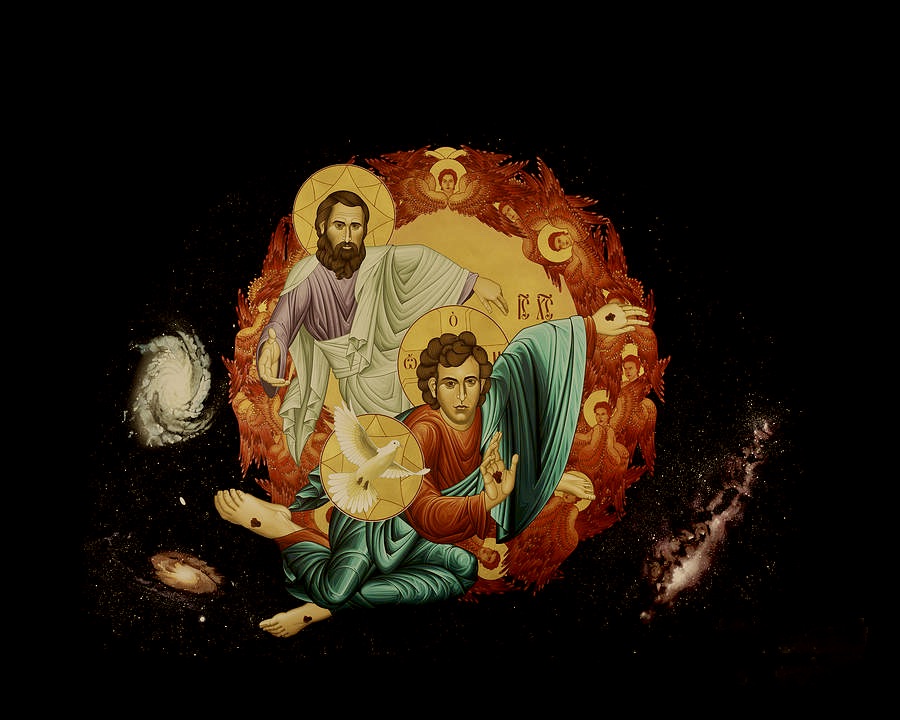
Brother Robert Lentz, Holy Trinity


Here is a Robert Lentz icon-styled painting that blends an historic approach to portraying the Holy Trinity with an inclusion of modern astronomical imagery. The facial depiction of the first two members of the Holy Trinity are presented in a very traditional way, while the images of the galaxies very obviously depend upon telescopic photography.

The most significant truth expressed within this composition by Lentz is that all three members of the Holy Trinity were and are involved in Creation, both in terms of the primal event, as well as in an ongoing divine presence within the whole of the cosmos, a theme found in John’s Gospel as well as in Paul’s letter to the Colossians among other biblical texts.

If there is any drawback to Lentz’s composition it is one shared with just about every Trinity-themed painting of which I am aware. To put it plainly, Lentz depicts the members of the Holy Trinity as ‘them,’ as objects of our subjectivity, as divine persons we contemplate, hold in regard, and with whom we contemplate or entertain relational involvement.

What this approach lacks, perhaps of necessity in a two dimensional medium, is an expression of the equally important and sometimes non-experiential truth that we are also the objects of the divine subjectivity, and how – after Baptism – we are inseparable from involvement with and in the Trinitarian life of God.

The simplest way to help make this evident can be found in all six of the Eucharistic Prayers in The Book of Common Prayer, as well as in many of the Collects. We pray to the Father, through the Son, in the Holy Spirit. And so, whether we are conscious of it or not, we are to live as we pray, to the Father, through the Son, in the Holy Spirit.

We should no longer try to depict the Holy Trinity through two dimensional imagery, much less with diagrams, or with objects like a three-leaf clover. For in each of these cases, we render the grace-filled context of our new and relational, post-Baptismal, life as if the grounding source for our being, and our life in Christ, was somehow external to us, and something which we might still have a need to approach.

Yet, through Christ and in the Holy Spirit, the Father is now in us, and we are in him. He is closer to us than we are to ourselves. This is the great mystery, the paradox, and the beauty of Trinitarian life in Christ after Baptism.

The Mystery of Pentecost

[If reading this by email, please tap the title at the top to open your browser for the best experience.]

Giotto, Pentecost (Scrovegni (or Arena) Chapel, Padua)


Once again we turn to Giotto, who helps put a ‘human face’ on a supernaturally-charged event. As we observed with his fresco depicting the Ascension of Jesus, Giotto’s Pentecost painting evidences the influence of medieval and Eastern Orthodox iconography (e.g., the gold-leaf halos). Yet, his work distinctively moved away from a primary absorption with portraying aspects of the eternal so as to display an appreciation for daily human life and activity. One mark of this is his employment of architectural perspective in his composition of the scene. In addition, each of the faces in this Scrovegni Chapel fresco are recognizably distinct from one another, with some of them reflecting a genuine regard for individual personality and temperament.

Here we can also notice Giotto’s attention to the biblical text. This scene portraying the gift of the Holy Spirit follow’s Luke rather than John. In John’s Gospel, on the evening of the day of the discovery of his Resurrection – the Risen Jesus enters the private room where the disciples are hiding fearfully behind a locked door. He breathes on them his Holy Spirit and implies that his Ascension has already occurred.

Luke, as Giotto faithfully portrays, describes the disciples being gathered together 50 days after the Resurrection on the Jewish feast of Pentecost. As Luke reports in the last two verses of his Gospel, after witnessing Jesus’ Ascension the disciples “worshiped him and returned to Jerusalem with great joy, and were continually in the temple blessing God.” Luke then commences his second book, Acts, with a parallel account of Jesus’ Ascension, and the selection process of Matthias as a replacement for the traitor, Judas. Having returned joyfully to Jerusalem, the disciples have been visiting the Temple daily, where they blessed and worshipped God in a public setting.

Luke’s Pentecost assembly differs markedly from John’s account of the fearful disciples on the afternoon of the first day of the new week, forty nine days before. For on Pentecost, into their midst and visibly upon their heads, came the Holy Spirit filling each of them with its power and presence.

Many visitors to Jerusalem for the great feast became aware of what had occurred, and were perplexed, marveling at the unexpected spectacle of how each of them heard the men from the north country speak in their own separate and distinct languages. The legacy of the tower of Babel had been overcome.

Peter quickly helped account for what was happening in light of Scriptures familiar to those gathered, which were fulfilled in and through Jesus’ death and resurrection. God was now doing a new thing, yet something promised long before.

How contrary to the spirit of Jesus’ ‘high priestly prayer, in John 17, and to the witness to the power and presence of the Holy Spirit at Pentecost, is our frequent experience of the Church throughout the world in our present day. Despite moving words centered on unity and a commonality of mission that we hear and recite in the baptismal rite, we are more often confronted with evidence of difference and division among Christians of varying denominations and cultural backgrounds. Perhaps it is because we let our own concepts of our mission and ministries take precedence over our awareness of and belief in the primacy of Christ’s continuing mission and ministry.

And so, we forget to marvel at what came about through the embodied presence of God. A divinely appointed and inspired country rabbi, who had recruited 12 unlikely followers, met persecution and a tragic death at the hands of a corrupt earthly empire. Yet, in the power of the Holy Spirit, over the course of a few centuries he transformed a sizable portion of the known world into the New Israel, his beloved community and family.


The Beauty of the Ascension

[If reading this by email, please tap the title at the top to open your browser for the best experience.]

Giotto, The Ascension of Jesus


The way that we envision the Ascension of Jesus is largely shaped by Luke’s Gospel, as well as by his book of Acts. As the Church’s liturgy observes and celebrates Luke’s presentation of this event, it occurs on the fortieth day after Easter Sunday, which always falls on a Thursday. With diminished weekday worship attendance in most churches, the feast of the Ascension is often observed on the following Sunday, on the Seventh Sunday of Easter. As Luke’s Gospel records the event,

[Jesus] led [the disciples] out as far as Bethany, and lifting up his hands he blessed them. While he blessed them, he parted from them and was carried up into heaven. And they worshiped him and returned to Jerusalem with great joy, and were continually in the temple blessing God.

In Acts, Luke presents a fuller account of

… the day when he was taken up…, [when] he presented himself alive to them… [H]e said to them, “… you will receive power when the Holy Spirit has come upon you, and you will be my witnesses in Jerusalem and in all Judea and Samaria, and to the end of the earth.” And when he had said these things, as they were looking on, he was lifted up, and a cloud took him out of their sight. And while they were gazing into heaven as he went, behold, two men stood by them in white robes, and said, “Men of Galilee, why do you stand looking into heaven? This Jesus, who was taken up from you into heaven, will come in the same way as you saw him go into heaven.”

Giotto beautifully portrays Jesus’ Ascension in a fresco found within the Scrovegni Chapel (also known as the Arena Chapel) in Padua, Italy. Giotto’s approach to painting proved pivotal in the transition within Western art from dependence upon Eastern Christian iconographic imagery toward a greater realism and sensitivity to ‘ordinary’ human life in this world. Unlike medieval and eastern Christian icons, which tend to be absorbed with expressing dimensions of the eternal, Giotto portrays a real event in the temporal lives of real people. Nevertheless, Giotto’s Ascension is clearly also attentive and faithful to the supernatural elements of the Luke-Acts descriptions of Jesus’ Ascension.

It has been observed that in these modern times, among the most neglected aspects of traditional Christian doctrine is a proper understanding of Jesus’ Ascension. This may be due to a contemporary proclivity to read the New Testament as if its significance is primarily ethical, while shying away from engagement with the metaphysical and the miraculous elements of the Gospel narratives.

A collect from The Book of Common Prayer helps us appreciate why the Ascension of Jesus continues to be a major feast of Our Lord on the Church’s calendar:

Almighty God, whose blessed Son our Savior Jesus Christ ascended far above all heavens that he might fill all things: Mercifully give us faith to perceive that, according to his promise, he abides with his Church on earth, even to the end of the ages; through Jesus Christ our Lord, who lives and reigns with you and the Holy Spirit, one God, in glory everlasting. (BCP:226)

Jesus ascended not so that he might withdraw from the world, making room as it were for the mission of the Holy Spirit. Instead, his Ascension marked his transition from being present at one time and in one place, to becoming present in all places all the time. Before his death, there were countless places where he was not. After his Ascension, there is no place where he is not. From being with only some of those who lived during his earthly years, he is with all of us now. And from having a particular presence and context for his ministry, Jesus in his Ascension transitioned to a universal presence for his continuing mission, so “that he might fill all things.”

Alleluia. Christ is Risen and Ascended! And in the Holy Spirit he is present everywhere and to all who might welcome him into our lives.


Through Death Into New Life

Peter Koenig, Christ as Second Moses


A perennial theme in the New Testament and in Christian reflection concerns how we are called to live through death into new life. When we die to our worldly attachments, and their hold upon us, we open ourselves to a greater life beyond. As the Christ our Passover canticle from The Book of Common Prayer puts it,

Christ being raised from the dead will never die again; *
death no longer has dominion over him.
The death that he died, he died to sin, once for all; *
but the life he lives, he lives to God.
So also consider yourselves dead to sin, *
and alive to God in Jesus Christ our Lord.

Peter Koenig’s painting, centered on themes within this Easter season, expresses this motif in a particularly evocative way. Just as Moses led the people of Israel through the waters of death into a new covenant life with God, so Christ leads us through and to the same. This happens for us liturgically in the rite of Baptism. As Koenig explores this idea, he not only depicts Christ parting the waters but also shows the water emerging from the Lord’s side. This reflects John’s account of how blood and water came forth from Jesus’ side on the cross, but also suggests how water from the rock in the wilderness brought life to God’s people during Israel’s wandering toward the Promised Land. The “Thanksgiving over the Water,” in The Prayer Book Baptismal Rite articulates these ideas in a compact way:

We thank you, Almighty God, for the gift of water. Over it the Holy Spirit moved in the beginning of creation. Through it you led the children of Israel out of their bondage in Egypt into the land of promise. In it your Son Jesus received the baptism of John and was anointed by the Holy Spirit as the Messiah, the Christ, to lead us, through his death and resurrection, from the bondage of sin into everlasting life.

We thank you, Father, for the water of Baptism. In it we are buried with Christ in his death. By it we share in his resurrection. Through it we are reborn by the Holy Spirit.

Notice how, in the painting at the top, Peter Koenig portrays the crucified and risen Christ before what appears to be a darkened tomb filled with people. As we hear Isaiah quoted in Advent, “The people who walked in darkness have seen a great light; those who dwelt in a land of deep darkness, on them has light shone.” Christ leads the way, and makes possible our journey from the darkness of death into our new covenant life with God.

The two side paintings that accompany Koenig’s Christ as Second Moses artfully yet powerfully suggest the drama within the Exodus account of Israel’s Red Sea Crossing. The chariots of Pharaoh succumb to the waters of death while Israel is safely delivered on dry ground to their Covenant encounter with God at Sinai. Another canticle from The Prayer Book puts it well:

I will sing to the Lord, for he is lofty and uplifted; *
the horse and its rider has he hurled into the sea.
The Lord is my strength and my refuge; *
the Lord has become my Savior.
This is my God and I will praise him, *
the God of my people and I will exalt him.
The Lord is a mighty warrior; *
Yahweh is his Name.
The chariots of Pharaoh and his army has he hurled into the sea; *
the finest of those who bear armor have been drowned in the Red Sea.
The fathomless deep has overwhelmed them; *
they sank into the depths like a stone.
Your right hand, O Lord, is glorious in might; *
your right hand, O Lord, has overthrown the enemy.

Most of us have the blessing of not facing the equivalent of Pharaoh’s army. But we do have an enemy. And our enemy is the darkness and death of loving self and this world, even to the contempt of God, when God bids us to love him, even to the contempt of self and this world. When we live as we pray, to the Father, through the Son, and in the Spirit, we experience new life.


The above painting is Peter Koenig’s, Christ as the Second Moses, also known as The Rainbow Resurrection (used by permission of the artist). The final paragraph contains a paraphrase of St. Augustine concerning how we love God, from The City of God (Book 14, chapter 28).