Good Friday

Through Death Into New Life

Peter Koenig, Christ as Second Moses


A perennial theme in the New Testament and in Christian reflection concerns how we are called to live through death into new life. When we die to our worldly attachments, and their hold upon us, we open ourselves to a greater life beyond. As the Christ our Passover canticle from The Book of Common Prayer puts it,

Christ being raised from the dead will never die again; *
death no longer has dominion over him.
The death that he died, he died to sin, once for all; *
but the life he lives, he lives to God.
So also consider yourselves dead to sin, *
and alive to God in Jesus Christ our Lord.

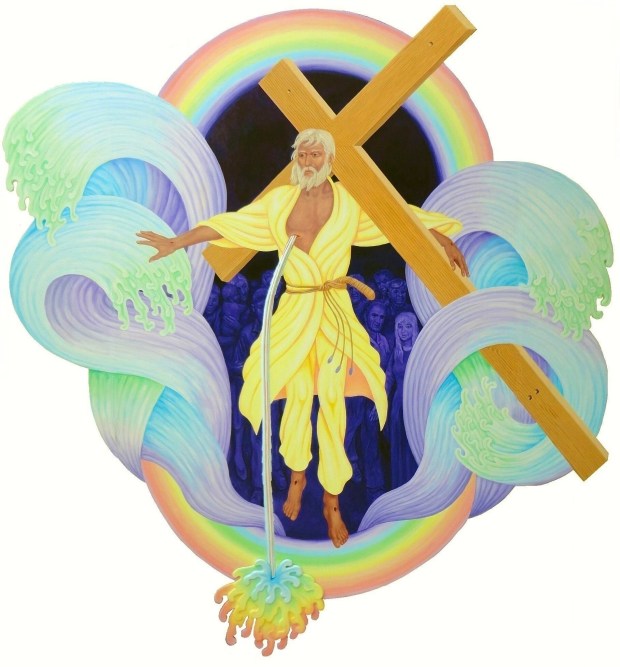
Peter Koenig’s painting, centered on themes within this Easter season, expresses this motif in a particularly evocative way. Just as Moses led the people of Israel through the waters of death into a new covenant life with God, so Christ leads us through and to the same. This happens for us liturgically in the rite of Baptism. As Koenig explores this idea, he not only depicts Christ parting the waters but also shows the water emerging from the Lord’s side. This reflects John’s account of how blood and water came forth from Jesus’ side on the cross, but also suggests how water from the rock in the wilderness brought life to God’s people during Israel’s wandering toward the Promised Land. The “Thanksgiving over the Water,” in The Prayer Book Baptismal Rite articulates these ideas in a compact way:

We thank you, Almighty God, for the gift of water. Over it the Holy Spirit moved in the beginning of creation. Through it you led the children of Israel out of their bondage in Egypt into the land of promise. In it your Son Jesus received the baptism of John and was anointed by the Holy Spirit as the Messiah, the Christ, to lead us, through his death and resurrection, from the bondage of sin into everlasting life.

We thank you, Father, for the water of Baptism. In it we are buried with Christ in his death. By it we share in his resurrection. Through it we are reborn by the Holy Spirit.

Notice how, in the painting at the top, Peter Koenig portrays the crucified and risen Christ before what appears to be a darkened tomb filled with people. As we hear Isaiah quoted in Advent, “The people who walked in darkness have seen a great light; those who dwelt in a land of deep darkness, on them has light shone.” Christ leads the way, and makes possible our journey from the darkness of death into our new covenant life with God.

The two side paintings that accompany Koenig’s Christ as Second Moses artfully yet powerfully suggest the drama within the Exodus account of Israel’s Red Sea Crossing. The chariots of Pharaoh succumb to the waters of death while Israel is safely delivered on dry ground to their Covenant encounter with God at Sinai. Another canticle from The Prayer Book puts it well:

I will sing to the Lord, for he is lofty and uplifted; *
the horse and its rider has he hurled into the sea.
The Lord is my strength and my refuge; *
the Lord has become my Savior.
This is my God and I will praise him, *
the God of my people and I will exalt him.
The Lord is a mighty warrior; *
Yahweh is his Name.
The chariots of Pharaoh and his army has he hurled into the sea; *
the finest of those who bear armor have been drowned in the Red Sea.
The fathomless deep has overwhelmed them; *
they sank into the depths like a stone.
Your right hand, O Lord, is glorious in might; *
your right hand, O Lord, has overthrown the enemy.

Most of us have the blessing of not facing the equivalent of Pharaoh’s army. But we do have an enemy. And our enemy is the darkness and death of loving self and this world, even to the contempt of God, when God bids us to love him, even to the contempt of self and this world. When we live as we pray, to the Father, through the Son, and in the Spirit, we experience new life.


The above painting is Peter Koenig’s, Christ as the Second Moses, also known as The Rainbow Resurrection (used by permission of the artist). The final paragraph contains a paraphrase of St. Augustine concerning how we love God, from The City of God (Book 14, chapter 28).

Beauty in Holy Week

[If reading this by email, please tap the title at the top to open your browser for the best experience.]

Stanley Spencer, The Crucifixion (1958)


During this Holy Week I find myself reflecting on the paradox at the heart of Jesus’ Crucifixion. In it we perceive a dramatic juxtaposition of serenity with antagonism, of beauty with its dark opposite, and of moral good with apparent evil.

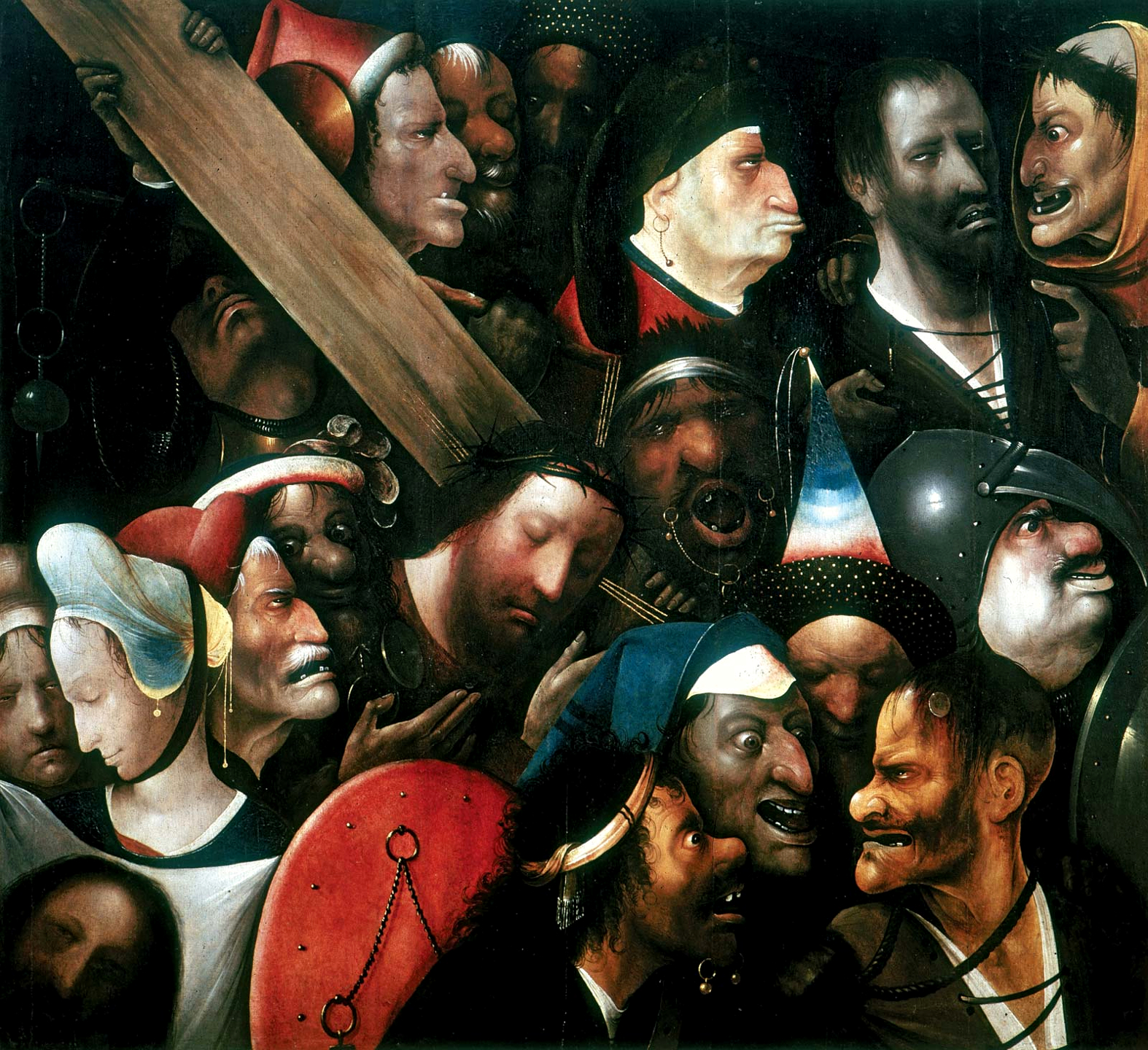
We can see this in a remarkable parallel between two paintings that were completed some 500 years apart: Hieronymus Bosch’s (attributed), Christ Carrying the Cross (1510-35), shown below, and Stanley Spencer’s, Crucifixion (1958). Both portray the tranquil visage and peaceful heart of Jesus, even in the face of vicious hostility.

Like Bosch, Spencer helps us see what the beautiful One in our midst sometimes provokes. Especially when the shining light of his presence exposes the dark shadows within and around us. For his light sometimes prompts fierce anger and envy, as well as a callous indifference to cruelty and suffering. Things of which we are all capable. And we are likely to have much invested in denying that ugly truth. Strangely, when confronted face to face with a divinity that is the opposite of our perversity, we will either fight the light that we encounter, or surrender to it. The Passion narratives give us examples of those who resisted and even fought against the Light of the World. Especially against the disturbing possibility that Jesus might conquer their pervasive ungodliness.  And so, they sought to do away with his godliness.

An encounter with true beauty can be unsettling and troubling, especially if we have already settled for so much less. It may be our sensitivity to the same juxtaposition of opposites I have noted, and their apparent lack of resolve. We often hope for the triumph of good over evil, that beauty will overcome darkness, and serenity displace antagonism. But we cannot find it within ourselves to do more than hope. We cannot achieve the redemptive resolution for which we haltingly reach out with our feeble hands and hearts.

It is not an accident that the Christ figure in Stanley Spencer’s painting recedes visually in the foreground, while those who oppose and crucify him grab our interest. Spencer, after mastering traditional realism, adopted what he called a neo-primitive style. He was a gifted colorist, and highly proficient with composition. And so, as Spencer has rendered him, Jesus’ skin tone and color roughly match that of the wood of the cross, as well as the clothing of the man with the hammer swung over his head. Spencer’s rendering of the Lord’s skin tone and color also matches much of the sky and the ground below, including the tunic of Mary Magdalene, prostrate at the foot of the cross. This forms a compelling visual symbol of Jesus’ total identification with us, in his Incarnation and in his Crucifixion. It symbolizes his complete joining with us, and with our world of tearing hurts and suffering.

In fact —as we see in Spencer’s composition and coloring— it is precisely because Jesus blended in so well with everyday life, that those who opposed him could literally gain the upper hand, ultimately with hammers and nails. But this is the marvel of the incarnation of our God in Jesus, that the fullness of divinity could be so thoroughly joined to our fallen humanity. As the Gospels attest, this joining was so complete that many did not notice or have regard for his divinity. When we do notice his total identification with us, when we come face to face with the truth it represents, we have either one or the other of two reactions. We throw ourselves down in humility before him. Or, we seek to throw him down, to humble him before us.

Spencer at work on his Crucifixion

The Body We Have Embraced


As soon as I heard the news on Monday, like everyone else I went to the internet. The live video of the flames rising up from the roof of Notre Dame in Paris was deeply disturbing. Like so many others, I felt an immediate grief. How touching that we would feel wounded when hearing about and seeing the wounding of a great and beautiful cathedral. And it is no accident that we should have felt this way.

For like so many other medieval cathedrals, Notre Dame de Paris is so much more than a building. It is first an offering of great love for our Lord and his physical, earthly mother. It is also an embodiment of faith, a tangible expression of the Body of Christ. This is particularly evident in the way that its floor plan is shaped in homage to his crucified Body. The cathedral therefore represents an ‘incarnation’ of what the book of Revelation calls the Alpha and the Omega, the Beginning and the End. For he is the One through whom all things were made, and the One through whom all things will come to their End… whether their End be their termination, or their fulfillment and completion.

Believers through the centuries who worship the Incarnate Lord have something in common. It is both true of his followers at the time of his crucifixion, two thousand years ago, and true of us today. As believers, we are never ambivalent about harm brought to the Lord’s Body, and to living symbols of his Body — both harm to the structures in which we worship, and harm to the ‘living temples’ formed by us, his embodied members.

For the Lord, for his followers, and for all members of his Body, death is always a gateway to new life. And, for the cathedral of Notre Dame, death to one phase in the life of this magnificent building will surely become a gateway to a new life ~ both for it, and for her people.

It is precisely with this awareness, I believe, that Peter Koenig has painted, and offered for our spiritual edification, his glorious image of Christ as the Second Moses. Peter Koenig’s vision is similar to that of the original builders of Notre Dame, the same mystical vision permeating John’ Gospel and John’s understanding of Jesus’ Incarnation, life, death and resurrection.

We should notice this: The body that the Son of God embraced, and with which he became one, has become the Body we have embraced, and with which we have become one. The Body of his transformation has become the Body of our own transformation. His death was a critical ‘hinge point’ ~ a hinge point in his and our process of transformation. And so, though our worship on Good Friday liturgy is ostensibly focused on the death of Jesus, it is also profoundly about the renewed lives of others, like us.

At the beginning of Lent, we reminded ourselves of a practical truth. Our journey toward knowing the fire of the Holy Spirit more truly, begins with physical ashes. A sign of death and destruction like ashes, or the Holy Cross, can help us see new life beyond it. May we, like our brothers and sisters in Paris, always remember this.


The above painting is Peter Koenig’s, Christ as the Second Moses, also known as The Rainbow Resurrection (used by permission of the artist). This post is based on my homily for Good Friday, April 19, 2019, which can be accessed by clicking here.  Other homilies of mine may be accessed by clicking here. The Revised Common Lectionary, which specifies the readings for Sundays and other Holy Days, can be accessed by clicking here.

Holy Week and the Good Samaritan

Art_Tissot_The Good Samaritan

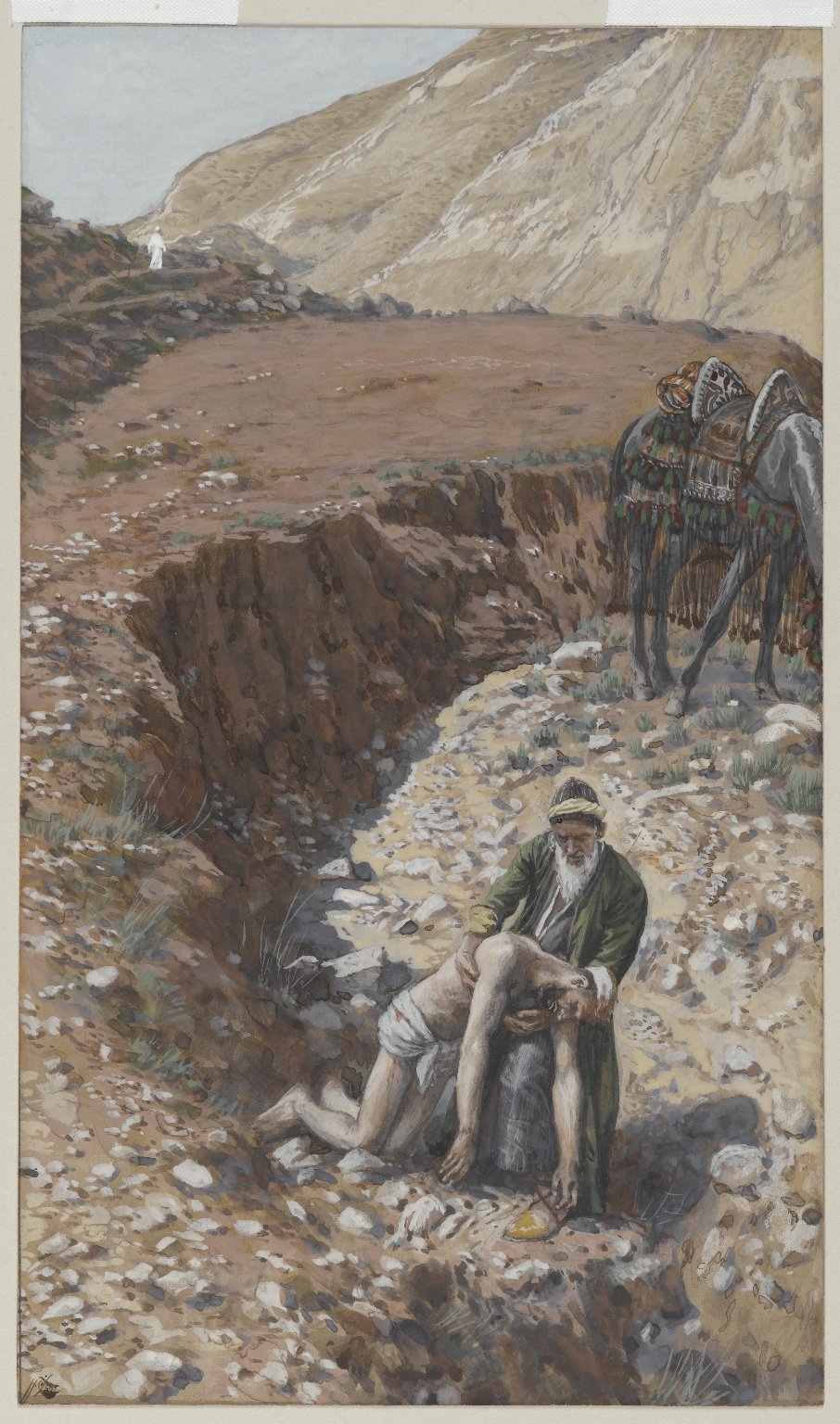
In telling his story about the Good Samaritan, Jesus was answering the question, “who is my neighbor?” At first, it may seem he was teaching us about how to live in God’s Kingdom. Cautioned by the negative example of the priest and Levite who pass by on the other side of the road, we should follow that of the charitable Samaritan who provides hospitality. But we can also hear the story as telling us something essential about God’s own charity and hospitality, and about Jesus’ role as God’s Messiah.

We are like the traveler in Jesus’ story who has been set upon. We often feel injured by life’s misfortunes, and the bad things that have happened to us through no fault of our own. Yet, God has not left us alone, to try and sort everything out. Instead, God in Jesus has come right to our point of need, and has ministered to us personally.

The mystery at the heart of Holy Week is this: God did not bypass the world’s need and suffering. Instead, in Jesus, God deliberately and willingly entered into the heart of the world’s darkness to offer the gift of light. God in Jesus took on every limitation we experience, and every pain we can endure. Why? So as to transform these real things from within.

Because God in Jesus did not bypass our world’s need and suffering, we shouldn’t bypass the way God entered into these everyday challenges. In God and with God, we have the holy opportunity to experience how the Spirit transforms our hurts and sorrows, and the emptiness of much of our lives. We see this particularly vividly in our services on Palm Sunday, Maundy Thursday and Good Friday.

Let us be with Jesus as he walks into Jerusalem to receive praise, and face scorn. Let’s be with him as he reclines with his friends for their last meal together. We can be with him as he enters the garden, prayerfully shaping his final resolve to live and die within God’s will. And we can be with him as he allows himself to be put to death on the cross for the sake of the world’s need and suffering.

As we walk through Holy Week with our brothers and sisters in Christ, we can rediscover how God has entered into, and transformed, our needy world.


The Good Samaritan image above is by James Tissot. Notice the figure in the upper left corner, who bypasses the traveler in need. Holy Week will be observed in most Western Christian churches this year during the week of April 9-15.

Our Beauty in His Eyes

Art_Tissot_Brooklyn_Museum_-_What_Our_Lord_Saw_from_the_Cross_(Ce_que_voyait_Notre-Seigneur_sur_la_Croix)_360KB

We are accustomed to looking up at him on the cross. Good Friday may prompt us, at least for a moment, to allow a reverse in the direction of the gaze.

For we are the objects of his attention, and of his love. If we discern anything about the meaning of Holy week, and the events within it, it is this: He acted for us, and not for himself. And God was in him, as he did so.

James Tissot pictures Jesus’ view from the cross on that dark afternoon, two thousand years ago. Just below his feet, he saw Mary Magdalene, prostrate with grief, showing her love for him. Just behind her, cloaked in dark blue and white, is his mother, hand across her heart, experiencing the sorrow it had been predicted she would endure. And to the left of Mary, in Jesus’ vision, we see the beloved disciple, John, in a white outer cloak over a green tunic. These three, and the two others behind Mary, are sympathetic figures. They have come to be by him in his darkest hour.

Others in Jesus’ field of vision may vary in their sympathies with his suffering. The Roman soldier cloaked in red could be the centurion, about whom we read in the Passion narratives. Standing by the cross, Tissot depicts him with a pained look on his face. He is beginning to realize that Jesus was innocent of the charges brought against him. By contrast, the two other soldiers near him appear either puzzled or disgusted by the whole situation.

As we survey this scene portraying Jesus’ field of vision from the cross, we cannot miss the group of men on horseback in the middle-ground. They are Scribes or Sadducees, those with power and wealth in the city, who had argued for his crucifixion. Some are shown taunting him. Some appear self-satisfied. And at least one is looking up at the darkening sky, which is already putting the upper edge of the scene in shadow.

He has acted for all these people, and especially for the ones who have turned against him. He looks upon them with love, and with a plea for God’s forgiveness. He knows what is in people’s hearts. What we so often forget is that he knows us better than we know ourselves. We may not understand how he knows us; but we do know that he knows us. We know that he loves us. And this is enough.

This is not a time for us to ponder the unknowability of God. This is a time to focus on our vulnerability, and our total knowability in God’s eyes. It is a time in which to contemplate the complete self-revealing of God, by Christ, for us. And to remember that he did this on a cross.


James Tissot, What Our Lord Saw From the Cross. For a link to my Good Friday homily, from which this is adapted, please click here.