God’s presence

God’s Handiwork Inspires Ours

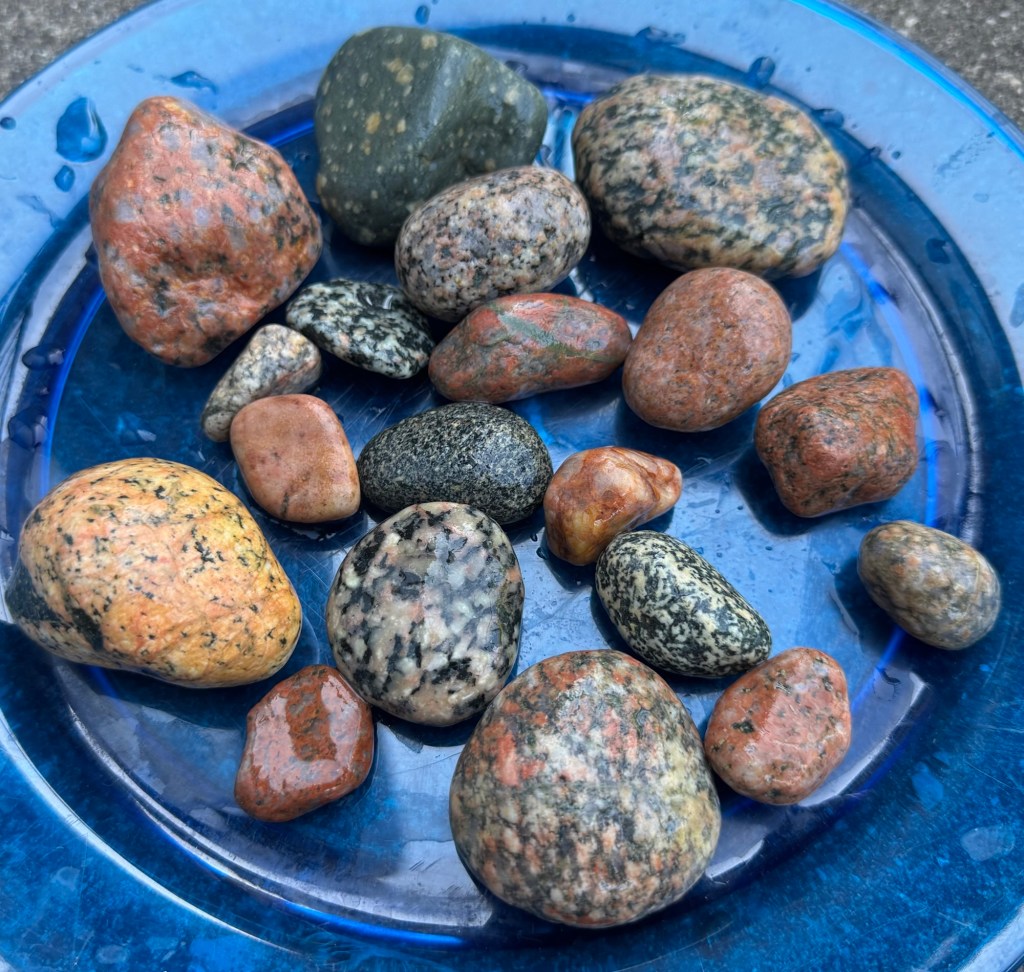
Stones found on a northern Lake Michigan beach

Labor Day is around the corner and some of us may receive and enjoy a day off from work. What we call retirement, a stage in life I am presently enjoying, tends to represent leaving work behind. Yet these and related ideas rest upon a common assumption, that work is different from, and in some ways inimical to, enjoying fulfillment in life.

I find a biblically based theological insight helpful when thinking about work. As with many matters that can be looked at from the perspective of Christian moral theology, our view of work can be enhanced by making reference to four specific reference points. These are, first, what we have learned about God’s purposes in Creation for this or that aspect of our lives; then, what impact sin associated with our Fall has had upon what we are thinking about; third, how God’s ongoing work of Redemption has restored and or transformed the matter presently under consideration; and fourth, to ask what future – if any – does this aspect of our lives have in Christ. 

Work provides a wonderful topic for engaging in this fourfold inquiry. Based on our common way of thinking about work, it may be hard for us to consider the meaning of work from any other vantage point than of attributing its role in our lives to the Fall and to the ongoing effects of human sin. Yet, we can also learn from many who have come before us who have distinguished work from toil. This can help us see how forms of labor, and pejorative associations the word may have for us, are surely due to our proclivity to link such activity with burdensome unpleasant duties.

For what we may overlook is the biblical view of how God has shared stewardship responsibility for aspects of Creation with us, as beings created in God’s image and likeness. This was symbolized by the way that our mythic forebears (Adam and Eve) were given their ‘work’ of naming the animals as a path toward fulfillment. It was not until their expulsion from the Garden that the first human beings are described as prone to acts characteristic of sin. Thereupon, in biblical theology, our heavenly ‘work’ of praise, and of divinely-invited participation in God’s Creation stewardship, ceased to be pleasingly ready pathways toward human fulfillment, and became energy draining and spirit-diminishing activities – such as we tend to find them to be now.

A growing segment of the wider Christian community shows signs of acknowledging how God’s work of Redemption is ongoing, quite aside from its ‘once and for all time’ episodic saving events. The pattern and purpose remains the same – nothing fundamentally new is added, nothing old of lasting value taken away. Preeminent remains God’s abiding purpose for us to become and be God-like in God-intended ways. For, as Athanasius taught us, the Son of God became the Son of Man, so that the children of men and women could become the children of God. Work – not toil nor burdensome labor but creative and fulfilling work – remains a vital part of our holy path toward wholeness.

And to remind us of this abiding truth, the loving Creator has spread around us an uncountable abundance. These are the signs of outpoured and participatory grace, some of them very small, like stepped-upon seashore pebbles and tiny blossoms among hurried-by roadside weeds.

Too quickly we dismiss the significance of our our small acts of selfless giving, not to be counted by us, but adding up to so much more than we imagine in the life-growth of others. This is our holy ‘work,’ overlooked but important stepping stones on our path toward living into the godly fullness with which Christ fills us.

If on our daily course our mind

Be set, to hallow all we find,

New treasures still, of countless price,

God will provide for sacrifice.

Old friends, old scenes, will lovelier be,

As more of heaven in each we see:

Some softening gleam of love and prayer

Shall dawn on every cross and care.

[John Keble, “Morning,” from The Christian Year]

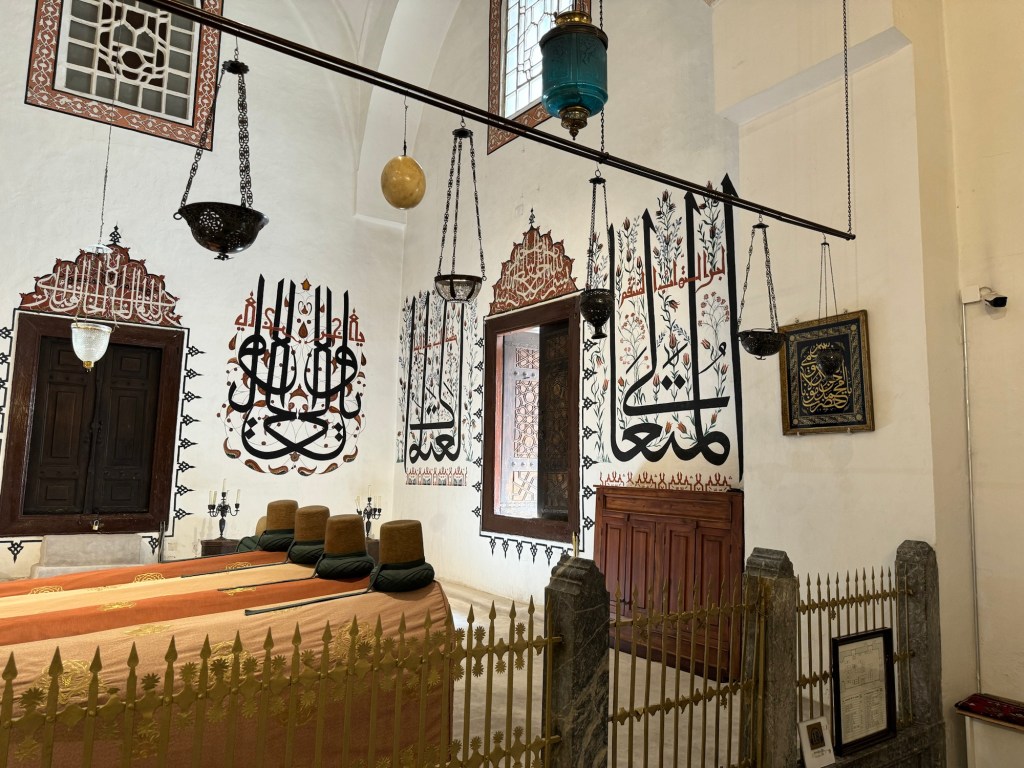
The Mystic Rumi’s Burial Place

The burial place of the mystical Sufi poet, Rumi, in Konya, Turkey

Here are some photos from a recent visit to the mausoleum of the mystic Sufi poet, known in the West as Rumi. It is a very holy place for many who visit there.

The honorary coffin cover, sitting far above the entombed remains of the mystic Rumi
A Persian style multi-faceted dome in the same building
An interior view showing some of the remarkable calligraphy on the wall surfaces
A broader interior view
An original 13th century silver door
A replica small space in the courtyard adjacent to the mausoleum

The Beauty of Mystical Union

Art_the-wedding-at-cana-niels-larsen-stevns_(1864-1941)


This painting by Niels Larsen Stevns, a relatively unknown Danish painter, strikes me as profound. I think he portrays the occasion in a way John the Evangelist would have liked. First, notice the huge stone basins, which by their placement in the painting occupy the center of our attention. These vessels exceed what we might imagine when we hear the English word “jars.” Yet John, who is consistently focused on mystical and symbolic themes, takes care to tell us how these ‘jars’ hold twenty to thirty gallons each. To put that in perspective, 24” of water in a standard bathtub equals roughly 24 gallons. And Jesus transformed six times that amount, for just one party!

After the large vessels, we notice next Jesus and his mother, the two main figures in this painting and in John’s story. In addition to their placement, we can tell who they are by their halo’s. While Mary stands fully graced by the glow of the late afternoon sun, the upper torso of Jesus is in shadow. I think this is for both pictorial and theological reasons, allowing the glow of his halo to be all the more radiant. At the same time, he is the only figure in the painting portrayed as praying. Very subtly, and faithful to John’s Gospel, Stevns depicts how the light shines in the darkness, and that the darkness has not ‘comprehended’ it. This moment is all about Epiphany, about the revealing of light in new and profound ways, for the benefit of all who long to see it. Water, set aside for the purification of the body, becomes wine that warms and gladdens the heart and soul.

The chief steward is just behind, being given an opportunity to apprehend and perceive the light. It comes in the form of a cup of wine, reckoned to be among “the best.” Also subtle is Stevn’s depiction of the two persons on the left side, who are in conversation. They appear to be discussing something whose meaning eludes them, reminding us of the two disciples later walking on the road to Emmaus. Like them, and like the chief steward, these two at Cana do not yet perceive what this is all about. Only in the background, under and through the low arches, do we see the wedding party, feasting together at the tables. Among many paintings of this scene, this may be among the most faithful to what John wants us to see, and to believe. This story, like the whole of John’s Gospel, is about the wedding of the human and the divine, in Jesus.

Many guests at this wedding probably noticed the sudden arrival of a batch of fine wine—but not where it came from, nor what it represented. Those at the table were likely focused on the bridal couple, while enjoying all the splendid things on offer. But those who stood nearby, at the edges of the scene, were in a position to notice something else. Of greatest significance at this event was not the hospitality provided by the wedding hosts, whose wine in fact ran out! Most significant was the abundant and mystical hospitality, revealed and provided by a higher source. In this gathering, God’s hospitality is extended not so much as it is in other Gospel stories, to people who are unique and different, and on the margins. Here, God’s hospitality embraces what is common and the same, our needy human nature. God shows us how the deficiency we all share is blessed, and then filled. The empty vessels of our souls are ‘filled to the brim’ with the living water of the Holy Spirit.


The Wedding at Cana by Niels Larsen Stevns (correct spelling! / 1864-1941), based on John 2:1-11. To see my homily, which explores this Gospel reading in relation to historical representations of it in art, click here.

Beauty in Community

Pentecost_CELPentecost[1]_buildfaith.org


A collection of individuals fills this painting, signifying Mary and the first followers of Jesus. They are looking in different directions at the moment when the great whooshing wind and the flames of the Holy Spirit come down upon them. Caught up in the movement of the wind and flames, they are pushed forward into a celebration that is turned outward, and toward the darkness that lies beyond. The fire of the Spirit blows in and through them, not just around and over them. And they are swept forward into the future, in common mission.

We have a challenge imagining this moment. Our culture emphasizes the particularity of personal experience, and differences between us. We hear much talk about diversity and inclusion, which might reflect a positive regard for community. But it may also reflect an assumption that, apart from our efforts to bring people together, we are separate and disconnected. Perhaps, on the day of Pentecost, some of the people dramatically experienced God’s power. But we may be surprised to hear that all of them did, and together!

We don’t appreciate how community is vital to individual human flourishing. We often want individual freedom without personal accountability to others, and individual opportunity without personal responsibility. Being in community with other people may seem to be occasionally beneficial, especially when it is on our terms. But we don’t see it as essential to our lives.

In the ancient biblical vision, we are created in community, and we are redeemed in community. Whether we experience it or not, after Baptism God abidingly dwells between us and within us. There is no distance between us and God, even if we perceive a disconnection within ourselves. Whether we are conscious of it or not, God pours out grace to us in revelation and in inspiration. This is why God encourages us to open ourselves in prayer to his abundant gifts. All are blessed, for all receive a full measure of the Holy Spirit in Baptism. And all are commissioned by the fire of the Holy Spirit to engage in mission wherever we are, at home, at school, at work or at play. All are called to share in the beauty of Christ in community.


The Pentecost painting is found on the website, http://www.buildfaith.org. See Acts 2 for the Pentecost story.

Beauty and Grace

All-Things-Relative-Portland-Japanese-Garden-Oregon_WhereToWillie


A 4th century liturgy speaks to contemporary concerns, particularly our attention to the health of the created world around us. It helps us see that we have more than an ethical motivation for our interest in respecting the ordered patterns we find in nature. Our flourishing, and that of other living things, also depends upon how nature mediates grace, and how the Creator infuses the whole world with divine presence.

The opening paragraphs of this prayer express the mystery of God’s transcendence and immanence. First, God’s transcendence: “It is truly right to glorify you, … for you alone are God, living and true, dwelling in light inaccessible from before time and for ever.” Next, God’s immanent presence: “Fountain of life and source of all goodness, you made all things and fill them with your blessing; you created them to rejoice in the splendor of your radiance.”

Discerning the beauty of God’s presence throughout creation is part of our our calling as human beings who are made in the divine image and likeness. Naming God’s presence, and helping others see it, also number among our vocational tasks. “Joining with [the countless throngs of angels who stand before God], and giving voice to every creature under heaven,” we acclaim our Lord, and glorify his Name.

The song we sing with the angels, in every eucharistic prayer, echoes Isaiah’s words in the Temple, and the seer John, in his Revelation: “Holy, holy, holy Lord, God of power and might, heaven and earth are full of your glory…”

Because the earth is full of God’s glory, we are in a position to notice and celebrate its reality. By doing so, we give voice to every creature under heaven, and especially to creatures unable to speak or recognize how the whole world mediates the Creator’s grace. For “ever since the creation of the world, his eternal power and divine nature, invisible though they are, have been understood and seen through the things he has made.” *

As long as we remember that God is both utterly beyond and absolutely near, it is appropriate to associate the beauty of this world with God’s mediated presence. When we are moved to praise the glory of nature, we should always remember to sing praise of her Creator and sustainer.


The evocative photo of the Japanese Garden in Portland, Oregon, is by William Woodward, and is reproduced here under “Creative Commons Attribution-NonCommercial.” Visit his website at http://www.wheretowillie.com. Also, see Isaiah 6:3; Revelation 4:8; *and Romans 1:19-20. Eucharistic Prayer D, in the Book of Common Prayer, is based upon the Liturgy of St Basil.