Annunciation

Learning from Mary’s Attentive Openness


Perhaps people living at the time of our Lord’s first coming were in some important ways like us. They may have been just as prone to orienting their security and sense of wellbeing around material concerns, while being generally indifferent to the spiritual life. Yet, in this season of Advent when many sing “O come, O come Emmanuel,” it is easy to imagine the people of Roman-occupied Palestine crying out with longing for the God of Israel to draw near in power. Even so, God chose an out of the way place in which to appear among us, incarnate in human form. Paradoxically, for this and other reasons, the arrival of the Holy One was largely overlooked. At least until his person and message provoked enough reactivity to cause the authorities to have to deal with him. Otherwise, the periodic waves of public attention that he received were most often inspired by the miraculous works of mercy attributed to him. While he encountered significant examples of deference to the revealed Law among his contemporaries, lived-adherence to God’s hope-shaping promises appeared to be rare.

This is why the Lectionary features a particular aspect of the Christian Gospel story at this time of the year. It does this by presenting some notable counter-examples to what may have been – in the first century – a widespread indifference to or loss of confidence in God’s promises. We learn about Zechariah, the father of the ‘forerunner,’ John the Baptizer, and about Elizabeth, John’s mother, who was a cousin of Mary and another woman that would bear a promised child. These three stand out for having been open in heart and mind to the heavenly glory that God was about to reveal in the midst of the lives of his wayward children.

In particular we remember the spirit of attentiveness that we find displayed in a third aspect of Mary’s response to God’s call through the Angel Gabriel. God’s call often challenges us to live in a different way; or to try and be a different person, especially in our relationships with our family, our friends, and those with whom we work. Receiving this call, we can react at first in fear at what this call will mean in practice. We can also respond with uncertainty, wondering about our worthiness or suitability for what God may have in mind for us. We have reflected on these themes in the last two web posts on this site.

But we can also see that —in faith— we are able to go into the heart of our fear, and find God’s power. Receiving God’s grace, we may move beyond relying on our own strength, and resist depending upon our estimate of our own abilities and worthiness for what God may have in mind. And we can choose to respond to God’s gracious invitation to participate in the Spirit’s redeeming work, just as Mary did, by saying, “Yes!” As John Lennon so simply captured the spirit of it, in the words of his famous song, “Let it be!” As Mary said to God through the Angel, “Behold the handmaid of the Lord; let it be unto me according to thy Word.”

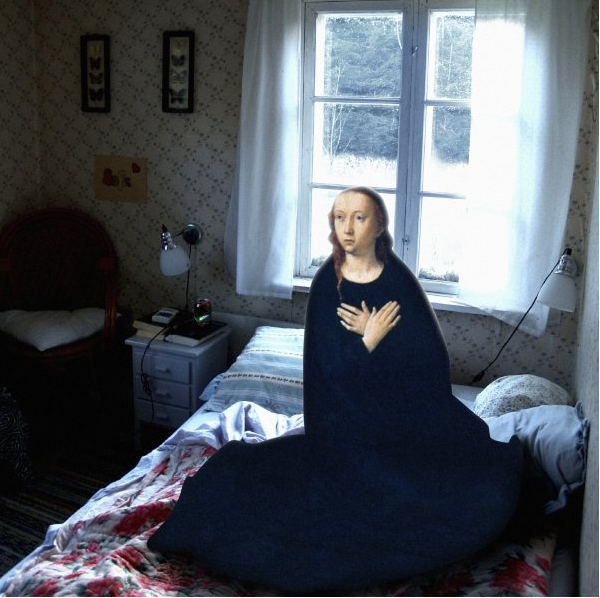
This is the spirit of Mary’s response to the message of the angel as portrayed in the third image I am sharing with you this Advent ~ Trygve Skogrand’s photo-collage, pictured above. The artist has skillfully placed a traditional painted figure onto a contemporary scene, juxtaposing an image of something old within a contemporary setting. We see a simplicity and spirit of humility in Mary’s posture, as she kneels in her plain gown. In the plain ‘bed-sit’ room in which she prays, we notice her uplifted eyes. They are now focused on the divine source of the message she is receiving.

Attentiveness is key to meaningful perception, just as we find in the Gospel reading for the third Sunday in Advent. John the Baptizer sends his disciples to Jesus with what should be our most persistent question ~ “Are you the One?” ‘Are you the One for whom we are looking, and whom we are awaiting?’ Notice Jesus’ response: “Go and tell John what you hear and see…” For they only hear and see if they are attentive. This is one reason why the Church sets aside this season of Advent ~ to encourage our attentiveness, so that we can hear and see, and then accept God’s Word to and for us.

“Let it be as God would have it.” Let things be as God wills. Let God be God! Perhaps nothing will be so hard in our lives, as to say those words in faith and in humility. Our pride objects. Our desire to be at the center of reality intrudes. But to say, “Let it be…,” in faith and in humility, is to return to the grace of the Garden of Creation. And it is also to begin to live forward into the fullness of the Kingdom, manifest in the New Jerusalem, as God will have things be.


The image above is a detail of Trygve Skogrand’s photo-collage, Bedsit Annunciation (one of my favorite artistic renderings of the Annunciation). This post is based on my homily for the Third Sunday of Advent, December 15, 2019, which can be accessed by clicking here.
Being Open to God’s Word of Hope


We may remember some pivotal moments from within the sweep of the Old Testament: God’s call to Moses from within the burning bush; God’s call to Isaiah in the Temple; and God’s later call to Jeremiah. In each of these encounters, a divine invitation accompanied by a word of hope comes to those whom God calls to be prophets. When this happens, they react in a similar way. Each of them responds with fear, just like the reaction we saw last week in Simone Martini’s Annunciation painting of Mary’s encounter with the Angel Gabriel. In these call passages, we also hear about Moses, Isaiah, and Jeremiah responding in a related way: each of them is overwhelmed by a sense of unworthiness at being called to serve the Lord. For in our hearts and our minds, we as God’s people do not always hear or receive what the Lord intends to be a word of hope as a hopeful message. And when challenged to participate in God’s ongoing mission, we fear our inadequacy in being able to respond positively.

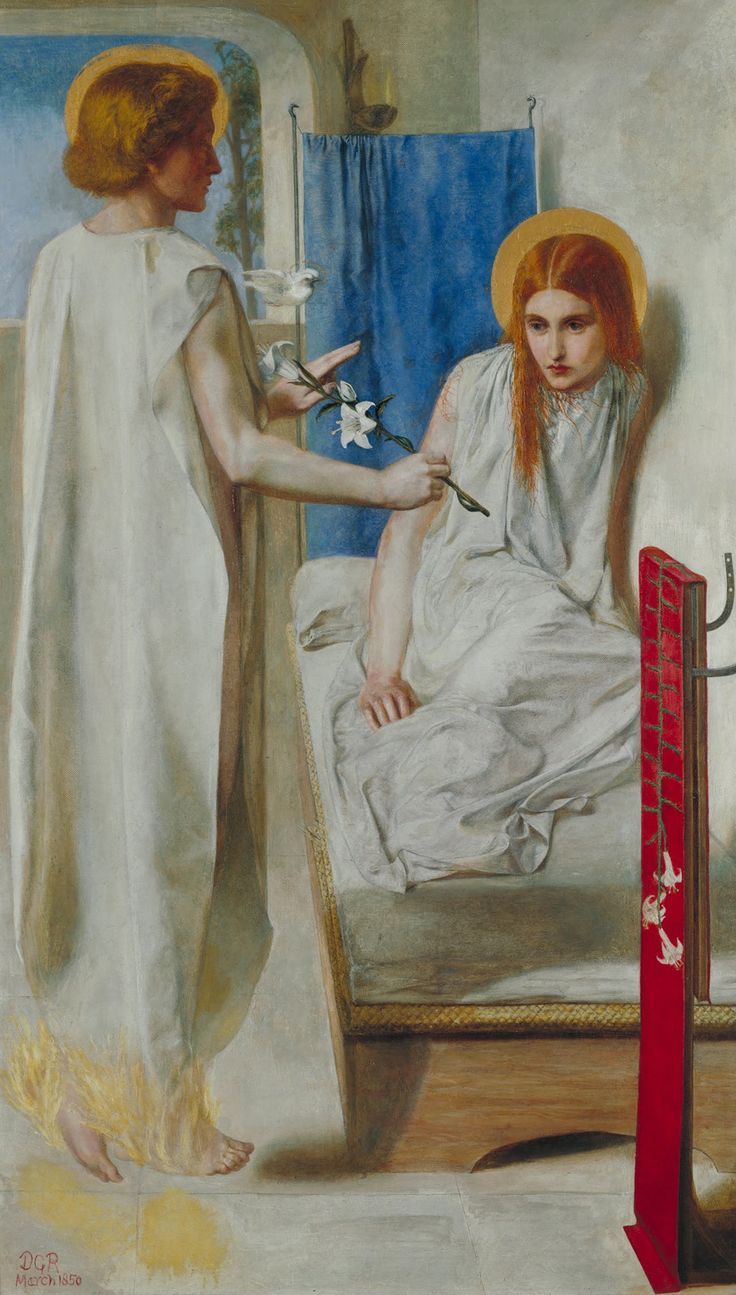
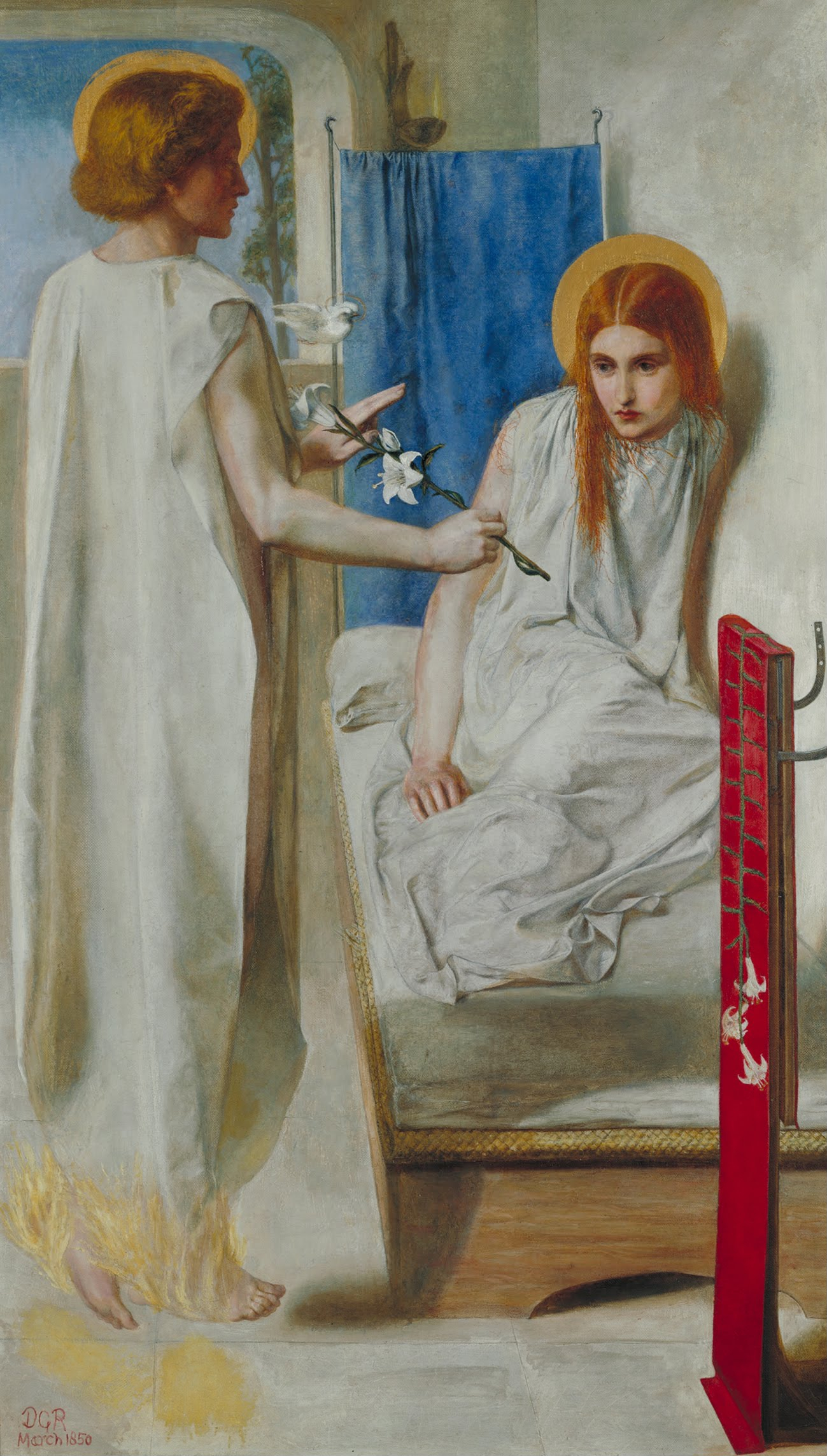
During this season of Advent I am once again reflecting on four Annunciation paintings. Here, I invite you to consider Dante Gabriel Rossetti’s depiction of the angel’s visitation to Mary, calling her to be a servant in God’s ongoing work of redemption. Observe how Rossetti portrays Mary’s response to the angel, and its contrast with Simone Martini’s painting (included below). In Martini’s Annunciation, we see an image portraying fear – Mary clutching the top of her cloak turning away from the angel and yet not able to take her eyes off the divine messenger. In Rossetti’s Annunciation (above), we see Mary looking in a different direction. Her gaze is off into the middle distance, and we can tell that she is not looking at anything in particular, ‘out there.’ Instead, she is looking within.

Here, we can make a common mistake, based on the self-absorption that is so much a part of the fallen humanity we share. For the angel’s announcement amounted to something even more dismaying than the news that Mary would bear a son as a result of this visitation rather than through the circumstances of a conventional marriage. That alone would cause confused wonder about how much this unexpected development would alter her life. But what we usually overlook is how she was being invited to become a feature in someone else’s story! As things emerged, the challenge of this momentary encounter did not so much concern how the coming of this child might alter her life, in part by diminishing her reputation. But rather, the real challenge came later as something else became clear. The coming of this child became the story for even more astonishing reasons. Mary then had to reckon with how her life and its circumstances would be significant for this child and the message of his story.

As the Annunciation helps us to perceive, when encountering the holiness, righteousness, and purity of God, we may experience not only fear about change that might lie ahead. Very likely we will also feel a sense of our own unworthiness. Perceiving the glory of God, we will become more aware of what within us falls short of God’s glory. When the Spirit invites us to experience a process of transformation back toward God’s own likeness, we are called to face and then set aside all that stands in the way of this positive change. In the Gospels we learn how God’s Word came through John the Baptizer’s ministry as a call to repent. We hear the same call to turn toward renewal in our own day. And – in the process – we learn how Mary and then the Baptizer responded. The story is not about us. It is about the Coming One.

Notice what Rossetti depicts in the angel’s hand. When inviting Mary to bear the Word of God for the sake of the world, the angel holds lilies. Lilies are a sign of the resurrection. We also see the prominent red sash that Mary may have been stitching. It bears an image of the same lilies, along with a vine that may recall the ‘Tree of Jesse’ motif (inspired by Isaiah 11). But here they are set against a red background – a sign of the passion that lies ahead. This suggests the path of suffering which the ‘Son of Man’ must walk so that we might experience the restoration and transformation of our fallen nature into his greater likeness.


 The image at the top is a detail of Dante Gabriel Rossetti’s painting, The Annunciation. This post is an adaptation of a post I first published in 2019, and is based on my homily for the second Sunday of Advent, December 8, 2019, which can be accessed by clicking here. Simone Martini’s Annunciation, referenced in the text above, is shown below.
Fearing an Unexpected Holy Invitation

Advent can be a providential season for reflecting on how the Holy Spirit invites us to go to a new place for the sake of God’s Kingdom. There is no question that this can happen at least spiritually, whether we hear the call or not. The real question, when it does happen, is how we will respond to God’s holy invitation.

This is the season when we focus especially on how God’s Kingdom enters the world in a new way. We look back to the earthly kingdom of Israel, and her difficulty fulfilling her spiritual vocation. We also look back to the promised first coming of the Messiah, who was to bring God’s Kingdom into the world with power. During Advent, we also look forward, to the Messiah’s coming again in glory. But here is a crucial fact about the first coming of the Messiah: Without Mary’s acceptance of God’s overture, there would have been no Jesus of Nazareth. In order for God’s great “YES” to us in Jesus to become manifest, Mary had to say “yes” to God.

As Luke tells the story, God’s call to Mary embodies God’s holiness and righteousness. In like manner, our encounter with God’s presence and holy invitation causes everything in us that is less than godly to undergo judgment. The bright light of God’s glory illumines all the dark corners of the world ~ and all the dark corners in our lives. The purity of God shows up all that is less than pure.

Our reaction to all this may involve at least one thing: fear! God’s call comes to us as Good News. And yet, we experience God’s call for us to become new persons, and do new things, as a fearful invitation. For me, it has involved a call to consider moving away from one beloved church and congregation to what I could only hope would be another. For both you and for me, it may be a call to go and speak to someone with whom we have a disagreement, or to reconcile with someone whom we have failed to forgive. When God calls us to new life, by inviting us to do something challenging, our first reaction is often fear. We think of all the things we are afraid might happen: like losing the security of a familiar home and community; or setting aside our own pride and sense of right; and opening ourselves in vulnerability to being hurt by another person.

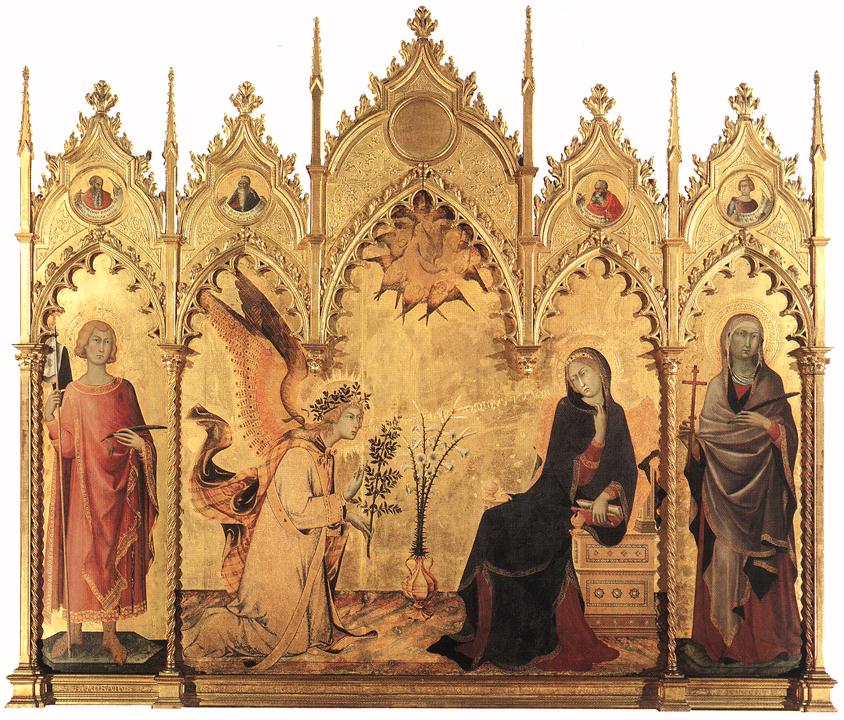
In the above detail of Simone Martini’s Annunciation, we see what may have been Mary’s first response to the presence of the holy angel. Gabriel comes to her sharing God’s good news about a child she will bear, who will bring salvation for the world. And in Martini’s image of the event, Mary draws back in fear at the message, frightened about what it might mean for her and her life. We all know the end of the story, how it all turned out for good. But in that moment, as may happen for us, God’s call surely had a frightening aspect to it. Because a change to something always means a change from something else, from where we started.

Martini’s painting reminds me of spiritual advice I received years ago ~ spiritual advice that gave me the courage to leave a tenured faculty position at one of our seminaries and return to parish ministry. The prospect of this change, for which I had a sense of call, was frightening. And the good advice I received was this: When you go toward the heart of your fear in faith, God will meet you there with power.

We know that this is what Mary did. For she moved beyond her reaction to the seeming strangeness of the angel’s greeting, not knowing what it would mean for her. She then opened herself to embrace the angel’s message and all that it would entail for her ~ and for the world.


It was my CREDO Institute team leader and colleague, (The Rev. Dr.) Bob Hansel, who offered the wonderful spiritual advice that I share above. I continue to benefit from it. The image at the top is a detail of Simone Martini’s painting, The Annunciation (a painting I have shared before). This post is adapted from one that first appeared here in 2019, and is based on my homily for the first Sunday of Advent, December 1, 2019, which can be accessed by clicking here.

Saying “Yes” to the Gift

[If reading this by email, please tap the title at the top to open your browser for the best experience.]


The spirit of attentive openness is at the heart of a third aspect of Mary’s response to God’s call through the Angel Gabriel. God’s call often challenges us to live in a different way or try and be a different person, especially in our relationships with our family, our friends, and those with whom we work. Receiving this call, we can react at first in fear at what this call might mean in practice. We can also respond with uncertainty, wondering about our worthiness or suitability for what God may have in mind for us.

But we can also see that — in faith — we are able to go into the heart of our fear and find God’s power. Receiving God’s grace, we may move beyond relying on our own strength, and not depend upon our estimate of our own abilities and worthiness for what God may have in mind. We can then choose to respond to God’s gracious invitation into the Spirit’s redeeming work, just as Mary did, by saying, “Yes!” As John Lennon so simply captured the spirit of it, in the words of his famous song, “Let it be.” Or, as Mary said to God through the angel, “Behold the handmaid of the Lord; let it be unto me according to thy Word.”

This is the spirit of Mary’s response to the message of the angel as portrayed in the fourth Annunciation image I am sharing with you in these 12 Days of Christmas, in Trygve Skogrand’s photo-collage, pictured above. The artist has skillfully juxtaposed a traditional painted figure onto a contemporary scene. We see a simplicity and spirit of humility in Mary’s posture, as she kneels in her plain gown. In the plain ‘bed-sit’ room in which she prays, we notice her uplifted eyes. They are now focused on the divine source of the message she is receiving.

Attentiveness is key to meaningful perception, just as we found recently in the Gospel reading for the third Sunday in Advent. John the Baptizer sends his disciples to Jesus with what should be our most persistent question, “Are you the One?” Are you the One for whom we are looking, and whom we are awaiting? Notice Jesus’ response: “Go and tell John what you hear and see…” For they only hear and see if they are attentive. This is one reason why the Church commends to us the season of Advent, in addition to Christmas ~ to encourage our attentiveness, so that we can hear and see, and then accept God’s Word to us.

“Let it be as God would have it.” Let things be as God wills. Let God be God! Perhaps nothing is so hard in our lives as to say those words in faith and in humility. Our pride objects! Our desire to be at the center of reality intrudes. But to say, “Let it be…,” in faith and in humility, is to return to the Garden of Creation Grace. And it is also to begin to live forward into the fullness of the Kingdom, as God would have things be, and as God will have things be..

May our Lord, who was and is, and is to come, bless us and our loved ones during this holy time.


The image above is a detail of Trygve Skogrand’s photo-collage, Bedsit Annunciation (an image I have shared before). This post is adapted from a prior post based on my homily for the Third Sunday of Advent, December 15, 2019, which can be accessed by clicking here. The Revised Common Lectionary, which provides the readings for Sundays and other Holy Days, can be accessed by clicking here.

Surprised by God

[If reading this by email, please tap the title at the top to open your browser for the best experience.]

Dante Gabriel Rossetti, Annunciation (1850)


During the remaining of these 12 Days of Christmas, I plan to share with you further images of the Annunciation to Mary, moving on from yesterday’s post featuring the theme of Holy Fear. We might refer to these as four moments of God’s decisive intervention in human history in the Incarnation of our Lord. And in each of these four moments we may find a personal connection with our own spiritual journeys, especially as Mary prefigures the church in some very significant ways.

Yesterday, we began with the unexpected moment of Mary’s encounter with the divine presence through the holy angel, and the holy fear that such a meeting might bring. Today, we consider what may often happen next, which is introspection prompted by being surprised by such an encounter.

One of the first things that strikes me about this painting by Rossetti is how Mary’s gaze is fixed on the middle distance. And this suggests that she is focussed more upon the potential significance of what she has just been told, than upon the prior object of her attention, the angelic visitor. She is now focussed on the possible meaning of the angel’s message. And so, as she abstractly looks outward, apparently not focussed on the stem of lilies held by the angel, she looks within.

Not only does she not appear to register the significance of the lilies, suggestive as we have noted both of her purity but also of the future resurrection of her son. She also seems to overlook the potential significance of the red colored, draped, fabric upon which perhaps she may have been applying needlework, placed so prominently by the artist in the foreground. Suggestive of both a priest’s or a deacon’s stole, as well as of altar fabrics, red is traditionally the color used for Holy Week as well as for saints days commemorating martyrs. And, once again, we notice the emblem of the lilies upon the needlework.

Four details briefly worth noting: the dove depicted above the angel’s left hand, symbolic of the Holy Spirit; that Mary is draped in white, in purity and resurrection motifs; the blue color of the fabric hanging behind Mary, in what is often referred to as Marian blue; and, the way that Rossetti depicts the angelic messenger hovering above the floor.

But note her gaze! I find it arresting. Especially as we consider the reality of God having come to us, to share our nature, our being, and our lives.

Holy Fear

[If reading this by email, please tap the title at the top to open your browser for the best experience.]

Simone Martini, Annunciation {detail} (1333)


It is easy at this time of the year to think of our observance of Christmas as being all about good news, the celebration of love, and “tidings of comfort and joy.” We find a caution with regard to this assumption within so many biblical texts, but especially within Matthew’s and Luke’s infancy narratives.

Consider for a moment how often the phrase, “fear not,” appears in Scripture. Encounters with the divine presence, whether directly as in Moses’ and Elijah’s experiences, or through the medium of an angelic messenger for Mary and Joseph, typically inspire fear about the prospect of coming into contact with the source of all goodness and holiness.

For me, one of the most compelling quotations from the Authorized or King James Version is that which we hear every year in the broadcast of the service of Nine Lessons and Carols from King’s College, Cambridge.

And in the sixth month the angel Gabriel was sent from God unto a city of Galilee, named Nazareth, to a virgin espoused to a man whose name was Joseph, of the house of David; and the virgin’s name was Mary. And the angel came in unto her, and said, Hail, thou that art highly favoured, the Lord is with thee: blessed art thou among women. And when she saw him, she was troubled at his saying, and cast in her mind what manner of salutation this should be. And the angel said unto her, Fear not, Mary: for thou hast found favour with God. (from Luke 1:26-35)

It is no surprise that, when she saw the angel, Mary was troubled, and wondered what form of greeting this may have been.

Simone Martini’s Annunciation altarpiece has long been one of my favorites in this genre, especially with its glorious gold-leafed background and stunningly carved woodwork. But most compelling for me is the way that God’s angel, depicted kneeling, greets Mary with the words of salutation literally cut into the surface of the painting’s wooden panel. Mary’s recoil at the encounter involves – I think – several dimensions: an innate humility along with a pious regard for the presence of divinity; an accompanying holy fear; and a natural human reticence about such an intimate encounter. Notice how she is shown pulling the collar of her cloak about her neck.

Note also how the angel bears what appears to be an olive branch of peace, and how a vase of lilies stands between them, a symbol as we have seen of both Mary’s purity and of the resurrection that will be gifted to God’s people through the Incarnation of her promised yet improbable offspring.

In considering all of the above, I encourage you to look up Exodus 24, especially verses 9-11. You may well be surprised by what you read there, an unexpected anticipation of what we celebrate at this time of year!

Martini’s complete altarpiece


If you wish to have greater access to biblical texts, and with multiple translations freely available, I recommend http://www.biblegateway.com, with which I have no professional or financial connection.

Annunciation to Mary

Luc-Olivier Merson, Annunciation (1908)


Having begun this series with a painting of the Annunciation to Joseph by Alexander Ivanov, and having featured Luc-Olivier Merson’s painting of the Flight into Egypt, I would like to offer Merson’s less-well known but equally memorable depiction of the Annunciation to Mary.

Unlike many Annunciation paintings, Merson does not focus on the encounter between two personal beings. His Annunciation is not colored by the dynamics of male-female interaction, a theme that so absorbs our present culture, and implicit in some historical treatments of the moment. Here we have a feminine or an androgynous angel, who instead of being face-to-face with Mary, hovers above another building.

I think Merson depicts the moment just after the angel shares the news with Mary, and before she sings her magnificat. Mary is wrapped in white, suggesting her purity, but also prefiguring the burial shrouds with which her son will be wrapped. Her gaze is focused on the unlikely stem of lilies she finds on the ground, outside a dark open doorway through which she emerges. Both symbolize resurrection. Doves grace the air in the foreground, a traditional way to suggest the presence and activity of the Holy Spirit.

Rather than gesturing toward Mary, the angel points to the heavens! Here we find a spiritual sign in accord with the Gospel. It depicts a call. The scene symbolizes what God is doing, and what God wants to accomplish.

May our Lord, who was and is, and is to come, bless us and our loved ones during this holy time.


For a more extended reflection on Merson’s Annunciation painting, some comparison with the rather different Annunciation image on the Santana Abraxas album cover, and in relation to the Gospel for the 4th Sunday of Advent, click this link: Advent 4 B 14 copy_for 2022 blog_PDF

[If reading this by email, please tap the title at the top to open your browser for the best experience.]

Acceptance with Joy


“Look,” says the prophet, “the young woman is with child and shall bear a son, and shall name him Immanuel. He shall eat curds and honey by the time he knows how to refuse the evil and choose the good.” What a strange promise! How could the birth of a child be a gift for a troubled world?

This is the kind of promise that Mary received from the Angel Gabriel. And it is the kind of promise that every one of us receives when we are called to acknowledge and accept that same gift. During this Advent season we have reflected on how there are a number of aspects of our response to God’s call, and to the promise of God’s gift to us.

Fear can often be our first reaction, followed then by wonder and uncertainty about the fit between God’s promise and our own suitability for receiving it. By attentiveness to God’s Grace, our uncertainty can be transformed into a humility ~ a humility that is willing to accept the Word of Promise and the Call to receive it. And if we come that far, if we are willing to believe and remain attentive, we may experience a wonderful moment. It is in Mary’s fourth response to God’s Word of Call. It is quite simply, Joy! There is no other word for it. Both Mary and Joseph, each in their own way, accept the unlikely and unexpected word of promise. And by accepting and receiving God’s will for what it is, they find joy.

Over the course of this Advent, I have shared with you four images of the Annunciation to Mary of the promised gift of a child ~ a child who would be God with us. In the image above, El Greco beautifully captures the sublime quality of the moment. Having accepted God’s Word in humility, Mary’s eyes and her whole being are uplifted up to receive the message. Her up-turned hand says it all! The gilded and hovering angel points upward, in the direction where all this is supposed to go, to the realm of Spirit. This is where the Lord will ascend through his Resurrection, taking us and our humanity with him into the very being of God.

Joy may not be the defining feature of our lives today. Yet, we can find the fullness of joy in the gift we celebrate this week. For we receive a gift whose meaning and value we can never fully anticipate in advance.

To this gift, Mary says “Yes!” And, with her, we can say, “yes,” as well. Yes to God’s Word that comes to us as both promise and call – a promise that he will be with us always, as we accept him for who He really is. And, a call for us to become new persons in him. For in him we find a spiritual maturity that this world can never give.

In raising our hearts in assent to God’s promises, and by receiving God’s call to be transformed by the Spirit, we grow. We grow into that quiet joy which was Mary’s, instilled by the Angel’s visit. Behold – a virgin has conceived, and has borne a Son, and we call his name Immanuel – for God is with us!


The image above is of El Greco’s Annunciation (1600). This post is based on my homily for the Fourth Sunday of Advent, December 22, 2019, which can be accessed by clicking hereOther homilies of mine may be accessed by clicking here. The Revised Common Lectionary, which provides the readings for Sundays and other Holy Days, can be accessed by clicking here.
Attentive Openness


The spirit of attentive openness is at the heart of the third aspect of Mary’s response to God’s call through the Angel Gabriel. God’s call often challenges us to live in a different way; or try and be a different person, especially in our relationships with our family, our friends and those with whom we work. Receiving this call, we can react at first in fear at what this call will mean in practice. We can also respond with uncertainty, wondering about our worthiness or suitability for what God may have in mind for us.

But we can also see that —in faith— we are able to go into the heart of our fear, and find God’s power. Receiving God’s grace, we may move beyond relying on our own strength, and not depend upon our estimate of our own abilities and worthiness for what God may have in mind. And we can choose to respond to God’s gracious invitation into the Spirit’s redeeming work, just as Mary did, by saying, “Yes!” As John Lennon so simply captured the spirit of it, in the words of his famous song, “Let it be!” As Mary said to God through the Angel, “Behold the handmaid of the Lord; let it be unto me according to thy Word.”

This is the spirit of Mary’s response to the message of the angel as portrayed in the third image I am sharing with you this Advent ~ Trygve Skogrand’s photo-collage, pictured above. The artist has skillfully juxtaposed a traditional painted figure onto a contemporary scene. We see a simplicity and spirit of humility in Mary’s posture, as she kneels in her plain gown. In the plain ‘bed-sit’ room in which she prays, we notice her uplifted eyes. They are now focused on the divine source of the message she is receiving.

Attentiveness is key to meaningful perception, just as we find in the Gospel reading for the third Sunday in Advent. John sends his disciples to Jesus with what should be our most persistent question ~ “are you the One?” ‘Are you the One for whom we are looking, and whom we are awaiting?’ Notice Jesus’ response: “Go and tell John what you hear and see…” For they only hear and see if they are attentive. This is one reason why the Church sets aside this season of Advent ~ to encourage our attentiveness, so that we can hear and see, and then accept God’s Word to us.

“Let it be as God would have it.” Let things be as God wills. Let God be God! Perhaps nothing will be so hard in our lives, as to say those words in faith and in humility. Our pride objects! Our desire to be at the center of reality intrudes. But to say, “Let it be…,” in faith and in humility, is to return to the Garden of Creation Grace. And it is also to begin to live forward into the fullness of the Kingdom, as God would have things be.


The image above is a detail of Trygve Skogrand’s photo-collage, Bedsit Annunciation (an image I have shared before). This post is based on my homily for the Third Sunday of Advent, December 15, 2019, which can be accessed by clicking hereOther homilies of mine may be accessed by clicking here. The Revised Common Lectionary, which provides the readings for Sundays and other Holy Days, can be accessed by clicking here.

God’s Word of Hope


Remember God’s call to Moses, through the burning bush. Remember God’s call to Isaiah in the Temple. And remember God’s call to Jeremiah. In each of these encounters, when a divine invitation and word of hope comes to those who would become prophets, they react in a similar way. Each of them responds with fear, just like the reaction we see in Simone Martini’s Annunciation painting of Mary’s encounter with the Angel Gabriel (featured in my prior blog post). Yet, in these call passages we see Moses, Isaiah and Jeremiah respond in a second way: each of them is overwhelmed by a sense of unworthiness at being called to serve the Lord. For in our hearts and our minds, we as God’s people do not always hear or receive what the Lord intends to be a word of hope as a hopeful message.

During this season of Advent I am once again reflecting on four Annunciation paintings. Here, I invite you to consider Dante Gabriel Rossetti’s depiction of the angel’s visitation to Mary, calling her to be a servant in God’s ongoing work of redemption. Observe Mary’s response to the angel and its contrast with Simone Martini’s painting (featured in my prior posting). In Martini’s Annunciation, we see an image portraying fear – Mary clutching the top of her cloak turning away from the angel and yet not able to take her eyes off the divine messenger. In Rossetti’s Annunciation (above), we see Mary looking in a different direction. Her gaze is off into the middle distance, and we can tell that she is not looking at anything in particular, ‘out there.’ Instead, she is looking within.

When encountering the holiness, righteous and purity of God, we may experience not only fear about change that might lie ahead. Very likely we will also feel a sense of our own unworthiness. Sensing the glory of God, we will become more aware of what fall’s short of God’s glory within us. When the Spirit invites us to experience transformation back into God’s own likeness, we are called to face and then set aside all that stands in the way of this positive change. In the Gospels we learn how God’s Word came through John the Baptizer’s ministry as a call to repent. We hear the same call to turn toward renewal in our own day.

Notice what we see in the angel’s hand. When inviting Mary to bear the Word of God for the sake of the world, the angel holds lilies. Lilies are a sign of the resurrection. We also see the prominent red sash that Mary may have been stitching. It bears an image of the same lilies, along with a vine that may recall the ‘Tree of Jesse’ motif (inspired by Isaiah 11). But here they are set against a red background – a sign of the passion that lies ahead. This suggests the path of suffering which the ‘Son of Man’ must walk so that we might experience the restoration and transformation of our fallen nature in his likeness.


The image above is a detail of Dante Gabriel Rossetti’s painting, The Annunciation (a painting I have shared before). This post is based on my homily for the second Sunday of Advent, December 8, 2019, which can be accessed by clicking hereOther homilies of mine may be accessed by clicking here. The Revised Common Lectionary, which provides the readings for Sundays and other Holy Days, can be accessed by clicking here.