Worship

Lo! He Comes with Clouds Descending (The Beauty of His Return)

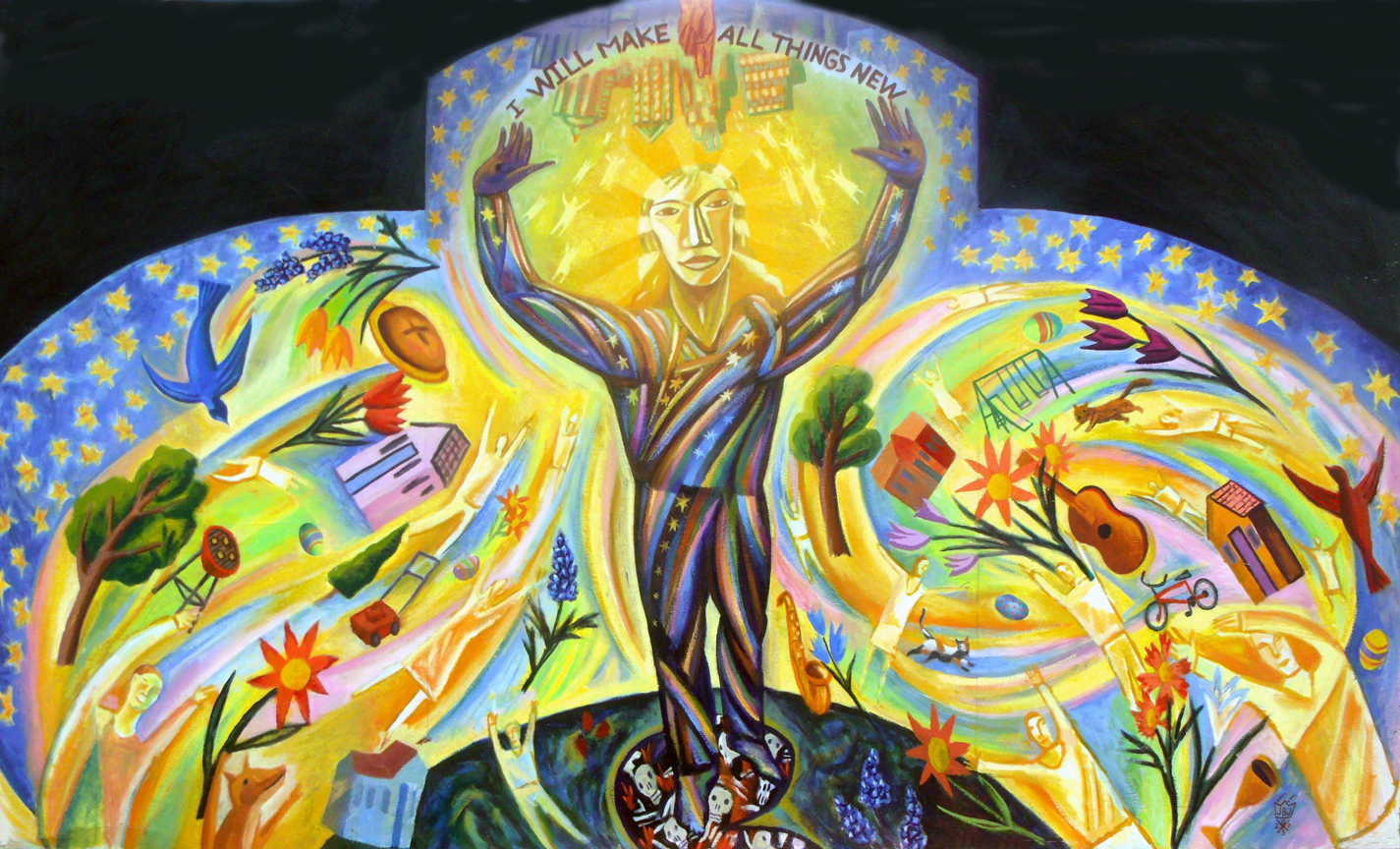
Jim Janknegt: I will make all things new (2005)


The title of this post comes from Charles Wesley’s hymn-text adaptation of words from Revelation that refer to the Second Coming of Christ in glory: “Behold, he is coming with the clouds, and every eye will see him, even those who pierced him, and all tribes of the earth will wail on account of him” (Rev 1:7). In this first week of Advent, and perhaps having sung Wesley’s hymn on Sunday, we need to explore what this ‘wailing’ may involve.

Many people today regard the Second Coming as something prompting fear about a Final Judgment. This may be one cause for the wailing that Wesley anticipates. Though texts in Revelation, as well as in the Gospels, certainly involve this theme, Revelation’s author is also very clear in expressing a faith that Christ’s return will involve restoration, the fulfillment of promises, and the beauty of shared glory. Hence, the wailing may also reflect holy sorrow stemming from a deepened awareness of personal sin, accompanied by ‘tears of joy’ over being forgiven.

Wesley’s verse 2 of his hymn predicts the first dimension of wailing: “Every eye shall now behold him, robed in dreadful majesty; those who set at nought and sold him, pierced, and nailed him to the tree, deeply wailing, … shall the true Messiah see.” Verse 3 describes the second dimension: “Those dear tokens of his passion still his dazzling body bears, cause of endless exultation to his ransomed worshipers; with what rapture, … gaze we on those glorious scars!”

Words in Revelation, preceding and following its prediction about how “all tribes of the earth will wail,” provide a foundation for hope. The author says at the beginning of this last book of the Bible (1:4-5), “Grace to you and peace from him who is and who was and who is to come, and from … Jesus Christ the faithful witness, the firstborn of the dead…” And then (in 1:8) we find, “‘I am the Alpha and the Omega,’ says the Lord God, ‘who is and who was and who is to come…’”

These words are echoed near the end of Revelation, where we find a description of the New Jerusalem and a renewed Creation. Among them are these: “And he who was seated on the throne said, ‘Behold, I am making all things new'” (21:5).

Jim Jaknegt’s painting, I will make all things new, expressively captures the positive dimension of these themes and the ground for hope that lies in the beauty of the Lord’s return. All things! That is a phrase worth exploring in terms of quite a number of biblical texts, especially Paul’s letter to the Colossians.

In the first chapter, Paul writes, “For by him all things were created, in heaven and on earth, visible and invisible, whether thrones or dominions or rulers or authorities—all things were created through him and for him. And he is before all things, and in him all things hold together” (1:16-17). Paul then indicates (1:19-20) the ground for hope regarding “all things,” which Janknect suggestively depicts: “For in him all the fullness of God was pleased to dwell, and through him to reconcile to himself all things, whether on earth or in heaven…”  God’s ultimate goal in all this is reconciliation rather than condemnation, even though people who dismiss God’s ongoing work of reconciliation may find themselves brought to sadness.

Notice the pronounced swirling motion in Janknegt’s painting, as all things are caught up into the returned Lord’s orbit. But all people? For unlike flora and fauna, as well as inanimate objects, human beings made in God’s image and likeness possess the freedom of will either to accept or to refuse God’s initiatives to reconcile us into divine intimacy. This is why there may be at least two dimensions to the wailing that the Lord’s return is likely to initiate. For grief over sin may bear fruit in repentance.

We should therefore note the words of invitation at the end of Revelation: “‘Surely I am coming soon.’ Amen. Come, Lord Jesus!” (Rev 22:20)


Jim Janknegt is a painter who is based in the Austin, Texas, area, who has produced a remarkably large body of work based on biblical themes and imagery. The website featuring his work can be found at http://bcartfarm.com/ I have admired, and with his permission have featured, his images for many years. Lo! He comes with clouds descending appears as Hymn 57 in The Episcopal Church’s The Hymnal 1982.


Being Within God’s Loving Regard


Today, Nov. 2, is commemorated by many as All Soul’s Day, or All Faithful Departed. I am reminded of how some years ago a friend suggested that I watch the Disney Pixar film, Coco. He commended it because the movie connects directly with the celebration of the great feast of All Saints on Nov. 1. Coco also bears upon our observance of All Soul’s Day and All Hallow’s Eve (or Halloween). The movie is set in a traditional Mexican village on the eve of All Saints. In Latin America, and especially in Mexican culture, this feast is traditionally called Día de Muertos, or the Day of the Dead. At the heart of the film and at the center of All Saints is a reality, the reality – through Baptism – of our continuing fellowship and communion with those who have died and gone before us. This is why, in the revised Lectionary, the Scripture readings for All Saints are among those also designated for funerals.

Coco draws us into recognizing how myths, whether ancient or modern, powerfully present truths we already know. We find this, of course, in the opening chapters of Genesis. But we also find how myths play a role in our secular culture. We are enchanted by narrative, and charmed by stunning visual imagery. And we are touched when we are reminded by how family and community relationships shape us. Yet, to refer to biblical and other stories as involving myth, we need to be very clear that the power of myth depends upon the power of truth. {In effect, not all myths are ‘real;’ not all news conveys ‘truth‘}. And so, because human connections are real in our life experience, we are moved by representations of them in ancient Scriptures, as well as in modern literature and the visual arts. What is true, has always been true.

And what surely has always been true for the peoples of the world is this: we do not want to be alone. We do not want to be separated from our families and our friends. And if either family or friends, or both, have been hurtful to us, we still yearn for ideal examples of them —especially when hopeful images of these relationships give us strength to hold our current experience to account.

So, if we don’t want to be separated from our families and friends, we also yearn for a connection with our heritage. We value the history of our family and our many forebears, as well as of our communities. Coco, the movie, plays upon this wonderful aspect of our human experience.

And yet, while commending Coco, I do not think we should accept uncritically every aspect of this delightful film’s story. For Coco contains a notable divergence from traditional Judaism and Christianity. The movie portrays —as being central to the observance of the Day of the Dead— a particular belief. It is this ~ that, if we are not remembered by others, we cease to exist. Yet, as faithful Christians and Jews believe, we are always known and remembered by God, even if our family or our community forgets us! Even if we cease to exist for them, we never cease to exist in God’s loving regard for us.

This day, All Souls or All Faithful Departed, is particularly focused on the idea that, even if we should be forgotten by others, we are never forgotten by God.


An earlier form of this post was first published in November, 2018. The image above was an image found on the internet related to promotion of the movie, Coco.

The Truth Within Beauty


There is something remarkable about traditional English and Anglican choral music. We hear it in the sustained notes sung without vibrato, and the full throated melodical willingness almost to shout out the most stirring words in beloved anthems.

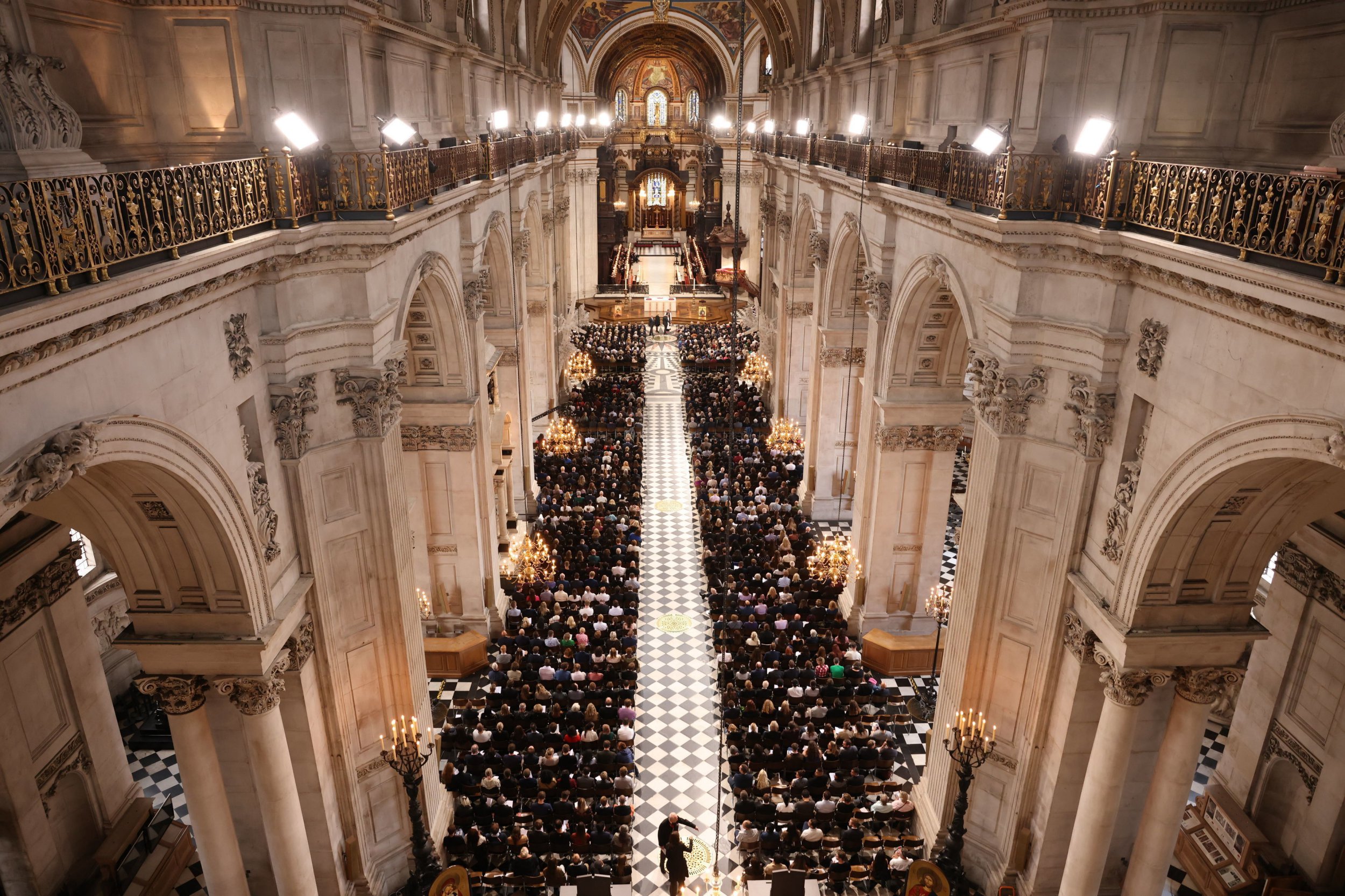
For me, this was most movingly displayed in the recent Service of Prayer and Reflection on the Queen’s Life, broadcast from St Paul’s Cathedral, London, following the televised address by the new King Charles.

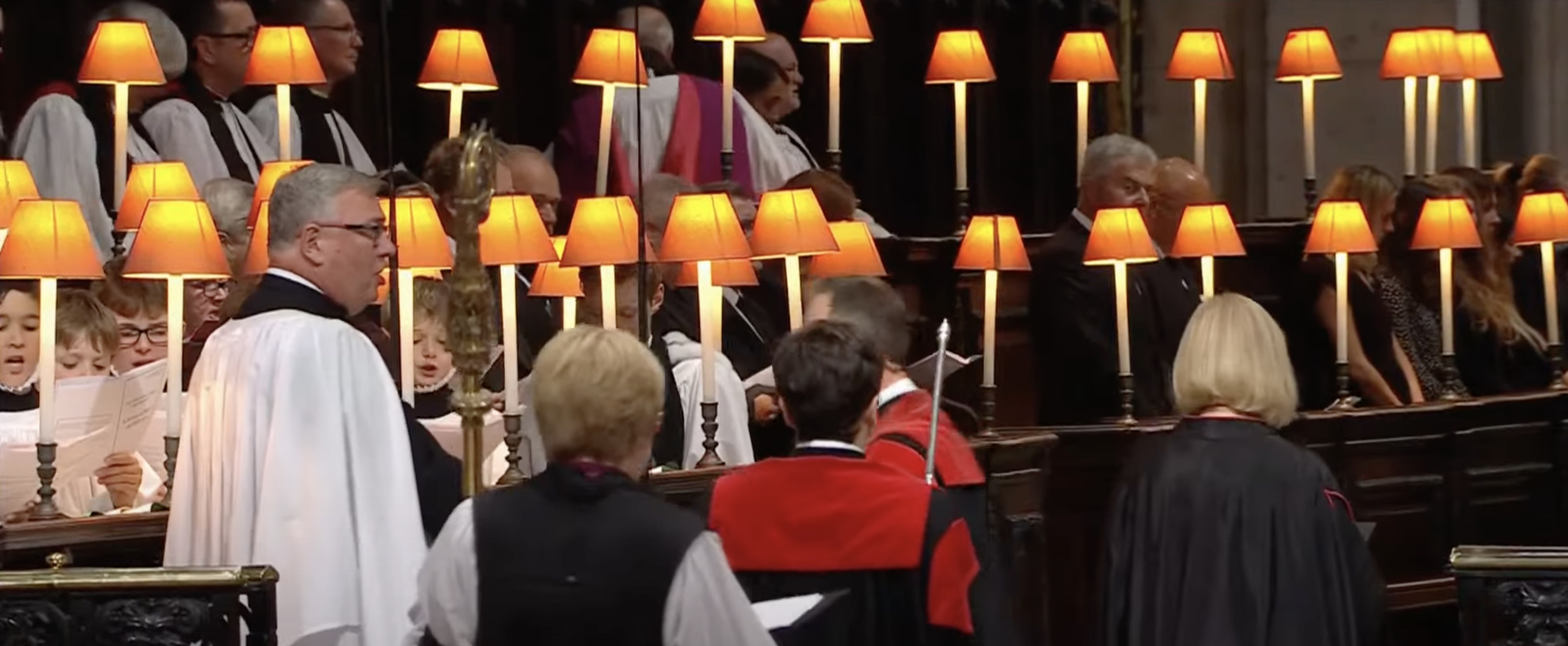
The beautifully lyrical Herbert Howells tune, Michael, set for the processional hymn, was a most appropriate way to begin this liturgy remembering Elizabeth. Especially with its text, so meaningful for the occasion (“All my hope on God is founded…”). And then, to my further wonder, the first anthem was also a stirring setting by Howells, and sung in the most inspiring way by the cathedral choristers.

Having lived almost six years in England, all of it at Oxford, with the opportunity to hear Evensong sung by equally gifted choirs on a daily basis during term, has surely disposed me to a particular bias. English Anglicans can do liturgy and ceremony in the most superior and yet also spiritually evocative way, especially when it is non-politicized. We have much to learn from them on this side of ‘the pond.’

Perhaps it is first a willingness – by some of the most reticent people I have lived and worked with – to reach for and grasp at transcendence. And then, to express that desire and its fulfillment in worship, in a way that is so compelling for many. Witness two thousand seats filled on short notice in a first come, first served way for the Prayer and Reflection service for Queen Elizabeth. Many of those among the congregation appeared moved by the experience though it was also apparent that not all were familiar with Anglican hymns or forms of worship.

I would suggest that it was, and will remain, in large part the capacity of music – and music well-composed and well-prepared – which draws people into the power of beauty, and which also creates experiences of transcendence and of truth. Yet it is also the power of the word, both in the form of the words of the liturgies as well as in the Word as presented in Scripture. Well-chosen and well-presented biblical and liturgical texts, as well as those prepared for proclamation, allow people unfamiliar with the Christian faith and its customary practices to find themselves stirred. For this preparation and these practices invite others to be curious about the transcendent motivation behind and accounting for these remarkable occasions of public worship.

I have no doubt that the Queen’s upcoming funeral will provide no less of such an experience.


The above photos are screen captures of images from the UK’s Sky News streaming rebroadcast of the Service of Prayer and Reflection on the Queen’s Life, from St. Paul’s Cathedral, London (https://www.youtube.com/watch?v=KgOridFp7Do). Here is a link to the full text of that service (C ofE_Anglican_service_of_prayer_and_reflection_1)

I offer this with grateful thanks for the music ministry of John Hamersma, Mary Hamersma Baas, and Benita Woltersdorf-Fredlund, whose ministries have not only enriched my life and those of many others, but also have changed and affirmed our lives forward in a most positive way.

The Beauty of Kingdom Potential


What has Jim Janknegt depicted with his painting? Right away, we can see that he portrays the Kingdom mustard seed parable in Mark’s Gospel. With his focus on this parable, we should remember that the Gospels include two kinds of mustard seed teaching. One is in Jesus’ parable ~ about the huge potential of what God can do with apparently small bits of the Kingdom. Jesus’ other teaching is about the tremendous potential of what we might accomplish through personal believing, especially given how personal faith can otherwise be deficient or defective.

To help recognize this difference, between Jesus’ Kingdom parable and his other teaching referring to the size of our personal believing, consider what we see in Janknegt’s painting. In the foreground we see things we usually think of as being big ~ like big cities, their large buildings and the businesses they house. Dwarfing them is a great tree, which may represent the ‘Tree of Life.’ Like the small mustard seed, the great tree that it becomes represents what the Spirit is doing with God’s Kingdom.

Notice the community for which the great tree provides a place of habitation ~ a community characterized by many birds, including both a beautiful peacock and a spoonbill, an owl and a descending dove. In traditional mythology, birds represent communication between the realm of the sky and the realm of the land, or between the heavenly sphere and that of the earth. The Tree of Life provides a context for this communication, and for the Kingdom community that God’s Spirit nurtures between the two.

If we ever worry or despair about the smallness of our faith, we should remember Jesus’ emphasis upon the huge potential of God’s Kingdom power. The seed of this Kingdom potential is planted within us at our Baptism.


This post is based on my homily for Sunday, June 17, 2018. Jim Janknegt’s painting, Worlds Smallest Seed, is used here with his permission. {Editorial note: I preached on this Gospel reading, and referenced Janknegt’s evocative painting again on Sunday, Jun 16, 2024. Here is a link to my reflections on the same Gospel reading.}