Stained Glass

A Church by Errol Barron in Gulfport

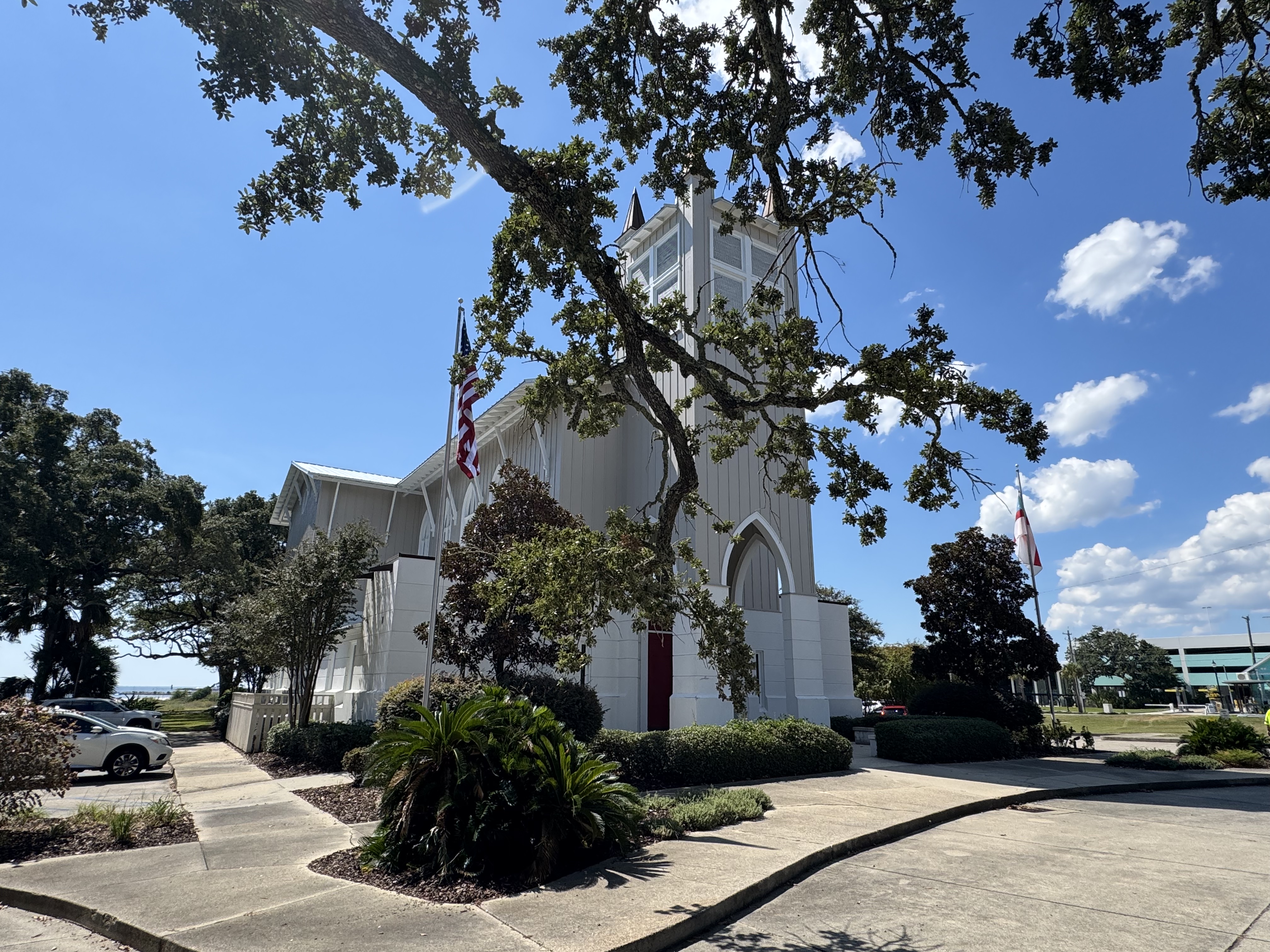
St Peter’s by the Sea, Gulfport, MS, designed by Errol Barron

Errol Barron’s work as an artist may be familiar to readers of this website based on some of his evocative New Orleans water color paintings previously featured here. His paintings of that city as well as of Tulane University, where he has taught for many years, provide strong indications that he is more than a skilled painter and draftsman, but also a trained architect. He has taught generations of architectural students at Tulane, and he has practiced his profession to great effect not only in this region but also overseas, with some houses of his located in Greece. Given Barron’s evident sensitivity to historical architecture and design features characteristic of this region, I was surprised to learn about a notable but unexpected feature of his resume. He worked for seven years with Paul Rudolph, architect of the well-known and oft-criticized Boston Government Services Center and a partial inspiration for the movie, The Brutalist.

St Peter’s by the Sea, interior

I was recently delighted to discover the Episcopal church in Gulfport, Mississippi, St. Peter’s by the Sea, and that Errol Barron was its architect. It is a gem of a church, and a very successful design that incorporates traditional ecclesiastical elements associated with European Gothic churches along with features reflecting contemporary liturgical renewal. I have heard people refer to this style of church building as Carpenter Gothic, and as Southern Gothic, and the labels seem to fit well. The worship space exudes an appreciation for traditional forms while harmoniously blending them with a contemporary focus upon light, color, and the greater participation of worshippers in flowing open spaces.

The main altar with the ornamental rood screen

Visitors to the Washington National Cathedral, and similar churches of Gothic-revival style, may recognize the particular heritage that stands behind the floor plan of St Peter by the Sea. At the National Cathedral, and in its medieval forebears (such as London’s Westminster Abbey), an arched stone ‘rood screen’ separates the chancel and choir (beyond the screen) from the nave where the congregation is seated. When, in the 1960’s, the liturgical renewal movement began to influence changes in the worship arrangements of these buildings, a new main altar was often then placed in the nave, on the congregation’s side of the rood screen. Smaller gatherings for weekday services could still occur in the choir side of that screen, while Sunday gatherings for the principal Eucharist would be celebrated in the nave, with the clergy, altar, and liturgical action proximate and visible to the congregation.

A view of the ceiling and woodwork above the choir

Though St Peter’s by the Sea is a comparatively recent building, its design reflects something of the historical sequence described above. Instead of an imposing stone rood screen, shielding the chancel and choir spaces beyond, Barron has designed an ornamental arched screen of light-colored wood that suggests rather than imposes separate areas within the overall space. This allows the evocative blue canopy of the ceiling over the chancel to draw one’s eyes forward, toward the visible clear windows at the liturgical ‘east end’ of that space behind the chapel altar, facing the seashore.

Further, the notably narrow, even sharp-looking, wooden ‘spires’ protruding above where the choir chairs are placed enhance the upward sense of lift in the nave, complemented by the radiant cream and white color scheme above where the congregation sits. Light pours in through clear windows above, while delicately fashioned and dangling wrought iron fixtures provide supplemental illumination for evening services and in poor weather.
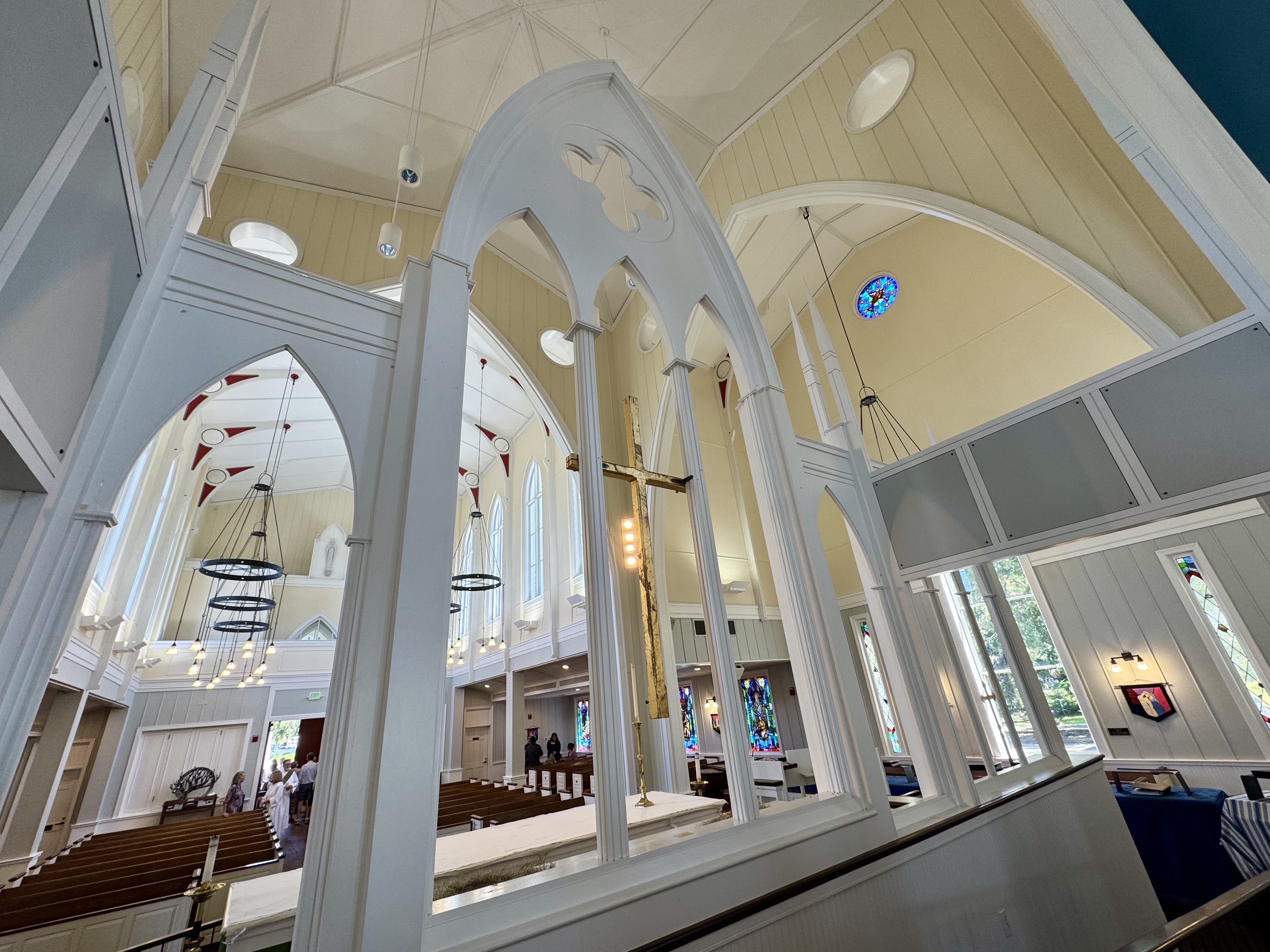
A view toward the nave from the choir, through the rood screen

On the Sunday of my recent visit, I was told that the congregation numbered about 145, and I estimate that the nave would comfortably seat about 200 people, though it could probably accommodate more. With the Gothic-inspired longitudinal floorplan, evident when one approaches the exterior of the building, a visitor might expect a rather narrow and linear worship space. Such an initial impression of the likely effect of the interior spatial arrangement is overcome by a number of subtle but effective design choices made by the architect and those who worked with him.

Accompanying the verticality of the large open area above the center of the nave are the seating areas adjoining the side aisles, taking the places of side chapels found in many medieval Gothic churches. The relatively low height of the box pews enhances the sense of horizontal width created by these adjacent seating areas, which provide relatively unobstructed views of the altar and lecterns. I also found the acoustics within the worship space to be well-suited for music as well as for public reading and speaking.

I am drawn to the ethos of historical churches; I am enthused by many examples of modern architecture; and I appreciate the fruits of the liturgical renewal movement. In my experience, a successful blend of these three things is not always found in contemporary buildings designed for worship and intended for the enhancement of congregational life. In his design for St. Peter’s by the Sea, in Gulfport, Mississippi, and in his supervision of its restoration after Hurricane Katrina, Errol Barron has achieved just such of a desirable synthesis.
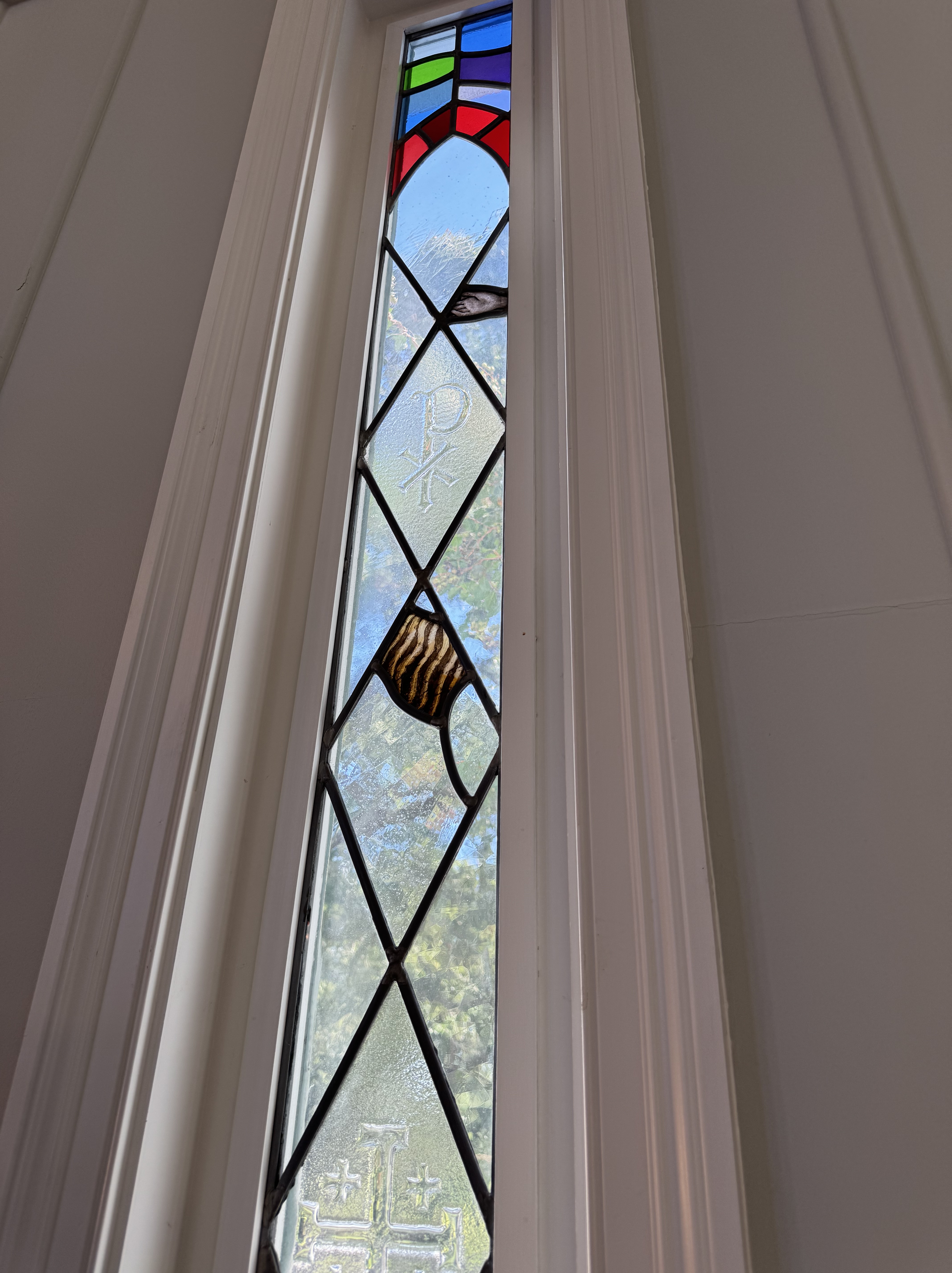
A representative side window incorporating stained glass window fragments recovered after Hurricane Katrina

Comfort Ye My People

[If reading this by email, please tap the title at the top to open your browser for the best experience. Then, clicking individual pictures will reveal higher resolution images.

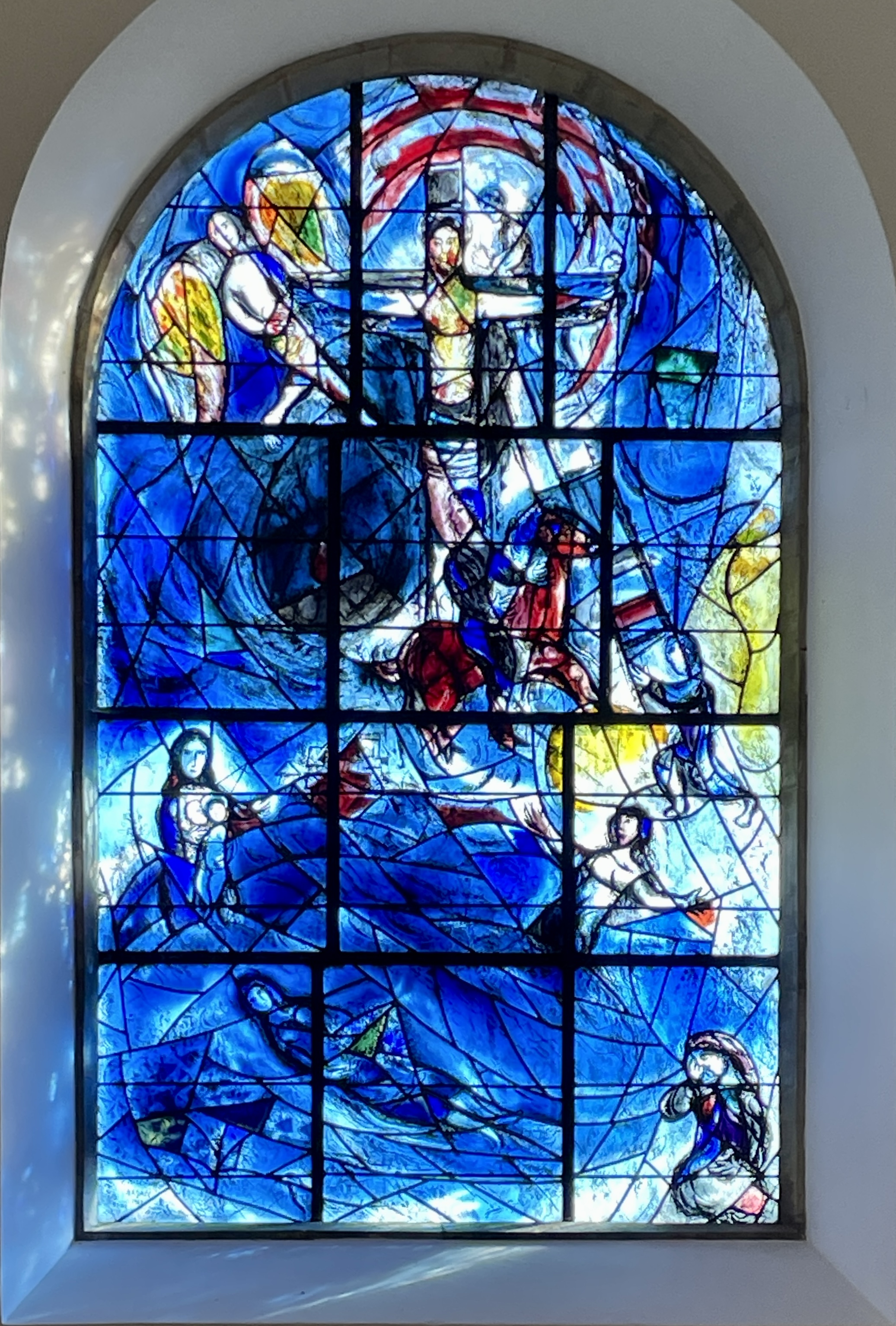
Marc Chagall, Memorial Window, All Saints Church, Tudeley, Tonbridge, UK


As a priest and from recent personal experience, I know how these weeks are a tender time for many of us. Especially for those who have lost loved ones at this time of year. Finding consolation and hope after losing the tangible nearness of a beloved family member or friend is hard at any time. Faced with such a loss or its memory around Christmas, how do we find comfort and reassurance in this season? Are “the hopes and fears of all the years” really met in Him, even now?

I find help with questions like these in what may seem an unlikely place: a beautiful window by an artist whose upbringing was shaped by Hasidic Judaism, placed over the altar of an Anglican church (shown above). It was designed by Marc Chagall for All Saints Church, Tudeley, in England.

Chagall was commissioned by a grieving couple to design this window as a memorial for their adult daughter who drowned in the sea. She is portrayed below the waves in the lower portion of the window, with what appears to be her grieving mother near her feet. We find here an unexpected coupling of images that frequently appear in Chagall’s work. Seeing his depiction of a crucified man juxtaposed with that of a mother and child surprises many Christians when they learn of Chagall’s Judaism.

The imagery in Chagall’s window may seem like an unusual choice for this holiday time. Yet, it fits. Though he often painted crucifixion images in his work, the artist had in mind the suffering of Jews through the centuries, and especially in his own time. In a similar way, he thought the portrayal of a mother and child, so familiar in Christian iconography, was a universal image within human experience. Chagall believed that the Christian conscience could be touched by familiar images from the Gospels, but which were also deeply resonant for Jews based on Hebrew Bible antecedents.

This is why I think that Chagall’s art might speak to us in this season. After all, the one whose birth we celebrate at this troubled time in the world awakens hope in us, hope for new life through the renewal of our shared humanity. Our Christmas hymns touch upon this theme. And, of course, the child born to Mary and Joseph was destined – as was prophesied – for the fall and rise of many (Luke 2:33-35).

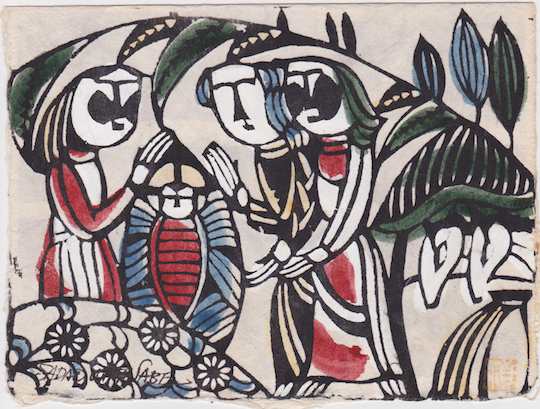
Christian artists through the centuries have been captivated by many aspects of our Lord’s Nativity. Countless examples of their work have sought to express our impression of the circumstances of Jesus’ birth, and its significance for the world, not just for his immediate family. It is noteworthy how often depictions of the Annunciation, and of the Nativity contain noticeable hints of his later saving death, and resurrection. The inclusion of discernible palm fronds, passion flowers and of lilies in these works provide common examples of these visual hints of a veiled significance yet to be revealed.

Sadao Watanabe, Nativity Christmas card, with palms, lilies, and passion flowers

Both literally and conceptually, what we celebrate at Christmas is easier to ‘grasp’ than what we celebrate at Easter. We are more prepared for the presence of the Word made flesh in a manger than we are for the absence of the Word, said to be risen and ascended from an empty tomb. The comforting appeal of the Virgin Mary holding her newborn son in a stable contrasts with the mystery of another Mary later reaching out to try and hold the risen Jesus in a garden.

This Holy Child brought us the possibility of new life by overcoming the power of death. We celebrate his birth precisely because his death and resurrection provide the pathway to our own new birth. He was born and died as one of us. And so, in him, we die and rise again to the new life he shares with the world.

Mild he lays his glory by,
born that we no more may die,
born to raise us from the earth,
born to give us second birth.
Risen with healing in his wings,
Light and life to all he brings,
hail, the Sun of Righteousness!
hail, the heaven-born Prince of Peace!

Hark! the herald angels sing,
glory to the newborn King!


The hymn text is by Charles Wesley (Hark! the herald angels sing, verse 3).

The Beauty of a Promise

Charles Blakeman’s portrayal of Isaiah and King Ahaz


In one of the oldest churches in London, St. Etheldreda’s, we find a series of evocative stained glass windows by Charles Blakeman, modern but medieval in style. The window shown above depicts the prophet Isaiah’s encounter with King Ahaz (Isaiah, Chapter 7), which contains a quote from Isaiah’s prediction of a promised child, a prediction fulfilled in Matthew’s Gospel (Chapter 1.)

This window portrays persons from very different times and places, side by side in the same scene. The prophet Isaiah, in gold, stands alongside King Ahaz, robed in royal purple. Both look ahead – literally and figuratively – to a later realization of Isaiah’s promise. That moment of realization occurred about seven hundred years later when an angel appeared to Joseph in a dream. And standing with, but behind, Isaiah and Ahaz, we see the boy David, who lived three hundred years before Ahaz. For David was a common ancestor both to the wicked King Ahaz, and to the later righteous King Jesus.

Freed from the constraints of geographical space and linear time, Charles Blakeman has portrayed the content of a vision. It is a spiritual perception not bound by our usual orientation toward objective data and factual information. The prophet and the king, if they are open to it, can apprehend the vision pictured in black and white, a revealed sign of something real, but not yet seen by human eyes.

There are fewer visionaries and seers in our world today, and this is no accident. We are overwhelmed by competing and high-quality visual images on electronic screens everywhere around us. And I value some of them like many others do. But they can lead us to be blind, blind to the important connection between what we see and what is yet unseen. By not appreciating the power of signs and dreams, we are not likely to look beyond what is literally ‘at hand.’

The Collect or focussing prayer for this past 4th Sunday of Advent mentions “God’s daily visitation.” This refers to a pattern we can see in Scripture. Through love, God is always revealing signs ~ signs of truth, signs of goodness, and signs of beauty. But, whether by reading Scripture and or through prayer, we can open ourselves to perceiving these signs. So that (as the same prayer says), at his coming, Jesus “may find in us a mansion prepared for himself.” In the final week of this season of anticipation and hope, this can be our Advent prayer.

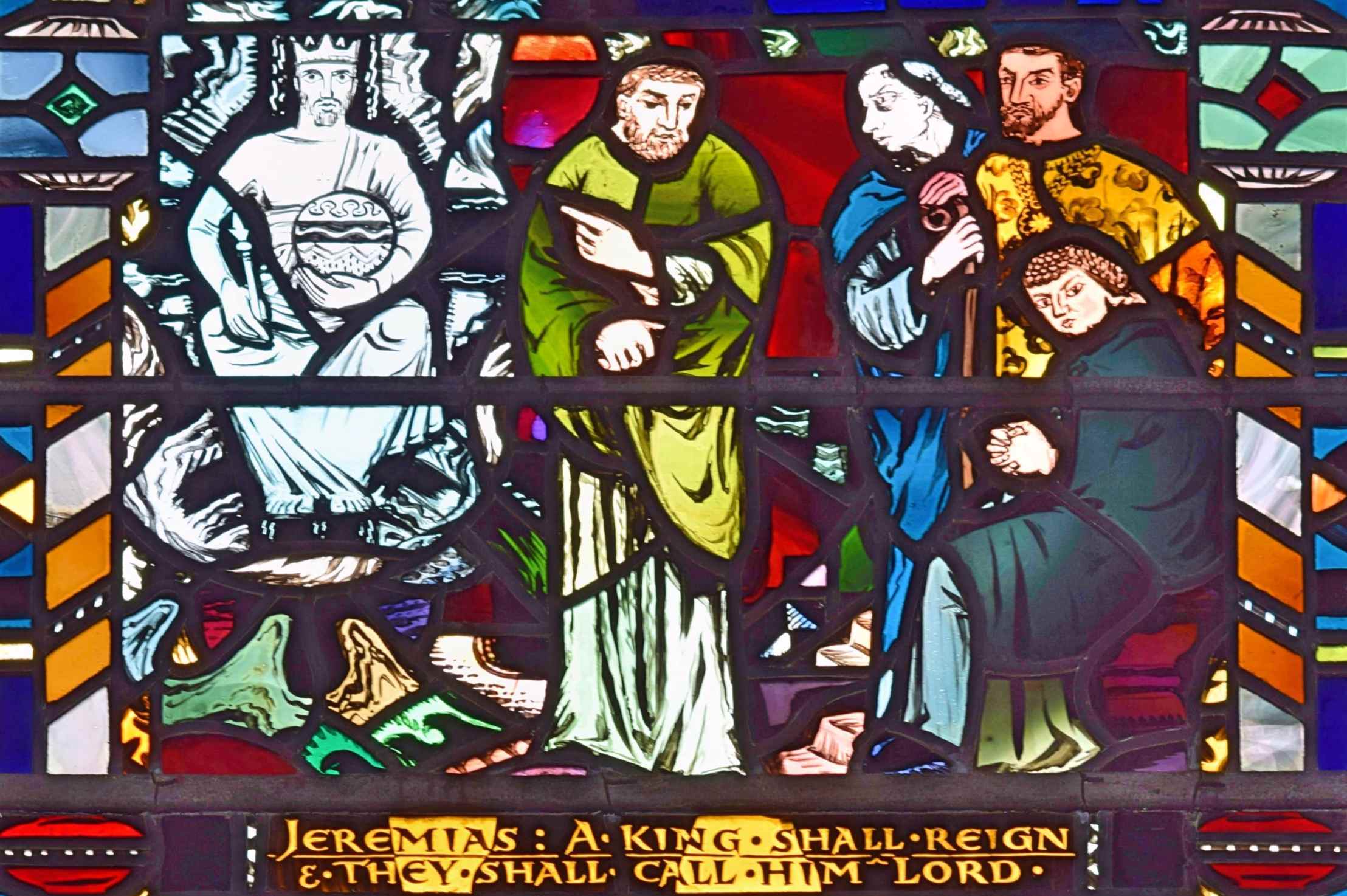
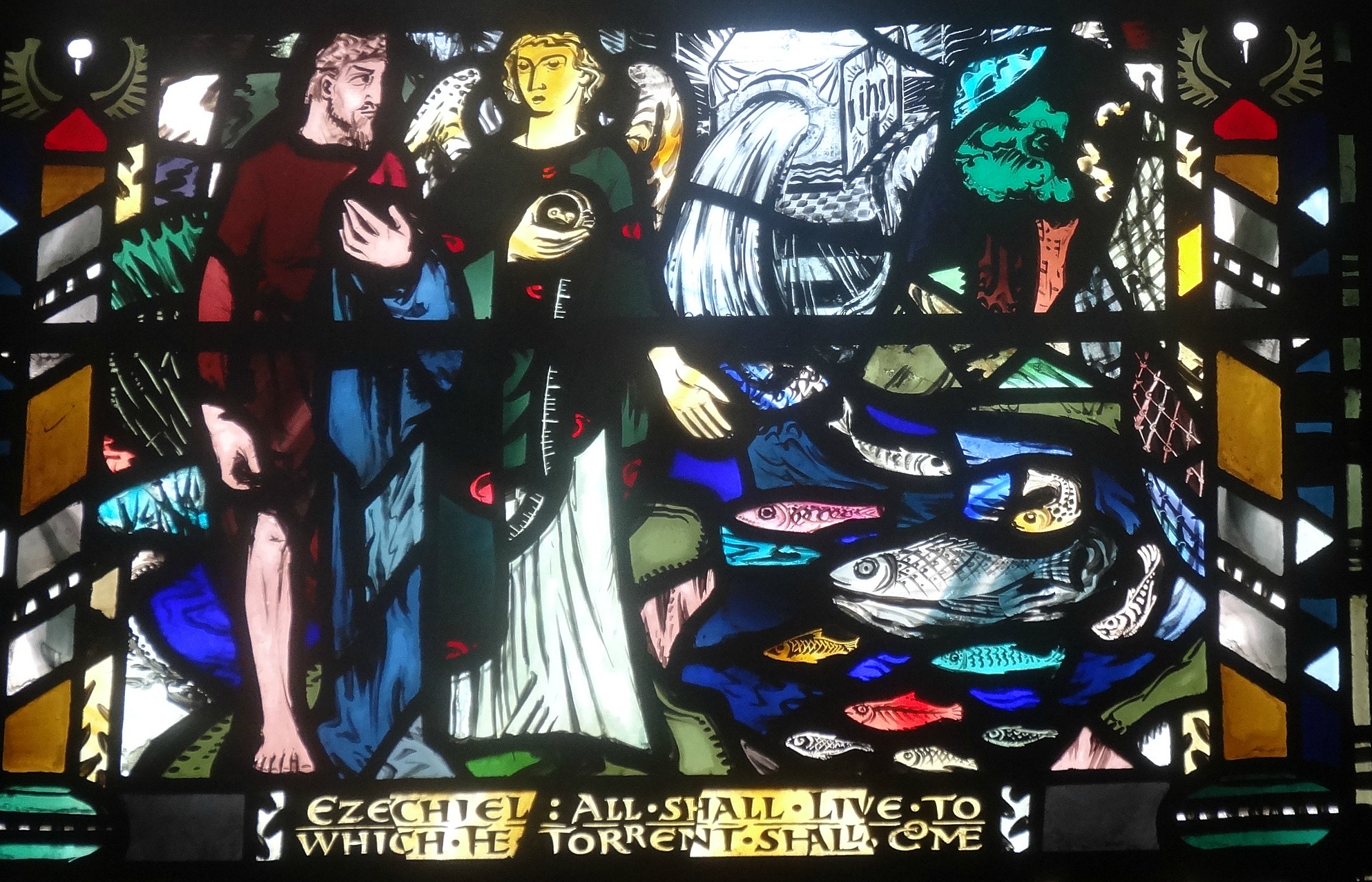
The above window by Charles Blakeman, portraying the prophecy of Jeremiah (Chapter 23) regarding a promised righteous king. Below, Blakeman’s depiction of the visionary prophecy of Ezekiel (Chapter 47.)

The Beauty of Christ the King

Windows over the chapel altar; Church of the Incarnation, Highlands, NC


I wonder if you were looking forward as much as I was to the the new season of The Crown. As we saw in September, while viewing the various events related to the Queen’s funeral, the British Royal Family is a source of enduring fascination for many of us. And yet, I think we -as Americans- have a hard time imagining what it means to live within a monarch’s sovereignty. Since the founding of our country as a republic, the framework for our government has made it difficult for us to understand the significance of having a king or a queen. Especially when these roles are transmitted through heredity, rather than resulting from whom we designate through our political will.

All this is especially significant for us this week, having celebrated the feast of Christ the King this past Sunday. For consciously or not, we are prone to an ancient heresy. It is this: in believing that Jesus was an ordinary and yet a particularly spiritual human being who, by faithfully serving as the Messiah, was then somehow ‘promoted.’ That is, promoted above and beyond his human family, to achieve a semi-divine status. It is easy to mis-read the passion narratives at the end of the Gospels and come to this misunderstanding. For in one way or another, the Gospel writers – especially John’s Gospel – portray Jesus’ Crucifixion, and his subsequent Resurrection and Ascension, as the sequence of his royal ‘coronation.’

Yet, in a monarchy like that of Britain, coronation does not suddenly make the forthcoming king or queen into something that he or she was not before then. Instead, a traditional coronation is an act of public declaration of what he or she has always been, even if only implicitly.

In other words, through a public ceremony of coronation we do not make kings or queens. As we will see next year with King Charles, who we should note is already king, his future coronation will recognize in an official public way how he has already begun to fulfill his sovereign role. This is very important for how we appreciate ‘the mock coronation’ of Jesus in Luke’s Gospel (23:33-43).

As Luke tells us in this passage, Jesus is crucified under an inscription that Pilate had written, “Jesus of Nazareth, the King of the Judeans.”* The crowd at the place of the crucifixion protests the inscription. And following their lead, the soldiers mock him, saying, “If you are the King of the Judeans, save yourself!” They mock him while ironically mimicking the words of Satan during Jesus’ temptations in the wilderness.

The irony here is that, so far as we know, Jesus never directly said of himself, “I am the King of the Judeans,” which would have implied being a legitimate descendant and heir to the thrones of David and Solomon. But he died for having assumed this identity, an identity that was revealed in his teaching and in his works, and in his selfless fulfillment of the Scriptures.

Among the many things for which we can be thankful this week is the following fact. No one in the crowd at Jerusalem two thousand years ago, and none of us, makes or declares him to be the King. What we can affirm in faith is that his royal identity has always been in and with him. This fact has been revealed by God, whom he called his Father. For Jesus to be King in the sense of being the Messiah, the Son of God, means that he lived into the reality of God’s own abiding kingship of Israel.

May you and your loved ones have a blessed Thanksgiving.


This post is based on my homily for this past Sunday, the Feast of Christ the King, which may be accessed by clicking here. I took the above photo (note the crown above Jesus’ head) after the first Eucharist celebrated by the Rev. Kellan Day in that chapel in 2019, and someone whose path to ordination I and my former parish endorsed most enthusiastically. I offer this post with continuing thanks for her recognized gifts for ministry.

*  “Judeans” is how N.T. Wright translates the word more traditionally rendered as “Jews,” with “Jews” being a contemporary translation that for readers may be misleading.

Note: John’s Gospel has the significant series of “I am” statements by Jesus, which may imply that he claimed legitimate succession from David and Solomon, but which do not approach anything like the political sounding self-identification that later condemned him.

The Beauty of Le Corbusier’s Ronchamp Chapel


When I was in high school, while aspiring to be an architect as well as an artist, I and my closest friend admired the architectural work of Le Corbusier. Among the attributes of his work that we held high were these: attention to human proportion and scale; a sensitivity to architectural ideals while mindful of the needs for human community, both domestic and commercial; and an equal sensitivity to providing ‘beauty’ for those in financially marginalized and especially in urban contexts.

With my long-term love for the architecture of the American ‘Prairie School,’ and especially that of Frank Lloyd Wright, appreciating Le Corbusier’s very European modernist style, rather linear and grid-like, was something of a stretch. Perhaps a parallel might be how an admirer of Monet’s water lily paintings or of Whistler’s nocturnes might be surprised by a new delight in seeing some geometric abstract paintings by Piet Mondrian.

But then, after admiring Le Corbusier’s famous Villa Savoy, and his Marseilles Block (a combined apartment and business building), I discovered his Ronchamp Chapel (completed 1954). Though I have yet to see and walk through it, I have long sensed that this is a masterpiece, precisely because it is so counter-intuitive to the main body of Le Corbusier’s work. Whereas much of his architecture is analytic, geometric, and mathematically precise in his approach to it, Ronchamp provides an example of a lyrical and semi-mystical appreciation for form and space, as well as for light and color. And whereas much of Le Corbusier’s work can be seen as the fruit of a meditation upon classical antecedents, both Greek and Roman, Ronchamp Chapel seems to bear the spiritual imprint of the culture that we associate with the medieval centuries.

For me, the best examples of that latter point are the immensely thick side walls in certain parts of the chapel, where the light intrudes through very dense materials. This, of course, is a beautiful metaphor for my life and yours.

‘Glimpses of a deeper soul’ ~ this is a phrase that has come to me, time and again, when reflecting upon the lives of persons we become acquainted with in Scripture and Christian history, in secular fiction, as well as in daily church and public life. Especially in North America, we tend to chart our lives forward, in planned linear paths of progression, each step building upon the prior one toward a calculated and hoped-for end. And yet, despite all our planning, we may be open to, or unexpectedly experience, dreams and visions of something other, more amorphous. In such moments, we perceive to our surprise unanticipated images of what may be an attainable beauty, a beauty that none of us would have imagined in the ordinary run of things. For human creativity reflects divine creativity.

To Le Corbusier, perhaps his vision and design for the Ronchamp Chapel came as just such an unexpected surprise. For me, the wonder is that he allowed himself to let his imagination bear fruit in this remarkable plan and building. Despite his avowed atheistic concept of reality, his chapel centers on the transcendent and mystical, while also touching upon and embracing the local and material aspects of our lives.